

Notifications
Clear all
Joining the Renewable Heating Hub forums is completely free and only takes a minute. By registering you’ll be able to ask questions, join discussions, follow topics you’re interested in, bookmark useful threads and receive notifications when someone replies. Non-registered members also do not have access to our AI features. When choosing your username, please note that it cannot be changed later, so we recommend avoiding brand or product names. Before registering, please take a moment to read the Forum Rules & Terms of Use so we can keep the community helpful, respectful and informative for everyone. Thanks for joining!

Topic starter
04/04/2026 9:42 am
Good morning everyone.
Can I ask what is considered the lowest temperature to set your heat pump to?
Is any lower than 25⁰c not worth it as your just pumping luke warm water around and just costing yourself and lowering your cop by paying for the heat pump(and in my case a secondary pump) to run and the extra wear and tear?
Is there also a chance the heat pump will use the booster heater too as I've read it can do this?
Thank you in advance.
Regards
Craig
This topic was modified 6 months ago by Mars


04/04/2026 9:54 am
@craigh, to answer your main question, it comes down to the modulation of the unit.
Modern inverter-driven heat pumps (most units sold in the last few years) can vary their output from roughly 100% right down to 20-40% (depending on the make and model). When the house only needs a small amount of heat (mild weather, good insulation or you deliberately run a low flow temperature) a well-modulating unit can slow right down and run continuously at part-load. That keeps the COP high, minimises start/stop cycling, reduces wear on the compressor & secondary pump and is actually more efficient and gentler on the system overall.
If your particular unit has poor/low modulation (or you have an older fixed-speed model), then yes, dropping the flow temperature too far can mean the heat pump is producing more heat than the house needs, so it short-cycles. That’s when you start wasting electricity, lowering your seasonal COP and adding unnecessary wear and tear on the compressor and your secondary pump.
On the "lukewarm water" side of things, lower flow temperatures actually give you higher COP because the compressor has less 'lift' to do. 35C is often the sweet spot for many systems and some well-designed setups with underfloor heating or oversized emitters run happily at 30C in milder weather and see COPs in the 4+ range. Going below the manufacturer’s recommended minimum flow temp is where you can run into issues.
On booster heater, many units only bring the electric booster in when the heat pump genuinely can’t keep up... very cold outdoor temperatures, defrost cycles, DHW set to high temps, etc.
🔥 Britain’s Heat Pump Shitshow
How Installing a Heating System Became a National Nervous Breakdown
Free UK shipping.
📗 Heat Pumps Explained
A Jargon-Free Guide for Homeowners
Rewritten and updated for 2027
📘 From Zero to Heat Pump Hero
🛠️ Bodge Buster
New to heat pumps?
Take the Heat Pump Fundamentals course and use INTRO50 at checkout for 50% off.
Topic starter
04/04/2026 10:21 am
@editor thank you, what do you think with regards to running at an lwt as low as 20⁰c, if your system can modulate that low without kicking in the booster heater is it worth it or do your emitters give out so little that the running costs outweigh this?
Thanks
04/04/2026 11:29 am
@craigh I've not heard of any heat pump being able to modulate that low... I might of course be wrong, but most big brands struggle to modulate below 28-30C.
@ashp-bobba, @jim-l and @aventus-eco can you please advise if I'm correct.
🔥 Britain’s Heat Pump Shitshow
How Installing a Heating System Became a National Nervous Breakdown
Free UK shipping.
📗 Heat Pumps Explained
A Jargon-Free Guide for Homeowners
Rewritten and updated for 2027
📘 From Zero to Heat Pump Hero
🛠️ Bodge Buster
New to heat pumps?
Take the Heat Pump Fundamentals course and use INTRO50 at checkout for 50% off.


04/04/2026 12:25 pm
@editor The ecodan states it can modulate down and achieve a sustained flow rate of 20 DegC, we often set these up on a WC of -2/45 20/20 showing we set the Ecodan to aim for 20 Deg C when outside is very mild, this flow temp will have no effect on rooms that are set to 20 but will effect rooms that are 16 and there is at least a 1.5 Deg Room / Emitter DT.
Try not to think of it as “running at a fixed 20°C flow temperature.” Instead, the heat pump is modulating its output to meet demand, and it may drop as low as ~20°C flow if system conditions (like a very low return temperature) allow it.
When using weather compensation, the ASHP is not operating at a single fixed flow temperature. It is continuously adjusting its flow temperature to match the required heat output, based on outdoor conditions and system demand, up to a defined maximum set-point. In other words, the flow temperature is a ceiling, not a constant target, and the unit will run at whatever temperature is necessary (within its operating range) to deliver the required capacity.
Its also worth noting that it is very unlikely that emitters will stay at a point where they need to operate on a low MWT of 17.5 (20F - 15R) as this is very low.
However if @craigh is referring to a fixed flow temperature and not using a weather curve, I would advise against setting lower than 27.5 allowing at least 5 Deg DT - room to emitter.
AAC Group Ltd covering the Kent Area for design, supply and installation of ASHP systems, service and maintenance, diagnostics and repairs.
1
04/04/2026 12:52 pm
Good morning everyone.
Can I ask what is considered the lowest temperature to set your heat pump to?
Is any lower than 25⁰c not worth it as your just pumping luke warm water around and just costing yourself and lowering your cop by paying for the heat pump(and in my case a secondary pump) to run and the extra wear and tear?
Is there also a chance the heat pump will use the booster heater too as I've read it can do this?
Thank you in advance.
Regards
Craig
To answer your question, running the system at its lower points is about comfort, it is cost effective to run these systems at very low temps if you want that comfort of a steady 20 Deg C all the time in the home. It is however cheaper to turn the heating off all together from early May - October and add another jumper if the eve gets cold. This will not work as well if you make the ASHP switch off all day and expect it to turn back on in the evening to lift the home 2 or 3 deg's. This is considered an intermittent heating regime and is actually a deign consideration but most systems are designed for continuous use until the warmer periods (end of May / early June)
Example, it is documented that the average ASHP can use slightly more energy by lifting the home from a 4 deg drop than maintaining the home within a 2 deg band permanently, these systems draw very little power when supplying 20% of there capacity compared to over over 80%, the system will ramp up to 80% if the heat demand is needed above a 2 deg band.
Example with made up figures based on a 5Kw system:
Continuous: 300w to maintain 2 deg diff - 10hrs x 300w = 3kW
Intermittent: 1500w to bring temp back up - 3hrs x 1000w = 4.5kW
Turn system off of heating = 0.3kW (standby power and heater tapes, valves and other bits still draw power so ASHP can be ready to heat the water although very low)
Summary: By maintaining heat in the home and not allowing the fabric to lose too much heat, you enable the ASHP to run for longer at its lower modulation rather than in short periods of ramping up to higher output. This works well because an ASHP is most efficient when operating steadily at low temperatures, allowing it to extract heat from the outside air more effectively and with a higher coefficient of performance, rather than working harder to rapidly reheat a cooled building.
AAC Group Ltd covering the Kent Area for design, supply and installation of ASHP systems, service and maintenance, diagnostics and repairs.
1
Topic starter
04/04/2026 5:32 pm
@ashp-bobba thanks for the reply, yes I was really asking about the wd curve side so you've explained it very well for me.
It's also said with Daikins that anything below an lwt of 25⁰c can trigger the immersion heater, I don't know if anyone knows if this is true or not? Is that the case with the Ecodan?
Cheers
This post was modified 6 months ago by CraigH

04/04/2026 7:36 pm
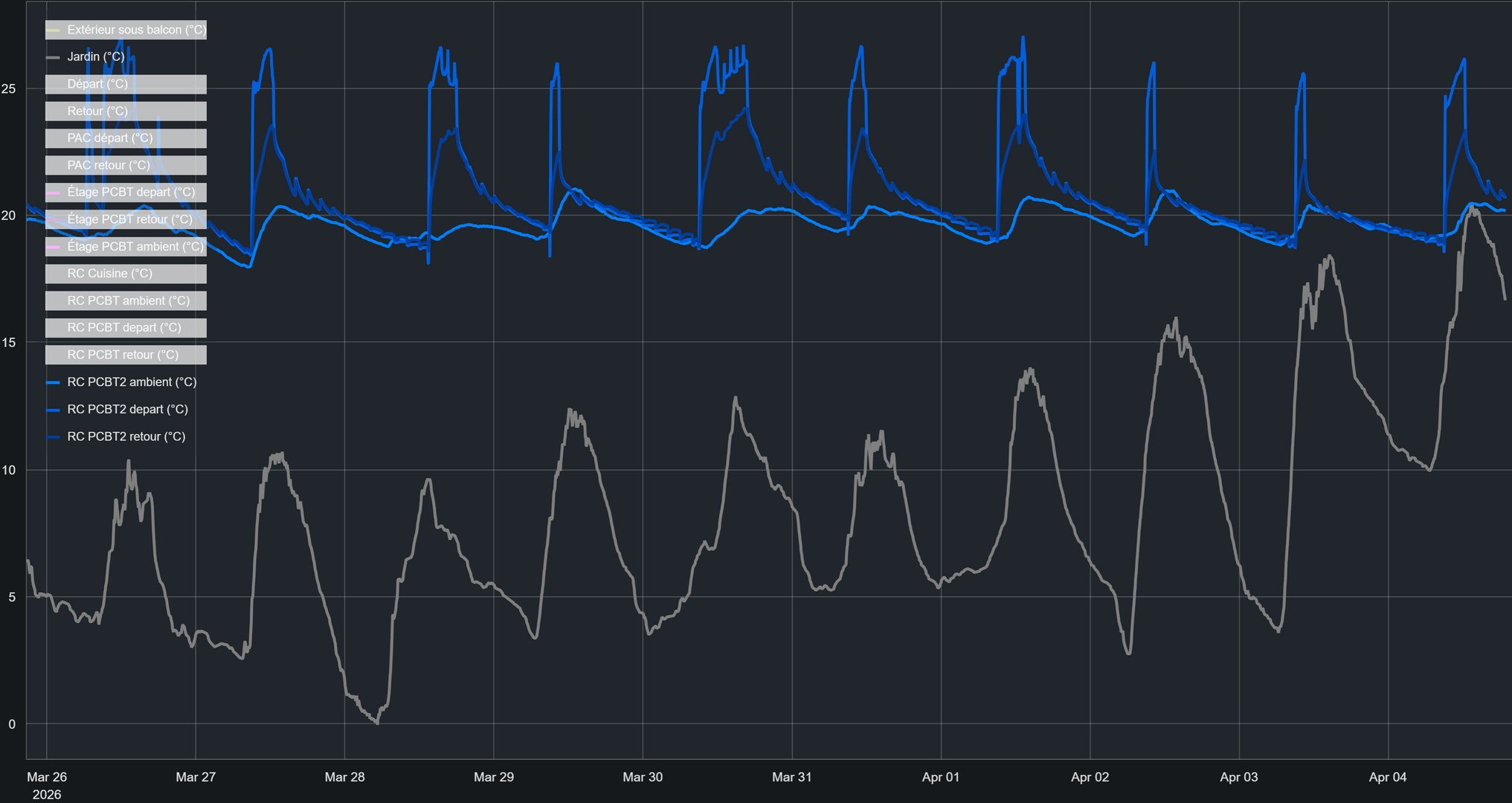
Flow and return in dark blue, Outside temp in yellow, Indoors temp in light blue (living room).
Indoors temp wiggles between 19-20°C.
Underfloor heating with a 10cm thick concrete slab, 20mm PEX pipes, 125mm spacing, so 25°C flow is already "high temperature" 🤣
Thermostat is necessary due to enormous south facing windows letting in a ton of free heat. When the sun shines, running the heat pump open loop would overheat the house. In fact you can look at the plot above, see how long the heat pump runs each day, and that's pretty much the reverse of how sunny the weather was.
It is possible to use higher flow temp, up to 35°C, but this heats the core of the slab too much, by the time the heat reaches the thermostat, the slab is too hot, and it will dump the heat into the room making it way too hot for the rest of the day. So it's important to control the flow temperature to "as low as possible" which also suits the heat pump. A low flow temperature reduces system open loop gain and allows a simple control strategy to keep the house comfortable.
There is so much thermal mass that it's fine to run the heat pump only during the day when PV provides free electricity and COP is also higher.
It's the opposite of the usual "intermittent heating regime" ASHP Bobba talks about. It heats when it's warm outside, and stops heating when it's cold outside 🤣
I'm currently redoing the whole installation, so this is WIP.
1

05/04/2026 7:07 am
@ashp-bobba thanks for the reply, yes I was really asking about the wd curve side so you've explained it very well for me.
It's also said with Daikins that anything below an lwt of 25⁰c can trigger the immersion heater, I don't know if anyone knows if this is true or not? Is that the case with the Ecodan?
Cheers
If you mean the immersion heater in the cylinder to heat the hot water tank then No, that is very unlikely or the system has something set up wrong like boost priority. The ASHP has 2 sets for settings, usually a heating settings in your case something like 35@-2, 20@20 and another setting for hot water where the ASHP will run at (R32-58 Deg C flow - R290 Up to 60/70 Deg C) to heat the water)
If you mean the Daikin has a 3 or 6kW electric booster for the heating circuits, unless your in Northern Scotland or Northern Europe you should never need this or have this option in your ASHP for our mild climate, these options are designed more for our Northern friends in Europe where the winters get to -15 or more and a month of boosting helps not to have to have an oversized ASHP the other 5 months of winter.
If you mean that you have a high temp system that uses a second refrigeration module like Hitachi to boost the heating from 50-70 or heaters to boost then you have the wrong system completely to run at 20 Deg C, this would be designed to run at 65-80 like a boiler. Its not that this system would not just run the ASHP section only at 20-35, it would but you would have wasted a fair bit of money purchasing a hi temp system without needing it.
Let me know which you were referring to.
AAC Group Ltd covering the Kent Area for design, supply and installation of ASHP systems, service and maintenance, diagnostics and repairs.
1

05/04/2026 9:06 am
There are a lot of terms used in this topic which require clarification:
Is any lower than 25⁰c not worth it as your just pumping luke warm water around and just costing yourself and lowering your cop by paying for the heat pump(and in my case a secondary pump) to run and the extra wear and tear?
very unlikely that emitters will stay at a point where they need to operate on a low MWT of 17.5 (20F - 15R) as this is very low.
It will depend on the DeltaT, typically determined by the medium you are heating. If you are heating a swimming pool (like another user in this forum was) or a large, concrete floor from a low temperature then a sustained flow temperature of 25⁰C may well be possible and efficient.
Is there also a chance the heat pump will use the booster heater too as I've read it can do this?
A booster heater is an electric element typically found inline with the flow, in the Ecodan these are only fitting in split designs (where the heat exchanger is located in a hydrobox unit inside the property) and located in the outdoor unit.
In monoblocs, most common in the UK, they are not fitted. The rest of Europe and Ireland almost exclusively use split systems, although R290 monoblocs are gaining popularity.
lwt of 25⁰c can trigger the immersion heater
Immerson elements are submerged into a domestic hot water tank, not a space heating operation mode. The logic to start these is not exactly known, but often are used when the heat pump is unable to sustain a positive rate of temperature climb in the DHW tank.
The final part of critical information is that the Ecodan's minimum compressor frequency, and therefore minimum flow temperature is hard coded in their logic.
For example in my R410a 8.5kW monobloc unit (this does varies unit to unit), that at OAT 4⁰C the minimum compressor frequency is 32Hz and therefore the minimum output power is ~4.0 to 4.7kW (47% to 55% of rated output)
Now, at an OAT of just 1 degree more, 5⁰C the minimum frequency is allowed to drop to 26Hz and the minimum output power is ~3.1 to 3.9kW (~36% to 45% of rated output)

05/04/2026 11:04 am
It will depend on the DeltaT, typically determined by the medium you are heating. If you are heating a swimming pool (like another user in this forum was) or a large, concrete floor from a low temperature then a sustained flow temperature of 25⁰C may well be possible and efficient.
Agreed, it's totally dependent on the emitters being able to dissipate the heat being produced. Imagine a very large concrete floor with large underfloor heating system, heating a high heat loss poorly insulated space in winter. You could happily pump 25C water around that circuit all day with a RWT of 20C or lower (dT of 5C or greater).
In my own home (real life example), with large K2 radiators (no UFH), the lowest flow temps we can achieve without cycling (continuous running) at OAT of 5-10C is 32C. This is a simple equilibrium between the minimum output of the heat pump (~4kW) and the flow temperature required to dissipate that 4kW of heat at a room temp of 20C. Every system will be different depending on the minimum output of the heat pump, the heat loss of the property and the size of the emitters attached to the system.
This post was modified 6 months ago 2 times by Old_Scientist
Samsung 12kW gen6 ASHP with 50L volumiser and large radiators. 7.2kWp solar (south facing), Tesla PW3 (13.5kW). Net Zero
1

05/04/2026 8:17 pm
@craigh if you have a target room temperature of 20C, then use the weather compensation curve to set the flow temperature to 20C when the outside temperature is also 20C. That way the heat pump neither heats nor cools when it is 20C outside. The other end of the curve should be set to the design temperatures - e.g. 40C flow temperature when it is -3C outside. You will need to play around with the settings to get it exactly right.
In practice you will probably find that your heat pump will not go below a flow temperature of about 25C. My Grant Aerona 290 has a nominal minimum of 25C, but the heat pump tends to cycle on and off when the flow temperature is about 27C.
Grant Aerona 290 15.5kW, Grant Smart Controller, 2 x 200l cylinders, hot water plate heat exchanger, Single zone open loop system with TRVs for bedrooms & one sunny living room, Weather compensation with set back by room thermostat based load compensation
1
Page 1 / 2
Next

SPONSORS

Degrees of Separation

Latest Posts
-

RE: Jokes and fun posts about heat pumps and renewables
According to today's Guardian article, ministers are re...
By Mars , 2 hours ago
-
RE: Renewables & Heat Pumps in the News
... which is why I've suggested that there be an inspec...
By Transparent , 5 hours ago
-
RE: Why are ASHP installs so expensive?
Absolutely agreed. I quoted the national figure as evi...
By JamesPa , 6 hours ago
-
RE: Does anyone have experience of a smart water meter?
@majordennisbloodnok That is my thinking precisely, I s...
By Toodles , 7 hours ago
-
RE: Replacing Storage Heaters with a Heat Pump in a Stone Cottage
I found some interesting data about the price of heat p...
By Rob of York , 14 hours ago
-
RE: Air-to-Air Heat Pumps & Air Conditioning: UK Heating and Cooling Q&A
Thanks for that, quite interesting. I liked the bit a...
By springswood , 15 hours ago
-
RE: PV and battery long payback - sense check query
Thanks for all the comments. I finally got to the bott...
By DavidB , 16 hours ago
-
RE: Indevolt Batteries UK Support & Info Thread
People following this thread who are hoping that plug i...
By JamesPa , 1 day ago
-
Safety study for plug in batteries out to tender - looks like Q3 2027 at best before legal
Whilst searching for other information I came across th...
By JamesPa , 1 day ago
-
RE: Passiv Smart Thermostat - Help & Forum Support
By Singlespeed , 1 day ago
-
RE: Help me keep the faith with my air source heat pump installation
just had Vaillant over to service the HP and asked abou...
By AdamK , 1 day ago
-
RE: tepeo ZEB UK Support & Info Thread
OK so ZEB is basically a variant on a storage heater, b...
By JamesPa , 2 days ago
-
RE: Heat Geek installations: share your experiences
@editor I suspect that the Heat Geek online quote is a ...
By AndrewJ , 3 days ago
-
RE: Adding additional Solar Panels to a DC coupled battery system
Ah, yes. Thanks for clarifying.
By Transparent , 3 days ago





SPONSORS

