

Notifications
Clear all
Joining the Renewable Heating Hub forums is completely free and only takes a minute. By registering you’ll be able to ask questions, join discussions, follow topics you’re interested in, bookmark useful threads and receive notifications when someone replies. Non-registered members also do not have access to our AI features. When choosing your username, please note that it cannot be changed later, so we recommend avoiding brand or product names. Before registering, please take a moment to read the Forum Rules & Terms of Use so we can keep the community helpful, respectful and informative for everyone. Thanks for joining!
Air Source Heat Pumps (ASHPs)
29
Posts
7
Users
4
Reactions
3,225
Views

Topic starter
05/04/2026 10:56 am
I find it difficult to decide on the ideal time for DHW heating both for winter and summer and often decide to try another set time, with no obvious conclusion.
I am on a two part tariff with a 47% reduction at night and part of the weekend, so nightime is the usual first choice.
However, with night time temperatures being lower than daytime (particularly in Winter) the efficiency of the ASHP is reduced, but to an unquantifiable degree.
Then we have SolarPV with a longer time span in the summer so I could take advantage of that, but I only have a 4 kW inverter and my ASHP consumes almost 6kW peak on the DHW heating cycle, which the inverter can't deal with. It is an Ecodan 12kW ASHP and it is on "Eco" DHW setting. I also have a 4kW immersion heater, but with a residual 1-2kW this also takes consumption over the 4kW inverter power
Finally we have the Melpump "Summer ECO" options, which can give significant savings, but has the limitation of only one operational period, so I cannot, e.g. set a midday time and an early morning top up.
I would welcome other views.
342sq m "Upside down" house in Algarve. Portugal
Mitsubishi PUHZ-120YUK 12kW ASHP
12 Solar Panels Growatt Inverter
2 x Growatt 7.5kW Batteries
Fronius EV Charger
Kia e- Niro 64kW

05/04/2026 11:12 am
I have a Cosy6, it draws 1.6kWh on DHW cycle, your Ecodan is taking allot of power, using your figures its COP 2
I trialled DHW cycle during my cosy cheap period of 10-11:55pm. I didn’t like it, the noise at 10pm when you're trying to sleep is invasive for me and neighbours; would be worse in summer with windows open. Also at that time OAT is low and it caused more defrost cycles.
I changed it to the 1-4pm slot, this produced a better COP for the day and less defrost cycles.
I advise experimenting and monitoring the energy used, and COP to determine what works best for you
Topic starter
05/04/2026 11:39 am
@agentgeorge On my Shelly EM3, I can watch the power increase to a peak of around 5.7kW on the DHW cycle, as the set required temperature of 52C is approached. I.e it is not a steady figure. However, this is usually on top of a residual 1-2kW for other things running. I have not found any way of reducing the Mitsu "Eco" setting still further.
I have experimented and monitored, but it is not easy to come to a conclusion with so many variables
342sq m "Upside down" house in Algarve. Portugal
Mitsubishi PUHZ-120YUK 12kW ASHP
12 Solar Panels Growatt Inverter
2 x Growatt 7.5kW Batteries
Fronius EV Charger
Kia e- Niro 64kW

05/04/2026 11:50 am
We heat starting at 1pm each day, usually warmest regardless of summer/winter, most likely to have PV generation and if not it's our cheap Cosy window too
The CNDM connector + dip switches in the outdoor unit can limit power draw up to 50%
At 50% limitation on the 8.5kW unit our DHW draws 1.5kW at peak flow of 60C, but takes an average of 2hr+ (often longer in winter) to reheat 250li to 47C
At 100% it can draw nearly 3.5kW at peak flow temperature of 60C but takes around 50-60min to 47
This post was modified 6 months ago by F1p


05/04/2026 12:08 pm
With a nighttime tarrif of 6.5p, a daytime tarrif of 32p, and an export tarrif for any excess generatred by the PV of 12p (all approx) its a no brainer for me, Heat DHW at night, summer and winter alike.
4kW peak of solar PV since 2011; EV and a 1930s house which has been partially renovated to improve its efficiency. 7kW Vaillant heat pump.
1
05/04/2026 12:13 pm
@jamespa having a battery the day rate tariff becomes the nighttime one
I'm currently at 98% usage at night time rate with a 5kW battery. I looked at increasing to 10kW but the payback would be 20+ years as it only kicks in Nov thru Feb
05/04/2026 12:37 pm
@jamespa having a battery the day rate tariff becomes the nighttime one
Sometimes. If you have otherwise unused capacity in the battery then yes, although if you also have an export tarrif that exceeds your night time import tariff by any reasonable margin, you would still be better off heating DHW at night and reselling the spare capacity having charged at night. Obviously if you are already using all your battery capacity then the daytime tarrif is still a daytime tarrif.
I dont have a battery other than the one in my EV, because I cant make the business case work, so this isn't yet a consideration for me.
4kW peak of solar PV since 2011; EV and a 1930s house which has been partially renovated to improve its efficiency. 7kW Vaillant heat pump.
Topic starter
05/04/2026 1:58 pm
With a nighttime tarrif of 6.5p, a daytime tarrif of 32p, and an export tarrif for any excess generatred by the PV of 12p (
What a different world! I have a daytime tariff of €0.1978 and a nighttime tariff of €0.1162 and NO payback for excess PV generation.
342sq m "Upside down" house in Algarve. Portugal
Mitsubishi PUHZ-120YUK 12kW ASHP
12 Solar Panels Growatt Inverter
2 x Growatt 7.5kW Batteries
Fronius EV Charger
Kia e- Niro 64kW


05/04/2026 2:07 pm
@davidalgarve
I'm not aware if your Mitsu comes with a 'silent mode' -- many people use this as a 24/7 workaround to limit input power.
This helps in many cases, even to mitigate on/off cycling; only drawback will be when you get cold feet around Christmas and need to lift that ban then.
A rule of thumb is, 1 Kelvin additional temperature difference in/out reduces efficiency at 3% .... less at bigger temp. differences, more at lower ones.
At 5°C ambient and 50°C cylinder temperature let's say it makes 2%, so 10 deg colder outside would cost 20% efficiency as a rough guessing.
When you strive for efficiency, unplug that immersion heater. Factory settings of your temperature control may use it amply, e.g. while defrosting, long before bivalence point for no good reason except 'security of supply' and 'comfort' -- suppliers try to avoid at any rate that you might get cold and start requiring their support.

05/04/2026 4:02 pm
I find it difficult to decide on the ideal time for DHW heating both for winter and summer and often decide to try another set time, with no obvious conclusion.
I am on a two part tariff with a 47% reduction at night and part of the weekend, so nightime is the usual first choice.
However, with night time temperatures being lower than daytime (particularly in Winter) the efficiency of the ASHP is reduced, but to an unquantifiable degree.
Then we have SolarPV with a longer time span in the summer so I could take advantage of that, but I only have a 4 kW inverter and my ASHP consumes almost 6kW peak on the DHW heating cycle, which the inverter can't deal with. It is an Ecodan 12kW ASHP and it is on "Eco" DHW setting. I also have a 4kW immersion heater, but with a residual 1-2kW this also takes consumption over the 4kW inverter power
Finally we have the Melpump "Summer ECO" options, which can give significant savings, but has the limitation of only one operational period, so I cannot, e.g. set a midday time and an early morning top up.
I would welcome other views.
Sounds to me like you need to look into this Indevolt kit like I asked Mars, I think I will only need one to back up my 13kW of batteries as they are connected to a 3.6Inverter so limited to that, my Vaillant 5kW will use MAX 2.5kW to heat the water, in this case it only leaves 1.1kW for the rest of the house, we could either, set a time not to use other high output appliances or add another inverter pack like the Indevolt. If it works this way I would end up with 5.6kW output at any time and will be well covered. It about having another 2kW of out put rather than more storage, assuming to can use 2 I could get 7.6kW output and so on.
This post was modified 6 months ago by Mars
AAC Group Ltd covering the Kent Area for design, supply and installation of ASHP systems, service and maintenance, diagnostics and repairs.
1
Topic starter
05/04/2026 4:46 pm
The CNDM connector + dip switches in the outdoor unit can limit power draw up to 50%
I have not come across this option previously and whilst being conversant with those in the Hydrobox, I was not even aware that there were dip switches in the outdoor unit.
Would this apply to a PUHZ-SW120YHA plus EHSC VM2D and if so could you point me in the direction of more information, please?
If a change is made as described, do you have to revert to get full output for winter heating?
P.S. I have susequently found details of the PUHZ-SW120 dip switch panel,
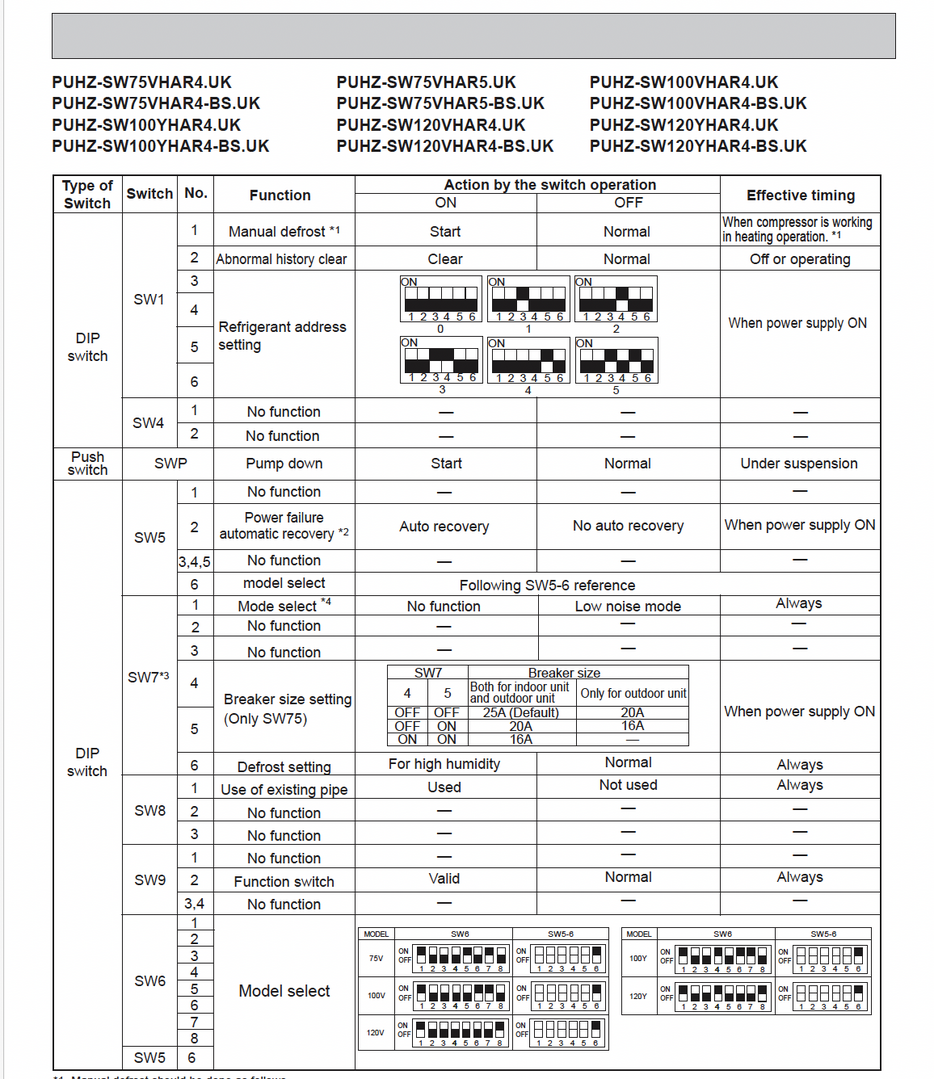
but I don't see any facility for changing output.
This post was modified 6 months ago by DavidAlgarve
342sq m "Upside down" house in Algarve. Portugal
Mitsubishi PUHZ-120YUK 12kW ASHP
12 Solar Panels Growatt Inverter
2 x Growatt 7.5kW Batteries
Fronius EV Charger
Kia e- Niro 64kW

05/04/2026 8:09 pm
I agree with @jamespa. I am on the Intelligent Octopus Go EV tariff, so it costs me 5p per kWh at night and 27p per kWh during the day. My export tariff is 12p per kWh - much higher than the night time import tariff. Therefore, it pays me to charge my Powerwalls at night and discharge and export any excess from them during the day
The heat pump will be more efficient during the day, but the difference is marginal compared to the difference in tariffs. That would be true, even with a tariff which is half price at night. Therefore, heat your hot water with the heat pump at night. Of course, you may need to top it up during the day, but that is driven by need, rather than by cost.
Grant Aerona 290 15.5kW, Grant Smart Controller, 2 x 200l cylinders, hot water plate heat exchanger, Single zone open loop system with TRVs for bedrooms & one sunny living room, Weather compensation with set back by room thermostat based load compensation
Page 1 / 3
Next
SPONSORS

Degrees of Separation
Latest Posts
-

RE: Jokes and fun posts about heat pumps and renewables
According to today's Guardian article, ministers are re...
By Mars , 1 hour ago
-
RE: Renewables & Heat Pumps in the News
... which is why I've suggested that there be an inspec...
By Transparent , 4 hours ago
-
RE: Why are ASHP installs so expensive?
Absolutely agreed. I quoted the national figure as evi...
By JamesPa , 5 hours ago
-
RE: Does anyone have experience of a smart water meter?
@majordennisbloodnok That is my thinking precisely, I s...
By Toodles , 6 hours ago
-
RE: Replacing Storage Heaters with a Heat Pump in a Stone Cottage
I found some interesting data about the price of heat p...
By Rob of York , 13 hours ago
-
RE: Air-to-Air Heat Pumps & Air Conditioning: UK Heating and Cooling Q&A
Thanks for that, quite interesting. I liked the bit a...
By springswood , 14 hours ago
-
RE: PV and battery long payback - sense check query
Thanks for all the comments. I finally got to the bott...
By DavidB , 15 hours ago
-
RE: Indevolt Batteries UK Support & Info Thread
People following this thread who are hoping that plug i...
By JamesPa , 1 day ago
-
Safety study for plug in batteries out to tender - looks like Q3 2027 at best before legal
Whilst searching for other information I came across th...
By JamesPa , 1 day ago
-
RE: Passiv Smart Thermostat - Help & Forum Support
By Singlespeed , 1 day ago
-
RE: Help me keep the faith with my air source heat pump installation
just had Vaillant over to service the HP and asked abou...
By AdamK , 1 day ago
-
RE: tepeo ZEB UK Support & Info Thread
OK so ZEB is basically a variant on a storage heater, b...
By JamesPa , 2 days ago
-
RE: Heat Geek installations: share your experiences
@editor I suspect that the Heat Geek online quote is a ...
By AndrewJ , 3 days ago
-
RE: Adding additional Solar Panels to a DC coupled battery system
Ah, yes. Thanks for clarifying.
By Transparent , 3 days ago





SPONSORS
