Joining the Renewable Heating Hub forums is completely free and only takes a minute. By registering you’ll be able to ask questions, join discussions, follow topics you’re interested in, bookmark useful threads and receive notifications when someone replies. Non-registered members also do not have access to our AI features. When choosing your username, please note that it cannot be changed later, so we recommend avoiding brand or product names. Before registering, please take a moment to read the Forum Rules & Terms of Use so we can keep the community helpful, respectful and informative for everyone. Thanks for joining!
so it costs me 5p per kWh at night and 27p per kWh during the day. My export tariff is 12p per kWh -
Rather different to my 10p at night and 17p during the day and no export credit.
I am leaning more towards a nighttime setting and then trying to avoid exporting by charging the car and running the pool pump but it is not easy to establish a pattern.
342sq m "Upside down" house in Algarve. Portugal
Mitsubishi PUHZ-120YUK 12kW ASHP
12 Solar Panels Growatt Inverter
2 x Growatt 7.5kW Batteries
Fronius EV Charger
Kia e- Niro 64kW
@davidalgarve I am curious that you are not receiving any credit for exporting. Is there any possibility of fixing that?
Grant Aerona 290 15.5kW, Grant Smart Controller, 2 x 200l cylinders, hot water plate heat exchanger, Single zone open loop system with TRVs for bedrooms & one sunny living room, Weather compensation with set back by room thermostat based load compensation
When you strive for efficiency, unplug that immersion heater.
I should have made it clear that my immersion heater is manually switched using smart home/ Zigbee. it's thermostat is halfway up the tank and it is not connected to the Mitsu Hydrobox. On the other hand, the thermostat used by the Mitsu is, (at the moment) in the lower of two ports to heat the full 600L.
342sq m "Upside down" house in Algarve. Portugal
Mitsubishi PUHZ-120YUK 12kW ASHP
12 Solar Panels Growatt Inverter
2 x Growatt 7.5kW Batteries
Fronius EV Charger
Kia e- Niro 64kW
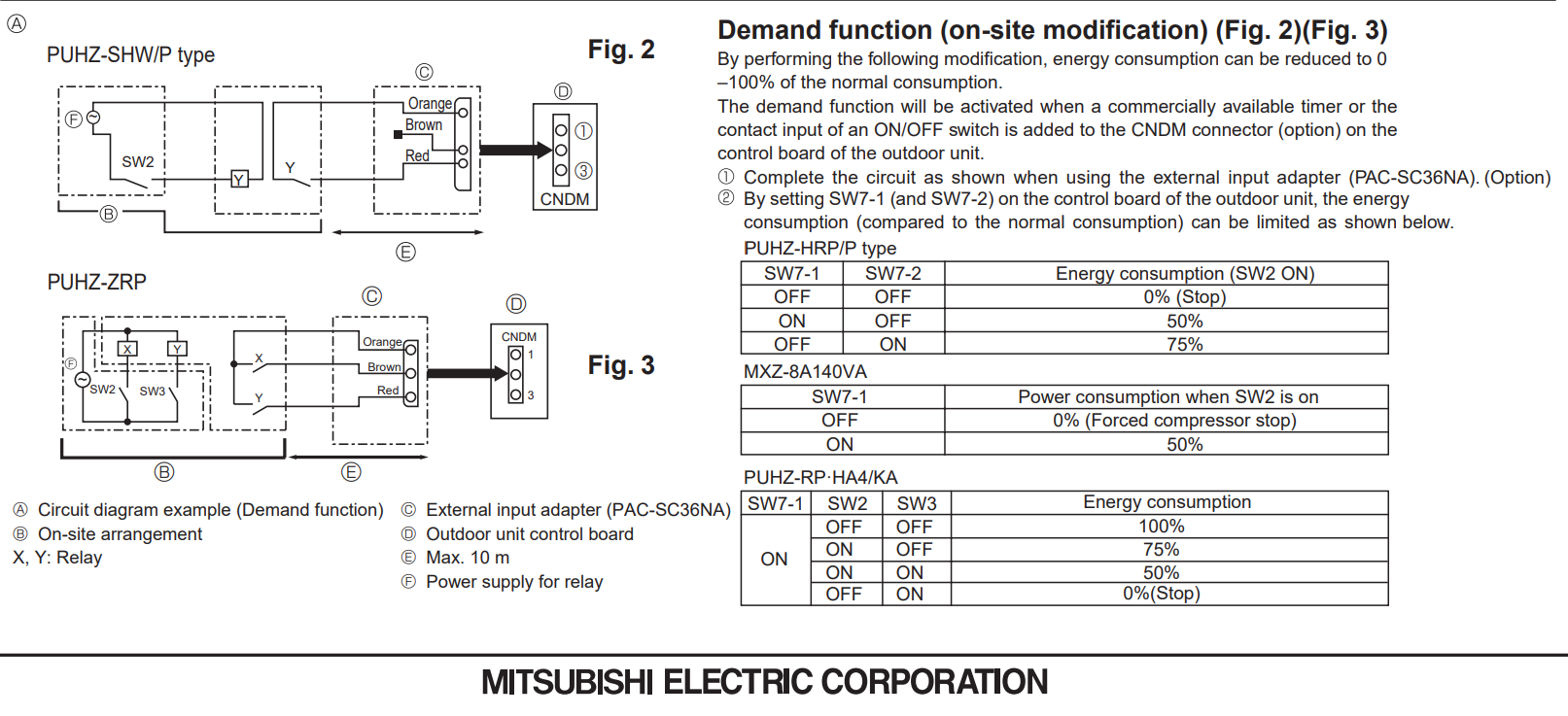
The CNDM connector + dip switches in the outdoor unit can limit power draw up to 50%
I have not come across this option previously and whilst being conversant with those in the Hydrobox, I was not even aware that there were dip switches in the outdoor unit.
Would this apply to a PUHZ-SW120YHA plus EHSC VM2D and if so could you point me in the direction of more information, please?
If a change is made as described, do you have to revert to get full output for winter heating?
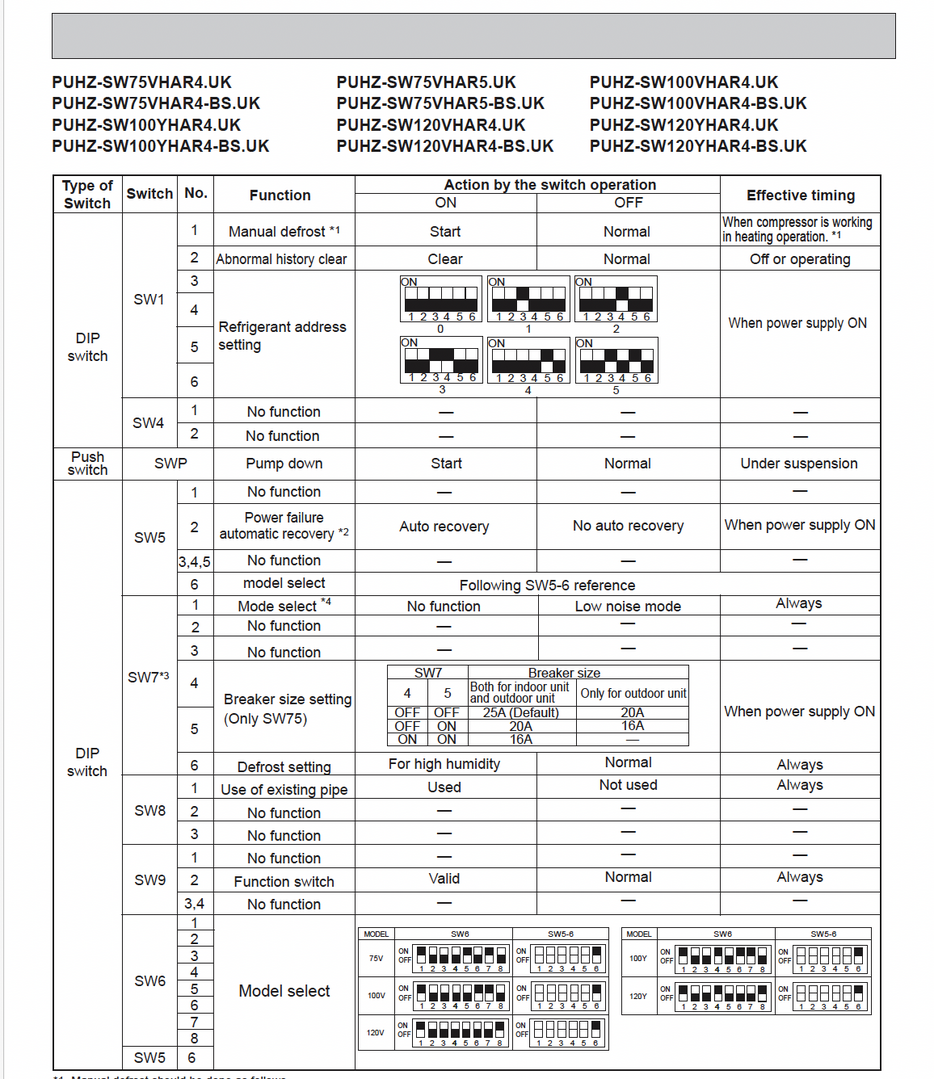
P.S. I have susequently found details of the PUHZ-SW120 dip switch panel,
but I don't see any facility for changing output.
The documentation is almost non-existent, it actually utilises the fact that the outdoor units control boards are shared between many makes and models.
The official Part Number is PAC-SC36NA-E but it's possible to replicate with correct resistor sizes and connector end.
My unit uses the "PUHZ-RP·HA4/KA" configuration
My house/sizes means i can mostly run at 50%, except in the coldest months of winter
This post was modified 6 months ago 2 times by F1p
My house/sizes means i can mostly run at 50%, except in the coldest months of winter
This may not make much difference, all it will do is limit the maximum power, its not likely to change the minimum. Since it modulates anyway, most of the time it is unlikely to change anything. The principal effect will probably be ramp ups, which will be slower as a result. This may cause recovery from defrost to be slower.
Basically dont expect a vast change!
4kW peak of solar PV since 2011; EV and a 1930s house which has been partially renovated to improve its efficiency. 7kW Vaillant heat pump.
My house/sizes means i can mostly run at 50%, except in the coldest months of winter
I still have work to do to optimise my system, but I need most available output in the worst of winter and I am not attracted to the idea of having to open up the outside unit to flip a dip switch as the colder weather approaches.
There doesn't seem to be a consensus, and I can't really expect one with all the site variables, but I am favouring switching on early in the nightime reduced tariff (12:30?) before the ambient temperature drops too much and accepting some heat loss overnight.
I may reconsider if I reposition the Mitsu thermostat to the upper port, i.e. half tank.
342sq m "Upside down" house in Algarve. Portugal
Mitsubishi PUHZ-120YUK 12kW ASHP
12 Solar Panels Growatt Inverter
2 x Growatt 7.5kW Batteries
Fronius EV Charger
Kia e- Niro 64kW
@davidalgarve If there is a low noise/quiet mode available from the FTC it will do something very similar to limiting output without any need to fiddle with dip switches.
The principal effect will probably be ramp ups, which will be slower as a result
Absolutely correct, it helps this hard coded logic of ramp up to a high frequency for ~10-15min (which introduces a risk of overshooting on some systems) In DHW it lets me run much longer (when there is no conflicting demand for space heating), which appears to be 50-70% more efficient and keeps a low input power which is excellent for the solar
If there is a low noise/quiet mode available from the FTC
There is on the FTC6+, under Service > Heat pump settings > Quiet Mode (1 > 3 bars) It should be noted that this setting does require a supporting outdoor unit and while the highest settings reduces a few Hz its mostly about fan speed
The principal effect will probably be ramp ups, which will be slower as a result
Absolutely correct, it helps this hard coded logic of ramp up to a high frequency for ~10-15min (which introduces a risk of overshooting on some systems) In DHW it lets me run much longer (when there is no conflicting demand for space heating), which appears to be 50-70% more efficient and keeps a low input power which is excellent for the solar
If there is a low noise/quiet mode available from the FTC
There is on the FTC6+, under Service > Heat pump settings > Quiet Mode (1 > 3 bars) It should be noted that this setting does require a supporting outdoor unit and while the highest settings reduces a few Hz its mostly about fan speed
DHW eco mode (does it exist?)
On my Vaillant NR/Quiet mode mostly limits compressor modulation. Deep in the installer menu the limit is adjustable between max 40% and max 70% (which is annoying to me because max 80% would be perfect!), but it can be turned on/off/timed from a pretty easy to find point in the installer menu.
4kW peak of solar PV since 2011; EV and a 1930s house which has been partially renovated to improve its efficiency. 7kW Vaillant heat pump.
but it can be turned on/off/timed from a pretty easy to find point in the installer menu.
This on/off/timed is the same as the Ecodan - but it knocks a few Hz off the highest frequency but the major action seems to be to reduce fan speeds which has more impact on the noise.
I am curious that you are not receiving any credit for exporting. Is there any possibility of fixing that?
Regrettably it is not a practical proposition.
I was given 5 steps, of which I might have attempted 4, but the 5th one reads:
5 Opening a business with the Tax and Customs Authority which you can do using number 35113 of the Economic Activities Code (CAE), or number 1519 of the IRS code (CIRS) so that you can issue invoices to the company that will buy your surplus energy ( we recommend seeking an accountant to assist you with this part). The amount invoiced will always depend on the contract you negotiate.
I am definitely not getting into that burocratic quagmire!
342sq m "Upside down" house in Algarve. Portugal
Mitsubishi PUHZ-120YUK 12kW ASHP
12 Solar Panels Growatt Inverter
2 x Growatt 7.5kW Batteries
Fronius EV Charger
Kia e- Niro 64kW
@davidalgarve compared to the UK, several things seem strange about this:
Our electricity suppliers have standard outgoing tariffs, which we pick from. We can’t negotiate them, only choose one.
We certainly don’t invoice the electricity company. Every month, they send us a bill, which may be positive or negative depending on the time of year.
We can be taxed as individuals, rather than needing to set up a business, which is taxed.
Given what you describe, I can’t imagine that anybody in Portugal exports their solar power to the grid, which sounds odd, especially in such a sunny country.
Grant Aerona 290 15.5kW, Grant Smart Controller, 2 x 200l cylinders, hot water plate heat exchanger, Single zone open loop system with TRVs for bedrooms & one sunny living room, Weather compensation with set back by room thermostat based load compensation