
Notifications
Clear all

Topic starter
11/11/2025 5:20 pm
@jamespa yes that all makes sense, a really useful plan. I'll cancel the setback now as I see increasingly cold weather forecast, -1 overnight and light snow next week!
1

11/11/2025 5:22 pm
I cant quite tell how the plumbing is connected and thus cant decide whether or not there is a buffer tank.
The buffer tank is beneath the DHW tank.
The DHW section has a brass drain-valve facing us.
The blue-handled lever valve is on a pipe which seems to enter the buffer section,
which suggests it is actually plumbed in.
The pipe insulation is poorly applied.
The use of cable-ties compresses the wall thickness, reducing efficiency and possibly leaving gapes at the back or underneath where we can't see.
All piping and valves must be insulated within 1m of a DHW cylinder.
that includes the flexible cold-water fill pipe and the over-pressure release pipe which descends to the tundish.
Brass valves and copper pipe will suck heat out of the cylinder.
There is an odd rectangular opening in the wall at lower left.
What is it @mairia ?
A redundant air-vent perhaps?
Save energy... recycle electrons!

11/11/2025 5:24 pm
Actually I've double checked my current heat curve settings and the LWT seems pretty much correct for the outside temperatures.
OK that shows its working as programmed so nothing broken or misconfigured.
Of course 'correct' is an interesting term which can mean either 'corresponds to design' or 'delivers the right outcome'. Remember that the design is based on estimated heat loss and actual may be different. I seem to remember you saying you had already adjusted the WC curve up a bit from the set point, but from what you say it still doesn't get the house warm enough when its very cold outside. Thats where steps 1-3 come in to find out why and, hopefully, fix this or alternatively prove that it cant be fixed with the current heat pump. In parallel we should hopefully find out a bit more re scop. If you haven't got a buffer, which now seems likely, one possible cause of relatively low scop is ruled out.
This post was modified 4 months ago by JamesPa
4kW peak of solar PV since 2011; EV and a 1930s house which has been partially renovated to improve its efficiency. 7kW Vaillant heat pump.
11/11/2025 5:30 pm
I cant quite tell how the plumbing is connected and thus cant decide whether or not there is a buffer tank.
The buffer tank is beneath the DHW tank.
The DHW section has a brass drain-valve facing us.
The blue-handled lever valve is on a pipe which seems to enter the buffer section,
which suggests it is actually plumbed in.
Well spotted. However if there isnt a secondary water pump, which OP seems to believe there is not, there can be no buffer - or at least not one of the configuration usually deployed in the UK (ie 4 port). Im not actually sure if there are 2 and/or 3 port bufferconfigurations which dont require a secondary pump. Alternatively the 'buffer' could be plumbed as a volumiser. Not sure we know.
This post was modified 4 months ago by JamesPa
4kW peak of solar PV since 2011; EV and a 1930s house which has been partially renovated to improve its efficiency. 7kW Vaillant heat pump.
Topic starter
11/11/2025 5:44 pm
@transparent yes it's an air vent. The side wall of the integrated garage there is an external wall. The rear and opposite side walls are shared with rooms in the house. Would you recommend doing anything with the pipework insulation?
11/11/2025 7:01 pm
@mairia - if you want to try following the discussion about the buffer tank, there are two previous topics with diagrams to help.
See this one about 4-port buffers,
and here where Mars uses his artistic talent to compare a buffer, volumiser and separator.
I'm tight for time atm, but I'll respond later regarding the air-vent, which is busy contributing to global warming,
and the insulation, which you might wish to re-do yourself.
Save energy... recycle electrons!
1
Topic starter
12/11/2025 10:59 am
@transparent thank you, I'll take a look at those links and see if I can work it out. You might be entertained to know that there are 2 more vents in that side wall, and it faces the prevailing wind!
12/11/2025 12:10 pm
@mairia Whist we wait for it to get cold, if you would like to post the exact model number of your heat pump and whether it is R32 or R290, I will try to find the expected COP figures to compare with your measurements. Daikin go to quite extreme lengths to hide any useful information from ordinary consumers, whereas some of there competitors publish extensive data openly. Nevertheless there is some out there and maybe an installer on this forum who has access to the installer data will chip in!
4kW peak of solar PV since 2011; EV and a 1930s house which has been partially renovated to improve its efficiency. 7kW Vaillant heat pump.
1
Topic starter
12/11/2025 2:06 pm
@jamespa thank you. The unit is a EDLA09DA3V3. Refrigerant is R32. SCOP on the MCS certificate is 3.6, on the heat loss calculation for space heating is 3.02 which the installer explained as being based on 'site-specific conditions'. SCOP was over 3 until a year ago, at best 3.24, then drifted down to around 2.7 and has stayed there. The weekly COP that I record seemed to fall after the first service 18 months ago and I got no resolution for that in spite of visits from the installer and one from Daikin. Unfortunately I only started recording that 6 months after installation. The installer is now suggesting the poor SCOP is 'most likely due to settings change', although all I have done is tweaked the weather dependent curve and mostly used LWT control in the winter especially rather than room thermostat (having watched Heat Geek videos) as I find it gives a much more stable and comfortable temperature in the house.
1

12/11/2025 3:27 pm
@mairia Are you relying on the Daikin MMI data? The consumption figures that the MMI supply to the Onecta app are very suspect I find. (As does Jonathan Tracey); please see
in which he compares the Onecta figures with those he has obtained via an external Shelley meter.
I also have found that Daikin’s rounding errors lead to very approximate figures on my Daikin EDLA08 8 kW monobloc. Regards, Toodles.
This post was modified 4 months ago by Toodles
Toodles, heats his home with cold draughts and cooks food with magnets.
12/11/2025 3:53 pm
So here is the basic spec sheet showing SCOPs. In an 'average climate' - is I think an EU definition) SCOP is quoted at 3.39 at 55FT and 4.72 @ 35FT. Separately (because its not climate dependent) COPs are quoted at 4.91 (A7/W35) and 3.71 (A7/W55) (A=Air temp, W=Water Temp)
I think you said you were operating at a peak water temp of 50 and getting a SCOP of 2.8, whereas you would expect something a bit better than 3.4, perhaps 3.6-4?
Some heat pumps report earned environmental energy rather than total energy to house, in which case you have to add this to the input energy to get the total to the house, before dividing by input energy to get COP. I dont know what Daikin does.
If there is a period in your data collection, or in the near future, where the air temperature is around 7 for a few hours, it would be worth looking at that as it would be a definite reference point.
Its unlikely but is there any chance your heat pump is cycling a lot. the 9kW model is actually the 16kW model derated is software. They might do some tweaking but this means that its minimum output may be higher than one would hope and so its quite likely to cycle at a lower temp than would ideally be the case, and be on for a shorter time each cycle than would ideally be the case. Depending on your total system volume that could reduce COP quite significantly and a 20l buffer tank/volumiser wont make much difference, its simply not big enough. I dont know if the Daikin UI reports compressor starts and total on time, but this gives an indication of the degree of cycling if you arent able to monitor it directly. Anything you can work out about cycling might be adding to the picture.
Heat pump manufacturers carry out tests in conditions which are at least in part specified by regulation, but I suspect are close to ideal. Thus you cant necessarily expect it to perform as well as the spec, but at the same time it shouldn't be widely out unless the conditions are far from ideal.
BTW increasing the flow temperature on the WC curve by a degree will reduce efficiency by 2-3%. So going from 47 which I think is what you had it at early on to 50 could account for ~9% reduction in efficiency.
Hopefully that gives something to think about while the temperature is still too warm to make progress on other matters.

This post was modified 4 months ago by JamesPa
4kW peak of solar PV since 2011; EV and a 1930s house which has been partially renovated to improve its efficiency. 7kW Vaillant heat pump.
12/11/2025 4:00 pm
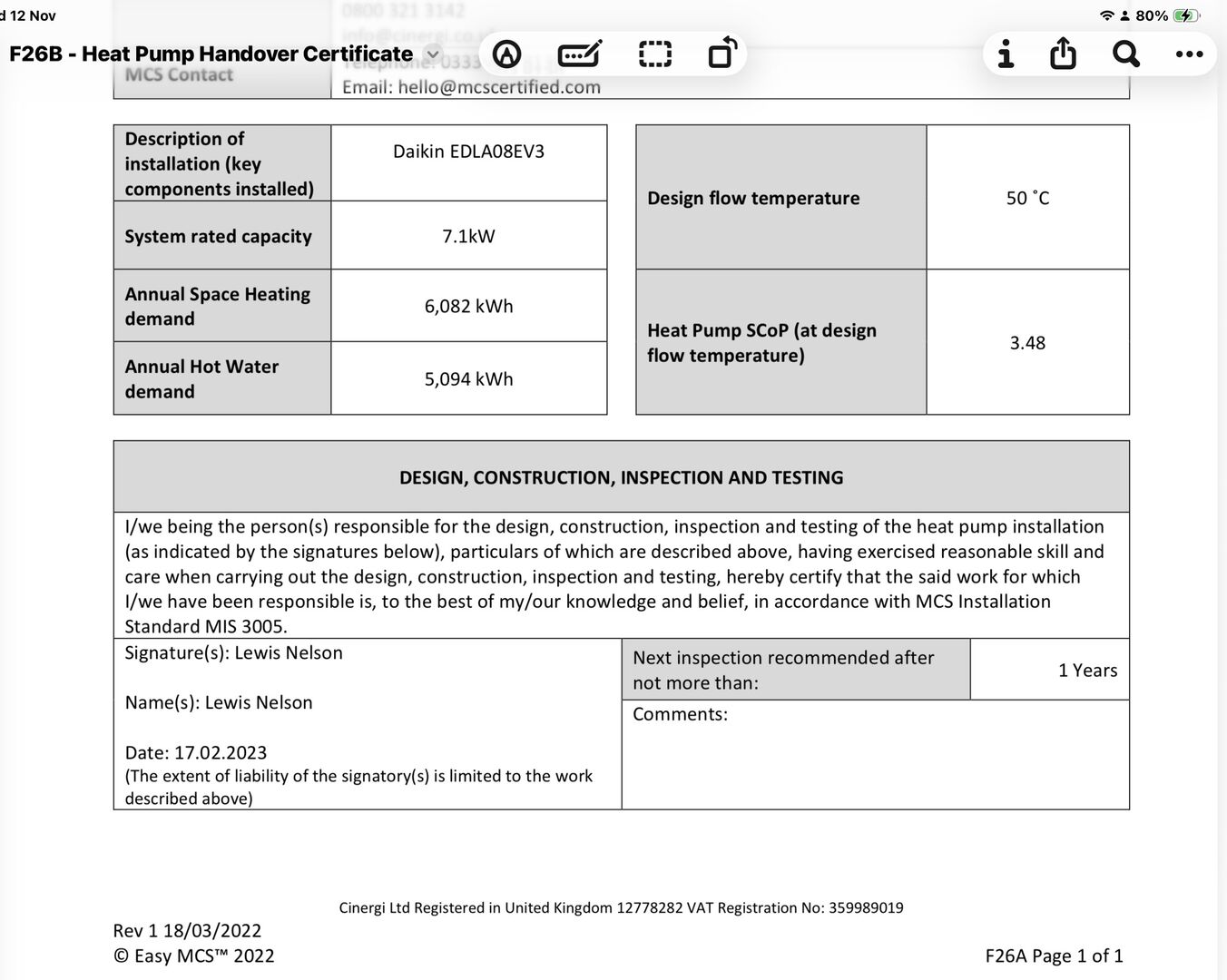
Further to the above suggestion of checking the accuracy of Daikin data, I am attaching a section of the form indicating my ASHP projected performance. You will note the design temperature is 50 degrees C.; from the start, I requested that the system be set for 45 degrees anyway and in fact with the Homely smart controller in operation, the range is 30-45 degrees but rarely exceeds 38 deg. The COP we appear* to enjoy varies between ~3.2 and 4.8 with the occasional rise to 5 plus.
*I say ‘appear’ because I have no external monitoring and have to rely on Daikin supplying Homely with the consumption data.😉 Regards, Toodles.
Toodles, heats his home with cold draughts and cooks food with magnets.
1

Latest Posts
-
RE: Heat Pump vs New Gas Boiler for Inherited House - Worth the Extra Cost?
*** I now see @jamespa has already posted but will stil...
By cathodeRay , 49 minutes ago
-

RE: Tell us about your Solar (PV) setup
@mk4 Charge to 100%, discharge down to 10%.
By bobflux , 56 minutes ago
-
RE: Daikin Altherma 3 LT compressor longevity question
This mess is intriguing: I wonder if this represent...
By bobflux , 2 hours ago
-
RE: Connecting Growatt SPH5000 over wired ethernet rather than wireless
The simplest wired option is usually the Growatt Ethern...
By Jonatan , 6 hours ago
-
RE: Peak Energy Products V therm 16kW unit heat pump not reaching flow temperature
ASHPs do have a minimum compressor speed. The minimum h...
By bobflux , 13 hours ago
-

RE: Electricity price predictions
@jamespa And it seems some of the nasty public cloud...
By Batpred , 13 hours ago
-
RE: Jokes and fun posts about heat pumps and renewables
Technology is rapidly advancing. BBC News reported th...
By Transparent , 17 hours ago
-
What matters for flow and pressure drop is internal dia...
By bobflux , 17 hours ago
-
RE: Do Fridges and Freezers have COP ratings?
@editor Thank you all for your replies and submitted in...
By Toodles , 20 hours ago
-
I know and yes. The secondary deltaT wont necessaril...
By JamesPa , 24 hours ago
-
RE: Designing heating system with air to water heat pump in France, near Lyon
Just love the way you put it! 🤣
By Batpred , 2 days ago
-
RE: Safety update; RCBOs supplying inverters or storage batteries
Thank you for sharing. So it seems that your Schneid...
By Batpred , 2 days ago
-

RE: Forum updates, announcements & issues
@upnorthandpersonal thanks for the thoughtful, consider...
By Mars , 2 days ago
-
RE: Solar Power Output – Let’s Compare Generation Figures
@mk4 All 21 panels have their own Enphase IQ7a microinv...
By Toodles , 2 days ago
-
RE: Setback savings - fact or fiction?
Great, so you have proven that MELCloud is consistently...
By RobS , 3 days ago
-
RE: Mitsu PUHZ120Y 'Outdoor Temp 'error?
Thanks David & James It almos...
By DavidAlgarve , 3 days ago
-
RE: Surge protection devices SPDs
@trebor12345 - your original Topic about the right type...
By Transparent , 3 days ago
-
RE: Help needed with Samsung AE120RXYDEG
@tomf I’ve been sent this from a service engineer at Sa...
By Mars , 3 days ago
-
RE: Buying large amp bidirectional RCD and RCBO
Yes... I went through this particular headache and ende...
By bobflux , 4 days ago
-
O-oh! Let's take this as an opportunity to 'pass the ...
By Transparent , 4 days ago
-
RE: Homely setup on daikin heat pump
@craigh I refer to our somewhat elevated temperature of...
By Toodles , 4 days ago
-
RE: Air source heat pump roll call – what heat pump brand and model do you have?
My turn, this describes the future installation, only t...
By bobflux , 4 days ago


