Joining the Renewable Heating Hub forums is completely free and only takes a minute. By registering you’ll be able to ask questions, join discussions, follow topics you’re interested in, bookmark useful threads and receive notifications when someone replies. Non-registered members also do not have access to our AI features. When choosing your username, please note that it cannot be changed later, so we recommend avoiding brand or product names. Before registering, please take a moment to read the Forum Rules & Terms of Use so we can keep the community helpful, respectful and informative for everyone. Thanks for joining!
Vaillant AroTHERM Plus Quotes Seem Inflated – Am I Being Overcharged for Controls & Installation?
Vaillant are neither the cheapest nor the most expensive, a good mid market choice for a balance of cost and quality. That doesn't make it the best, just an option seriously worth considering.
Obviously different installers will load things differently which is why shopping around is worthwhile.
The other class of solution I would look at in the 5kW range where you are, is cheapest available homlely compatible unit plus homely. For this option check you are happy with the subset of homely functionality that is cloud independent imho. Homely is obviously optional but your posts suggest you want a fairly good UI with a fair few features.
So we are starting to see the options land where they may be worth drilling down...
I had a look at the spec for the 5kw vs the 7kw Vaillant and it seems that, at W35, the "5kW" system provides almost the same heat as the 7kW. Is this why you were suggesting 5kW?
And when you mentioned using homely, would this mean I would essentially not need any controls from Vaillant? Or were you thinking about another R290 brand?
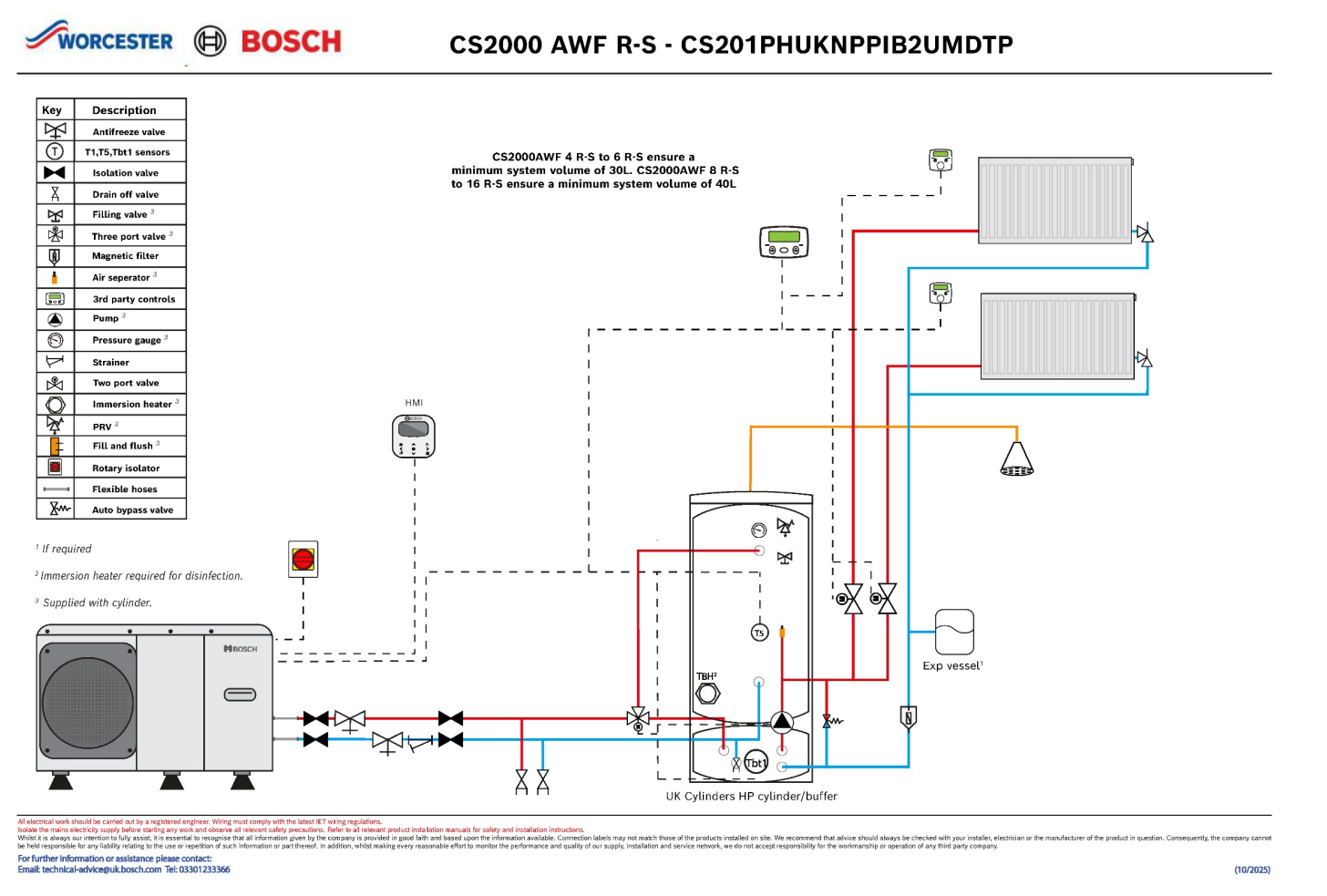
By the way, Bosch came back with a nice spec with diagrams, etc (with 2 zones, etc and buffer). They also used R32 kit (indicating some SCOP of over 5!) so I provided some feedback and am hoping to get a new one..
8kW Solis S6-EH1P8K-L-PLUS hybrid inverter; G99: 8kW export; 16kWh Seplos Fogstar battery; Ohme Home Pro EV charger; Vaillant Arotherm Pro 7kW; 100Amp head, HA lab on mini PC
I had a look at the spec for the 5kw vs the 7kw Vaillant and it seems that, at W35, the "5kW" system provides almost the same heat as the 7kW. Is this why you were suggesting 5kW?
Attached the full data for the current (not the Black) Vaillants. In Czech unfortunately but still understandable. 5 and 7 are different and not this was not why I suggested 5, I suggested 5 might be sufficient based on the figures presented but that this needs more evidence to confirm.
And when you mentioned using homely, would this mean I would essentially not need any controls from Vaillant? Or were you thinking about another R290 brand?
I was thinking other brands with less comprehensive control options, especially but not limited to Samsung and Midea. With Vaillant dont bother with anything other than the native controls until you have had it a couple of years and only then if there is actually something you want to do that you cant find a way of doing, such as dynamically optimising for Octopus Agile.
By the way, Bosch came back with a nice spec with diagrams, etc (with 2 zones, etc and buffer). They also used R32 kit (indicating some SCOP of over 5!) so I provided some feedback and am hoping to get a new one..
Unless they are guaranteeing the SCOP (which I doubt) and guaranteeing its as measured at the property not the heat pump - avoid, you dont want and dont need a buffer. I dont know if those controls are thrid party ones, but you dont want those either.
Attached the full data for the current (not the Black) Vaillants. In Czech unfortunately but still understandable.
I'm an electronics engineer, this is the kind of documentation considered appropriate for a 10 cents chip: about 50 pages describing all the characteristics, good and bad. This level of detail is absolutely necessary. If they want to sell a 10 cent chip, they must make it clear that the defects inherent in the 10 cent chip are not actually a problem in the application. Otherwise the engineer will buy a 11 cent chip with lesser defects from another manufacturer instead.
For an ARM M0 microcontroller worth between 0.5-1.5€ you'd expect a manual like so, 1384 pages, describes every aspect of the product in excruciating detail.
Compare with Vaillant (or any other heat pump manufacturer) "documentation", draw conclusions 🤣
Attached the full data for the current (not the Black) Vaillants. In Czech unfortunately but still understandable.
I'm an electronics engineer, this is the kind of documentation considered appropriate for a 10 cents chip: about 50 pages describing all the characteristics, good and bad. This level of detail is absolutely necessary. If they want to sell a 10 cent chip, they must make it clear that the defects inherent in the 10 cent chip are not actually a problem in the application. Otherwise the engineer will buy a 11 cent chip with lesser defects from another manufacturer instead.
For an ARM M0 microcontroller worth between 0.5-1.5€ you'd expect a manual like so, 1384 pages, describes every aspect of the product in excruciating detail.
Compare with Vaillant (or any other heat pump manufacturer) "documentation", draw conclusions 🤣
Im not justifying Vaillant or anyone else's documentation but please note that there is other documentation available, including in particular lengthy installation instructions.
The heating industry is not the electronics industry and plumbers aren't electronic engineers. 1384 pages about a heat pump or a boiler (they have similar levels of documentation so far as I can tell) would rather flummox them.
Mind you the heating industry is still better than the software industry where you are lucky to get any documentation at all!
4kW peak of solar PV since 2011; EV and a 1930s house which has been partially renovated to improve its efficiency. 7kW Vaillant heat pump.
Mind you the heating industry is still better than the software industry where you are lucky to get any documentation at all!
So true!
Note I wasn't criticizing your message. Simply felt like ranting, because it's ridiculous we have to jump through these hoops to obtain basic performance data like capacity*/COP* then hunt for the "* defrosting included (or not)" small print...
By the way, Bosch came back with a nice spec with diagrams, etc (with 2 zones, etc and buffer). They also used R32 kit (indicating some SCOP of over 5!) so I provided some feedback and am hoping to get a new one..
It's not a buffer, it's a low loss header
Explanation: To actually "buffer" you need to store heat. 1 kg of water stores 4180J for a temperature rise of 1°C. So a 30l "buffer" heated up by 5°C stores 627 kJ or just 0.17 kWh, which corresponds to a heat pump runtime of only a few minutes even at minimum power.
If you have a log powered boiler which delivers 90°C water then you can store heat in a big tank because the temperature rise is enormous. I put a 1000l tank on my wood boiler, so if I heat it from 30°C to 85°C it will store 64 kWh, which is a useful amount of heat, plenty enough to keep the house warm for a day or two so I can make a fire then not have to wake up in the middle of the night to feed more wood.
But with a heat pump, first it's not gonna heat to 85°C, and second raising the temperature destroys the COP, so storing heat from a heat pump in a tank is not generally a good idea unless the electricity used is free or very low cost (PV excess production, etc). Even then, a bunch of lithium batteries store a lot more energy in a lot less space at usually lower cost. If my heat pump runs at COP 4-5, and I have 20kWh batteries, the batteries actually store enough for the heat pump to output 80-100kWh of heat. That's the equivalent of about four 1000l tanks heated to 50°C.
So the usual "buffer" doesn't actually buffer anything. It just acts as a low loss header for hydraulic decoupling, an energy reserve for defrosting, adds distortion, lowers flow temp to your rads, requires the heat pump to work at higher temp, and nukes your SCOP. All this most likely so the installer can avoid having to actually check your pipes and put numbers on flow rates and pressure drops to really know whether you need it or not. It should really be piped as a volumizer instead to keep the useful features (helps with defrosting, lengthens cycles although with this tiny volume, not much) or just deleted.
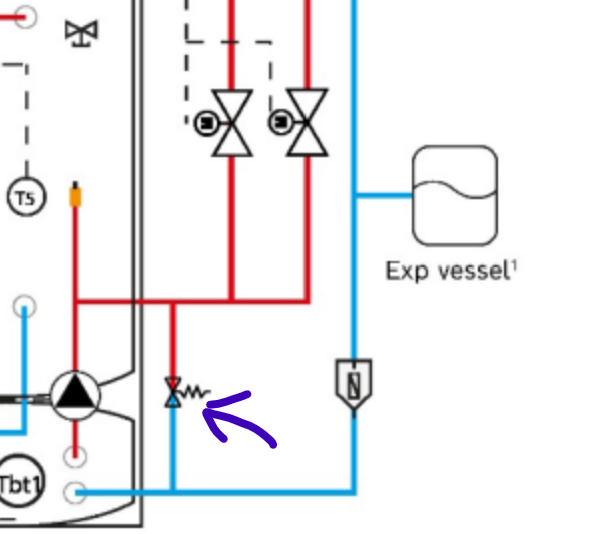
Also check the arrow.
That's a constant pressure relief valve. It means the circulator will be configured to run on constant pressure mode, and if the zone valves shut, flow will be shorted through the pressure relief valve instead, to make sure the circulator gets enough flow and doesn't overheat/cavitate. This indicates the control system is not smart enough (or not configured) to know it should not run the circulator when all zones are shut off, and it points to a whole can of worms of control issues. James tells you to avoid third party controls, because if they're not configured properly, you can end up with your heat pump configured to keep the "buffer" at a set point temperature while all the zones are shut off, or you have just one towel rail open, so the heat pump will run for nothing and cycle like crazy wasting electricity and wearing out the compressor for no reason at all. Adding more control systems creates more opportunities for really annoying scenarios like this one to occur, and is hard to fix, because these control systems usually are quite dumb and do not talk to the heat pump in a useful way, rather in a very crude way like a dry contact. In other words, zoning with a heat pump requires a lot of flow/pressure calculations and smarter controls, to ensure the heat pump will run well and not cycle frantically when some zones are shut off.
Explanation: To actually "buffer" you need to store heat. 1 kg of water stores 4180J for a temperature rise of 1°C. So a 30l "buffer" heated up by 5°C stores 627 kJ or just 0.17 kWh, which corresponds to a heat pump runtime of only a few minutes even at minimum power.
I definitely agree with the principle, but the term 'buffer' is universally used in the industry (so far as I can tell) even though, as you correctly say, not a lot of heat is stored. The term 'low loss header' is used for an arrangement of pipes that performs the same hydraulic function (essentially its a 'buffer' where the volume is zero or near zero).
Unfortunately some people in the industry also use the term 'buffer' to mean a 2 port tank plumbed in either the return or the flow. There is an alternative term 'volumiser' which more accurately describes the function and distinguishes it from a 'buffer'.
The scope for confusion of terminology is massive, and I strongly suspect that there are installers out there who couldn't tell you the distinction between the various items and just see it as a tank.
Using the industry terminology 'Buffers' and 'Low Loss Headers' which connect flow and return are to be avoided. 'Volumisers', which do not connect flow and return, do no harm and may be needed.
James tells you to avoid third party controls, because if they're not configured properly, you can end up with your heat pump configured to keep the "buffer" at a set point temperature while all the zones are shut off, or you have just one towel rail open, so the heat pump will run for nothing and cycle like crazy wasting electricity and wearing out the compressor for no reason at all.
Indeed so, also they frustrate the correct operation of weather compensation and in well insulated low loss houses with UFH are almost certain to cause temperature oscillation which operation on WC avoids. Furthermore the 'smarter' ones* use a pwm like technique in an attempt to turn an on/off signal into a proportional signal. That really messes with a heat pumps efficiency.
*excepting always Aida, Homely and Havenwise which are specifically designed to interface to the heat pump bus as opposed to just operating on/off.
4kW peak of solar PV since 2011; EV and a 1930s house which has been partially renovated to improve its efficiency. 7kW Vaillant heat pump.
By the way, Bosch came back with a nice spec with diagrams, etc (with 2 zones, etc and buffer). They also used R32 kit (indicating some SCOP of over 5!) so I provided some feedback and am hoping to get a new one..
It's not a buffer, it's a low loss header
Explanation: To actually "buffer" you need to store heat. 1 kg of water stores 4180J for a temperature rise of 1°C. So a 30l "buffer" heated up by 5°C stores 627 kJ or just 0.17 kWh, which corresponds to a heat pump runtime of only a few minutes even at minimum power.
...
So the usual "buffer" doesn't actually buffer anything. It just acts as a low loss header for hydraulic decoupling, an energy reserve for defrosting, adds distortion, lowers flow temp to your rads, requires the heat pump to work at higher temp, and nukes your SCOP. All this most likely so the installer can avoid having to actually check your pipes and put numbers on flow rates and pressure drops to really know whether you need it or not. It should really be piped as a volumizer instead to keep the useful features (helps with defrosting, lengthens cycles although with this tiny volume, not much) or just deleted.
Thanks, I use the buffer tank concept in the same way as @jamespa and others here (4 ports), to distinguish from volumizer (with 2 ports).
A buffer would just add more complexity, an extra pump, etc.
In any case, the combi tank concept is not something we are likely to take. We want to tuck all these bits away and combi tanks would not fit.
The Bosch play is turning out a bit of a long shot as the idea was to approach an installer with it and see if they provide reasonable pricing. And so far the Vaillant options seem to be moving closer to target quicker.
Plus the Bosch CS5800 R290 7kW delivers less than 7kW heat at -3C, which may just about not work.
I was not expecting product labelling in the ASHP industry to be so obfuscated. Are these products not meant to have been assessed specifically on energy efficiency (for consumer awareness) and MCS "best practice" fitting?
No chance for other industries like software engineering. There, if you do not like something, in the extreme, you just stop the subscription from renewing! So they can't operate in the same fashion.
8kW Solis S6-EH1P8K-L-PLUS hybrid inverter; G99: 8kW export; 16kWh Seplos Fogstar battery; Ohme Home Pro EV charger; Vaillant Arotherm Pro 7kW; 100Amp head, HA lab on mini PC
I was not expecting product labelling in the ASHP industry to be so obfuscated. Are these products not meant to have been assessed specifically on energy efficiency (for consumer awareness) and MCS "best practice" fitting?
Unfortunately its a function of the physics. Max heat pump output naturally changes with OAT and FT, that is unavoidable. Some manufacturers, most notably Mitsubishi, deal with this by limiting the output in firmware, others allow the machine to do what it naturally does. Design OAT and FT varies so its impossible, unless you limit in firmware (and why would you do this?) to give a number that is applicable in all situations.
EU regulations specify particular conditions under which the actual output must be quoted, but don't specify how the heat pump must be branded. Anyway we left the EU so, even if such regulations existed, they wouldn't necessarily apply to us. Our market isn't big enough to support our own standards.
So the better manufacturers publish output curves showing how they perform under a range of conditions, which your designer can match to your circumstance. Some manufacturers unfortunately obfuscate this data.
Thats how it is, blame the physics and the fact that the climate is not constant over a sufficient area to encompass a population large enough to justify specifications specific to that location.
This post was modified 6 months ago 2 times by JamesPa
4kW peak of solar PV since 2011; EV and a 1930s house which has been partially renovated to improve its efficiency. 7kW Vaillant heat pump.
That is taking the piss. Frost protection valves are about £100 each. Additional labour to fit them is about 10 minutes. And whether they're even needed is debatable.
That is taking the piss. Frost protection valves are about £100 each. Additional labour to fit them is about 10 minutes. And whether they're even needed is debatable.
Contractors pack for inta antifreeze valves are around £220 to the installer, so lets say they sell them to you for £300, fitting them is another £75 so all in £375-£400 for this item.
Some companies might be adding something ehre when they take something off somewhere else, perhaps concentrate on whole price and compare 5 companies. most installations for a medium home subject to the amount of emitter changes are around 13-14K
AAC Group Ltd covering the Kent Area for design, supply and installation of ASHP systems, service and maintenance, diagnostics and repairs.