
Notifications
Clear all

24/02/2026 7:36 pm
The Grant Aerona Smart Controller has an interesting approach. It has a parameter called Room Temperature Correction. It applies the following formula:
Corrected Flow Temperature = Nominal WC Flow Temperature + (Target Room Temperature - Actual Room Temperature) x Room Temperature Correction
As an example, suppose that the Nominal WC Flow Temperature is 28C, Target Room Temperature is 20C and Actual Room Temperature is 19C and Room Temperature Correction is 2.
Then Corrected Flow Temperature = 28 + (20-19) x 2 = 30.
Room Temperature Correction is adjustable between 0-10 in steps of 0.1.
Through the whole of January, despite quite big swings in outdoor temperature, our room temperature has held solidly between 19.3-20.7C, using only weather compensation. However, in the last few days, it has started to drift upwards, probably due to solar gain in the room near the thermostat. I have changed Room Temperature Correction from 0 to 1, but so far it has not made any noticeable difference.
Grant Aerona 290 15.5kW, Grant Smart Controller, 2 x 200l cylinders, hot water plate heat exchanger, Single zone open loop system with TRVs for bedrooms & one sunny living room, Weather compensation with set back by room thermostat based load compensation

Topic starter
24/02/2026 7:53 pm
Yes that sounds like a good approach to me.
In technical control engineering terms most controllers have two or possibly three or even four things going on- We have a proportional effect - this is the (room temp - actual temp) x correction factor bit in your example. This can get you close to where you want to be - but will always settle below the set point since there has to be an error for any output to exist. Normally there is an Integral Action , this just looks at the error at a regular time period and adds or subtracts a bit from the controller output to gradually bring you to the set point. Then you can have feedforward which is what the weather comp bit is doing.
I imagine weather comp is much more relevant to underfloor heating which has a very long response time which may be longer than the time it takes the weather to change. Room influence probably better for radiators which can react pretty quickly.
We have both so not sure - it all seems to work Ok - though now the weather is milder the radiator rooms seam a bit chilly strangely.
Topic starter
24/02/2026 8:04 pm
Yes that sounds like a good approach to me.
In technical control engineering terms most controllers have two or possibly three or even four things going on- We have a proportional effect - this is the (room temp - actual temp) x correction factor bit in your example. This can get you close to where you want to be - but will always settle below the set point since there has to be an error for any output to exist. Normally there is an Integral Action , this just looks at the error at a regular time period and adds or subtracts a bit from the controller output to gradually bring you to the set point. Then you can have feedforward which is what the weather comp bit is doing.
not a bad explainer here
I imagine weather comp is much more relevant to underfloor heating which has a very long response time which may be longer than the time it takes the weather to change. Room influence probably better for radiators which can react pretty quickly.
We have both so not sure - it all seems to work Ok - though now the weather is milder the radiator rooms seam a bit chilly strangely.

24/02/2026 8:42 pm
I imagine weather comp is much more relevant to underfloor heating which has a very long response time which may be longer than the time it takes the weather to change. Room influence probably better for radiators which can react pretty quickly.
Experimentally I dont think thats the case - I, and many others here, have radiators, use WC with no room influence, and find it much more comfortable than room influence.
The problem is not the reaction time of the heating its the reaction time of the house and the air within the house. Additionally the house stores history within its fabric, there is no cooling mechanism, only a no heating mechanism, and also the range of output available from the radiators (with a boiler or a heat pump) and the pipework is quite limited.
Lest start with the heat capacity of the house. Mine, for example, has a heat capacity of (roughly) 14kWh/C and a loss of 7kW at the design temperature of -2. Thus the radiators are sized to deliver 7kW or thereabouts, ie equilibrium at the design temperature. That much we know. What follows is a bit hand waving because the dynamics of the propagation of heat through the fabric and into the air (which is the temperature that an indoor sensor measures) are a bit complex, but hopefully generally about right:
I think the argument then goes like this: If the outside goes from say 7C to -2C it takes time for the effects to reach the inside air and thus be detected by an IAT sensor. In this time the outside layers of the fabric have cooled below the temperature that they would be when the system is in equilibrium at -2. This means that more than 7kW (quite a lot more given the high heat capacity of the house) is needed to restore equilibrium. The radiators either cant deliver this, or can only deliver it by a significantly elevating the flow temperature (and thus the air temperature in the vicinity) for a long time, which leads either to increased temperature gradients and increased running costs, or a delay in calming the wave of cold that is making its way through the fabric and restoring it to equilibrium. With a house heat capacity of 14kWh/C relative to a design loss of 7kW, its not difficult to see that there is a problem if you wait until the cold wave hits the inside of the fabric and cools the air inside enough for an IAT sensor to react.
The converse is true if the OAT warms, but exacerbated by the absence of a cooling capability (or reluctance to use it alternately with heating).
Thats roughly it I think, modelling and visualisation of heat transfers would doubtless show the dynamics more clearly, but at this point I lose interest a bit given that WC seems to work better than room influence, at least for my house and many others.
This post was modified 1 week ago by JamesPa
4kW peak of solar PV since 2011; EV and a 1930s house which has been partially renovated to improve its efficiency. 7kW Vaillant heat pump.

25/02/2026 10:51 am
@jamespa I'm really interested in this. We are having a Vaillant 10KW installed in a few months and I've been looking at figures obtained from our current Tado control running an elderly 18KW boiler with a flow temp of 60 degrees. In the depths of the icy weather a couple of weeks ago (-2) the house degraded when the heating went off over about an 8 hour period by 4 degrees until the heating came back on. This week with 10 degrees outside the temperature fall was 3 degrees. I was surprised at the small difference but I think it agrees with your contention that WC is the way to go.
This post was modified 1 week ago by Cliffy
25/02/2026 12:16 pm
@jamespa I'm really interested in this. We are having a Vaillant 10KW installed in a few months and I've been looking at figures obtained from our current Tado control running an elderly 18KW boiler with a flow temp of 60 degrees. In the depths of the icy weather a couple of weeks ago (-2) the house degraded when the heating went off over about an 8 hour period by 4 degrees until the heating came back on. This week with 10 degrees outside the temperature fall was 3 degrees. I was surprised at the small difference but I think it agrees with your contention that WC is the way to go.
There is essentially no doubt that operating heat pumps on well adjusted weather compensation, is, in the vast majority of cases, the way to go. In some cases applying tweaks are useful, such as limiting overshoot using TRVs/thermostats set a couple of degrees above the target, timed heating to take advantage of ToU tarrifs (particularly if the heat pimp is well oversized and you have UFH in a slab) , or an element of room influence driven by the heat pump's own temperature sensor and controller (not external thermostats), but the starting point should in almost all cases be well adjusted WC. You can only adjust WC properly if you disable room influence during the period of adjustment. Whether you choose to re-enable it is house and maybe season dependent. In my own case I disable room influence entirely except in March and April when the solar gain starts to exceed the loss. At this point I enable a limiting function (Vaillant 'expanded' mode).
This post was modified 1 week ago 2 times by JamesPa
4kW peak of solar PV since 2011; EV and a 1930s house which has been partially renovated to improve its efficiency. 7kW Vaillant heat pump.
25/02/2026 2:02 pm
Thanks James that's very helpful. I am planning to leave my Tado TRVs in place essentially set above the required temperature where they will act as Temperature sensors. Do you think there is mileage for continuing to use them in a limited fashion, say in two of our Bedrooms where we never want the temperature above 18? I worry that this goes against the "open loop" principle.
1
25/02/2026 2:19 pm
Thanks James that's very helpful. I am planning to leave my Tado TRVs in place essentially set above the required temperature where they will act as Temperature sensors. Do you think there is mileage for continuing to use them in a limited fashion, say in two of our Bedrooms where we never want the temperature above 18? I worry that this goes against the "open loop" principle.
If you only ever want them at 18C then it would be better simply to turn down the lockshields on these rads. Then you retain the full active system volume, which helps with cycling and defrost. That said it wont make that much difference if a small proportion of your total load/system volume is on TRVs, so if that suits your need then don't be too onbsessive. The objective is comfort not just ultimate efficiency.
FWIW I started out with all bedrooms on TRVs. After a couple of weeks I unscrewed all but one completely and instead adjusted the lockshields (which is actually more comfortable because of the TRV hysteresis). The one active TRV remaining is in the room used primarily for guests; here I left the LSV on full and applied the TRV, as a courtesy so a guest could adjust up or down as they please.
4kW peak of solar PV since 2011; EV and a 1930s house which has been partially renovated to improve its efficiency. 7kW Vaillant heat pump.
Topic starter
25/02/2026 5:52 pm
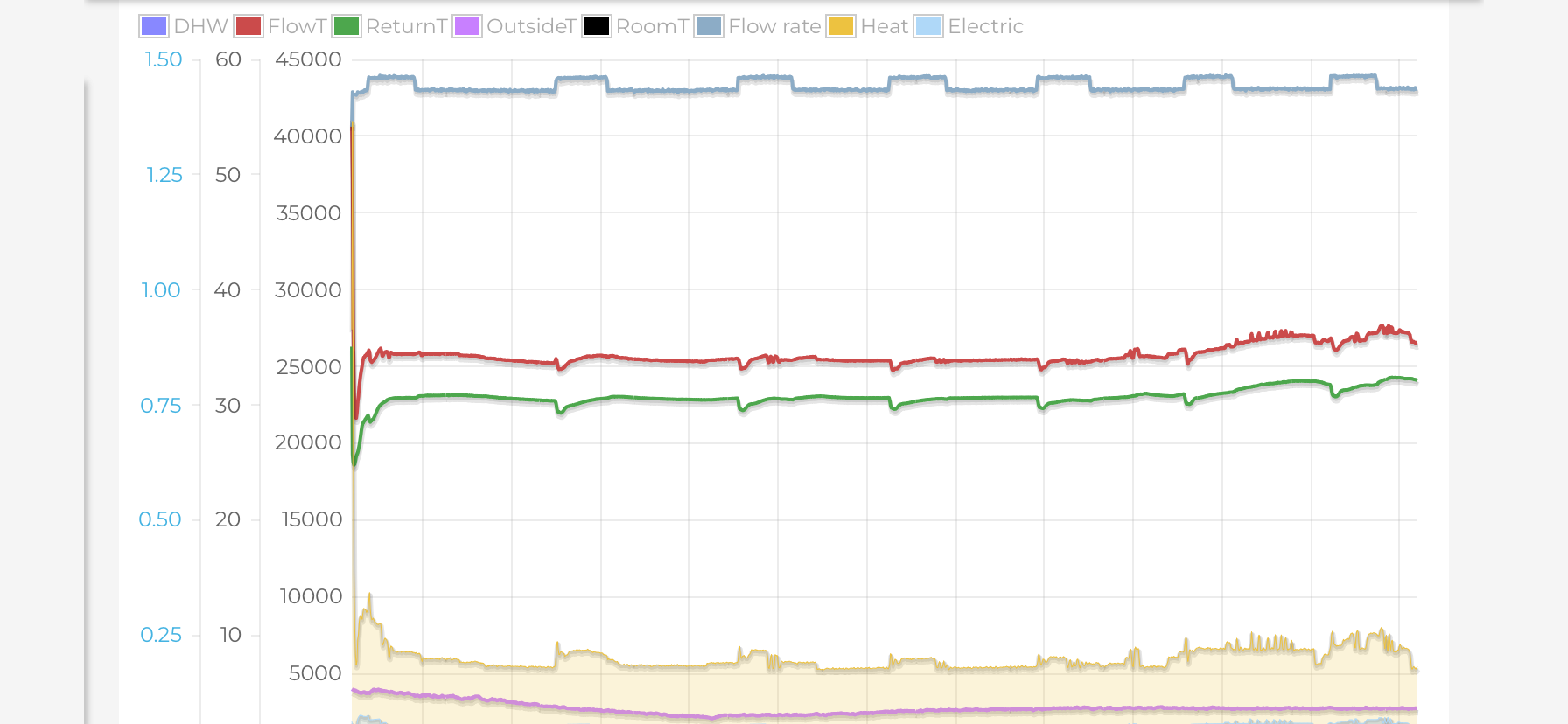
I have one Sonoff smart TRV in our bedroom set to 18DegC. On the trend you can clearly see it cycling on and off and the heatpump having to react to this small change in flow rate. I have no idea if this has a negative impact - on the face of it the heatpump just had to tweak the speed of the compressor slightly - which it is after all designed to do. When I get the urge I will turn down the lockshield till the cycling of the TRV just about stops - or at least the closed time is minimal- then I will turn it up and my trend will be nice and flat😀
Topic starter
25/02/2026 5:57 pm
I think the dynamic behaviour and propagation of heat flux in response to a step change in external conditions is a really interesting point.
I started to pen some thoughts but life got in the way- will try to come back shortly. Not sure my knowledge of physics is up to it but let’s see.
25/02/2026 6:48 pm
I think the dynamic behaviour and propagation of heat flux in response to a step change in external conditions is a really interesting point.
I started to pen some thoughts but life got in the way- will try to come back shortly. Not sure my knowledge of physics is up to it but let’s see.
I find it quite challenging to think about, to say the least.
The simple model of a house, which we use much of the time, is a monolithic block characterised by a loss and, where (very occasionally) necessary for the analysis, a heat capacity. However we know that is far from the case in reality, and this matters when it comes to the detail of fancy control algorithms and how the outside world really affects the human inside.
My next level conceptual model is that a house in steady state has a temperature gradient through the fabric. If the outside changes, a wave of heat (or cold) propagates through the thickness of the fabric in response, meeting the heat leaving the fabric and distorting the gradient as it goes. After its passed through, which may take many hours, the house returns to a an 'equilibrium' gradient again (except that by then the conditions have probably changed once more!). This is also a gross approximation and ignores the fact that we largely heat (and touch) the air inside the house, not the fabric through which the heat passes and of course the fabric is very far from uniform.
If we aren't careful we will be talking about transfer functions and impulse responses before we know it.
I have one Sonoff smart TRV in our bedroom set to 18DegC. On the trend you can clearly see it cycling on and off and the heatpump having to react to this small change in flow rate. I have no idea if this has a negative impact - on the face of it the heatpump just had to tweak the speed of the compressor slightly - which it is after all designed to do. When I get the urge I will turn down the lockshield till the cycling of the TRV just about stops - or at least the closed time is minimal- then I will turn it up and my trend will be nice and flat

As I say above one radiator, or a small minority, with TRVs isnt likely to make much difference so far as I can see. The real problem is when a significant proportion have TRVs, leading to excessive cycling, risking defrost failures and also risking some rooms being cold because of control conflicts.
This post was modified 1 week ago 5 times by JamesPa
4kW peak of solar PV since 2011; EV and a 1930s house which has been partially renovated to improve its efficiency. 7kW Vaillant heat pump.
Topic starter
26/02/2026 9:07 am
You are correct we are probably getting a bit too deep in the thermodynamics- I will take it offline - Ive now gone down a rabbit hole of looking at free multiphysics simulation tools - if I make any progress I will report back. Used to use Comsol at work but far to expensive for mere mortals.
On a more practical note - below is the link I found where someone has hacked a Sonoff TRV valve to act as a modulating control valve with PID control
Also found this thread on the form
where a lot of this stuff is already discussed. Since this is a year old do you know if there is any update on the self balancing TRV subject.
I don’t know much about smart TRVs - on the basis of the thread above I got a couple of the Sonof TRVs and can confirm that they are definately on/off control - when I get round to it I will give the home assistant integration above a try.
Are all smart TRVs on/off or are more advanced ones modulating?
At the risk of re-inventing the wheel again - my understanding of what is required for a self balancing system is broadly as follows
Each radiator with a modulating TRV and local PID control of room temp
A central controller which can monitor the status of each TRV - in particular the valve open % of each TRV
The central controller algorithm needs to control the flow temperature of the heatpump - something like ghis
Say - every hour(depending on reaction times of TRVs)
Check to see if all the TRVs have achieved setpoint temperature and valves are less than 100% open
If not - increase flow temp by some increment
If yes - decrease flow temp by some increment.
Repeat.
So essentially fine tune the flow temperature to find the lowest value that allows all of the rads to achieve the desired room temp.
You can then rank the radiators by TRV open % - the rad with 100% open TRV being the weakest rad - etc
This seems to be what the ADIA system is doing.
This is of course a more sophisticated form of load compensation but some feedforward from external temp could also be included.
Shouldn’t be too hard to set up on home assistant - especially as the heavy lifting with the TRV seems to have been done.
I could give it a try - but if it’s already being worked on then not much motivation to do so.
When I say worked on I mean a commercial solution is about to be launched or already available- I know about ADIA but for those of us with an existing and reasonably well designed heatpump installation.
This post was modified 7 days ago by Travellingwave

Latest Posts
-

Heat loss and radiator sizing are necessary, but they’r...
By Mars , 33 seconds ago
-
RE: How to control DHW with Honeywell EvoHome on Trianco ActiveAir 5 kW ASHP
Well I've had an interesting few days and would like to...
By giganto , 44 minutes ago
-

RE: Peak Energy Products V therm 16kW unit heat pump not reaching flow temperature
Yes, here's mine. From the service manual parts numbers...
By bobflux , 5 hours ago
-
RE: Underfloor Heating Installation Issues with Heat Pump
Thanks for sharing your observations, both of you. From...
By Jonatan , 5 hours ago
-
Had to learn the hard way 🤣 now I'm sharing T...
By bobflux , 5 hours ago
-
RE: Issue with a Grant Air Source Heat Pump & Tado Smart Thermostat
Im assuming from your original post that hysterisis ref...
By JamesPa , 6 hours ago
-
RE: Heat Pump vs New Gas Boiler for Inherited House - Worth the Extra Cost?
Hi @fretless6 Mike, I have experience with Taggas (Re...
By Old_Scientist , 8 hours ago
-
RE: Daikin Altherma 3 LT compressor longevity question
@bobflux With my limited HA skills I can't ad...
By Ubert767 , 9 hours ago
-
RE: Testing new controls/monitoring for Midea Clone ASHP
Now seems a good time to summarise the costs and effici...
By benson , 12 hours ago
-
RE: Tell us about your Solar (PV) setup
@mk4 Charge to 100%, discharge down to 10%.
By bobflux , 14 hours ago
-
RE: Connecting Growatt SPH5000 over wired ethernet rather than wireless
The simplest wired option is usually the Growatt Ethern...
By Jonatan , 19 hours ago
-

RE: Electricity price predictions
@jamespa And it seems some of the nasty public cloud...
By Batpred , 1 day ago
-

RE: Jokes and fun posts about heat pumps and renewables
Technology is rapidly advancing. BBC News reported th...
By Transparent , 1 day ago
-

RE: Do Fridges and Freezers have COP ratings?
@editor Thank you all for your replies and submitted in...
By Toodles , 1 day ago
-
I know and yes. The secondary deltaT wont necessaril...
By JamesPa , 2 days ago
-
RE: Designing heating system with air to water heat pump in France, near Lyon
Just love the way you put it! 🤣
By Batpred , 2 days ago
-
RE: Safety update; RCBOs supplying inverters or storage batteries
Thank you for sharing. So it seems that your Schneid...
By Batpred , 2 days ago
-
RE: Forum updates, announcements & issues
@upnorthandpersonal thanks for the thoughtful, consider...
By Mars , 2 days ago
-
RE: Solar Power Output – Let’s Compare Generation Figures
@mk4 All 21 panels have their own Enphase IQ7a microinv...
By Toodles , 3 days ago
-
RE: Setback savings - fact or fiction?
Great, so you have proven that MELCloud is consistently...
By RobS , 3 days ago
-
RE: Mitsu PUHZ120Y 'Outdoor Temp 'error?
Thanks David & James It almos...
By DavidAlgarve , 3 days ago
-
RE: Surge protection devices SPDs
@trebor12345 - your original Topic about the right type...
By Transparent , 3 days ago
-
RE: Help needed with Samsung AE120RXYDEG
@tomf I’ve been sent this from a service engineer at Sa...
By Mars , 4 days ago