

Notifications
Clear all
Joining the Renewable Heating Hub forums is completely free and only takes a minute. By registering you’ll be able to ask questions, join discussions, follow topics you’re interested in, bookmark useful threads and receive notifications when someone replies. Non-registered members also do not have access to our AI features. When choosing your username, please note that it cannot be changed later, so we recommend avoiding brand or product names. Before registering, please take a moment to read the Forum Rules & Terms of Use so we can keep the community helpful, respectful and informative for everyone. Thanks for joining!

Topic starter
18/02/2026 6:52 pm
Hi @jamespaThanks for posting the photos which are very useful. You are asking the right questions!
Without knowing exactly how the Honeywell is wired/connected its difficult for me to tell how best to disable it. Can you tell anything from the wiring around? Others, eg someone with one of the Honeywell devices, may well have a better idea.
The final picture is your weather compensation curve. This changes the temperature of the water that the heat pump produces to feed the radiators according to the outside temperature. With the current settings its likely you are paying 30% -50% more for your heating than you need to and are less comfortable than you could be. Dont panic though, it can be changed and we will provide help.
Before you start changing anything I recommend you read this introduction to heat pumps which explains some of the key concepts. You need to forget everything you learned about running a boiler (much of which was wrong even for boilers!) and think instead 'low and slow' - on 24x7 at a very low level, just enough to keep the house warm. The weather compensation is key to this.
If you read the introduction and tell us something about how the Honeywell is connected we can talk you through the key steps. If you do this your house should be more comfortable and your heating bills lower.
Thanks for the reply. I have read through the info and posts again. I am ignoring the Honeywell at the moment. I have activated the AT compensation and moved the curve so to be around 35C FT @ 0C which ranges from 25C FT @ 20C to 50C FT @ -30C (40C FT @ -10C). I'll try this for a few days to see. I've attached pics. I think that I was looking for 'unicorn dust'. I just spiked the DHW for a shower!
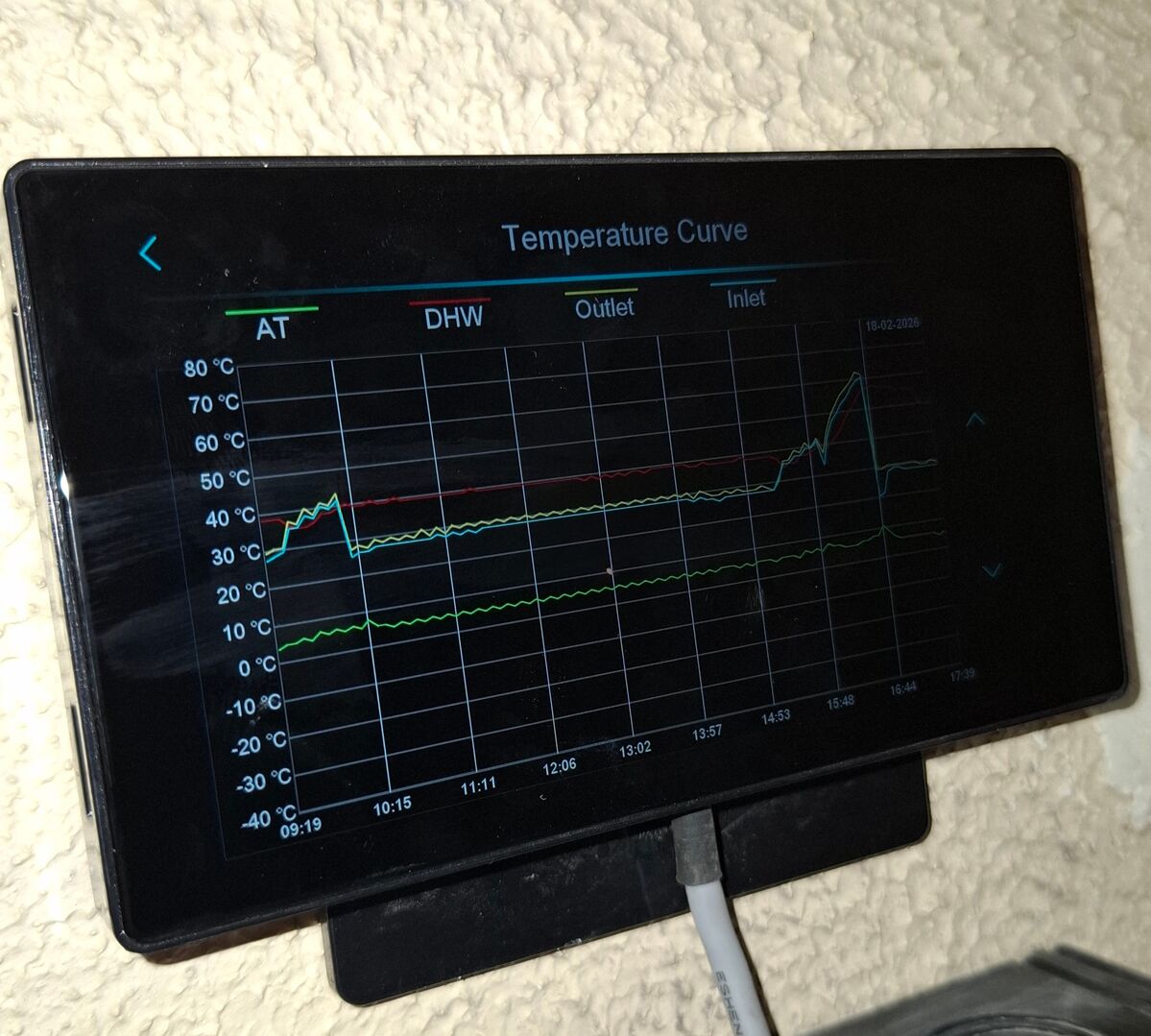
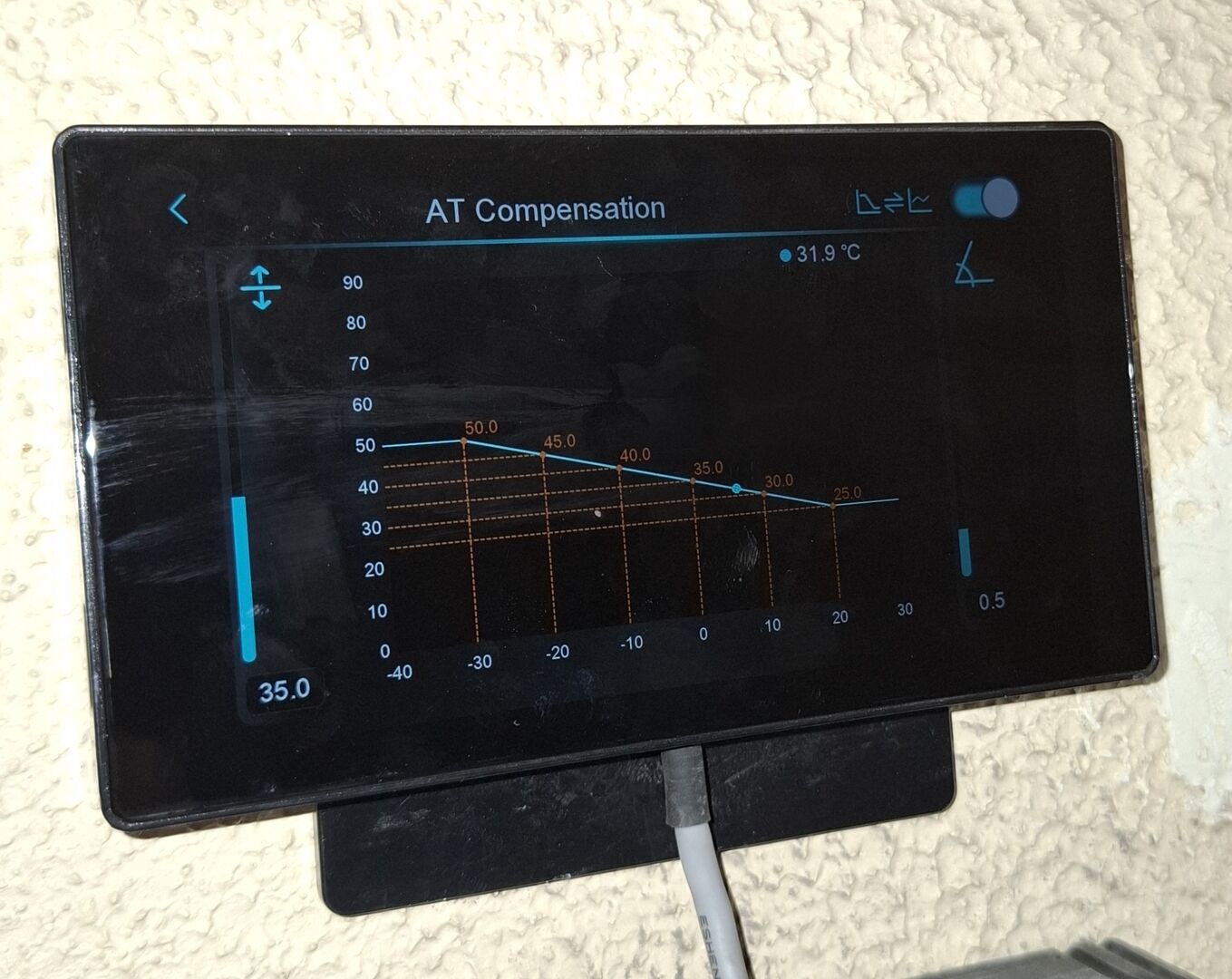
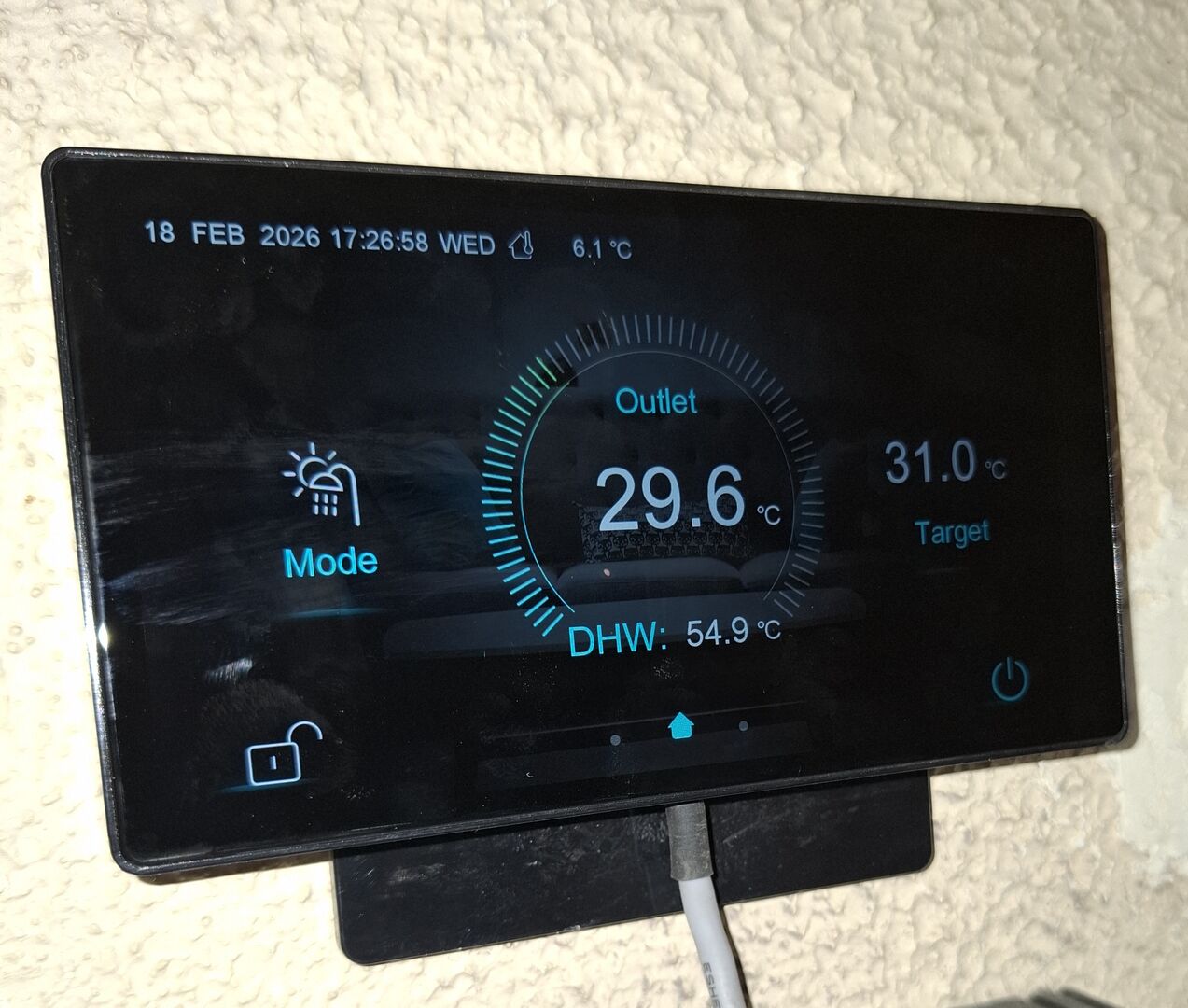

18/02/2026 8:47 pm
. I think that I was looking for 'unicorn dust'.
Not if you are systematic and patient.
The high OAT end is logically something like 20 at 20, or more practically something like 25-27 @ 16 or thereabouts. At this level it's fairly self regulating. So that leaves only the low oat end. Start at the design ft if there is one or if not 35 for ufh or 45 for rads at design oat (or do a linear extrapolation of that to a lower oat if you wish Then turn it up ir down as appropriate, once a day no more frequently. Once the house is getting close to the right temperature (go by feel) start trimming radiator lsvs if there are major discrepancies.
Fortunately rad balancing doesn't have to be particularly accurate because rooms share heat. Adjusting the WC curve is basically one parameter up or down, same as a thermostat.
This really is much more difficult to describe than to do, so long as you are patient.
This post was modified 8 months ago by JamesPa
4kW peak of solar PV since 2011; EV and a 1930s house which has been partially renovated to improve its efficiency. 7kW Vaillant heat pump.
1
Topic starter
19/02/2026 1:24 pm
Hi @jamespa , Thanks for the reply - cautionary tale re adjustment.. I think that I was looking for 'unicorn dust'.
Not if you are systematic and patient.
The high OAT end is logically something like 20 at 20, or more practically something like 25-27 @ 16 or thereabouts. At this level it's fairly self regulating. So that leaves only the low oat end. Start at the design ft if there is one or if not 35 for ufh or 45 for rads at design oat (or do a linear extrapolation of that to a lower oat if you wish Then turn it up ir down as appropriate, once a day no more frequently. Once the house is getting close to the right temperature (go by feel) start trimming radiator lsvs if there are major discrepancies.
Fortunately rad balancing doesn't have to be particularly accurate because rooms share heat. Adjusting the WC curve is basically one parameter up or down, same as a thermostat.
This really is much more difficult to describe than to do, so long as you are patient.
AT curve centred around 35C as per last post. Late evening not quite enough comfort for the missus, so I altered AT curve to 37C. At approx 4 ish am, both of us downstairs - synchronised loo system - complaining how warm it was so I quickly altered AT curve back to 35C - fabulous this morning when we got up properly. Anyways I attach some pics of the temp traces of the system showing the Flow and Return (oulet and Inlet) temps. You can clearly see the lines around 4 ish pre alteration, then a little reset downwards? then settle at reduced values. i checked again when I got up and noticed another slightly larger reset? before returning to the previous temps. With the second blip, you can see the Flow and return temps appear to separate to about 5C apart (Usually around 2.5 max) before returning to normal readings. I thought that it might be something to do with defrost but with the larger dip the AT(outside) actually rise upwards at the same time. Any thoughts?
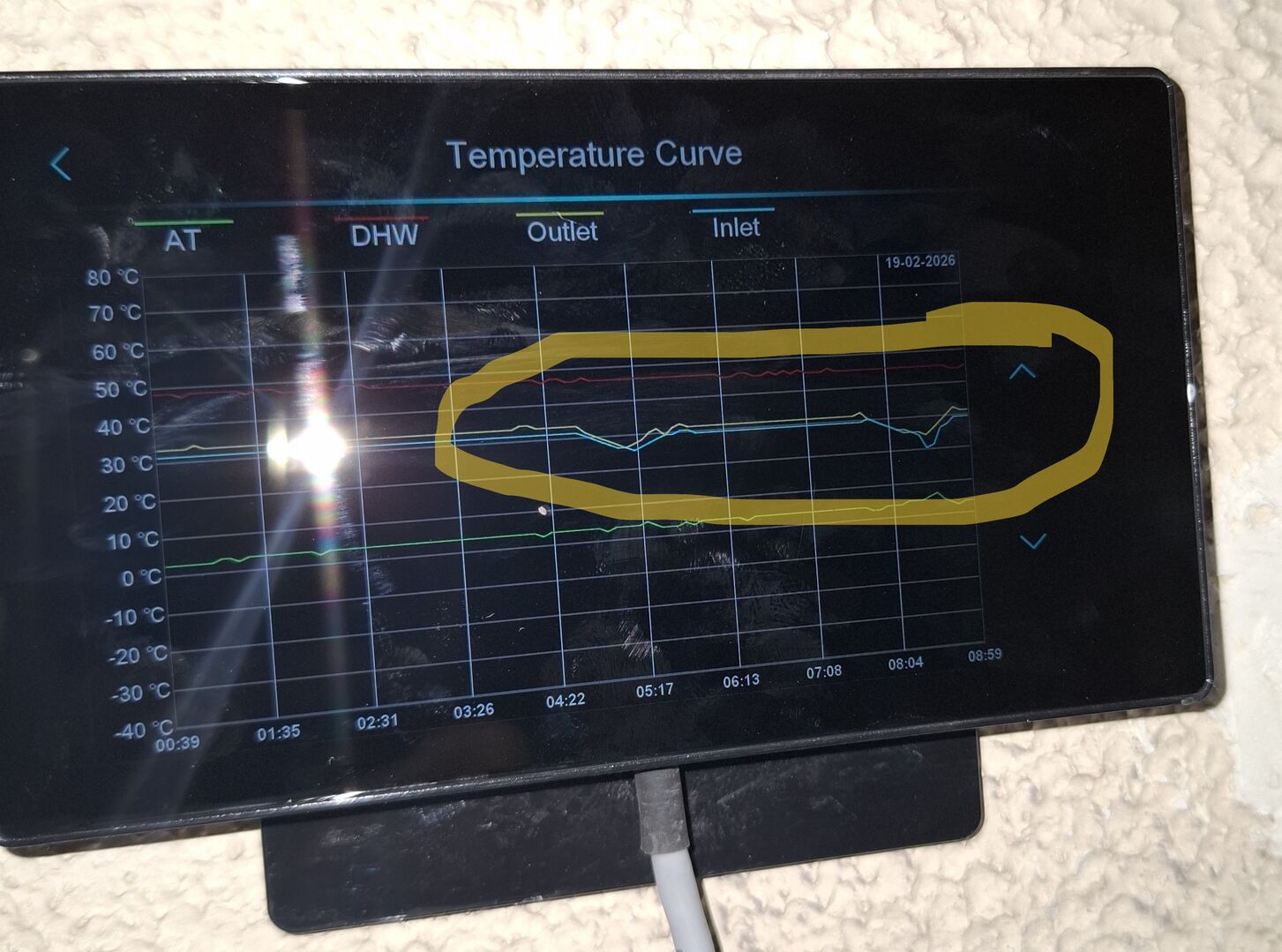
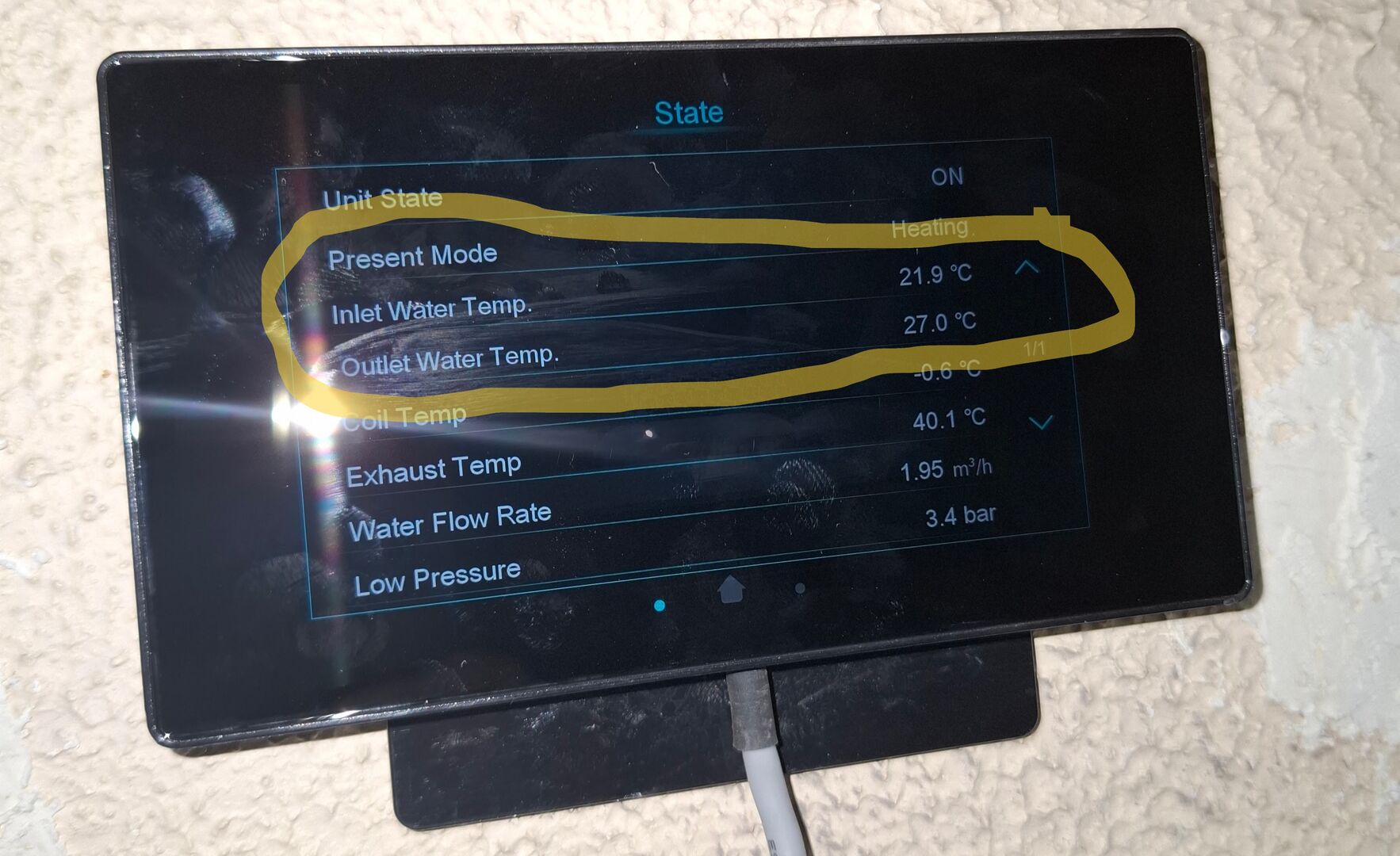
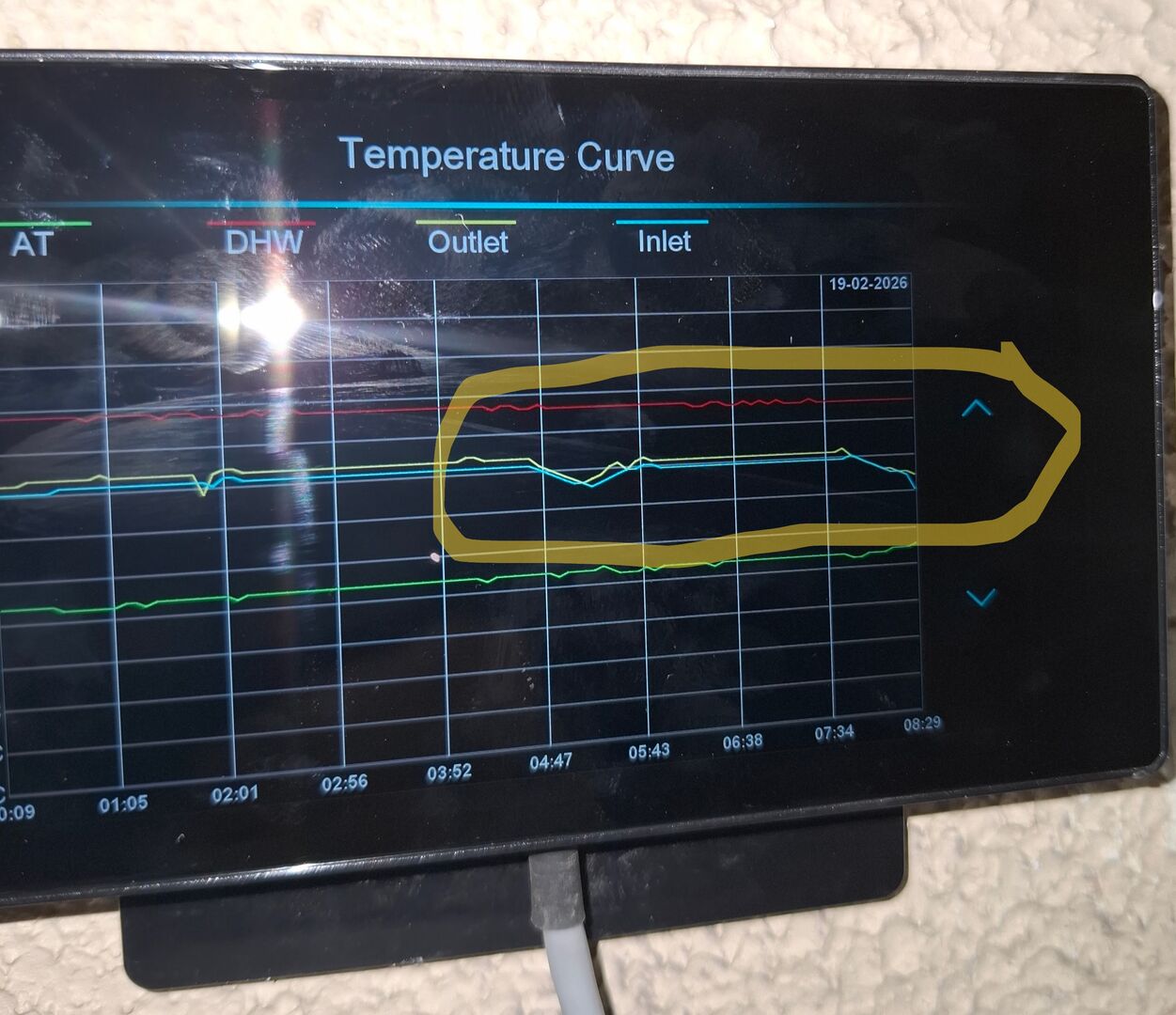
would be appreciated
This post was modified 8 months ago by giganto
19/02/2026 3:12 pm
The last photo is defrost for sure (or cooling, but presumably not at this time of year). You can tell because flow < return.Once you get close to the right curve I would go for one adjustment every 2 days or even longer, and make smaller changes. Houses take a very long time to stabilise so adjusting too much too frequently just leads to oscilllation.
4kW peak of solar PV since 2011; EV and a 1930s house which has been partially renovated to improve its efficiency. 7kW Vaillant heat pump.
2

Topic starter
04/03/2026 10:47 pm
Well I've had an interesting few days and would like to share my cautionary tale.The last photo is defrost for sure (or cooling, but presumably not at this time of year). You can tell because flow < return.Once you get close to the right curve I would go for one adjustment every 2 days or even longer, and make smaller changes. Houses take a very long time to stabilise so adjusting too much too frequently just leads to oscilllation.
My system was installed in Sept 25 under an eco 4 grant. Sparce info - 'set it to 55C water and 50C heating'. 'set temps for each room on the Honeywell Home controller and leave it alone' being about it.
We've discussed running ASHP on this forum and I've read, listened, queried, reread info about third party controls, ASHP controller, low and slow flow temp, weather compensation curves and I've generally been on an upward curve wrt knowledge about ASHP = thank you all!
I've queried 'issues/ settings' with my installer only to be assured everything is fine. My installation was chosen randomly by MCS to be inspected about 2 months ago. The inspection went well, with the inspector very happy with the standard of install with just a few minor concern about insulation opening on the exterior pipes. I forgot all about it.
Last week, there's a knock on the door from my installer's commissioning engineer/ trouble shooter. He puts new piece of insulation in sorted! While we're by the ASHP I mention that I can't connect to the ASHP via a phone app and that a 'DTU' for the job is in wrapping, sitting in my garage - left after the install. He takes a look inside the case of the ASHP- finds the 'DTU' absent and fits the one I'm holding in my hand for him. Within 5 mins - 4mins 30 secs to link to my wifi - I'm linked to the ASHP on my phone as intended.
Off inside to the DHW tank room for another 'insulation issue'. While there I mention that the system experiences a 'BRR' at random times - like a PRV blowing - but there is never a reduction in pressure and no physical evidence. This may occur every other day or once a month. Engineer turns system off, then back on - 'BRR'. Repeats it - 'BRR'. He says that a secondary pump installed in the return of the heating circuit before a ' volumiser' is fighting the onboard pump causing cavitation briefly. He wonders why it was installed as it is unnecessary - the onboard pump will easily cope with the system on its own. The pump is left in situ but electrically disconnected.
The Spec from the handbook left after install said 'water flow' at stated conditions - 0.77m3/hr. Previously, I had asked the installer why the flow rate on the display unit was usually close to 1.8 m3/hr. I was told that the flow was really good and strong. This gentleman turns to me , without prompting and says that the on board pump is set too fast and sets the pump at 50% speed - about 0.89 m3/hr or so. I never appreciated how loud the secondary pump had been - i have got 2x hearing aids lol- but the system is now silent!
The dT between outlet flow and return flow is now 5+C - had been constantly around 1.5 - 2.5 max.
Next he informs me that he's got to remove the Honeywell Home controller and swap out the wifi TRVs for standard TRVs with a standard room thermostat controller. Apparently, they have been 'sticking open, on occasion, causing the ashp to continually cycle'. Hoorah!!
Anyways, I now have a system which has finally been 'commissioned' - at least partially - with 'native control', no third party influences - settings arranged to negate them, working with weather compensation delivering a comfortable 21/22C on the new thermostat in the living room.
I have experienced high kWh averaging daily usage over 30+ kWh since September with nothing other than the ASHP to blame blindly for the increase - ASHPs suck!
It turns out that the app on my phone shows temp parameter curves but it also shows total daily input kWh to the ASHP. I appreciate that the weather has brightened but since the improvements have been made the daily average to the ASHP is between 6 and 8.5 kWh. How much money have I lost since Sept?
Who'd have thought that a good install would make such a difference eh?
For those who have followed to the end, I hope that this tale is both a 'shout out' to the good advice available on this forum and an example of a 'good install with poor commissioning' and lack of technical information left by the installer!
Finally, My introductory message to the group contained a desire to understand how to control the DHW. May I tell you now that that wish has been granted and the control is as I want and really responsive with this High temp ASHP. Thanks again for your advice and I'm learning so much about other stuff!
2
Page 2 / 2
Prev

SPONSORS

Degrees of Separation
Latest Posts
-

RE: PV and battery long payback - sense check query
@energystoragetech it's highly improbable that @davidb ...
By Transparent , 5 hours ago
-
RE: Heat Geek installations: share your experiences
@editor I suspect that the Heat Geek online quote is a ...
By AndrewJ , 5 hours ago
-
RE: tepeo ZEB UK Support & Info Thread
@toodles The tepeo ZEB is a residential heat battery, w...
By wully , 5 hours ago
-
RE: Adding additional Solar Panels to a DC coupled battery system
Ah, yes. Thanks for clarifying.
By Transparent , 5 hours ago
-
RE: Replacing Storage Heaters with a Heat Pump in a Stone Cottage
Ah, that explains it. Thanks! Then I agree with ot...
By cathodeRay , 7 hours ago
-
RE: Vaillant ecoTEC Plus - Flow Temp and Set Up
@trebor12345 I have been meaning to get home assista...
By Batpred , 16 hours ago
-
RE: Indevolt Batteries UK Support & Info Thread
SunSynk hybrid inverters also have the capability to as...
By Transparent , 19 hours ago
-
RE: Is This Initial Free Quote From Octopus Trusted Partner Reasonable?
If you've got a sash window or a door you can remove th...
By EtchedPixels , 20 hours ago
-
RE: Are We Sleepwalking Into Another Race to the Bottom?
Roughly how most air/air is done except that step 3 doe...
By EtchedPixels , 20 hours ago
-
RE: Nook batteries from Octopus
@batpred If your energy use is low enough that just get...
By EtchedPixels , 20 hours ago
-
RE: Missing flow temperature in Heat Geek proposal
I suspect 4 yrs ago, their approach had not got to this...
By Batpred , 21 hours ago
-
RE: battery storage without solar
Also don't forget that in you may not be able to use th...
By JamesPa , 1 day ago
-
RE: Tesla Powerwall (2) Calibration Cycles
One practical safeguard is to separate the calibration ...
By EnergyStorageTech , 1 day ago
-
RE: Getting closer to a finished Haier system
Apart from sealing the external Primary Pro joints and ...
By Singlespeed , 2 days ago





SPONSORS

