Joining the Renewable Heating Hub forums is completely free and only takes a minute. By registering you’ll be able to ask questions, join discussions, follow topics you’re interested in, bookmark useful threads and receive notifications when someone replies. Non-registered members also do not have access to our AI features. When choosing your username, please note that it cannot be changed later, so we recommend avoiding brand or product names. Before registering, please take a moment to read the Forum Rules & Terms of Use so we can keep the community helpful, respectful and informative for everyone. Thanks for joining!
Any thoughts on control strategies for heat pumps?
Just wondering what thoughts are on different control strategies for heatpumps. And is there a winner?
To my knowledge the main options seem to be
1. Fixed Flow temp with on/off control via third party room stat- think we can agree not the way to go.
2. Weather compensation
3. Load or room temp compensation
4. Third party optimisers like Havenwise etc.
I have dabbled with all 4 but not really come to any conclusion.
Initially ran with weather compensation - seems to work ok but you have to tweek quite a bit.
This year have been running Auto Adapt on our Ecodan. As others have mentioned it seems to have better ability to keep the heatpump running constantly when running at low output. It does what it says on the tin - ie it will maintain the room at the temperature you set, as it can only see the temp of one room , the rest of the house relies on your rads to be balanced in order to get the temp you want in that room.(or TRV limiters not ideal)
My impression from watching it work is that it only controls based on room temp ie does not use outside temp as well?? Am I right? I also note it is quite aggressive in its action - ie if you increase the set point it will try to reach the new set point as quickly as possible by ramping up the flow temp. It would be nice to have an option to dial this down.Full access to PID parameters might be a recipe for disaster but maybe 3 or 4 response settings ranging from aggressive to very slow would be good,
Other brands may use a combination - ie primarily weather compensation with automatic tweaking of the curve depending on room temperature.
Is there any practical difference in running cost between the approaches?
I could imagine that sub optimal weather compensation would waste energy due to overheating?? Whereas room comp should find the correct and lowest possible flow temp for room temp that you request.
I tried Havenwise - like the simplicity of the app - use the hot water optimiser since I presume it finds the best time to reheat based on outside temp?? For the heating control it seemed to lead to a lot of stop start running which seems to go against the low and slow philosophy. So to be honest I switched that bit off. I expect if you have time of use tariff it makes more sense.
Really like what Adia have done (in principle, have no experience with it). If it works brilliant bit of work , Must admit I like the idea of the TRVs optimising for lowest flow temp whilst achieving room temp, plus flagging undersized rads. Not so sure about the hydro box bit of it?? Do they have any plans to sell the TRV bit separately I wonder. Anyone tried it yet?
I have seen that it is possible to hack smart TRVs via home assistant to allow for PID (modulating) control rather than on/off control- this combined with some optimisation logic might be a way to DIY something similar to ADIA??
Also benefit of fixed speed v variable speed circulation pumps- Mitsubishi is fixed speed which definately seems sub optimal to me. I guess it removes a variable from the mix.
Whereas room comp should find the correct and lowest possible flow temp for room temp that you request.
Given your background, you will have come across control theory (you probably know more than I do!). The fundamental problem with room compensation is the response delay. The house might take 6-24 hours to react to a small change in stimulus or response, you will understand why this is a problem. In a fairly static/predictable system this can as you infer be tuned out using PID, but the weather is very far from a static system and houses differ enormously, so adjusting PID parameters would be challenging to say the least, exacerbated by the fact that you can control upwards only. This is perhaps why WC was invented, its simple and works (see below). It is used for boilers elsewhere in Europe (mandatory in some countries), but we in the UK didnt generally adopt is.
Weather compensation gets around the delay because it senses the external stimulus, ie outside temperature, as soon as it changes. This is the main driver of heat loss, which is what the heating must compensate for. So correctly adjusted weather compensation will mean that the heating dumps into the house exactly as much energy as the house loses, at (more or less) the time its needed, and thus the house stays at the same constant temperature.
Many heat pumps (and boilers which also feature WC), including Mitsubishi and my Vaillant, have some sort of auto adapt which slightly tweaks the weather compensation derived value for FT according to room temp. Its typically only a small tweak though, so not sufficient for set up.
In practice many here (including me) find that pure weather compensation without any reference to internal temperature gives the best comfort level (and much better than was ever achieved awith my gas boiler). Actually I tweak very slightly - throughout most of the season I run pure WC, but in March and early April, when solar gain is sufficiently high that it can more than compensate for the loss, I run a limiting mode which stops excessive overheating due to the solar gain.
I have seen that it is possible to hack smart TRVs via home assistant to allow for PID (modulating) control rather than on/off control- this combined with some optimisation logic might be a way to DIY something similar to ADIA??
I believe @editor has signed an NDA with a company that may be developing something along these lines (in addition to what Adia has said). Its an obvious need, but the control aspects are probably quite challenging without some sort of central coordinator - how to stop the flow regulators on different rads fighting each other?
Also benefit of fixed speed v variable speed circulation pumps- Mitsubishi is fixed speed which definitely seems sub optimal to me. I guess it removes a variable from the mix.
The question is what are the benefits of variable speed? Its not actually obvious. To first order fixing the speed at whatever the highest you can reasonably achieve is leads to the lowest FT required for any given rad output, which maximises COP. As it happens doing this also means that a linear WC curve, which the majority of heat pumps have, is a bit closer to the 'ideal', taking into account that rad output is proportional to average rad temp ^ 1.3 not rad temp ^1.
Of course not reducing the speed when demand is lower means more water pump power consumption, so that's a trade off against better COP due to lower FT. Its as yet unclear if there any other trade offs. Some installers have said there are, but a coherent description of a mechanism for such a trade off hasn't yet been advanced on this forum so far as I know.
Hope that helps, many of the questions you are asking have been debated (and sometimes even resolved) in past threads.
This post was modified 8 months ago 5 times by JamesPa
4kW peak of solar PV since 2011; EV and a 1930s house which has been partially renovated to improve its efficiency. 7kW Vaillant heat pump.
Logically, the answer as to which is best should be weather compensation, for the reasons outlined by@jamespaabove. However, the Mitsubishi systems appear to have a quirk within them in that Auto-Adaptive mode has more finely tuned tolerance settings available to it than when running in other modes, including weather compensation, which enable it to regulate its operation better to reduce cycling. Quite why Mitsubishi have chosen to set up their systems this way is beyond me, but I've seen a CoP improvement of circa 0.2 from running in Auto-Adaptive mode compared to weather compensation across periods of comparable average outside air temperature over this heating season.
If weather compensation was able to run with the same tolerance settings, then I'd expect this difference to be eliminated, at the very least, so this is a very Mitsubishi-specific response. To provide appropriate credit, the underlying insight regarding this was provided by @f1p, who has a lot of insight into the internal workings via his development of the dongle that he sells for users of Ecodan systems.
This year have been running Auto Adapt on our Ecodan. As others have mentioned it seems to have better ability to keep the heatpump running constantly when running at low output. It does what it says on the tin - ie it will maintain the room at the temperature you set, as it can only see the temp of one room , the rest of the house relies on your rads to be balanced in order to get the temp you want in that room.(or TRV limiters not ideal)
My impression from watching it work is that it only controls based on room temp ie does not use outside temp as well?? Am I right? I also note it is quite aggressive in its action - ie if you increase the set point it will try to reach the new set point as quickly as possible by ramping up the flow temp.
Your observations on reduced cycling appear to be consistent with my experience.
As I understand it, auto-adaptive mode still uses weather compensation as the underlying basis for operation, but it internally tweaks the curve and supposedly learns from previous operation. None of this is visible to the end user so it's difficult to verify this but there are some distinctive behaviours I've seen in auto-adaptive mode. Quite often during the most stable periods of operation the target temperature set by the system matches the return temperature, rather than the flow temperature. In WC mode, this would not occur as the system would continue to try to match it to the flow temperature.
The interaction of the room temperature influence, at least as far as I can see so far, is that it's a trigger for the system to stop providing active heating when it senses that the room temperature will increase too far above this, so it results in a period of idle operation.
I've also not experienced the 'aggressive' behaviour you describe from auto-adaptive mode, but I'm running at a consistent room temperature target for 24 hours, rather than a timed schedule, so this may be a factor in your observations. I've considered applying a timed set-back overnight and during the working day, but haven't done so to date. Havenwise operation, by comparison, does provide heating bursts in an aggressive manner, and shows noticeable peaks and troughs in room temperature as a consequence.
The one failure I've seen from auto-adaptive mode so far is that the stat reporting from the system becomes much more inaccurate in auto-adaptive mode, with the overstatement of energy consumption increasing relative to weather compensation mode. Both modes overstate actual consumption, relative to the measured output of the unit, but the error is much more significant in auto-adaptive mode, and is sufficient to mask any performance improvement if the Ecodan reporting is used as the source data.
It is possible that the multi-point weather compensation curve, which is available in Mel Pump if used with the dongle, might offer further scope for improvement, as this would potentially allow a very specific temperature curve to be operated, with set points at every 1°C change in outside air temperature as an extreme example. However, I can only see this being the case if the internal tolerance settings from Auto Adaptive mode were available in this mode. I don't think this is currently the case, although I'd be happy to be corrected on this, as it would then be a logical incentive to include this method of operation within my ongoing analysis.
This post was modified 8 months ago 2 times by Sheriff Fatman
130m2 4 bed detached house in West Yorkshire 10kW Mitsubishi Ecodan R290 Heat Pump - Installed June 2025 6.3kWp PV, 5kW Sunsynk Inverter, 3 x 5.3kWh Sunsynk Batteries MyEnergi Zappi Charger for 1 EV (Ioniq5) and 1 PHEV (Outlander) User of Havenwise (Full control Jun-Dec 2025, DHW only from early Dec) Subscriber to MelPump App data via CN105 Dongle Kit
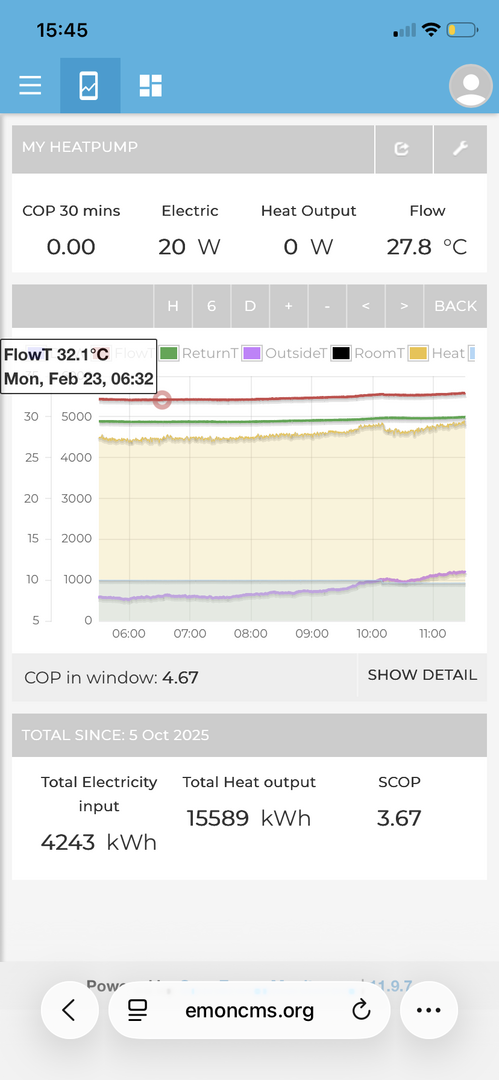
The reason I question if AutoAdapt is using any element of weather compensation is that I have seen examples where outside temperature has risen but this does not seem to feed through to an increase in flow temp which I would expect to see if weather compensation was the principle mechanism.
I am familiar with control theory - PID , feedforward , cascade loops , model based control etc - though more at a practical level than the mathematics of it. I suppose you could say that weather compensation is an example of open loop feedforward control , Load compensation is PID(probably) feedback control , and weather compensation with self learning a form of adaptive model based control.
Normally you would use feedforward to help a process deal with external disturbances - especially where a primary control loop might be slow to react to a disturbance. In my case we have a very high thermal inertia so the house temp takes a long time to react to any change, whereas the heatpump can react relatively quickly - in this scenario I’m not sure if the benefit of feedforward is so great as the feedback loop has plenty of time to react to minute changes in room temp.
In my case we have a very high thermal inertia so the house temp takes a long time to react to any change, whereas the heatpump can react relatively quickly -
I think that's the problem though. Heat pump reacts but house won't because of its large heat capacity. By the time the heat pump measures a change in iat, the bulk of the fabric has already responded to an earlier change in oat, and will keep on responding. Heat pump can't keep up. If it's a warming up then the heat pump can't even respond unless it switches between heating and cooling mode constantly.
4kW peak of solar PV since 2011; EV and a 1930s house which has been partially renovated to improve its efficiency. 7kW Vaillant heat pump.
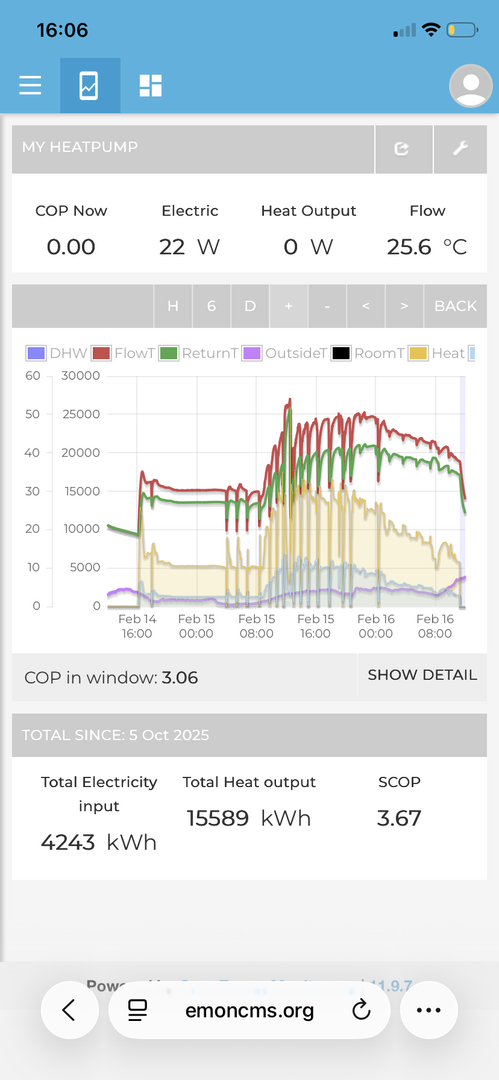
Here is an example of quite aggressive action of AutoAdapt - in this example we had been on holiday and set the heating down to 16deg C - On resetting to 20 Deg C the flow temp is ramped up to bring the room temp up. This is perfectly normal behaviour for a PID loop with a relatively high proportional term. Depending on your priority you might want a slower response with lower flow temps to give better COP at expense of longer recovery time.
The reason I question if AutoAdapt is using any element of weather compensation is that I have seen examples where outside temperature has risen but this does not seem to feed through to an increase in flow temp which I would expect to see if weather compensation was the principle mechanism.
Presumably you meant a decrease in flow temp with increasing outside temperature?
It would be interesting to see what the system target temperature is doing in this time as, based on looking at my own system, there may be temperature changes occurring which are within the tolerances of operation so the actual output isn't noticeably changing. In particular, if the target temperatures fall within within the delta between flow and return then there may be periods where the flow and return are separately the ones matching to the target temperature, so the visual picture would be the steady state you're seeing between flow and return, but with movement as to where the target temperature sits within this.
It may also be a consequence of the flow and return temperatures being towards the lower end of the achievable output of the heat pump as they're at 32/29°C respectively. My radiator-only system seems to have a natural floor of 35°C before it starts to cycle at lower target flow temperatures, so there's perhaps an element of the system continuing to run at a sustainable equilibrium rather than cycling at a lower target temperature. If so, then the natural consequence would be that as the room temperature rises the auto-adaptive mode will cut-out at some point and let the system run idle to prevent over-heating against the target room temperature.
I don't know how intuitive the 'self-learning' element of auto-adaptive mode is, so the above is just a vaguely educated guess based on some of the things I've seen from my own system.
130m2 4 bed detached house in West Yorkshire 10kW Mitsubishi Ecodan R290 Heat Pump - Installed June 2025 6.3kWp PV, 5kW Sunsynk Inverter, 3 x 5.3kWh Sunsynk Batteries MyEnergi Zappi Charger for 1 EV (Ioniq5) and 1 PHEV (Outlander) User of Havenwise (Full control Jun-Dec 2025, DHW only from early Dec) Subscriber to MelPump App data via CN105 Dongle Kit