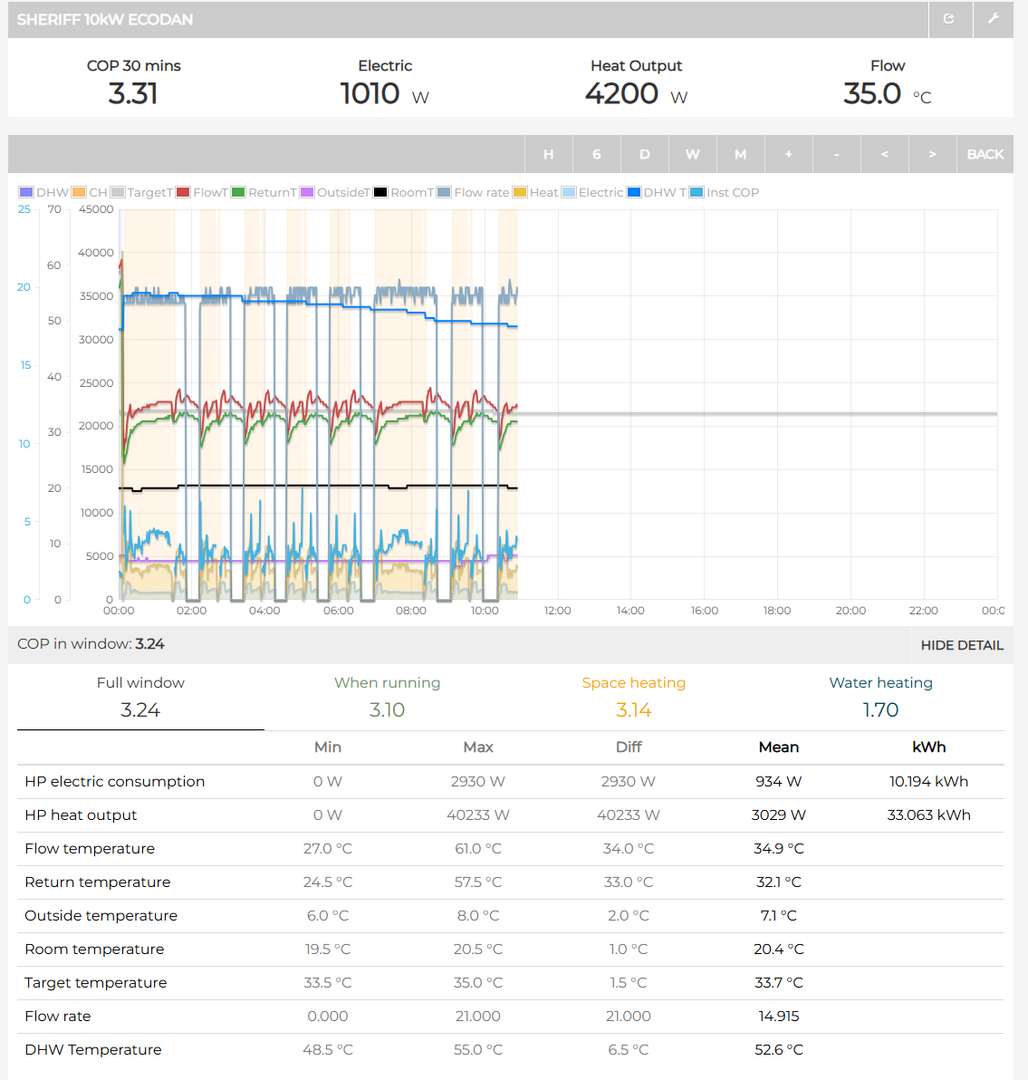
Whilst I agree with @sheriff-fatman’s point, I checked my Ecodan and found on 6th it was indeed defrosting about once an hour from late morning. Although it had been pretty cold the night before, the defrost cycling was whilst the temperature was hovering around one degree.
We all know the real enemy of heat pump performance isn’t the cold as much as the damp, so my guess for the hourly cycling of mine was damp air oscillating around the threshold between ice and vapour.
Could it be similar for your heat pump, @green_fox?
105 m2 bungalow in South East England
Mitsubishi Ecodan 8.5 kW air source heat pump
18 x 360W solar panels
1 x 6 kW GroWatt battery and SPH5000 inverter
1 x Myenergi Zappi
1 x VW ID3
Raised beds for home-grown veg and chickens for eggs
"Semper in excretia; sumus solum profundum variat"
Whilst I agree with @sheriff-fatman’s point, I checked my Ecodan and found on 6th it was indeed defrosting about once an hour from late morning. Although it had been pretty cold the night before, the defrost cycling was whilst the temperature was hovering around one degree.
We all know the real enemy of heat pump performance isn’t the cold as much as the damp, so my guess for the hourly cycling of mine was damp air oscillating around the threshold between ice and vapour.
Could it be similar for your heat pump, @green_fox?
Fair point. The highest frequency of defrosts I'd seen so far had been 6 within a 24 hour period, but my sample size of relevant data is very small.
130m2 4 bed detached house in West Yorkshire 10kW Mitsubishi Ecodan R290 Heat Pump - Installed June 2025 6.3kWp PV, 5kW Sunsynk Inverter, 3 x 5.3kWh Sunsynk Batteries MyEnergi Zappi Charger for 1 EV (Ioniq5) and 1 PHEV (Outlander) User of Havenwise (Full control Jun-Dec 2025, DHW only from early Dec) Subscriber to MelPump App data via CN105 Dongle Kit
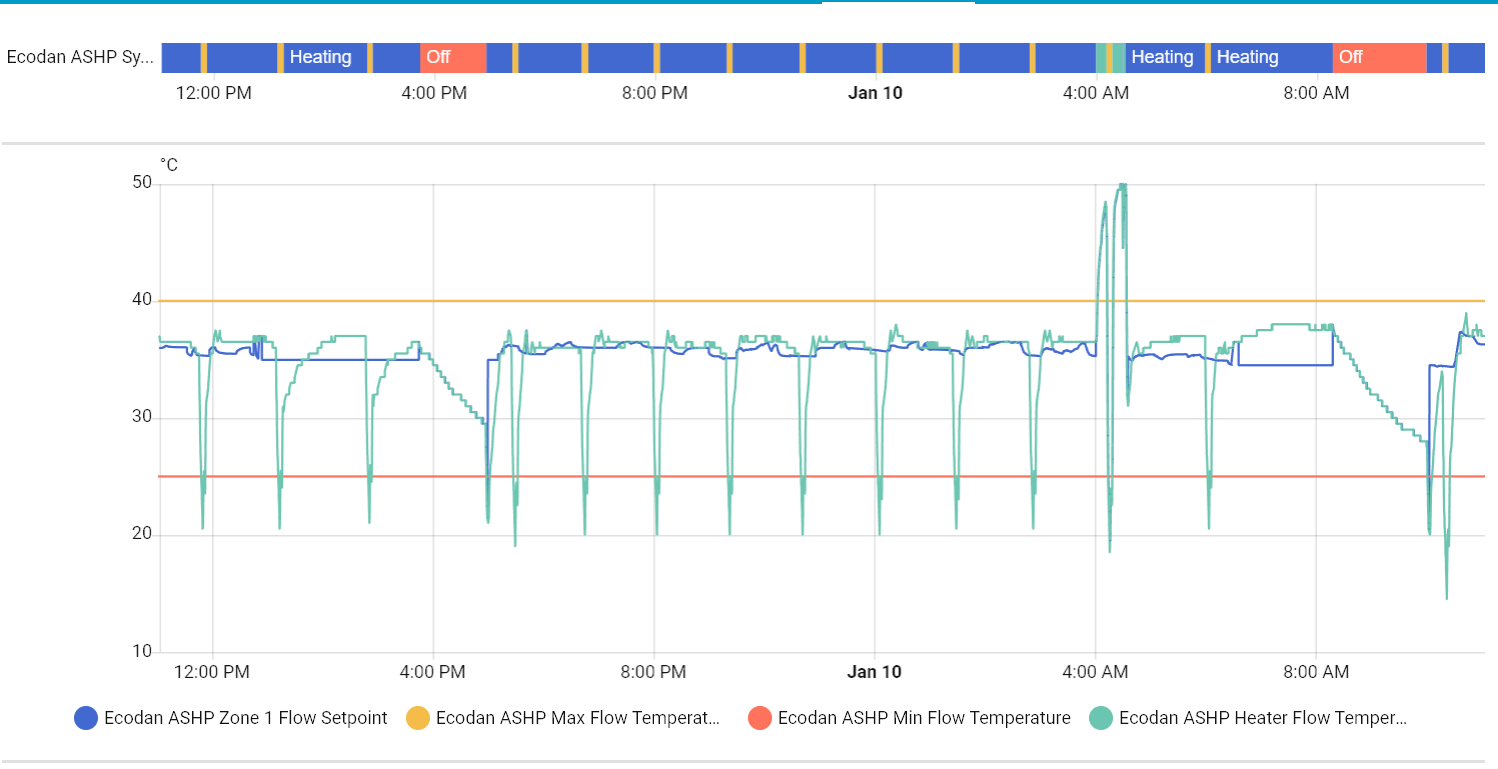
In terms of the number of defrosts 1 an hour is what i experience with my 11.2kw ecodan when outside temperature is between 0 and 4 oC. Blue is heating, yellow is defrost and green is DHW.
I queried why the heat pump seemed to be cycling once an hour. He mentioned the defrost function, but that seemed a little off. Would it really be defrosting every hour?
In Ecodan world there are two bits of terminology that are easily confused.
Anti-freeze protection (which MelCloud shows as a running mode as Freeze Stat operation) is when it runs water at low temperature around the system, and kicks in at around 5°C outside temperature. It causes cycling when it's a factor, but is only typically an issue (on my system at least) at 4 or 5°C. Below that, the system is providing heat for longer periods consistently, so it doesn't kick in, except immediately after a DHW reheat.
Defrost mode, which doesn't show up in MelCloud as a specific mode of running, is when the heat pump periodically reverses it's operation and provides heat to the pump to melt ice on the fan blades. The heat pump will do this whenever it's required, so it occurs a few times a day at anything from 3°C or below, as a rough guideline.
I suspect by 'defrost function' he was referring to the freeze stat mode, as I've not hit a temperature yet where defrost occurs on an hourly basis, and I've had temperatures as low as -4°C in this cold spell. You can probably work out the context he meant depending on what temperatures you've been getting where you live today. If it's around the 4°C mark, as it has been here today, then that would definitely suggest anti-freeze mode rather than defrost.
Freeze Stat is to stop the water in the outside pipework freezing when the heat pump is not operating (heating), it doesn't cause cycling as the heat pump must have cycled off (e.g. internal thermostat satisfied) before Freeze Stat comes on.
Defrost mode can occur more than once an hour when the humidity is high and the temperature low, the frequency also varies based on the amount of heat the heat pump is being asked to create, less heat usually translates in to fewer defrosts.
Freeze Stat is to stop the water in the outside pipework freezing when the heat pump is not operating (heating), it doesn't cause cycling as the heat pump must have cycled off (e.g. internal thermostat satisfied) before Freeze Stat comes on.
Defrost mode can occur more than once an hour when the humidity is high and the temperature low, the frequency also varies based on the amount of heat the heat pump is being asked to create, less heat usually translates in to fewer defrosts.
Thanks for clarifying. Excessive cycling seemed to be a factor for me when I hit the 5°C and 4°C temperatures where freeze stat protection kicks in. It improved when I dropped the temperature for freeze stat protection to engage at 4°C, rather than 5°C, so I've seen a correlation between the freeze stat active temperatures and increased cycling activity, even though logically it's not be the direct cause of such, as per your explanation.
The databook performance stats also include greyed out numbers at the 2°C settings which are a caveat that they include defrost protection. Logically this has to be the freeze stat function, rather than defrost cycles, as they'd also need to grey out all the temperature settings below 2°C aswell, where defrost would also form part of the operation being tested. That was my interpretation of it at least, and I'd taken it as indicating that anti-freeze mode was understood to adversely impact the performance of the unit. If I'm wrong on this, then having that row of numbers shaded, and only that row, due to genuine defrost operation feels more misleading than helpful to me.
I'm not disputing anything you've written, by the way, as it makes perfect sense to me. In hindsight, my post was clumsily worded to suggest that the freeze stat operation causes the cycling, rather than suggesting that there is increased cycling (at least in my case) at the temperatures where it starts to become part of the operational mix. I had one day on 20th December where it was particularly bad, which is what prompted the reduction to 4°C in the settings, and this seems to have avoided a repeat. It looks like I've also been fortunate to date in the defrost cycling not activating as frequently as it has for others, so perhaps I've had fewer humidity issues to trigger this to date.
130m2 4 bed detached house in West Yorkshire 10kW Mitsubishi Ecodan R290 Heat Pump - Installed June 2025 6.3kWp PV, 5kW Sunsynk Inverter, 3 x 5.3kWh Sunsynk Batteries MyEnergi Zappi Charger for 1 EV (Ioniq5) and 1 PHEV (Outlander) User of Havenwise (Full control Jun-Dec 2025, DHW only from early Dec) Subscriber to MelPump App data via CN105 Dongle Kit
I wonder, @sheriff-fatman, if Mitsi have chosen to use a shared parameter between defrost cycle and freeze protection. If that were the case, we’d see a software-induced correlation rather than a physics correlation, but a correlation nonetheless.
“Curiouser and curiouser”, said Alice…
105 m2 bungalow in South East England
Mitsubishi Ecodan 8.5 kW air source heat pump
18 x 360W solar panels
1 x 6 kW GroWatt battery and SPH5000 inverter
1 x Myenergi Zappi
1 x VW ID3
Raised beds for home-grown veg and chickens for eggs
"Semper in excretia; sumus solum profundum variat"
I wonder, @sheriff-fatman, if Mitsi have chosen to use a shared parameter between defrost cycle and freeze protection. If that were the case, we’d see a software-induced correlation rather than a physics correlation, but a correlation nonetheless.
“Curiouser and curiouser”, said Alice…
They show up as two distinct processes within MelPump, so I can see the two independently of each other. Within the HA settings you'll see the Defrost Flag as being 'on' when it's in a defrost cycle (shock, horror) but MelPump picks up the antifreeze protection separately to this when it shows the system as being 'Idle' at the time (as the relevant operation it's reporting on is the Heating Zone, not the pump in general). Oddly enough, the much maligned MelCloud app can distinguish between freeze stat mode and Idle, so this is one of the few limitations/niggles of MelPump that I've discovered to date.
Hopefully the screenshot from yesterday clarifies what I'm referring to. There are two blue bars near the top, which are defrost cycles. Near the bottom of the screen there are coloured bars for the operating mode which includes a single yellow block that was an antifreeze cycle running just after a water reheat (the only time this kicked in yesterday). Just underneath this, there's the operation mode for Zone 1 (the only heating zone I have) where, as far as heating goes, the system was idle during the DHW reheat and the brief anti-freeze mode.
130m2 4 bed detached house in West Yorkshire 10kW Mitsubishi Ecodan R290 Heat Pump - Installed June 2025 6.3kWp PV, 5kW Sunsynk Inverter, 3 x 5.3kWh Sunsynk Batteries MyEnergi Zappi Charger for 1 EV (Ioniq5) and 1 PHEV (Outlander) User of Havenwise (Full control Jun-Dec 2025, DHW only from early Dec) Subscriber to MelPump App data via CN105 Dongle Kit
Thanks for clarifying. Excessive cycling seemed to be a factor for me when I hit the 5°C and 4°C temperatures where freeze stat protection kicks in. It improved when I dropped the temperature for freeze stat protection to engage at 4°C, rather than 5°C, so I've seen a correlation between the freeze stat active temperatures and increased cycling activity, even though logically it's not be the direct cause of such, as per your explanation.
Cycling at 5C and below is usually defrosts. The other cause can also be an internal thermostat cycling the heat pump due to the WC curve being too high.
How often have you seen a correlation between between freeze stat setting changes and cycling frequency?
The databook performance stats also include greyed out numbers at the 2°C settings which are a caveat that they include defrost protection. Logically this has to be the freeze stat function, rather than defrost cycles, as they'd also need to grey out all the temperature settings below 2°C aswell, where defrost would also form part of the operation being tested. That was my interpretation of it at least, and I'd taken it as indicating that anti-freeze mode was understood to adversely impact the performance of the unit. If I'm wrong on this, then having that row of numbers shaded, and only that row, due to genuine defrost operation feels more misleading than helpful to me.
The databook performance is based on test conditions (less humid than the UK), so at outside temperatures -7C and below there would be very little humidity and so little/no need for any defrosts. That is why the databook table doesn't have the rows at -7C and below in grey. Also, in test conditions the heat pump will be running constantly except for defrosts, so freeze stat functionality will not be used.
Cycling at 5C and below is usually defrosts. The other cause can also be an internal thermostat cycling the heat pump due to the WC curve being too high.
How often have you seen a correlation between between freeze stat setting changes and cycling frequency?
In my case it was a very specific pattern of behaviour at an OAT of 5°C that I could only attribute as being related to freeze stat function that I observed, to the extent that I could predict from the flow curve data alone whenever OAC was 5°C without looking.
For context, the heat pump has been installed in late June 2025 and I had run it using Havenwise control from that point until switching onto weather compensation on 4th December to see whether this would ultimately improve the COP performance, so the caveat is that observations are over a small sample size. Havenwise provides heating in short, sharp bursts that aren't dis-similar to how a hot water cycle runs at times, with the system then sitting idle for long periods of time. When the temperature started to drop into the anti-freeze zone the freeze stat protection kicked in during those idle periods, as expected, and were easily visible in the MelPump data. (NB: I've just discovered that the URL export for the MelPump data produces an interactive version, so the info below should be far easier to interrogate than a static screenshot).
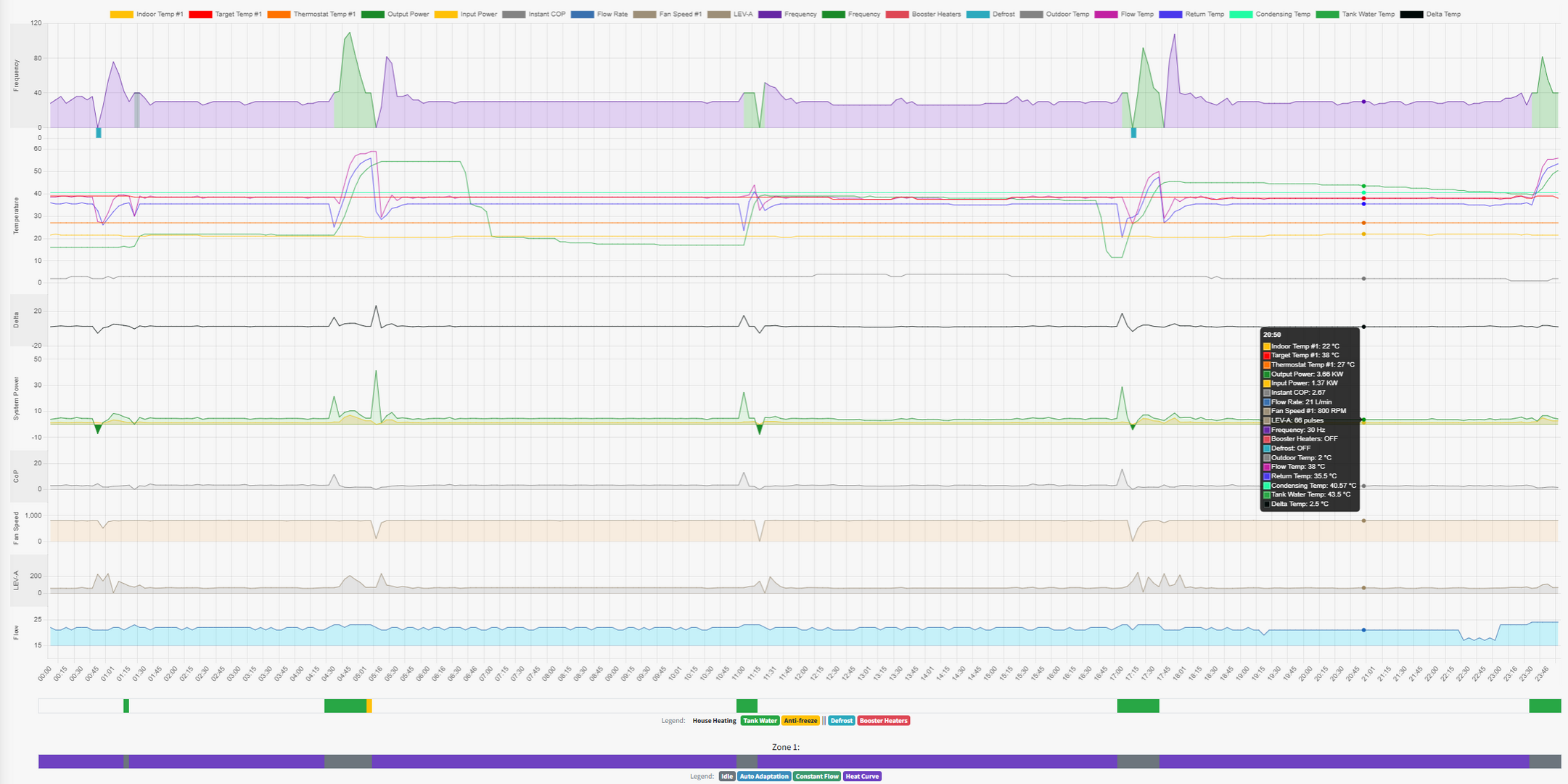
3rd December data is a good example of this. Ironically it's day with a bit of everything in it, including a legionella cycle, a defrost and was also the day when I installed the dongle device to the heat pump to get additional stats from it, which is why the data fields increase from the early evening. The main point to note is the significant amount of yellow in the Zone 1 bar at the bottom, which is when the antifreeze mode is running.
I switched the operation mode to weather compensation late in the evening on 4th December and was somewhat underwhelmed by the first full day of WC operation on 5th December, as there had been a lot of cycling, at intervals of around 20 minutes or so. These occur when the OAT is hovering around the 5°C mark. Below this, when the temperature was around 3°C the operation was noticeably different, with the 2 visible cycles being over a duration of around 3 hours each, rather than 20 minutes. Consequently, my first full day of WC operation resulted in a deterioration in COP from the Havenwise control, with a heating COP of 2.56 at an average OAT of 4.2°C.
The following day was the start of a milder spell of weather, and the profile for that day looked very different. Heating COP for that day jumped to 3.26 at an OAT of 8.4°C. Since installation the SCOP between late June has been around 3.0, so the system COP figures are low in general, but the system is producing significant savings vs gas heating, so this is a 'niggle' that I'm investigating rather than a concern about a poor installation. The constraints of the house might ultimately be a reason why the SCOP will only ever be modest. As you can see, on this day there's still some cycling happening around the tolerances set around the flow temperature, but it's 'more normal' cycling at intervals of 1 hour or more, with the odd point of interference from DHW cycles (2 teenage girls showering for long periods being the driver as to why these are timed at various points in the day).
I monitored things for a couple of weeks and the same kind of pattern would typically recur. An OAT of 5°C would produce this distinctive 20 minute cycling profile that looked entirely different to temperatures above or below this. 20th December was the peak day for this, as profiled below. The only thing I could attribute this to was the influence of the anti-freeze protection kicking in at that temperature. You can see in the bar data at the bottom that there's frequent intervals of short heating bursts (white) and antifreeze activity (yellow) as if the system can't figure out which one it wants to use. There's also no defrost activity at these temperatures and, if so, these would be visible as blue segments just under the compressor profile.
On 24th December, at some time in the afternoon, I changed the settings so that the anti-freeze protection would start at 4°C, rather than 5°C, and it pretty much immediately changed the profile of operation at 5°C to something similar to the other temperatures. Compared to the overnight operation and that around 2pm, there's a spell at 5°C between 5:30 and 7:30pm where it runs at a fairly steady state before being interrupted by a DHW reheat.
The only attributable change to cause this is the amendment to the anti-freeze settings, which is why I believe that it's a factor in causing cycling, at least as far as my system goes, which is what prompted the earlier comments.
The Christmas Day data is also compelling, following this change, as there are some similar periods of the shorter cycling activity in that profile, but these now occur at OAT of 4°C and are slightly longer in duration and don't include the same frequency of yellow in the analysis to suggest that it's a repeat of the conflict between heating and anti-freeze mode referred to above. It's as if I've moved the system beyond the 'equilibrium' point where the two seem to conflict.
29th December is the first day subsequent to making the anti-freeze setting change that there was a significant amount of time at an OAT of 5°C and the profile for that day, compared to the one for 20th December, looks very different, in a positive way. The COP scores for the two days were 20th with a Heating COP of 2.44 at average OAT of 4.6°C, and 29th with a heating COP of 2.81 at average OAT of 5.1°C. Some improvement will be attributable to the slightly higher average OAT, but the majority of that increase, in my view, is the difference in profile arising from the anti-freeze stat setting change.
For info, all of the above relates to activity on or around 4-5°C. In the recent colder weather, when defrosts have become a part of the picture, there's far less, if any, cycling going on as the system operates largely in a steady state at these lower temperatures. Below, for info, is the coldest day I've seen so far, on 5th January, with an average OAT of -1.8°C. The heating COP on that day of 2.54 is pretty much the same as that I experienced on the first day of WC operation on 5th December, but at very different outside air temperatures.
Hopefully the above provides the context for why I find the anti-freeze operation far more intrusive on performance than the defrost activity.
This post was modified 2 months ago 5 times by Sheriff Fatman
130m2 4 bed detached house in West Yorkshire 10kW Mitsubishi Ecodan R290 Heat Pump - Installed June 2025 6.3kWp PV, 5kW Sunsynk Inverter, 3 x 5.3kWh Sunsynk Batteries MyEnergi Zappi Charger for 1 EV (Ioniq5) and 1 PHEV (Outlander) User of Havenwise (Full control Jun-Dec 2025, DHW only from early Dec) Subscriber to MelPump App data via CN105 Dongle Kit
Cycling at 5C and below is usually defrosts. The other cause can also be an internal thermostat cycling the heat pump due to the WC curve being too high.
How often have you seen a correlation between between freeze stat setting changes and cycling frequency?
In my case it was a very specific pattern of behaviour at an OAT of 5°C that I could only attribute as being related to freeze stat function that I observed, to the extent that I could predict from the flow curve data alone whenever OAC was 5°C without looking.
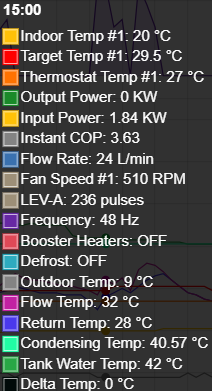
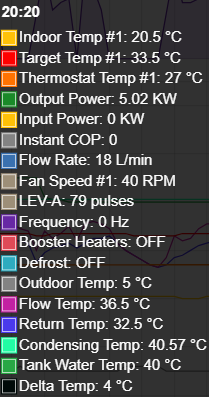
The interactive versions are much better as trying to see details and cause & effect on the multiple graphs is not easy. But there are only data points every 5 minutes, so a lot of detail of what the heat pump is doing isn't captured. This might be the cause of odd values like this, input power of 1.84kW, frequency of 48Hz but output of zero kW.
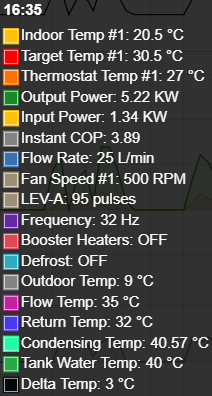
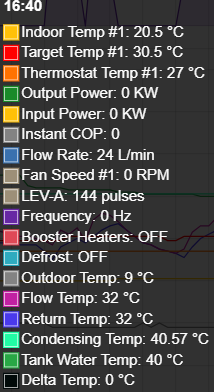
The freeze stat function doesn't initiate, it is initiated after the heat pump is cycled off for another reason. It's a purely reactive bit functionality of the heat pump. The interactive versions show why you are getting so much cycling, and hence why freeze stat is starting so often, and that is because your heat pump flow temperature exceeds your target temperature by so much that it cycles off. In the example below the target temp is 30.5C but the flow temp is 35C and so the heat pump cycles off, which is seen with the data 5 mins later.
The flow temperature overshooting the target temperature occurs over and over in your data, even at lower temperatures:
This is the cause for your cycling, often this is caused by an oversized heat pump. Your signature says you have a 10kW heat pump and a 130m2 house, that's 77W/m2 which is quite high - is your house older with limited insulation?
@robs Quick response while I'm in stationary traffic leaving Anfield.
This doesn't explain why the cycling behaviour at 5°C is so distinctive to that at 4°C or 6°C and you would expect the two to be very similar.
The Ecodan was initially set to a +5/-5 tolerance, which is it's default option. I've subsequently adjusted this to +3/-7, but it still works around a 10°C tolerance around the flow temperature currently.
As for sizing, heat loss was assessed by various parties between 8 & 10kW and the pump sizes quoted were between 8-13kW of various models from memory. There's a conservatory in the property which is a factor in the assessment, so the square footage alone doesn't tell the whole story. It might prove to be oversized, but the rationale for the sizing was similar across multiple quotes obtained, which is perhaps a study for another time.
I appreciate the detailed response, if not clear from the text.
130m2 4 bed detached house in West Yorkshire 10kW Mitsubishi Ecodan R290 Heat Pump - Installed June 2025 6.3kWp PV, 5kW Sunsynk Inverter, 3 x 5.3kWh Sunsynk Batteries MyEnergi Zappi Charger for 1 EV (Ioniq5) and 1 PHEV (Outlander) User of Havenwise (Full control Jun-Dec 2025, DHW only from early Dec) Subscriber to MelPump App data via CN105 Dongle Kit
@robs Just to quickly fill in some of the gaps in the response, now that I have more time to post properly (I think the car moved about 10 metres in 30 minutes while sending the one last night, so I wasn't typing whilst moving but I didn't have the normal time to compose a post, and I didn't want to leave it unresponded overnight, given the time taken on your reply).
The interactive versions are much better as trying to see details and cause & effect on the multiple graphs is not easy. But there are only data points every 5 minutes, so a lot of detail of what the heat pump is doing isn't captured. This might be the cause of odd values like this, input power of 1.84kW, frequency of 48Hz but output of zero kW.
Just on this, as I'd spotted similar things with the output previously, there's an instant COP calculation of 3.63 in the same snapshot, which doesn't match the input and output figures, so I think there's probably an issue with how the output data is displaying from time to time. @f1p might be able to shed more light on this, as he makes and sells the dongle device, and liaises with the MelPump team, whom I believe are a separate entity. The dongle, as far as I recall, polls every 10 seconds so the 5 minute snapshots are summarising this data in some way, but this one is an example of where the output looks odd. The fact that the COP figure is non-zero suggests to me there's undisplayed data, and I assume its the output data where this manifests, based on the fact that it looks to be the obvious 'wrong' number.
I hope the above helps to show that it isn't the freeze stat functionality but overshooting flow temperatures causing the cycling.
Just to clarify my point from yesterday evening's post, it's not the cycling itself that I'm querying, as I understand the general concept of what is going on and, like you, I have questions about how effectively the Ecodan is able to modulate down. At slightly higher temperatures, as we experienced yesterday, it switches to idle for a period of time as part of the cycling process, which in turn increases the overall COP relative to it's output. I'm not sure if all heat pumps are designed to do the same thing, but in general terms cycling whilst constantly running is only something that seems to occur within a range of outside temperatures of 4-7°C.Below 4°C, it runs generally in equilibrium. Above 7°C it includes idle periods within the cycling loop, as it's doing currently, as shown below, and the idle periods are adding about 0.1 to the daily COP as per the summary stats, as there is still a diminishing delta T during these idle periods providing some heat output into the mix. Most of the data snapshots taken in your reply are at OAT of 9°C, and one of them looks to have picked up an idling period within this, so it's outside of the area where the freeze stat issue is occurring.
If that's how the system will operate on weather compensation in warmer periods, then I can live with that, as it's going to be doing the same overall thing as the Havenwise control methodogy of having idle periods between 'blasts' of heat and the WC blasts based on flow temperature should overall be gentler and more consistent than those that were being driven by the internal room stats within Havenwise control. It seems a sensible way for the heat pump to run if it's unable to modulate down appropriately.
The bit that doesn't make logical sense to me, and which still remains unclear, is why there's a distinct pattern of behaviour within the small range of 4-7°C where the cycling activity is erratic at a specific temperature of 5°C, relative to the less frequent cycling around it, and why this behaviour improved via a change in the freeze stat protection settings.
Based on your explanation, the freeze stat protection isn't the driver behind this, but it is causing interference by kicking in at the end of a cycling operation, and the 5°C temperature appears to be some sort of resonant interaction where the two processes collide in a really distinctive way. Preventing the anti-freeze activity from operating at this temperature looks to remove this interaction and when the equivalent intervention kicks in at a 4°C OAT it does so in a much less disruptive way. I could perhaps get a further improvement by shifting the setting down to 3°C, which is the lowest option available other than 'off', intended for systems with glycol added, but I've been reluctant to do this given that there seemed to be sufficient improvement at a 4°C setting to prevent the distinctive 20 minute cycles occurring.
So I fully accept your explanation that the anti-freeze cycles are not the trigger or the driver of this behaviour, as they don't initiate it, but the settings around which they operate can potentially have a negative influence on system performance and, if so, there are potential ways to improve this behaviour via a change in the anti-freeze settings.
This post was modified 2 months ago 7 times by Sheriff Fatman
130m2 4 bed detached house in West Yorkshire 10kW Mitsubishi Ecodan R290 Heat Pump - Installed June 2025 6.3kWp PV, 5kW Sunsynk Inverter, 3 x 5.3kWh Sunsynk Batteries MyEnergi Zappi Charger for 1 EV (Ioniq5) and 1 PHEV (Outlander) User of Havenwise (Full control Jun-Dec 2025, DHW only from early Dec) Subscriber to MelPump App data via CN105 Dongle Kit