We have a Sunnyboy inverter 15years old and going strong. When we had a battery fitted which ended up being an AC system in order to leave the 4kW FIT system alone we also had an extra 2kW PV fitted (to ensure zero VAT too at the time).
So as a result we have two AC PV inverters one AC battery inverter and each PV inverter has a current transformer (CT) and both feed the battery. It’s not as efficient as a hybrid inverter would be but very much more cost effective overall, (for FIT reasons).
The installer who fitted the battery and the second PV system applied for the export permit after fitting and we got G99, but later I realised they probably should have applied beforehand.
It’s not exactly what you’re thinking of, but I hope it helps you see there are lots of options. We export less than a third of our generation since we are a heavy summer user.
2kW + Growatt & 4kW +Sunnyboy PV on south-facing roof Solar thermal. 9.5kWh Givenergy battery with AC3. MVHR. Vaillant 7kW ASHP (very pleased with SCOP 4.7) open system operating on WC
Regs is another world. They may decide that what you are trying to do is moving you to another class of generator.
However, there are variations available for Small Generation Installations (SGI) within the G99 Fast-Track application scheme. For example SGI-2 is for sites with multiple G98-certified devices, where there is an overall export-limitation system operating at 32A. See this page from National Grid if you want more detail on SGI-2 and SGI-3.
I didn't raise this possibility earlier because I can't see how the Sunny Boy owned by @jamespa could be incorporated in an export-limitation mechanism.
Those concepts didn't exist when the Sunny Boy was developed.,
Even if James' devices could be covered within the scope of SGI-2, that still doesn't mean he'd actually get approval for 32A export.
The specifics of his site are still taken into account by the Network Planner for his area. So a homeowner might be given approval for a 22A export-limitation for example.
I had a look at the SGI-2 that @transparent suggested, to evaluate the "fit" based on my understanding of James´ requirements:
All generation / storage devices are each rated at no more than 16A and the total of all ratings is also no more than 32A. Any G100 scheme limits the export to the distribution network to no more than 16A.
The Solis S6 being accepted in a G100 scheme, seems ok?
All generation is installed on an existing premise
Assume so
All existing and new generation is fully type tested
Solis S6 is type tested, as the ENA link shows
Basic design capacity of each generation unit is ≤32A
I think an 8k unit is above this, but there are plenty below
Any generation unit with a basic design capacity >16A is limited to 16A or below, using the manufacturer’s facility to limit
In the solis S6, the export limit can be switched on at any Kw capacity - I think not at amps. But all the communication and approval I had with UKPN was on Kw, not amps.
Sum of all the ratings of all equipment is no more than 16A per phase
It would seem that adding anything to the Sunnyboy would fail this. But a circuit diagram could show that since the sunnyboy is behind a device like the Solis S6 that would limit to 16A, the only relevant inverter would be the S6. Otherwise, this sets a very low bar for it.
So I had a look at SGI-3, again what the national grid site says..
SGI-3 is an application process followed by a notification within 28 days of commissioning. To qualify for the SGI-3 pathway, your generation installation must meet the following criteria:
All generation / storage devices are each rated at no more than 32A and the total of all ratings is also no more than 60A. Any G100 scheme limits the export to the distribution network to no more than 32A.
It seems the Solis S6 is accepted to do this at 8Kw
All generation is installed on an existing premise
Assume so
All existing and new generation is fully type tested
the Solis S6 is
Basic design capacity of each generation unit is ≤32A
yes
Sum of all the ratings of all equipment is no more than 60A per phase
yes (32+16=48)
Seems happy days for James on this! 😀
8kW Solis S6-EH1P8K-L-PLUS hybrid inverter; G99: 8kw export; 16kWh Seplos Fogstar battery; Ohme Home Pro EV charger; 100Amp head, HA lab on mini PC
Thanks everyone, this is going to take some analysis so it might take a while before I respond fully. Of course any further inputs are appreciated! The sunnyboy BTW limits its own output to 16A. It has no ct input so can't take anything else into account. If it sits behind another inverter it's presumably irrelevant as far as the regs are concerned? It needs power to it else it switches off (to protect the grid when it's grid connected) thus it won't work on an aux port unless that port is 'live'.
This post was modified 2 months ago 3 times by JamesPa
4kW peak of solar PV since 2011; EV and a 1930s house which has been partially renovated to improve its efficiency. 7kW Vaillant heat pump.
Thanks everyone, this is going to take some analysis so it might take a while before I respond fully. Of course any further inputs are appreciated! The sunnyboy BTW limits its own output to 16A. It has no ct input so can't take anything else into account. If it sits behind another inverter it's presumably irrelevant as far as the regs are concerned? It needs power to it else it switches off (to protect the grid when it's grid connected) thus it won't work on an aux port unless that port is 'live'.
The aux port in option 2 (gen/smart port) is probably going to need to be live to allow AC coupling. Not having a CT clamp should not make any difference, as the Solis would not add to the export in case the Sunnyboy is working at full power.
If the Sunnyboy would switch off in case there´s no grid, it may still be fine, the important thing is that it starts again when it sees the grid.
8kW Solis S6-EH1P8K-L-PLUS hybrid inverter; G99: 8kw export; 16kWh Seplos Fogstar battery; Ohme Home Pro EV charger; 100Amp head, HA lab on mini PC
So as a result we have two AC PV inverters one AC battery inverter and each PV inverter has a current transformer (CT) and both feed the battery.
@judith please confirm that your (existing) Sunny Boy unit does not have a CT clamp for export current measurement, and that the CTs you've mentioned are connected to the new PV inverter and the new battery inverter.
Any generation unit with a basic design capacity >16A is limited to 16A or below, using the manufacturer’s facility to limit
In the solis S6, the export limit can be switched on at any Kw capacity - I think not at amps.
This point needs clarification.
To satisfy the criteria for G99 approval, the export limit should not be capable of being later increased by the user settings.
It's not enough to state that a particular inverter can achieve something. G99 is a regulatory matter, and a DNO doesn't work on the basis of 'trust'!
@batpred - please clarify your sentence "In the solis S6, the export limit can be switched on at any Kw capacity" to state whether export to the grid can be configured >16A.
Thanks.
The whole reason for me raising the issue of SGI-2 (and SGI-3) is that those schemes do allow for export above 16A (3.68kW).
Let's avoid merging those two issues in this discussion.
There is a case whereby James may need to also use the G100 criteria in his application. But it's going to get very confusing if those concepts are muddled together here.
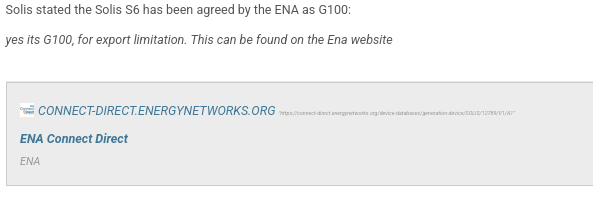
The link Solis shared and I pasted (pointing to the ena site) is expanded by the renewableheatinghub website, so the image below the text. It is a deep link and should take you directly to the information about my specific Solis inverter.
I will get back regarding the other topics when I hear back from Solis.
It seems though that SGI-2 is not applicable/helpful in this case, best to stick to SGI-3?
8kW Solis S6-EH1P8K-L-PLUS hybrid inverter; G99: 8kw export; 16kWh Seplos Fogstar battery; Ohme Home Pro EV charger; 100Amp head, HA lab on mini PC
Just to be clear, when you set an export limit on all the inverters you have, do you set it as a maximum in amps?
If a limit is being maintained in Kw, how does the certification standard expect it to be converted to amps. To be divided by 240? Or does it accept the 217V low limit?
From a power dissipation perspective of the conductor, it would make sense to be amps of course.
8kW Solis S6-EH1P8K-L-PLUS hybrid inverter; G99: 8kw export; 16kWh Seplos Fogstar battery; Ohme Home Pro EV charger; 100Amp head, HA lab on mini PC
If a limit is being maintained in Kw, how does the certification standard expect it to be converted to amps.
The Regulations specify the export limits in Amps.
If an inverter only permits a user to configure parameters in kW, then you'll need to set it low enough to not contravene the consent granted by the DNO.
when you set an export limit on all the inverters you have, do you set it as a maximum in amps?
That's not easy to answer.
Firstly, the only option available to be configured by the user is to reduce the export current below the level stipulated by the DNO. It shouldn't be possible for an end-user to increase the power being exported to the grid.
Secondly, each manufacturer will have created their own firmware, and the user-interface with which it's configured.
You can end up with two configuration parameters which might conflict.
Eg: Parameter 02 might set the maximum charging current for a battery (from solar, grid or both) whilst parameter 11 sets the maximum charging current when recharging from the grid.
Thirdly, it's possible to operate inverters in parallel. Such inverters have a data cable between them which, at its most basic, should ensure that the 'work' is shared equally between them. If that weren't the case, then one inverter could cause a fuse to blow whilst the others are sitting idle.
However, it doesn't necessarily imply that configuration settings get automatically replicated between devices in the set. Commonly, it's left to the installer/user to work out which parameters need to be configured and how!
I've not yet met a set of paralleled inverters that automatically share export or charging parameters. If I have three inverters in parallel and I wish to recharge a battery from the grid at 60A, then it's left to me to enter 20A into each inverter.
That means I could decide to unevenly apportion the load... provided that it doesn't exceed the maximum settings for that model of inverter, of course.
If a limit is being maintained in Kw, how does the certification standard expect it to be converted to amps.
The Regulations specify the export limits in Amps.
If an inverter only permits a user to configure parameters in kW, then you'll need to set it low enough to not contravene the consent granted by the DNO.
when you set an export limit on all the inverters you have, do you set it as a maximum in amps?
That's not easy to answer.
Firstly, the only option available to be configured by the user is to reduce the export current below the level stipulated by the DNO. It shouldn't be possible for an end-user to increase the power being exported to the grid.
Thank you.
It is clearly a problem I do not experience. Ukpn as dno granted the export limit in kw. I can set it on the inverter in kw. At the moment, it is 0..
In someone else's case, if ukpn is granting a limit in kw and one of their inverters only allows it to be set in amps, their installer has a tricky dilemma in hands, it seems. Luckily, they are generally not electricians. Perhaps the mcs world they operate in has more pressing concerns.
I still wonder whether this is something for the ena to consider..
But while that does not happen, it seems @jamespa has one less regulation topic to focus on?
8kW Solis S6-EH1P8K-L-PLUS hybrid inverter; G99: 8kw export; 16kWh Seplos Fogstar battery; Ohme Home Pro EV charger; 100Amp head, HA lab on mini PC