Regs is another world. They may decide that what you are trying to do is moving you to another class of generator.
Not 'Class'. That term is already used for the different G99 export levels as per my earlier chart.
However, there are variations available for Small Generation Installations (SGI) within the G99 Fast-Track application scheme. For example SGI-2 is for sites with multiple G98-certified devices, where there is an overall export-limitation system operating at 32A. See this page from National Grid if you want more detail on SGI-2 and SGI-3.
I didn't raise this possibility earlier because I can't see how the Sunny Boy owned by @jamespa could be incorporated in an export-limitation mechanism.
Those concepts didn't exist when the Sunny Boy was developed.,
Even if James' devices could be covered within the scope of SGI-2, that still doesn't mean he'd actually get approval for 32A export.
The specifics of his site are still taken into account by the Network Planner for his area. So a homeowner might be given approval for a 22A export-limitation for example.
This post was modified 2 months ago by Transparent
But they would both need to increase their own voltage when they see some of the export capacity available, and the opposite when above the limit.
Which is fine in theory, but do you know of a storage inverter which has achieved certification to act like that?
I don't.
Both inverters would be limited by the max 16A export that the DNO approved, so if there is a mechanism the manufacturers designed and support for it. James asked if "technically" it could work.
Regs is another world. They may decide that what you are trying to do is moving you to another class of generator.
Not 'Class'. That term is already used for the different G99 export levels as per my earlier chart.
However, there are variations available for Small Generation Installations (SGI) within the G99 Fast-Track application scheme. For example SGI-2 is for sites with multiple G98-certified devices, where there is an overall export-limitation system operating at 32A. See this page from National Grid if you want more detail on SGI-2 and SGI-3.
I didn't raise this possibility earlier because I can't see how the Sunny Boy owned by @jamespa could be incorporated in an export-limitation mechanism.
Those concepts didn't exist when the Sunny Boy was developed.,
The alternative of plugging everything through a hybrid inverter could avoid this.
One option being to wire PV into it as well as the battery.
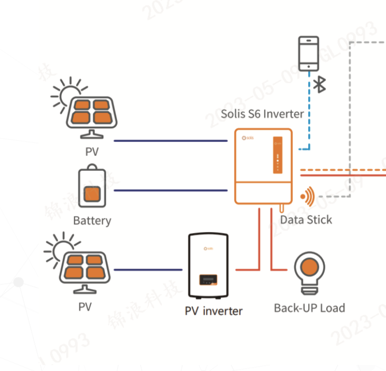
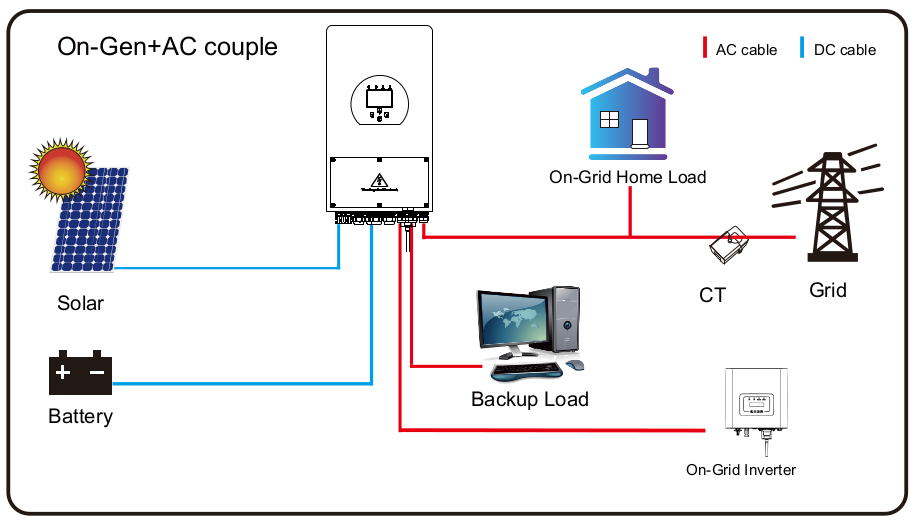
The second potential option would be to make the existing inverter feed AC into the hybrid (possible with the gen port or the smart port of my Solis). I do not know if it is technically possible to do this with the Sunny Boy.
With smart port:
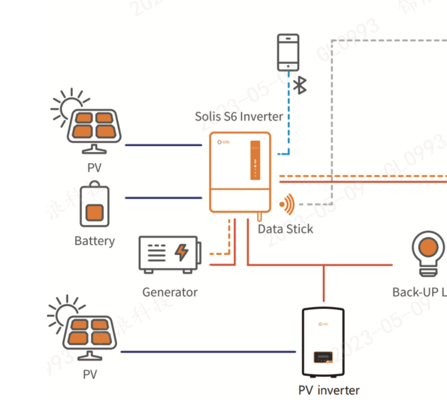
If that is busy, it can apparently also be done on the backup port:
Hope that helps
8kW Solis S6-EH1P8K-L-PLUS hybrid inverter; G99: 8kw export; 16kWh Seplos Fogstar battery; Ohme Home Pro EV charger; 100Amp head, HA lab on mini PC
Both inverters would be limited by the max 16A export that the DNO approved [...] James asked if "technically" it could work.
James asked:
"Can anyone outline (or point me at) the main regulatory considerations (ie what triggers G98/99/100 - noting I already have a 3.68kW PV inverter - and can you avoid by setting the battery inverter not to export), what kit, apart from a suitable inverter, do you need to specify to allow islanding and inverter options [...]
Not only have none of us yet identified a storage inverter which would achieve export-limitation to include the existing SunnyBoy, but it's the regulatory considerations which are at the core of this discussion. James even identified that in the topic title.
Your three diagrams above do take us a step further forward.
But, as you` stated:
"I do not know if it is technically possible to do this with the Sunny Boy."
It's not just the possibility of incorporating the Sunny Boy with a Solis S6 inverter which concerns me, but also not knowing whether
the Solis has an Export Limitation feature
that Export Limitation is approved by the ENA (G99 SGI-2)
"I do not know if it is technically possible to do this with the Sunny Boy."
It's not just the possibility of incorporating the Sunny Boy with a Solis S6 inverter which concerns me, but also not knowing whether
the Solis has an Export Limitation feature
that Export Limitation is approved by the ENA (G99 SGI-2)
Can you help with either of those points?
The Solis has an export limitation feature. This was accepted by UKPN who issued an export MPAN.
I tried to check on the ena connect direct site, but there are too many models and documents, even Solis. Or perhaps I am just not able to find the right search options..
So I will ask Solis and report when I hear from them.
8kW Solis S6-EH1P8K-L-PLUS hybrid inverter; G99: 8kw export; 16kWh Seplos Fogstar battery; Ohme Home Pro EV charger; 100Amp head, HA lab on mini PC
Both inverters would be limited by the max 16A export that the DNO approved [...] James asked if "technically" it could work.
James asked:
"Can anyone outline (or point me at) the main regulatory considerations (ie what triggers G98/99/100 - noting I already have a 3.68kW PV inverter - and can you avoid by setting the battery inverter not to export), what kit, apart from a suitable inverter, do you need to specify to allow islanding and inverter options [...]
Not only have none of us yet identified a storage inverter which would achieve export-limitation to include the existing SunnyBoy, but it's the regulatory considerations which are at the core of this discussion. James even identified that in the topic title.
Your three diagrams above do take us a step further forward.
But, as you` stated:
"I do not know if it is technically possible to do this with the Sunny Boy."
It's not just the possibility of incorporating the Sunny Boy with a Solis S6 inverter which concerns me, but also not knowing whether
the Solis has an Export Limitation feature
that Export Limitation is approved by the ENA (G99 SGI-2)
Can you help with either of those points?
The Sunny boy is old enough that it should be considered dumb for all practical purposes. It limits its own output to 16A (measured at its own output terminals) and doubtless disconnects if the grid fails, but there is no material concept of communicating with it. At this stage I dont intend to replace it, its part of a FIT certified generation setup (acquired at vast expense by todays standards) for which I get 25p+ per kWh generated, and if I have surplus I can still get paid for export. Whilst you can now change FIT certified generators and retain the FIT payments, thats a job for another time and needs MCS certification, so will only happen when and if it has to (probably when the inverter fails - apparently SunnyBoys are doing unexpectedly well in the field so that may be a while).
So the bottom line is that the battery inverter is 'on its own'. It can measure itself, it can measure what's happening on the grid connection, but it cant talk to the SunnyBoy.
Logically the battery inverter could
measure whats happening on the grid connection and limit its output if necessary so that the amount exported (including any export from devices with which it does not communicate) never exceeds 16A.
measure whats happening on the grid connection and stop 'generating' if it sees any export on that connection, ie it could act as a 'zero export' device.
Alternatively if, as @batpred suggests, the battery inverter can cope with an additional AC input, then the AC output from the SunnyBoy could, after the FIT meter, feed the AC input to the battery inverter so it acts as a sort of master.
It seems to me that, if any limits are to be imposed other than the sum of the capacities of the two inverters, one of these is how it has to happen. Technically thats all sensible, what I still dont understand is, in these circumstances where there are technical limits that are <(sum of the inverter capacities), how is the G98/99/100 requirement affected?
4kW peak of solar PV since 2011; EV and a 1930s house which has been partially renovated to improve its efficiency. 7kW Vaillant heat pump.
Yes, I concur with the Sunny Boy being treated as if it's dumb.
In addition to the Solis which @batpred has mentioned, Sunsynk inverters can also use their Aux connector to import AC power from another inverter:
This is the same port which could also be used to connect a diesel generator. It requires different configuration settings, depending on what you attach to it.
What I now need to check is whether the UK-version of Sunsynk's firmware allows export to the grid.
As I stated earlier, the default position for their inverters sold in UK is to employ the CT to limit export to zero.
Thanks. The concept of daisy chaining the inverters is attractive in principle as there is no ambiguity what's happening! It also makes for a simple changeover if/when the Sunnyboy fails.
If I can get the total installed cost of say 15kWh to £3500 or thereabouts, the business case looks good, at least with the current peak/off peak differential of 20p. Payback period is 5 years, which provides some margin if the peak/off peak differential reduces. If I combine the inverter installation with CU upgrade I reckon £3500 is probably just about doable. I still have to convince my wife about fire risk of batteries in the (attached) garage however!
I still have to convince my wife about fire risk of batteries in the (attached) garage however!
...
Do the batteries have to go in the garage? Personally, I'd only ever consider siting batteries outside, but then again I have plenty of room outside where those batteries could (and, indeed do) go.
105 m2 bungalow in South East England
Mitsubishi Ecodan 8.5 kW air source heat pump
18 x 360W solar panels
1 x 6 kW GroWatt battery and SPH5000 inverter
1 x Myenergi Zappi
1 x VW ID3
Raised beds for home-grown veg and chickens for eggs
"Semper in excretia; sumus solum profundum variat"
I still have to convince my wife about fire risk of batteries in the (attached) garage however!
...
Do the batteries have to go in the garage? Personally, I'd only ever consider siting batteries outside, but then again I have plenty of room outside where those batteries could (and, indeed do) go.
There is room outside but only the other side of the house to the garage. The CU is in the garage so it would require a long run of cable to connect it up. I suppose that, in principle, I could site the inverter also near the batteries on the 'other' side of the house, and connect it to a suitable existing circuit, eg one of the 4 ring mains I have. That feels mighty naff though, and there are probably electricians that would object although I cant immediately see why.
Also, unless its actually separated by some distance from the house, isnt a fire quite likely to ignite flammable external material, eg soffits and thus spread anyway. I can see that the risk is lower, but I cant see that it eliminates it altogether. Thus my current feeling is that the control measures for the fire risk (unless physically separated from the house) are in the battery itself.
This post was modified 2 months ago 3 times by JamesPa
4kW peak of solar PV since 2011; EV and a 1930s house which has been partially renovated to improve its efficiency. 7kW Vaillant heat pump.
Both inverters would be limited by the max 16A export that the DNO approved [...] James asked if "technically" it could work.
It's not just the possibility of incorporating the Sunny Boy with a Solis S6 inverter which concerns me, but also not knowing whether
the Solis has an Export Limitation feature
that Export Limitation is approved by the ENA (G99 SGI-2)
Can you help with either of those points?
So the bottom line is that the battery inverter is 'on its own'. It can measure itself, it can measure what's happening on the grid connection, but it cant talk to the SunnyBoy.
Logically the battery inverter could
measure whats happening on the grid connection and limit its output if necessary so that the amount exported (including any export from devices with which it does not communicate) never exceeds 16A.
measure whats happening on the grid connection and stop 'generating' if it sees any export on that connection, ie it could act as a 'zero export' device.
Alternatively if, as @batpred suggests, the battery inverter can cope with an additional AC input, then the AC output from the SunnyBoy could, after the FIT meter, feed the AC input to the battery inverter so it acts as a sort of master.
It seems to me that, if any limits are to be imposed other than the sum of the capacities of the two inverters, one of these is how it has to happen. Technically thats all sensible, what I still dont understand is, in these circumstances where there are technical limits that are <(sum of the inverter capacities), how is the G98/99/100 requirement affected?
Solis stated the Solis S6 has been agreed by the ENA as G100:
yes its G100, for export limitation. This can be found on the Ena website
I have not had an answer about the G99 SGI-2. But since UKPN accepts this, I wonder how this is a problem that James needs to solve for his installation?
Now, I had outlined three possible options:
1) connect the PV to a hybrid inverter that would manage the battery. Decommission the sunnyboy
2) connect the sunnyboy to the "gen" port (also called smart port in the Solis S6). This may need AC coupling
The second potential option would be to make the existing inverter feed AC into the hybrid (possible with the gen port or the smart port of my Solis).
With smart port:
In this scenario, the CT clamp of the sunnyboy is near the house meter. So the sunnyboy would never generate more than 16A.
The power is fed to the Solis S6 and that inverter would also be setup to provide max 16A.
One topic to check is how the AC coupling would work. I assume that the AC coupling method involves the Solis S6 making grid power available on that port, but I assume the sunnyboy is happy to live off PV power whenever available.
3) connect the sunnyboy to the backup port of the S6
If that is busy, it can apparently also be done on the backup port:
With this option to plug into the backup port, you would need to have the config settings, etc confirmed with Solis. I am less confident with this option. And since the smart port is unlikely to be needed, I do not see any advantage.
Option 1 is a trivial setup, a subset of both diagrams. With the 8k Solis, up to an additional 12kw PV can be connected.
8kW Solis S6-EH1P8K-L-PLUS hybrid inverter; G99: 8kw export; 16kWh Seplos Fogstar battery; Ohme Home Pro EV charger; 100Amp head, HA lab on mini PC
I still have to convince my wife about fire risk of batteries in the (attached) garage however!
...
Do the batteries have to go in the garage? Personally, I'd only ever consider siting batteries outside, but then again I have plenty of room outside where those batteries could (and, indeed do) go.
There is room outside but only the other side of the house to the garage. The CU is in the garage so it would require a long run of cable to connect it up. I suppose that, in principle, I could site the inverter also near the batteries on the 'other' side of the house, and connect it to a suitable existing circuit, eg one of the 4 ring mains I have. That feels mighty naff though, and there are probably electricians that would object although I cant immediately see why.
Also, unless its actually separated by some distance from the house, isnt a fire quite likely to ignite flammable external material, eg soffits and thus spread anyway. I can see that the risk is lower, but I cant see that it eliminates it altogether. Thus my current feeling is that the control measures for the fire risk (unless physically separated from the house) are in the battery itself.
A few things to consider, that I am sure you are already aware:
the 50V DC connection between battery and inverter should be kept short. This reduces power losses. Additionally as we are talking about very thick cables (at least in my case where sized for 200A), long runs are expensive
the connection from the inverter to consumer unit is bi-directional. Most RCD and RCBOs are one-directional. And some can have a solenoid component "burn" when used in reverse. So if this circuit needs RCD protection (an electrician can confirm), you need to have bi-directional RCBOs, sometimes with the manufacturer recommending different sensitivity. Large power ones are not easy to find in the UK (and as some electricians may be very keen to have a single manufacturer for all parts, you end up with tricky problems). I started a thread in this forum and had a debate including with @transparent about this.
lifepo4 batteries are not fire risk prone, not when included as part of a BMS managed pack (you are right that the battery includes multiple fire risk control measures). But rumours abound and since other types of lithium batteries are tricky to manage, there is enough noise in the "ecosystem". Some people make a living from click-bait and concerning videos related to this. There´s another thread in this forum going into it in some detail.
lifepo4 batteries do not like to be in very cold environments, they do not perform as well. But it is not a showstopper.
inverters have very specific manufacturer dependent constraints for siting. I think the Solis S6 is IP66 (or something similar) and can be sited outdoors, only if not in direct sunlight, etc. Others may be less flexible.
I assume your ring mains are rcd protected, I would doubt any manufacturer would recommend that for any sizeable inverter.
If you are able to have a cable run for the inverter that does not need rcd protection, you also avoid situations where grid power quality issues cause the circuit feeding the inverter to trip.
8kW Solis S6-EH1P8K-L-PLUS hybrid inverter; G99: 8kw export; 16kWh Seplos Fogstar battery; Ohme Home Pro EV charger; 100Amp head, HA lab on mini PC