The inverter can measure the voltage and current, I suppose state of charge but is there anything else.
The issue of knowing the SoC is often misunderstood.
It's clearly the case that an inverter can't assess the SoC of a storage battery without being sent that data (usually by the BMS).
The voltage measured at the inverter-end of the battery cables will be higher than the battery-voltage when charging, and lower than battery-voltage during discharge. That makes an assessment of SoC impossible for an inverter on its own.
But BMS units are also notoriously poor at calculating SoC. What data they send back to the inverter (via Modbus) is unlikely to better than 20% accurate.
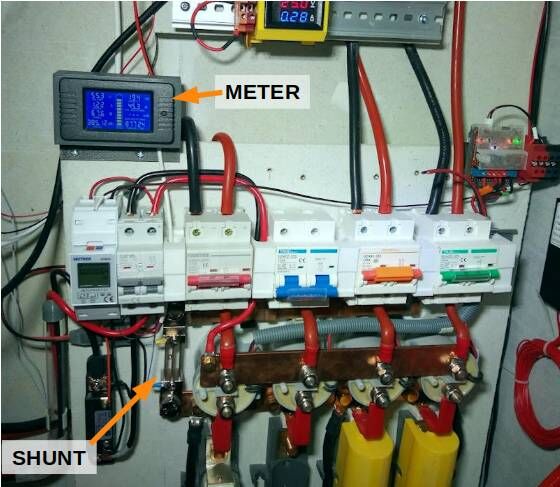
I have an entirely separate device to calculate SoC. It uses a 400A shunt sited on the busbar which connects my four batteries and three inverters.
I've tried three different SoC devices so far, all with better than 5% accuracy. But I'm still making changes to that part of the system, and may yet decide on another solution.
Here's the busbar board with a cheap SoC monitoring device from Chinese company CG Instruments
It uses a generic shunt with 75mV maximum range.
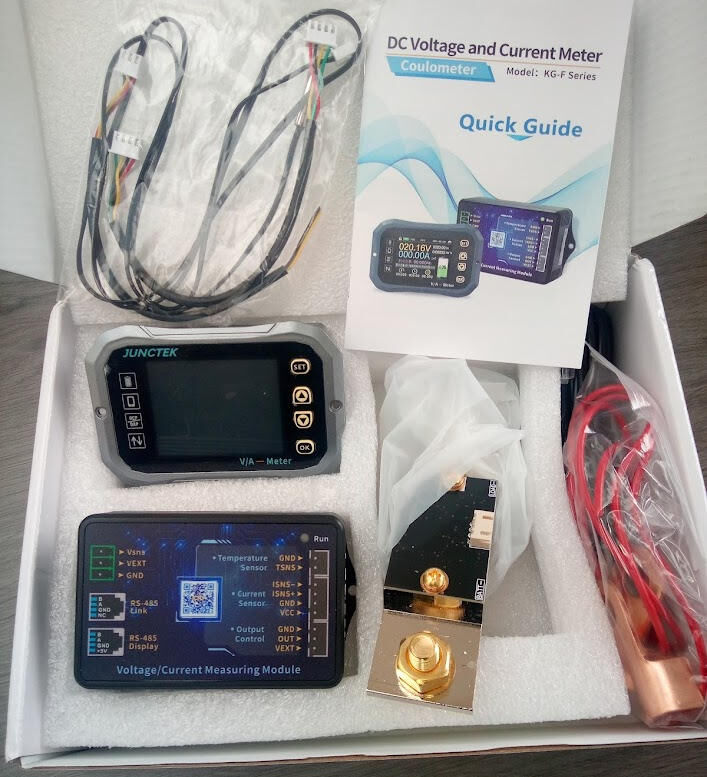
And here's a more expensive SoC monitor kit from Junctek. It uses their own dedicated shunt, and offers an RS485 port which can be connected to your own micro-controller.
Both Victron (Netherlands) and Batrium (Australia) offer SoC measurement systems with even greater accuracy, for which you will be paying £150+
This post was modified 2 months ago 2 times by Transparent
Can anyone outline (or point me at) the main regulatory considerations (ie what triggers G98/99/100
1: The EREC G standards apply to devices which can export to the grid. If it doesn't have export capability then it isn't covered by a G-standard, and doesn't need to be.
2:G98 is the standard for a basic domestic-level device, limited to export at 16A per phase. Manufacturers test their products to G98, and they get added to the database held by the ENA.
If you install a single G98-certified device in a home, then it doesn't require prior approval from your DNO.
3:G99 covers all other export devices, right up to a large commercial generator.
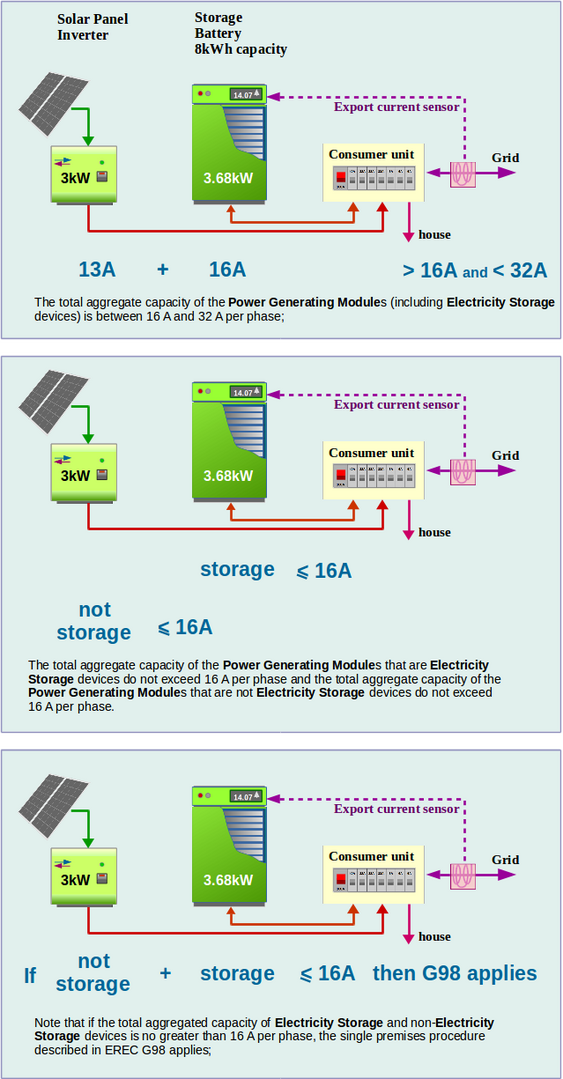
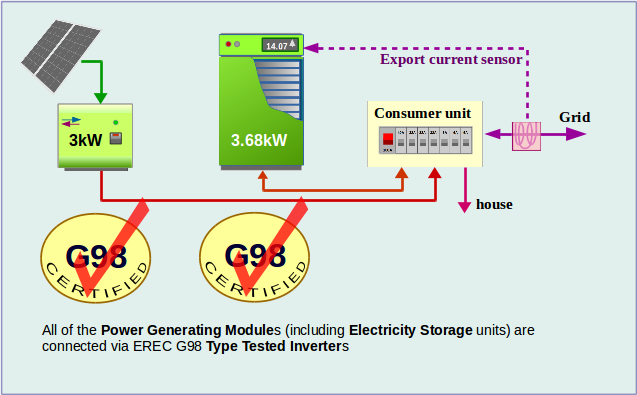
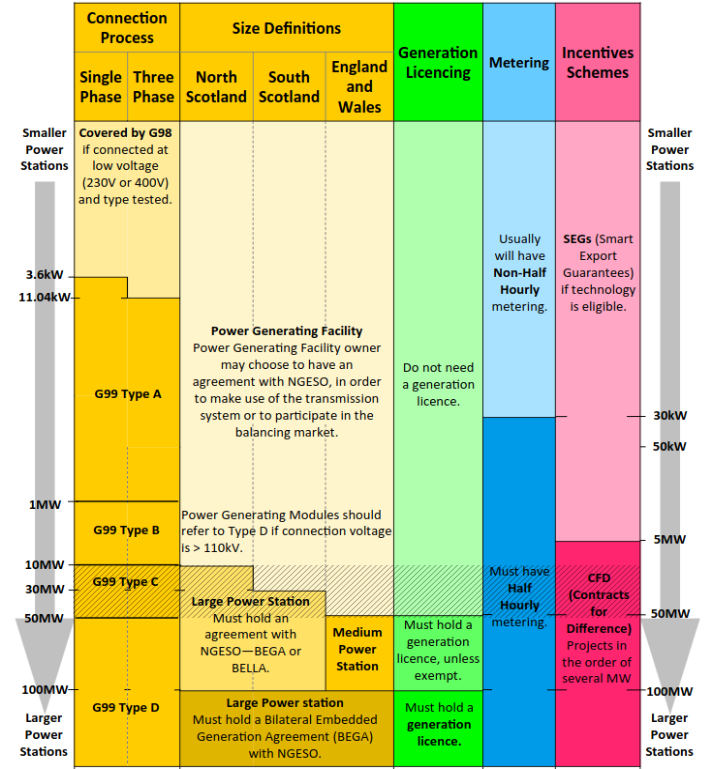
I've taken the terms from the G99 documentation, and changed them into a series of diagrams: 😎
For Domestic installations each device must be G98 certified:
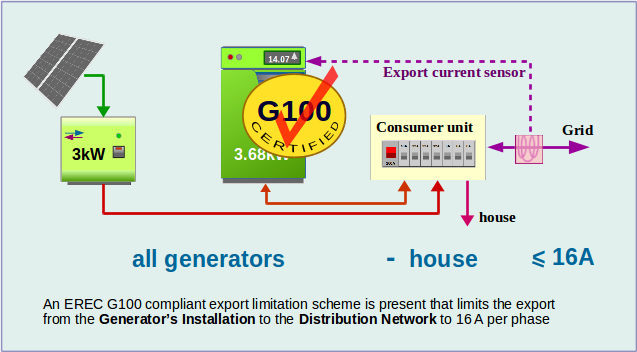
4:G100 is the standard for devices which could theoretically exceed the 16A per phase export level, but are constrained due to mitigating factors.
The common example is a solar-inverter handling two PV arrays facing east and west on a roof. Both arrays cannot output full power simultaneously.
5: Here's the full set of G99 classification for grid export:
I've cross-hatched the category Type-C, which is the one you will commonly see in commercial planning applications for solar-farms or a Battery Energy Storage System (BESS).
If you're submitting a response to such a planning application in your locality, it's helpful to Councillors on your Planning Committee if you include this diagram. It shows them the context for why the Applicant might be declaring the grid connection is 49.99MW !
This post was modified 2 months ago by Transparent
@transparent thanks thats really helpful, particularly the diagrams. In the G100 case I presume that the inverter must be specifically G100 certified and presumably must detect if the CT is removed or reversed- otherwise it can be easily fooled into thinking there is zero export or, if the CT is put on the wrong way round, import when there is actually export
My current PV inverter is actually old enough to be G59(?) but I presume that I could add a G100 battery inverter set to max 16A export as measured at the CT and thus qualify should if I run up against approval for G99 at the total theoretical capacity of the two inverters?
4kW peak of solar PV since 2011; EV and a 1930s house which has been partially renovated to improve its efficiency. 7kW Vaillant heat pump.
Yes, you're right about G100. The export device will be certified to both G98 and G100.
If the CT is absent then no export is possible.
And if it's the wrong way around then the entire grid empties itself into your house...
EREC G59 is the base-level specification for anything which could export to the grid.
If I was designing my own weird inverter based on capturing power from electric eels, then I'd make a G59 application, and the DNO would send an engineer to site to certify it as compliant, and check my sanity.
G59 (and G83) had timings which weren't as 'tight' as the current G98 tests.
That caused problems in some areas of GB, which threatened the grid. Installers were sent to revisit homes in those locations and make changes.
I'm having difficulty visualising what you might mean by "a G100 battery inverter set to max 16A export"...
What sort of storage device might you wish to install such that one "battery" produces power in circumstances when the other one doesn't? Are we thinking about storage devices using weights which descend under gravity but share the same rope?
You will need to make a G99 Application because you'll have two devices which could potentially export to the grid.
But are you sure that the new inverter must export to the grid?
Why not have an inverter which can supply the house, but the CT mechanism is approved to achieve zero-export? Would that satisfy what you want to achieve?
Why not have an inverter which can supply the house, but the CT mechanism is approved to achieve zero-export? Would that satisfy what you want to achieve?
I have PV, Im considering adding a battery. In summer I have more PV than I consume in 24hrs so I still need to export at times even with a battery. Im thinking that the PV inverter will just do its thing (ie generate electricity without monitoring export). Depending on load and state of charge of battery this will either be consumed or stored locally, or exported.
Meanwhile the battery inverter will either store electricity or release it to the house or possibly release it to the grid if I decide arbitrage makes sense. By setting the battery inverter to limit grid export to 16A it will throttle back its output if solar is already consuming some of the 16A allowance.
This post was modified 2 months ago 2 times by JamesPa
4kW peak of solar PV since 2011; EV and a 1930s house which has been partially renovated to improve its efficiency. 7kW Vaillant heat pump.
By setting the battery inverter to limit grid export to 16A it will throttle back its output if solar is already consuming some of the 16A allowance.
No.
And I suspect this is the crunch issue.
Your two inverters won't "know" about each other. They will be from different manufacturers and will operate independently.
If your existing Sunny Boy is already taking up the 16A allowance, then the new inverter musn't export.
In the evening, after sunset, the "allowance" remains allocated to the Sunny Boy.
So thats a regulatory matter not technical?
The Sunnyboy has no CT. If the CT for the battery inverter is on the incoming main then it does know that export is taking place and to what extent, albeit that it may not be exporting and is not talking to the SunnyBoy.
So in principle it could decide to limit its export so that the total, as measured on the CT, is <16A. thus ensuring that the grid is protected. With this logic (if the battery inverter supports it) then If the Sunnyboy is exporting 16A then the battery inverter would export zero, if the Sunnyboy is exporting 8A then the battery inverter could export 8.
Seems there's a bit more going on than I expected, but all understandable and sensible.
Battery state of charge
Battery power
Battery's limits
Battery temperature
Battery alarms
Requests between battery and inverter to do stuff (e.g. charge request)
Thank you for sharing. This communication from battery to inverter uses the pylontech protocol, that is seen as a reference in BMS to inverter comms. Of course any specific battery installation may not need all of the information, but if provided reliably, the firmware/software can make use of it.
This architecture supports separation of duties. This allows any specific function, one example being knowing how much power is stored in a battery, to be managed by a single component. This simplifies assurance and testing and so reliability of implementation of a specific design. So:
Battery state of charge
As mentioned before, the inverter would always be limited vs a BMS to calculate this. So the BMS provides it and this enables any monitoring management system like home assistant and/or energy management system or us as users can act based on that information.
Battery power
The BMS knows the capacity and state of cells and calculates this. A general purpose inverter would not be able to provide it to better accuracy.
Battery's limits
Assume this is information provided for convenience use by the inverter. Like knowing the maximum rate of charge and discharge allows the inverter to make better decisions according to the algorithm selected (for example, should grid power fail, which outputs can it keep running)
Battery temperature
Assume this is for convenience, but this information coupled with knowledge of the type of battery, could allow a second level of optimisation. Like if the algorithm is trying to maximise battery health, the inverter may use grid power rather than battery.
Battery alarms
In case of standardised alarms, like comms failures, the inverter can decide to treat the battery as unusable.
Requests between battery and inverter to do stuff (e.g. charge request)
This is at the core. As typically the programming of when to charge and discharge is inverter side, the battery can confirm to the inverter whether it is charging or not. Again, an inverter may treat inconsistent responses as a sign of battery malfunction.
Also worth for the benefit of other readers to reproduce a piece of advice from the author of the Home assistant community post:
Disconnecting the CANbus in my experience results in the inverter seeing a flat battery, and immediately applying a full emergency charge, the result of which would probably be the individual battery BMSs opening the MOS gate fuses to prevent overcharge, overheating, and a fire.
Tinker at your own risk.
8kW Solis S6-EH1P8K-L-PLUS hybrid inverter; G99: 8kw export; 16kWh Seplos Fogstar battery; Ohme Home Pro EV charger; 100Amp head, HA lab on mini PC
With this logic (if the battery inverter supports it) then If the Sunnyboy is exporting 16A then the battery inverter would export zero, if the Sunnyboy is exporting 8A then the battery inverter could export 8.
But I don't know of an inverter which is approved to operate like that.
A manufacturer might well make such a claim, but it would need confirming by making a G99 application to your DNO. That costs nothing, but the DNO might (reasonably) assign it to the standard G99 application stream, rather than it falling into the Fast Track process. So there will be a time delay whilst your Network Planner checks the issues.
Yes, you're right about G100. The export device will be certified to both G98 and G100.
If the CT is absent then no export is possible.
And if it's the wrong way around then the entire grid empties itself into your house...
🤣
Not minimising the safety aspects, the inverter would usually report an error as it spots something´s incorrect in the installation. It may also shutdown.
The grid is always ready to discharge the 100Amps or whatever your master fuse allows to your house. But unless anything closes a suitable circuit, nothing happens.
In the Solis, plugging a CT the other way around is quickly reported and causes it to go hands-off. Then the inverter config can be adjusted to confirm how the CT info is meant to be used. I have a few other CT clamps that feed my HA - £30 and the app also reports it all.
Additionally UKPN never had any issues with the G100 certification (which the Solis has), which made the commissioning tests and form filling "kids play".
With this logic (if the battery inverter supports it) then If the Sunnyboy is exporting 16A then the battery inverter would export zero, if the Sunnyboy is exporting 8A then the battery inverter could export 8.
But I don't know of an inverter which is approved to operate like that.
A manufacturer might well make such a claim, but it would need confirming by making a G99 application to your DNO. That costs nothing, but the DNO might (reasonably) assign it to the standard G99 application stream, rather than it falling into the Fast Track process. So there will be a time delay whilst your Network Planner checks the issues.
Fair enough and Im not trying to circumvent regulation, I was just checking that I understood the underlying cause for your comment and that I hadn't missed any obvious technical barrier to an inverter doing what I suggest it could
4kW peak of solar PV since 2011; EV and a 1930s house which has been partially renovated to improve its efficiency. 7kW Vaillant heat pump.
Fair enough and Im not trying to circumvent regulation, I was just checking that I understood the underlying cause for your comment and that I hadn't missed any obvious technical barrier to an inverter doing what I suggest it could
Each inverter would be limited to 16A export. But they would both need to increase their own voltage when they see some of the export capacity available, and the opposite when above the limit. The question is whether any would report a fault and shutdown.
Regs is another world. They may decide that what you are trying to do is moving you to another class of generator.
And then enlisting a sparky that will be happy to do what you need may be another case of talking through the whole thing again. Electricians are just completely focused on full regulatory compliance, they just stand still unless they know all the specific regs will be complied with.
Unfortunately getting something done is completely our problem.
I am not sure if it would be simpler to plug everything into a hybrid inverter, perhaps a bit more wiring but less surprises in the journey. 😀
8kW Solis S6-EH1P8K-L-PLUS hybrid inverter; G99: 8kw export; 16kWh Seplos Fogstar battery; Ohme Home Pro EV charger; 100Amp head, HA lab on mini PC