
Notifications
Clear all

24/11/2025 11:11 am
I did appreciate, but I am not responsible, it is not my call [...]
Hmmm.
That's like saying that Climate Change doesn't fall within my remit!
If residential use of electricity is accounting for 10% losses at the local substation, then there's a sizeable proportion of the UK population who would like to reduce those losses.
The reason they don't currently use electricity in a grid-friendly manner is because they're unaware of the issue.
Readers of this forum will hear about the problem of course...
... and what they can do to alleviate it. 😊
UKPN have little interest in tackling the problem because they can make vast amounts of additional profit by upgrading the substation transformers for high capacity units.
Under the present RIIO-ED2 Agreements with Ofgem, that is regarded as a satisfactory 'solution'.
It's not of course.
The same amount of energy is lost due to phase imbalance,
but the newer/larger transformer doesn't get so hot because the oil-based cooling system is more effective.
I've asked NESO to add initiatives for Losses Reduction to the forthcoming RIIO-ED3 contracts.
Save energy... recycle electrons!
1

Topic starter
24/11/2025 1:47 pm
I did appreciate, but I am not responsible, it is not my call [...]
Hmmm.
That's like saying that Climate Change doesn't fall within my remit!
If residential use of electricity is accounting for 10% losses at the local substation, then there's a sizeable proportion of the UK population who would like to reduce those losses.
@transparent , I am not saying I do not care. Just that I do not consider my own individual response could ever be appropriate.
I am also not one that applauds when youngster get over concerned about climate and make major lifestyle changes. Like live on a canal boat and not have children to reduce their carbon footprint..
There are answers, hope that NESO does something about loss reduction. But as an individual, I should be expected to sell if someone buys at a suitable price? And only do it if I do not need the capacity at the time (and in case I see it as economically viable)? Whether it is lost or not is in fact something that others can respond, my response would be suboptimal. Whatever my DNO asks me to change, since I understand the limits of current market setup, I will accept some inconvenience to make adjustments.. And so I am grateful for you taking the time to explain it!
Overall the situation of selling power that goes to waste is not dissimilar to selling your car and the buyer not using it and keeping it in their drive for ever. Why should the seller feel guilty?
And I still think it is better that people seek the flexibility to be able to export than keep the spare electrons in their house? 😉
8kW Solis S6-EH1P8K-L-PLUS hybrid inverter; G99: 8kw export; 16kWh Seplos Fogstar battery; Ohme Home Pro EV charger; 100Amp head, HA lab on mini PC

24/11/2025 2:00 pm
...
@transparent , I am not saying I do not care. Just that I do not consider my own individual response could ever be appropriate.
...
I live in a rather rural setting and problems for the last few months with the local substation mean UKPN have rerouted power to keep the lights on. However, the present situation means any time my home is operating differently from normal households (e.g. exporting back to the grid or importing heavily enough to charge the EV), whatever I'm doing has a significant effect on the grid voltage. That affects not only my home but that of my neighbours too. I did see times during July, August and September where the voltage was high enough my inverter had to stop exporting. I have seen times in this past month or so when the voltage has been dropping to 185 or so.
My point? My individual response can and does have a significant effect. To think otherwise would just mean I'm ignoring my personal responsibility.
105 m2 bungalow in South East England
Mitsubishi Ecodan 8.5 kW air source heat pump
18 x 360W solar panels
1 x 6 kW GroWatt battery and SPH5000 inverter
1 x Myenergi Zappi
1 x VW ID3
Raised beds for home-grown veg and chickens for eggs
"Semper in excretia; sumus solum profundum variat"
Topic starter
24/11/2025 2:21 pm
...
@transparent , I am not saying I do not care. Just that I do not consider my own individual response could ever be appropriate.
...
My point? My individual response can and does have a significant effect. To think otherwise would just mean I'm ignoring my personal responsibility.
I agree. I live in medium density suburban setting, so I guess people like us end up paying for everyone to have electricity on tap.
On an emergency I would do the same as I have the time to. But I would not expect my dad to do the same not my daughter just starting her job as well..
Ukpn had a few issues a few years back with a power station that was leading to frequent blackouts. I worked with them and eventually they replaced it.
8kW Solis S6-EH1P8K-L-PLUS hybrid inverter; G99: 8kw export; 16kWh Seplos Fogstar battery; Ohme Home Pro EV charger; 100Amp head, HA lab on mini PC
24/11/2025 2:28 pm
...
@transparent , I am not saying I do not care. Just that I do not consider my own individual response could ever be appropriate.
...
My point? My individual response can and does have a significant effect. To think otherwise would just mean I'm ignoring my personal responsibility.
I agree. I live in medium density suburban setting, so I guess people like us end up paying for everyone to have electricity on tap.
On an emergency I would do the same as I have the time to. But I would not expect my dad to do the same not my daughter just starting her job as well..
Ukpn had a few issues a few years back with a power station that was leading to frequent blackouts. I worked with them and eventually they replaced it.
I think you miss the point, @batpred. What I may or may not be doing isn't because of any emergency situation; all I'm doing is recognising that what I do as an individual has an effect at local level for my neighbours. That 10% loss due to imbalance is, as @transparent said, at the local substation, so your individual response carries a significant weight.
105 m2 bungalow in South East England
Mitsubishi Ecodan 8.5 kW air source heat pump
18 x 360W solar panels
1 x 6 kW GroWatt battery and SPH5000 inverter
1 x Myenergi Zappi
1 x VW ID3
Raised beds for home-grown veg and chickens for eggs
"Semper in excretia; sumus solum profundum variat"
24/11/2025 2:55 pm
I did appreciate, but I am not responsible, it is not my call [...]
Hmmm.
That's like saying that Climate Change doesn't fall within my remit!
If residential use of electricity is accounting for 10% losses at the local substation, then there's a sizeable proportion of the UK population who would like to reduce those losses.
The reason they don't currently use electricity in a grid-friendly manner is because they're unaware of the issue.Readers of this forum will hear about the problem of course...
... and what they can do to alleviate it. 😊
UKPN have little interest in tackling the problem because they can make vast amounts of additional profit by upgrading the substation transformers for high capacity units.
Under the present RIIO-ED2 Agreements with Ofgem, that is regarded as a satisfactory 'solution'.It's not of course.
The same amount of energy is lost due to phase imbalance,
but the newer/larger transformer doesn't get so hot because the oil-based cooling system is more effective.I've asked NESO to add initiatives for Losses Reduction to the forthcoming RIIO-ED3 contracts.
Is the national 10% figure quoted somewhere @transparent? I assume you are looking at a different figure than me?
The government gives a breakdown for total losses for 2024 at 9%, broken down as:
Transmission losses 8,572
Distribution losses 17,426
Theft losses 2,119
Total losses 28,117
I assume the local substation losses you mentioned are in the Distribution figure?
1
Topic starter
24/11/2025 3:07 pm
I agree. I live in medium density suburban setting, so I guess people like us end up paying for everyone to have electricity on tap.
On an emergency I would do the same as I have the time to. But I would not expect my dad to do the same not my daughter just starting her job as well..
I think you miss the point, @batpred. What I may or may not be doing isn't because of any emergency situation; all I'm doing is recognising that what I do as an individual has an effect at local level for my neighbours. That 10% loss due to imbalance is, as @transparent said, at the local substation, so your individual response carries a significant weight.
In my case, my voltage reads are now 240V. They should be 230V, so should I consume less?
I see your point is to adjust on a personal level, but I am concerned that by letting UKPN believe that is an acceptable service, they are not doing what they should to correct it.
8kW Solis S6-EH1P8K-L-PLUS hybrid inverter; G99: 8kw export; 16kWh Seplos Fogstar battery; Ohme Home Pro EV charger; 100Amp head, HA lab on mini PC
1
Topic starter
24/11/2025 3:10 pm
My inverter is set to use G99, so it would also automatically stop exporting, etc according the the normal rules expected.
But 185 volts on your network is not acceptable, what has UKPN's response been?
This post was modified 3 months ago by Batpred
8kW Solis S6-EH1P8K-L-PLUS hybrid inverter; G99: 8kw export; 16kWh Seplos Fogstar battery; Ohme Home Pro EV charger; 100Amp head, HA lab on mini PC
24/11/2025 3:33 pm
...
In my case, my voltage reads are now 240V. They should be 230V, so should I consume less?
...
No. There are already acceptable limits quoted and variations within that are to be expected.
However, if I had historical data showing consistently high voltages during the summer months, I would feel it irresponsible of me to follow an "export first to maximise profit" strategy rather than a "minimise import by using as much home-grown as I can" approach. Please note, I am talking about me and my situation not you and yours but I still underline the point that each individual's actions can have an appreciable effect on those directly around them.
...
I see your point is to adjust on a personal level, but I am concerned that by letting UKPN believe that is an acceptable service, they are not doing what they should to correct it.
...
I agree. I do not think UKPN - or any other DNO - should be let off scot-free. They have a responsibility as well and should be made to face up to it. However, what each of us does is not a binary choice. It's not a matter of either we adapt our behaviour or the DNO fixes the problem; it's a combination of both. UKPN's helpline is starting to get to know me quite well now, so I'm not making it easy for them to ignore the problem. However, I am making it easier to solve the problem - in this case by providing historical data and being open and accurate with the network engineers who visit - and I am doing what I reasonably can to avoid causing problems for my neighbours. In other words I'm trying to take personal responsibility for what I can influence and applying pressure to UKPN to resolve what I can't influence myself.
Once again, we come back to the same point; my individual response can and does have a significant effect.
105 m2 bungalow in South East England
Mitsubishi Ecodan 8.5 kW air source heat pump
18 x 360W solar panels
1 x 6 kW GroWatt battery and SPH5000 inverter
1 x Myenergi Zappi
1 x VW ID3
Raised beds for home-grown veg and chickens for eggs
"Semper in excretia; sumus solum profundum variat"
Topic starter
24/11/2025 4:55 pm
...
I see your point is to adjust on a personal level, but I am concerned that by letting UKPN believe that is an acceptable service, they are not doing what they should to correct it.
...
UKPN's helpline is starting to get to know me quite well now, so I'm not making it easy for them to ignore the problem. However, I am making it easier to solve the problem - in this case by providing historical data and being open and accurate with the network engineers who visit ...
I am afraid the same is probably the case with me and Solis. Their AI or not AI system is a clear worry of their support engineers...
The local support engineers seem to know me and try to put any questions on optimisation as related to Solis AI (so HQ...).
And anyway, the Solis is delivering much more than I paid for!
This post was modified 3 months ago by Batpred
8kW Solis S6-EH1P8K-L-PLUS hybrid inverter; G99: 8kw export; 16kWh Seplos Fogstar battery; Ohme Home Pro EV charger; 100Amp head, HA lab on mini PC
24/11/2025 7:32 pm
In my case, my voltage reads are now 240V. They should be 230V, so should I consume less?
Let me just clarify this point - especially as there is a proposal to change the grid specification for the future.
The Electricity Safety, Quality and Continuity Regulations 2002 state in Section 27
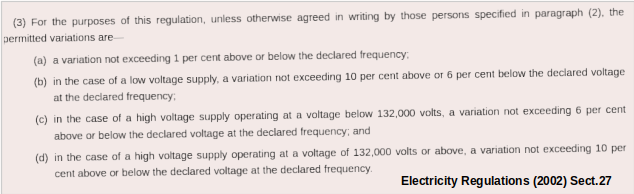
And that the Grid Frequency shall be 50Hz, plus or minus 1%
The 'Declared Voltage' for LV is currently stated as 230v RMS,
which means the upper and lower thresholds are 253v and 216.2v
You can see those thresholds shaded pink on some of the voltage monitoring timelines I post here occasionally.
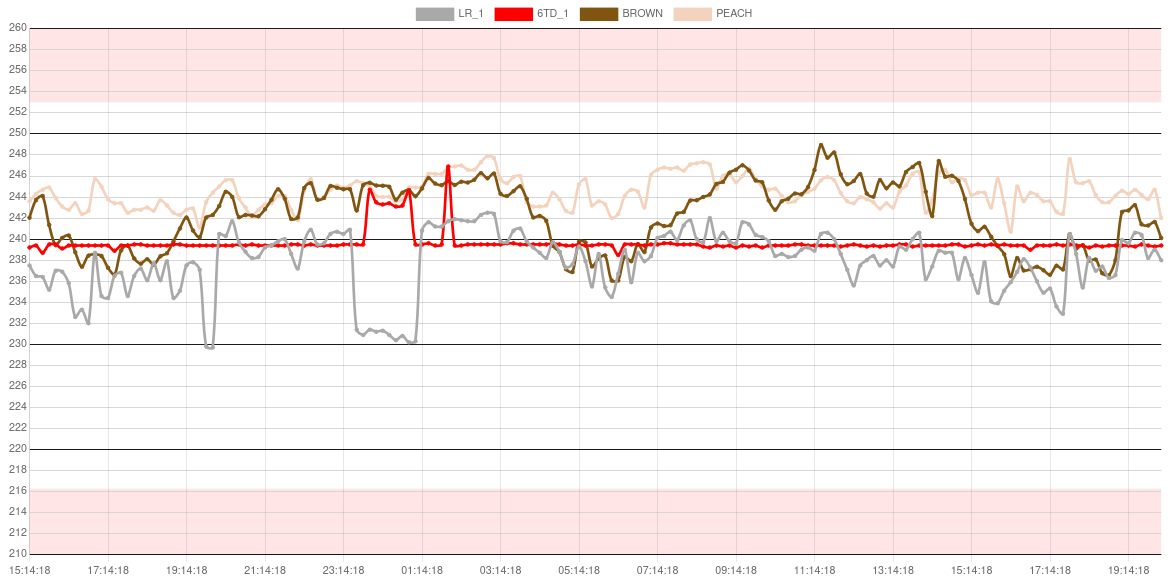
However, in practice DNOs keep the LV voltage around 240v using transformer taps.
That allows the longer rural electricity routes to suffer greater voltage drops before they can be declared as "outside the regulations".
The ENA has a proposal to change the voltage to be 230v.
That brings GB in line with the rest of Europe and provides for more headroom before the upper threshold is reached.
It's also a reasonable response to counteract the problem of over-voltage which was exhibited during the Iberian grid-outage of 28th April'25.
In theory having 230v as the starting point should facilitate more export from small-scale embedded generation, which is the subject matter of this topic.
But there are downsides to the 230v argument.
A high proportion of small-scale generation from renewable sources is actually connected to the grid on those long rural cable routes.
On days when there's less solar or wind generation, it greatly increases the risk of the end-of-route voltage falling below the 216.2v lower threshold.
Since inverters have been pre-certified to G98/G99, they are more likely to decouple themselves from the grid due to low-volts detection.
The small amount of export which they were providing is therefore lost, causing the grid voltage to fall yet further.
That will be detected by other neighbouring inverters, which will also disconnect, as they're designed to do.
The result is a Cascade Effect which ripples across the region, with thousands of small-scale embedded sites no longer supplying electricity.
Electricity demand from those rural areas will remain the same, but it must now be satisfied by increased generation from elsewhere.
It can take a minute or two for NESO to see the effect of bringing on-stream those generation sites and BESS being held on standby.
In the meantime the additional load will cause the 50Hz frequency to fall.
Too low a frequency prevents an offline generation site (or BESS) from being able to connect to the grid.
An attempt to do so would cause the breakers to re-open due to the surge current.
That's what happened during the GB grid outage in August 2019.
To meet a sudden increase in demand, National Grid ESO brought on-stream two gas-powered generators at Little Barford in Bedfordshire.
Each failed within 85-seconds, resulting in a 244MW loss from plant-1, followed by 187MW from plant-2.
Most of East England was plunged into blackout and the frequency fell to 48.8Hz.
The national grid was saved from total collapse by Load Shedding (LFDD), which removed power from another 1-million homes countrywide.
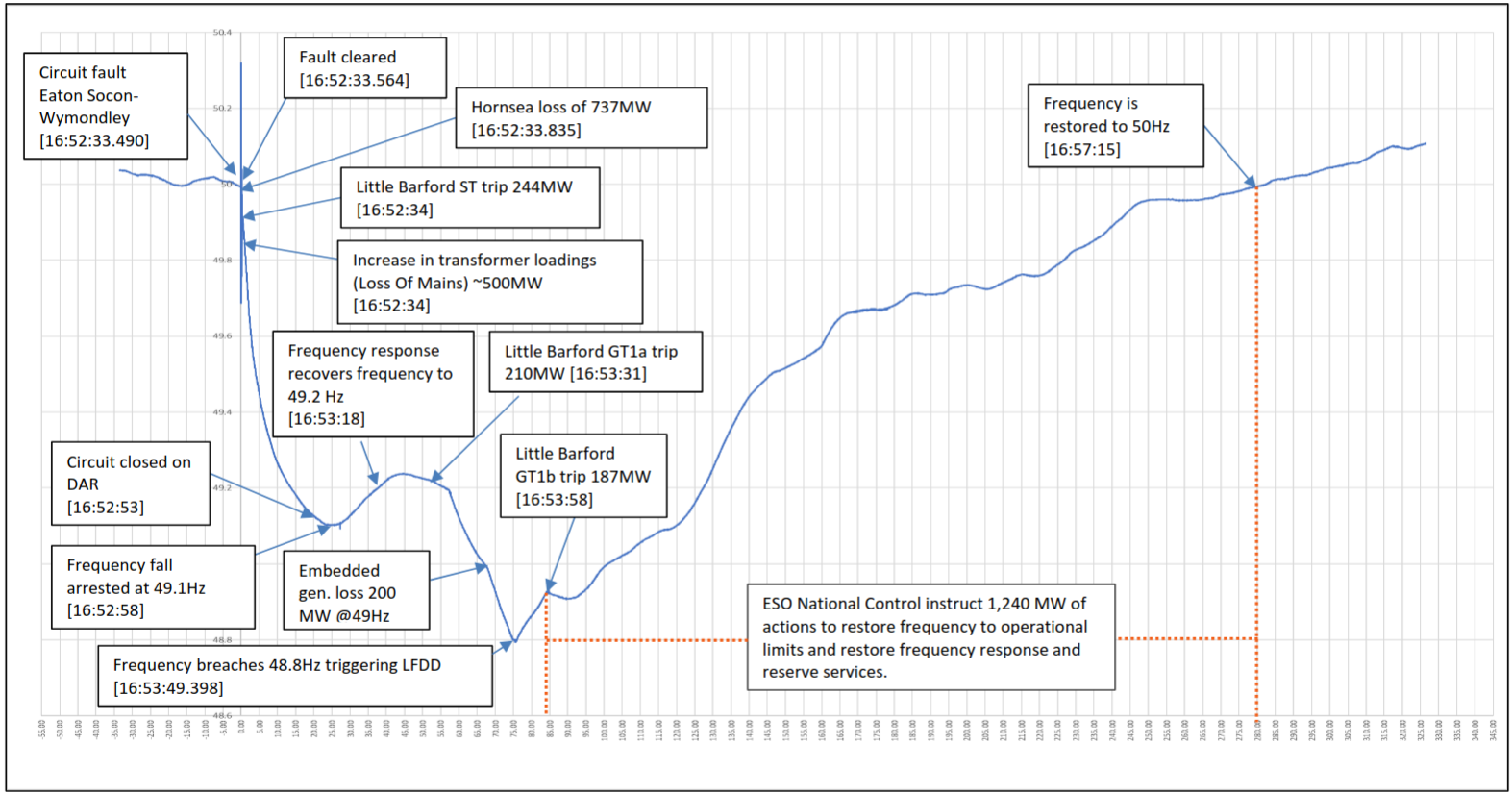
It doesn't take much for inverters to be caught up in a Cascade Effect.
We all have a responsibility to use common sense when seeking export to the grid.
The sudden loss of export from one home can rapidly escalate to something much more severe.
There are very good reasons why DNOs won't normally allow export above 16A (per phase), which equates to 3.68kW.
This post was modified 3 months ago by Transparent
Save energy... recycle electrons!
24/11/2025 8:22 pm
Is the national 10% figure quoted somewhere @transparent? I assume you are looking at a different figure than me?
The government gives a breakdown for total losses for 2024 at 9%, broken down as:
Transmission losses 8,572
Distribution losses 17,426
Theft losses 2,119
Total losses 28,117
I assume the local substation losses you mentioned are in the Distribution figure?
I'm pretty sure it's not profitable to delve much deeper into these statistics.
If we're within 1% of each other, I'd be happy with that.
For the sake of others who wish to quote from these centralised DUKES reports in future, there are a number of variables which we need to keep in mind.
Let me cite a few:
1: The large industrial users of electricity will be using 3-phase machinery.
They're not contributing to phase-imbalance losses...
... but they are contributing to overall demand.
The losses quoted by DUKES are 9% of the total electricity generation (including Industry).
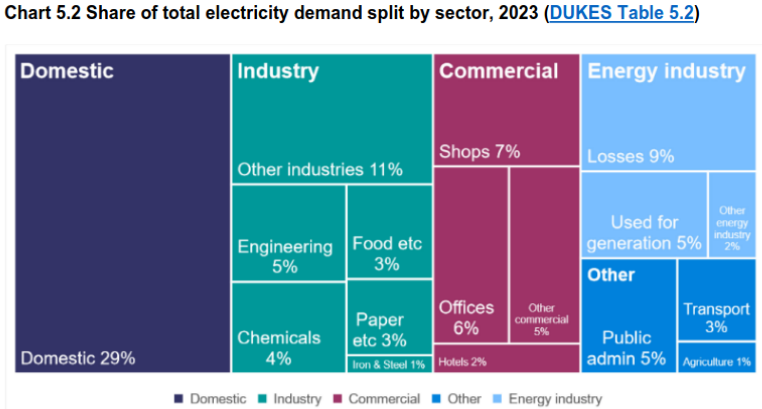
My 10% technical losses figure is only looking at sites supplied with single-phase.
Those are almost all domestic premises, plus at least 50% of Commercial
2: DUKES includes losses due to theft/fraud.
Those aren't technical losses, which is what the DNOs are tasked with tracking.
So I get a different picture if I talk with grid operators.
The causes of technical losses include
- phase imbalance (mainly at LV level)
- harmonics (mainly at HV levels)
- measurement / metering inaccuracies
- data errors
3: Let's note that most of those phase imbalances are occurring at the local substations, of which there are 550,000 in GB.
The vast majority of those substations have no monitoring at all.
Even if monitoring were to be fitted, there would also need to be a secure communications system to transfer that data.
It's prohibitively expensive.
The timeline graphs I post here on the Forum don't get seen by the great majority of DNO staff.
Remember, some of this data is being collected by my own monitors.
But I think it's important that members here can appreciate what's actually occurring at our local substations.
Your decisions regarding grid-export and EV charging can then be based on genuine data.
4: A significant proportion of rural Britain isn't connected to 3-phase cable networks anyway.
It's commonly the case that rural supplies are 'split-phase'.
There are just two conductors at the 11kV level.
Any electricity demand from those areas must cause phase-imbalances
Here's a drawing I created about 5 years ago when discussing the possibility of solar panels with the farmer at Brule Farm.
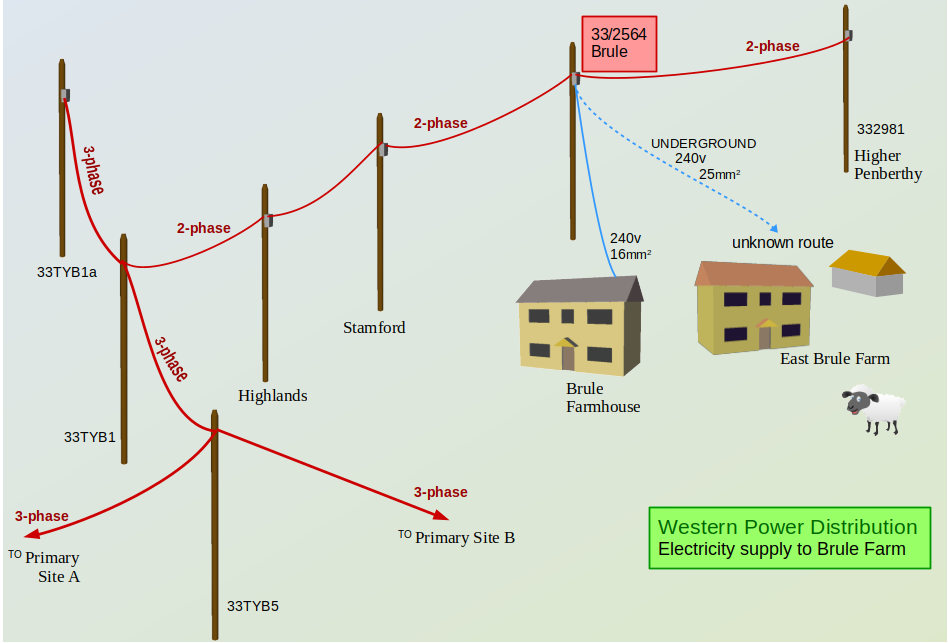
This dates from the time prior to National Grid buying Western Power Distribution from its owners, based in the USA.
It's a real location, but I've changed the place names to maintain confidentiality.
The split-phase pole-mounted electricity feed towards Higher Penberthy actually has ten poles,
but I've only drawn the four which also have a transformer supplying 240v to cottages and farms.
This post was modified 3 months ago by Transparent
Save energy... recycle electrons!

Latest Posts
-
Issue with a Grant Air Source Heat Pump & Tado Smart Thermostat
Hi all I'm having some trouble with a Grant ASHP and ...
By Renewables345 , 22 minutes ago
-
RE: Underfloor Heating Installation Issues with Heat Pump
We suffered a water leak last year in two rooms and had...
By MartinHook_UK , 33 minutes ago
-
RE: Testing new controls/monitoring for Midea Clone ASHP
Now seems a good time to summarise the costs and effici...
By benson , 42 minutes ago
-
RE: Heat Pump vs New Gas Boiler for Inherited House - Worth the Extra Cost?
*** I now see @jamespa has already posted but will stil...
By cathodeRay , 2 hours ago
-

RE: Tell us about your Solar (PV) setup
@mk4 Charge to 100%, discharge down to 10%.
By bobflux , 2 hours ago
-
RE: Daikin Altherma 3 LT compressor longevity question
This mess is intriguing: I wonder if this represent...
By bobflux , 3 hours ago
-
RE: Connecting Growatt SPH5000 over wired ethernet rather than wireless
The simplest wired option is usually the Growatt Ethern...
By Jonatan , 7 hours ago
-
RE: Peak Energy Products V therm 16kW unit heat pump not reaching flow temperature
ASHPs do have a minimum compressor speed. The minimum h...
By bobflux , 14 hours ago
-
RE: Electricity price predictions
@jamespa And it seems some of the nasty public cloud...
By Batpred , 14 hours ago
-
RE: Jokes and fun posts about heat pumps and renewables
Technology is rapidly advancing. BBC News reported th...
By Transparent , 18 hours ago
-
What matters for flow and pressure drop is internal dia...
By bobflux , 18 hours ago
-

RE: Do Fridges and Freezers have COP ratings?
@editor Thank you all for your replies and submitted in...
By Toodles , 21 hours ago
-
I know and yes. The secondary deltaT wont necessaril...
By JamesPa , 1 day ago
-
RE: Designing heating system with air to water heat pump in France, near Lyon
Just love the way you put it! 🤣
By Batpred , 2 days ago
-
RE: Safety update; RCBOs supplying inverters or storage batteries
Thank you for sharing. So it seems that your Schneid...
By Batpred , 2 days ago
-

RE: Forum updates, announcements & issues
@upnorthandpersonal thanks for the thoughtful, consider...
By Mars , 2 days ago
-
RE: Solar Power Output – Let’s Compare Generation Figures
@mk4 All 21 panels have their own Enphase IQ7a microinv...
By Toodles , 2 days ago
-
RE: Setback savings - fact or fiction?
Great, so you have proven that MELCloud is consistently...
By RobS , 3 days ago
-
RE: Mitsu PUHZ120Y 'Outdoor Temp 'error?
Thanks David & James It almos...
By DavidAlgarve , 3 days ago
-
RE: Surge protection devices SPDs
@trebor12345 - your original Topic about the right type...
By Transparent , 3 days ago
-
RE: Help needed with Samsung AE120RXYDEG
@tomf I’ve been sent this from a service engineer at Sa...
By Mars , 3 days ago
-
RE: Buying large amp bidirectional RCD and RCBO
Yes... I went through this particular headache and ende...
By bobflux , 4 days ago
-
O-oh! Let's take this as an opportunity to 'pass the ...
By Transparent , 4 days ago


