
Notifications
Clear all

Topic starter
28/12/2025 10:53 am
Background
I bought a house at the beginning of 2025. There was a gas heater installed, but it was 20 years old, had a lot of switching on and off, and was on its last legs. The house was thermo-modernized in 2019, so I decided to go for a heat pump.
I installed a Midea MHC-V12WD2RN7. According to the heat loss calculations, our house needs a 10 kW unit, but since this Midea is an inverter model, the extra 2 kW shouldn’t hurt. It also has an auxiliary heater, and it uses R290, so it sounded like a good choice.
Installer company
The company I chose seemed very professional. Everyone I was in touch with before the installer showed up was very professional as well.
Unfortunately, the installer did a very poor job, which forced me to learn about heating and heat pumps. Since the installation, there have been five visits to fix things I noticed were done wrong (for example: the tray heater not connected, the 3-way valve connected the wrong way around, and many other issues).
These issues were fixed fairly quickly. The last fix was done by the installer’s manager, so it seems like I’m finally dealing with someone more knowledgeable — but my trust is completely gone.
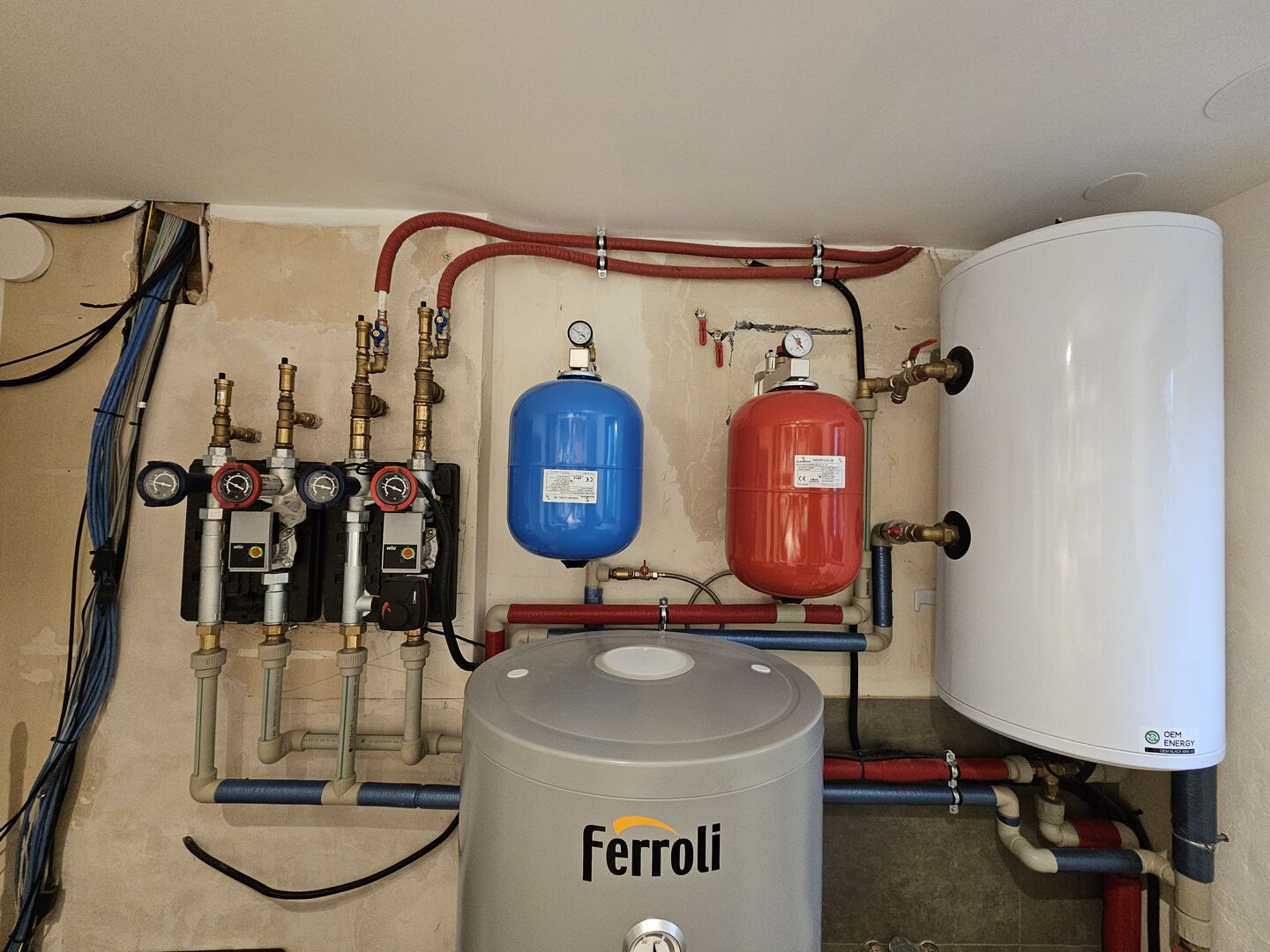
4-port buffer
Probably no surprise here: I have a 4-port buffer, and I’m seeing a very large temperature drop.
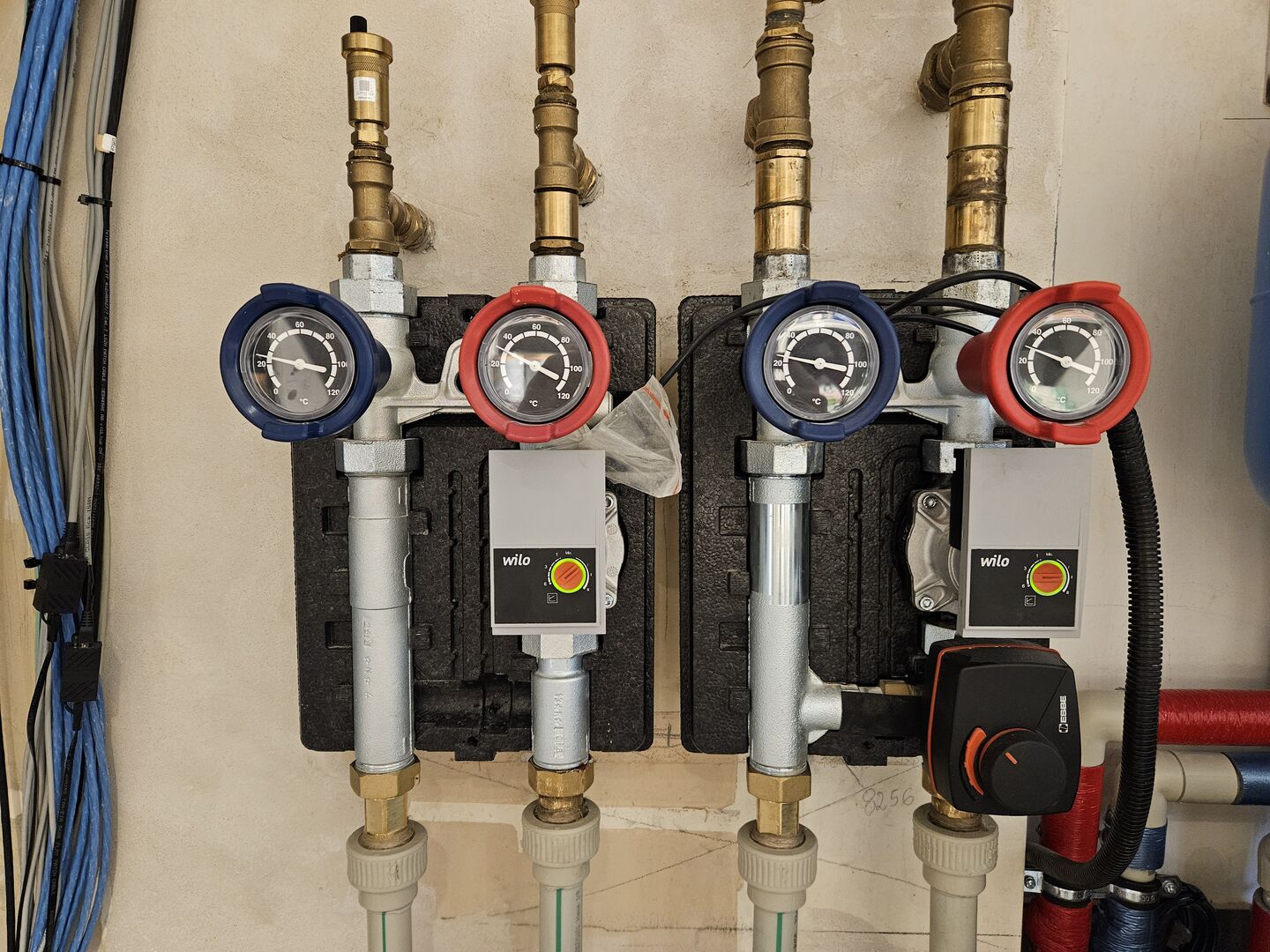
• With 35°C set on the heat pump, I get only ~30–31°C at the pump groups.
• It seems like the flow on the heat pump side is much lower than on the house side.
House heating setup
I have two loops:
Loop 1 (floor heating)
HSM 25/6 BU-EXP (Wilo pump, check valve, ESBE mixing valve)
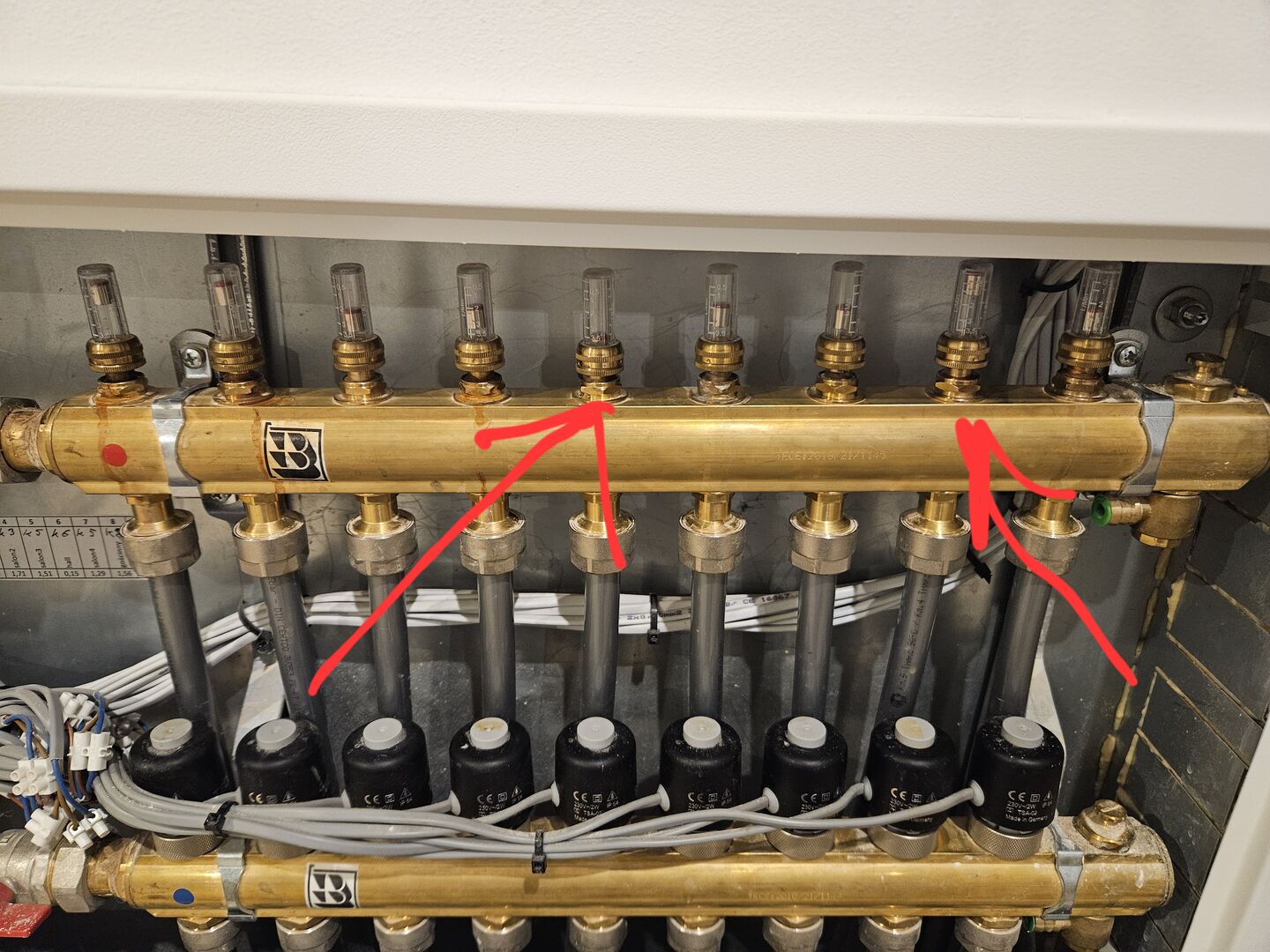
• Ground floor: floor heating in 9 loops (see image, igonre the arrows, those are showing stuff flow meters)
• Plus: 1 loop for the 1st-floor bathroom floor heating with an RTL valve
• I keep the RTL valve and the ground-floor floor heating fully open
Loop 2 (radiators + convectors)
Buderus HS 25/6 BU (Wilo pump, check valve)
• 3 radiators in the upstairs bedrooms
• 2 convector radiators in the living room (not used at all)
The previous owner was concerned that the floor heating wouldn’t be enough and installed the two convector radiators “just in case.” The floor heating is doing the job, so those convectors have never been used.
Current comfort
Right now, with all loops open (except the convector radiators), I can reach comfortable indoor temperatures. The bedrooms are about 1.5°C cooler than the rooms with floor heating.
The problem / questions
My main concern is the temperature drop and the resulting efficiency loss. I want to request modifying the 4-port buffer to make it a volumizer.
My questions are:
• Should the volumizer be on the flow side?
• Should there be a pressure relief valve as a bypass, just in case?
• Should the circulation pumps on the main loops be removed?
• Should the two main loops be modified into one (I’m never going to use high-temperature heating)?
• Can I keep the two loops but remove the pumps?
o If yes: should I have some way to control how much flow goes to each loop?
• What else should I pay attention to?
Thank you in advance for all the help!
This topic was modified 2 months ago by Andy1618

28/12/2025 2:55 pm
My questions are:
- • Should the volumizer be on the flow side?
- • Should there be a pressure relief valve as a bypass, just in case?
- • Should the circulation pumps on the main loops be removed?
- • Should the two main loops be modified into one (I’m never going to use high-temperature heating)?
- • Can I keep the two loops but remove the pumps?
- o If yes: should I have some way to control how much flow goes to each loop?
- • What else should I pay attention to?
Thank you in advance for all the help!
Here are my comments, others may have something to add or even dispute what Im suggesting.
1 - Yes ideally, but it doesnt matter that much so not something to argue over
2 - Assuming you keep one circuit always open (which you should), then no. But it wont do any harm assuming its set high enough so again not something to argue over.
3 - Yes (or bypassed) assuming that the primary pump can do the job alone. Do you know why the heat pump side is much lower than on the house side?
4 - I dont see any harm in their being in parallel, its no different to an upstairs and a downstairs radiator loop, but you may need to 'balance' the flow between them
5 - Yes but see (4)
6 - Yes, so you can balance them appropriately
7 - With a few valves it is possible to do the plumbing so that the change is reversible if that is attractive to you. Also note any warranty implication
4kW peak of solar PV since 2011; EV and a 1930s house which has been partially renovated to improve its efficiency. 7kW Vaillant heat pump.
Topic starter
28/12/2025 4:55 pm
3 - Yes (or bypassed) assuming that the primary pump can do the job alone. Do you know why the heat pump side is much lower than on the house side?
I'm not sure about the Heat Pump side, but very often it settles around 0.8 m3/h and on the emitters branches I've set it to get around 4-5°C delta and have all the parts of the floor warm.
Regarding the warranty implications. Do you think that not using 4-port buffer will void the warranty? Is that a think that is being practiced? I will check with the installator.
1


28/12/2025 8:38 pm
Regarding the warranty implications. Do you think that not using 4-port buffer will void the warranty? Is that a think that is being practiced? I will check with the installator.
The requirement for a buffer tank to maintain a manufacturer's warranty is often used as a scaremongering tactic by installers. The best course of action is to contact the manufacturer directly for clarification on their specific technical requirements... I'd initially sidestep the installer here.
I will note that Midea can be one of the least responsive major manufacturers in the UK to deal with, so persistence may be needed.
For a deeper dive into this common issue, you can read more here: https://renewableheatinghub.co.uk/buffer-tanks-heat-pump-warranty/
Get a copy of The Ultimate Guide to Heat Pumps
Subscribe and follow our YouTube channel!
2
Topic starter
31/12/2025 12:02 pm
Thank you so much for your help. After New Years I'll get to it.
One thing that crossed my mind: I can see very often that the HP circulation pump is starting at 2.5m³/h (after turning on or after defrosting) and then it settles down at around 0.8m³/h. Is it possible that the HP circurlation pump is going to be delivering too low flow for my system?
1

31/12/2025 6:04 pm
@andy1618 If this is of any interest / help, my Daikin EDLA08 8 kW monobloc will start a run with a flow rate of ~28 lpm. Within a minute or two, this reduces to ~14 lpm and then, after a few more minutes, it further drops to ~7 lpm. Regards, Toodles.
Toodles, heats his home with cold draughts and cooks food with magnets.
Topic starter
31/12/2025 7:38 pm
@toodles I'm not concerned that the behaviour is not normal. I'm concerned if pushing 0.8m³/h is going to be sufficient for 10 UFH loops + 5 radiators in open loop setup without secondaey pumps.

Latest Posts
-

RE: Tell us about your Solar (PV) setup
@mk4 Charge to 100%, discharge down to 10%.
By bobflux , 5 minutes ago
-
RE: Say hello and introduce yourself
Welcome to the forums. You are in an interesting posi...
By JamesPa , 6 minutes ago
-
RE: Daikin Altherma 3 LT compressor longevity question
This mess is intriguing: I wonder if this represent...
By bobflux , 1 hour ago
-
RE: Connecting Growatt SPH5000 over wired ethernet rather than wireless
The simplest wired option is usually the Growatt Ethern...
By Jonatan , 5 hours ago
-
RE: Peak Energy Products V therm 16kW unit heat pump not reaching flow temperature
ASHPs do have a minimum compressor speed. The minimum h...
By bobflux , 12 hours ago
-

RE: Electricity price predictions
@jamespa And it seems some of the nasty public cloud...
By Batpred , 13 hours ago
-

RE: Jokes and fun posts about heat pumps and renewables
Technology is rapidly advancing. BBC News reported th...
By Transparent , 16 hours ago
-
What matters for flow and pressure drop is internal dia...
By bobflux , 17 hours ago
-
RE: Do Fridges and Freezers have COP ratings?
@editor Thank you all for your replies and submitted in...
By Toodles , 19 hours ago
-
I know and yes. The secondary deltaT wont necessaril...
By JamesPa , 23 hours ago
-
RE: Designing heating system with air to water heat pump in France, near Lyon
Just love the way you put it! 🤣
By Batpred , 2 days ago
-
RE: Safety update; RCBOs supplying inverters or storage batteries
Thank you for sharing. So it seems that your Schneid...
By Batpred , 2 days ago
-

RE: Forum updates, announcements & issues
@upnorthandpersonal thanks for the thoughtful, consider...
By Mars , 2 days ago
-
RE: Solar Power Output – Let’s Compare Generation Figures
@mk4 All 21 panels have their own Enphase IQ7a microinv...
By Toodles , 2 days ago
-
RE: Setback savings - fact or fiction?
Great, so you have proven that MELCloud is consistently...
By RobS , 3 days ago
-
RE: Mitsu PUHZ120Y 'Outdoor Temp 'error?
Thanks David & James It almos...
By DavidAlgarve , 3 days ago
-
RE: Surge protection devices SPDs
@trebor12345 - your original Topic about the right type...
By Transparent , 3 days ago
-
RE: Help needed with Samsung AE120RXYDEG
@tomf I’ve been sent this from a service engineer at Sa...
By Mars , 3 days ago
-
RE: Buying large amp bidirectional RCD and RCBO
Yes... I went through this particular headache and ende...
By bobflux , 4 days ago
-
O-oh! Let's take this as an opportunity to 'pass the ...
By Transparent , 4 days ago
-
RE: Homely setup on daikin heat pump
@craigh I refer to our somewhat elevated temperature of...
By Toodles , 4 days ago
-
RE: Air source heat pump roll call – what heat pump brand and model do you have?
My turn, this describes the future installation, only t...
By bobflux , 4 days ago


