

Notifications
Clear all
Joining the Renewable Heating Hub forums is completely free and only takes a minute. By registering you’ll be able to ask questions, join discussions, follow topics you’re interested in, bookmark useful threads and receive notifications when someone replies. Non-registered members also do not have access to our AI features. When choosing your username, please note that it cannot be changed later, so we recommend avoiding brand or product names. Before registering, please take a moment to read the Forum Rules & Terms of Use so we can keep the community helpful, respectful and informative for everyone. Thanks for joining!

15/02/2026 5:25 pm
The risk with an rcbo is that the cheap normal ones use a tiny transformer to create a signal if there is a difference in current between L and N cables, tripping the unit. If a dc fault slowly develops, the dc signal will not couple across the transformer - and worse it will saturate the core so that the rcbo will then fail to operate even with a dangerous AC leakage current. Most devices plugged into a ring main must draw AC power - eg a kettle resistive element, etc and so cannot create this dc leakage fault even if faulty. Any mains device plugged in that can develop a dc leakage, could compromise the rcbo for all other items on that circuit. It’s not a power direction issue - the rcbo can’t tell power flow direction. Inverters are arguably more likely to develop these sorts of faults than other items, hence the worry. The fix could be a new standard of inverter robustness against this fault - eg victron inverters have old school 50Hz toroids stepping up from a 30Vac ish sine wave to 240Vac - these would not be likely to cause this fault due to having galvanic isolation on the 50Hz side.
This post was modified 8 months ago by robl
1

15/02/2026 6:02 pm
Ok all of this is very interesting but other EU countries seem to manage it. The risks are identical unless there are differences in fixed wiring design which materially affect these risks.
Hopefully those who are advising government understand how other countries tackle this and have identified material differences in the electrical practices which result in a different conclusion for the UK which cannot be circumvented.
Otherwise it's a case of industry protectionism, NIH, or British exceptionslism.
Until someone can explain to me why the UK is different to other countries in this case, I will remain suspicious that it's one of the above, whilst also remaining open minded to the possibility that there is a genuine difference.
This post was modified 8 months ago 2 times by JamesPa
4kW peak of solar PV since 2011; EV and a 1930s house which has been partially renovated to improve its efficiency. 7kW Vaillant heat pump.

15/02/2026 6:03 pm
I respectively disagree @robl
Here's the relevant paragraphs from the BEAMA Report which alerted the IET to the problem back in 2024
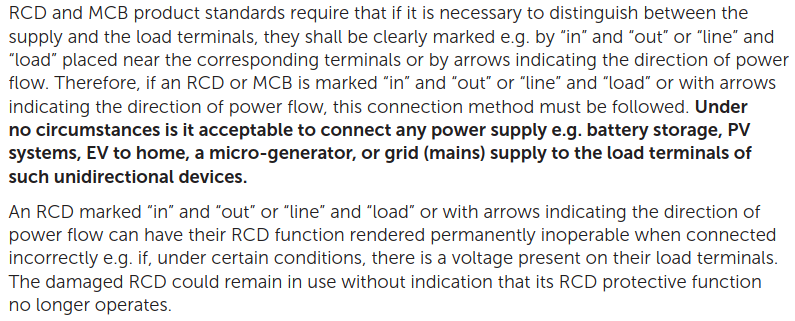
The bi-directional RCBO is a requirement in order to protect against faults within the generating equipment.
It's not to do with a possible DC component on that waveform.
See here the YouTube video which provides weekly news updates to professional electricians:
This post was modified 8 months ago by Transparent
Save energy... recycle electrons!
2


15/02/2026 6:31 pm
Until someone can explain to me why the UK is different to other countries in this case, I will remain suspicious that it's one of the above, whilst also remaining open minded to the possibility that there is a genuine difference.
I leave that to the expert in the room: @transparent
🔥 Britain’s Heat Pump Shitshow
How Installing a Heating System Became a National Nervous Breakdown
Free UK shipping.
📗 Heat Pumps Explained
A Jargon-Free Guide for Homeowners
Rewritten and updated for 2027
📘 From Zero to Heat Pump Hero
🛠️ Bodge Buster
New to heat pumps?
Take the Heat Pump Fundamentals course and use INTRO50 at checkout for 50% off.

15/02/2026 6:51 pm
Until someone can explain to me why the UK is different to other countries in this case, I will remain suspicious that it's one of the above, whilst also remaining open minded to the possibility that there is a genuine difference.
I leave that to the expert in the room: @transparent
In fairness to @transparent he has already said he doesn't know about other countries and, unless he is advising government, there is no reason why he should..
My comment was that those who are advising government definitely should, and if they dont then I am suspicious that it's industry protectionism, British exceotionalism or nih.
4kW peak of solar PV since 2011; EV and a 1930s house which has been partially renovated to improve its efficiency. 7kW Vaillant heat pump.
15/02/2026 7:19 pm
if they dont then I am suspicious that it's industry protectionism, British exceotionalism or nih.
Allow me to me turn the argument around.
Let's suppose it was the MCS proposing that "the solenoid coil in the RCBO won't burn out because the micro-inverter is certified to to G98, so that means it will stop generating as soon as there's a power-outage anyway."
How would we respond to that?
Would Members here agree with them and decide that the IET Wiring Regulations were over-zealous and protecting the energy sector?
Or might we be more inclined to tell the MCS that the regulations are there for good reason,
and that the safety of the public shouldn't be compromised?
This post was modified 8 months ago 2 times by Transparent
Save energy... recycle electrons!
15/02/2026 8:12 pm
if they dont then I am suspicious that it's industry protectionism, British exceotionalism or nih.
Allow me to me turn the argument around.
Let's suppose it was the MCS proposing that "the solenoid coil in the RCBO won't burn out because the micro-inverter is certified to to G98, so that means it will stop generating as soon as there's a power-outage anyway."
How would we respond to that?
Would Members here be inclined to agree with them and decide that the IET Wiring Regulations were over-zealous and protecting the energy sector?
Or might we be more inclined to tell the MCS that the regulations are there for good reason,
and that the safety of the public shouldn't be compromised?
Sorry but thats not a valid comparison, MCS is irrelevant here and anyway it misses the key point.
Other perfectly respectable countries in the EU, with very similar or higher levels of consumer protection and not dissimilar electrical standards, have found a way to do this.
The question therefore is how? Not to ask that is a dereliction of duty. Not your duty (unless you are advising Government) but certainly the duty of those who are advising Government.
The underlying risks are the same, because EU countries are subject to the same laws of physics and biology. Nevertheless if those who argue against what is obviously (subject to safety) a desirable relaxation of regulation, can put forward a valid argument why either (a) the other countries are wrong or (b) our electrical practices make a material difference to the risk, then they may well have a case.
If they haven't bothered to understand what other countries do, then they are not in a position to put forward that argument, and it is entirely fair of us to suspect NIH, self interest or British exceptionalism.
I don't know whether or not those advising Government have bothered to understand what other countries do which is why my current position is one of openminded suspicion.
4kW peak of solar PV since 2011; EV and a 1930s house which has been partially renovated to improve its efficiency. 7kW Vaillant heat pump.

15/02/2026 8:25 pm
In fairness to @transparent he has already said he doesn't know about other countries and, unless he is advising government, there is no reason why he should..
My comment was that those who are advising government definitely should, and if they dont then I am suspicious that it's industry protectionism, British exceotionalism or nih.
I had a look for this and it seems this is not a concern elsewhere.
The report from the manufacturer´s association (that includes the logos of a wide range of leading suppliers) does not go into details about the claimed limitation of some old RCCB or RCDs that use solenoid. It stated something like, since a british standard required the devices to be marked with input and output, they were marked as such. So they are not valid for bi-directional use. There´s also some talk about DC currents.
Could it be that this type of issue only applies to some unusual RCCB/RCDs that had a particular circuit using solenoid, etc? I am curious as to how an RCD would have been built in such a way that the "bit" that triggers it to trip (when there is a differential between neutral and earth) burns when the power (live/neutral) is flowing backwards. Why would the direction of flow matter?
And did the IEC standards not require the devices to be marked with input and output?
8kW Solis S6-EH1P8K-L-PLUS hybrid inverter; G99: 8kW export; 16kWh Seplos Fogstar battery; Ohme Home Pro EV charger; Vaillant Arotherm Pro 7kW; 100Amp head, HA lab on mini PC

15/02/2026 8:37 pm
If the RCBO was on a normal power circuit, opening the contacts would remove power from the electronics.
The trip would remain open until the lever was manually moved, and the solonoid would no longer be powered-on.But if there is power still being applied in the reverse direction by an inverter or storage battery, when the contacts open, the solonoid remains energised.
Surely the solenoid remains energised only until the reverse power is removed which, if the generator cuts out once the grid tie is removed (which grid tied generators are required to do), is for a short time only, which one would hope, possibly expect, the solenoid could survive.
Is this a real risk in the case we are discussing namely plug in solar, with limited output and a set of protections built in?
If you take this to its logical conclusion (if my understanding is correct) then plug in grid tied solar is unsafe in any house without bidirectional RCBOs on every circuit. Yet somehow other EU countries allow it!
I remain willing to being convinced that, for the circumstance we are discussing, this is a real risk that is somehow different in the UK than in several EU countries (or alternatively that the regulators in those other countries have 'got it wrong'.)
Until we have the comparison with other countries and an explanation why we are different, we must, IMHO, all be suspicious that this is British Exceptionalism, industry protectionism or NIH.
This post was modified 8 months ago 4 times by JamesPa
4kW peak of solar PV since 2011; EV and a 1930s house which has been partially renovated to improve its efficiency. 7kW Vaillant heat pump.
15/02/2026 8:44 pm
It's the other way around @batpred
Newer RCDs and RCBOs are most likely to have a small solenoid with the coil being energised via a control circuit board.
The markings on RCBOs denoting the Load (output) terminals were there precisely because they were introduced as uni-directional devices, whereas RCDs and MCBs are not.
Please re-read my description on the earlier topic about RCBOs to understand why there is a risk of the small solenoid coil remaining energised if the device has been used on a circuit supplying a source of generation.
Remember that this is a protection device which must trip if there is a fault.
That includes there being a fault with the inverter itself.
Yes, these inverters will have been tested for G98 compliance by the manufacturer, and the test results filed with the ENA.
The IET is a separate regulatory organisation.
They are setting standards which must protect against such an inverter being faulty, and that includes the possibility of the inverter continuing to export for too long after the mains/grid has dipped outside the statutory 216.4 - 253 voltage window.
This post was modified 8 months ago by Transparent
Save energy... recycle electrons!
15/02/2026 8:56 pm
In response to @jamespa 's similar point, there is an unfortunate history of generation devices (inverters) continuing to output power after the time-interval has passed which dictates they should've ceased to do so.
I'm aware of one area in England where installation engineers were required to revisit sites and change the firmware in solar inverters which had been operating for several years.
You might expect that a small inverter would cease all output as soon as it could no longer 'see' a 50Hz reference voltage.
But in practice they don't act immediately, which is why the G98 (and G59) tests required them to do so within a time interval which is defined by the level by which the grid supply has gone outside its envelope.
Since the 50Hz reference is no longer present, the output waveform may not be a neat sinusoidal wave, but instead contain an increasing DC element.
The RCBO must still trip-out.
It does so, not because of the amount of DC component, but because there is a fault with the equipment.
If RCBOs only needed to trip when an inverter behaved as its G98 certification says it should, then it's a pretty useless safety device!
This post was modified 8 months ago 2 times by Transparent
Save energy... recycle electrons!
15/02/2026 9:04 pm
In response to @jamespa 's similar point, there is an unfortunate history of generation devices (inverters) continuing to output power after the time-interval has passed which dictates they should've ceased to do so.
Sorry but is this a UK specific problem which has been shown to occur with plug in solar devices, or is it a theoretical risk?
Nothing in life is totally risk free, including not having sufficient green energy at a price you can afford!
I am trying to avoid being awkward but am genuinely finding it very difficult to accept that regulatory bodies in the EU are somehow incompetent, whereas ours are somehow competent! I do accept that these countries have different wiring practices, but nothing so far seems to relate to these.
This post was modified 8 months ago 4 times by JamesPa
4kW peak of solar PV since 2011; EV and a 1930s house which has been partially renovated to improve its efficiency. 7kW Vaillant heat pump.

SPONSORS

Degrees of Separation

Latest Posts
-

RE: Renewables & Heat Pumps in the News
Years ago I worked for a company who won a best in show...
By EtchedPixels , 5 hours ago
-
RE: Octopus Cosy Heat Pump Owners & Discussion Thread
Has anyone here had a Cosy 12 installed yet?
By Mars , 7 hours ago
-
RE: How quickly would you want/expect heat recovery to take from setback?
But looking at your graphs, why are your LWT and RWT cy...
By Temperature_Gradient , 7 hours ago
-
RE: How should the Boiler Upgrade Scheme be reformed?
Not quite, regular A2W heat-pumps need a load of extra ...
By Temperature_Gradient , 1 day ago
-
RE: Heat Geek installations: share your experiences
one thing i learnt from reading people’s comments and e...
By Batpred , 1 day ago
-
RE: Cooling/heating with one unit
"The way we use A2A on a cheap overnight EV tariff is t...
By mrkfm , 1 day ago
-
RE: Do I add Air Con or MVHR to existing A2W ASHP?
We have ‘signed on the dotted line’ today for a Panason...
By Toodles , 1 day ago
-
RE: Heat pump branding. Clever, contemporary… or a bit too much?
...or it was there and was lost thanks to laziness and ...
By Majordennisbloodnok , 1 day ago
-
@bobflux Thank you for your response. I am trying to ...
By RonV. , 1 day ago
-
This post is about how I successfully configured a buff...
By Tony.Stolz , 2 days ago
-
The installer visited yesterday and suggested the noise...
By JamesChatz , 2 days ago
-
RE: HeatGeek vs Octopus surveys: puzzling disparity - any ideas why?
Your house sounds a lot like mine. 2 surveyors each sp...
By JamesPa , 2 days ago
-
RE: Heat Geek Zero Disrupt: Are We Sleepwalking Into Another Race to the Bottom?
Thats true only if you do the wrong experiment. Done c...
By JamesPa , 2 days ago
-
RE: battery storage without solar
As of October 1st they need specific qualifications to ...
By EtchedPixels , 2 days ago






SPONSORS