

Notifications
Clear all
Joining the Renewable Heating Hub forums is completely free and only takes a minute. By registering you’ll be able to ask questions, join discussions, follow topics you’re interested in, bookmark useful threads and receive notifications when someone replies. Non-registered members also do not have access to our AI features. When choosing your username, please note that it cannot be changed later, so we recommend avoiding brand or product names. Before registering, please take a moment to read the Forum Rules & Terms of Use so we can keep the community helpful, respectful and informative for everyone. Thanks for joining!

Topic starter
14/05/2024 3:28 pm
BEAMA have issued a safety update (March 2024) regarding the use of RCBOs to connect PV inverters or storage batteries.
This is not yet part of the IET Electrical Wiring Regulations, but it is sufficiently serious that an amendment is being expedited.
Overview: household electrical circuits are wired from a Consumer Unit which contains a number of trips.
Most trips are there to prevent excessive current being passed through wires/cables. Those are MCBs (Miniature Circuit Breakers).
It is common for a consumer unit to have one or more RCDs (Residual Current Detectors).
These compare the outgoing current on the Live wire, with that being returned on the Neutral.
If there is an imbalance, the contacts will open to prevent fire or electric shock to someone who has touched a live cable.
Increasingly, electricians are fitting RCBOs for individual power circuits.
These combine the functions of an MCB and RCD.
They will open the contacts either for over-current, or because current is leaking away somewhere.
If a single-circuit RCBO trips out, then at least the lights remain on so you can see what's gone wrong!

RCDs and RCBOs both have a test button.
This should be pressed periodically to check that it will open the contacts to protect against electric shock
When solar panels or storage batteries are installed, it is not mandatory that the circuit is supplied from an RCBO. An MCB is sufficient.
However, many installers do use an RCBO to provide an extra level of safety for when it might be necessary for an inverter to undergo maintenance.
Most Solar Inverters and Storage Batteries are "Grid tied".
They export to the mains supply through the same wires which connect them to the consumer unit.
A grid-tied inverter will have a G98 certificate, and requires permission from the regional DNO to install it.

This common arrangement means that electricity will pass through the RCBO in either direction.
The RCBO contains a small amount of electronics to handle the current sensing.
When there is a fault (either over-current or earth-leakage) a solonoid is energised (switched on), which opens the contacts.
If the RCBO was on a normal power circuit, opening the contacts would remove power from the electronics.
The trip would remain open until the lever was manually moved, and the solonoid would no longer be powered-on.
But if there is power still being applied in the reverse direction by an inverter or storage battery, when the contacts open, the solonoid remains energised.
Such a small solonoid will overheat and burn out.
The circuit can still be re-powered using the lever, but it will no longer be able to protect against electric shock.
The home owner won't know that.

The solution is to use a an RCBO specifically designed for bi-directional use.
A bi-directional RCBO has a third pair of contacts.
When the solonoid operates to open the trip, that 3rd contact set removes power from the electronics, and the solonoid coil is de-energised, preventing burn-out.
How can you tell if an RCBO is bi-directional?
Most RCBOs have arrows to show the direction of current, or have a label which denotes Supply and Load terminals.
A Bi-directional RCBO will not be marked for Supply and Load.
It may also have a set of arrows pointing in both directions.
If an RCBO isn't marked as being bi-directional, then it isn't.
The IET Wiring Regulations aren't retrospective.
When the amendment is released which specifies the need for a bi-directional RCBO, there will still be many thousands of installations which appear to have an operational RCBO, but it will only offer protection against over-current. It won't be acting to prevent fire or avoid electric shock.
It is up to forum members here to spread the word to others and advise that an existing RCBO is exchanged (by an electrician!) for a bi-directional type.
Save energy... recycle electrons!
4
Topic starter
20/05/2024 3:45 pm
This photo shows a bi-directional RCBO by Proteus at Redditch.

The symbols are correct, and the third-contact which the solonoid switches is visible in the diagram on the side.
What I still don't like is:
- the terminals being labelled 'In' and 'Out'
- no bi-directional symbol or marking on the part of the RCBO which remains visible to the householder after installation is completed
This particular RCBO is Type A

and Curve C... which defines the time it takes to trip due to over-current.
Most household MCBs and RCBOs are curve-B, which operates faster.
I use Curve-C trips to supply circuits which are likely to have large inductances connected (motors in a workshop or an inverter).
Update 28may24:
I have a response from Proteus Switchgear to say that they are already acting on the BEAMA directive and "will remove the in/out and also add on a bidirectional arrow symbol to the front of compliant devices"
The changes will filter through once existing stocks have been exhausted.
Save energy... recycle electrons!
1

15/02/2026 11:42 pm
I had a read and I still cannot understand the below. We are talking about the direction of power flows. An alternating current changes direction 100 times a second. So the issue cannot be about the direction of the current.
But if there is power still being applied in the reverse direction by an inverter or storage battery, when the contacts open, the solenoid remains energised.
As it is about DC currents, why not describe it as such?
And it does seem thar this Beama originated confusion was related to a British electrical labelling standard?
8kW Solis S6-EH1P8K-L-PLUS hybrid inverter; G99: 8kW export; 16kWh Seplos Fogstar battery; Ohme Home Pro EV charger; Vaillant Arotherm Pro 7kW; 100Amp head, HA lab on mini PC
Topic starter
16/02/2026 12:25 pm
See matching discussion here in the topic about Plug'n'Play Balcony Solar kits.
Save energy... recycle electrons!


16/02/2026 2:25 pm
Thanks for the clear explanation @transparent. I think I agree with two sides of this issue:
There is a risk that when a unidirectional rcbo/rcd trips out or is flicked off with an inverter connected and running, that inverter may continue to backfeed for long enough to destroy the rcd solenoid inside the rcbo rendering it non functional as a protective device. It also would be odd if this prevents the engagement of the wider public with solar.
Risk management is standard practice in such circumstances - eg: we're happy to use non earthed power supplies in our home, simply by using higher levels of insulation internally - all those usb chargers, laptop supplies, so many things! These are still sold to people for use without an RCD. There must be some way that an inverter can pose an acceptable risk to a unidirectional rcd/rcbo, and if necessary some new standard imposed for UK legal balcony solar - whilst simultaneously phasing out unidirectional devices. For example, a new standard mandating the power down on disconnect to be much faster than the present 0.5s. Of course the inverter could be faulty; this feature could be 100% tested. A fault could develop - so could a fault with the insulation I mentioned above.
I had a look for bidirectional rcbos, and they don't seem to be obbviously more expensive, screwfix have them for £17 ish. Other distributers are available:-)
We have an EV charger, which has an expensive type B rcd which can trip in the case of dc leakage, which normal rcd/rcbo's may not. I think that most power electronics devices (solar inverters, inverter heatpumps...) are recommended to have type B. I think type B are £200 ish, probably this reduces adoption!
16/02/2026 2:56 pm
There is a risk that when a unidirectional rcbo/rcd trips out or is flicked off with an inverter connected and running, that inverter may continue to backfeed for long enough to destroy the rcd solenoid inside the rcbo rendering it non functional as a protective device.
Are you saying that an RCD solenoid would burn only when a current is not flowing through it? So (and I am taking the risk of making the options up):
- if inverter power is off, it would not burn
- if inverter power is fed from the load side, and not used from grid side, it burns
- if inverter power is fed from the load side, and used from the grid side, it does not burn
So in this latter case, how much power would need to be drawn from the grid side in order for it to not burn?
It would be great if we could access a single test report for a product version with such a risk.
Whether power flows in one or the reverse direction does not change the physics that an AC current changes direction 100 times a second...
8kW Solis S6-EH1P8K-L-PLUS hybrid inverter; G99: 8kW export; 16kWh Seplos Fogstar battery; Ohme Home Pro EV charger; Vaillant Arotherm Pro 7kW; 100Amp head, HA lab on mini PC
16/02/2026 3:32 pm
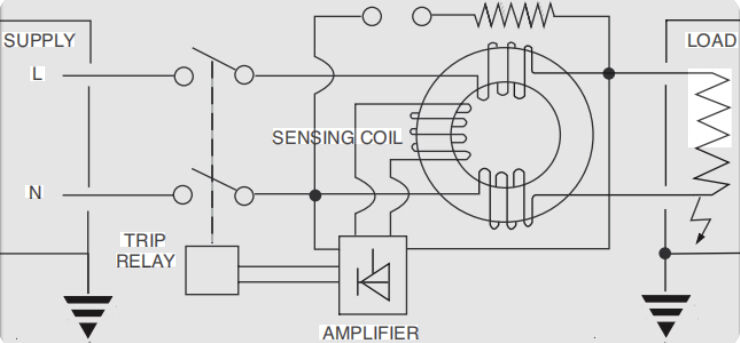
Below is a simplified problematic RCD circuit I ‘found’. The trigger is the difference between L and N currents, which is then amplified using a power supply from the output, which remains possible for 1/2s after switch off so could burn out the coil. I imagine speed is crucial, so it can’t drive anywhere near continuously. I must admit it looks like it should only cause the coil to fail if there is an actual RCD trip current AND the inverter power is on, rather than the more general case I mentioned before, apols.
1
Topic starter
16/02/2026 3:38 pm
For example, a new standard mandating the power down on disconnect to be much faster than the present 0.5s. Of course the inverter could be faulty;
And that's the nub of the problem, isn't it?
Even if such a Balcony Solar Standard were imposed, I'm not convinced that the IET would accept it.
The Wiring Regulations are valid based on 'ignorance' of the appliances which get connected.
The assumption is "safety first", and that means the rules are there to cope with an appliance which is not complying with a 'standard' as it should.
- if inverter power is fed from the load side, and used from the grid side, it does not burn
So in this latter case, how much power would need to be drawn from the grid side in order for it to not burn?
Please recheck the schematic of the bi-directional RCBO at the top of this page.
The issue has nothing to do with the amount of power being drawn, but what happens when the contacts have opened in response to an earth-leakage fault.
Save energy... recycle electrons!
16/02/2026 4:54 pm
@transparent I do like the safety first precautionary approach. We could do with it in other aspects of life (PFC's, CO2 emissions...). I trust a balanced approach will be taken of risk versus PV adpotion. In my experience, once an individual is engaged in green topics - be it PV, EV, a heatpump, diy loft insulation - they've started on a journey that keeps going. I think individuals are more engaged if hands on, rather than paying someone - so I really hope this is all possible somehow, even though I myself am unlikely to do it even if available.
I don't think expensive type B (DC capable) devices are very common*, and all the usual cheap parts can be "blinded" by a DC leakage path which is very concievable with earthed PV panels, even if bidirectional. As mentioned before, you can use non-earthed devices without an RCD at all - it's easy to see this causing a serious problem that's only "discovered" when charging your iphone while touching a radiator.
*actually - I just googled it, and I think they are now mandated. I'm guessing most installs avoid the whole issue by having MCB only for solar/battery/heatpump installs.
16/02/2026 5:31 pm
Thanks, that makes sense. The issue would occur just after the RCD trips (probably depending on the coil material, etc), in case the inverter is still providing power. We should bear in mind that all inverters approved for domestic use have anti-islanding, so when they detect a loss of grid, they should stop providing power within a certain time. I deduct it could also depend on how quickly the inverter stops providing power. And it would also be obvious that the RCD is faulty whenever the RCD test button is pressed.
As the real risk depends on the coil material and heat dissipation and the inverter timings involved, I can only hope that the IET made the decision after careful risk analysis of the equipment combinations (RCD and inverter) that had been historically deployed at the time. And how the risk would evolve.
So the IET officially named these as "bi-directional" RCDs which essentially requires that all installations use them and so are able to cope with an inverter where anti-islanding is not active. This also has the effect of allowing inverters with that type of fault to continue to work undetected (most would as they are probably on MCBs). I am glad I do not have any role in advising government in these matters!
This post was modified 8 months ago by Batpred
8kW Solis S6-EH1P8K-L-PLUS hybrid inverter; G99: 8kW export; 16kWh Seplos Fogstar battery; Ohme Home Pro EV charger; Vaillant Arotherm Pro 7kW; 100Amp head, HA lab on mini PC
16/02/2026 5:38 pm
*actually - I just googled it, and I think they are now mandated. I'm guessing most installs avoid the whole issue by having MCB only for solar/battery/heatpump installs.
Yes, for sites with multi generation sources that seems to be the case. Thankfully all MCBs are bi-directional!
I assume heatpumps will be fine on an RCD...
This post was modified 8 months ago by Batpred
8kW Solis S6-EH1P8K-L-PLUS hybrid inverter; G99: 8kW export; 16kWh Seplos Fogstar battery; Ohme Home Pro EV charger; Vaillant Arotherm Pro 7kW; 100Amp head, HA lab on mini PC
Topic starter
16/02/2026 5:50 pm
In my experience, once an individual is engaged in green topics - [...] - they've started on a journey that keeps going. I think individuals are more engaged if hands on, rather than paying someone
So that again comes back to the Public leading the way, rather than having Net Zero strategies imposed on them...
... in which case we're going to need
- more hands-on community energy groups
- a nationwide Energy Knowledge dissemination program
There are a number of reputable manufacturers in China who offer Type-B RCDs
Geya, Chint and Tongou are worthwhile considering.
I haven't yet found a Chinese manufacturer of bi-directional RCBO units.
But at least their uni-directional ones are properly labelled for 'load' and 'supply'.
Save energy... recycle electrons!
Page 1 / 3
Next

SPONSORS
Degrees of Separation
Latest Posts
-

RE: Indevolt Batteries UK Support & Info Thread
@editor Hi, To resolve this, please tap on the A...
By Indevolt Tech , 5 hours ago
-
RE: How will removing the standing charge on gas bills benefit heat pumps?
@toodles GIGO always stands! My Cosy 6, as you can...
By Watcher , 14 hours ago
-
RE: How much of your renewable and home setup would still work if the internet went down?
Interestingly we had an internet outage about a month a...
By Rob of York , 20 hours ago
-
RE: Double or Triple Glazed Windows?
Posted by: @singlespeed With 9 years repairing windo...
By Rob of York , 21 hours ago
-
@transparent we’re still running a secure version of PH...
By Mars , 1 day ago
-
RE: How quickly would you want/expect heat recovery to take from setback?
Much longer than that here. The heating isn't even on. ...
By bobflux , 2 days ago
-
RE: Passiv Smart Thermostat - Help & Forum Support
Obviously the weather is changeable but there's a defin...
By Singlespeed , 2 days ago
-
RE: The Changing Jet Stream Could Challenge UK Air Source Heat Pumps
@rob-of-york I must admit that when we had a Daikin hea...
By Toodles , 2 days ago
-
RE: Forum updates, announcements & issues
Get the Renewable Heating Hub heads-up on WhatsApp. I...
By Mars , 2 days ago
-
RE: Safety study for plug in batteries out to tender - looks like Q3 2027 at best before legal
@editor I pointed out to the one of the Fuse execs that...
By dansus , 2 days ago
-
RE: 15kw pump for 225m2 1990's house - over kill?
@seaviews As well as loft insulation, there are othe...
By Rob of York , 2 days ago
-
RE: BT cuts you off, Plusnet blames Openreach... welcome to “seamless” broadband switching
Both of which (in most cases) use Openreach for the las...
By JamesPa , 2 days ago
-
RE: Renewables & Heat Pumps in the News
Yes, this is a swiss and german standard I believe, Vai...
By Batpred , 2 days ago
-
RE: Octopus Cosy 12 Heat Pump Regret: Incredibly Loud, Poor Heating & Constant Hum - Help!
@editor FWIW my problem was resolved, eventually, after...
By BigFish , 3 days ago





SPONSORS
