Just to clarify, are you doing this to work out how much thermal gain you're getting as a result of the windows?
Thermal gain from Windows is a common issue.
But Home Assistant can also run on a Raspberry Pi, which takes less power of course. 😉
Badoom, tsh.
105 m2 bungalow in South East England
Mitsubishi Ecodan 8.5 kW air source heat pump
18 x 360W solar panels
1 x 6 kW GroWatt battery and SPH5000 inverter
1 x Myenergi Zappi
1 x VW ID3
Raised beds for home-grown veg and chickens for eggs
"Semper in excretia; sumus solum profundum variat"
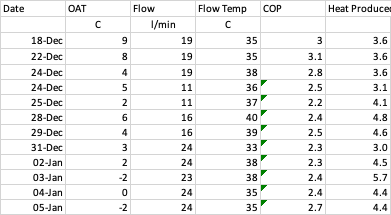
@sheriff-fatman New Year Greetings. Here is some of my data from over Christmas and New Year. I have been experimenting with flow rates, flow temperatures and a colder house. I have also looked at the heat produced
Here's the summary. As before a very disappointing COP value from the Mitsubishi Ecodan R290 10kW unit, making it expensive to run. As before I am using the data available from the Mitsubishi system and my Powervault system. The heat produced is in line with my experiences from last year when I had a gas central heating system.
My concern is that I am tinkering with a heat pump that doesn't come close to its manufacturers stated performance, e.g. a COP of 4.2 at 2C for 4.2kW of heat with a flow temperature of 35C. Still glad that I have 2 wood burning stoves.
@ecoste Interesting figures, thank you for sharing.
For context, my heating costs are 55% lower than last year's gas boiler usage, so I'm trying to tweak a system that is doing the job required, but for which the COP data is still 'bugging' me. It's possible mine is a reporting issue, for example.
Yours isn't providing the cost savings, but has better COP figures than mine in some points of that data, so there's a more fundamental concern to address. Common sense might suggest that I could step away from looking too deeply at my system and be content with the financial result, but I'm not the type to do sensible things like that . You don't have that option at present, so I can understand your frustration.
I hope you get the answers/resolution that you're seeking in due course. If I can provide anything to assist with that, from a data perspective, let me know.
130m2 4 bed detached house in West Yorkshire 10kW Mitsubishi Ecodan R290 Heat Pump - Installed June 2025 6.3kWp PV, 5kW Sunsynk Inverter, 3 x 5.3kWh Sunsynk Batteries MyEnergi Zappi Charger for 1 EV (Ioniq5) and 1 PHEV (Outlander) User of Havenwise (Full control Jun-Dec 2025, DHW only from early Dec) Subscriber to MelPump App data via CN105 Dongle Kit
@sheriff-fatman New Year Greetings. Here is some of my data from over Christmas and New Year. I have been experimenting with flow rates, flow temperatures and a colder house. I have also looked at the heat produced
Here's the summary. As before a very disappointing COP value from the Mitsubishi Ecodan R290 10kW unit, making it expensive to run. As before I am using the data available from the Mitsubishi system and my Powervault system. The heat produced is in line with my experiences from last year when I had a gas central heating system.
My concern is that I am tinkering with a heat pump that doesn't come close to its manufacturers stated performance, e.g. a COP of 4.2 at 2C for 4.2kW of heat with a flow temperature of 35C. Still glad that I have 2 wood burning stoves.
Quick query, but what is the Heat Produced column measuring in your data table? The only thing I can equate those number to is an hourly rate in kWh, but over what period is that being measured? Also, you have two results for 24th December. Is one of them a typo or are there two separate measurement periods on that day, and if so how long are the gaps.
I ask, because I've got a daily heat output of over 100kWh on each of the last 3 days (today being one of them) which I can't obviously relate to the numbers shown in your table but if I convert this to an hourly average then it lands in a similar ballpark to those figures.
130m2 4 bed detached house in West Yorkshire 10kW Mitsubishi Ecodan R290 Heat Pump - Installed June 2025 6.3kWp PV, 5kW Sunsynk Inverter, 3 x 5.3kWh Sunsynk Batteries MyEnergi Zappi Charger for 1 EV (Ioniq5) and 1 PHEV (Outlander) User of Havenwise (Full control Jun-Dec 2025, DHW only from early Dec) Subscriber to MelPump App data via CN105 Dongle Kit
@sheriff-fatman All data is the average of readings taken at 5 minute intervals over a period of about 2 hours during which the system was stable, e.g. no defrosting took place over the measurement period. I did take 2 sets of readings on 24 Dec, a few hours apart. The heat produced is the averaged instantaneous power, which is kW. So for example if the Jan 5th value of 4.4kW ran all day it would be 24*4.4=105.6kWHr of heat generated from 39.1kWHr of electricity.
@majordennisbloodnok This is some really good stuff. I wasn't aware of these integrations and they look like being a bit more targeted than the Forecast.Solar integration. We're also within a few miles of a METAR station. Being able to include some indication of local horizons is a big improvement on my current implementation. The value is, admittedly, a bit limited as I know that the actual solar gain at this time of year is effectively zero (east-west-north facing only, with buildings on all sides means we don't actually get any direct sun into the windows for most of winter), but it could certainly be useful come summer as we do get a lot of solar gain then.
Including a windchill correction is interesting, too, and I'll definitely be keeping an eye out for a correlation between wind speed/direction and indoor temperature. We're generally fairly sheltered, but when the wind is from specific directions, I think it can have a much larger impact.
@steelbadger, I’ve pretty much decided now that there’s an integration for everything and it’s just a matter of finding it. I tok started with solar radiance for estimating solar gain but didn’t find it directional enough. Now I’m in danger of installing interesting stuff and trying to find a use for it later; the tail wagging the dog never ends well….
105 m2 bungalow in South East England
Mitsubishi Ecodan 8.5 kW air source heat pump
18 x 360W solar panels
1 x 6 kW GroWatt battery and SPH5000 inverter
1 x Myenergi Zappi
1 x VW ID3
Raised beds for home-grown veg and chickens for eggs
"Semper in excretia; sumus solum profundum variat"
Just realised that this image of the cylinder cupboard also includes the location of the Ecodan's flow sensor (as I've just discovered from a part listing for it showing what it looks like, and realised that it looked familiar).
The yellow circled section is where Ecodan sensor for its reported flow rate data and, for reference, the green circled section is where the pump controller than I'm able to manipulate is located. They're on adjacent pipes, so presumably one is on the inflow pipe and one on the outflow, based on where these two pipes then lead into the loft area (as per the pictures on the previous post).
I hope that helps to clarify things in terms of the system setup. I've continued to run at the 16l/m reported flow rate since posting the original query, and this has been fine through several defrost and anti-freeze cycles over the last couple of days while running at outside temperatures as low as -4°C, so there are no obvious issues going this low so far. I potentially might extend the experiment further, incrementally, down to 10l/m (this being the low point of the recommended operational flow rates per the databook) but would likely do so when we're out of the current cold snap and not at risk of defrosts being required.
In the meantime, the only potential test might be to temporarily increase flow rate back to the original setting of 25l/m in a period of stable performance and temperature to see if I can demonstrate the difference in real-time COP between the two extremes so far.
130m2 4 bed detached house in West Yorkshire 10kW Mitsubishi Ecodan R290 Heat Pump - Installed June 2025 6.3kWp PV, 5kW Sunsynk Inverter, 3 x 5.3kWh Sunsynk Batteries MyEnergi Zappi Charger for 1 EV (Ioniq5) and 1 PHEV (Outlander) User of Havenwise (Full control Jun-Dec 2025, DHW only from early Dec) Subscriber to MelPump App data via CN105 Dongle Kit
Well I've now finally got round to knocking a small task off the list. Nothing I was talking about earlier on this list, but useful nonetheless.
As we all know, Octopus from time to time send out notifications of "saving sessions", whereby one earns Octopoints for energy not used during a given time period - typically an hour. This also happens to be provided through their API, thereby opening it up for a bit of automation in Home Assistant.
As a result, I've now set up three new automations:
One automation for spotting a new saving session that's been announced and automatically opting in.
One automation for putting the heat pump into holiday mode 15 minutes before the saving session's start time (the 15 minutes to allow wiggle room for smart meter offset).
One final automation for waiting until 15 minutes after the saving session's end time and then turning the heat pump's holiday mode back off again.
That means I should never miss a saving session again. Now, where's the "smug" emoji when you want one....
105 m2 bungalow in South East England
Mitsubishi Ecodan 8.5 kW air source heat pump
18 x 360W solar panels
1 x 6 kW GroWatt battery and SPH5000 inverter
1 x Myenergi Zappi
1 x VW ID3
Raised beds for home-grown veg and chickens for eggs
"Semper in excretia; sumus solum profundum variat"
@majordennisbloodnok you wouldn’t be smug if you had a Vaillant because the first task coming out of holiday mode is an anti-legggionaire DHW cycle up to 60+C, (sensible if you’ve been away for a while) So the unnecessary high heat would use all of the saving session benefits and it takes at least an hour longer for the heating to come on
2kW + Growatt & 4kW +Sunnyboy PV on south-facing roof Solar thermal. 9.5kWh Givenergy battery with AC3. MVHR. Vaillant 7kW ASHP (very pleased with SCOP 4.7) open system operating on WC
@judith, is that even when you use the Ebus integration for Home Assistant or just when you use Vaillant’s own app or wall box?
I agree it does make sense but if that’s the programmed behaviour it’d definitely need a modified approach for saving sessions.
105 m2 bungalow in South East England
Mitsubishi Ecodan 8.5 kW air source heat pump
18 x 360W solar panels
1 x 6 kW GroWatt battery and SPH5000 inverter
1 x Myenergi Zappi
1 x VW ID3
Raised beds for home-grown veg and chickens for eggs
"Semper in excretia; sumus solum profundum variat"
@majordennisbloodnok you wouldn’t be smug if you had a Vaillant because the first task coming out of holiday mode is an anti-legggionaire DHW cycle up to 60+C, (sensible if you’ve been away for a while) So the unnecessary high heat would use all of the saving session benefits and it takes at least an hour longer for the heating to come on
I didn't know that, what a sensible piece of programming on the part of Vaillant (but obviously not right for saving sessions!)
4kW peak of solar PV since 2011; EV and a 1930s house which has been partially renovated to improve its efficiency. 7kW Vaillant heat pump.