

Notifications
Clear all
Joining the Renewable Heating Hub forums is completely free and only takes a minute. By registering you’ll be able to ask questions, join discussions, follow topics you’re interested in, bookmark useful threads and receive notifications when someone replies. Non-registered members also do not have access to our AI features. When choosing your username, please note that it cannot be changed later, so we recommend avoiding brand or product names. Before registering, please take a moment to read the Forum Rules & Terms of Use so we can keep the community helpful, respectful and informative for everyone. Thanks for joining!
Air Source Heat Pumps (ASHPs)
306
Posts
12
Users
61
Reactions
25.4 K
Views

Topic starter
22/02/2026 11:03 am
I have found the setting which changes from rads to UFH so that looks like a good workaround if I need it. That said, coasting nicely at 35°C LWT presently and 21 indoors which is perfect.
I have slightly redesigned by dashboard with a selector at the bottom so I can easily change the above. This is the main dashboard I use for the control side of things. Strangely with weather comp turned off the WCC set outlet temp defaults to 255°C. No idea why.

I'm minded to keep it as it is for now and then just use off/on automations to trigger if OAT is milder (probably above 12°C or thereabouts)- as we are approaching the spring and slightly warmer weather.
22/02/2026 11:05 am
a few of the different modbus register overviews (I collected multiple from different Midea heat pump types and clones) have a statement about the registers we are talking about.
Ah, that is much clearer, my manual doesn't have the statement about registers 200-208 being read only. Your decision to implement those resisters as read only, and the reason you give for doing so, make very good sense.
Midea 14kW (for now...) ASHP heating both building and DHW

22/02/2026 7:44 pm
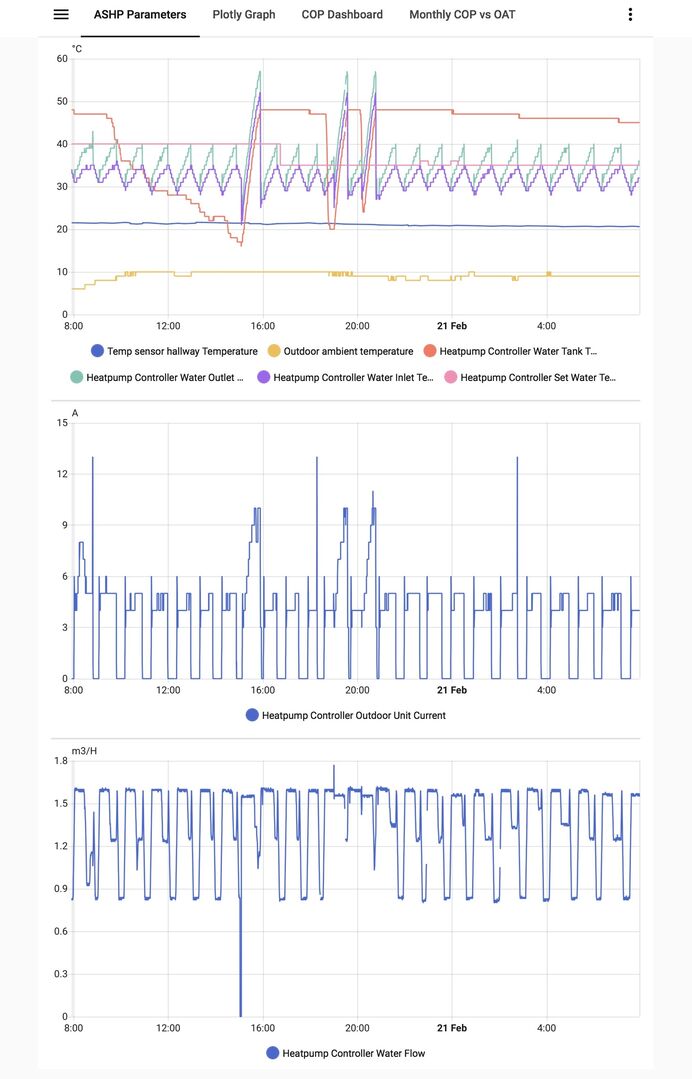
Please excuse my persistence, but I am struggling to understand what triggers the pump on-off. I presume it is some internal check or external signal. So, as a consequence to this, RWT approaches LWT, as there is no fluid motion. Would you agree ?
Midea MHCV10WD2N7 R290, 5.8kWp energy community solar power.
22/02/2026 8:45 pm
Please excuse my persistence, but I am struggling to understand what triggers the pump on-off. I presume it is some internal check or external signal. So, as a consequence to this, RWT approaches LWT, as there is no fluid motion. Would you agree ?
I don't think so. If you look at the bottom of the three charts, there there is always water flow, apart from one brief moment near the DHW spike. I have essentially the same pattern on my Midea charts. The step changes in water flow do appear to coincide with the on / off periods of the compressor (shown by the middle current chart) and the ups and downs of the LWT. But I don't think any of us has worked out exactly what the control logic is, or how it is implemented, which is to say we are all struggling!
Midea 14kW (for now...) ASHP heating both building and DHW
Topic starter
22/02/2026 9:02 pm
@tasos as above the pump is always running...
Thanks for the suggestion regarding the workaround to lower the set outlet flow temps below 35°C by changing to UFH. I did implement it today as running at 35°C was too warm. In true midea fashion however, when changing over from rads to UFH in the settings it then deactivated all of my DHW reheats! Which I only realised this evening....
I have now set up a notification automation which will alert me in turn via an app notification if the DHW schedule fails to turn on at the correct times, as a failsafe. This midea wired controller continues to conspire to make life challenging as soon as you touch any serviceman settings.
This post was modified 2 months ago by benson
23/02/2026 12:54 pm
@benson My system is a "simple" one: no DHW, no defrosts, no decontamination. So it is rather easy to decipher control logic. Would it be possible to see some data from a "simple" period of your heat pump ? i.e. just heating ?
Midea MHCV10WD2N7 R290, 5.8kWp energy community solar power.
Topic starter
23/02/2026 7:21 pm
@benson My system is a "simple" one: no DHW, no defrosts, no decontamination. So it is rather easy to decipher control logic. Would it be possible to see some data from a "simple" period of your heat pump ? i.e. just heating ?
@tasos the graph above from around 2100hrs shows the longest space heating run I'm going to have a plot for, without a DHW reheat. This is when LWT set point was 35°C.
23/02/2026 9:22 pm
@benson thanks a lot.
Midea MHCV10WD2N7 R290, 5.8kWp energy community solar power.
24/02/2026 1:57 pm
Hi all. I have made some progress regarding cause of cycling.
First thing I noticed, is that cycling is exaggerated when set LWT is less than 40 C. For example, have a look at this diagram:
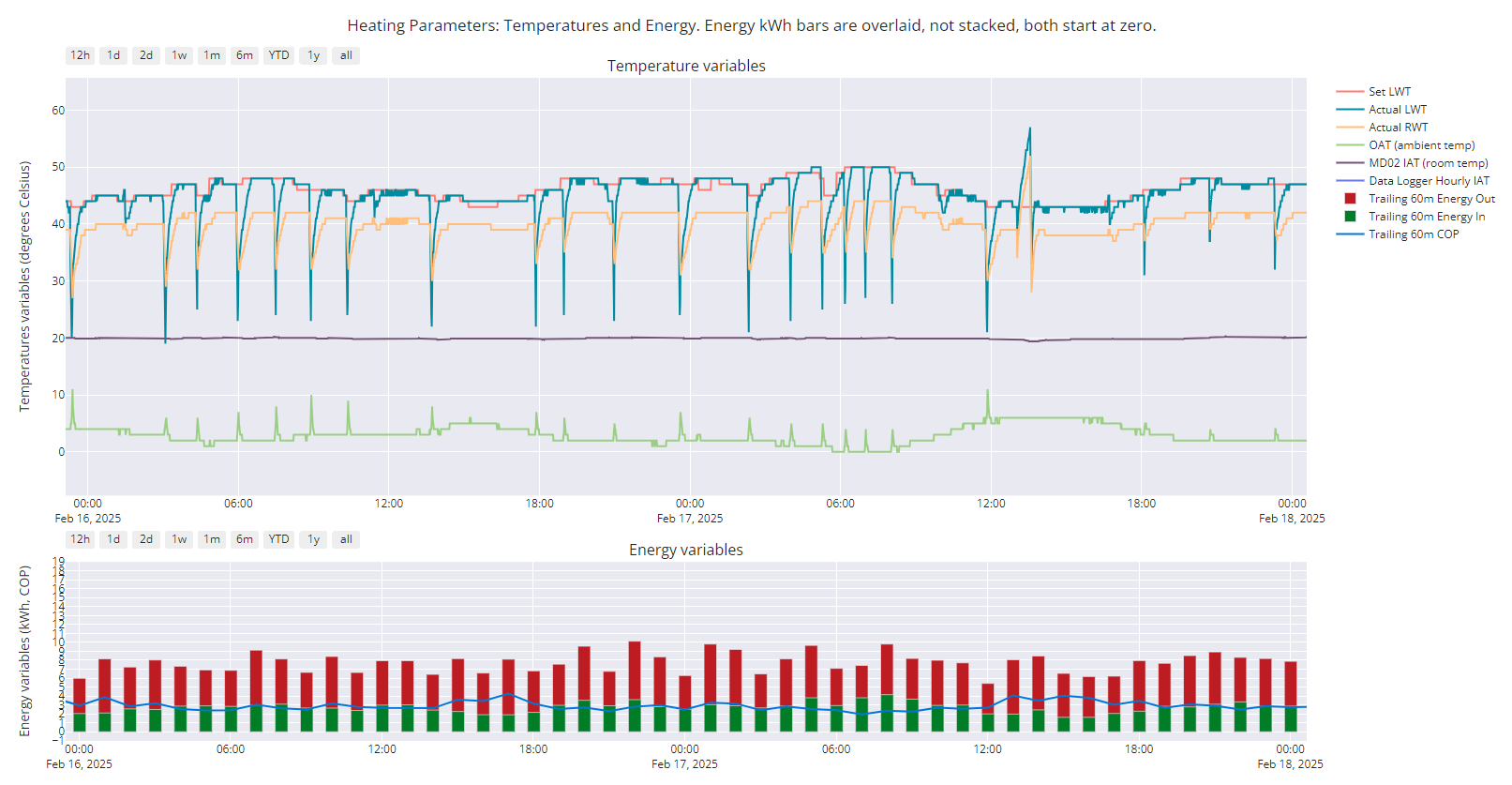
As you can see, as a result of OAT being below 10 C, set LWT is above 40 C and leaving LWT is around there.
However, in this diagram:
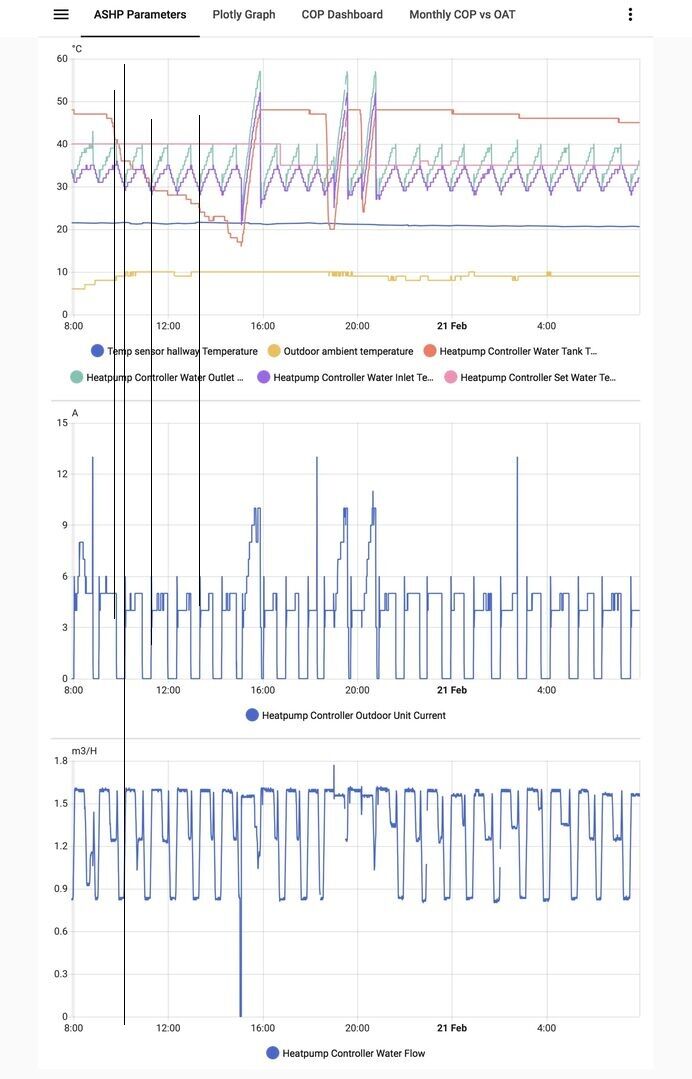
set LWT seems to be below 40 C, causing the system to cycle.
Now, why does this happen ? Well, I think because of "water temperature hysteresis of activating heat pump" logic:

coupled with lower LWT limit in heating mode (dT1SH is 5 C and lower LWT, 35 C for my setting).
To figure out the exact details, 1 minute plots of a couple of cycles would be very helpful.
This post was modified 2 months ago 2 times by Tasos
Midea MHCV10WD2N7 R290, 5.8kWp energy community solar power.
24/02/2026 7:06 pm
For example, have a look at this diagram
That is a very abnormal period, almost all defrosts (LWT below RWT) and two steady state runs (both afternoons, second one also has a DHW reheat). It is not normal Midea slow cycling, that chart tells you nothing about normal Midea cycling. It does tell you a bit about steady state running, when the actual LWT does approximate to the set LWT.
In the second chart, the OAT is mostly around 10°C, and that is in the normal slow cycling range.
Now, why does this happen ?
That is indeed the question those of us who are interested in this problem are asking! But I am not sure I understand your possible explanation yet...
To figure out the exact details, 1 minute plots of a couple of cycles would be very helpful.
My temperature charts are one minute plots, I can do a very zoomed on one (a couple of normal Midea cycles) for you if that would help, let me know.
Midea 14kW (for now...) ASHP heating both building and DHW

26/02/2026 12:16 pm
Just dropping a post here so that I will get updates from this thread and avoid pestering you with points already addressed. 🙂
1
Topic starter
04/03/2026 11:02 am
Now seems a good time to summarise the costs and efficiency side of things now that the higher usage months are out of the way. I will have to use the average outdoor temps as recorded by our [relatively] local weather station as I have no historical data for this, pre Sept 25.
It is worth summarising/highlighting the following perhaps:
-our ashp was up and running early to mid Oct 24 so homely had been set up for a few weeks by the time we reach the earliest comparison month below (Nov)
-we also generally have our IAT higher now than we did in the initial stages post install (probably averaging closer to 21.5 rather than 20.5).
-homely was removed around August 25. It was quite cold in our house for that first winter we had it as the max LWT had been set at 48 (the setting on OUR ashp which you cannot change unless you pester homely by email 😆 ) which wasn't sufficient to keep our house warm.
-I was spending a fair bit of Nov and Dec 25, having removed it and then using native controls, fiddling with the WCC settings to try and get them just right
-mid February was when I changed the control strategy from using WCC mode in the midea controller to using HA automations instead to set the outlet flow temp. This uses a similar method compared with our old WCC automations to slightly adjust LWT if IAT deviates from our comfort range. This is definitely the way to go if you have a wired controller like mine that will turn everything off when accessing serviceman settings- much better.
-whilst I thought pure WCC worked well initially, it is definitely a challenge on cold windy days so realistically I'm not sure this is a viable strategy unless you want to be monitoring and manually adjusting, or at least not for our house.
[Figures in bold are with homely removed]
November 2024 (average OAT 9°C): 675kWh. COP 3.77
November 2025 (average OAT 9°C): 684kWh. COP 3.78
December 2024 (average OAT 9°C): 824kWh. COP 3.87
December 2025 (average OAT 8°C): 928kWh. COP 3.74
January 2025 (average OAT 5°C): 1383kWh. COP 3.15
January 2026 (average OAT 6°C): 1230kWh. COP 3.37
February 2025 (average OAT 7°C): 1089kWh. COP 3.31
February 2026 (average OAT 8°C): 733kWh. COP 3.94
I appreciate that it isn't an exact science particularly with the average OATs as it depends if there has been a prolonged cold snap, more windy etc. Gives an idea though.
This post was modified 1 month ago 2 times by benson
1

Latest Posts
-
RE: Octopus Cosy Heat Pump Owners & Discussion Thread
Hush mode now released. I've not tried it yet. Should b...
By swwils , 1 hour ago
-
RE: Air-to-air heat pumps - best models and installers
Are you creating a whole new category for A2A?
By ASHP-BOBBA , 1 hour ago
-

RE: A2A vs A2W: Which Heat Pump Would You Pick?
There isn’t as far as I know, @djh, but you’re welcome ...
By Majordennisbloodnok , 14 hours ago
-
RE: Can anyone explain the following behaviour with a Grant Aerona 3 R30 / Smart Controller?
Final Update. Yesterday, I was going through the moti...
By Unsure , 15 hours ago
-

RE: How much can an east/west solar solar system be oversized?
Best performance occurs with PV string near inverter no...
By bobflux , 15 hours ago
-

RE: Forum updates, announcements & issues
Thank you Mars for all your dedication to improvements;...
By Toodles , 18 hours ago
-

RE: Who do I complain to about a poor ECO4 installation, can anyone advise?
Take it one step at a time. If you can get the dhw and...
By JamesPa , 1 day ago
-
RE: Selling 2 x Kensa Shoebox 7kw GSHP (New)
Hi Jain, we’ve got an ashp so I’m afraid we won’t be yo...
By Judith , 1 day ago
-
No buffer or low loss header Grant controller in sens...
By JamesPa , 1 day ago
-

RE: Are We Sleepwalking Into Another Race to the Bottom?
That's an amazing job to get all that in there! A truly...
By Batpred , 2 days ago
-
RE: Anyone concerned about GivEnergy?
Thanks for your advice - I'll keep trying with the inst...
By JohnDwyer , 2 days ago
-
RE: Plug and play solar. Thoughts?
I am also yet to find a case where an installation that...
By Batpred , 2 days ago
-
RE: British Gas vs Octopus Energy vs Heat Geek vs EDF vs Aira vs OVO vs EON.Next vs Boxt
This is what I got from OVO. At least it was quick.. ...
By Batpred , 2 days ago
-

RE: IVT greenline HT Plus E - Circulation Pump Constantly On
Welcome to the forums. Irrespective of which brand yo...
By Mars , 2 days ago
-
RE: 7.5kW Heat Loss, But Quoted a 10kW Midea. No Re-Pipe, No Buffer Tank. Does This Add Up?
Oh, how I love these old scientists!I'm in with your 5 ...
By LeJamaisContent , 2 days ago
-
RE: Jokes and fun posts about heat pumps and renewables
@jamespa Someone who is not easily phased I suppose.
By Toodles , 3 days ago
-
@downfield Once OE had removed our gas meter and capped...
By Toodles , 3 days ago
-
Living with a Low Loss Header (Or Measure For Measure, it’s All About the Pump)
I know, low loss headers (LLHs) aren’t necessarily ‘low...
By Toodles , 3 days ago
-
RE: What is the main ‘dictator’ of Agile’s unit price?
After seeing umpteen negative price slots again today, ...
By ChandyKris , 3 days ago
-
RE: The Reality Behind a Failed Heat Pump Installation – and an IWA Insurance Rejection
@ian-w Getting back to the problem in hand, what do yo...
By JamesPa , 3 days ago
-
RE: Solar Power Output – Let’s Compare Generation Figures
@papahuhu Generally, I leave Homely to take care of mat...
By Toodles , 4 days ago
-
@judith, glad you found the story interesting. On eff...
By Mars , 4 days ago