

Notifications
Clear all
Joining the Renewable Heating Hub forums is completely free and only takes a minute. By registering you’ll be able to ask questions, join discussions, follow topics you’re interested in, bookmark useful threads and receive notifications when someone replies. Non-registered members also do not have access to our AI features. When choosing your username, please note that it cannot be changed later, so we recommend avoiding brand or product names. Before registering, please take a moment to read the Forum Rules & Terms of Use so we can keep the community helpful, respectful and informative for everyone. Thanks for joining!
Air Source Heat Pumps (ASHPs)
15
Posts
5
Users
7
Reactions
2,766
Views

Topic starter
13/04/2026 8:15 pm
After what has now been a couple of months of research and getting quotes, work has finally begun
So far all the old radiators are out and about half of the news ones have been fitted to the wall (but not yet plumbed in)
New small consumer unit added in the plant room and power cable from the main consumer unit in the garage has been fed to it. There's a fuse for the immersion in the new Grant 250L DHW cylinder (yet to be plumbed in) and a second for the Grant R290 9kW, also yet to be plumbed in
Trunking has been laid out and a small bit of path around my house has been dug up (pipes needed to go overhead or under an outdoor step, I opted for going under). It's a short run to begin with and I didn't see the harm in going under a single concrete flagstone if it's insulated. Big name installers wanted to do a deep trench but also said they can't do a trench for such a small distance.
The heat pump itself has plenty of room around it whilst also being shielded from wind from all angles, and should also benefit from solar gains as it is in a south facing garden
Is there any checklist I can follow to ensure everything has been done properly? I don't want to bother the guys doing the work too much. I'm meaning to ask if they flushed or will be flushing the system (I kept a few old radiators and the existing pipework)

13/04/2026 8:45 pm
No buffer or low loss header
Grant controller in sensible place in house
No third party controls
Weather compensation adjusted
Radiators balanced
Explanation how to operate it, how to tweak the WC curve (because you will probably need to once it gets cold next season), how to change dhw temperature and timing.
Everything well insulated, outside insulation closed cell/waterproof
Freeze protection valves installed
Dirt filter installed and they should show where it is.
Ensure odu level and there is a route for defrost water to go away without causing a path to get icy.
System and controls diagram (possibly just the ones in the manual, but they should confirm which ones
All manuals including the installer manual to remain
Probably a few others that someone else will contribute.
This post was modified 6 months ago 2 times by JamesPa
4kW peak of solar PV since 2011; EV and a 1930s house which has been partially renovated to improve its efficiency. 7kW Vaillant heat pump.
1
Topic starter
17/04/2026 12:35 am
Okay, everything's done apart from a few things that they're coming back early next week to sort (damaged radiator grill, tidying up, etc)
There's no buffer/low loss header - just a volumiser. In the controller the hydraulic scheme has been set to direct.
Grant controller is in the cupboard with the heating, but I asked for a wireless thermostat which has been set as the primary temperature sensor source, and that is in a sensible location
Weather compensation is on but I don't know what a good place to start is for the curve, I think the installer lowered the curve already. I know how to change it so I guess just lower it until it's no good?
Outside insulation doesn't look to be closed cell but it is in some trunking. The exposed insulation between the trunking and heat pump (covering the flexi pipes) does appear to be closed cell/weatherproof. Is that sufficient?
Freeze protection valves are installed
Dirt filter installed
Magnetic filter installed
Condensate is piped to nearby flowerbed
I've got the manual
My questions for the forum are should the pipes inside the plant room (cupboard) be insulated? And there's an immersion but it's just plugged into a wall socket, switched off, not connected to the controller in any way. It's an R290 unit so I imagine I'll only need the immersion if I have an issue with the heat pump, but should it be installed to the controller regardless?
They've added a small consumer unit with a couple of fuses. Whilst I was out it already tripped at some point but I'm unsure when. My partnet said she did put the kettle on at some point, but that's on a different circuit and nothing else tripped. A bit concerning, I will bring it up with them
Oh and the fan seems to be really rather loud even in quiet fan mode? It's at 650 rpm, target temp 35c, outlet temp 34.3c, inlet temp 30.5c outside temp 11.c, inside temp 17.7c, target inside temp 20c, 1.5 bar, 23L/min flow rate. If I open any nearby windows, even slightly, it's obvious there's a large fan blowing a lot of air around outside
Edit: silent schedule was set but silent mode wasn't set to schedule! Quieter now!
I can't find a way to see how much power it's drawing yet, but looking at my house energy usage it seems to be over 1000W - is that reasonable for the above numbers?
This post was modified 6 months ago 2 times by petch
1
Topic starter
17/04/2026 1:39 am
So it turns out you can only see the power consumption, COP, etc. on the Aerona smart controller itself, not the econet24 web interface or mobile app
On the bright side, I've got a COP of 6 so far
1

Topic starter
17/04/2026 1:03 pm
Tripping apparently caused by Type B fuse, changed to type C I believe
My outstanding questions for the forum before I sign-off are:
Is polyethylene foam pipe insulation sufficient when inside trunking? Exposed insulation is of a different type
Should the pipes inside the plant room (cupboard) be insulated? They're currently exposed and my 250L DHW cylinder seems to be dropping around 0.3c per hour without use
Should the immersion heater be connected to the controller rather than just being something I can manually turn on if the heat pump is not working for whatever reason? By having no immersion heater set in the controller, the option for a legionnaire cycle is not there (despite it being an R290 ASHP)
Thanks
17/04/2026 1:51 pm
Should the pipes inside the plant room (cupboard) be insulated? They're currently exposed and my 250L DHW cylinder seems to be dropping around 0.3c per hour without use
Should the immersion heater be connected to the controller rather than just being something I can manually turn on if the heat pump is not working for whatever reason? By having no immersion heater set in the controller, the option for a legionnaire cycle is not there (despite it being an R290 ASHP)
Hot pipes connected to the cylinder should be insulated for at least 1m from the cylinder. 0.3 C/hr is 87W, what is the cylinder loss spec, this doesn't feel far out.
A legionella cycle should be possible and if it's not the system has not been wired correctly. It depends on the heat pump whether or not this requires the immersion (and thus a power control by the heat pump). My vaillant doesn't, legionella is done by the heat pump itself, so the immersion is standalone. Others use the immersion for the legionella cycle so normally need to be connected back to the heat pump. Grant do funny things though so it maybe that they supply a separate timer to be located by the dhw tank. You would need to ask the installers how legionella cycle is controlled.
Is polyethylene foam pipe insulation sufficient when inside trunking? Exposed insulation is of a different type
I can't comment authoritatively on this, can't see why not provided the inside of the ducting stays dry.
This post was modified 6 months ago 2 times by JamesPa
4kW peak of solar PV since 2011; EV and a 1930s house which has been partially renovated to improve its efficiency. 7kW Vaillant heat pump.
1
Topic starter
18/04/2026 1:46 am
Thanks @jamespa !
I've been reading the manual and tinkering with some settings. What I'm going to state might not be 100% correct so anyone who is familiar with this controller please correct me if I'm mistaken
I have a single, open loop circuit with a thermostat (in a sensible location) and outdoor temperature sensor
By setting the following settings
Circuit 1 Regulation mode to Weather
Circuit 1 Decrease water temperature to 3c
Circuit 1 Room temperature correction to 0
Circuit 1 Thermostat pump blockade to off
The system will continue to operate even when the thermostat is satisfied using the weather curve, but will reduce flow temperature by 3c until the thermostat drops below the hysteresis threshold (which is set to 0.3c)
Prior to these changes the thermostat was 'in control' and the system ran for roughly 2 hours then shut off for another 2 hours. Now it is running constantly and my house is being kept bang on 19c (my desired temperature). To be fair to my installer he did have most of this setup but I went and mucked around as a learning experience.
My only question regarding the settings is it possible to have the flow rate be reduced a little bit via software? I can see on the econet24 graphs the flow rate seems to change dynamically, but I'm sitting between 3-4c delta T at the minute and I believe it would be a little better with a slightly lower flow rate to get a delta T of 5?
18/04/2026 8:46 am
Now it is running constantly and my house is being kept bang on 19c (my desired temperature)
Well thats a win for starters. Enjoy! You may need tweak the WC settings during the height of the next season, but until then you cant really do so.
By setting the following settings
Circuit 1 Regulation mode to Weather
Circuit 1 Decrease water temperature to 3c
Circuit 1 Room temperature correction to 0
Circuit 1 Thermostat pump blockade to offThe system will continue to operate even when the thermostat is satisfied using the weather curve, but will reduce flow temperature by 3c until the thermostat drops below the hysteresis threshold (which is set to 0.3c)
I am not an expert on Grant controls so like you I rely on the manual (plus the fact I have read about 10+ manuals from different heat pumps and you soon get to realise that they are doing more or less the same thing just subtly different ways and with different terminology).
With that caveat I believe you are correct!
My only question regarding the settings is it possible to have the flow rate be reduced a little bit via software? I can see on the econet24 graphs the flow rate seems to change dynamically, but I'm sitting between 3-4c delta T at the minute and I believe it would be a little better with a slightly lower flow rate to get a delta T of 5?
Unless you are getting excess noise then dont bother. There is no harm in having a DT lower than 5, in fact it will slightly increase efficiency because it means you can operate at a slightly lower flow temperature for the same average emitter temperature. In any case you should expect DT5 only when its operating at design load (ie its very cold outside).
Hope that helps!
This post was modified 6 months ago 2 times by JamesPa
4kW peak of solar PV since 2011; EV and a 1930s house which has been partially renovated to improve its efficiency. 7kW Vaillant heat pump.
1


20/04/2026 9:06 am
I have a Grant Aerona 290 15.5kW. It is running really nicely, so I think you will be pleased with yours. I’m happy to help in any way I can, including a video call, if that would be useful.
Here is my list, some of which is also covered above:
- I am assuming you have inhibitor in the system and a magnetic filter.
- Hopefully, you have a new expansion vessel and valve. If not, make sure that it is not leaking.
- I had a Shelly Pro EM-50 installed in my consumer unit, so that I could monitor how much power the heat pump is using.
- Hopefully, you have the Econet24 phone app up and running.
- Schedule the heating to run 24 hours per day. If you have zones, run all of them all the time.
- Schedule the hot water to run in 1 hour slots 2-3 times per day. Don’t leave it on all the time, because the heat pump cannot run heating and hot water at the same time. DHW Priority should be set to Yes (check), so you don’t want it to interrupt the heating which reduces efficiency.
- Start with all your TRVs wide open. Adjust lock shield valves to balance temperatures across rooms.
- Your flow temperature looks a bit high to me, but time will tell. Weather compensation:
- Assuming you want the indoor temperature to be at 20C, for an outdoor temperature of 20C, set the flow temperature to 20C. This means it is neither cooling nor heating when it is 20C. From memory, this is Shift = 0.
- Your design document should tell you the target flow temperature when it is about -3C outside. Suppose it is 45C, then adjust the heating curve so that the flow temperature is 45C for an external temperature of -3C.
- In cold weather, Heating Curve is more significant. In warm weather, Shift makes more difference.
- Check the data history for each 24 hour period. You are aiming to minimise the number of compressor starts and stops, which you can see from the compressor frequency and outlet/inlet temperatures.
- Initially, adjust the heating curve, but don’t adjust Shift. Make small changes and then leave it to settle for 24 hours.
I hope this helps.
Grant Aerona 290 15.5kW, Grant Smart Controller, 2 x 200l cylinders, hot water plate heat exchanger, Single zone open loop system with TRVs for bedrooms & one sunny living room, Weather compensation with set back by room thermostat based load compensation
2

20/04/2026 6:31 pm
I had an initial estimate for a Grant HP, as we are looking to replace our old combi boiler. The price seems interesting, but I have not looked much at their range.
Our standard query, inspired on @jamespa is along these lines " We only want a simple system with weather compensation and a thermostat. We do not want any buffer (2 port volumiser acceptable) and no external heat exchanger between ODU (outdoor unit) and emitters, for max efficiency ".
This is what installers that are particularly interested in Grant included:
- Grant HP R290 65
- Grant Aerona Heat pump pack (no idea what this could include)
- Telford Tempest Short (cylinder, hopefully the 300L we want)
- ESBE MBA132 3-Way Diverter (they thought of splitting it from the pack)
I thought "who best than @grahamf to point if this could be missing much"? But please feel no pressure to respond..
8kW Solis S6-EH1P8K-L-PLUS hybrid inverter; G99: 8kW export; 16kWh Seplos Fogstar battery; Ohme Home Pro EV charger; Vaillant Arotherm Pro 7kW; 100Amp head, HA lab on mini PC
22/04/2026 10:33 am
On the bright side, I've got a COP of 6 so far
that’s pretty impressive. I cannot remember many pumps beating that..
8kW Solis S6-EH1P8K-L-PLUS hybrid inverter; G99: 8kW export; 16kWh Seplos Fogstar battery; Ohme Home Pro EV charger; Vaillant Arotherm Pro 7kW; 100Amp head, HA lab on mini PC
Topic starter
22/04/2026 10:55 pm
@grahamf thanks!
I'm unsure if there's inhibitor, I can double check but they seemed to know what they were doing. There's the mag filter and 2 new expansion vessels and one valve I believe
Econet24 up and running, I've spent way too long looking at it already
Single zone, and yes running 24/7
For now I've got a single DHW run overnight, I know this isn't the most efficient time but it's when my electricity is cheapest. So far it has held up just fine
Good advice on the lock-shield valves, I think I slightly oversized my living room radiator so I will try to balance them all
Here is how it has been running so far, I've had it set to quiet mode (level 2) which seems to limit the compressor/fan - although I've noticed the limited fan speed caused more defrosts overnight, so I've actually set a schedule on the quiet mode so that it turns off overnight during my off-peak electricity rates and hopefully needs to defrost less often. I still can't hear it inside when it's not on a quiet mode and it's not a problem for the neighbours either, but it is quite loud if you stand near it!
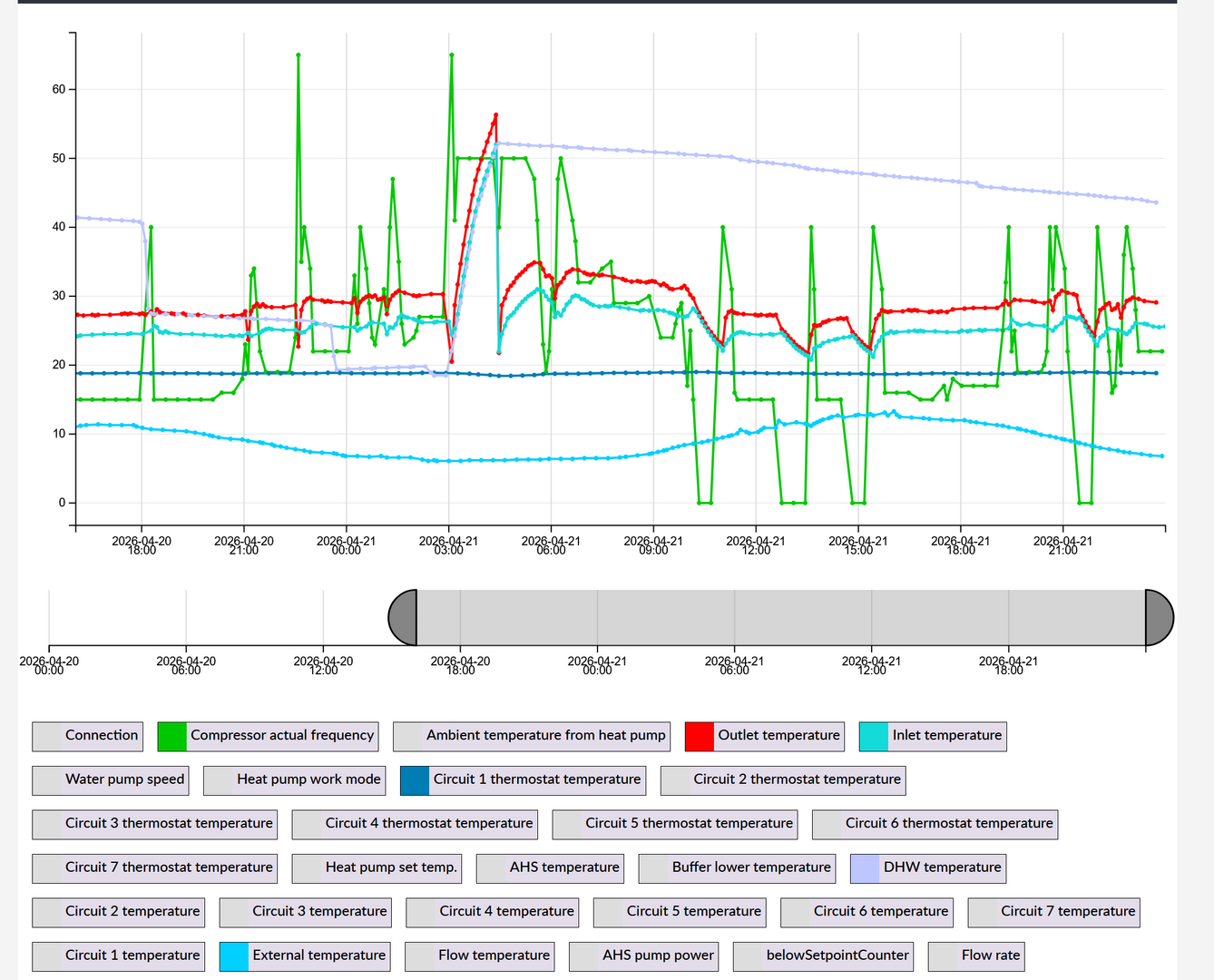
For Circuit 1 (the only circuit) I've disabled Thermostat pump blockade. Having that on seemed to make it behave like a traditional thermostat, where once temperature was met the system would shut off entirely until it falls below the hysteresis value. The only issue is that even when the pump is on standby (compressor & fan both off) the pump continues to run at about 11L/min, effectively cooling the radiators sooner... I don't see any way to stop this behaviour.
I'm also not entirely confident on what effect Decreasing fixed water temperature and Room temperature correction settings have when the pump blockade is disabled. If you, or anyone else, has knowledge here I'd love to hear it. Sometimes the unit goes into standby for 30 min when I'm not sure it needs to, like earlier this evening:
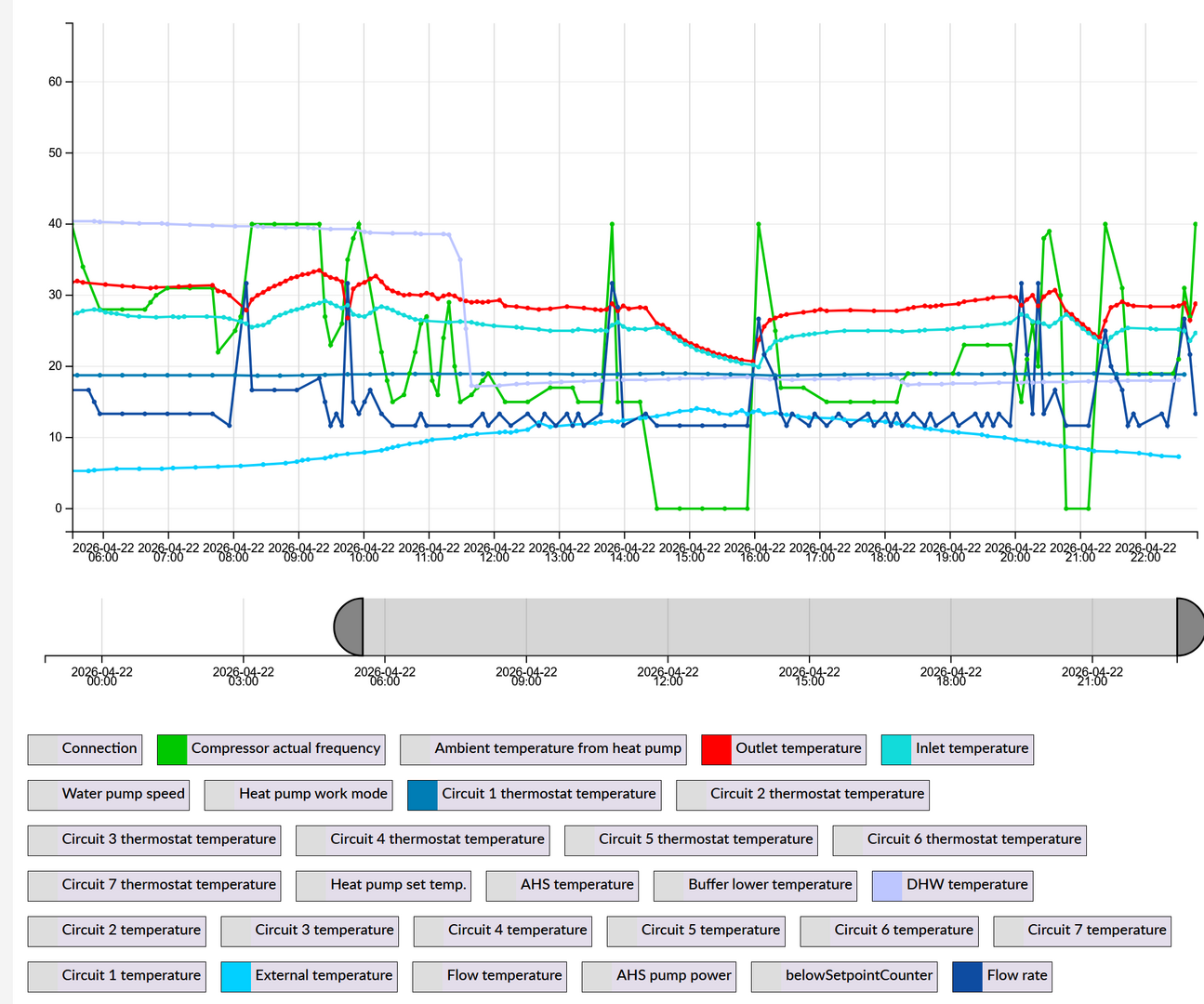
Ignore the low DHW temperature above... the thermostat is at the bottom of the cylinder and it didn't do a DWH cycle last night because I set the hysteresis too high. Despite being over a day since last reheat, it was still plenty hot enough for a shower!
I have changed the default fans speeds for idle/min/max to 25/30/100 (this is the lowest you can set idle/min without the setting being reverted). I don't know why, but minimum is 50% by default which was giving me a higher flow rate than I needed
@batpred I think its own COP rating is probably being a little generous, I'm relying on its own power consumption values which I don't know the accuracy of. It's also April so a favourable month overall for heat pumps.
This post was modified 6 months ago 2 times by petch

Page 1 / 2
Next
SPONSORS

Degrees of Separation

Latest Posts
-

RE: Heat pump branding. Clever, contemporary… or a bit too much?
I think Heat Geek have done an amazing job on their bra...
By Tomtheheatingengineer , 6 hours ago
-
RE: HeatGeek vs Octopus surveys: puzzling disparity - any ideas why?
I have just had 3 heat loss surveys, one by heat geek o...
By David , 6 hours ago
-
RE: Heat Geek Zero Disrupt: Are We Sleepwalking Into Another Race to the Bottom?
I think that's the key question. After all inverter uni...
By Prunus , 8 hours ago
-
RE: battery storage without solar
As of October 1st they need specific qualifications to ...
By EtchedPixels , 9 hours ago
-
RE: How should the Boiler Upgrade Scheme be reformed?
A unit which uses water to transfer the heat/chill from...
By Temperature_Gradient , 9 hours ago
-
RE: Renewables & Heat Pumps in the News
With regards to the BUS grant raid, I gave it more thou...
By ASHP-BOBBA , 9 hours ago
-
RE: Why are ASHP installs so expensive?
The whole system seems to work on the basis of...
By ian33a , 10 hours ago
-
RE: Missing flow temperature in Heat Geek proposal
Good plan. If you can get half hourly meter readings a...
By JamesPa , 15 hours ago
-
RE: Heat Pumps Without Grants: Would You Have Installed One & Will You Now?
@editor Most certainly. The heat pump was an ideal s...
By Abernyte , 15 hours ago
-
Although regulations may well vary from country to coun...
By Majordennisbloodnok , 16 hours ago
-
RE: Does anyone have experience of a smart water meter?
Yep I caught our slow leak from a £100 bill rise 8)
By EtchedPixels , 16 hours ago
-
RE: Do You Need a Buffer Tank or Low Loss Header for Underfloor Heating in a Large Property?
@jamespa in some cases, failing the Turing test might b...
By GrahamF , 19 hours ago
-
RE: Passiv Smart Thermostat - Help & Forum Support
@energystoragetech The heat capacity of some...
By JamesPa , 21 hours ago
-
RE: tepeo ZEB UK Support & Info Thread
Sorry you are correct, I was remembering figures from t...
By JamesPa , 1 day ago



SPONSORS
