Joining the Renewable Heating Hub forums is completely free and only takes a minute. By registering you’ll be able to ask questions, join discussions, follow topics you’re interested in, bookmark useful threads and receive notifications when someone replies. Non-registered members also do not have access to our AI features. When choosing your username, please note that it cannot be changed later, so we recommend avoiding brand or product names. Before registering, please take a moment to read the Forum Rules & Terms of Use so we can keep the community helpful, respectful and informative for everyone. Thanks for joining!
Heat Geek Zero Disrupt: Are We Sleepwalking Into Another Race to the Bottom?
I am however getting very high estimates from EDF and local installers, up to like £12k on top on BUS.
It is making me wonder if this is just not the time to get into it...
Could the quotes come down from the clouds into reasonable territory after a survey?
Unless there is something particularly difficult about your installation £12K plus BUS seems high IMHO although that's based on 2 years ago. It may be price gouging, or it may be just that they are cr*p installers who want to replace all sorts of things unnecessarily and add lots of unnecessary kit. Either way you probably don't want them. They may come down after survey, but I wouldn't bet on it. I got numbers up to 20K plus BUS and some totally silly suggestions for unnecessary replacement pipework, but ended up paying £5K (corrected figure in later edit) plus BUS. That was possibly particularly good; I did some of the building myself in fairness to expose the route for the primaries. However yours sounds potentially simpler than mine I cant see any reason that the timing is especially bad, but people in the industry may be able to comment.
Shop around, check Octopus, check HG zero disrupt, work out for yourself routing for pipework/wiring, particularly the pipework from outside to where the indoor pipes converge (presumably where the boiler is). If possible think through the job so they cant try to pull the wool over your eyes with loads of BS. Its worth doing this anyway to minimise disruption - you know your house better than even the best installer ever can.
Best of all work out exactly what you want and set it out for prospective installers giving them the option to suggest reasoned improvements of course. Many wont quote because they don't like to be told, those that do are the ones to work with because it means that they actually listen to the customer and, because they actually know their stuff, aren't frightened of customers that actually understand things.
Just my view of course, probably controversial.
This post was modified 6 months ago 4 times by JamesPa
4kW peak of solar PV since 2011; EV and a 1930s house which has been partially renovated to improve its efficiency. 7kW Vaillant heat pump.
@batpred - PS in case it helps here is the briefing I gave to suppliers when I was seeking quotes (there were some slight variants but this is the essential brief). Needless to say I got some questions back; I engaged with those where the questions were sensible and politely thanked the others for their time.
I am looking for a quote to supply and fit a 8-10kW heat pump and UVC (replacing a 140l vented cylinder), plus a small number of rad upgrades (4-6). I want a simple system operated on weather compensation with no buffer (2 port volumiser acceptable) and no external heat exchanger between ODU and emitters, for max efficiency.
I can provide: full dimensioned drawing, schedule of existing radiators, schedule of possible upgrades, measured consumption, likely pipe routes, and much more.
If you plug the 'MCS' default assumptions into the plan you will calculate a heat loss of approx 10.5-11kW however I have detailed consumption data for the past 2 seasons (which included an especially cold period in December 2022) showing that the actual loss (including an allowance for DHW heating) is ~7.5kW, The difference is believed to be accounted for by air change rate. My boiler output has been capped at 8.5kW for the past 18 months to prove the point.
Exiting primaries are 2*22mm (one each to first and ground floor) and 22mm to the DHW tank. These converge the existing boiler location in the garage. Existing rads have 15mm feeds so I dont believe any pipework upgrades are required.
Upstairs radiators, other than the bathroom, are already upgraded for 45C flow temp (or probably a bit less). Some downstairs rads will need upgrading
A location and probable pipework routes for the feeds from ODU to the point where the current primaries converge, and for the D2 drain for the UVC, have been identified. Full planning permission has been obtained including a screen which is (just) necessary to meet the MCS noise criteria. Any installation will need to conform to the conditions of this permission, the material ones of which are
The ODU is QuietMark and MCS certified
its dimensions is no greater than 1018 (H) x1270 (W) x533 (H) mm
its specified sound power does not exceed 60dB(A)
Preference will be given to machines with lower noise than 60dB(A).which look smart.
My default machine is the '7kW' Vaillant', which meets or betters all the technical and planning criteria, assuming one accepts the consumption data. However this is not set in stone, I just want a sensible, reasonably cost effective installation which I am hoping is not beyond the capability of the industry to deliver.
This post was modified 6 months ago 2 times by JamesPa
4kW peak of solar PV since 2011; EV and a 1930s house which has been partially renovated to improve its efficiency. 7kW Vaillant heat pump.
@jamespa
Thank you, these days I found that reputable local heating system installers all seem to use a common website calculator. It produces simple schedules and probably overprices…
In some cases, email is the way and there i can leverage something similar to what you used!
8kW Solis S6-EH1P8K-L-PLUS hybrid inverter; G99: 8kW export; 16kWh Seplos Fogstar battery; Ohme Home Pro EV charger; Vaillant Arotherm Pro 7kW; 100Amp head, HA lab on mini PC
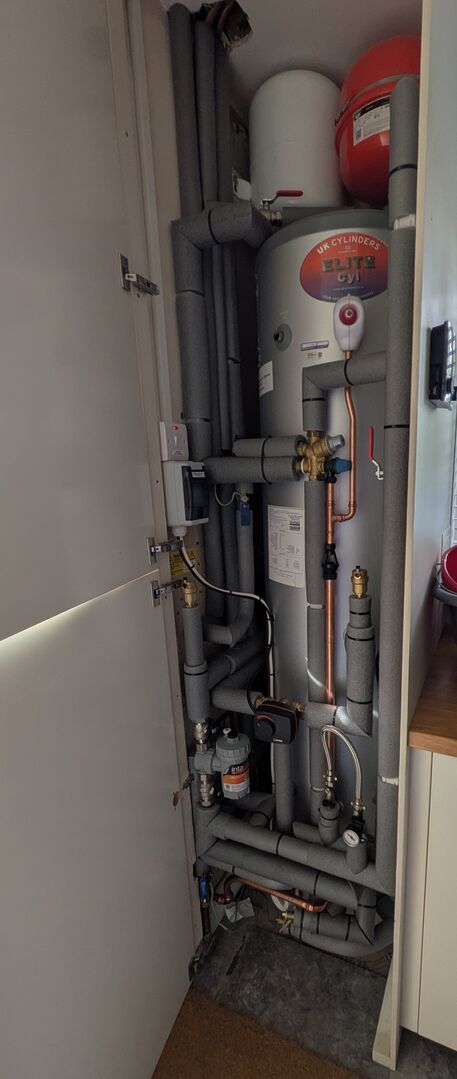
Our install officially finished a couple of weeks ago as we decided to re-pipe the old part of our house radiator circuit after the install, which added another £1000.
The total bill after the grant was £4200 (including the extra re-pipe).
We had a lot of work done, replacing 12 radiators, new cylinder, heat pump, volumiser and a chunk of electrics.
We too had ours fitted in the existing cupboard where the old gas boiler and megaflo were.
@bash Cor thats tightly packed in, obviously quite an agile plumber! Good price too.
@batpred if you have a short list of heat pump(s) you are selecting from, then most manufacturers have a list of accredited installers. Thats actually how I found mine. As it turns out he is very local but I didn't know about him until he popped up on a list of 3 provided by Vaillant. Some of these (including the one I ended up with) wont advertise much because they don't need to! Its another route to getting a spread of quotes which is never a bad thing.
This post was modified 6 months ago 2 times by JamesPa
4kW peak of solar PV since 2011; EV and a 1930s house which has been partially renovated to improve its efficiency. 7kW Vaillant heat pump.
@jamespa
For sure, hopefully nothing needs to be done to it for some while!
Thankfully we had some very experienced heating engineers, 3 of them for the week and an excellent electrician for 4 days.
We too had ours fitted in the existing cupboard where the old gas boiler and megaflo were.
That's an amazing job to get all that in there! A truly exceptional heating team... @jamespa I am using a range of approaches to find plumbers including the odd one we were recommended.
As for manufacturers, Bosch promised a design upfront, I will believe it when I see it!
8kW Solis S6-EH1P8K-L-PLUS hybrid inverter; G99: 8kW export; 16kWh Seplos Fogstar battery; Ohme Home Pro EV charger; Vaillant Arotherm Pro 7kW; 100Amp head, HA lab on mini PC
@batpred I would agree with your comment about flow temperature. The industry has latched on to this because a lower flow temperature results in a higher SCOP. The reverse is also true: a higher guaranteed SCOP is based on a lower flow temperature.
With my HG installation, I went for a minimum guaranteed SCOP of 4. The MCS Certificate confirms this to be the case at a max flow temperature of 45C.
The deciding factors for me were good installation feedback, and the guaranteed minimum SCOP. Irrespective of what is in a survey proposal, Ì am not aware of any installer other than Heat Geek that offers a performance guarantee.
I had similar concerns about the performance of one of my radiators at a gas flow temperature of 50C. It struggled to keep an open plan kitchen at the set temperature on very cold days. My Heat Geek installer looked at the K2 that was in situ and he upgraded it to a K3 as a customer option in the Heat Geek survey. I got him to agree to move the kitchen radiator to my dining room. Both these changes were a given before the HG survey was run. The survey came out at a £1700 cost to me (which included the two radiator changes) with a minimum SCOP of 3.7. Increasing the minimum SCOP to 4 (involving 5 new radiators and switching the lounge radiator to a main bedroom) cost another £1200.
We kept our existing Worcester Bosch unvented cylinder (£2000 to change) and it is producing an average efficiency of 3.2 (including the weekly disinfection cycle).
@l8again, that’s useful (I wanted to shift the conversation here), and I can see why the guarantee carried so much weight in your decision. What I’d really like to understand, though, is how that Heat Geek promise is checked once the system is installed and you’re living with it.
Is the efficiency being calculated from the heat pump’s own reported figures or did Heat Geek fit separate monitoring equipment to measure the electricity going in and the heat coming out? I’m also curious whether you can see the same information they use to assess the guarantee, so you, the installer and Heat Geek are all looking at the same numbers rather than trying to reconcile different readings.
Does your guaranteed minimum of 4 cover the heating and hot water together, or is it specifically for space heating, with hot water assessed separately? Your mention of the disinfection cycle made me wonder how any immersion-heater use, where applicable, is captured too... essentially, how closely the guaranteed figure reflects all the electricity you’re paying for to keep the house warm and provide hot water.
And finally who actually keeps an eye on it? Your installer, Heat Geek centrally or you as the homeowner? I’d be interested to know whether they proactively flag disappointing performance and arrange adjustments, or whether you need to raise it yourself, and what they’ve explained would happen if the system fell short over the agreed monitoring period.
What I’d really like to understand, though, is how that Heat Geek promise is checked once the system is installed and you’re living with it.
Well said.
A promised SCOP is potentially much more valuable to the householder than a promised flow temperature and potentially is a significant maturing of the industry which others should be following. By way of analogy, you dont ask how hot your car engine runs, you ask how many mpg or mpkWh it does!
However a promise is only valuable if it is measured and implemented in a reasonable way. I have yet to see a post where someone has 'claimed' on the Heat Geek guarantee, which may be very good news, or may not.
My suspiscion is that they monitor the Vaillant figures (they predominantly fit Vaillant), Thats potentially, at least arguably, good enough since they dont fit buffers or other miscellaneous efficiency sapping devices, but obviously not as good as a properly certified heat meter. The latter, however, is expensive and probably not readily justifiable,
No additional monitoring equipment fitted. Both Heat Geek HQ and my installer have remote access to my installation. I would assume that Heat Geek HQ's system would alert them to an issue; however, as you would expect, I am keeping a close eye on things and my installer is available for advice.
That said, I do have a concern about the warranty. This and other forums are full of advice on how to 'fiddle' with a heat pump's settings for maximum efficiency. The old adage of 'a little knowledge can be a dangerous thing' might apply if the homeowner played around with settings and ended up with poor efficiency; for example, setting an on/off schedule when Heat Geek's set up is constant heat pump operation on an open single zone system with weather compensation. Heat Geek could reasonably argue this is down to the customer playing around with the settings.
At the moment, I am running my heat pump as per the Heat Geek advice on a 0.2 Valliant heat pump curve with Active set (as we are still getting a lot of solar gain). I will need a full Winter to see how this pans out and I will ask for advice from my installer as needed.
My suspicion is that they monitor the Vaillant figures (they predominantly fit Vaillant), Thats potentially, at least arguably, good
It would be good to get that verified, because there’s a running joke among some engineers that Vaillant’s own efficiency readings can be rather generous. That’s not evidence in itself, but (with my cynical hat firmly on) it would be awfully convenient if those same readings were being used to confirm that an efficiency guarantee had been met.
That said, I do have a concern about the warranty. This and other forums are full of advice on how to 'fiddle' with a heat pump's settings for maximum efficiency. The old adage of 'a little knowledge can be a dangerous thing' might apply if the homeowner played around with settings and ended up with poor efficiency; for example, setting an on/off schedule when Heat Geek's set up is constant heat pump operation on an open single zone system with weather compensation. Heat Geek could reasonably argue this is down to the customer playing around with the settings.
In fairness Heat Geek would, in this case (setting an on/off schedule) have a reasonable argument. Its only reasonable to expect the guarantee to be valid if the householder operates the heat pump sensibly. What would not be reasonable is if they reject the guarantee because the householder has made a minor change.
At the moment, I am running my heat pump as per the Heat Geek advice on a 0.2 Valliant heat pump curve with Active set (as we are still getting a lot of solar gain). I will need a full Winter to see how this pans out and I will ask for advice from my installer as needed.
With those settings you should get a SCOP in excess of 4. I get 4 on a curve of 0.6. FWIW, during periods of high solar gain (basically 2-3 weeks at the extremes of the season) I use extended mode which basically uses the inbuilt temp sensor as a limiter. The rest of the time I use 'inactive'.
It would be good to get that verified, because there’s a running joke among some engineers that Vaillant’s own efficiency readings can be rather generous. That’s not evidence in itself, but (with my cynical hat firmly on) it would be awfully convenient if those same readings were being used to confirm that an efficiency guarantee had been met.
I did a bit of comparison early on with electricity consumption and expected heat demand and the Vaillant figures seemed to be good so far as I can tell. However I suspect there is some considerable variation both ways. The Vaillant measurement depends on comparing the output of two temperature sensors (to measure DT), which so far as I can tell from occasional posts here, are not calibrated. If DT is 5 then a 0.5C error (which lower grade thermistors may exhibit) is only 10%, if DT is 2 its 25%. If the system has been designed for a DT of 5 at design temp, then the DT will actually be 2-3 much of the time because Vaillant doesn't by default appear to modulate the flow rate for constant DT. Thus mismatched sensors could cause a fair error, either way of course! I believe its fairly easy to swap them round to check!
This post was modified 1 week ago 4 times by JamesPa
4kW peak of solar PV since 2011; EV and a 1930s house which has been partially renovated to improve its efficiency. 7kW Vaillant heat pump.