Joining the Renewable Heating Hub forums is completely free and only takes a minute. By registering you’ll be able to ask questions, join discussions, follow topics you’re interested in, bookmark useful threads and receive notifications when someone replies. When choosing your username, please note that it cannot be changed later, so we recommend avoiding brand or product names. Before registering, please take a moment to read the Forum Rules & Terms of Use so we can keep the community helpful, respectful and informative for everyone. Thanks for joining!
I also need to correct something I said by mistake earlier:
"Given the relationship between OAT and (power and) energy in is tolerably linear (energy out isn't because it is affected by changing efficiency)"
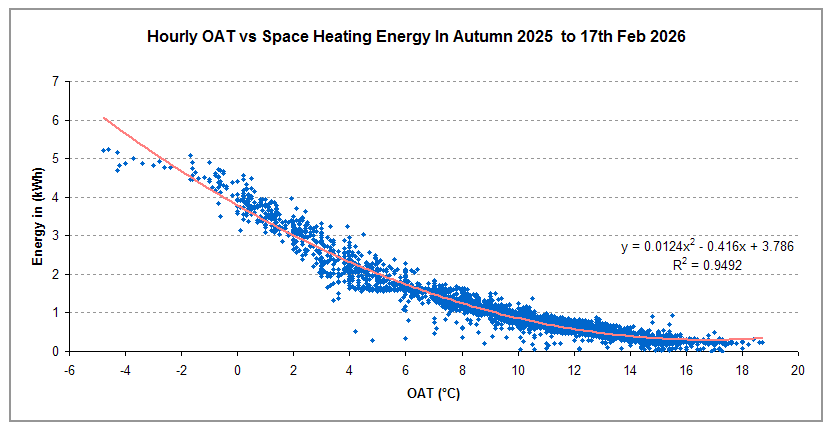
It is of course the other way round. The energy out (which is the heat loss) is tolerably linear, it is the energy in that is not linear, because as the OAT goes down efficiency goes down, and so disproportionately more energy is needed at lower OATs. The OAT vs energy in chart, to which I have now added autumn and winter 2025, should look like this:
Midea 14kW (for now...) ASHP heating both building and DHW
@robs — I am still not persuaded that you can take an observation at one OAT from one date, and then say because "the OAT was steady at 6C for multiple hours on the [the date] (so the requirements on the refrigerant circuit was the same), the WC curve unchanged and the IAT steady at the same temperature (so the load was the same), then the inputs to the controller algorithm would be the same and so the output (compressor speed) would be the same, and along with it the input power required" then when the same conditions apply at another time, the input power/energy will be the same.
The input power is largely determined by the compressor speed (it's by far the largest component) and that is set by the controller algorithm, which uses a limited set of inputs (sensors). If those inputs are the same then the same output (compressor speed) will occur. Exactly the same inputs isn't very likely but small differences should result in small differences to compressor speed and hence input power.
Here are a couple of more examples of multi-hour 6C stable running. The ~560W is the largest value of multi-hour stable running at 6C I've found.
The reason for thinking this is that at OATs when my heat pump does normally run in steady state, which happens to include include 6°C OAT, the energy in varies considerably. Here is a (reposted) chart showing steady state running for several hours at 6° OAT:
The 21:30ish to 01:00ish period shows stable running, with a stable compressor speed/frequency and input power despite the OAT slowly dropping. The period after 01:00 looks to be the controller algorithm finally reacting to the dropping OAT, although its reaction isn't a nice smooth ramp up that you'd have hoped for. Something odd happens just before 03:00 where your compressor frequency spikes up followed by your flow rate spiking up and then down - do you know what caused this?
Checking the underlying 2026 data, and excluding the DHW heating hour outlier, the range is 1.165 to 2.117 kWh. I can't explain this variation, but it is definitely there in the data. Same OAT, same WCC, steady IAT, the energy in should be the same, yet it varies by getting on for a factor of two. I think you need to confirm that your data doesn't show the same variations
If you are using periods of steady running then the size of the variation makes me suspicious, as it's too big to explain easily. How long a time period are you using to determine that the OAT is steady?
For periods of steady (multi-hour) running the variation I can find is only ~490W to ~560W (see above).
I suspect, but won't know until you do the plot and post it, that you will also see similar variations, caused in effect by unknown unknowns. If you don't see such variations, then I will have to take a long hard look at my system and its monitoring!
As above, for periods of stable running the variation is much smaller. If I was to include transiatory instances of an OAT of 6C then I might have a similar wide variation. But as I posted before, data from periods where the heat pump is ramping up or down doesn't tell us anything about the steady state.
The input power is largely determined by the compressor speed (it's by far the largest component) and that is set by the controller algorithm, which uses a limited set of inputs (sensors). If those inputs are the same then the same output (compressor speed) will occur. Exactly the same inputs isn't very likely but small differences should result in small differences to compressor speed and hence input power.
I fully understand your reasoning, same steady inputs should produce the same steady output, but even with your two steady state samples there is considerable variation, ~490W to ~560W, 70W variation. I agree that my much wider variation is because I included all hours when the mean OAT was 6°C and most of those were almost certainly not steady state periods. In fact, even the chart for the 13th/14th Feb with the apparent period of steady state running happened while the OAT was, as you note, dropping, from 7 to 4°C, so not really steady conditions, even if the heat pump behaved as if they were. In fact steady state conditions are extremely rare, as can be seen from this chart for the last month (arrows point to examples):
To get a steady state condition, the OAT has to be steady, obviously, but for a Midea unit it also needs to be in the 6 to 8°C range give or take, and the co-occurrence of both conditions is relatively rare. This means that even if I can establish what the steady state energy use is, almost all of the time it won't apply, ie I can't use it to predict expected use, because the unit is not in a steady state. For practical purposes in this thread, ie determining what happens during a setback, I think the pursuit of the ideal steady state energy use number becomes a bit of a red herring, because it only tells us about something that very rarely happens.
Which is probably why I moved away from observed vs expected approaches to comparing observations from setback and non-setback periods. The general idea is that if you have enough observations, then random variations (which are to be expected) will cancel themselves out. I still don't have enough data to do a meaningful analysis of last spring (with setback) and this spring (no setback) as we are only just over halfway through February at the moment but I might just be tempted to do an 'interim analysis' even though i probably shouldn't to see how things are shaping up.
Something odd happens just before 03:00 where your compressor frequency spikes up followed by your flow rate spiking up and then down - do you know what caused this?
No. Since it was the middle of the night, not a lot was going on, and we can see from the chart the temps were stable. Perhaps it just decided to have a hissing fit.
If you are using periods of steady running then the size of the variation makes me suspicious, as it's too big to explain easily. How long a time period are you using to determine that the OAT is steady?
As mentioned above, I used all hours when the mean OAT was 6°C, I am sure that explains the variation, and I didn't need define steady state. If I had to define it, I would suggest an absolute minimum of one hour, preferably two, possibly even three hours. But as hinted earlier, I suspect that in attempting to define a reliable steady state energy in value for for various OATs for my heat pump, which spends the vast majority of its time not in steady state, we are hunting a snark and are likely to end up with a boojum.
Midea 14kW (for now...) ASHP heating both building and DHW
I fully understand your reasoning, same steady inputs should produce the same steady output, but even with your two steady state samples there is considerable variation, ~490W to ~560W, 70W variation.
True there is a variation but importantly it's understandable. The ~560W value occurs before a defrost at 5C and so the ~560W is at the colder end of 6C (~5.5C). While the ~490W occurs when the heat pump is slowly reducing its output as the OAT is slowly rising and is at the warmer end of 6C (~6.5C).
In fact steady state conditions are extremely rare, as can be seen from this chart for the last month (arrows point to examples):
To get a steady state condition, the OAT has to be steady, obviously, but for a Midea unit it also needs to be in the 6 to 8°C range give or take, and the co-occurrence of both conditions is relatively rare.
I see what you mean, if your system only runs continuously within a 6-8C OAT window then steady state will be rare. But our system is the polar opposite, cycling is very rare and it's just defrosts that break the continuous running in the winter. Our system will run without cycling from 6C up to around 14C, so this makes using steady state values much easier.
Which is probably why I moved away from observed vs expected approaches to comparing observations from setback and non-setback periods. The general idea is that if you have enough observations, then random variations (which are to be expected) will cancel themselves out.
Understandable, but if almost all of your data is non-steady state then how applicable your results will be to others needs some thought.
I still don't have enough data to do a meaningful analysis of last spring (with setback) and this spring (no setback) as we are only just over halfway through February at the moment but I might just be tempted to do an 'interim analysis' even though i probably shouldn't to see how things are shaping up.
Despite my comment above, it will be interesting to see what your results are.
This post was modified 3 weeks ago 2 times by RobS
True there is a variation but importantly it's understandable. The ~560W value occurs before a defrost at 5C and so the ~560W is at the colder end of 6C (~5.5C). While the ~490W occurs when the heat pump is slowly reducing its output as the OAT is slowly rising and is at the warmer end of 6C (~6.5C).
This illustrates what I am getting at, even apparent steady states aren't really steady states. A building including its occupants, its immediate environment and its heating system are all in a constant state of flux. Heisenberg's uncertainty principle starts to apply, the more you pin down the observations to a moment in time, the less you know about the system as a whole. This is why I favour looking at longer periods. A day (or more accurately a 24 hour interval, say noon to noon) is one such sensible interval that we humans intuitively understand, a season is another. Over those intervals 'stuff happens', and what we are interested in is the cumulative, or net, effect of all that stuff happening. We can then start to ask what happens when we influence how that stuff happens eg by running with or without a setback.
But our system is the polar opposite, cycling is very rare and it's just defrosts that break the continuous running in the winter. Our system will run without cycling from 6C up to around 14C, so this makes using steady state values much easier.
This raises the obvious question, is your system (a Mitsubishi I believe) somehow better than mine, a Midea? The kitchen table assumption has it that cycling is somehow a bad thing, and short cycling (several times an hour) almost certainly is a bad thing, but is Midea long cycling (around once an hour) also a bad thing? I'm not sure it is. If it were so, then it would almost certainly become obvious that heating a building with a Midea unit was more expensive than heating a like for like building in the same climate with a Mitsubishi unit, and I don't think that has happened. Or maybe we just haven't looked.
In passing, being able to avoid cycling for modulation up to around 14°C OAT is impressive (so long as one accepts that not cycling is a good thing). Does your particular unit have a particularly low lower end ie minimum output?
Understandable, but if almost all of your data is non-steady state then how applicable your results will be to others needs some thought.
This has been covered so often that I now tend to consider it taken as read. Yes my results are the results from a n=1 study, and there is no assumption that they apply to anyone else's system. But (a) they may establish some general principles, and (b) they certainly expose the methodologies used to investigate these things to considerable scrutiny. For example, I started out thinking an observed vs expected method was likely to be useful and effective, but I now think that approach is flawed not because the logic is flawed, it isn't, but because of the extreme difficulties in establishing what the expected value should be. With hindsight, that revised position is entirely consistent with my general position, that only fools and horses use whatiffery (modelling) in complex messy dynamic systems. The problem is the unknown unknowns screw things up. This is why I now favour an approach that avoids any form of modelling at all, and rely only on observations, no whatifs whatsoever.
I am not bothered by the fact the data is non-steady state, it is what it is, this is what it does, and this is what I am therefore interested in. As I say, I avoid the problem of modelling non-steady state systems by not using modelling.
Despite my comment above, it will be interesting to see what your results are.
Indeed, I think they may be interesting. I have done an interim analysis (allowable I suggest in the circs) and there is a clear hint that setbacks do not save energy/money. Because of the limitations imposed by stuff happening, notably 'big bang' (opening up all my lock shield valves, which had a major beneficial impact on low OAT output) in late January last year, and the need to compare like with like, I can only reasonably compare periods entirely before or after big bang. I did indeed do this for 2025, comparing the post big bang spring which had setback running with the autumn which had no setback running, and the results were inclusive. There may have been some savings at lower OATs, maybe not, It is also very much the case that while spring and autumn may have have similar daily mean OATs, a lot of other variables, things like ground temperature, are not the same. The best comparison is a like season for like season comparison, and that is what I have now done, comparing spring 2025 post big bang setback running with spring 2026 to date running without a setback. The number of samples is relatively small, and the range of OATs covered vary, but this is what I get when I plot daily mean OAT against daily energy use:
The lack of 2025 low OAT readings (happened because the setback period only started in late February) is a problem, but for more moderate mean daily OATs over 4-5°C, which usefully is most of the time, even a visual inspection strongly suggests there is no difference in energy use between setback and no setback running. I haven't run these data through R to get confidence intervals yet, and won't do so until I have the full Spring 2026 data set, but I think we can see where it's heading.
Midea 14kW (for now...) ASHP heating both building and DHW
With hindsight, that revised position is entirely consistent with my general position, that only fools and horses use whatiffery (modelling) in complex messy dynamic systems
I am not sure where you draw the boundaries of 'whatiffery', but I think we can be certain that we will need some theorising, whether numerical or analytical, to answer the question in the title of this thread (Setback savings - fact or fiction? not Setback savings - fact or fiction for a particular specified system).
I don't dispute the value of n=1 results, but, to draw any conclusions which are more generally applicable (and thus answer the question even partially) we either need a mechanism to explain the results (ie some theory) or a large statistical sample of systems, which we aren't going to get (Octopus and Aira might) and anyway isnt n=1! I think you would acknowledge this.
There is an obvious mechanism for setback savings of 0-10% (but typically ~5%). There are also fairly obvious mechanisms for negating or indeed reversing these savings. I don't yet know of any mechanism to explain savings of 20+% which are sometimes claimed, unless the house in question has the thermal characteristics of a tent, or the setback is quite extreme. That doesn't mean that there isn't one, just that I don't know of one.
@cathoderay your latest data seems qualitatively different, is this because of condition matching or something else.
This post was modified 3 weeks ago 3 times by JamesPa
4kW peak of solar PV since 2011; EV and a 1930s house which has been partially renovated to improve its efficiency. 7kW Vaillant heat pump.
True there is a variation but importantly it's understandable. The ~560W value occurs before a defrost at 5C and so the ~560W is at the colder end of 6C (~5.5C). While the ~490W occurs when the heat pump is slowly reducing its output as the OAT is slowly rising and is at the warmer end of 6C (~6.5C).
This illustrates what I am getting at, even apparent steady states aren't really steady states.
It's close enough to steady (+/- 35W) to get reasonably accurate steady state values, that can then be used to calculate what happens if something happens or doesn't happen like a defrost. Or at least good enough to "establish some general principles".
Heisenberg's uncertainty principle starts to apply, the more you pin down the observations to a moment in time, the less you know about the system as a whole.
Defrosts are a short duration events, so you don't need to know the "system as a whole", just what the system would do if a defrost didn't happen.
This is why I favour looking at longer periods. A day (or more accurately a 24 hour interval, say noon to noon) is one such sensible interval that we humans intuitively understand, a season is another. Over those intervals 'stuff happens', and what we are interested in is the cumulative, or net, effect of all that stuff happening. We can then start to ask what happens when we influence how that stuff happens eg by running with or without a setback.
But if we want to know if defrosts use more/less/equal energy then data from >5C isn't going to help much. But then you seem to have switched back to the set back question, where I think the general consensus is already that matched observations are the most practical approach.
This raises the obvious question, is your system (a Mitsubishi I believe) somehow better than mine, a Midea? The kitchen table assumption has it that cycling is somehow a bad thing, and short cycling (several times an hour) almost certainly is a bad thing, but is Midea long cycling (around once an hour) also a bad thing? I'm not sure it is.
Yes it's a Mitsubishi. Looking at the chart you posted on the 19th and the period of cycling on the 13th, which seems to be approximately 2/3 on and 1/3 off, this seems to be caused by your emitters (secondary circuit) not shedding enough energy and so the return temperature rises, when it rises to the set temperature the controller cycles the heat pump off. Is this bad once an hour at 8-10C OAT, probably not. Does it use more energy than continuous running, maybe (does the time off save enough energy to offset the ramp up and over shoot of the on periods?). Can I ask how frequent are the cycles at greater OATs like 15C?
If it were so, then it would almost certainly become obvious that heating a building with a Midea unit was more expensive than heating a like for like building in the same climate with a Mitsubishi unit, and I don't think that has happened. Or maybe we just haven't looked.
I don't think anyone has done that comparison to know one way or the other.
In passing, being able to avoid cycling for modulation up to around 14°C OAT is impressive (so long as one accepts that not cycling is a good thing). Does your particular unit have a particularly low lower end ie minimum output?
It has a larger than usual modulation range due to having two compressors.
This has been covered so often that I now tend to consider it taken as read. Yes my results are the results from a n=1 study, and there is no assumption that they apply to anyone else's system. But (a) they may establish some general principles, and (b) they certainly expose the methodologies used to investigate these things to considerable scrutiny.
It's not n=1 but if you can establish general principles from such data, is it too atypical?
For example, I started out thinking an observed vs expected method was likely to be useful and effective, but I now think that approach is flawed not because the logic is flawed, it isn't, but because of the extreme difficulties in establishing what the expected value should be.
Establishing such values with a system that doesn't cycle much (if at all) is somewhat easier that with a system that cycles almost all the time.
With hindsight, that revised position is entirely consistent with my general position, that only fools and horses use whatiffery (modelling) in complex messy dynamic systems. The problem is the unknown unknowns screw things up.
The heating system of a house isn't really very complex though and has a quite limited dynamic range, so to produce usable results modelling doesn't need an exceptional level of fidelity. Also as humans have been heating their homes for millenia there aren't many unknown unknowns.
Indeed, I think they may be interesting. I have done an interim analysis (allowable I suggest in the circs) and there is a clear hint that setbacks do not save energy/money.
... but for more moderate mean daily OATs over 4-5°C, which usefully is most of the time, even a visual inspection strongly suggests there is no difference in energy use between setback and no setback running. I haven't run these data through R to get confidence intervals yet, and won't do so until I have the full Spring 2026 data set, but I think we can see where it's heading.
Thank you for sharing your interim analysis. It is interesting to see how you data gathering is going and what the early data suggests.
I am not sure where you draw the boundaries of 'whatiffery'
I did say (but didn't call it a boundary): "that only fools and horses use whatiffery (modelling) in complex messy dynamic systems" which certainly includes much of epidemiology — look at the track record for epidemic/pandemic mortality predictions for example* — but also it seems things like n=1 heat pump installations, insofar as we don't yet have a working model. I also accept that we don't as yet, have a satisfactory empirical result.
I don't dispute the value of n=1 results, but, to draw any conclusions which are more generally applicable (and thus answer the question even partially) we either need a mechanism to explain the results (ie some theory) or a large statistical sample of systems, which we aren't going to get (Octopus and Aira might) and anyway isnt n=1! I think you would acknowledge this.
I do, and nothing has changed, I have said it many many times. I just get bored of repeating n=1 is shorthand for my results only apply with certainty (if that, because I get different results at different times) to my property in the conditions in which the data was collected! But at the same time, I can't rule out there may be some general truths even in a just n=1 study. And furthermore, unless the study is obviously absurd, n=1 is better than n=0.
I also agree we need to have some understanding of how and why we get the results and conclusions we do if we are to apply them more widely. Otherwise, we just have a black box, with no sense check.
your latest data seems qualitatively different, is this because of condition matching or something else.
I very much agree they appear qualitatively different. This hasn't happened because of matching, I didn't do any. The plot is just all the data I have to date from the relevant periods. But it may be the first occasion when I have done a significantly better like for like comparison: same settings, same season, only known significant difference being whether I had a setback running in place or not.
Clearly I need to explain this qualitative difference as best I can. I intend to do some more analyses that are as like for like as possible.
* Inevitably it gets complicated, but consider this reasonably unhysterical article in what is at times a very hysterical field. You have to remember that when an academic predicts "50 to 50,000 human deaths", most politicians only hear one number, 50,000 deaths.
Midea 14kW (for now...) ASHP heating both building and DHW
The heating system of a house isn't really very complex though and has a quite limited dynamic range, so to produce usable results modelling doesn't need an exceptional level of fidelity. Also as humans have been heating their homes for millenia there aren't many unknown unknowns.
Only we have so far not managed to produce a model that works across the board. Sure, humans humans have been heating their caves for a very long time, but it is only recently they have started taking measurements and doing physics. And there just may be some unknown unknowns, because, well, they are by definition unknown!
Looking at the chart you posted on the 19th and the period of cycling on the 13th, which seems to be approximately 2/3 on and 1/3 off, this seems to be caused by your emitters (secondary circuit) not shedding enough energy and so the return temperature rises, when it rises to the set temperature the controller cycles the heat pump off. Is this bad once an hour at 8-10C OAT, probably not. Does it use more energy than continuous running, maybe (does the time off save enough energy to offset the ramp up and over shoot of the on periods?). Can I ask how frequent are the cycles at greater OATs like 15C?
The on / off ratio appears to vary, while the frequency, around once an hour, appears to stay the same. Here's a snapshot from when the OAT was around 15°C (big spike is DHW heating):
The on /off ratio has pretty much reversed, on for one third off for two thirds, perhaps even less on to off. Maybe that behaviour (changing the ratio) is part of the control logic. I'm not sure why you think the explanation is the emitters are unable to shed enough energy. They shed enough to the rooms to the desired IAT, the problem, if it is one, seems to be that the Midea unit is over-keen, and over heats the LWT, and as a result turns itself off to, it seems, achieve a mean LWT close to the set LWT. Furthermore, this 'normal cycling' seems to be the normal way these units work, and it is unlikely that most Midea systems have under-sized emitters. I think the more likely explanation is that these units are designed to run like this. Why this is so is certainly an interesting question, at least for Midea and Midea clone owners who are interested in such things.
More generally, yes I have returned to the question of overnight setbacks, as that is what the thread is primarily about. But that doesn't mean we have to stop looking at defrosts and other similar events.
Edit: @robs you may also be interested to have a look at this post if you haven't already seen it, shows another Midea clone (Clivet) doing normal Midea cycling.
@robs — thank you for your as ever valuable comments. The only one I might quibble with is this one:
Only we have so far not managed to produce a model that works across the board. Sure, humans humans have been heating their caves for a very long time, but it is only recently they have started taking measurements and doing physics. And there just may be some unknown unknowns, because, well, they are by definition unknown!
@cathoderay - thanks for an interesting discussion!
The heating/building industry doesn't but science/engineering isn't so limited. Modelling heat transfer (via conduction, convection and radiation) is well understood, so too are thermal properties of materials, solar radiation and wind effects can be modelled accurately, heating from humans/animals and from equipment is a subset of heat transfer modelling. How recent is recent? Romans understood heating well enough to use underfloor hot air heating and passive solar heating in their baths, and that was around 2000 years ago. I'd suggest that there are no unknown unknowns that would have an effect sufficient to materially affect any macro (i.e. not micro or nano) level analysis. It is just we are not experts in the field and so are still learning.
The on / off ratio appears to vary, while the frequency, around once an hour, appears to stay the same. Here's a snapshot from when the OAT was around 15°C (big spike is DHW heating):
The on /off ratio has pretty much reversed, on for one third off for two thirds, perhaps even less on to off. Maybe that behaviour (changing the ratio) is part of the control logic.
Thanks for the chart and description, it's logic to control cycling seems to be based on a fixed one hour period with variable on/off durations, which seems to work quite well!
I'm not sure why you think the explanation is the emitters are unable to shed enough energy. They shed enough to the rooms to the desired IAT, the problem, if it is one, seems to be that the Midea unit is over-keen, and over heats the LWT, and as a result turns itself off to, it seems, achieve a mean LWT close to the set LWT. Furthermore, this 'normal cycling' seems to be the normal way these units work, and it is unlikely that most Midea systems have under-sized emitters. I think the more likely explanation is that these units are designed to run like this. Why this is so is certainly an interesting question, at least for Midea and Midea clone owners who are interested in such things.
I think that because your charts show the signs of your emitters being unable to transmit the energy supplied to them into your house or, as you have a plate heat exchanger, insufficient energy transferred across to the secondary circuit.
But let's start with a period of steady state for comparison:
The LWT rises and overshoots the set LWT a little but is then modulated back, this is typical of many/most heat pumps. The heat pump then runs non-stop for almost 6 hours, which shows that the Midea controller logic is similar to other manufacturers logic and won't cycle the heat pump unless it needs to.
Zooming out to show the above period and a one hour cycle that occurred earlier at a greater OAT:
You can see that the peak LWT of the one hour cycle is approximately the same as the LWT during the non-stop period even though the OAT was ~3C greater and so the set LWT lower. Your chart for ~15C OAT clearly shows that your heat pump is capable of producing cooler LWTs, so heat pump modulation doesn't seem to be the cause of the greater than set LWT flow temperature. So if the heat pump can modulate down and produce cooler water (at under 40C) but it doesn't then something else is happening, and the RWT rising all the way up to the set LWT shows heat isn't being removed from the primary circuit.
I hope that explains my thinking, I could be wrong of course but the signs are there.
Edit: @robs you may also be interested to have a look at this post if you haven't already seen it, shows another Midea clone (Clivet) doing normal Midea cycling.
Thanks for the link. The owner of that system described it as: "160sq m house, ... with estimated heat losses just under 8kW and a 12kW Clivet (midea) installed". A 12kW heat pump heating a <8kW house at mild(er) OATs is likely to cycle simply because the heat pump can't modulate low enough. Also, the chart in that post shows the set LWT was reduced from 40C to 35C at about 16:30 but the heat pump didn't react to the change and still produced LWT of 40C, which suggests that it wasn't using WC or it has a minimum flow temp setting of 40C (which is rather high).
Romans understood heating well enough to use underfloor hot air heating and passive solar heating in their baths, and that was around 2000 years ago. I'd suggest that there are no unknown unknowns that would have an effect sufficient to materially affect any macro (i.e. not micro or nano) level analysis. It is just we are not experts in the field and so are still learning.
Monty Python may have asked 'what have the Romans ever done for us?' but I agree, the Roman achievements are impressive but I suggest they got there empirically, by trial and error, rather than by using theory maths and models (mathematical not physical). I have no doubt they knew that hot air rises, but the units joule and the watt have only been around for 200 years or so, and without the units, you can't do the maths. As a bit of curious trivia, here is the google ngram for the two words joule and watt:
It seems the 1500s and 1600s had lots of watts, and even the occasional joule, but I wonder if that may have been because at least English spelling had yet to be standardised, and 'what's up doc' could just as well have been written as 'watt's up doc'.
Likewise the key concepts and equations eg heat transfer that we use today only appeared in the 1800s, though there were some preliminary discoveries in the 1700s, notably the concepts of heat capacity and latent heat, and a gradual appreciation of the nature of heat itself as we understand it today.
But I do accept that even with only 200-300 years of history (plus perhaps a little help from the Romans) there has been plenty of time to become aware of all of the effects that will materially affect a heating system. But, as you say, we are still learning how to apply them. For example, we can see and feel solar gain happening, but so far as I know we don't yet have a way to quantify it beyond saying the IAT appears to be one or two degrees higher than it might have been — and once again we find ourselves up against 'what might have been' if X didn't happen.
This chart does indeed show two of the three states my heat pump and very likely other Midea/Midea clone heat pumps use in operation (the third is defrost cycling). On the left, we have slow cycling, with the saw tooth pattern. This is by far the most common mode of operation, and occurs whenever the OAT is above around 8°C. Typically, the actual LWT oscillates around the set LWT such that the mean actual LWT is likely to be close to the set LWT. More recently, we have noted that the ratio between the on and off periods on the cycle appears to be part of the modulation mechanism. However, I think it is fair to say that no one has yet managed to explain why Midea chose to modulate their heat pumps this way, or even in any detail how they do it. Why not stop the ramp up when the actual LWT reaches the set LWT, and chug along in steady state? Why overshoot, and then have to have an off period?
In the other state, steady state, seen on the right in the chart, this is what happens. The actual LWT rises to the set LWT and then stays there, or within a degree or so, apart from relatively rare unexplained anomalies. But this only happens over a relatively narrow band of OATs, around 6-8°C. Why only run in steady state over such a narrow band?
then something else is happening, and the RWT rising all the way up to the set LWT shows heat isn't being removed from the primary circuit.
I think this needs more thought. For a start, I don't think my emitters are under-sized. For example, at a mean radiator temp of 47 degrees, giving a rad to room delta t of around 27 degrees, their combined capacity is 12.7kW, which is both more than the design (-2°C) heat loss (~9.6kW) and the heat pump's max output (~11.5kW), while the maximum ever calculated hourly output was 10.25kWh (0500 on 04 Mar 2025). Before 'big bang' (all lock shield valves fully open), my system was restricted, not in flow rate (didn't change before/after big bang), but because I surmise some of the individual radiators had insufficient flow (and others presumably got more than they needed). Here is what actually happened at 'big bang' (1730 on 25 Jan 2025, apologies for the clutter on the chart, it is the all variables one):
Compare midnight on 23 Jan (restricted output) with midnight on 26 Jan (unrestricted output), both have OAT at around zero, but on 26 Jan the heat pump was, for want of a better term. breathing easier. The LWT/RWT delta t is also appears to be larger. The peak hourly output was 9.98kWh, between 0300 and 0400, although the mean hourly output was perhaps around 8.5kWh, which is pretty much what the heat loss is at around zero OAT.
I think this chart may have more to tell us, but I am not sure yet what it might be!
Midea 14kW (for now...) ASHP heating both building and DHW
So, as James suggests in a thread above. You can’t make a universal statement about a heat pump performance if it only applies to a specific system. This is the case regarding @robs “Detailed Analysis” of his defrost energy usage. The issue with this system is that for what ever reason robS has chosen a 100 minute defrost cycle. It is only operating at an outdoor temperature of 3C with an electrical input of 0.95kwh. The a 100 minute period between defrosts and energy input is well below what other heat pumps of similar size are reporting. Defrosts of a higher energy demand are typically 60 minutes apart whereas a 100 minute period may even be an automated Safety Defrost. A truer reflection of how much energy a defrost requires would be to properly account for all energy inputs from a wider range of typical heatpump brands as already posted. All of the posted brands show electrical inputs of 2 kWh and even 2.5 kWh with a higher drop in flow temperature during the defrost.
I have relisted the original post of RobS on his system so that the graphs can be viewed in their right position in time.
Ouch, your lower system volume is being seen here with big flow temperature drops. Our larger system volume results in only a ~7C drop in flow temp at 3C OAT and 11C drop at -6C OAT. Hopefully the 3 extra radiators you have identified as needed will help with this, also have you considered a volumiser (or bigger volumiser)?
I don’t think you can compare the two systems. Ours is entirely radiator system while yours appears to be under floor heating possibly with volumiser of some kind. A volumiser, depending on where it’s placed will mask a lot of performance as it blends and mixes before the temp sensors.
Our system is radiators, large ones and now with DIY fan systems (so fancoil like), and is straight open loop (no buffer/LLH/etc). So no blending or masking of anything, the figures/charts are simply what our system is doing. All of the electricity into the system and movements of thermal energy via the water in the system are monitored.
Your system does however show high delta T at minus temperatures - which was all I was interested in showing our -3 delta T image.
There is no ‘ouch’ in our defrosting it is simply operating within its capacity with no secondary pumps and no blending tanks or valves. Regarding capacity It is just a personal decision that I would like to extend the system at some point mainly to allow us to operate at lower temperatures.
All systems' dT will rise when increasing output. Your system in negative temperatures has a high dT (~9C) even before a defrost, while ours pre-defrost is a fairly typical ~5C.
Your flow temperature drops 18C, from 45C to 27C, during a defrost at -3C, while ours only drops ~11C at -3C OAT (only 61% of your system's drop).
My thoughts are I’d like to get back to the topic in question. As far as the recent posts has been, how much electrical energy is used in a defrost and what are all the elements that make up that energy. To that end it would appear there are 3 items unless someone knows of others?
1. the electrical energy used to reverse the flow in the compressor for defrosting purpose
2. the energy to replace the 12 minutes heating lost while the defrost took place and
3. the energy needed to reheat the 180 litres of water which has been chilled and sent around the heating system after the defrost.
I have some figures on this but interested if any views on other energy usage which might be relevant to this total.
As we have an H4 boundary OEM level 3 monitoring setup all of the electricity used by the system (heat pump, water pump, controller, etc.) and all of water thermal energy flows (heating/defrost/cooling) are monitored. These data points are recorded every 60 seconds, providing a detailed record of what our system is doing 24/7. In the following charts the energy (input and output) and flow/return temperatures are from the OEM level 3 sensors, while the target flow temp, room temp/IAT and outside temp/OAT are from a device connected to the controller sold by @f1p on ebay (this reads values from the Mitsubishi controller and are the values used by the controller to control the heat pump).
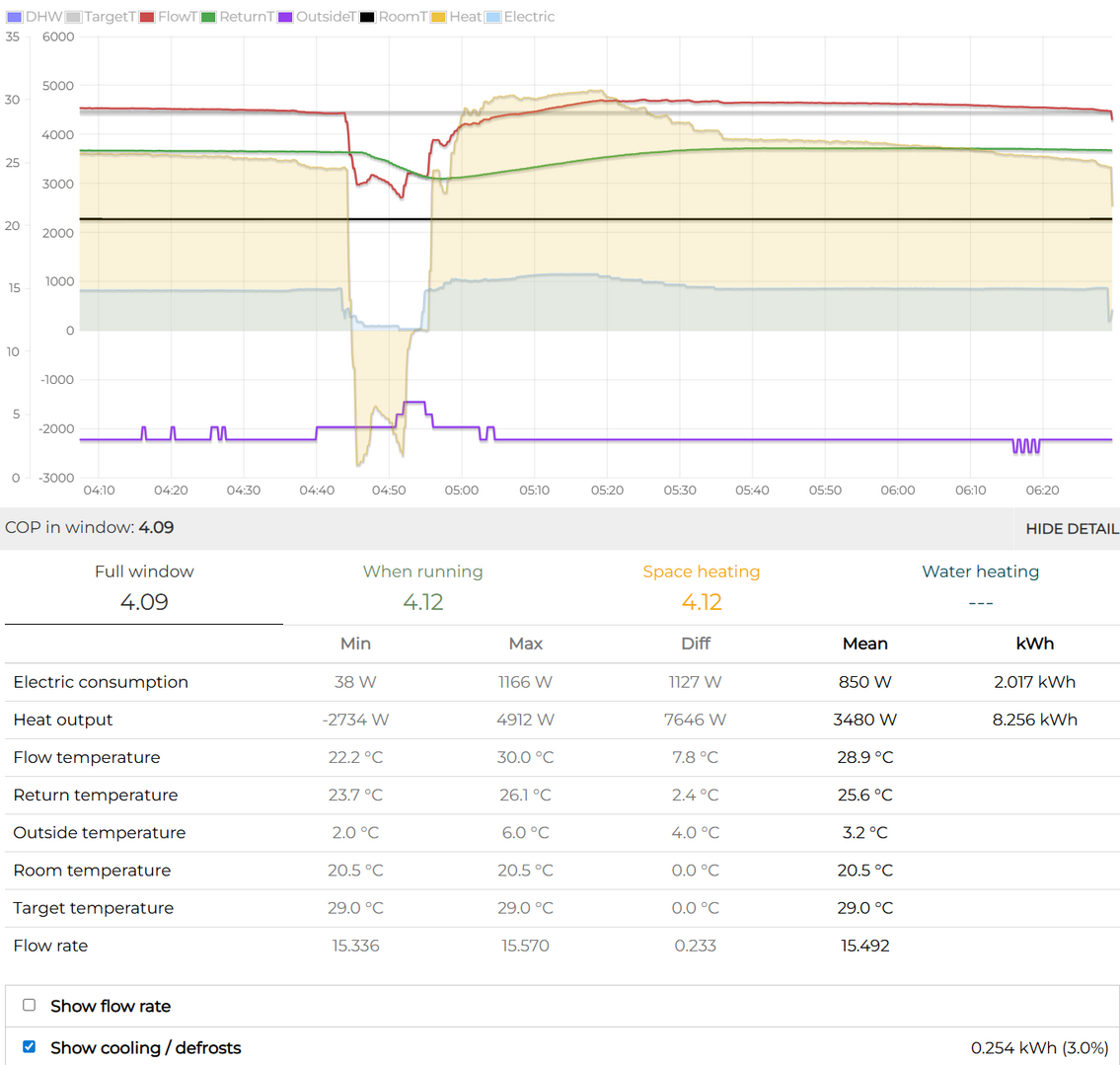
The following is a defrost cycle in lots of detail, it is at 3C OAT and lasts ~11 minutes, so I have used 11 minute units of time to make comparisons easy. The full cycle looks like this:
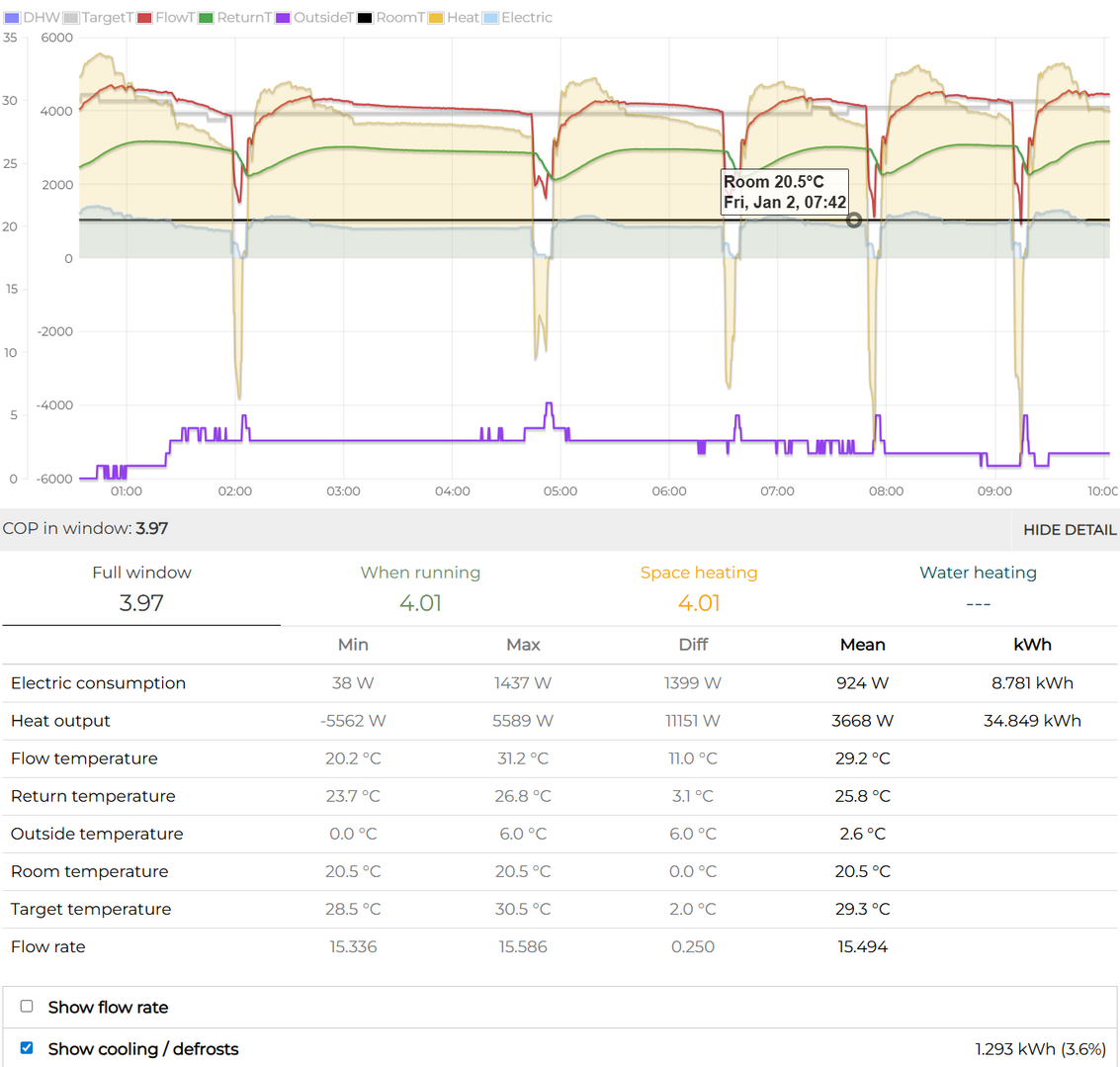
Zooming out further you can see that the IAT is maintained, indicating that the system is repeatedly replacing the energy lost to defrosts and not running a noticeable deficit.
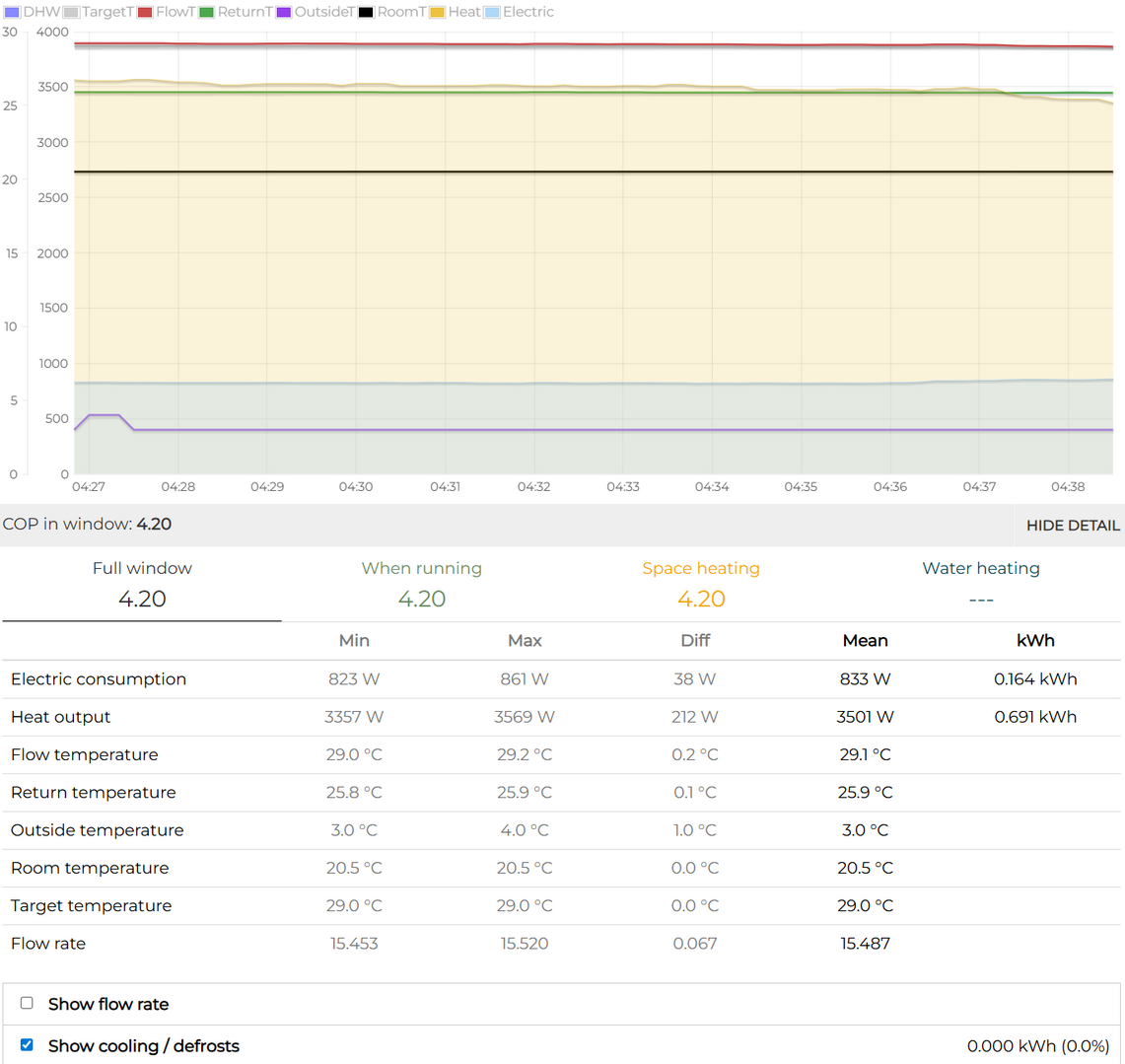
Also the defrost being considered (in the middle of the above) is after a period of continuous running and so the operation of the heat pump immediately prior to the defrost isn't effected by the previous defrost and can be used as a baseline. Below is prior to the defrost and representative of the consistent output in the ~1 hour prior to the defrost. In this 11 mins the system used 0.164 kWh of electricity to produce 0.691 kWh of heat, at a COP of 4.2:
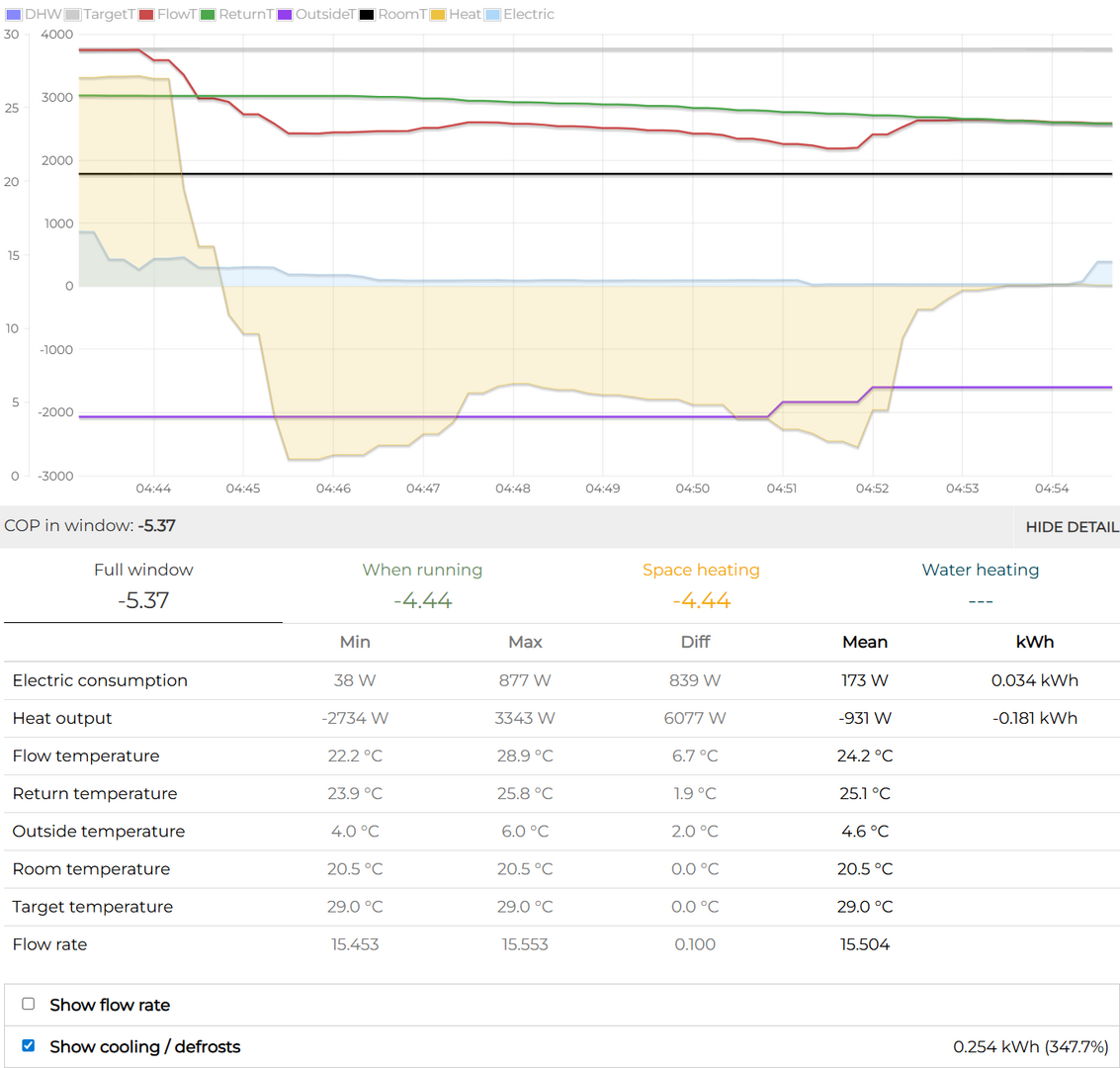
During the 11 mins of the defrost the system used 0.034kWh of electricity and 0.256 kWh of thermal energy is taken from the water to defrost the heat pump:
But the system saved 0.164 - 0.034 = 0.13 kWh of electricity when compared to pre-defrost. The total heat to replace is 0.691 + 0.256 = 0.947 kWh. I've been quite conservative here, as can be seen there is a thermal lag in the system and positive heat output continues for ~1.5 mins after the compressor starts its defrost cycle (the drop in electrical input is the start of the defrost), so only 0.691 + 0.181 = 0.872 kWh of heat actually needs to be replaced.
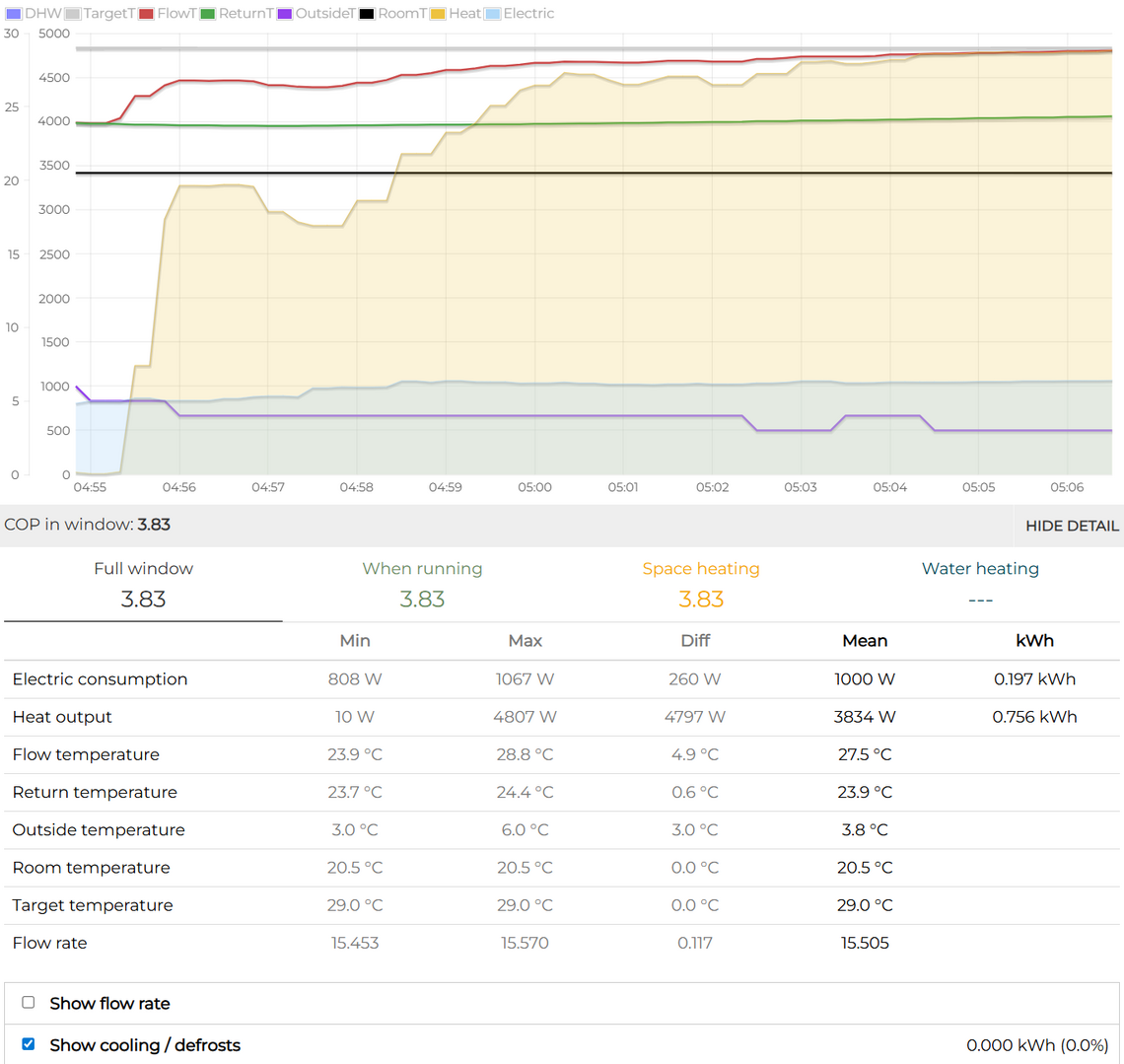
Post defrost the first 11 mins the system used 0.197 kWh to produce 0.756 kwh of heat, at a COP of 3.83.
That's 0.197 - 0.164 = 0.033 kWh more than pre-defrost (0.13 - 0.033 = 0.097 kWh remaining from the defrost period saving). And 0.756 - 0.691 = 0.065 kWh more than pre-defrost (0.947 - 0.065 = 0.882 kWh remaining to be restored).
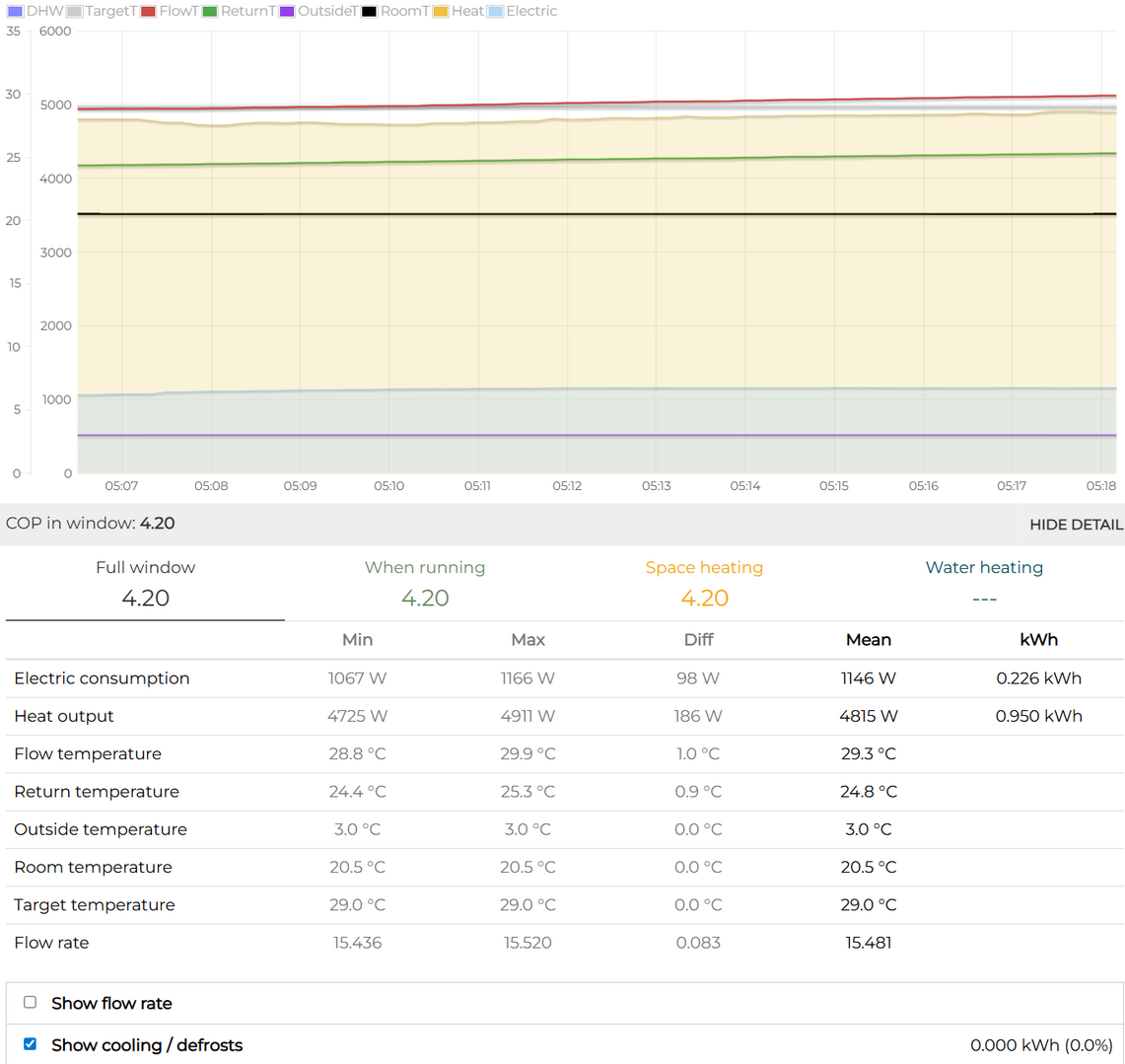
In the next 11 mins the system used 0.226 kWh to produce 0.950 kWh of heat, at a COP of 4.2.
That's 0.226 - 0.164 = 0.062 kWh more than pre-defrost (0.097 - 0.062 = 0.035 kWh remaining from defrost saving). And 0.950 - 0.691 = 0.259 kWh more than pre-defrost (0.882 - 0.259 = 0.623 kWh remaining to be restored).
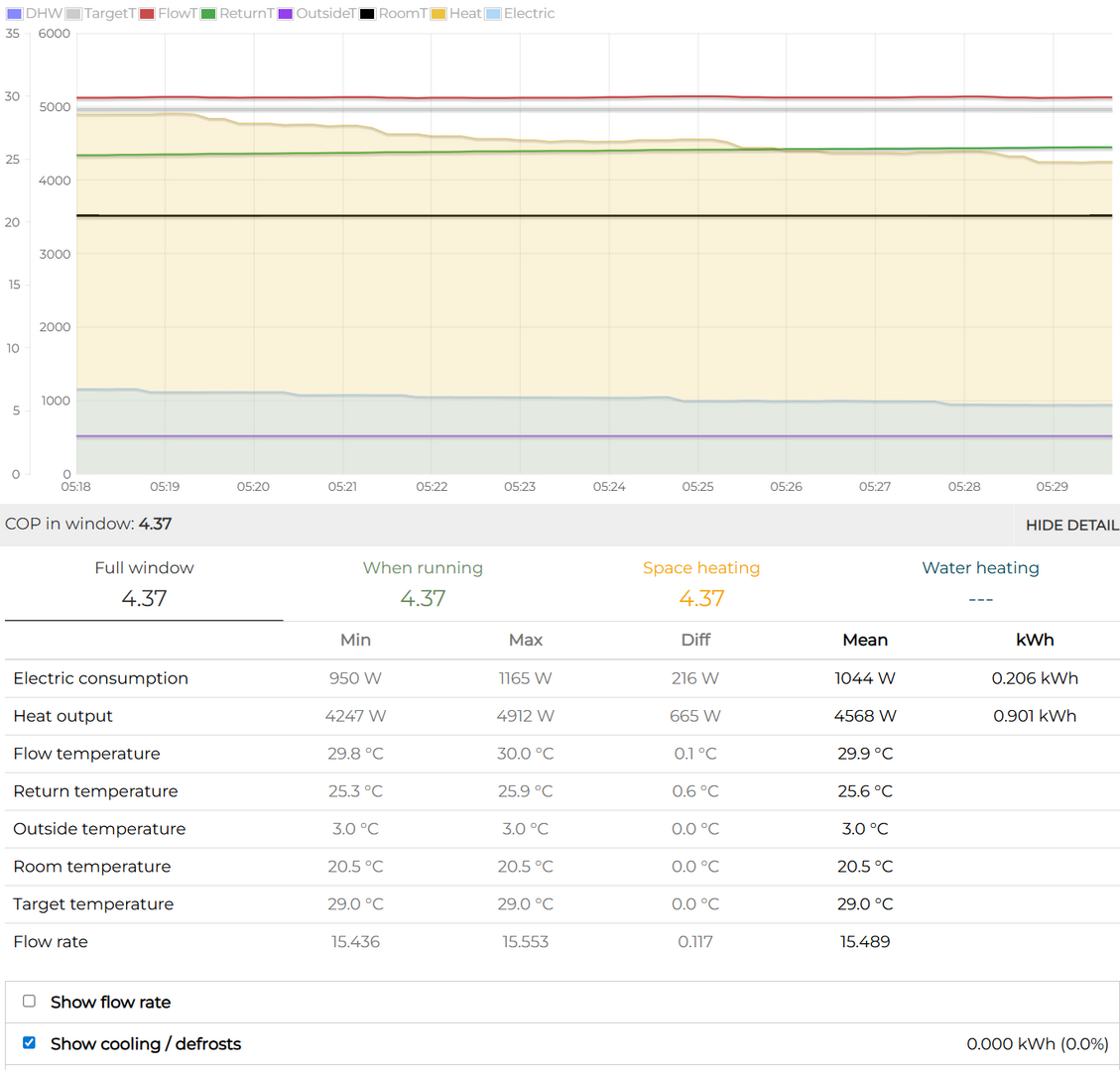
In the next 11 mins the system used 0.206 kWh to produce 0.901 kWh, at a COP of 4.37.
That's 0.206 - 0.164 = 0.042 kWh more than pre-defrost (0.062 - 0.042 = 0.020 kWh remaining). And 0.901 - 0.691 = 0.210 kWh more than pre-defrost (0.623 - 0.210 = 0.413 kWh remaining to be restored).
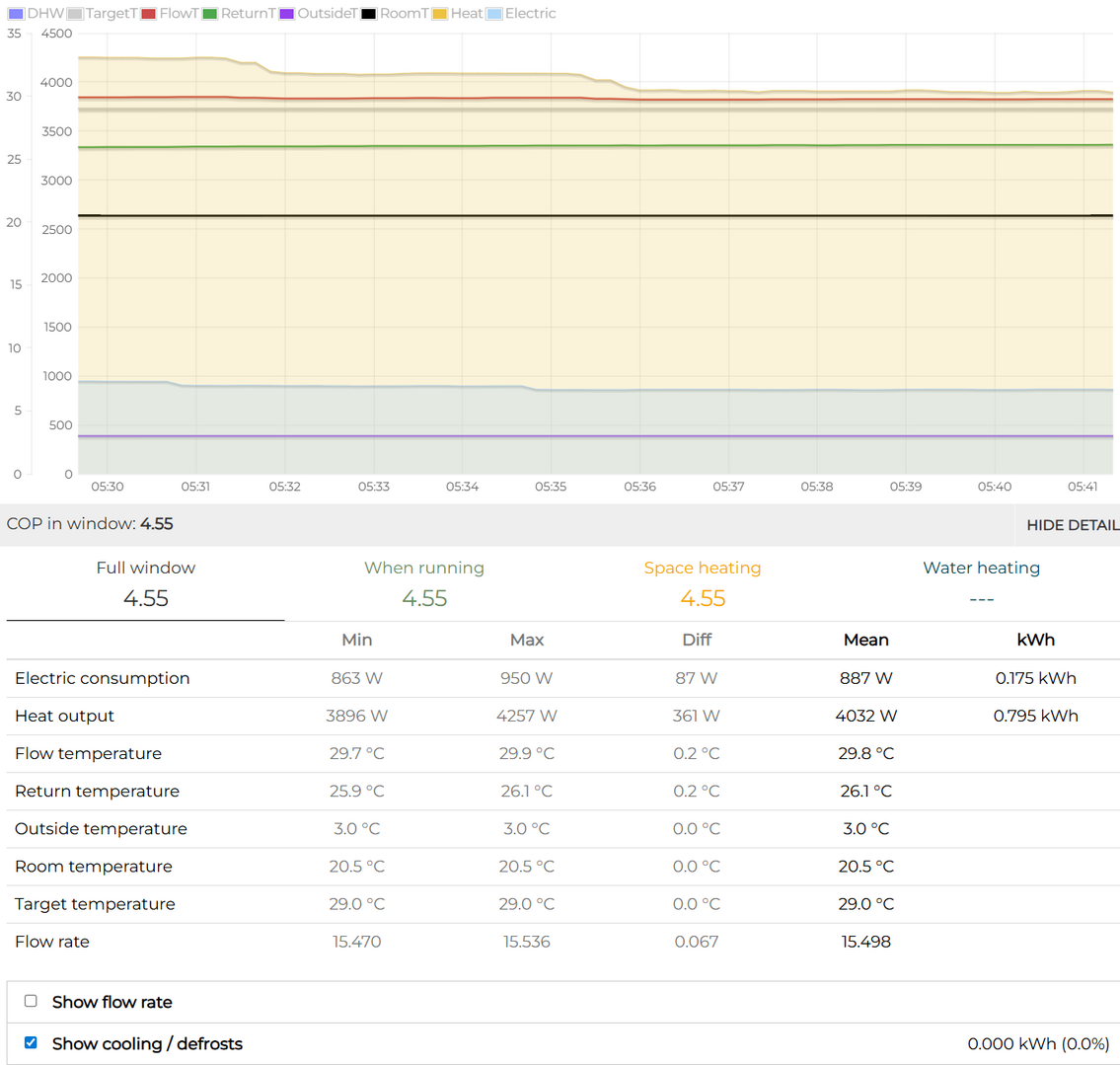
In the next 11 mins system used 0.175 kWh to produce 0.795 kWh, at a COP of 4.55.
That's 0.175 - 0.164 = 0.011 kWh more than pre-defrost (0.020 - 0.011 = 0.009 kWh remaining). And 0.795 - 0.691 = 0.104 kWh more than pre-defrost (0.413 - 0.104 = 0.309 kWh remaining to be restored).
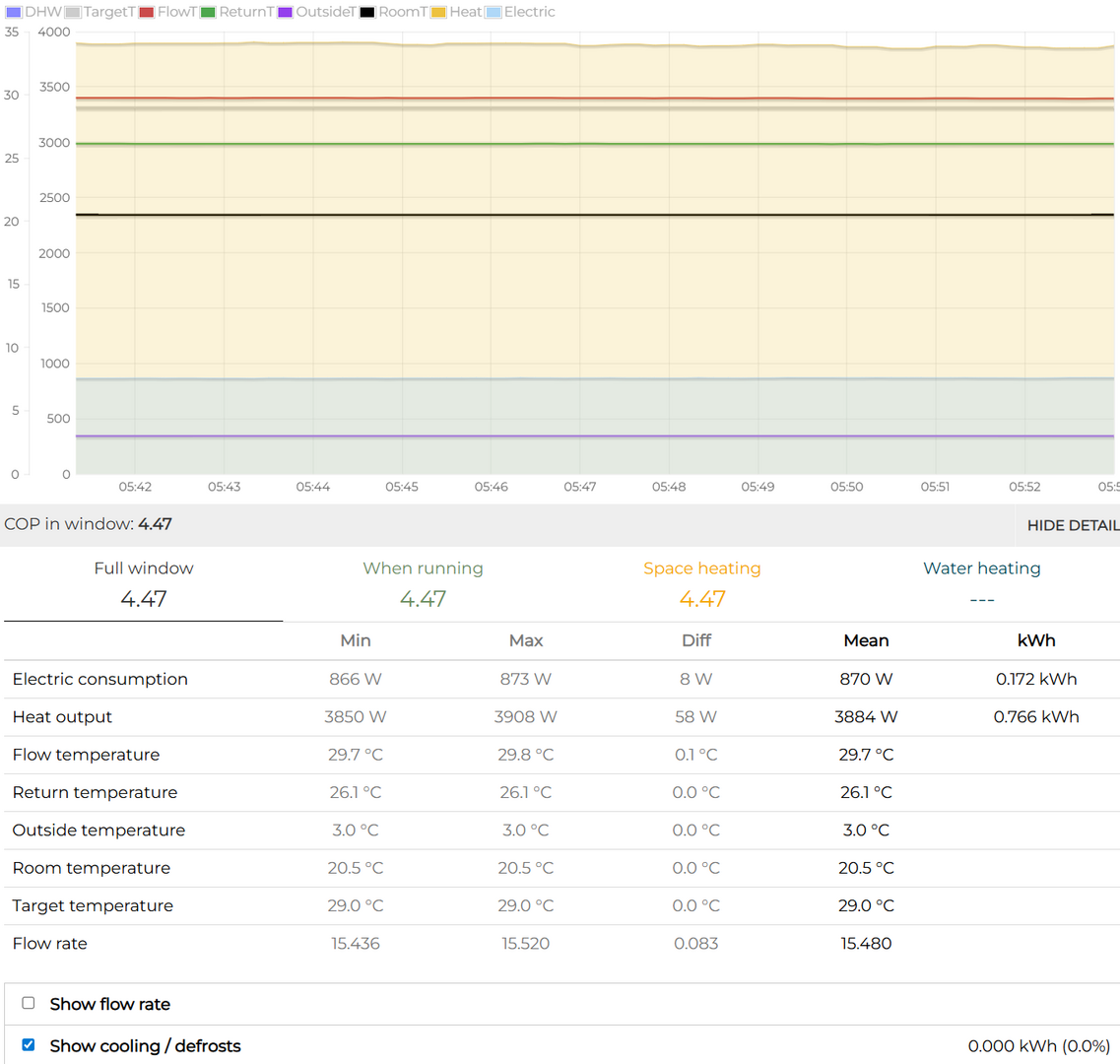
In the next 11 mins system used 0.172 kWh to produce 0.766 kWh, at a COP of 4.47.
That's 0.172 - 0.164 = 0.008 kWh more than pre-defrost (0.009 - 0.008 = 0.001 kWh remaining). And 0.766 - 0.691 = 0.075 kWh more than pre-defrost (0.309 - 0.075 = 0.234 kWh remaining to be restored).
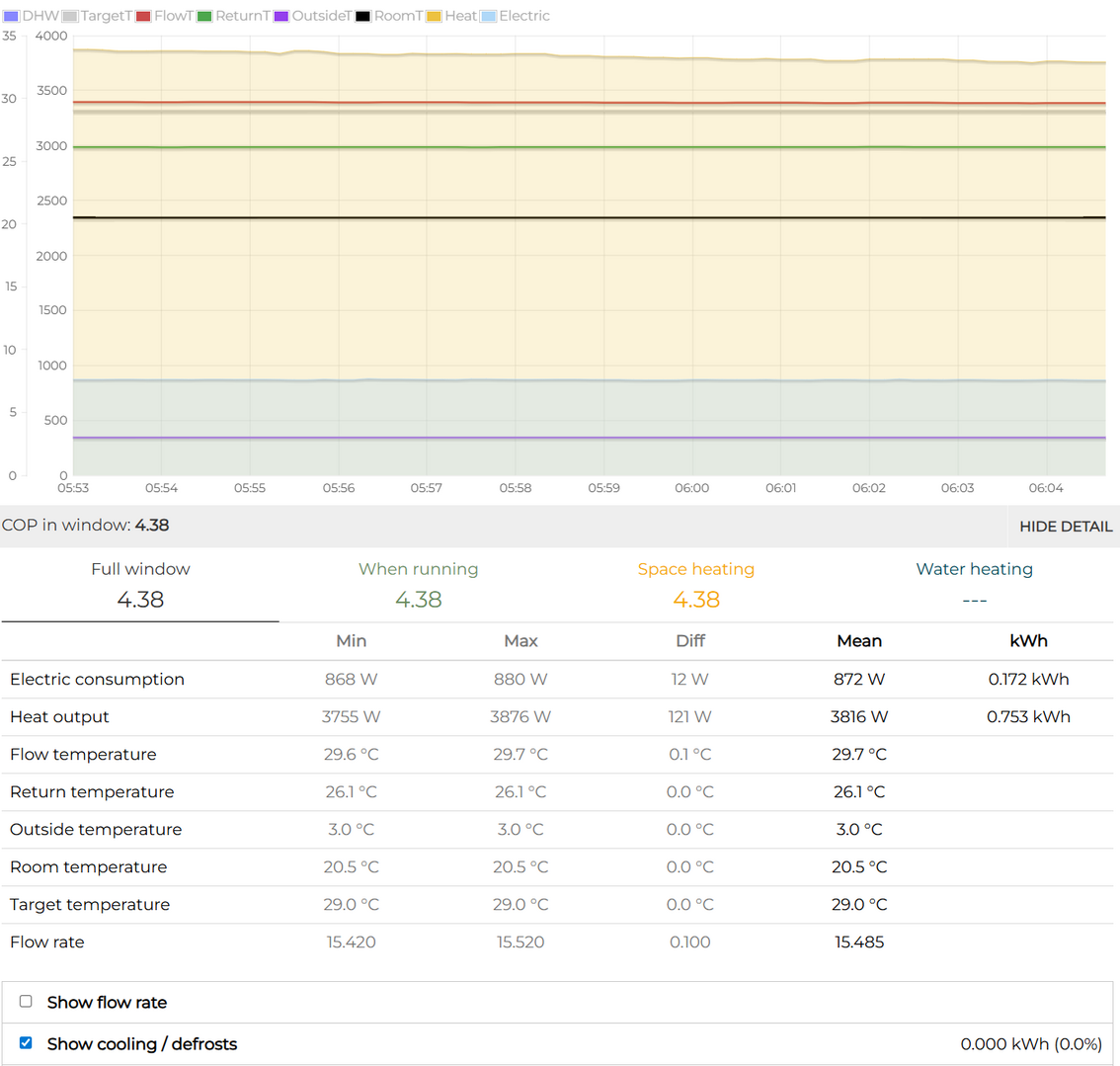
In the next 11 mins system used 0.172 kWh to produce 0.753 kWh, at a COP of 4.38.
That's 0.172 - 0.164 = 0.008 kWh more than pre-defrost (0.001 - 0.008 = -0.007 kWh remaining, so all of the savings during the defrost have been used at this point). And 0.753 - 0.691 = 0.062 kWh more than pre-defrost (0.234 - 0.062 = 0.172 kWh remaining to be restored).
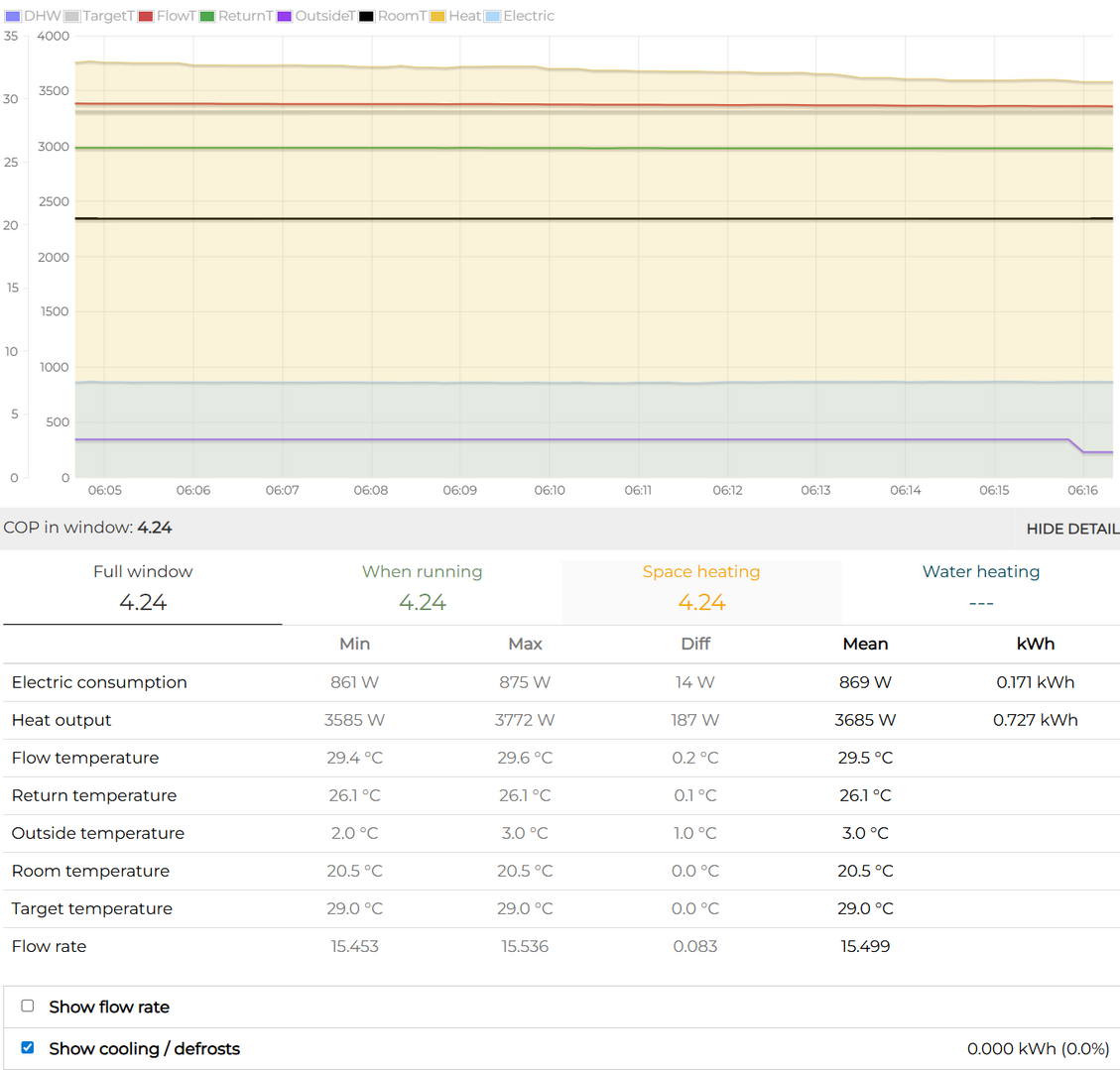
In the next 11 mins system used 0.171 kWh to produce 0.727 kWh, at a COP of 4.24.
That's 0.171 - 0.164 = 0.007 kWh more than pre-defrost (-0.007 - 0.007 = -0.014 kWh remaining). And 0.727 - 0.691 = 0.036 kWh more than pre-defrost (0.172 - 0.036 = 0.136 kWh remaining to be restored).
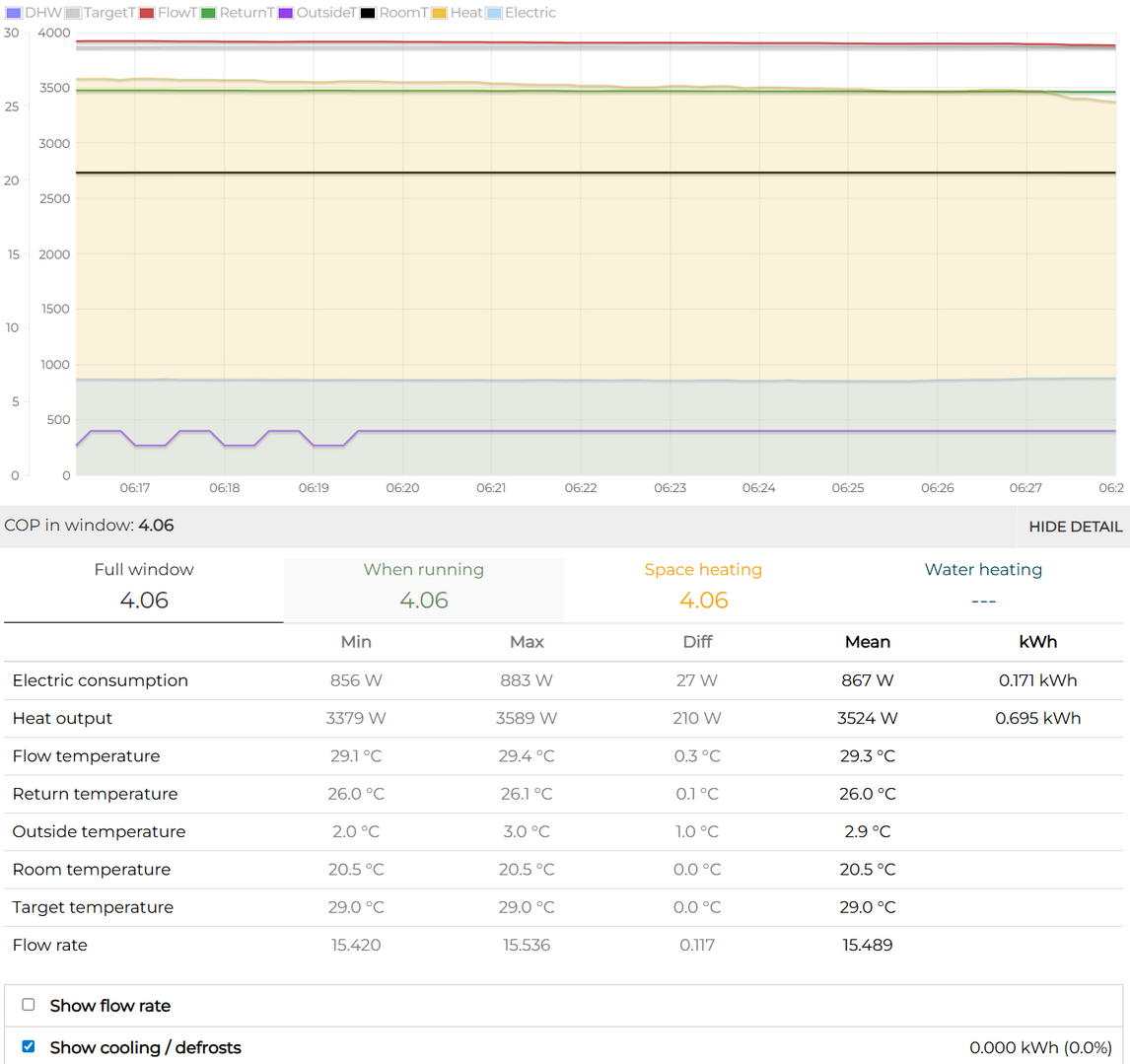
In the next 11 mins system used 0.171 kWh to produce 0.695 kWh, at a COP of 4.06.
That's 0.171 - 0.164 = 0.007 kWh more than pre-defrost (-0.014 - 0.007 = -0.021 kWh remaining). And 0.695 - 0.691 = 0.004 kWh more than pre-defrost (0.136 - 0.004 = 0.132 kWh remaining to be restored).
The next defrost starts one minute later, and the cycle repeats. So there is a tiny 0.132 kWh deficit, 2% of the total output between the defrost and the next one (with the less conservative value above the deficit is only 0.057 kWh). The defrost has caused just 0.021 kWh of extra electrical input, which I have to admit is less than I expected!
Could the flow temperature be lower if there were no defrosts? Almost certainly yes, but not much lower as the ~1 hour prior to the defrost that doesn't raise the IAT shows. But defrosts are a fact of life (well physics) and the above shows they are not terrible for electrical usage.
Hopefully that helps our collective understanding of defrosts. If there are any mistakes in the maths above please let me know!
This is a cut and paste so that all the charts can be seen in scroll format. It is then possible to see each 11 minute division in larger detail. My position is that the defrost and compressor-reset period is somewhat longer in reality than 11 minutes and that to start the energy count where it has started in this summary is incorrect since there is energy used by the compressor and motorized valves in some cases several minutes before the defrost begins. In addition the 11 minute period does not extend to when the compressor has fully re pressurised the refrigerant and returned to full operational mode.
My last point has always been that in the end the full recovery energy is controlled by a moving target flow temperature - the weather compensation curve.
So the rather simplistic view that electrical energy data is all that is needed does not meet the requirement. There needs to be a combined understanding of the electrical energy inputs plus how the compressor stores and replenishes refrigerant liquid, for example what are the volumes used during the defrost and to pressurise and replenish -which is completely invisible to the electrical charts posted by @robs.
This post was modified 2 weeks ago 2 times by SUNandAIR