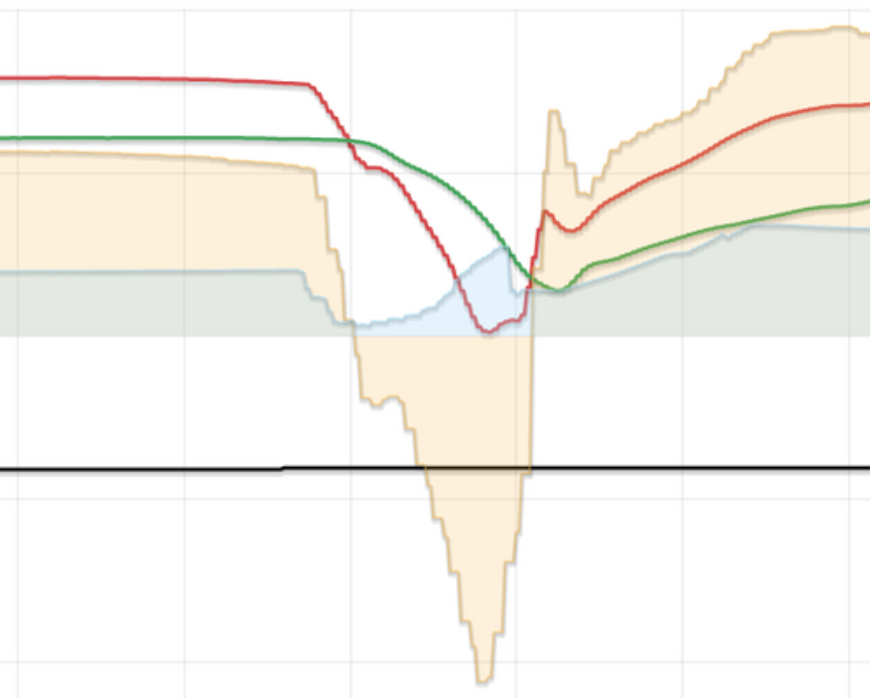
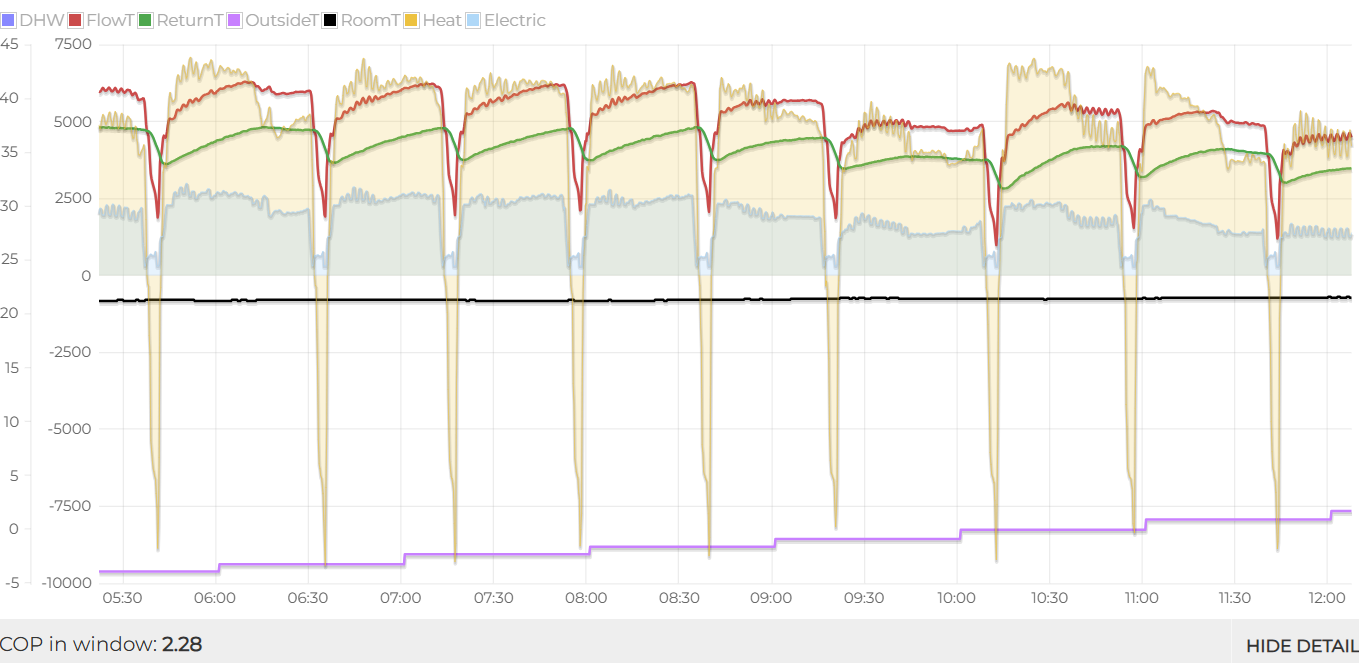
@jamespa — thanks. But the coal is added during the defrost, the shark's fin in energy in happens while there is still 'negative' energy out, ie heat is being dumped from the house to the heat pump (as LWT/RWT delta t is reversed, ie negative). I suppose another possibility is that it is just a lag effect. If we zoom in on the Vaillant defrost (vertical lines are 5 mins apart):
Remember that the measured RWT is the temperature of water that left at the LWT measured several minutes ago and then travelled through the heating system. So we can expect this to continue to decrease for a while after the actual defrost is complete. That, I believe, is what we are seeing. Or, to put it another way, ... "it's lag in the system."
This post was modified 4 weeks ago 5 times by JamesPa
4kW peak of solar PV since 2011; EV and a 1930s house which has been partially renovated to improve its efficiency. 7kW Vaillant heat pump.
As I wrote above "in both of these cases the OAT was rising so it's possible that the WC curve of both has reduced the required flow temp, and hence the softer ramp ups."
But is it rising? Looking at my composite image, it isn't rising at the relevant time. And even it it was, which it isn't, how could a rising OAT suppress the independent conservation of energy requirement that the recovery must replace the energy lost during the defrost?
What I am really getting at here is are we sure we have accounted entirely for all the energy flows in a way that doesn't violate the conservation of energy requirement? This question is fundamental to both defrost, which I consider to be short sharp setbacks, and longer eg overnight setbacks.
Each system has a different lag between input power (compressor) changes and output power (heat) changes. So it's quite possible for a compressor change not to be see by the heat meter in the plant room for a couple of minutes.
I agree about the likelihood of lag in the system, which is why I raised the possibility in my later post, but I am not sure about the 'heat meter in the plant room'. Not everyone has a 'plant room', I don't, for example. Do we even know what HeatpumpMonitor.org's 'Full MID Metering' amounts to? Do we know that the metering is done consistently? It's a personal opinion, but I have never really liked HeatpumpMonitor.org for all sorts of reasons but the key one here is that i suspect it is the heat pump equivalent of a pissing competition among self-selected pissers each of whom believes they can piss further than the next one. Or to put that more formally, how do we know they are a representative sample? How do we know that the data is collected in such a was that it is comparable?
"As of November 2025 there are over 600 heat pump systems uploading data to the site including systems installed by some of the best heat pump engineers in the UK. A core goal for the site is to discover what the state of the art is in terms of system performance and to highlight that with good system design, installation and commissioning, high performance results are possible."
That looks rather like 'Here's the answer, now where is the evidence?' to me. It also increases my suspicion that the 600+ heat pump systems with data on the site are not representative. Furthermore, of the 600+ systems on the site, only around a third (~210) are 'MID metered with full year of data'. The sample is really quite small, and very likely highly self selected. And I still can't find anything that defines what 'full MID metering' is for the purposes of the site.
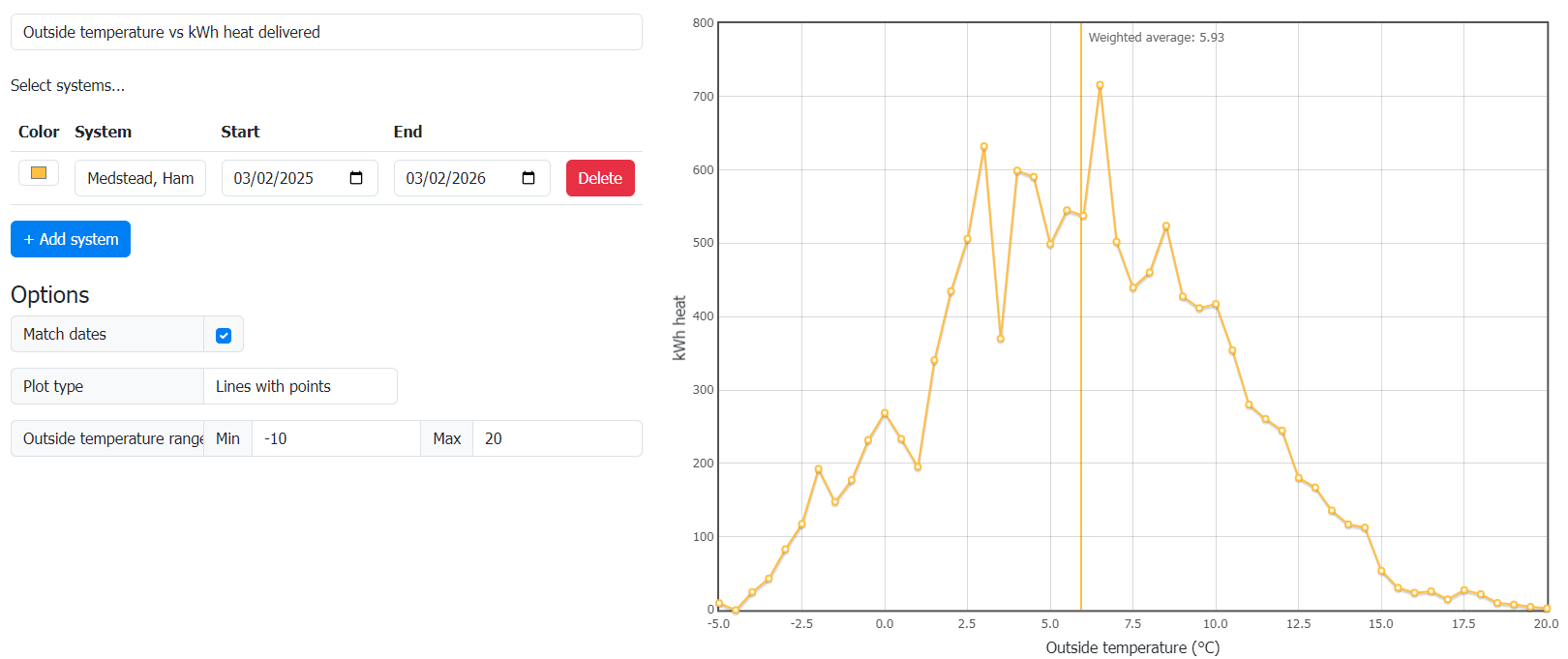
Furthermore, and this is probably just me being stupid and failing to find the right links, I can't find any charts like the ones you posted. I can find some rather odd ones, like this one from a Midea unit which appears to show the heat delivered falls as the OAT falls below 2.5°C until the system gives up the ghost at -5°C OAT:
I know Midea units can struggle at low OATs (I have a Midea unit myself), but zero heat output at -5°C? I don't think so...
Also, as I wrote above, the Mitsubishi, and probably the Daikin, run just their water pump during the latter part of the defrost, so the flow temperature is no longer being actively cooled and so increases to the return temperature without any compressor input.
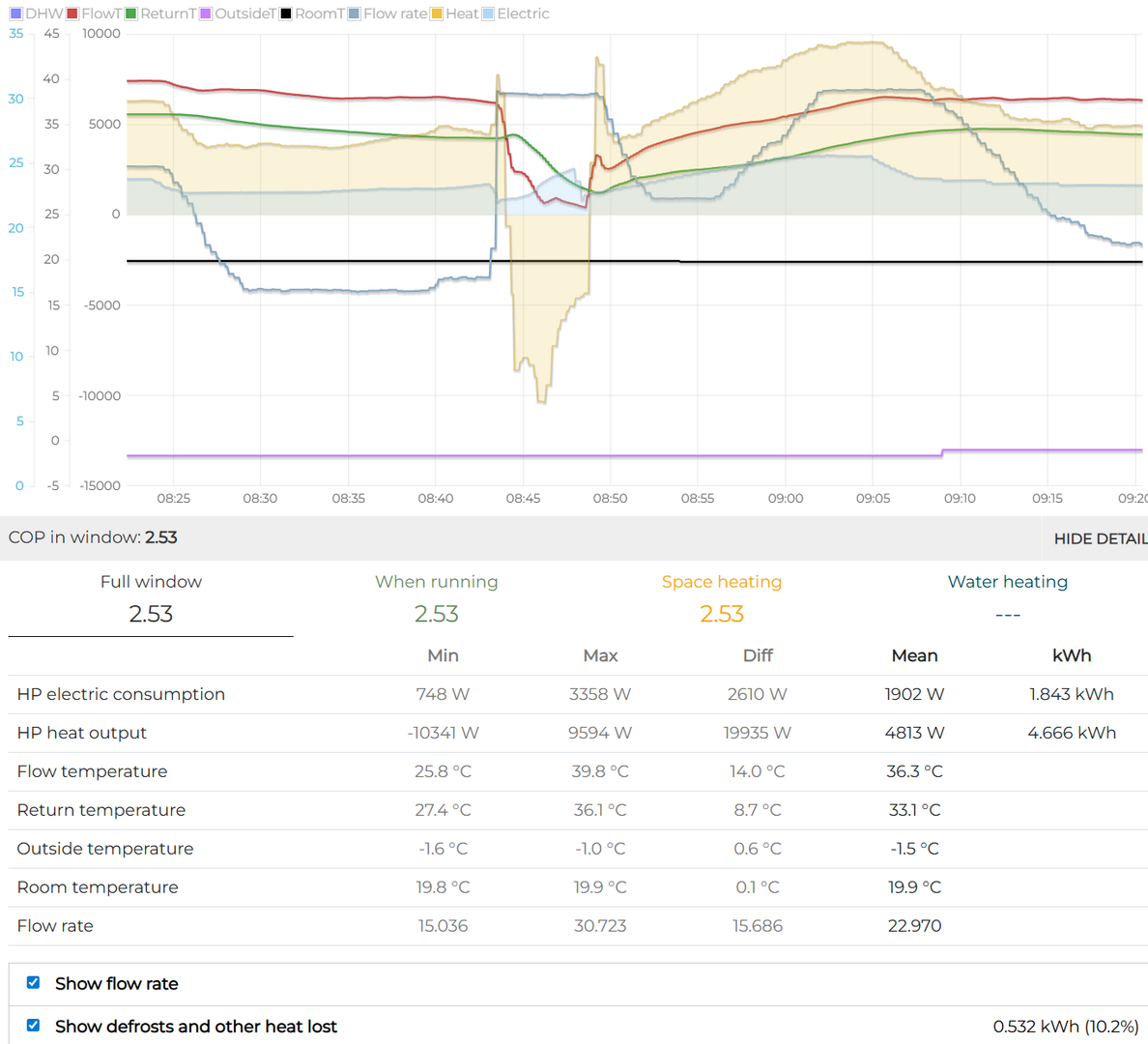
I meant to mention this earlier (when you wrote "The Grant and Samsung both increase their flow rate during the defrost ... et seq"), I cant see any flow rate data anywhere on any of the charts, so I can't see how it is possible to infer anything about flow rate from the charts. The tables below the charts do have Min and Max flow rates, and from that we might be able to infer that four of the five examples run their circulating pumps continuously at a steady rate. The exception is the Grant unit, which varies the flow rate between 15 and 31 (units? not given) but that still suggests it is running all the time.
although this Mitsubishi system has an odd negative energy out spike just before ramping up for the recovery - which seems to be an oddity of this system as other Mitsubishi's (like ours) don't do this.
I noticed that too - why does that appear? Is it real, or an artefact? Another oddity that makes no sense is the Grant two horned approach to defrosts:
What is that sharp peak in energy out just before the defrost? How does it happen as the energy in and flow temp appear to fall? Is this real, or an artefact?
All in all, I now find myself leaning towards thinking these charts raise more questions than they answer, with the biggest question of all being do they actually show what really happened? Or are we in fact looking at a curious set of artefacts?
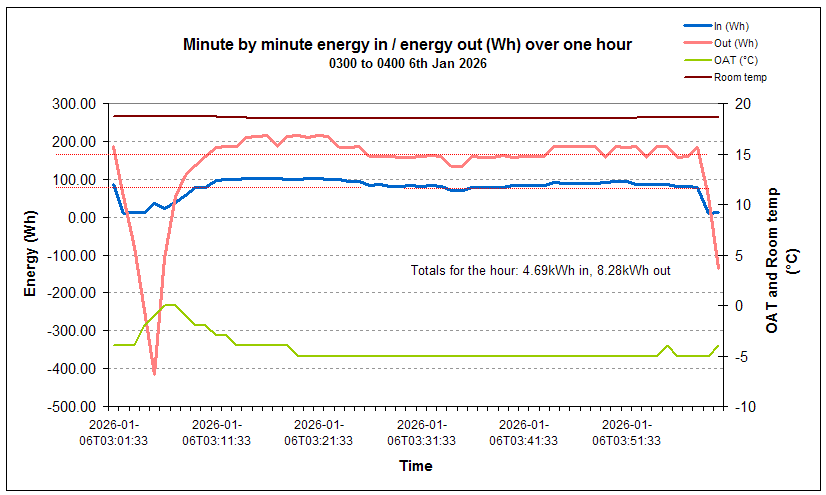
In contrast, my chart of a defrost that I posted earlier appears both artefact free and to tell a credible story:
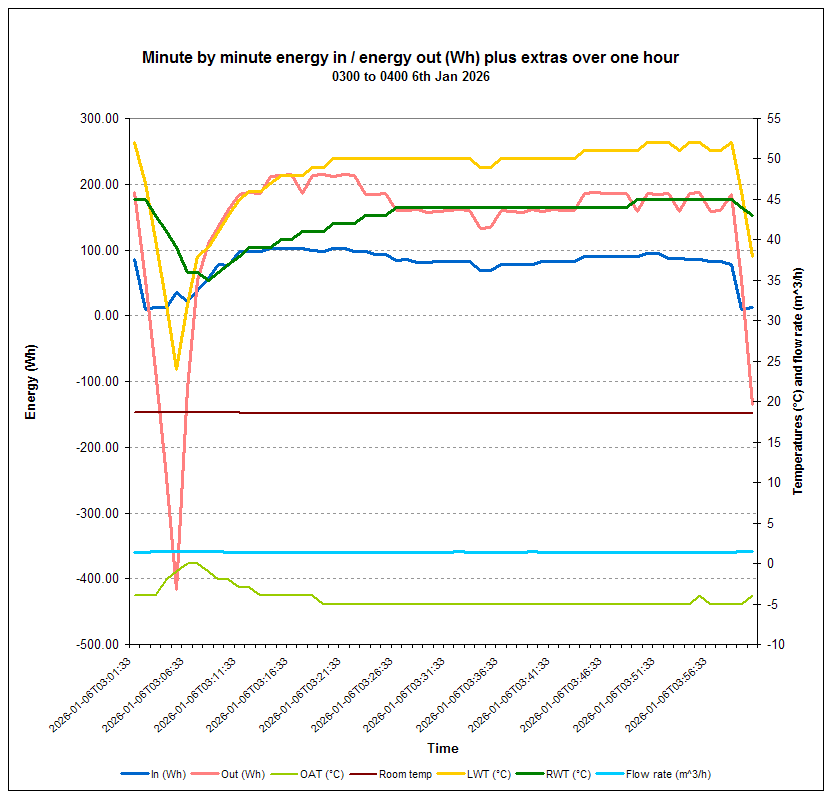
I've also previously described exactly how I get the data behind those lines (apart from the separate room temp sensor, it all comes from the raw Midea data collected over modbus). The data also has the LWT/RWT and flow rate, and so I can add those:
Doing so certainly adds clutter, but I am not sure much else, and it is certainly not my prettiest chart. That said, once you have got past the clutter, it still tells a coherent credible story.
The bottom line, the answer to the question I was trying to answer, do defrosts use more energy, and so increase running costs, is still the same, No, they don't, at least on my setup.
Midea 14kW (for now...) ASHP heating both building and DHW
I cant offer any charts of measured figures to the defrost debate, however i can add observed conditions during a defrost. My heat pump is outside the back door so i have seen the defrost cycle in operation many times. Initially as the cycle starts a small amount of heat is lost to the air, probably due to the thermal shock of introducing warm water back into the radiator, this must have a cost, as it has used energy to produce it, however after the first 30 seconds the heat loss reduces to a level that i cant detect. From then on, the warm water slowly defrosts the radiator removing the ice over 5 minutes or so. This part of the defrost warms the radiator, when the system restarts this energy will be recouped back into the house so very little of this stage is "lost".
The small amount of energy lost in the first 30 seconds is so small, and so many variables are at work at the same time, that the sensors are not accurate enough to detect it in any reliable way.
My view would be that a very small amount is lost but it is not enough to make any difference to the performance figures.
I see things have moved on, all of a sudden and Rob has introduced interesting variants of defrosts across various brands.
im glad the topic of lag effect has come up since each individual installation may have different flow rates and different distances to the thermistors..
For my installation we have a distance of 25 metres between thermistors (LWT and RWT) and the Plate heat exchanger of the heat pump is exactly half way between the two thermistors. But we also have a low flow rate of only 14lpm. So even though the thermistors are side by side the water volume between the two thermistors is 12.88 litres. (Calc Rounded up to 15lpm) This calculates out for 28mm pipes at time delay of 26 seconds to the PHE and 52 seconds between the two thermistors. To correct this time lag the LW thermistor reading needs to be read 26 seconds earlier than drawn while the RW thermistor needs to be read 26 seconds later than drawn.
obviously bigger Heat Pumps generally have much higher flow rates so the lag effect might be more significant but I personally don’t see 26 seconds between lead or lag as a major shift in interpretation.
While on the subject of volume…. We noted a 4 minute defrost. This amounts to 60 litres of water circulating in that time to carry out the defrost. We have then seen another 4 minutes of return water flowing through the plate heat exchanger without the compressor working so this return water is possibly a useful reheat reducing component stress, using the lower water temperature to gently reheat all the components without using any compressor energy. So that means we have still only used 120 litres of Return Water to prepare the compressor for activation. This also means we still have around 70 litres of return water yet to pass through the heat pump since the defrost started.
We are given to understand that during the restart of the compressor it can take up to 4 or 5 minutes to build up enough pressure to start producing meaningful heat output. This would coincide with the graphs we have been posting.
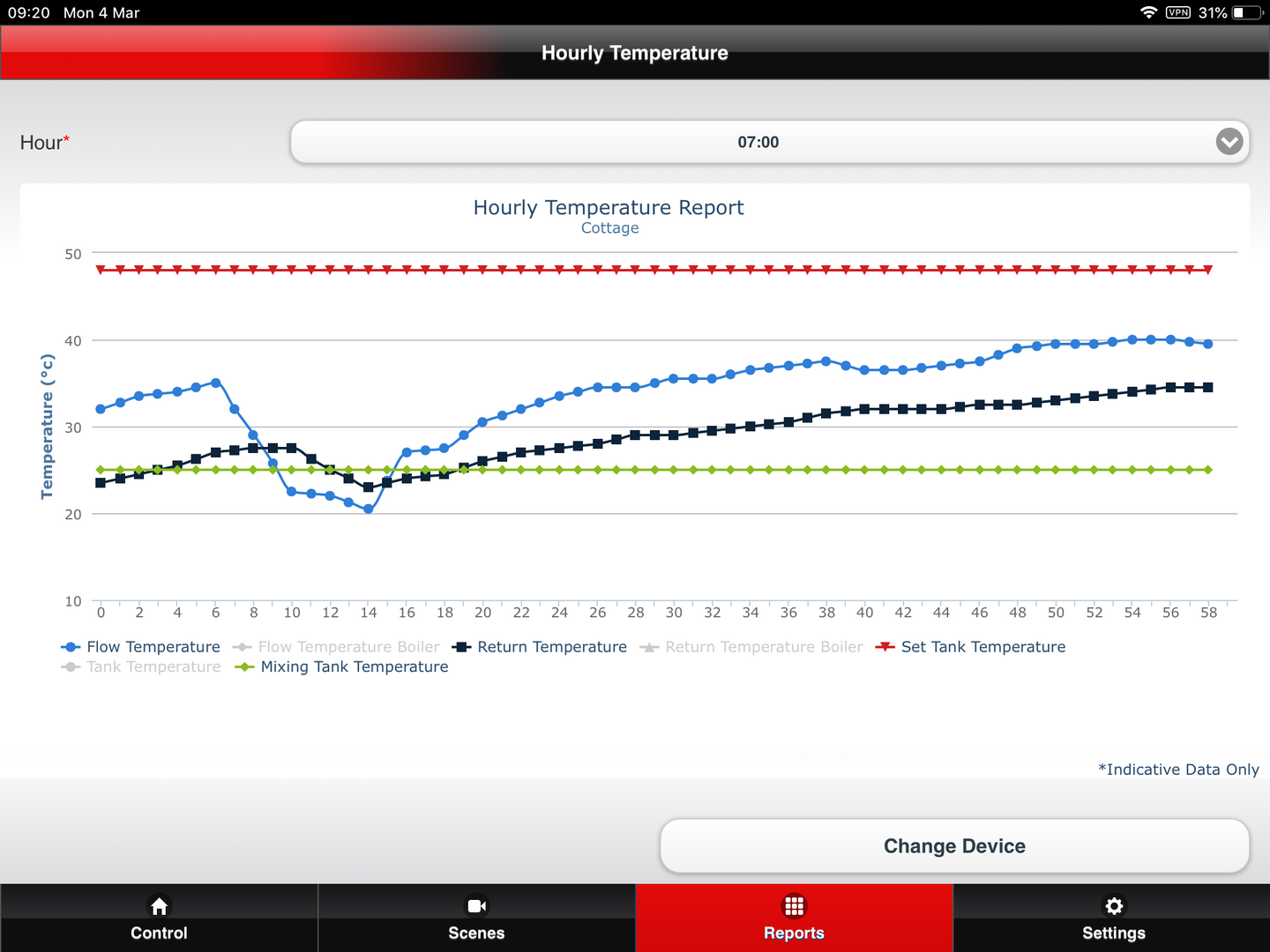
I’ve reposted my last post since I found last Friday a early startup defrost where the heat pump went straight into defrost when it hadn’t been operating long enough to have a high return temperature.
this meant it was possible to see the same 4 minute defrost but the 4 minute reheat using RWT wasn’t sufficient to add any heat.
here is the post. You can see the return temperature is still low and climbing at the point of defrost. But the fact that the 4 minutes after the defrost the temperature continues to fall shows that there was no compressor active heating in action.
Finally I believe the actual defrost is very quick… possibly only 4 minutes. I am also seeing a standard defrost reheat for the next 4 minutes.
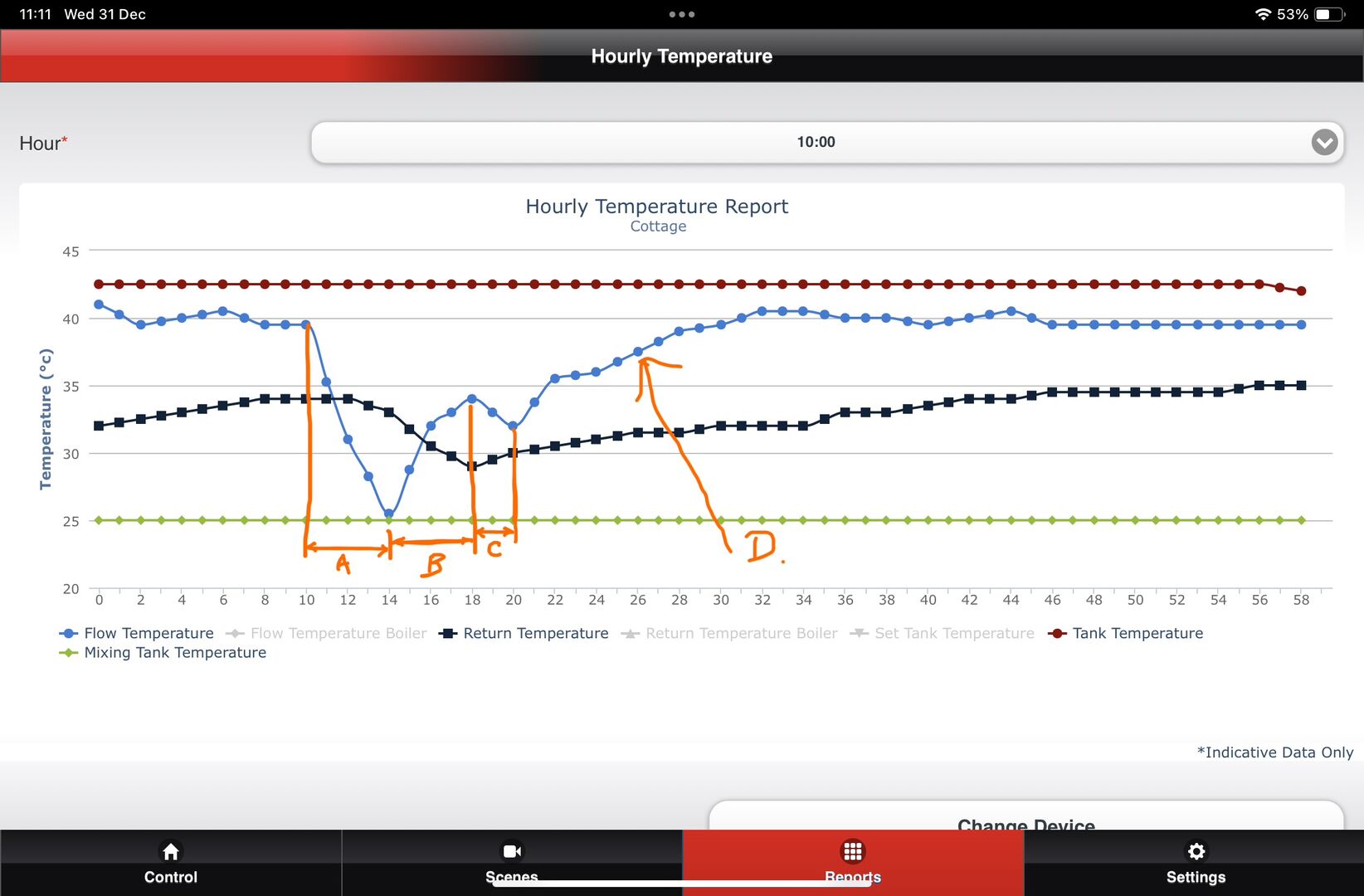
Here is my own interpretation of a different defrost from December, which follows the same pattern, they all follow the same sequence and time frame. A = rapid temp drop 4 mins, B = defrost reheat to algorithmic targeted output. 4 mins. C = 2 minute check with variable heat output. D = apparent standard ramp up in line with normal restart operation and targetting the weather compensation target temperature.
So in my above theory where I thought the reheat was possibly from the compressor I believe the reheat activity in section B is purely from the Return Water flowing through the PHE without any heat from the compressor. However by the time the process reaches the 2 minutes at point C there have been occasions where small amounts of extra heat is starting to be created. And in the new graph above you can see definite signs of increased energy in the 2 minutes of the area C.
obviously bigger Heat Pumps generally have much higher flow rates so the lag effect might be more significant but I personally don’t see 26 seconds between lead or lag as a major shift in interpretation.
Indeed that doesn't trigger a major shift but I think you have calculated is the lag (and water volume) between return and flow. The lag between flow and return is different, it's however long it takes for water to circulate through the heating system, which may be quite a bit longer because of the volume in the emitters. So for example in my system the volume is 200l and the flow rate 1200l/hr. That's 10 mins for a complete change. Basically there is a substantial slug of flow temperature history making its way through the system and that definitely does affect interpretation.
@jamespa yes I see what you mean. I think what was on my mind is how to read the impact of the eventual drop in return temperature water. What I’ve noticed is that some radiators are very close to the primary pipe end and so the cooldown is quite quick to appear on the graph. Lots of things happening at different times.
@cathoderay I kind of guessed you might come back with the data validation route. The problem with that route is that it is only as good as the understanding of the data and the process that created the data. “Rubbish in begets Rubish out. If we don’t know exactly how a defrost algorithm activates… when it starts, when it stops, what scales its output. We cannot say it is low or high in energy.
There are 3 (and probably more) important gaps in the energy figures discussed so far. EG in @robs breakdown and other interpretations.
1. the energy USED and dumped outside on the pavement in the form of meltwater.
2. the eleven minutes of heating stop-time during the defrost period and the initial defrost recovery. This needs to be replenished and added to the energy recovery cost in KWH.
3. the energy lost to the house from the chilled water from the defrost which has entered the heating system.
We have a good understanding of the data and don't need to reverse engineer a defrost algorithm as we are just interested in the energy flows, which ultimately determine how much we pay and how warm our houses are.
All of those three were included in my breakdown. So we can say if a defrost (of my Mitsubishi) is low or high in energy - it requires only a small amount of additional energy.
Can I ask you to explain what you see as the energy attributable to the defrost and defrost Recovery. To my mind there are some energy activities which are just as likely to be applied by the set target flow temperature and that the target is a manually set target.
My view is that if it is the target flow temperature of the WC CURVE that operates after the defrost it could easily hide the extra energy needed to replace lost operating time simply because the weather curve is set to reach the target during defrosts.
There has also been lost time of heating taken up by the defrost and reset. This amounts to approx 20% heating time per hour based on one defrost per hour. My thoughts are that the system has to operate at a slightly higher temperature to properly recover and simply returns to Weather Compensation control as in position D on the graph I posted above. And continues to heat until the target flow temperature is reached. Do you see a different scenario to this?
The cold slug of water which has entered the heating system over the 8 or 10 minutes would obviously not have occurred had there not been a defrost. So it would be interesting to know where this appears in the recovery process.
On another perhaps smaller point, the defrost commences by using stored energy in the form of high pressure refrigerant. This is refrigerant which is already pressurised and would normally be used to transfer heat into the building -Instead of heating the ice and pavement. Isn’t this more energy lost to the heating of the home and needs to be repaid to home heating. I think you said you can account for the energy used in the defrost but what accounts for the lost pressurised refrigerant?
As I wrote above "in both of these cases the OAT was rising so it's possible that the WC curve of both has reduced the required flow temp, and hence the softer ramp ups."
But is it rising? Looking at my composite image, it isn't rising at the relevant time. And even it it was, which it isn't, how could a rising OAT suppress the independent conservation of energy requirement that the recovery must replace the energy lost during the defrost?
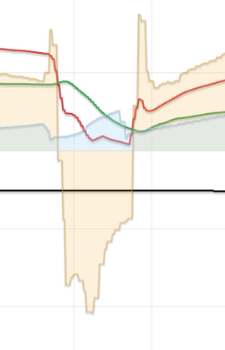
Yes, here's the Samsung zoomed out:
If the OAT is rising then less heat will be lost by the property and hence during the recovery less heat will be needed to be generated by the heat pump.
What I am really getting at here is are we sure we have accounted entirely for all the energy flows in a way that doesn't violate the conservation of energy requirement? This question is fundamental to both defrost, which I consider to be short sharp setbacks, and longer eg overnight setbacks.
The energy in (electricity) and energy out (heating/cooling of the water) is recorded, what other energy do you suggest? Solar gain could be playing a part in some of these defrosts but there are no clear indications of increased solar gain during the the relatively short defrost periods.
Each system has a different lag between input power (compressor) changes and output power (heat) changes. So it's quite possible for a compressor change not to be see by the heat meter in the plant room for a couple of minutes.
I agree about the likelihood of lag in the system, which is why I raised the possibility in my later post, but I am not sure about the 'heat meter in the plant room'. Not everyone has a 'plant room', I don't, for example.
You don't have a hot water tank, water pump, expansion vessels, filter(s), controller, etc. in a cupboard (or similar) somewhere in your house? The term plant room for this is commonly used, for example there are nine pages of results when searching this forum.
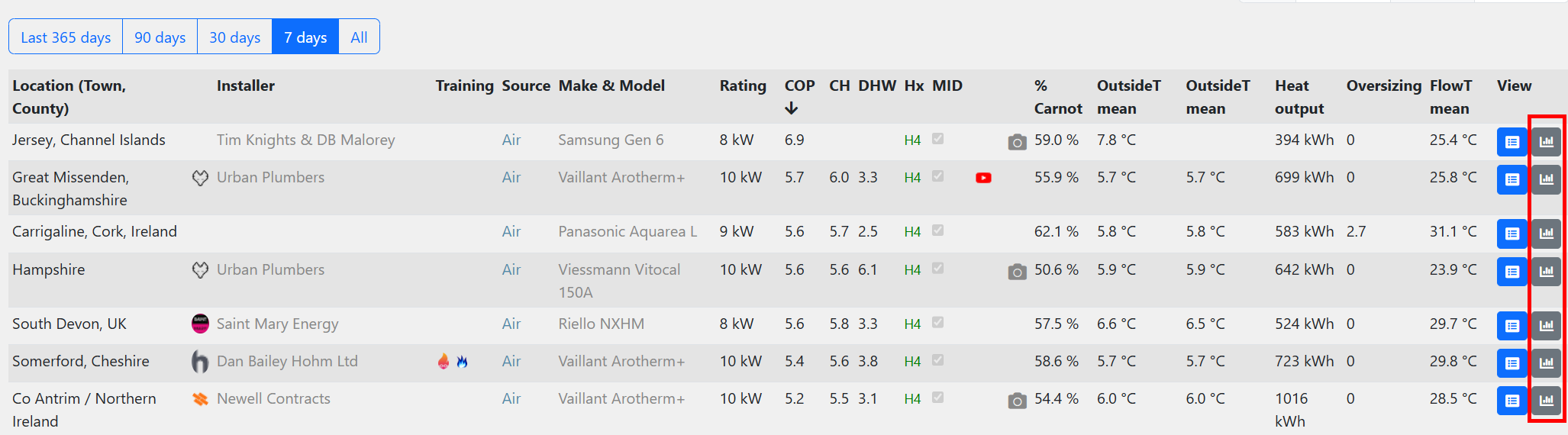
Do we even know what HeatpumpMonitor.org's 'Full MID Metering' amounts to? Do we know that the metering is done consistently?
MID is an EU directive on measuring instruments, it means that the sensors used are certified to be to a level of accuracy and so some confidence can be placed on their readings. Unlike, for example, the thermistors used by heat pump manufacturers to measure water temperature that are typically only accurate to 0.5C and are attached to the outside of the pipework and not in the water. The metering is more consistent and accurate than any other easily available source, manufacturers will have better monitoring in their labs but they don't share that data.
It's a personal opinion, but I have never really liked HeatpumpMonitor.org for all sorts of reasons but the key one here is that i suspect it is the heat pump equivalent of a pissing competition among self-selected pissers each of whom believes they can piss further than the next one. Or to put that more formally, how do we know they are a representative sample? How do we know that the data is collected in such a was that it is comparable?
How representative are the contributors to this forum? Are we representative of the multitude of people who own a heat pump? I doubt it.
"As of November 2025 there are over 600 heat pump systems uploading data to the site including systems installed by some of the best heat pump engineers in the UK. A core goal for the site is to discover what the state of the art is in terms of system performance and to highlight that with good system design, installation and commissioning, high performance results are possible."
That looks rather like 'Here's the answer, now where is the evidence?' to me. It also increases my suspicion that the 600+ heat pump systems with data on the site are not representative. Furthermore, of the 600+ systems on the site, only around a third (~210) are 'MID metered with full year of data'. The sample is really quite small, and very likely highly self selected. And I still can't find anything that defines what 'full MID metering' is for the purposes of the site.
So the goal is to show what is possible and what good looks like, what is so wrong with that? The evidence is the mass of data available from the 600+ heat pumps, which is 600x more data than any one of us has individually. And the probability of 600+ systems being closer to representative, or just your or my system alone?
Furthermore, and this is probably just me being stupid and failing to find the right links, I can't find any charts like the ones you posted. I can find some rather odd ones, like this one from a Midea unit which appears to show the heat delivered falls as the OAT falls below 2.5°C until the system gives up the ghost at -5°C OAT:
I know Midea units can struggle at low OATs (I have a Midea unit myself), but zero heat output at -5°C? I don't think so...
That's cumulative over a year, the sum of heat delivered in a year at 5C is far greater than at -5C because 5C OAT occurs much more often.
Try the dashboard buttons:
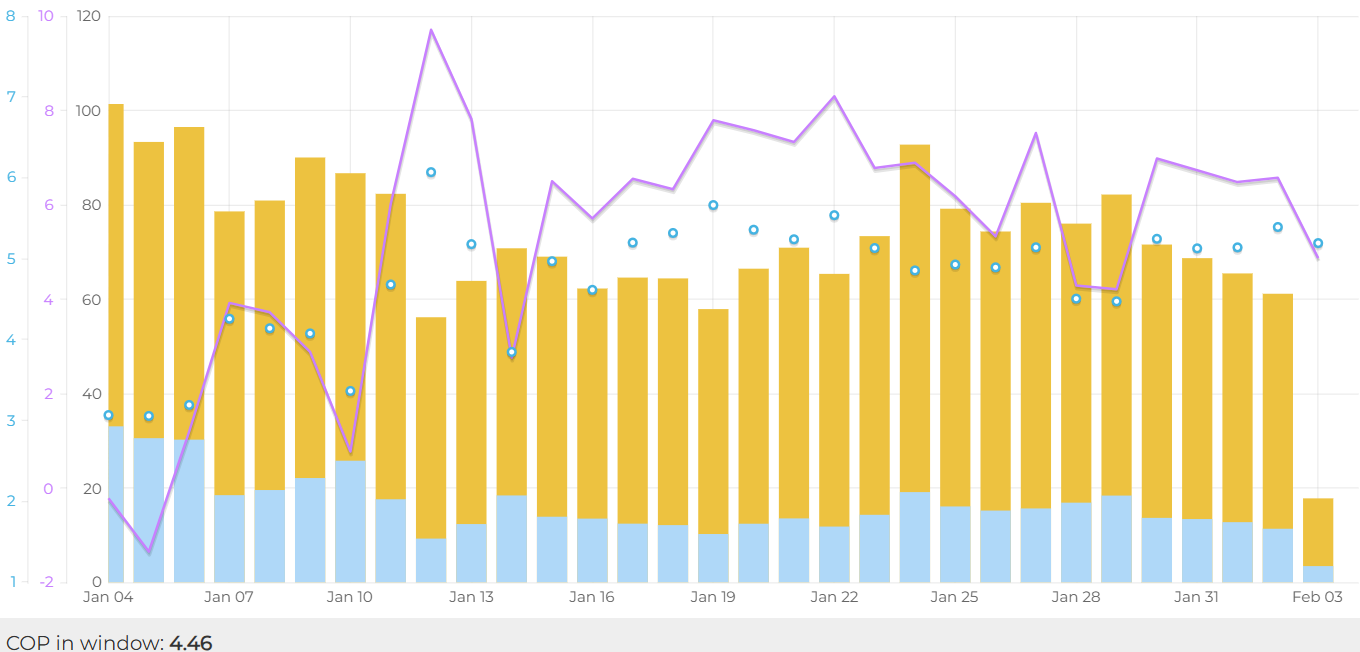
These lead to monthly summaries (can be changed to weekly/monthly/3 monthly/year):
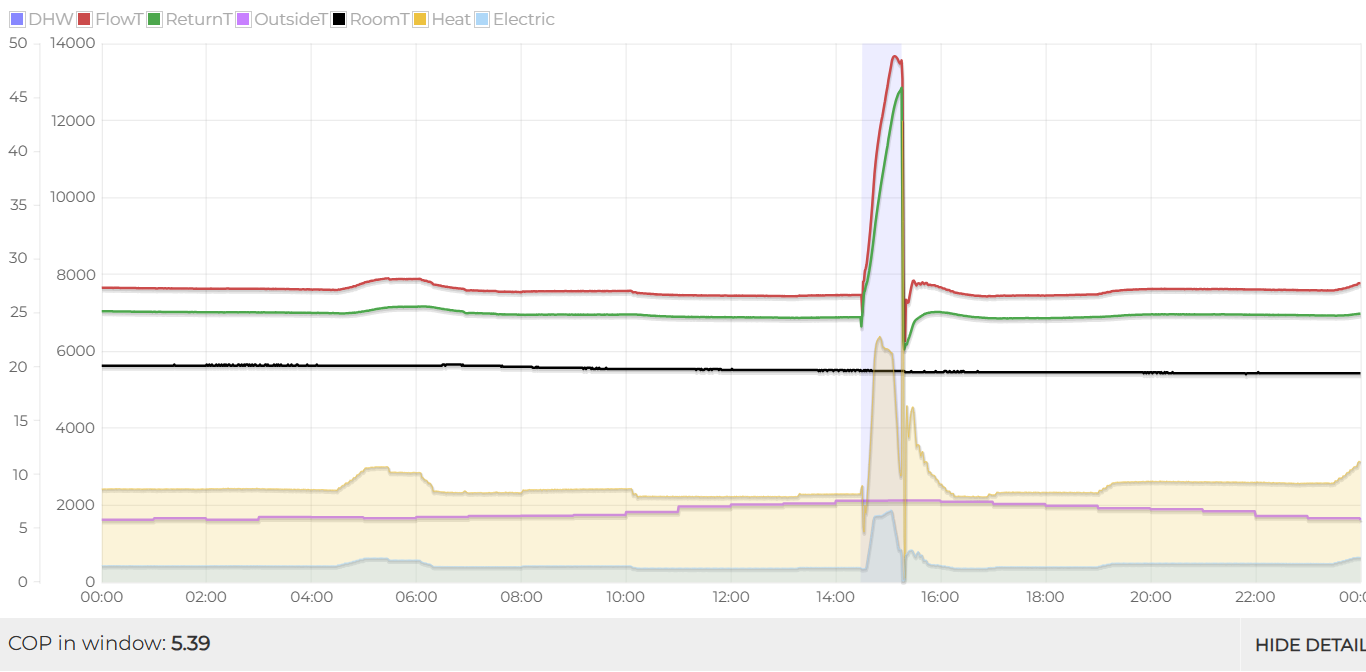
From where you can open each day (by clicking on the required day's bar):
And from there you can zoom and pan, plus press the SHOW DETAIL button to get more info and switch on more info like COP and flow rate.
Also, as I wrote above, the Mitsubishi, and probably the Daikin, run just their water pump during the latter part of the defrost, so the flow temperature is no longer being actively cooled and so increases to the return temperature without any compressor input.
I meant to mention this earlier (when you wrote "The Grant and Samsung both increase their flow rate during the defrost ... et seq"), I cant see any flow rate data anywhere on any of the charts, so I can't see how it is possible to infer anything about flow rate from the charts. The tables below the charts do have Min and Max flow rates, and from that we might be able to infer that four of the five examples run their circulating pumps continuously at a steady rate. The exception is the Grant unit, which varies the flow rate between 15 and 31 (units? not given) but that still suggests it is running all the time.
The Grant with flow rate, clearly showing the increase while defrosting (grey line):
although this Mitsubishi system has an odd negative energy out spike just before ramping up for the recovery - which seems to be an oddity of this system as other Mitsubishi's (like ours) don't do this.
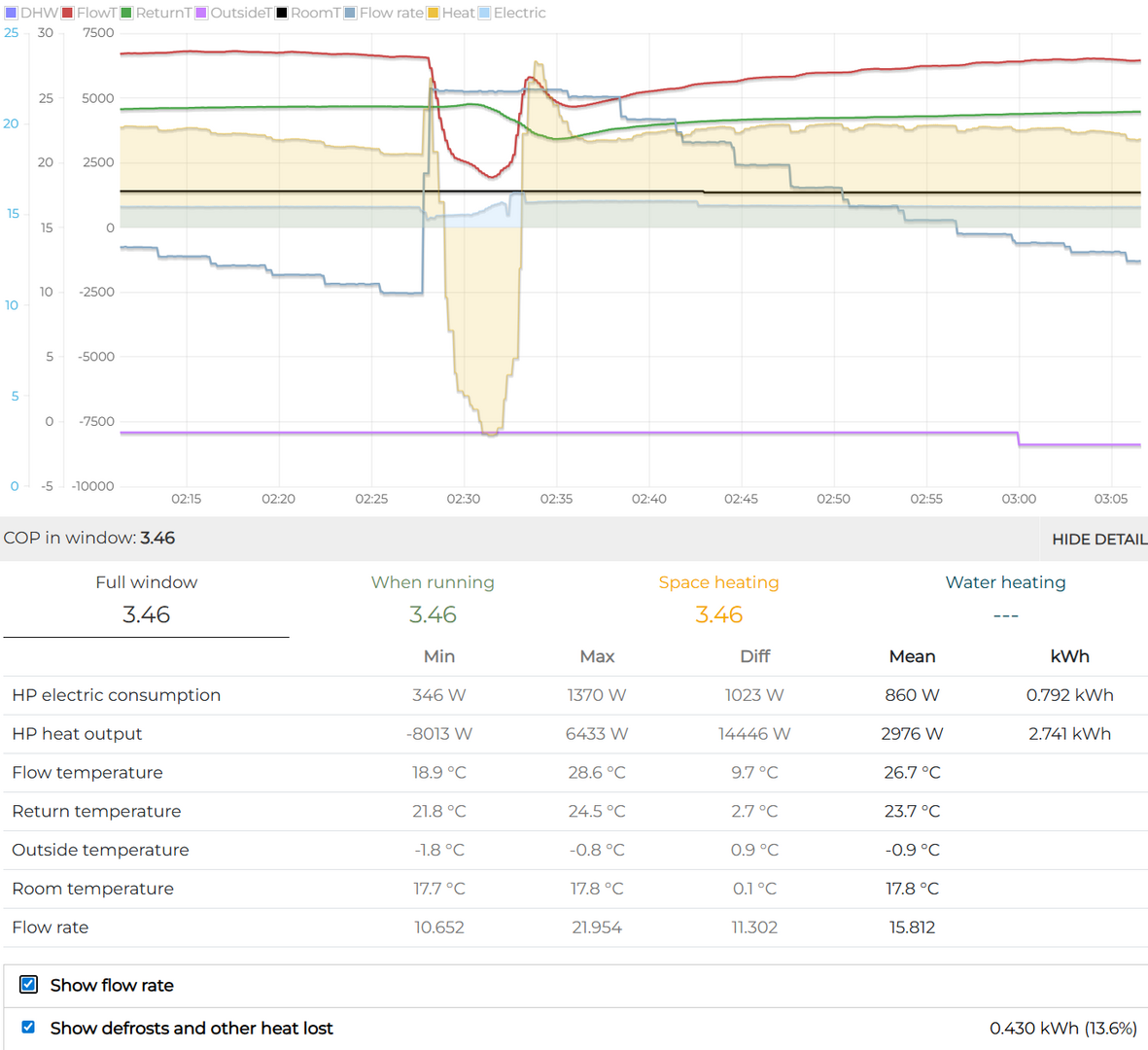
I noticed that too - why does that appear? Is it real, or an artefact? Another oddity that makes no sense is the Grant two horned approach to defrosts:
What is that sharp peak in energy out just before the defrost? How does it happen as the energy in and flow temp appear to fall? Is this real, or an artefact?
Don't know why that Mitsubishi does that, but it does it consistently so clearly some oddity of that system that sees water from the coldest part of the defrost return later. Maybe rad(s) on a very long pipe run or something like that?
The Grant's "horns" are explained above, it's an increased flow rate.
All in all, I now find myself leaning towards thinking these charts raise more questions than they answer, with the biggest question of all being do they actually show what really happened? Or are we in fact looking at a curious set of artefacts?
In contrast, my chart of a defrost that I posted earlier appears both artefact free and to tell a credible story:
They show what is really going on, using temp sensors with 0.1C accuracy and logging data several times a minute. Sadly your data uses the manufacturers thermistors for temperature (only 0.5C accurate, so system dT could really be 10-20% different) and logged only every minute (?), so in a 5-7 minute defrost you only have 5-7 data points and so miss quite a lot of detail.
All of the systems tell a credible story, just with more fidelity than most people are used to.
I've also previously described exactly how I get the data behind those lines (apart from the separate room temp sensor, it all comes from the raw Midea data collected over modbus).
The bottom line, the answer to the question I was trying to answer, do defrosts use more energy, and so increase running costs, is still the same, No, they don't, at least on my setup.
The details of the OEM level 3 (the comprehensive monitoring package) are on their website and the software is all open source - all transparent. The Midea data is sadly only as good as the Midea sensors.
My Mitsubishi is the same and it is likely that all of the other systems are too, but we need data to determine if that is the case and OEM can provide that data.
This post was modified 4 weeks ago 3 times by RobS