@cathoderay I kind of guessed you might come back with the data validation route. The problem with that route is that it is only as good as the understanding of the data and the process that created the data. “Rubbish in begets Rubish out. If we don’t know exactly how a defrost algorithm activates… when it starts, when it stops, what scales its output. We cannot say it is low or high in energy.
There are 3 (and probably more) important gaps in the energy figures discussed so far. EG in @robs breakdown and other interpretations.
1. the energy USED and dumped outside on the pavement in the form of meltwater.
2. the eleven minutes of heating stop-time during the defrost period and the initial defrost recovery. This needs to be replenished and added to the energy recovery cost in KWH.
3. the energy lost to the house from the chilled water from the defrost which has entered the heating system.
Finally I believe the actual defrost is very quick… possibly only 4 minutes. I am also seeing a standard defrost reheat for the next 4 minutes.
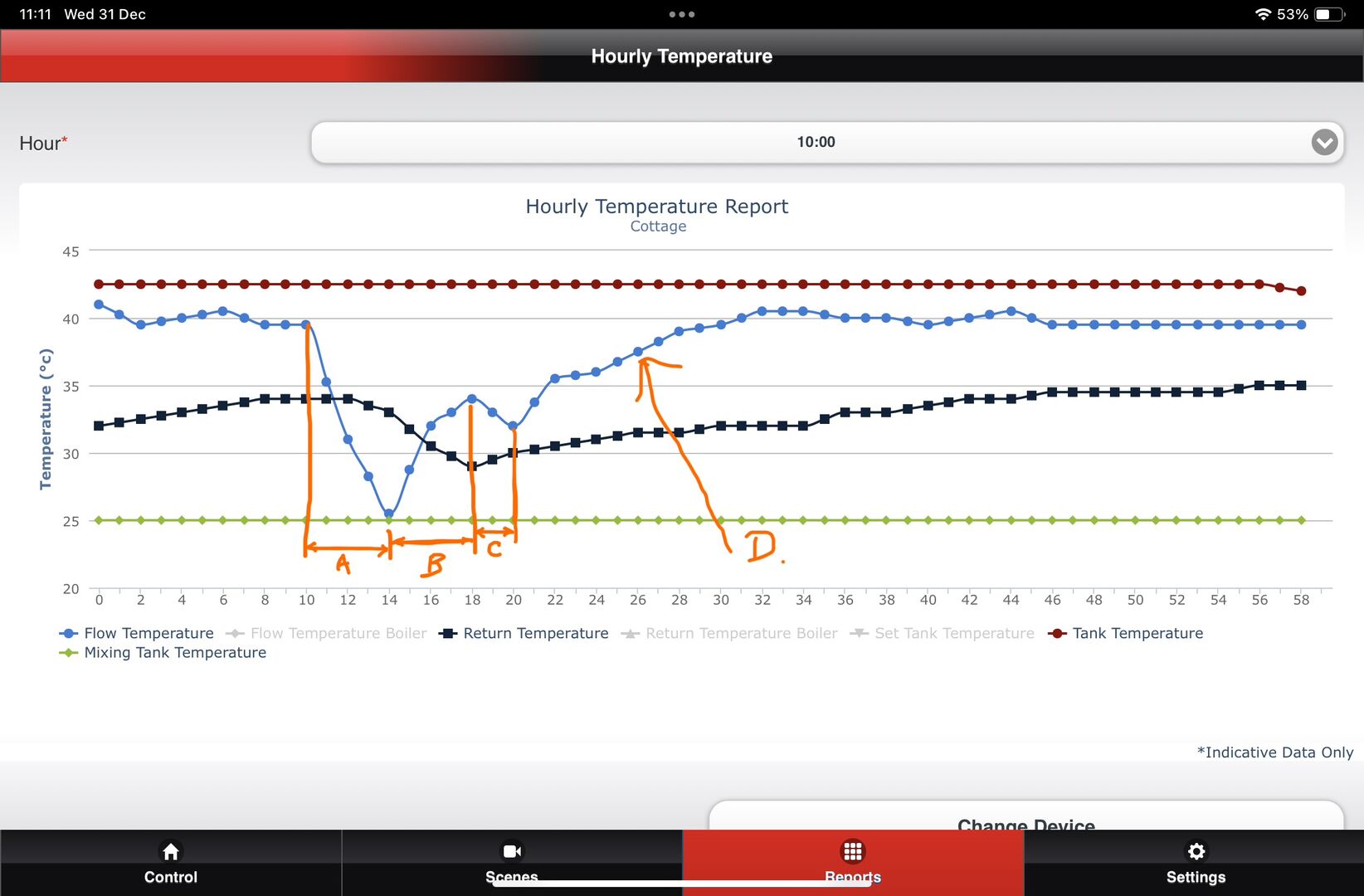
Here is my own interpretation of a different defrost from December, which follows the same pattern, they all follow the same sequence and time frame. A = rapid temp drop 4 mins, B = defrost reheat to algorithmic targeted output. 4 mins. C = 2 minute check with variable heat output. D = apparent standard ramp up in line with normal restart operation and targetting the weather compensation target temperature.
But the biggest unknown is how much of the major defrost recovery is carried out by the manually set target flow temperature. In other words the hidden energy cost of the true defrost recovery is contained (and therefore hidden) in the weather compensation curve setting . The WCC has to be set, by customer’s hand, to compensate for the extra energy needed at the colder defrost temperatures otherwise the target room temperature will not be reached. The extra energy demands of the defrost recovery are therefore hidden in the setting of the weather compensation curve..
I dare say some hydronic maths might produce a better picture of the true energy cost of a defrost cycle. I think the Samsung report on the anatomy of a defrost put the initial recovery value at over 0.500 kWh per defrost.
Here is a 24 hour operation of our system from 5th Jan 2026. Just imagine the extra cost of all those defrosts if they take an extra 500wh for each defrost recovery.
This post was modified 1 month ago 2 times by SUNandAIR
I kind of guessed you might come back with the data validation route.
It is not so much data validation (against something else) as getting at the primary data, the energy flows. Using proxies and inference is fraught with the potential for error. I, and I think @robs, do have minute data for the primary variables, in this case amps and volts in, and so I/we can calculate the energy in (used) on a minute by minute basis and at the end of the day this measure (energy used) is the one that matters when asking both do setbacks save energy/money, and what actually happens during a defrost. Having this data also means I can calculate energy use over different time periods, including days with a setback and days without a setback. The problem is not can I calculate the energy in, I can, but whether the two days are well matched in all the other variables, leaving with/without setback as the only variable that has changed. It's the basic problem we all know about, a setback day may use less energy, but was that because the OAT was a bit milder, or was it because of the setback? My proposed answer is to collect enough data from periods of both setback and non-setback running, and then identify matched pairs of days, one with and one without a setback, and then compare the energy use for each. Since 'big bang' (opening up all the lock shield valves) had such a big effect on system performance, I need to use post 'big bang' data, which happened almost exactly a year ago.
The problem with that route is that it is only as good as the understanding of the data and the process that created the data. “Rubbish in begets Rubish out. If we don’t know exactly how a defrost algorithm activates… when it starts, when it stops, what scales its output. We cannot say it is low or high in energy.
I absolutely agree about GIGO, and the importance of understanding how the data is gathered. I already know that the Midea data tends to under-estimate energy use, compared to that shown on a third party kWh meter that only supplies the heat pump. My presumed explanation is that the amps and volts (and indeed Midea energy in, reported in kWh) only report what the compressor uses, plus maybe some ancillaries, but not all. I deal with this by applying a correction factor to the Midea data, which on average brings it up to align more closely with the third party kWh meter.
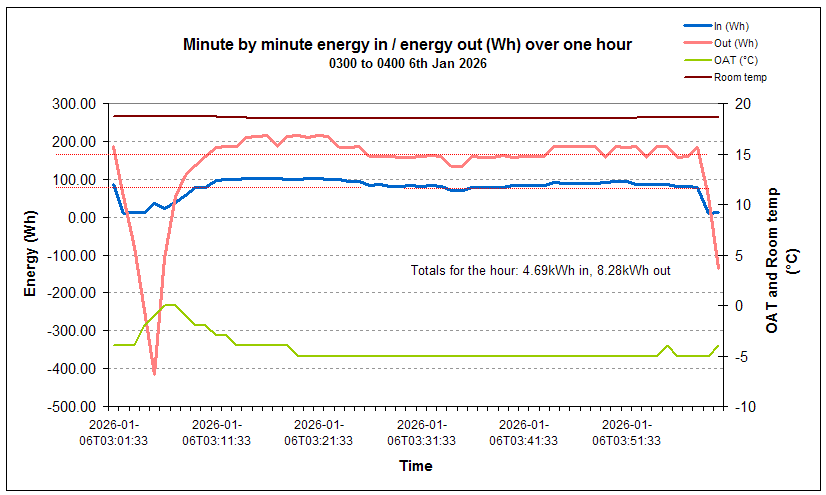
Now let us return to defrosts, look at the minute data for a single defrost (I may have posted part of this plot before, this time round I have added the OAT and room temp, the latter started the hour at 18.7°C, dropped to 18.5° immediately after the defrost, and recovered to 18.6°C by the end of the hour):
On the face of it, this looks rather like a defrost as shown by the LWT/RWT plots, but in fact it is a defrost shown by energy flows: energy in (used) and energy out (to the house). The energy flow out goes negative ie from house to heat pump rather than heat pump to house because that is exactly what happens during a defrost, and it is in the data because the LWT-RWT goes negative, and that in turn means a negative energy flow. But the line we are really interested in is the blue line, the energy in. At the start of the defrost, it drops to almost zero, and then after a few minutes starts to rise to show a small 15 minute or so post defrost recovery boost before setting down to a reasonably stable steady state for the second half of the hour.
Now, the key thing is we don't have to do any reverse engineering of the defrost control logic algorithm, or Heaven forbid attempt to model the defrost, because the blue line, showing the energy in, is the net effect of all those influences at work. It is what it is, as they say.
Furthermore, we can make a good stab at whether overall the defrost hour used more, less or the same amount of energy as would have been used without a defrost. This does involve some whatiffery (what if there had not been a defrost), but I think it is fair to say the second half of the hour is steady state enough to say that it shows the energy in at an OAT of -5°C. Lets say it is 90Wh per minute, multiply that by 60 for 60 mins, which gives 5400Wh, or 5.4kWh with no defrost. With the defrost, the actual usage was 4.69kWh. Overall, the defrost appears to have reduced overall electrical energy in, which is the number we are interested in, because it is what ultimately ends up on our bills.
There is another way of doing the analysis, by comparing the area under the curve for the defrost period and then the recovery period, against the same baseline (90Wh). I haven't done the full pixel count way of doing this, but I think I can say that visually the defrost area is larger than the recovery area, which is really just another way of saying the same thing, the net effect of the defrost was to slightly reduce the total energy in compared to a similar hour without a defrost.
Finally, we can even estimate the extra energy used during the post defrost recovery boost. Lets say, from eye-balling the chart, that the heat pump used an extra 10Wh per minute for 15 minutes: 10 x 15 = 150Wh, or 0.15kWh.
I think the Samsung report on the anatomy of a defrost put the initial recovery value at over 0.500 kWh per defrost.
I can't actually see that number in the report (it's not really a report on the anatomy (structure), though it does include some, its's primarily a report on the physiology (function) by the way, even if she titled is as on the anatomy!). The closest is the net transfer from the house to the heat pump of 570Wh (573Wh in the spreadsheet), but that is a very different consideration to the extra energy in during recovery. I don't think she directly calculated that, I can't see it anywhere in the spreadsheet, though she does remark the energy out peaked at over 10600W (an instantaneous power value, in W), compared to a 'pump nameplate duty of 8000W' (which in passing makes one wonder - the heat pump is operating in defrost conditions, when it is rather unlikely to exceed its rated output...). But the key thing is, she only looks at the energy out, not the energy in. However, she did record the compressor current, and I think, assuming a steady supply voltage, we can use that as a proxy for energy in, with a lot of caveats. totally different setup, 3 phase, is the voltage assumption valid, and her period of interest is shorter (~17 min), but with those caveats very much in mind this is what her data shows for the compressor current (PS yes I do feel awkward using her data, but she did put it in the public domain, the source is here):
In broad terms we see a similar picture: sharp fall for the defrost, then recovery with a shorter but greater amplitude post defrost boost. Since I have only limited data, I do not want to do anything too fancy, like estimate actual energy in, but if we accept that compressor current is proxy for it, and at a guess the baseline draw for that unit at the time was around 5.75A, then we can use visual area under the curve from that baseline for both the defrost and the recovery boost and I am pretty sure that drop during the defrost exceeds the extra during the recovery, in other words the defrost appears to cause a net saving in energy in (electrical energy use), compared to not having a defrost.
Midea 14kW (for now...) ASHP heating both building and DHW
in other words the defrost appears to cause a net saving in energy in (electrical energy use), compared to not having a defrost.
Interesting, I have highlighted the possibility of hidden energy that may not be accounted for during recovery, as listed, including contained in the setting of the weather compensation curve. You’re obviously sure of your data.
Interesting, I have highlighted the possibility of hidden energy that may not be accounted for during recovery, as listed, including contained in the setting of the weather compensation curve. You’re obviously sure of your data.
I think the key thing is we are using fundamentally different approaches, which is a good thing, each method provides a check on the other. Using the structure - process - outcome framework of analysis, you are looking at the structures and processes and trying to make sense of them, in effect build up a model of what is going on. I on the other hand am deliberately only interested in the outcome, specifically how much energy is used. Arguably, while structure and process can be interesting, it is outcome that matters the most. To use a medical analogy, I might count hospital beds, their occupamcy and operating activity for hip replacements (ie structure and process) but what i am really interested in is outcomes, successful hip replacements and of course other unwanted outcomes like mortality. As I said before, with a heat pump, the outcome, how much energy was used, is the net result of all the structures and processes that contributed to that outcome. In the real world, of course we want to know about all three, precisely because the structures and processes affect the outcome.
I am as sure of my energy in data as I can be. It does what we might expect it to do, goes up when the OAT goes down, down when the OAT rises etc, but more importantly I have that independent kWh meter that only supplies the heat pump. I thus have three sources of energy in data, firstly my calculated values (Midea reported amps x volts), secondly Midea's running kWh total (lifetime) kWh register (I don't know how it calculates this number, and it only increments in whole kWh, so is not very useful for short time frames, but it does provide a check over longer intervals), and thirdly the independent kWh meter. The first two are usually very close over longer periods, but as I mentioned before, the independent kWh meter suggests the first two under report actual usage, with unaccounted for ancillary usage being the most likely explanation. To put some numbers on all this, for the whole of 2025, my calculated total energy in (sum of the amount for every hour in the year including the correction factor) was 7033kWh, the Midea total energy in (lifetime use at end of year minus lifetime use at the start of the year) was 6958kWh (1.07% less than my calculated value, I think that is close enough), while the metered use for the year from the independent meter (actually 30/12/24 to 29/12/25, as I only manually read the meter once a week) was 7188kWh (2.2% more than my calculated use). Again, not exact agreement, but I think it is close enough. These are real readings taken from a dynamic system using two totally independent measuring systems, Midea raw data which is then converted into kWh vs the independent kWh meter, and they are within a few percentage points of each other. While I don't know in any absolute sense that they are correct, there is nothing to suggest they are not.
Edited to correct typos...
This post was modified 1 month ago 2 times by cathodeRay
Midea 14kW (for now...) ASHP heating both building and DHW
@cathoderay I kind of guessed you might come back with the data validation route. The problem with that route is that it is only as good as the understanding of the data and the process that created the data. “Rubbish in begets Rubish out. If we don’t know exactly how a defrost algorithm activates… when it starts, when it stops, what scales its output. We cannot say it is low or high in energy.
There are 3 (and probably more) important gaps in the energy figures discussed so far. EG in @robs breakdown and other interpretations.
1. the energy USED and dumped outside on the pavement in the form of meltwater.
2. the eleven minutes of heating stop-time during the defrost period and the initial defrost recovery. This needs to be replenished and added to the energy recovery cost in KWH.
3. the energy lost to the house from the chilled water from the defrost which has entered the heating system.
We have a good understanding of the data and don't need to reverse engineer a defrost algorithm as we are just interested in the energy flows, which ultimately determine how much we pay and how warm our houses are.
All of those three were included in my breakdown. So we can say if a defrost (of my Mitsubishi) is low or high in energy - it requires only a small amount of additional energy.
But does this hold true for other manufacturers? Looking at defrosts on heatpumpmonitor.org it is seems that there are some differences in how defrosts are performed. The following are all 7-8.5kW heat pumps performing a defrost at around -1.5C OAT. The Grant and Samsung both increase their flow rate during the defrost and then progressively reduce the flow rate during the recovery. The Vaillant and Grant noticeably ramp up their compressor during the defrost, while the Samsung, Mitsubishi and Dakin don't. The Mitsubishi (and possibly the Daikin) just runs the water pump and not the compressor during the latter part of the defrost (flow temp increases to return temp with low levels of input power). The ramp up for the recovery also varies, the Vaillant, Grant and Mitsubishi all ramp up progressively to clearly greater input power than the previous steady running. While the Samsung and Daikin only ramp up to a little more than the previous input power steady state, but in both of these cases the OAT was rising so it's possible that the WC curve of both has reduced the required flow temp, and hence the softer ramp ups.
7kW Vaillant
9kW Grant
8kW Daikin
8kW Samsung
8.5kW Mitsubishi
So no simple answer to the question I posed above. The Vaillant and Grant both ramp up the compressor during the defrost using more electricity and extract more energy from the water (both ~0.5kW in the examples above), but maybe they defrost less frequently? The others (Daikin, Samsung and Mitsubishi) use less electricity and extract less energy from the water, but maybe they defrost more frequently? Nature doesn't often give us the same conditions (e.g. OAT and humidity) in multiple locations very often, or for very long, so those are not easy questions to answer.
The Vaillant and Grant noticeably ramp up their compressor during the defrost, while the Samsung, Mitsubishi and Dakin don't.
FWIW the ramp with my Vaillant up occurs shortly after the cloud of vapour appears, so its during the 'recovery' phase. I have always assumed that the intention was to restore the flow temperature to the target quickly. If my heat pump is put into low noise mode (which limits compressor modulation) the ramp up is supressed and the recovery is much slower, or indeed (in my case) it may never fully recover leading to a reduction in FT relative to the target (my heat pump capacity is pretty well matched to the house so this is not entirely surprising).
4kW peak of solar PV since 2011; EV and a 1930s house which has been partially renovated to improve its efficiency. 7kW Vaillant heat pump.
We have a good understanding of the data and don't need to reverse engineer a defrost algorithm as we are just interested in the energy flows, which ultimately determine how much we pay and how warm our houses are.
Now, the key thing is we don't have to do any reverse engineering of the defrost control logic algorithm, or Heaven forbid attempt to model the defrost, because the blue line, showing the energy in, is the net effect of all those influences at work. It is what it is, as they say.
They key thing is the bit I put in italics (in the original), the energy in is the net effect of all those influences at work. What that means is analysing in detail everything that happens during a defrost is a red herring, because nature and our heat pumps have between them already done the work, and our monitoring tells us the answer, in the energy flow values. By all means analyse defrost algorithms as a separate activity if you want to, but such an analysis is not needed to understand the net effects of a defrost, in particular whether it uses more, less or the same amount of energy compared to that which would have been used had the defrost not occurred.
The following are all 7-8.5kW heat pumps performing a defrost at around -1.5C OAT.
A very interesting collection of charts, thank you for collecting and posting them. The OAT and IAT where shown is pretty much constant within and between the charts, so far as I can see, ie any changes if present are small, apart from one or two relatively minor exceptions. What I find interesting is the variation is the visible presence of a recovery boost. In particular, the Daikin and the Samsung somehow manage to recover without any visible recovery boost, or maybe a small one in the Samsung. The Daikin chart has other oddities, eg the flow temperature is remarkably low throughout most of the period, especially at the start of the charted period, <30 degrees despite an OAT below zero, and at the same time the flow temp outside the defrost varies considerably, despite the constant OAT, which suggests it is not using conventional weather compensation. Another possibility is the data is simply wrong.
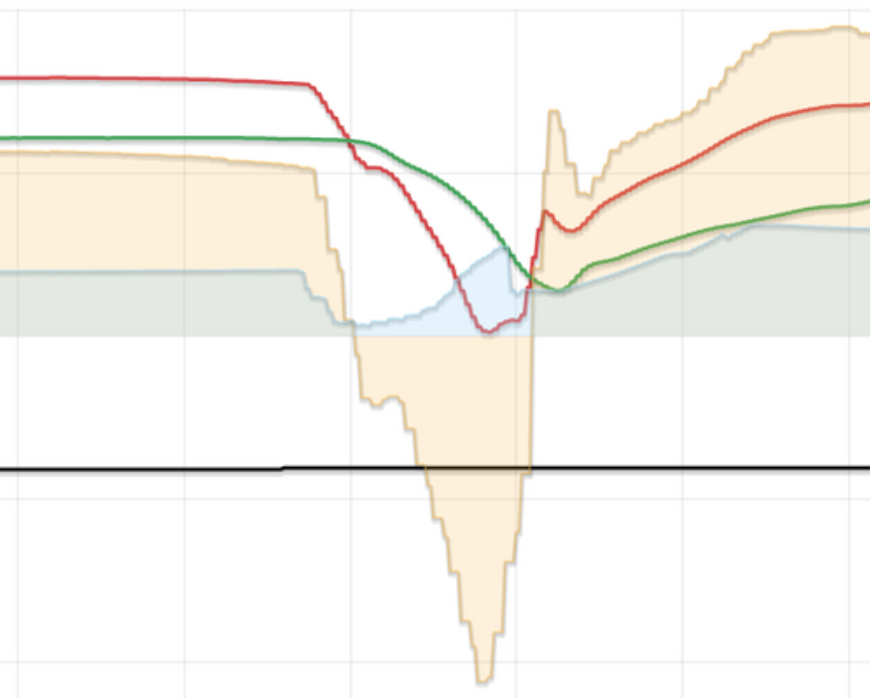
Indeed, this possibility seems more likely when one looks in detail at the defrosts. I am not sure we can say much about flow rates, because they are not on any of the charts. We do however have the energy flows and the flow and return temps, and some things appear to happen that don't really make sense. Here are the defrost side by side (you should be able to work out which line is which):
The Vaillant and the Grant both increase energy use during the second half of the defrost. Where does that energy go? In both cases, the flow temp is still falling. The Daikin manages to increase the flow temp without apparently using much if any energy. How does it do that? The Samsung is similar, it manages to ramp up the flow temp while only using a small amount of energy. How does it do that? The Mitsubishi is quite literally all over the place, with a flow temp hump that appears without any apparent energy use. Few if any of these patterns make any obvious sense. One has to wonder...
Which leaves me back where I started, the only thing we need to look at is the energy flows. All of the charts show negative energy out flows, ie the energy out flow has reversed direction, and that is the defrost. Energy has been lost from the house, and taken to the heat pump, to do the defrost. Three of the charts show moderately or substantially less energy in, which represents a saving in energy in, compared to what would have been used without a defrost. Three show a clear recovery boost (so probably satisfying the conservation of energy principle), one shows a possible slight recovery boost, and one (the Daikin) shows no immediate recovery boost at all, along with other 'oddities', which, as I said, makes one wonder. All in all I am led back to the same practical conclusion: in general (there will always be exceptions) defrosts do not use more energy in than would have been used had they not occurred, and so do not of themselves increase energy bills. Instead, the reason why bills are high when defrosts occur is due to the compound effect of a low OAT needing more heat energy and that heat energy being produced at lower efficiency. Don't forget that for a given amount of energy out, a drop in COP from 4 to 2 doubles your energy bill. If at the same time you need twice as much energy out, because of the drop in OAT, then your bill will four times what it normally is. Ouch.
Midea 14kW (for now...) ASHP heating both building and DHW
The Vaillant and the Grant both increase energy use during the second half of the defrost. Where does that energy go? In both cases, the flow temp is still falling
The FT is still falling but so is the return temp, so most likely into the water, it takes a while for 200l of water to circulate through the system!
4kW peak of solar PV since 2011; EV and a 1930s house which has been partially renovated to improve its efficiency. 7kW Vaillant heat pump.
The FT is still falling but so is the return temp, so most likely into the water, it takes a while for 200l of water to circulate through the system!
I did try to visualise how the water circulation might somehow influence things eg by mixing, but got stuck on the old train idea, the flow is a series of wagons on a train carrying heat around the system, and there no more mixing of the water than there is of wagons on a train (except perhaps in a buffer). But the paradox I was really looking at is how come electrical energy gets added to the system, and yet the temperature drops. It makes as much sense as turning on the kettle makes the temperature of the water in the kettle drop!
Midea 14kW (for now...) ASHP heating both building and DHW
. But the paradox I was really looking at is how come electrical energy gets added to the system, and yet the temperature drops. It makes as much sense as turning on the kettle makes the temperature of the water in the kettle drop!
Easy I think. If the temperature of the incoming water drops then the temperature of the outgoing water may drop even though it's still hotter than the incoming.
The easy way to envisage the flows is just a long pipe connecting outgoing to incoming.
In your wagon analogy the arriving wagons are significantly less full than the previous arriving wagons. So although some coal is added, the departing wagons are still less full than the previous departing wagons. This situation will continue until the first set of departing wagons after the hopper was opened have done the full circuit. At any point in time during the recovery there may be wagons in the circuit that are less full than the wagons currently currently arriving at the hopper, because they were emptied more at the discharge station or have suffered two discharges.
This post was modified 4 weeks ago 4 times by JamesPa
4kW peak of solar PV since 2011; EV and a 1930s house which has been partially renovated to improve its efficiency. 7kW Vaillant heat pump.
@jamespa — thanks. But the coal is added during the defrost, the shark's fin in energy in happens while there is still 'negative' energy out, ie heat is being dumped from the house to the heat pump (as LWT/RWT delta t is reversed, ie negative). I suppose another possibility is that it is just a lag effect. If we zoom in on the Vaillant defrost (vertical lines are 5 mins apart):
there is probably less than a minute between the peak of the shark's fin increase in energy in, and the subsequent rise in LWT and then energy out.
Midea 14kW (for now...) ASHP heating both building and DHW
What I find interesting is the variation is the visible presence of a recovery boost. In particular, the Daikin and the Samsung somehow manage to recover without any visible recovery boost, or maybe a small one in the Samsung.
As I wrote above "in both of these cases the OAT was rising so it's possible that the WC curve of both has reduced the required flow temp, and hence the softer ramp ups."
Indeed, this possibility seems more likely when one looks in detail at the defrosts. I am not sure we can say much about flow rates, because they are not on any of the charts. We do however have the energy flows and the flow and return temps, and some things appear to happen that don't really make sense. Here are the defrost side by side (you should be able to work out which line is which):
Each system has a different lag between input power (compressor) changes and output power (heat) changes. So it's quite possible for a compressor change not to be see by the heat meter in the plant room for a couple of minutes.
Also, as I wrote above, the Mitsubishi, and probably the Daikin, run just their water pump during the latter part of the defrost, so the flow temperature is no longer being actively cooled and so increases to the return temperature without any compressor input.
The Vaillant and the Grant both increase energy use during the second half of the defrost. Where does that energy go? In both cases, the flow temp is still falling. The Daikin manages to increase the flow temp without apparently using much if any energy. How does it do that? The Samsung is similar, it manages to ramp up the flow temp while only using a small amount of energy. How does it do that? The Mitsubishi is quite literally all over the place, with a flow temp hump that appears without any apparent energy use. Few if any of these patterns make any obvious sense. One has to wonder...
Most of that is due to the system's lag and hence interpreting requires some time shifting. The Daikin and Mitsubishi I've described above, although this Mitsubishi system has an odd negative energy out spike just before ramping up for the recovery - which seems to be an oddity of this system as other Mitsubishi's (like ours) don't do this.