
Notifications
Clear all
Air Source Heat Pumps (ASHPs)
380
Posts
21
Users
50
Reactions
59 K
Views

25/02/2026 2:17 pm
Hi everybody, we are approaching a month with our midea and I have officially become the laughing stock of my family as I frequently stand in front of the wired controller taking manual measurements. Remaining undeterred, I'd like to share with you the following findings:
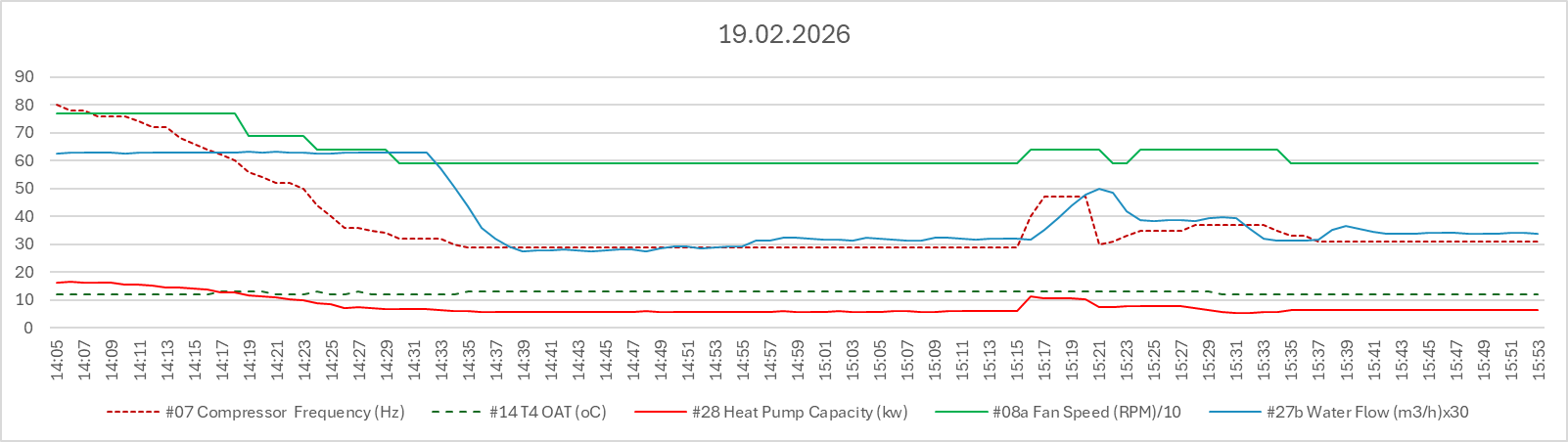
1. Our unit exhibits a wide range of modulation capabilities. The diagram below is based on 2-hour data manually collected, starting almost half an hour after its daily switch on on 19.02.2026 (beware, scaling factors have been applied). Modulation is applied on compressor frequency, fan speed and water circulation.
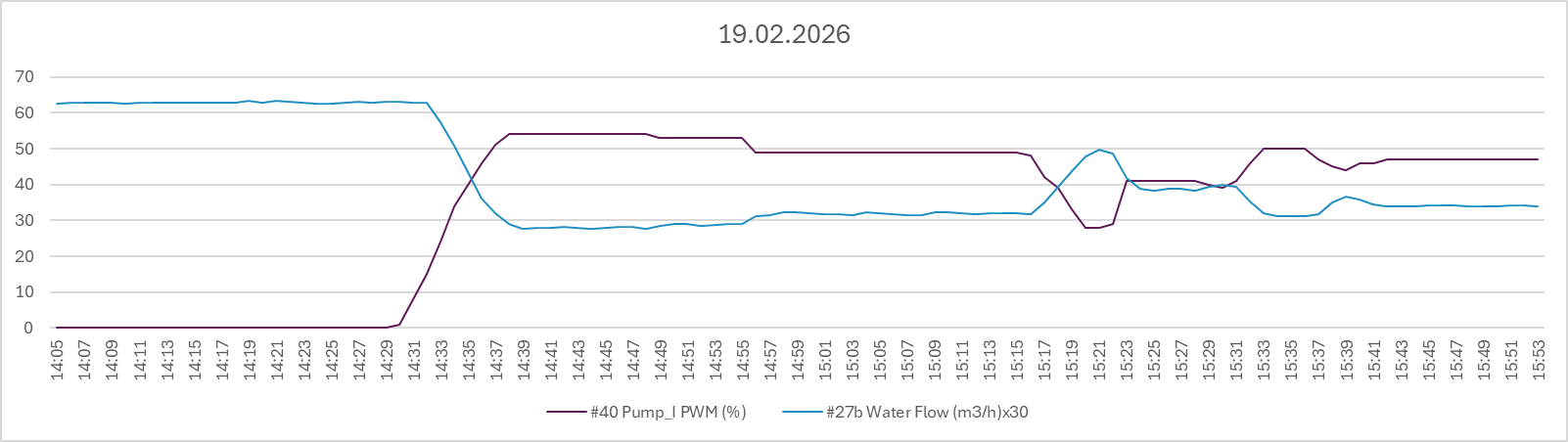
2. Indeed as @jamespa had mentioned, 0% Pump_I PWM corresponds to maximum waterflow, the more PWM increases, the more water flow decreases (scaling factor x30 has been applied to water flow)
3. The Ta IAT sensor of the wired controller is actually affected by human presence in close proximity (and I guess fiddling).
During the 19.02.2026 sampling window, commencing a mere half hour after midea had switched on, it went from 20 to 22 degrees within 30 mins (astronomic leap, not even achievable in our oil boiler days). Meanwhile, the Siemens thermostat moved by 0.2 degrees. An hour after I stopped sampling, I rechecked: the wired controller had dropped back to 21 degrees, whereas the Siemens sensor had risen further.
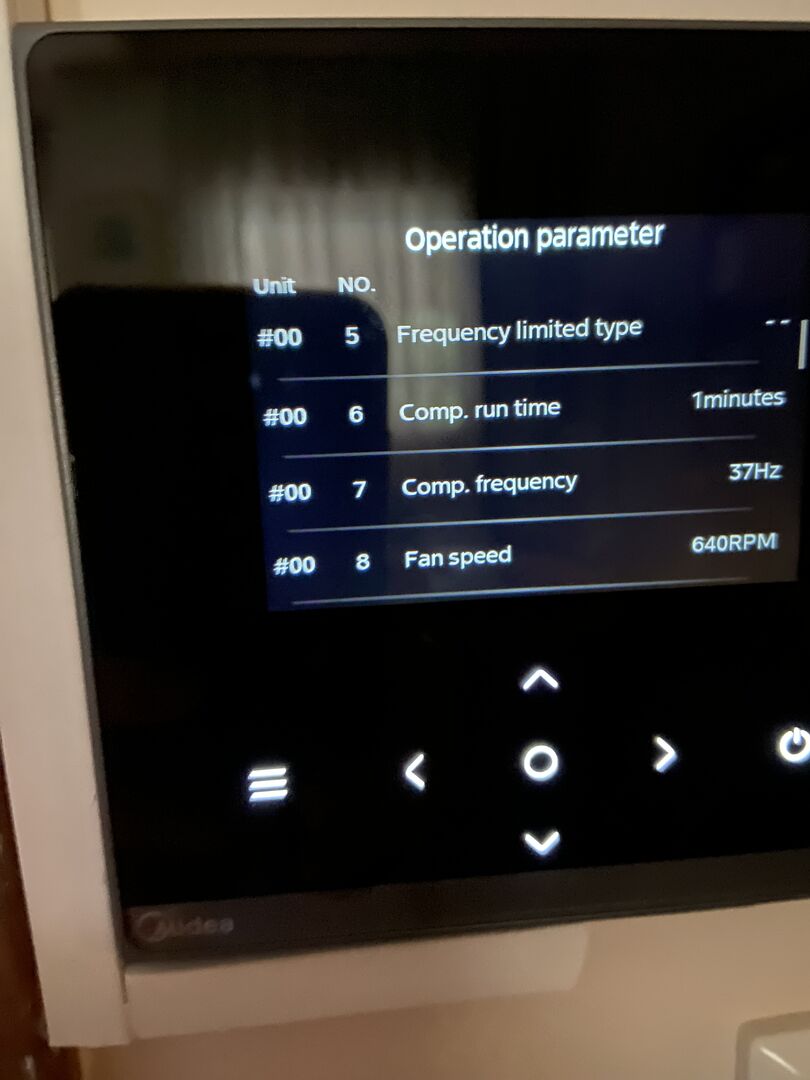
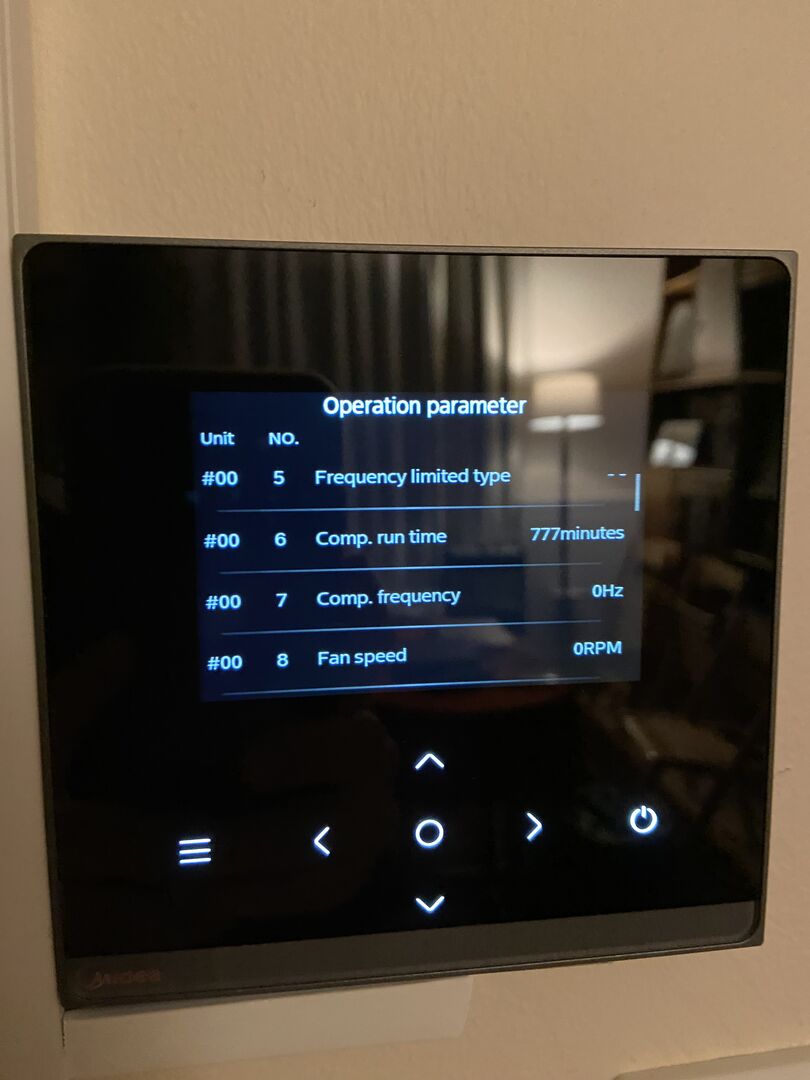
4. Our unit does not cycle. At all. See the screen shots with the compressor running time (reset every time the unit starts). It starts with 1 minute run time and ends us with 777 mins 13 hours later. The 3min difference is due to the fact that the ASHP has a built in 3 min delay to compressor start up from the moment the unit is switched on. I am checking compressor run time every single day and it always equals the scheduled run time minus 3 mins.
So the big question is why does our unit not cycle when almost everybody else's does?
What makes it exhibit this behavior and is it replicable to other installations (without unacceptable compromises, because our unit is probably oversized and our wc curve is definitely on the high range of temperatures and delivering more heat than what is required by the house - which is OK with us for the time being, so let us not go down that path).
What I have observed is that the actual LWT is almost always lower than the LWT set by the wc (not only in the diagram below, but consistently throughout the days). Whereas in @cathoderay 's diagrams, LWT overshoots T1S and then the unit cycles. But what is it that keeps our LWT below its theoretical set value?
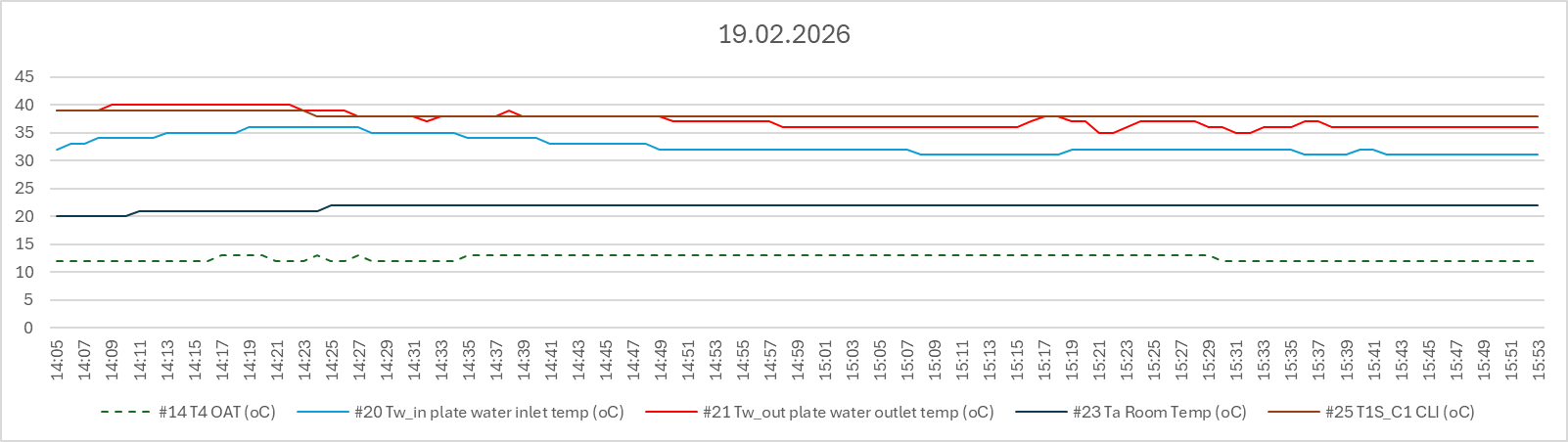
Mind you, even with this lower LWT, the house warms up and keeps slowly but steadily warming up while the ASHP runs (with OATs ranging from 6 to 14 degrees) - meaning that our wc curve is set overall at a level higher than what is required by the house. The ASHP runs continuously from 10 to 14 hours daily, depending on the schedule we set.
Could it be that somehow ΔΤ equilibrium supersedes the goal of reaching set LWT when measured IAT floats around set IAT? And I can see @cathoderay rolling his eyes, but I am just wondering. Because, the ASHP has no way of knowing the heat loss rate of the building, the only feedback it has is how ΔT fluctuates....
BTW, COP remains around 4.2 for the entire month and the thermal mass of the building works wonders while the ASHP is switched off.
25/02/2026 6:18 pm
@mk4 — all very interesting, especially the water pump stuff and the absence of cycling.
So the big question is why does our unit not cycle when almost everybody else's does?
I may be wrong, but I think 'almost everybody else's' means R32 units where as your is a R290. I think @tasos may have a R290 unit, but I get the impression he runs his unit in a rather unconventional way. All of which is to say I think it may be that Midea changed more than just the refrigerant gas and display when they designed the new unit.
Could it be that somehow ΔΤ equilibrium supersedes the goal of reaching set LWT when measured IAT floats around set IAT? And I can see @cathoderay rolling his eyes, but I am just wondering. Because, the ASHP has no way of knowing the heat loss rate of the building, the only feedback it has is how ΔT fluctuates....
Don't worry, my eyes are not rolling! I do think I recall at some point @jamespa gave an explanation that covered how the RWT gave feedback, but it was a while ago. If he did give such an explanation, he might be able to do so again.
Both the Midea units on heatpumpmonitor.org show cycling and mostly step-wise flow rate changes (get the daily chart and then click on a day to get the detail, then Show Detail and check the flow rate box to get it on the chart as well). Interestingly, the Medstead one is R32, but the commercial experimental one in London is R290, and it also shows cycling. All very curious!
Midea 14kW (for now...) ASHP heating both building and DHW

25/02/2026 6:57 pm
Because, the ASHP has no way of knowing the heat loss rate of the building,
Er, it does. It knows the heat loss because it knows LWT, RWT and flow rate. Thats the heat supplied which, if the house is in equilibrium, must equal the heat loss.
But actually it doesn't need to know the heat loss, which is doubtless why the sensors are frequently not too well calibrated much to the chagrin of those who rely on them to measure COP.
@jamespa gave an explanation that covered how the RWT gave feedback
As above, but it doesn't need this information explicitly. All it needs to do is take whatever return water it gets and heat it to the target LWT. That is, in principle, a simple control loop which (in principle) depends on measuring LWT only, though doubtless optimising it is more challenging and probably does involve knowledge of the RWT.
4kW peak of solar PV since 2011; EV and a 1930s house which has been partially renovated to improve its efficiency. 7kW Vaillant heat pump.
25/02/2026 7:01 pm
@jamespa — thanks, that is what I vaguely remembered, much clearer now.
Midea 14kW (for now...) ASHP heating both building and DHW

25/02/2026 7:06 pm
I think @tasos may have a R290 unit, but I get the impression he runs his unit in a rather unconventional way.
I do actually, but I don't yet run it in an "unconventional" way. This is a latest plot of operation:
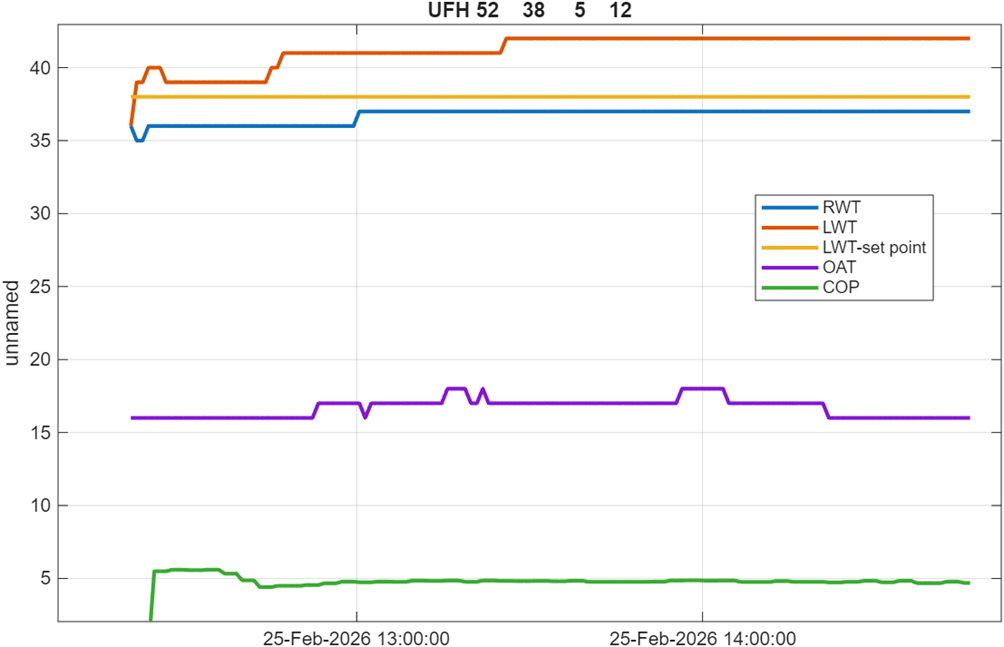
I have switched to UFH mode to see what happens at getting actual LWT where it should be.
As you can see, LWT is constantly above set LWT and I can only contribute this to the ΔΤ = 5 C requirement, though I have not seen it documented in any of the documents I have.
The compressor does not slow low enough nor does the flow rate. I can't figure out what is preventing them from doing so.
This post was modified 7 days ago by Tasos
Midea MHCV10WD2N7 R290, 5.8kWp energy community solar power.
25/02/2026 8:01 pm
@tasos — thanks for confirming you have a R290 unit. I'm pretty sure most if not all R32 units would be cycling in the condition on your chart. Also, the set LWT never mind the actual LWT seem rather high for the OAT, mine might be 10 degrees lower, in fact i might even turn the heat pump off altogether in those OATs!
Midea 14kW (for now...) ASHP heating both building and DHW
25/02/2026 9:40 pm
Because, the ASHP has no way of knowing the heat loss rate of the building,
Er, it does. It knows the heat loss because it knows LWT, RWT and flow rate. Thats the heat supplied which, if the house is in equilibrium, must equal the heat loss.
But actually it doesn't need to know the heat loss, which is doubtless why the sensors are frequently not too well calibrated much to the chagrin of those who rely on them to measure COP.
@jamespa gave an explanation that covered how the RWT gave feedback
As above, but it doesn't need this information explicitly. All it needs to do is take whatever return water it gets and heat it to the target LWT. That is, in principle, a simple control loop which (in principle) depends on measuring LWT only, though doubtless optimising it is more challenging and probably does involve knowledge of the RWT.
My understanding is that LWT, RWT and flow rate provide the heat dissipated by the radiators, not necessarily the house loss. Our system is not in equilibrium because the IAT keeps rising while the AHSP runs (regardless of OAT - presumably due to the wc curve we chose). And actual LWT remains almost constantly below set LWT.
I understand from you diagram that your unit is not cycling either. Is that so? Apart from both of us having R290 based midea units, we also set LWT (be it via wc or fixed LWT) much higher than the level almost everybody else in this forum would.... Do you have a buffer or low loss header in your installation? Or do you connect your ASHP directly to the radiator network?
In wc curve 9, the lowest LWT I am allowed to set from the wired controller (not Serviceman menu) is 35 degrees. Is that the same for you?
25/02/2026 10:09 pm
My understanding is that LWT, RWT and flow rate provide the heat dissipated by the radiators, not necessarily the house loss. Our system is not in equilibrium because the IAT keeps rising while the AHSP runs (regardless of OAT - presumably due to the wc curve we chose). And actual LWT remains almost constantly below set LWT.
You are of course correct in the short term. If the system (hp, house, rads, pipework) isn't in equilibrium something will heat up until it is, or shut off because of a control loop. In the medium term it will end up on average in equilibrium, nature (conservation of energy) will ensure that's the case even if we don't. For a house the 'medium term' is perhaps around 24-48 hours because of the heat capacity.
If the radiators are emitting more heat than the house is losing, IAT will, as you say, rise. It will continue to rise until either (a) some control loop changes the flow temperature or (b) the loss from the house (which increases as IAT increases) equals the emission from the radiators (which decreases as IAT increases). One way or another nature will find an equilibrium, whatever we do, and averaged over time (and excluding relatively minor losses outside the heated envelope and heat absorbed by and stored in the fabric, which can be significant in the short term but is insignificant in the longer term) the heat supplied by the heat pump will equal the heat lost from the house.
What is the effect you are trying to explain? Is it
"The ASHP runs continuously from 10 to 14 hours daily, depending on the schedule we set." and "So the big question is why does our unit not cycle when almost everybody else's does?"
If so the first part probably explains the second. Basically, because of part time operation, your slab never reaches equilibrium and continues to absorb more heat than the minimum output of the heat pump. If your heat pump is oversized and you have UFH in a slab (effectively a storage heater) there is a sound argument for 'batch heating' ie running part time, particularly if you can, as a result, take advantage of ToU tarrifs. Is this the issue?
4kW peak of solar PV since 2011; EV and a 1930s house which has been partially renovated to improve its efficiency. 7kW Vaillant heat pump.
25/02/2026 10:54 pm
My understanding is that LWT, RWT and flow rate provide the heat dissipated by the radiators, not necessarily the house loss. Our system is not in equilibrium because the IAT keeps rising while the AHSP runs (regardless of OAT - presumably due to the wc curve we chose). And actual LWT remains almost constantly below set LWT.
You are of course correct in the short term. If the system (hp, house, rads, pipework) isn't in equilibrium something will heat up until it is, or shut off because of a control loop. In the medium term it will end up on average in equilibrium, nature (conservation of energy) will ensure that's the case even if we don't. For a house the 'medium term' is perhaps around 24-48 hours because of the heat capacity.
If the radiators are emitting more heat than the house is losing, IAT will, as you say, rise. It will continue to rise until either (a) some control loop changes the flow temperature or (b) the loss from the house (which increases as IAT increases) equals the emission from the radiators (which decreases as IAT increases). One way or another nature will find an equilibrium, whatever we do, and averaged over time (and excluding relatively minor losses outside the heated envelope and heat absorbed by and stored in the fabric, which can be significant in the short term but is insignificant in the longer term) the heat supplied by the heat pump will equal the heat lost from the house.
And you are of course right, in the long term! I see your point. We have yet to let the system reach an equilibrium as we apply a daily control mechanism (a schedule that lowers the set IAT) that makes the ASHP switch off.
Still however I do not understand why actual LWT is almost always below the target LWT as set by the wc (for the 10 to 14 hours the unit operates daily). Don't get me wrong, I am happy our unit does not cycle. But I am also curious as to why this is so.
25/02/2026 11:09 pm
Still however I do not understand why actual LWT is almost always below the target LWT as set by the wc (for the 10 to 14 hours the unit operates daily). Don't get me wrong, I am happy our unit does not cycle. But I am also curious as to why this is so.
I cant explain that unless either (a) the heat pump is working at its maximum capacity (which could be the case given you are operating part time and possibly never reach equilibrium) or (b) there is somewhere a programmed offset, perhaps a 'correction' factor.
4kW peak of solar PV since 2011; EV and a 1930s house which has been partially renovated to improve its efficiency. 7kW Vaillant heat pump.

26/02/2026 6:06 am
In wc curve 9, the lowest LWT I am allowed to set from the wired controller (not Serviceman menu) is 35 degrees. Is that the same for you?
There is a workaround for this that another forum member signposted me to recently- put heating zone in UFH mode.
26/02/2026 6:28 am
Ι understand from you diagram that your unit is not cycling either. Is that so? Apart from both of us having R290 based midea units, we also set LWT (be it via wc or fixed LWT) much higher than the level almost everybody else in this forum would.... Do you have a buffer or low loss header in your installation? Or do you connect your ASHP directly to the radiator network?
In wc curve 9, the lowest LWT I am allowed to set from the wired controller (not Serviceman menu) is 35 degrees. Is that the same for you?
Yes, it does not cycle and I use a buffer, as shown in Midea's diagrams for 2 zones.
To use LWT below 35, you could "fool" the system by defining UFH instead of radiators.
This post was modified 6 days ago 3 times by Tasos
Midea MHCV10WD2N7 R290, 5.8kWp energy community solar power.

Latest Posts
-
Issue with a Grant Air Source Heat Pump & Tado Smart Thermostat
Hi all I'm having some trouble with a Grant ASHP and ...
By Renewables345 , 20 minutes ago
-
RE: Underfloor Heating Installation Issues with Heat Pump
We suffered a water leak last year in two rooms and had...
By MartinHook_UK , 31 minutes ago
-
RE: Testing new controls/monitoring for Midea Clone ASHP
Now seems a good time to summarise the costs and effici...
By benson , 40 minutes ago
-
RE: Heat Pump vs New Gas Boiler for Inherited House - Worth the Extra Cost?
*** I now see @jamespa has already posted but will stil...
By cathodeRay , 2 hours ago
-

RE: Tell us about your Solar (PV) setup
@mk4 Charge to 100%, discharge down to 10%.
By bobflux , 2 hours ago
-
RE: Daikin Altherma 3 LT compressor longevity question
This mess is intriguing: I wonder if this represent...
By bobflux , 3 hours ago
-
RE: Connecting Growatt SPH5000 over wired ethernet rather than wireless
The simplest wired option is usually the Growatt Ethern...
By Jonatan , 7 hours ago
-
RE: Peak Energy Products V therm 16kW unit heat pump not reaching flow temperature
ASHPs do have a minimum compressor speed. The minimum h...
By bobflux , 14 hours ago
-

RE: Electricity price predictions
@jamespa And it seems some of the nasty public cloud...
By Batpred , 14 hours ago
-

RE: Jokes and fun posts about heat pumps and renewables
Technology is rapidly advancing. BBC News reported th...
By Transparent , 18 hours ago
-
What matters for flow and pressure drop is internal dia...
By bobflux , 18 hours ago
-

RE: Do Fridges and Freezers have COP ratings?
@editor Thank you all for your replies and submitted in...
By Toodles , 21 hours ago
-
I know and yes. The secondary deltaT wont necessaril...
By JamesPa , 1 day ago
-
RE: Designing heating system with air to water heat pump in France, near Lyon
Just love the way you put it! 🤣
By Batpred , 2 days ago
-
RE: Safety update; RCBOs supplying inverters or storage batteries
Thank you for sharing. So it seems that your Schneid...
By Batpred , 2 days ago
-

RE: Forum updates, announcements & issues
@upnorthandpersonal thanks for the thoughtful, consider...
By Mars , 2 days ago
-
RE: Solar Power Output – Let’s Compare Generation Figures
@mk4 All 21 panels have their own Enphase IQ7a microinv...
By Toodles , 2 days ago
-
RE: Setback savings - fact or fiction?
Great, so you have proven that MELCloud is consistently...
By RobS , 3 days ago
-
RE: Mitsu PUHZ120Y 'Outdoor Temp 'error?
Thanks David & James It almos...
By DavidAlgarve , 3 days ago
-
RE: Surge protection devices SPDs
@trebor12345 - your original Topic about the right type...
By Transparent , 3 days ago
-
RE: Help needed with Samsung AE120RXYDEG
@tomf I’ve been sent this from a service engineer at Sa...
By Mars , 3 days ago
-
RE: Buying large amp bidirectional RCD and RCBO
Yes... I went through this particular headache and ende...
By bobflux , 4 days ago
-
O-oh! Let's take this as an opportunity to 'pass the ...
By Transparent , 4 days ago