
Notifications
Clear all

Topic starter
05/01/2026 3:48 pm
Since the UK outdoor temperature has dropped below 3 degrees our heat pump is unable to go over 40 degrees flow temp. It reaches 40 degrees for shortish period before starting a defrost drops back to 33ish and starts again in a loop.
The installer has enabled the back up heater which resolves the issue but why is this happening? Is it standard practise to use the backup heater for this during cold spells?
It is unlike to be an issue with the size of the heat pump as this has already been upgraded to a 16KW from an 11KW to resolve the a similar issue where the flow temps where only reaching 32 degrees before getting into a defrost cycle.
This topic was modified 4 weeks ago by Mars

05/01/2026 3:58 pm
Can you tell us what the weather compensation settings are please and also is there a buffer tank/LLH or (separate question) a volumiser. Have you got any kind of low noise/night mode/noise reduction set? Also whats the system volume
Backup heater isn't 'standard practice' but is a known way to deal with a heat pump that is either undersized or operating beyond the system, design envelope (eg my system is designed for -2, its -5 today).
This post was modified 2 months ago by JamesPa
4kW peak of solar PV since 2011; EV and a 1930s house which has been partially renovated to improve its efficiency. 7kW Vaillant heat pump.

05/01/2026 3:59 pm
@johnd, I'd hesitate before saying that's definitely wrong, but I'm certainly sceptical. Defrost cycles are certainly a big hit on performance but they're far more affected by damp weather than cold weather - that's why heat pumps work perfectly well in Scandiwegia.
Just to start the ball rolling before better brains than mine come along here, are you able to tell us what heat pump you have, what size of house it's supposed to be heating (with any heat loss info if you have it, but don't worry if you haven't) and whereabouts in the UK your house is?
**edited to add that said better brains than mine definitely includes @jamespa with whom I cross-posted**
This post was modified 2 months ago by Majordennisbloodnok
105 m2 bungalow in South East England
Mitsubishi Ecodan 8.5 kW air source heat pump
18 x 360W solar panels
1 x 6 kW GroWatt battery and SPH5000 inverter
1 x Myenergi Zappi
1 x VW ID3
Raised beds for home-grown veg and chickens for eggs
"Semper in excretia; sumus solum profundum variat"
1
Topic starter
06/01/2026 2:30 pm
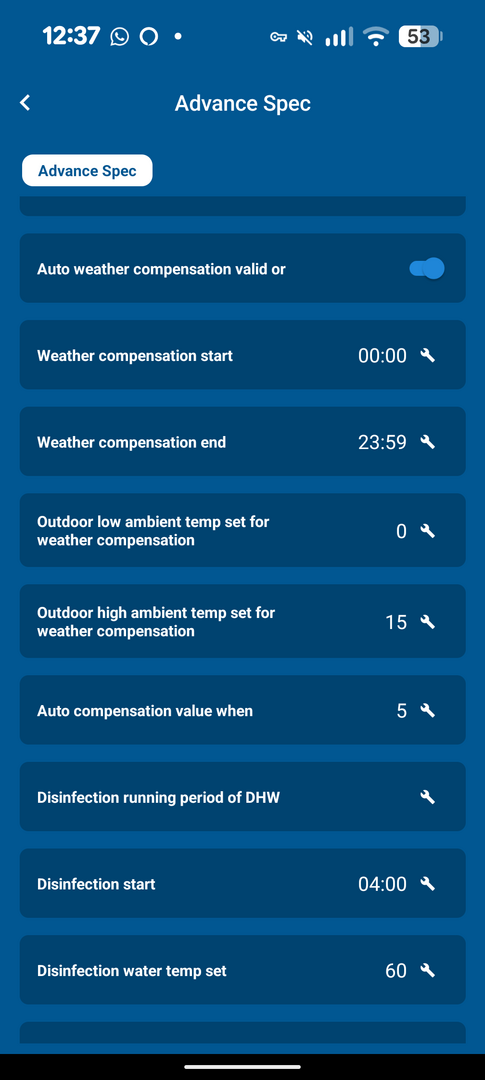
@jamespa There isn't a volumizer or buffer tank. Weather compensation is enabled although it doesn't seem to alter the flow temp automatically based outdoor temps. Low is 0 degrees and high is 15 degrees. I do not know what the system volume is, there are 19 radiator with a mix of 10mm and 15mm plastic pipework. No noise reduction enabled. Octopus did the heat loss calcs at -3 @ 50 degrees = 11KW heat loss. The 11KW heatpump which was installed has been upgraded to a 16kw as the manufacturer deemed it too small when we initially had issues with getting the flow temp above 32 when the outside temp dropped below 3 degrees.
Topic starter
06/01/2026 2:33 pm
@majordennisbloodnok Its a Peak Energy Products V therm 16KW unit. The house is detached, 3 storey and 5 bedrooms based in Lancashire. Heat loss according to Octopus onsite survey is 11KW.
06/01/2026 4:06 pm
Weather compensation is enabled although it doesn't seem to alter the flow temp automatically based outdoor temps. Low is 0 degrees and high is 15 degrees
That doesn't make much sense as it should alter the flow temp, that's what WC is.
0 and 15 are presumably the outside temps, what are the corresponding flow temps set on the curve? Also with 0 being the low OAT point the ft will flatline at this temp so as soon as oat drops below it won't be warm enough. This needs to be changed.
Can you do some screenshots of the WC config screen? Also how often is defrost occurring and is there anything about where it is sited that would restrict airflow or make the air particularly humid? According to their website/manual "Our unique defrost process means we get better performance in the critical temperature range of between -2°C & +2°C because
our units go into defrost mode less often."!
The online manual is pretty short on detail (I think they have edited out all the useful bits), hopefully the UI is reasonably self explanatory! Is this an Octopus install or someone else?
This post was modified 2 months ago 3 times by JamesPa
4kW peak of solar PV since 2011; EV and a 1930s house which has been partially renovated to improve its efficiency. 7kW Vaillant heat pump.
1


06/01/2026 10:21 pm
@johnd, what you’re experiencing is common with air source heat pumps in colder weather in the UK where it’s humid during cold snaps. When the outdoor temperature drops below around 3/4C, frost tends to build up on the outdoor coil, which reduces the heat pump’s ability to extract heat efficiently. To clear this frost, the heat pump initiates a defrost cycle, during which the flow temperature can drop temporarily, often from +40C down to the low 30s. This cycling between heating and defrost is normal and necessary to maintain system performance.
The backup heater is designed to support the system during these cold spells when the heat pump alone can’t maintain the desired flow temperature continuously, especially during defrost cycles. So yes, it is standard practice for some units for the backup heater to come on during cold weather to ensure your home stays warm. Even upgrading the heat pump size doesn’t eliminate the need for defrost cycles or backup heating because the physics of frost formation and heat extraction limits remain.
Having said that, one thing to consider is whether your system has sufficient water volume and proper flow rates. Insufficient system volume can make defrost cycles more noticeable inside the home due to rapid temperature drops, and get stuck in the cycle of flow temperatures not getting above 40C because you’re persistently battling defrosts. Devices like volumisers can help by maintaining stable flow temperatures during defrost, preventing sudden cold blips in your radiators.
I therefore wonder if you have sufficient volume from what you’re describing.
Get a copy of The Ultimate Guide to Heat Pumps
Subscribe and follow our YouTube channel!

07/01/2026 9:59 am
Since the UK outdoor temperature has dropped below 3 degrees our heat pump is unable to go over 40 degrees flow temp. It reaches 40 degrees for shortish period before starting a defrost drops back to 33ish and starts again in a loop.
The installer has enabled the back up heater which resolves the issue but why is this happening? Is it standard practise to use the backup heater for this during cold spells?
It is unlike to be an issue with the size of the heat pump as this has already been upgraded to a 16KW from an 11KW to resolve the a similar issue where the flow temps where only reaching 32 degrees before getting into a defrost cycle.
is the house warm enough?
1
Topic starter
10/01/2026 12:36 pm
I have spoken to the installer, apparently the defrost cycles is on a fixed 45 minute cycle, it does not use a sensor to manage it. He has adjusted the cycle and I have seen a huge improvement. Has anyone has this issue with fixed timed defrost cycles?
Topic starter
10/01/2026 12:38 pm
@jamespa I have attached a screenshot of the weather compensation settings available within the mobile app. Thanks
Topic starter
10/01/2026 12:40 pm
@davidnolan22 It hasn't been whilst it has been defrosting so frequently.
Topic starter
10/01/2026 12:41 pm
@editor With 19 radiators, all of which being k2, would that indicate that there should be enough volume in the system?
1
Page 1 / 6
Next

Latest Posts
-

RE: Say hello and introduce yourself
*** I now see @jamespa has already posted but will stil...
By cathodeRay , 6 minutes ago
-

RE: Tell us about your Solar (PV) setup
@mk4 Charge to 100%, discharge down to 10%.
By bobflux , 13 minutes ago
-
RE: Daikin Altherma 3 LT compressor longevity question
This mess is intriguing: I wonder if this represent...
By bobflux , 1 hour ago
-
RE: Connecting Growatt SPH5000 over wired ethernet rather than wireless
The simplest wired option is usually the Growatt Ethern...
By Jonatan , 6 hours ago
-
RE: Peak Energy Products V therm 16kW unit heat pump not reaching flow temperature
ASHPs do have a minimum compressor speed. The minimum h...
By bobflux , 13 hours ago
-

RE: Electricity price predictions
@jamespa And it seems some of the nasty public cloud...
By Batpred , 13 hours ago
-

RE: Jokes and fun posts about heat pumps and renewables
Technology is rapidly advancing. BBC News reported th...
By Transparent , 16 hours ago
-
What matters for flow and pressure drop is internal dia...
By bobflux , 17 hours ago
-

RE: Do Fridges and Freezers have COP ratings?
@editor Thank you all for your replies and submitted in...
By Toodles , 19 hours ago
-
I know and yes. The secondary deltaT wont necessaril...
By JamesPa , 23 hours ago
-
RE: Designing heating system with air to water heat pump in France, near Lyon
Just love the way you put it! 🤣
By Batpred , 2 days ago
-
RE: Safety update; RCBOs supplying inverters or storage batteries
Thank you for sharing. So it seems that your Schneid...
By Batpred , 2 days ago
-

RE: Forum updates, announcements & issues
@upnorthandpersonal thanks for the thoughtful, consider...
By Mars , 2 days ago
-
RE: Solar Power Output – Let’s Compare Generation Figures
@mk4 All 21 panels have their own Enphase IQ7a microinv...
By Toodles , 2 days ago
-
RE: Setback savings - fact or fiction?
Great, so you have proven that MELCloud is consistently...
By RobS , 3 days ago
-
RE: Mitsu PUHZ120Y 'Outdoor Temp 'error?
Thanks David & James It almos...
By DavidAlgarve , 3 days ago
-
RE: Surge protection devices SPDs
@trebor12345 - your original Topic about the right type...
By Transparent , 3 days ago
-
RE: Help needed with Samsung AE120RXYDEG
@tomf I’ve been sent this from a service engineer at Sa...
By Mars , 3 days ago
-
RE: Buying large amp bidirectional RCD and RCBO
Yes... I went through this particular headache and ende...
By bobflux , 4 days ago
-
O-oh! Let's take this as an opportunity to 'pass the ...
By Transparent , 4 days ago
-
RE: Homely setup on daikin heat pump
@craigh I refer to our somewhat elevated temperature of...
By Toodles , 4 days ago
-
RE: Air source heat pump roll call – what heat pump brand and model do you have?
My turn, this describes the future installation, only t...
By bobflux , 4 days ago