

Notifications
Clear all
Joining the Renewable Heating Hub forums is completely free and only takes a minute. By registering you’ll be able to ask questions, join discussions, follow topics you’re interested in, bookmark useful threads and receive notifications when someone replies. Non-registered members also do not have access to our AI features. When choosing your username, please note that it cannot be changed later, so we recommend avoiding brand or product names. Before registering, please take a moment to read the Forum Rules & Terms of Use so we can keep the community helpful, respectful and informative for everyone. Thanks for joining!
Air Source Heat Pumps (ASHPs)
845
Posts
25
Users
101
Reactions
292.2 K
Views

14/01/2024 2:43 pm
I thought that when operating in WC mode, the LWT was the parameter being adjusted. Do you have charts for the LWT and RWT?

14/01/2024 4:42 pm
Correction from previous post due to rushing and over exuberant predictive text
The reheat isn’t IS being deliberately created by setting the setback Temperature high enough so that the setback triggers an early reheat. And yes this will vary depending on OAT but it still boostS some the room temperature by 1.5 to 2 degrees which raises the start temperature of the reheat.
the principle isn’t overly complicated but doesn’t DOES speed up the reheat time
Topic starter
14/01/2024 7:51 pm
I would respectfully suggest that rather than the V x I x Correction Factor, a more suitable equation would be:-
Input Power = V x I + Auxiliary Power.
Where Auxiliary Power is the sum of the power used by the other equipment which is powered through the heat pump dedicated Power Meter.
I've had another look at the data and found the only series where I read the external meter of a daily basis. It is a short run, for the period 0700 on 6th Nov 2023 to 0700 on 20th Nov 2023. I then plotted the uncorrected calculated kWh in against the metered kWh in for each 24 hour period in the series. Here is the calculated kWh in on the x axis and the metered kWh in on the y axis. I have done it this way round to get the actual regression equation:

There is a clear near constant linear relation between the two. R squared is 0.992 (>99%), about as good as you get in the real world.
Here is another way of looking at the data: the relative difference (the ratio between the two) vs the absolute difference (metered minus calculated):
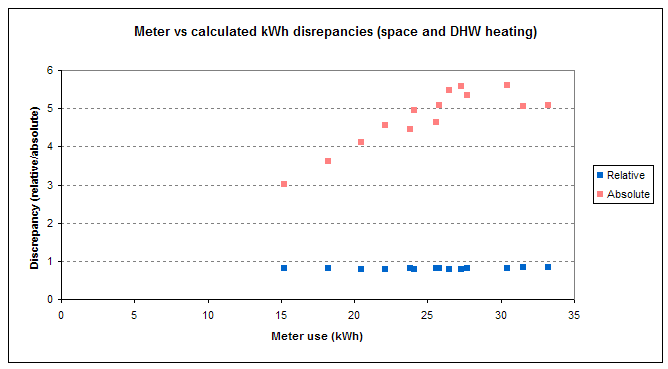
The relative difference stays constant, whereas the absolute difference varies.
I know this is counter-intuitive, if we choose to assume the difference reflects the standing charge. But what if the difference is part standing charge, and part something that does vary, depending perhaps on compressor activity?
I would respectfully suggest that the conclusion to be drawn from this limited but not unacceptable data is that that the calculated to metered correction is best done using a multiplication, not an addition.
I could go back and use the regression equation to revise all the values, but life is too short, I could very easily end up corrupting the data, and the factor I used (1.18) gives values not too far from reality. The blue points are the metered values for each calculated value, the orange points the predicted metered value derived from the calculated value with the correction factor applied for each calculated value:
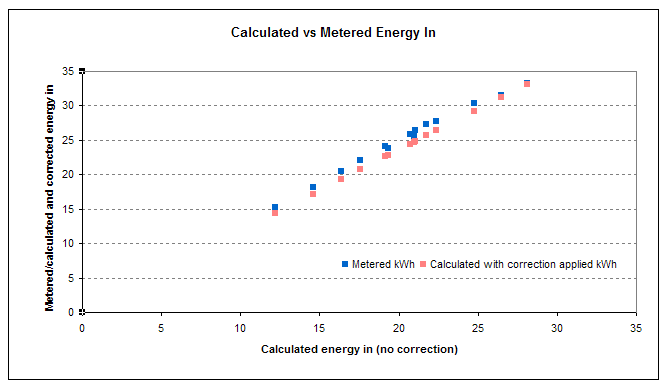
I don't know why this is the case. I don't think it has to do with the OAT (which did vary during the period, between around 7 and around 14 degrees), and in any event, the energy in is itself highly correlated with the energy in. Any thoughts welcome.
Midea 14kW (for now...) ASHP heating both building and DHW
14/01/2024 8:37 pm
Is there a particular reason why you keep changing the start time for the 24 hour test periods?

Topic starter
14/01/2024 8:45 pm
Is there a particular reason why you keep changing the start time for the 24 hour test periods?
Yes, to keep you on your toes 😉
Seriously, though, usually there is a reason, this time it is because the daily meter readings were taken at 0700.
Midea 14kW (for now...) ASHP heating both building and DHW
14/01/2024 9:00 pm
Could you please provide a copy of the data that you used to produce the most recent charts.

14/01/2024 9:41 pm
In the interests of science I'm going to take one for the team and switch to 24 hour operation. I'll then be able to compare with my setback data. It'll take a day or two for AA to settle down and then I'll wait till I have a few days.
I may have to curtail the experiment if Mrs M doesn't like it. Even worse will be if she does like it but it costs more. I'll report back on the results (Mrs M and the ASHP) in a week or so.
2
14/01/2024 10:01 pm
Could you please confirm the source of the data in the columns headed 'energy_in' and 'energy_out'.


14/01/2024 10:47 pm
I would respectfully suggest that rather than the V x I x Correction Factor, a more suitable equation would be:-
Input Power = V x I + Auxiliary Power.
Where Auxiliary Power is the sum of the power used by the other equipment which is powered through the heat pump dedicated Power Meter.
I've had another look at the data and found the only series where I read the external meter of a daily basis. It is a short run, for the period 0700 on 6th Nov 2023 to 0700 on 20th Nov 2023. I then plotted the uncorrected calculated kWh in against the metered kWh in for each 24 hour period in the series. Here is the calculated kWh in on the x axis and the metered kWh in on the y axis. I have done it this way round to get the actual regression equation:
There is a clear near constant linear relation between the two. R squared is 0.992 (>99%), about as good as you get in the real world.
Here is another way of looking at the data: the relative difference (the ratio between the two) vs the absolute difference (metered minus calculated):
The relative difference stays constant, whereas the absolute difference varies.
I know this is counter-intuitive, if we choose to assume the difference reflects the standing charge. But what if the difference is part standing charge, and part something that does vary, depending perhaps on compressor activity?
I would respectfully suggest that the conclusion to be drawn from this limited but not unacceptable data is that that the calculated to metered correction is best done using a multiplication, not an addition.
I could go back and use the regression equation to revise all the values, but life is too short, I could very easily end up corrupting the data, and the factor I used (1.18) gives values not too far from reality. The blue points are the metered values for each calculated value, the orange points the predicted metered value derived from the calculated value with the correction factor applied for each calculated value:
I don't know why this is the case. I don't think it has to do with the OAT (which did vary during the period, between around 7 and around 14 degrees), and in any event, the energy in is itself highly correlated with the energy in. Any thoughts welcome.
Presumably fan speed (and thus power drain) varies with compressor speed. I believe you said that your pump speed is constant and thus power consumption approx constant, I would expect the power consumed by the electronics to be constant or thereabouts. So its pretty certain you (and others) have both a fixed element and a variable element in addition to the power draw due to the compressor.
So far as I can see the Midea databook doesn't give the quiescent loads. I suspect somewhere there will be a document that does.
4kW peak of solar PV since 2011; EV and a 1930s house which has been partially renovated to improve its efficiency. 7kW Vaillant heat pump.
14/01/2024 11:54 pm
Could you please provide all the relevant data and information in a timely manner, so that a correct peer review of your suggestions can be made.
15/01/2024 12:35 am
I had arrived at the same conclusion, but did not make comment since I did not wish to influence others.
From the table that I published, the power input to the heating system via the external kWh Meter would appear to consist of the following:-
The power used by the compressor derived from the V x I calculation. This of course will vary with compressor speed and loading, which may have a defined relationship with OAT.
The power used by the fan, the power rating of which I could not find in the Midea and Chofu documentation, though I do believe that there are some Modbus registers that contain the DC voltage and I think also the DC current. Compared to the compressor power draw it will be much lower, but again may have a relationship to changes in OAT.
For much of the time the water flowrate, and presumably the speed of the two water pumps is reasonably constant, so should not vary to any great extent with changes in OAT.
I suspect that the power consumed by the electronic circuits will be quite low, and to all intents and purposes could possibly be ignored.
From the table I produced from the raw data, it would appear that the hourly auxiliary power is in the order of 150W to 260W and is affected to an extent by variations in OAT, so I agree with your assessment that there is a relatively fixed component, and a component that probably varies with OAT.
Rather than spend time myself working out the possible underlying equations, I thought it more productive to let others do so, while I concentrate on optimising the spreadsheet to give the most accurate results that may be possible.
15/01/2024 9:52 am
From the table I produced from the raw data, it would appear that the hourly auxiliary power is in the order of 150W to 260W and is affected to an extent by variations in OAT, so I agree with your assessment that there is a relatively fixed component, and a component that probably varies with OAT.
I would guess electronics 25-50W, pump 30-50W each. Fan is probably most of the rest. The electronics won't switch off during setback and there may be a sump heater which kicks in to keep the compressor oil warm. Without detailed specs not really possible to tell.
4kW peak of solar PV since 2011; EV and a 1930s house which has been partially renovated to improve its efficiency. 7kW Vaillant heat pump.
1

SPONSORS

Degrees of Separation
Latest Posts
-

RE: Indevolt Batteries UK Support & Info Thread
@editor Hi, To resolve this, please tap on the A...
By Indevolt Tech , 60 minutes ago
-
RE: How will removing the standing charge on gas bills benefit heat pumps?
@toodles GIGO always stands! My Cosy 6, as you can...
By Watcher , 10 hours ago
-
RE: How much of your renewable and home setup would still work if the internet went down?
Interestingly we had an internet outage about a month a...
By Rob of York , 16 hours ago
-
RE: Double or Triple Glazed Windows?
Posted by: @singlespeed With 9 years repairing windo...
By Rob of York , 17 hours ago
-
@transparent we’re still running a secure version of PH...
By Mars , 20 hours ago
-
RE: How quickly would you want/expect heat recovery to take from setback?
Much longer than that here. The heating isn't even on. ...
By bobflux , 1 day ago
-
RE: Passiv Smart Thermostat - Help & Forum Support
Obviously the weather is changeable but there's a defin...
By Singlespeed , 1 day ago
-
RE: The Changing Jet Stream Could Challenge UK Air Source Heat Pumps
@rob-of-york I must admit that when we had a Daikin hea...
By Toodles , 2 days ago
-
RE: Forum updates, announcements & issues
Get the Renewable Heating Hub heads-up on WhatsApp. I...
By Mars , 2 days ago
-
RE: Safety study for plug in batteries out to tender - looks like Q3 2027 at best before legal
@editor I pointed out to the one of the Fuse execs that...
By dansus , 2 days ago
-
RE: 15kw pump for 225m2 1990's house - over kill?
@seaviews As well as loft insulation, there are othe...
By Rob of York , 2 days ago
-
RE: BT cuts you off, Plusnet blames Openreach... welcome to “seamless” broadband switching
Both of which (in most cases) use Openreach for the las...
By JamesPa , 2 days ago
-
RE: Renewables & Heat Pumps in the News
Yes, this is a swiss and german standard I believe, Vai...
By Batpred , 2 days ago
-
RE: Octopus Cosy 12 Heat Pump Regret: Incredibly Loud, Poor Heating & Constant Hum - Help!
@editor FWIW my problem was resolved, eventually, after...
By BigFish , 3 days ago





SPONSORS