

Notifications
Clear all
Joining the Renewable Heating Hub forums is completely free and only takes a minute. By registering you’ll be able to ask questions, join discussions, follow topics you’re interested in, bookmark useful threads and receive notifications when someone replies. Non-registered members also do not have access to our AI features. When choosing your username, please note that it cannot be changed later, so we recommend avoiding brand or product names. Before registering, please take a moment to read the Forum Rules & Terms of Use so we can keep the community helpful, respectful and informative for everyone. Thanks for joining!


Topic starter
21/11/2025 1:43 pm

In the world of renewable heating, trust sits on a three-legged stool: homeowners, installers and manufacturers. When any one of those legs weakens (or starts wobbling) everyone feels it. And nothing tests trust more than warranties. Who sets them, who decides their length, who benefits from shortening them and who ultimately pays when things go wrong.
A couple of weeks ago, I received a piece of promotional marketing circulating among installers. It wasn’t a homeowner-facing email. It wasn’t a consumer guide. It was a manufacturer-to-installer incentive, and the reaction from the installer who sent it to me was one word: appalled.
The promotion in question sets out three warranty options for installers registering a heat pump: two years, five years or seven.
What is unusual is the way this choice is financially weighted. Registering a two-year warranty earns the installer £300 cashback and a sizeable haul of loyalty points. Choosing five years earns a reduced sum: £120 and fewer points. Selecting the full seven years (the maximum warranty publicly quoted by the manufacturer) earns nothing at all.

The implication is not subtle. The manufacturer appears to be ascribing a monetary value to the removal of warranty cover and is offering that money directly to the installer. The shorter the warranty given to the homeowner, the more the installer stands to gain. It is a simple equation with complicated consequences.
What makes this structure particularly sensitive is that warranty registration is rarely a transparent process. Many homeowners assume the installer merely “activates” whatever warranty the manufacturer provides as standard. Few realise the installer may have discretion over the warranty length. Fewer still realise this discretion can carry a financial incentive.
On paper, there is nothing unlawful about a manufacturer offering commercial incentives to installers. But the moment that incentive results in a homeowner unknowingly receiving a materially shorter warranty than the one publicly associated with the product, the situation begins to move towards what consumer law defines as a misleading omission.
As I understand it, under UK consumer protection regulations, failing to disclose information that would affect a homeowner’s purchasing decision, such as the fact that a longer warranty exists and has been deliberately withheld in exchange for a cashback payment, can amount to a breach even if no explicit false claim is made. If an installer were to openly explain the incentive to the homeowner, and the homeowner knowingly chose the reduced warranty, the legal position becomes less clear-cut, though still ethically questionable.
It appears that the incentive is designed to sit between manufacturer and installer, not between installer and customer. That lack of transparency, the fact that the consumer may never realise their warranty was truncated for someone else’s financial benefit, is precisely what elevates this from a marketing oddity to a potential consumer-rights issue. It’s the silence, not the cashback, that creates the legal risk.
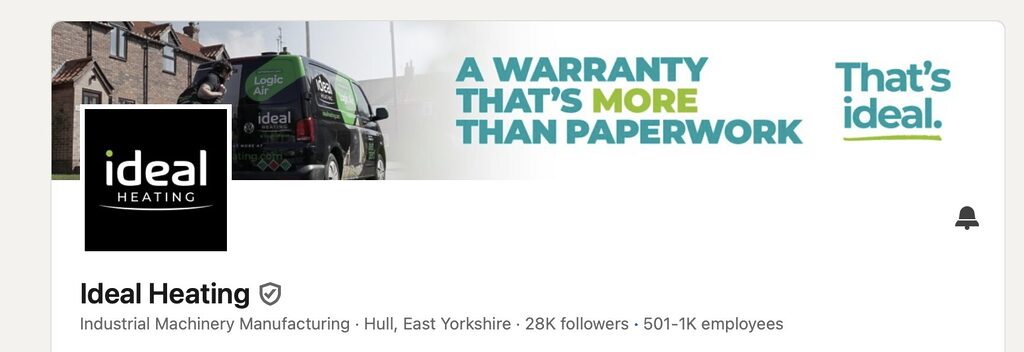
Adding a final layer of irony, Ideal’s own LinkedIn page is currently fronted by a banner proudly declaring: “A warranty that’s more than paperwork.” It’s difficult to square that public message with an incentive scheme that financially rewards installers for potentially offering homeowners less warranty cover. The contrast is stark: a slogan about trust and protection on one hand, and a behind-the-scenes promotion that appears to place a cash value on reducing that very protection on the other. Whatever the intent, the optics are undeniably jarring, and they might as well have said, “A warranty that’s more than paperwork… it’s negotiable for cash.”
So on a recent podcast, I asked Patrick Wheeler and Barry Sharp whether they had encountered structures like this before and what it means for homeowners.
Patrick noted that manufacturers have long treated warranties as costed financial products. In the boiler market, extended warranties are buyable commodities and installers can pay to upgrade customers to longer cover. That, he said, is not inherently problematic. What is problematic is asymmetry of information.
A homeowner assumes the installer is registering the warranty in their best interest. The installer, meanwhile, may be weighing two competing pressures: what protects the customer and what benefits the business. Patrick called this “a conflict built into the transaction” one that places ethical installers in an impossible position and opens the door for less scrupulous ones to profit at the customer’s expense.
Barry pointed out that many warranty claims stem not from product faults but from poor installation. Incorrect pipe sizing, poor water quality, bad commissioning and inadequate controls account for a significant portion of issues. Manufacturers, he noted, often end up covering the cost of installer errors, so it is not hard to see why a manufacturer might quietly prefer a shorter warranty.
This is why, Barry said, transparency must be non-negotiable. If a manufacturer offers multiple warranty options, the homeowner must be part of that decision, not an incidental participant in a commercial incentive.
After receiving the promotion, I contacted a broad group of installers across the country and asked a hypothetical version of the same question: If a manufacturer offered you £300 to register a shorter homeowner warranty, would you take it?
I expected a mixed response. Some discomfort. Some pragmatism. Perhaps even a few who would justify the incentive on commercial grounds.
What I received was unanimity.
Every installer (from sole traders to multi-team businesses) said they would select the longest warranty available. Not one indicated they would reduce a customer’s cover in exchange for cashback. Not one viewed the incentive as appropriate. And not one believed the scheme was in a homeowner’s interest.
Several told me that the longer warranty is a critical selling point. In a competitive market, extended warranties differentiate installers and build trust. Offering a shorter warranty, even with a financial incentive, would undermine that trust before the system was even commissioned.
Others raised concerns about reputation. If an installer takes £300 to reduce warranty cover and a customer later discovers that their neighbour received seven years for free, the damage is irreparable. “My brand is worth more than any cashback,” one installer told me.
Some highlighted a broader cultural issue. Incentivising shorter warranties shifts the industry’s priorities away from engineering and towards margins. One installer described it as “a slippery slope”, recalling boiler manufacturers that attempted to incentivise sales with holidays and non-cash perks. “This isn’t the mindset the heat pump industry needs,” he said. “If you start paying people to reduce warranties, you undermine the core selling point of renewable heating: long-term reliability.”
Interestingly, a minority acknowledged that installers already receive incentives from some manufacturers, but all insisted they ignored them. “We use the most reliable products, not the most lucrative incentives,” one wrote. Another said his company receives no incentives for around 65% of its installations, yet still seeks the maximum warranty because that is what customers expect and deserve.
The most striking pattern, however, was this: while installers rejected the idea of choosing shorter warranties for money, very few said they would disclose such a scheme if it existed and believed it would confuse customers. Which means the homeowner could still be left in the dark.
A Fragile Trust at Risk
Trust in heat pumps is fragile. Homeowners are still learning what they are, how they work and how they will be supported over the long term. Warranties are central to that confidence. When manufacturers introduce incentives that reward the withholding of protection, the consequences extend far beyond one product or one brand.
The entire industry suffers.
For that reason alone, incentives tied to reduced warranty lengths demand scrutiny. If a homeowner can receive seven years of protection but is given two because it enriches the installer, the relationship between consumer, installer and manufacturer has failed at its most basic level.
This story is still unfolding. Ideal Heating was invited to comment and given a deadline to respond. That deadline has passed without any acknowledgement. If Ideal provides a statement, we will add it below in the interest of transparency.
In the meantime, homeowners should check their warranty documentation carefully. If your brand publicly offers up to seven years and your paperwork states otherwise, ask your installer why. It may be a simple registration error. Or it may be something else, something you were never told about.
If you have been affected by warranty issues on your heat pump, or if you are an installer who has encountered similar schemes, you can leave a comment or contact me confidentially (editor@renewableheatinghub.co.uk). Transparency is the foundation on which this industry must build. Anything less, and all three legs of the stool begin to wobble.
This topic was modified 11 months ago 2 times by Mars
🔥 Britain’s Heat Pump Shitshow
How Installing a Heating System Became a National Nervous Breakdown
Free UK shipping.
📗 Heat Pumps Explained
A Jargon-Free Guide for Homeowners
Rewritten and updated for 2027
📘 From Zero to Heat Pump Hero
🛠️ Bodge Buster
New to heat pumps?
Take the Heat Pump Fundamentals course and use INTRO50 at checkout for 50% off.
2

21/11/2025 1:59 pm
It is appalling, even worse given the marketing strapline: "Your warranty, your way". It isn't the installer's warranty at all. I'm glad the feedback from installers is positive to homeowners.
I think this is not unreasonable: "The most striking pattern, however, was this: while installers rejected the idea of choosing shorter warranties for money, very few said they would disclose such a scheme if it existed and believed it would confuse customers." Once a customer finds out there is the possibility of shenanigans even though their installer isn't involved in them, it does start surfacing other questions about the possibility of where else dodgy practice might be occurring with manufacturers. Even if that's a likely "none" it still leaves a bad taste and a nagging doubt so it's probably best not to bring the subject up.
Fortunately, Octopus are upfront about it all and, indeed, give you the option of a basic warranty for free or an extended warranty plus service plan for £9 a month. There are no incentives to installers as they are all employees.

21/11/2025 4:34 pm
@andrewj Indeed, ’Appalling’ is a rather mild term for such practices! I noted that when I wanted to install SunPower solar panels, there were two warranties, the longer would apply if the installer was on their premium or experts listing. This meant if your installer was not on this preference list, the warranty was shorter! I feel that that is a poor agreement for the end-user - to actually offer a shorter warranty with a ‘back hander; to the installer is really beyond despicable.
It would seem that ‘Caveat Emptor’ has grown legs now! Rewards? Toodles.
Toodles, heats his home with cold draughts and cooks food with magnets.

22/11/2025 1:01 pm
Quite aside from any blurring or crossing of legal lines, we now know how Ideal view their customers.
On a more obscure note, if a product is particularly reliable, it costs a company almost the same to offer a long warranty as a short one. If this morally bankrupt offer makes an appreciable financial difference to Ideal then perhaps they know something about the quality control of their products.
Here be dragons….
105 m2 bungalow in South East England
Mitsubishi Ecodan 8.5 kW air source heat pump
18 x 360W solar panels
1 x 6 kW GroWatt battery and SPH5000 inverter
1 x Myenergi Zappi
1 x VW ID3
Raised beds for home-grown veg and chickens for eggs
"Semper in excretia; sumus solum profundum variat"


22/11/2025 8:10 pm
This is analogous to the PCP (personal contract purchase) issue facing finance companies after selling cars to retail customers via car dealerships. Simply, the higher the interest rate you sold the car at using a PCP the bigger commission you got from the finance company. Well over £1000 per vehicle in some cases. All the dealer had to do was get you focused on how much you could afford weekly/monthly and forget the APR. That ended well didn’t it? This is underhand behaviour. Well called out.
Ideal HP290 14kw heat pump, 2.99kw PV, Powerwall 2, Zappi charger, EV. Midlands location hybrid house part 1911, part 1970, part 2020s.
Topic starter
23/11/2025 9:55 pm
Comment to bring this topic back into the spotlight for all Ideal heat pump owners.
If you have an Ideal heat pumps, please check your warranty directly with Ideal or on your documentation.
If you have anything less than a 7-year warranty, please can you contact me because there's every chance your installer registered a shorter warranty as detailed in the first post of this thread.
You can contact me confidentially at editor@renewableheatinghub.co.uk or DM me on the forums.
🔥 Britain’s Heat Pump Shitshow
How Installing a Heating System Became a National Nervous Breakdown
Free UK shipping.
📗 Heat Pumps Explained
A Jargon-Free Guide for Homeowners
Rewritten and updated for 2027
📘 From Zero to Heat Pump Hero
🛠️ Bodge Buster
New to heat pumps?
Take the Heat Pump Fundamentals course and use INTRO50 at checkout for 50% off.
24/11/2025 1:25 pm
@editor Time for an FOI request asking how many warranties have been provided this way and then passing the information to Which?
Ideal HP290 14kw heat pump, 2.99kw PV, Powerwall 2, Zappi charger, EV. Midlands location hybrid house part 1911, part 1970, part 2020s.
1
Topic starter
24/11/2025 5:48 pm
@davesoa, great thought, but FOI won’t work in this case as Ideal is a private company and FOI requests only apply to public bodies.
But you have got me thinking, and there may be another way. Will work on this.
🔥 Britain’s Heat Pump Shitshow
How Installing a Heating System Became a National Nervous Breakdown
Free UK shipping.
📗 Heat Pumps Explained
A Jargon-Free Guide for Homeowners
Rewritten and updated for 2027
📘 From Zero to Heat Pump Hero
🛠️ Bodge Buster
New to heat pumps?
Take the Heat Pump Fundamentals course and use INTRO50 at checkout for 50% off.


SPONSORS

Degrees of Separation

Latest Posts
-

RE: Heat pump branding. Clever, contemporary… or a bit too much?
I think Heat Geek have done an amazing job on their bra...
By Tomtheheatingengineer , 4 hours ago
-
RE: HeatGeek vs Octopus surveys: puzzling disparity - any ideas why?
I have just had 3 heat loss surveys, one by heat geek o...
By David , 5 hours ago
-
RE: Heat Geek Zero Disrupt: Are We Sleepwalking Into Another Race to the Bottom?
I think that's the key question. After all inverter uni...
By Prunus , 6 hours ago
-
RE: battery storage without solar
As of October 1st they need specific qualifications to ...
By EtchedPixels , 7 hours ago
-
RE: How should the Boiler Upgrade Scheme be reformed?
A unit which uses water to transfer the heat/chill from...
By Temperature_Gradient , 7 hours ago
-
RE: Renewables & Heat Pumps in the News
With regards to the BUS grant raid, I gave it more thou...
By ASHP-BOBBA , 8 hours ago
-
RE: Why are ASHP installs so expensive?
The whole system seems to work on the basis of...
By ian33a , 8 hours ago
-
RE: Missing flow temperature in Heat Geek proposal
Good plan. If you can get half hourly meter readings a...
By JamesPa , 13 hours ago
-
RE: Heat Pumps Without Grants: Would You Have Installed One & Will You Now?
@editor Most certainly. The heat pump was an ideal s...
By Abernyte , 13 hours ago
-
Although regulations may well vary from country to coun...
By Majordennisbloodnok , 14 hours ago
-
RE: Does anyone have experience of a smart water meter?
Yep I caught our slow leak from a £100 bill rise 8)
By EtchedPixels , 14 hours ago
-
RE: Do You Need a Buffer Tank or Low Loss Header for Underfloor Heating in a Large Property?
@jamespa in some cases, failing the Turing test might b...
By GrahamF , 17 hours ago
-
RE: Passiv Smart Thermostat - Help & Forum Support
@energystoragetech The heat capacity of some...
By JamesPa , 19 hours ago
-
RE: tepeo ZEB UK Support & Info Thread
Sorry you are correct, I was remembering figures from t...
By JamesPa , 1 day ago


SPONSORS
