

Notifications
Clear all
Joining the Renewable Heating Hub forums is completely free and only takes a minute. By registering you’ll be able to ask questions, join discussions, follow topics you’re interested in, bookmark useful threads and receive notifications when someone replies. Non-registered members also do not have access to our AI features. When choosing your username, please note that it cannot be changed later, so we recommend avoiding brand or product names. Before registering, please take a moment to read the Forum Rules & Terms of Use so we can keep the community helpful, respectful and informative for everyone. Thanks for joining!
Air Source Heat Pumps (ASHPs)
51
Posts
8
Users
20
Reactions
32.7 K
Views

25/11/2022 10:02 pm
Would you mind providing details of the secondary glazing that you are installing, I think many others may find the information useful.

26/11/2022 11:02 am
@derek-m - The secondary glazing uses sheets of clear plastic held in place by magnetic strips. It is very unobtrusive but not invisible when in place and has a number of advantages:
(a) it is surprisingly effective, reducing U values from typically around 5 to around 2.5 W/m²K. It also greatly reduces condensation and somewhat reduces noise. Both the plastic sheet itself and the air gap it creates contribute to the insulation. The ideal air gap from a performance point of view is a moot point - as ever, authorities do not agree, and the calculations are far from straightforward eg larger air gaps may have better static performance, but end up shooting themselves in the foot because of convection currents. From my point of view, mounting the secondary glazing on the window frame, typically creating a 30 to 50mm air gap, is good enough. Even better ie lower U values are possible using specialist materials and fittings, but those are beyond my ken (and wallet).
(b) it significantly reduces draughts from old leaky window casements that are simply not sealable short of permanently injecting a high quality sealant, thereby making it impossible to open window
(c) it can be used in listed buildings without needing listed building consent because it doesn't permanently alter the fabric of the building
(d) it can be removed for example in summer so the windows can be opened
(e) DIY installation is possible, making it very affordable; alternatively there are firms that will fit it at a cost
If you are going to do it yourself, there are a number of considerations:
(a) there are a number of plastics that can be used, all with minor pros and cons. I used 3mm PETg cut to size by the supplier, widely available online. Having it cut to size by the supplier makes it easier to transport and it generally makes sure the edges and corners are cut square with a clean finish. When sizing the sheets, you need to allow an 1/8 inch margin (more is also of course OK), as PETg expands in warm weather
(b) 3mm PETg up to about 1m² can be held in place by 12mm (1/2 inch) magnetic strip, larger sheets will need a wider magnetic strip. Larger sheets also start to get a bit more awkward to handle so if the window is large, and the frame allows it, ie there are landing places for the magnetic strip, divide the sheet into smaller panels. Almost all my windows are less than 1m² meaning in most cases a single sheet is fine. The magnetic strip comes in two rolls, in effect a North and a South pole, that will hold themselves together when in a particular alignment (out of alignment they repel). Both are adhesive backed, one gets stuck to the perimeter of the of the PETg sheet, the other to the window frame. The strips have a thin foam backing which, along with the flexibility of the sheet, allows it to adapt to minor irregularities in the frame, thereby achieving a reasonable seal, which is how secondary glazing helps reduce draughts. The backing foam is whitish in colour, and so blends in with a white painted window frame very well.
(c) I used an A4 paper size guillotine to cut the magnetic strip to length, making it easier (and quicker) to get square ends. The procedure is: (1) cut and fit the sheet side strips in place (2) cut and fit the frame side strip to the strip already on the sheet and then, and only then, with the strips in magnetic alignment with each other (3) peel off the protective strip from the frame strip and fit the sheet to the window. I used glaziers rubber suction cup glass holders to quite literally get a grip on the sheets, because there isn't room to get your fingers between the sheet and the window reveal. I also used temporary spacers to rest the sheet on at the bottom to get the sheet lined up and level (many of my windows are neither square not level)
(d) by a long way, by far the most time consuming part of the process for me is frame preparation. If the paint finish is less than perfect, it makes sense to redecorate, and if there is any rot or other damage, that needs cutting out and repairing first. Many of my windows clearly have lead based paint on them, making redecorating far from straightforward, and in some (most) cases any rot tends to affect the corners where there is exposed end grain, meaning repairs are also not straightforward, you need at least a modicum of woodworking tools and skills, which luckily I have. Often the frame is not square, and so extreme care is needed ensure you have a square 'bounding box' that your rectangular PETg cut sheet will fit ie be very careful when measuring up, to the extent of cutting a template in lining paper or whatever if not sure, to be sure the cut sizes you order will fit. Use a builder/roofer's square and spirit levels to keep things square and level. The other two snags are frames that have steps on their inner faces (maybe one side has a face or trim that protrudes a small distance, it may only be 1/8 inch, but that's an 1/8 inch too much) and window furniture that gets in the way of the PETg sheet. Both of these snags can be fixed using small packing pieces fitted to the frame before redecorating, and once the paint is on, they are invisible
(e) if all else fails, you can apparently use sharp hand tools to trim the PETg sheet. So far I haven't needed to do that, all the time spent measuring up has paid off (apart from the order in which all the cut panels were exactly 24mm undersize - for some bonkers reason I subtracted the width of the magnetic strip from the sheet before sending in the order, luckily it was only a small order). Think thrice, measure twice (and then twice again), cut once.
All in all, somewhat fiddly and very time consuming work, but affordable and very worth while. Of course, if you can't or don't fancy doing it yourself, there are plenty of firms that will do it for you at a cost, no doubt some of them good, but others decidedly dodgy, so make sure if getting someone to do the work that they know what they are doing. You will in effect be dealing with double glazing sales people.
PS @editor - if you want to move this to its own place, that makes sense, but also leave a link to it here?
Midea 14kW (for now...) ASHP heating both building and DHW
3
26/11/2022 2:01 pm
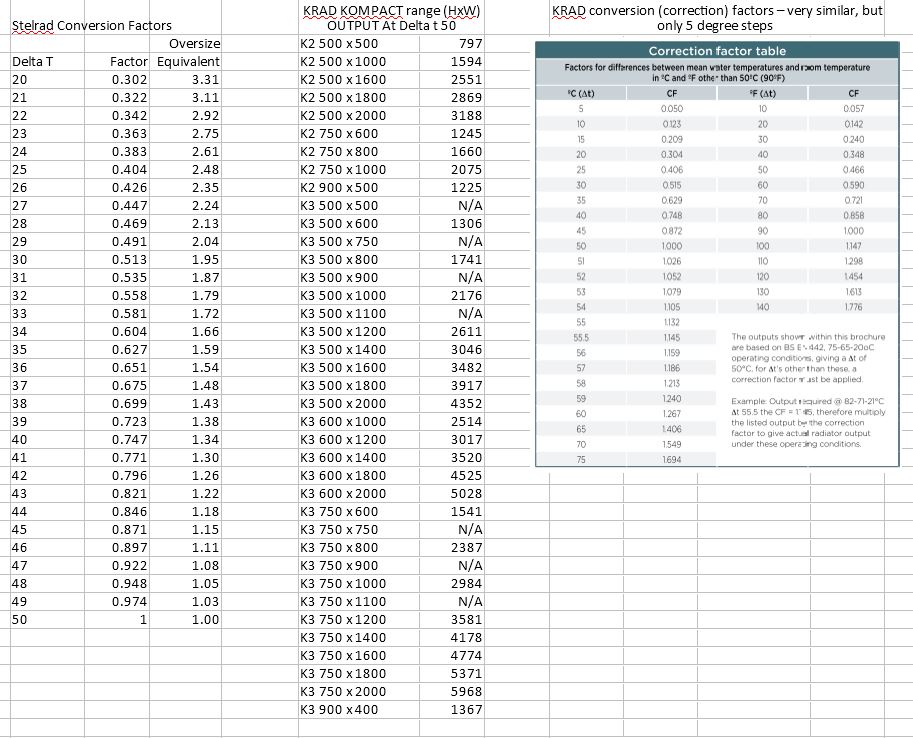
@hughf - to expand on the use of conversion factors, this is a screen grab from the key bit of my spreadsheet. I was sizing KRAD rads but their correction factor table only had 5 degree increments so I used Stelrad's widely available factors which use one degree increments. The figures for different manufacturers are all very similar. You can use the table in one of two ways:
(a) downrate the delta T 50 output by the correction factor for your delta T. As you can see, a delta T of say 30, the output is just over half (0.513, or 51.3%) of the delta T 50 output. This is my preferred way of doing things, you have rows for each rad, one column has your delta T, which can be set by a reference to two cells containing the LWT/RWT (so the delta T cell has a formula, LWT - RWT), allowing you can adjust at will, and then another column for the rad's type and size, and then in a third column you do a lookup for that rad in the two tables in the screen grab, first lookup uses the rad type/size to lookup the delta T 50 output, and then the second lookup gets the correction factor for your delta T, and the you multiply the two together to get your rads output at your delta T, which you then compare to the room's heat loss, you can use conditional formatting to make it change from red to green when it is sufficient, and tweak as necessary. This method achieves accurate results that are specific to the particular rad.
(b) the other method is to use the inverse of the correction factor, the oversize factor, which tells you how much bigger your rad needs to be at your delta T. Again, using delta T 30 as an example, a rad that would be OK at delta T 50 needs to be almost twice as large (1.95 times larger) at delta T 30. I find this method clunky and less intuitive, and so use the output conversion factor method, but the oversize table itself is a useful reminder that ASHP systems generally need rads MUCH larger than fossil fuel system rads, typically by a factor of 2 of more.
Midea 14kW (for now...) ASHP heating both building and DHW
Page 5 / 5
Prev

SPONSORS

Degrees of Separation

Latest Posts
-

The video in the link mentions a direction arrow, which...
By Singlespeed , 7 minutes ago
-
RE: Cooling/heating with one unit
@rob-of-york thank you. Hadn't occurred to me that some...
By mrkfm , 3 hours ago
-
RE: Renewables & Heat Pumps in the News
Posted by: @editor I think we should make that approa...
By Rob of York , 9 hours ago
-
RE: Does anyone have experience of a smart water meter?
My neighbour received an email from Anglian Water sayin...
By AndrewJ , 10 hours ago
-
RE: Jokes and fun posts about heat pumps and renewables
Well the military is well known for going green, isn't ...
By Majordennisbloodnok , 11 hours ago
-
RE: Why are ASHP installs so expensive?
I've ripped out over 11kw of storage and panel heaters ...
By Singlespeed , 12 hours ago
-
RE: Safety study for plug in batteries out to tender - looks like Q3 2027 at best before legal
I think it may depend how much of the world is on fire ...
By EtchedPixels , 19 hours ago
-
RE: Air-to-Air Heat Pumps & Air Conditioning: UK Heating and Cooling Q&A
I hope it's not the same people who make the awful TV s...
By EtchedPixels , 19 hours ago
-
RE: Replacing Storage Heaters with a Heat Pump in a Stone Cottage
I found some interesting data about the price of heat p...
By Rob of York , 1 day ago
-
RE: PV and battery long payback - sense check query
Thanks for all the comments. I finally got to the bott...
By DavidB , 2 days ago
-
RE: Indevolt Batteries UK Support & Info Thread
People following this thread who are hoping that plug i...
By JamesPa , 2 days ago
-
RE: Passiv Smart Thermostat - Help & Forum Support
By Singlespeed , 2 days ago
-
RE: Help me keep the faith with my air source heat pump installation
just had Vaillant over to service the HP and asked abou...
By AdamK , 2 days ago
-
RE: tepeo ZEB UK Support & Info Thread
OK so ZEB is basically a variant on a storage heater, b...
By JamesPa , 3 days ago





SPONSORS
