

Notifications
Clear all
Joining the Renewable Heating Hub forums is completely free and only takes a minute. By registering you’ll be able to ask questions, join discussions, follow topics you’re interested in, bookmark useful threads and receive notifications when someone replies. Non-registered members also do not have access to our AI features. When choosing your username, please note that it cannot be changed later, so we recommend avoiding brand or product names. Before registering, please take a moment to read the Forum Rules & Terms of Use so we can keep the community helpful, respectful and informative for everyone. Thanks for joining!

03/05/2025 10:06 am
Presumably mixing of return water with flow water to the emitters (and thus a reduction of ft to emitters) will however still occur if the primary pump throughput is less than the secondary,
This could be mitigated by putting a one way check valve on the top input so that flow is only downwards. Can't think of any detrimental effects.
Private individual. No affiliation with commercial "Heat Geeks" of same coincidental name.

03/05/2025 1:08 pm
This could be mitigated by putting a one way check valve on the top input so that flow is only downwards. Can't think of any detrimental effects
Or of course not having a buffer at all!
Would an installer that wants to fit a buffer unnecessarily because 'thats what we do' or because of warranty reasons be prepared to fit a three way buffer with a one way check valve. I suspect this would be a tiny minority!
It's ab interesting thought experiment though.
4kW peak of solar PV since 2011; EV and a 1930s house which has been partially renovated to improve its efficiency. 7kW Vaillant heat pump.

03/05/2025 2:41 pm
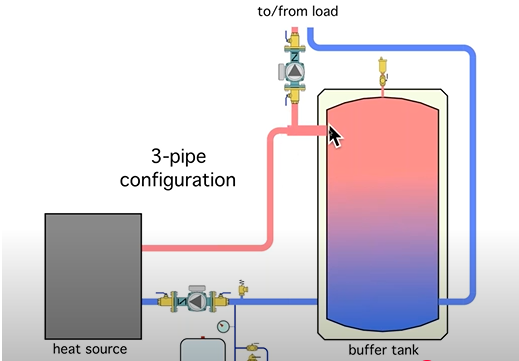
@heatgeek I kind of get it… but aren’t you still in the same situation of having excess flow temp water at the bypass entering the buffer at circa 23 LPM.
In so doing, raising the return temp and narrowing the DT… ergo prompting a raising of the flow temp and inducing the cycling.?
Only now there are 2 pumps?
(It isn’t like it’s just trickling into the buffer, is it? And the return pump will want to maintain the flow rate, for sure!)
Also on 4 port systems I’m not convinced that PWM pumps can cope with matching actual water flow rates, at variable speeds on either side of the hydronic circuits - since there is already believed to be a compromise or resistance to flow on the emitter side. Yet that’s possibly the very reason why buffers are being proposed.
Is there a proper definition as to why buffer tanks are being specified and what exact problem is expected to be overcome?

04/05/2025 2:47 pm
buffer tanks are being specified
A buffer is a legacy issue, they were never used on gas boiler systems, but generally specified when fixed output heat pump came along. So unlike today's heat pump which modulates they had a fixed kW output and generally a fixed flow temp. Add to this a UK liking for zones, the heat pump didn't stand a chance of running well without one.
Today people are still obsessed with zones - so it's the easy choice for manufacturers and installers to add one. Plus more product to install and sell, more profit.
2

05/05/2025 10:38 am
@johnmo yes I can believe that. It seems to be human nature to keep dong what we did before.


Topic starter
02/09/2025 3:05 pm
I’m really pleased to see that we’re starting to have a positive impact on homeowners who are getting smart about their systems. I received this email today from a homeowner, and based on our content they’ve declined an installer who was hell bent on fitting a buffer tank.
Here’s what they wrote:
“I’ve been watching your videos on YouTube, I have learnt so much!
We are moving house in the next couple of months and have an ideal opportunity to install a new heating system from scratch.
I have had a site visit and quote from an installer but they are telling me I will need a buffer in the system. When questioned why they replied:
'Your research seems very very high! We fit systems with buffers or a low loss header, never without either. The reason is because to keep a heat pump running efficiently, we need a higher flow rate than most heating systems require, so the heat pump satisfies the buffer and the buffer satisfies the space heating system. This stops the heat pump short cycling, short cycling is bad for efficiency and the life expectancy of the heat pump compressor will be compromised.'"
This kind of explanation should set off alarm bells for consumers everywhere. If the default answer from an installer is “we never fit a system without a buffer or LLH,” it usually means they’re designing to their own convenience (or they're just incompetent) rather than what’s best for the homeowner.
It’s fantastic to see homeowners pushing back and questioning these decisions!
🔥 Britain’s Heat Pump Shitshow
How Installing a Heating System Became a National Nervous Breakdown
Free UK shipping.
📗 Heat Pumps Explained
A Jargon-Free Guide for Homeowners
Rewritten and updated for 2027
📘 From Zero to Heat Pump Hero
🛠️ Bodge Buster
New to heat pumps?
Take the Heat Pump Fundamentals course and use INTRO50 at checkout for 50% off.
1
02/09/2025 9:45 pm
'We fit systems with buffers or a low loss header, never without either.
@mars That response surely deserves a nomination for Turkey of The Year, for the company itself not for the specific installation. It shows a company which either consistently does the wrong thing, or lies to its customers. Either way it doesn't deserve to be in business unless it changes radically.
4kW peak of solar PV since 2011; EV and a 1930s house which has been partially renovated to improve its efficiency. 7kW Vaillant heat pump.
1

14/01/2026 3:44 pm
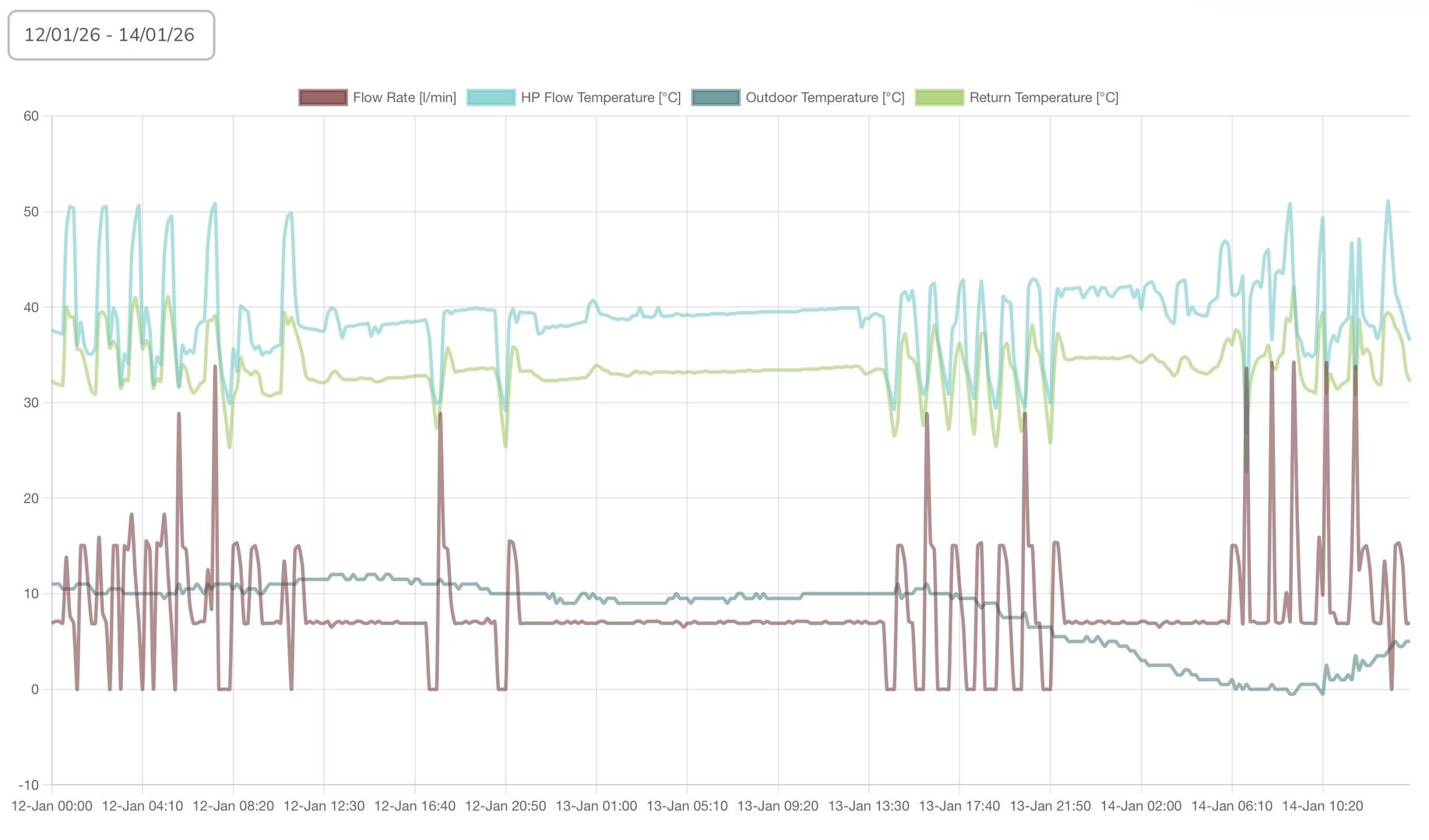
With all the talk in the past about reducing ‘distortion’ that affects efficiency when the energy has to pass through a Low Loss Header, I have endeavoured to reduce these losses as much as possible by careful tweaking of the secondary pump speed.
Now, I think I have been moderately successful in achieving temperature differences between flow into and then out of the LLH to the secondary pump and then between the return flow from the emitters to the LLH and hence on to the return to the primary pipe return. Most of the time, the differential is within ~0.2 degrees either side of the LLH - so the losses are fairly low.
Come mid October, I noticed that the flow rate (dictated by the Daikin unit itself) had taken on a third level; usually the flow would step between ~28 lpm and then reduce to ~ 14 lpm. As the lower rate was the dominant, I had set the secondary pump (Wilo Pico) to match with the ~0.2 degrees difference across the LLH. From this time, the flow rate took on a dominant rate of ~7 lpm and I tweaked the secondary pump to match.
I still see the flow rate start a cycle at ~28 lpm then drop and then drop again. I am curious to know if any reader has seen similar activity and if so why this might be please? I also wonder about the efficiency at the higher flow rates as presumably LLH distortion may increase? I think the lowest flow rate still has the longest running time so suspect I should be satisfied with my present setting - but I would be grateful for any observations please. I have attached a plot of the flow and temperatures seen in the last few days.
Regards, Toodles.
Toodles, heats his home with cold draughts and cooks food with magnets.

Topic starter
14/01/2026 4:35 pm
I continue to receive emails from homeowners sharing heat pump quotes, and I’m still genuinely surprised by how many of them include a buffer tank. From what I’m seeing, it’s easily 60–70% of quotes at the moment.
What’s particularly telling is that these quotes are usually from installers I’ve never come across before, and they all follow the same pattern. Very stock, boilerplate proposals that suggest little real thought has gone into the actual design of the system. A buffer tank by default, multiple circulation pumps, zoning, on/off stats and often a fixed flow temperature thrown in for good measure.
Because of that, I’ve put together a video that goes into why buffer tanks can introduce efficiency losses, how mixing (distortion) and separation can affect radiator performance and why homeowners often end up paying for design shortcuts every time the system runs.
This isn’t about saying buffer tanks are always wrong (they absolutely have valid use cases) but in typical UK homes they’re still being used far more often than they should be and almost always for the wrong reasons.
If you’re currently looking at quotes, or you’ve already got a system with a buffer and are wondering whether it’s helping or hindering performance, this should give you some useful context.
Here’s the video:
As always, interested to hear others’ experiences, especially from homeowners who’ve removed or repurposed a buffer and seen what difference it made.
🔥 Britain’s Heat Pump Shitshow
How Installing a Heating System Became a National Nervous Breakdown
Free UK shipping.
📗 Heat Pumps Explained
A Jargon-Free Guide for Homeowners
Rewritten and updated for 2027
📘 From Zero to Heat Pump Hero
🛠️ Bodge Buster
New to heat pumps?
Take the Heat Pump Fundamentals course and use INTRO50 at checkout for 50% off.

14/02/2026 5:52 pm
Hi all,
First post here.
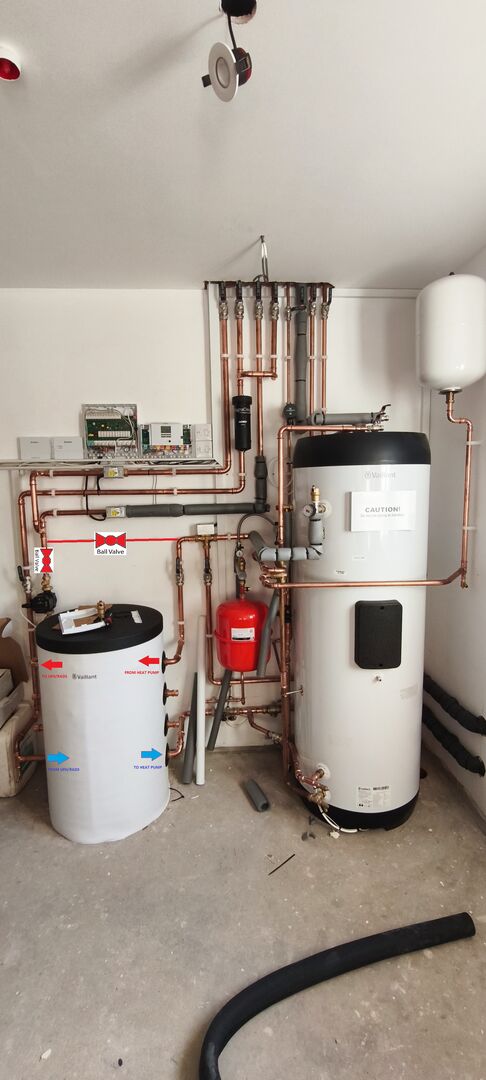
I have a 7kw Vaillant with a 100l 4 port buffer. I'm looking to squeeze every bit of efficiency out of the system and so I'm looking to re-pipe my buffer to a volumiser on the return side. I have attached an image to show my proposed re-piping but wanted to check if all looks OK. Basically I want to fit a bypass in around the buffer and secondary circulation pump so if, for any reason, I wanted to revert back to the original set up, I can.
My main questions are:
- For ease and minimum work I want to keep the return from the UFH/rads and return back to the heat pump, on the bottom ports of the new "volumiser". Will this be OK or will I need to cross flow the volumiser? In at the top, out of the bottom or vice versa?
- Will the internal pump on the Vaillant cope as the only pump on the circuit? Currently pumping 1200l quite happily.
Thanks all
1

14/02/2026 9:40 pm
I want to keep the return from the UFH/rads and return back to the heat pump, on the bottom ports of the new "volumiser"
If you do that then most of the water in the top of volumiser will be "out of circuit" and not adding to the heated volume? I recently had a buffer converted and it was piped in at the top and out at the bottom (on the flow side FWIW).
Mitsubishi Zubadan 14kW with Mixergy 210l DHW in 220m2 barn property. 24 solar panels = 9kWp with GivEnergy 5.0kW Hybrid inverter and 19kWh GivE batteries. Jaga Strada fan-assisted rads throughout. Landvac vacuum glazing/triple glazed windows.
2

14/02/2026 11:27 pm
@ch_18 downfield is completely correct but you should insulate your pipework as a first task. You must have an unnecessarily warm plant room at present. Did your installer leave it like that? It won’t help your efficiency at all, since it’s the rest of the house which matters.
Have you calculated your total system volume? Having an effectively smaller volumiser may not matter.
This post was modified 8 months ago by Mars
2kW + Growatt & 4kW +Sunnyboy PV on south-facing roof Solar thermal. 9.5kWh Givenergy battery with AC3. MVHR. Vaillant 7kW ASHP (very pleased with SCOP >4) open system operating on WC

SPONSORS

Degrees of Separation
Latest Posts
-

At this point, whenever someone mentions our heat pump,...
By Mars , 55 minutes ago
-
RE: Say hello and introduce yourself
@e-a-west as the good Major said, welcome to the forums...
By Mars , 1 hour ago
-
RE: New Build 3 Phase or 1Phase
We are on three phase power because it's an enormous li...
By EtchedPixels , 1 hour ago
-
RE: How much of your renewable and home setup would still work if the internet went down?
Yes I actually have a copy of a tool that whenever a ce...
By EtchedPixels , 10 hours ago
-
RE: How will removing the standing charge on gas bills benefit heat pumps?
The shoulder months are very difficult to judge COP on ...
By scrchngwsl , 11 hours ago
-
RE: Indevolt Batteries UK Support & Info Thread
@editor Hi, To resolve this, please tap on the A...
By Indevolt Tech , 18 hours ago
-
RE: Double or Triple Glazed Windows?
Posted by: @singlespeed With 9 years repairing windo...
By Rob of York , 1 day ago
-
@transparent we’re still running a secure version of PH...
By Mars , 2 days ago
-
RE: How quickly would you want/expect heat recovery to take from setback?
Much longer than that here. The heating isn't even on. ...
By bobflux , 2 days ago
-
RE: Passiv Smart Thermostat - Help & Forum Support
Obviously the weather is changeable but there's a defin...
By Singlespeed , 2 days ago
-
RE: The Changing Jet Stream Could Challenge UK Air Source Heat Pumps
@rob-of-york I must admit that when we had a Daikin hea...
By Toodles , 2 days ago
-
RE: Forum updates, announcements & issues
Get the Renewable Heating Hub heads-up on WhatsApp. I...
By Mars , 2 days ago
-
RE: Safety study for plug in batteries out to tender - looks like Q3 2027 at best before legal
@editor I pointed out to the one of the Fuse execs that...
By dansus , 2 days ago
-
RE: 15kw pump for 225m2 1990's house - over kill?
@seaviews As well as loft insulation, there are othe...
By Rob of York , 2 days ago


SPONSORS
