
Notifications
Clear all

27/01/2026 7:21 pm
@jamespa – fuses and trips must be rated according to the current-carrying capacity of the cable, not calculated on the load(s) you intend to supply.
So if you want to deliver 80A max to the larger CU, then that dictates the cable size and how it can be carried/supported.
Fixing a cable to a solid surface (like a wall) by using clips, will give it a different rating than running the same size cable through conduit.
It affects how much heat can be radiated away into the air.
A professional electrician would look at the building and decide a route and fixing-strategy which has least adverse affect on the current that the cable can carry.
Sometimes he/she will use the 'standard' Twin & Earth cable (6424Y) which is most commonly used in domestic properties,
but there are other circumstances when more current could be passed by running 'singles' (6491X) through a 20mm diameter plastic conduit.
There isn't a 'standard' mains cable size between 16mm² and 25mm².
Let's assume you'd prefer to pay less for the 16mm² cable size:
To achieve 80A capacity using twin&earth it would need to be in free air for its entire length. That would give a rating of 83A.
If 16mm² single-cored wire was pulled through a conduit, then it would be rated 74A – 85A, depending on length and how much free space there was left in the conduit.
So you're asking for something which is close to the limits for that size of copper conductor.
Having an 80A Service Fuse might not be regarded as sufficiently fast protection for that 16mm² cable.
It could still get hot enough to be dangerous without the fuse blowing.
It's likely that an electrician will require a faster-acting MCB to which the cable is connected.
I can't immediately find an 80A MCB on the wholesaler sites I've just looked at.
They may not exist.
But there are 80A RCBOs with 30mA 'earth leakage' protection, with prices around £30.
The transfer switch must be rated at 80A minimum.
In practice you'd probably select one with 100A capability.
The MTS is not going to act as an MCB.
It doesn't 'trip out' if you try to draw more current through it.
This post was modified 1 month ago 2 times by Transparent
Save energy... recycle electrons!
2

27/01/2026 10:47 pm
@jamespa – fuses and trips must be rated according to the current-carrying capacity of the cable, not calculated on the load(s) you intend to supply.
So if you want to deliver 80A max to the larger CU, then that dictates the cable size and how it can be carried/supported.
Fixing a cable to a solid surface (like a wall) by using clips, will give it a different rating than running the same size cable through conduit.
It affects how much heat can be radiated away into the air.A professional electrician would look at the building and decide a route and fixing-strategy which has least adverse affect on the current that the cable can carry.
Sometimes he/she will use the 'standard' Twin & Earth cable (6424Y) which is most commonly used in domestic properties,
but there are other circumstances when more current could be passed by running 'singles' (6491X) through a 20mm diameter plastic conduit.There isn't a 'standard' mains cable size between 16mm² and 25mm².
Let's assume you'd prefer to pay less for the 16mm² cable size:
To achieve 80A capacity using twin&earth it would need to be in free air for its entire length. That would give a rating of 83A.
If 16mm² single-cored wire was pulled through a conduit, then it would be rated 74A – 85A, depending on length and how much free space there was left in the conduit.
So you're asking for something which is close to the limits for that size of copper conductor.
Having an 80A Service Fuse might not be regarded as sufficiently fast protection for that 16mm² cable.
It could still get hot enough to be dangerous without the fuse blowing.It's likely that an electrician will require a faster-acting MCB to which the cable is connected.
I can't immediately find an 80A MCB on the wholesaler sites I've just looked at.
They may not exist.But there are 80A RCBOs with 30mA 'earth leakage' protection, with prices around £30.
The transfer switch must be rated at 80A minimum.
In practice you'd probably select one with 100A capability.The MTS is not going to act as an MCB.
It doesn't 'trip out' if you try to draw more current through it.
Thanks, I understand and indeed understood all of that, which is why my original diagram showed thick cable (illustrated by a thick line) from service fuse to MTS and again from MTS to CU, and (at least in my mind) a 100A changeover switch, thus preserving the integrity of the cable and interrupter capacity relative to the (80A service) fuse right up to the point where it enters the CU (diagram reproduced in part below - ignore the question in the call out - that has now been resolved - it is necessary). Your suggestion of a lower rated MTS complicates that relatively simple model, and requires yet another component between the service fuse and what would otherwise be the first point of interruption, in order to preserve the integrity with the lower rated components you suggest using. Its possible of course, but putting another component in the box which must, in practice, be worked on 'live' (I have yet to see an electrician call out the DNO to interrupt the service and reconnect it!) seems like a retrograde step if it can be avoided.
I think the safety parameters are now sufficiently clear (for which many thanks) and the limiting factor is the components that can be purchased from a company that I and the electrician trust, which in the case of a component required to stand 100A, is unlikely to include a one from an unknown Chinese manufacturer advertised on Alibaba or eBay! Given the relatively small choice that I have found so far, that will probably determine the detailed design. There do appear to be 100A transfer switches available from CES or the like, but unfortunately sold in an enclosure that is full already. As the same enclosure ideally needs also to accommodate the two 32A MCBs protecting the inverter, that wont do. I suppose that, in the limit, I could buy the enclosure plus switch and throw away the enclosure, but that feels a bit silly.
Hopefully a more in depth search will turn up a suitable part!
Once I have a final design with available components I will post it again.

This post was modified 1 month ago by JamesPa
4kW peak of solar PV since 2011; EV and a 1930s house which has been partially renovated to improve its efficiency. 7kW Vaillant heat pump.
1

Topic starter
27/01/2026 11:03 pm
The main fuse is 80A, I was told to upgrade from 60A before getting an ashp. In retrospect I don't know why. However, given that this is rhe case it seems to me the transfer switch has to be rated at at least 80A as does everything else downstream until MCBs are reached. Of course I could put in 63A MCB immediately prior, but its getting a bit silly tge number of components.
With our 8kw inverter we did not need any MCB over 63A (and that was just because Solis required 36.4*1.25 and we had to round up)...
8kW Solis S6-EH1P8K-L-PLUS hybrid inverter; G99: 8kw export; 16kWh Seplos Fogstar battery; Ohme Home Pro EV charger; 100Amp head, HA lab on mini PC
28/01/2026 8:39 am
The main fuse is 80A, I was told to upgrade from 60A before getting an ashp. In retrospect I don't know why. However, given that this is rhe case it seems to me the transfer switch has to be rated at at least 80A as does everything else downstream until MCBs are reached. Of course I could put in 63A MCB immediately prior, but its getting a bit silly tge number of components.
With our 8kw inverter we did not need any MCB over 63A (and that was just because Solis required 36.4*1.25 and we had to round up)...
I am sure I wont need anything bigger for the inverter, but the grid supply is fused at 80A so any components and cable upstream of the first MCB have got to be rated for 80A or above. The thick lines in the diagram I drew were intended to depict that.
4kW peak of solar PV since 2011; EV and a 1930s house which has been partially renovated to improve its efficiency. 7kW Vaillant heat pump.
Topic starter
28/01/2026 1:15 pm
The main fuse is 80A, I was told to upgrade from 60A before getting an ashp. In retrospect I don't know why. However, given that this is rhe case it seems to me the transfer switch has to be rated at at least 80A as does everything else downstream until MCBs are reached. Of course I could put in 63A MCB immediately prior, but its getting a bit silly tge number of components.
With our 8kw inverter we did not need any MCB over 63A (and that was just because Solis required 36.4*1.25 and we had to round up)...
I am sure I wont need anything bigger for the inverter, but the grid supply is fused at 80A so any components and cable upstream of the first MCB have got to be rated for 80A or above. The thick lines in the diagram I drew were intended to depict that.
The approach in my case was as follows:
- supply is 100amp
- tails (I think 25mm) connect to Henley box
- tails connect from Henley box to CU
- CU has a 63Amp MCB for grid port (as 36.4*1.25 is 45.5 and the cable could take more) . But a 50Amp MCB could have been used instead
- 16mm cable to grid port
- the same CU also has a RCBO of 16amp for sockets, connecting to 2.5mm cable.
The goal is, as I am sure you are aware, just to make sure that each section of cable is protected by an MCB of lower rating than the maximum rating of that cable.
It was decided that the maximum required for the house (excluding EV and a small CU) was 36.4A. This was based on the inverter capacity (but it would be 50 with the same inverter if used with an AC coupled inverter on the smart port). So we no longer consider we could have a 100A supply to the house. Does this approach help?
This post was modified 1 month ago by Batpred
8kW Solis S6-EH1P8K-L-PLUS hybrid inverter; G99: 8kw export; 16kWh Seplos Fogstar battery; Ohme Home Pro EV charger; 100Amp head, HA lab on mini PC
Topic starter
15/02/2026 11:02 pm
We mentioned a need for bidirectional rcbos.
It needs to be made clear that, in a system with multiple generating units, all that can be named bidirectional are some of the cables where the power flows in different directions.
An alternating current changes direction 100 times a second. So no issue can be caused to an RCBO or RCD by the direction of the current.
As @transparent mentioned,
But if there is power still being applied in the reverse direction by an inverter or storage battery, when the contacts open, the solenoid remains energised.
But if there could be an issue caused by extraneous DC currents, is there a reason to not describe it as such?
And while it does seem that the Beama manufacturers association could have caused confusion, it actually commented on a British electrical labelling standard indicating switches have input and output.
The iec international standards do not seem to be particularly concerned about 'bidirectional' rcbos.
This post was modified 2 weeks ago by Batpred
8kW Solis S6-EH1P8K-L-PLUS hybrid inverter; G99: 8kw export; 16kWh Seplos Fogstar battery; Ohme Home Pro EV charger; 100Amp head, HA lab on mini PC

27/02/2026 11:59 pm
Noark makes 100mA/63A and higher RCDs.
FYI the reason for going above 30mA are:
- Higher power inverters have larger EMI filter caps causing higher leakage to ground
- PV panels form a plate capacitor between themselves and the nearest grounded conductor, which is either the roof (when dry) or the rainwater film on the panel (when wet). The more panels the higher the capacitance. In inverters without insulation between PV and Mains this capacitance creates AC common mode leakage current. On rainy days, my 12kWp has capacitive leakage of about 40-50mA, so the system would be unusable with a 30mA RCD.
Topic starter
28/02/2026 7:00 am
Noark makes 100mA/63A and higher RCDs.
FYI the reason for going above 30mA are:
- Higher power inverters have larger EMI filter caps causing higher leakage to ground
- PV panels form a plate capacitor between themselves and the nearest grounded conductor, which is either the roof (when dry) or the rainwater film on the panel (when wet). The more panels the higher the capacitance. In inverters without insulation between PV and Mains this capacitance creates AC common mode leakage current. On rainy days, my 12kWp has capacitive leakage of about 40-50mA, so the system would be unusable with a 30mA RCD.
Thanks for sharing.
We initially used Wylex 100mA RCD. But the uk electrical regulations mandate use of bidirectional devices when protecting circuits connecting multiple sources of generation.
A bidirectional RCD device ensures that, when it opens the circuit, the device itself will not be damaged in case the output ports are still energised (which can happen due to malfunction of an inverter).
To our knowledge, this requirement for bidirectional RCDs does not exist in other European countries.
This post was modified 4 days ago by Batpred
8kW Solis S6-EH1P8K-L-PLUS hybrid inverter; G99: 8kw export; 16kWh Seplos Fogstar battery; Ohme Home Pro EV charger; 100Amp head, HA lab on mini PC
28/02/2026 8:07 am
Most if not all type A/AC RCDs are bidirectional... Ironically, manufacturers seem to consider this too obvious to explicitly mention it in the datasheet 🤣 or even on the fine print on the device itself.
It's common to wire the input on the top or bottom, whatever allows most convenient wiring for the rest of the panel... unless the device has an arrow indicating direction.
Noark shows both direction arrows:
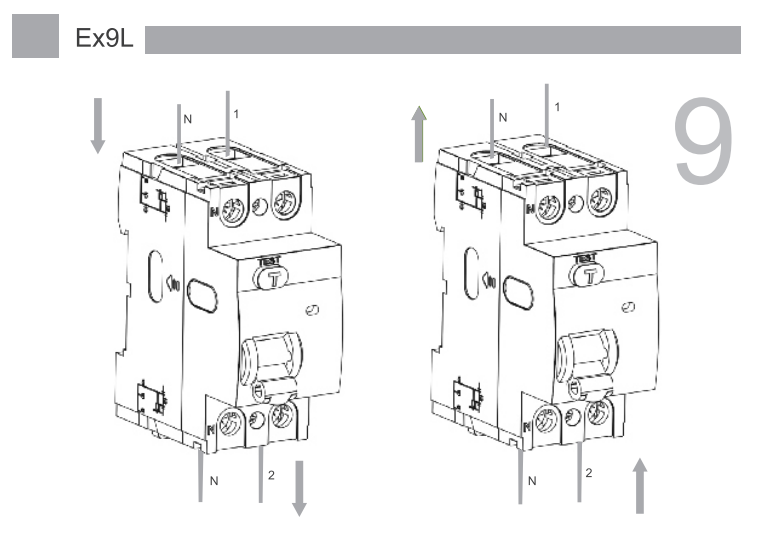
The breaker/switch component is designed for AC so it has neither direction nor polarity.
If the datasheet mentions "Voltage independent" then the tripping mechanism is powered by the fault current itself through the current sense transformer, so the sensing circuit isn't actually connected to the terminals, hence bidirectional.
However if it contains electronics which must be powered (Type B...) then there's probably an IN and an OUT direction.
DC breakers though, tend to have a direction for current (not voltage) and will probably explode or start a fire if connected wrong.
28/02/2026 12:14 pm
DC breakers though, tend to have a direction for current (not voltage) and will probably explode or start a fire if connected wrong.
I can answer that point! 🙂
DC breakers have a pair of magnets either side of the arms which have the contacts at the end.
When the contacts open, the magnets pull the resulting DC arc into a series of metal plates called the arc-ladder where it gets quenched.
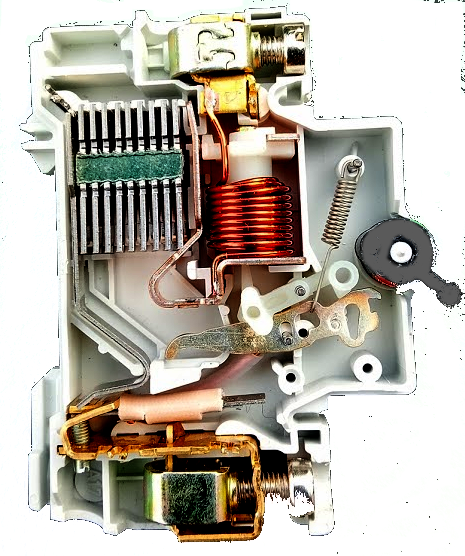
If the DC wires are connected the 'wrong way around' then the outcome depends on the current which is flowing.
At low currents of 10A or so, the contacts open but the arc causes pitting on them. It's not that serious, but can increase the time taken for the trip to operate in future.
At high currents (100A) the magnets force the arc onto the contacts which welds them together. Current continues to flow to downstream devices because the circuit remains 'live'.
DC Breakers rated at 125A are commonly used as manual isolators between inverters and storage batteries. That means the direction of current changes depending on whether the battery is charging or discharging. Inevitably that means the breaker will sometimes be 'the wrong way round'.
For that reason it's good practice to also have a high-capacity fuse in series with the breaker. Should the contacts get welded together, it's the fuse which provides the required level of safety.
Save energy... recycle electrons!
2
28/02/2026 5:07 pm
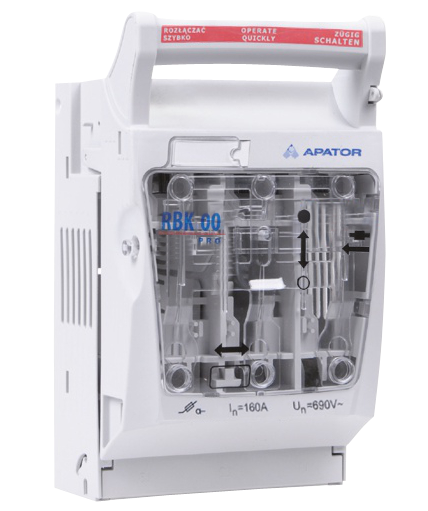
Yes... I went through this particular headache and ended up with NH00 fuse holders / disconnectors. Very robust and reliable, since they're just fuses and contacts. Yanking the handle pulls the fuses out. 125A DC fuses are available in NH00 format.
Page 2 / 2
Prev

Latest Posts
-
RE: Connecting Growatt SPH5000 over wired ethernet rather than wireless
The simplest wired option is usually the Growatt Ethern...
By Jonatan , 3 hours ago
-
RE: Peak Energy Products V therm 16kW unit heat pump not reaching flow temperature
ASHPs do have a minimum compressor speed. The minimum h...
By bobflux , 10 hours ago
-
RE: Electricity price predictions
@jamespa And it seems some of the nasty public cloud...
By Batpred , 10 hours ago
-
@bobflux My apologies, they somehow were removed in ...
By Ubert767 , 10 hours ago
-
RE: Tell us about your Solar (PV) setup
Location: near Lyon, France 12kWp on the roof, 2x Sol...
By bobflux , 11 hours ago
-
RE: Jokes and fun posts about heat pumps and renewables
Technology is rapidly advancing. BBC News reported th...
By Transparent , 14 hours ago
-
What matters for flow and pressure drop is internal dia...
By bobflux , 14 hours ago
-

RE: Do Fridges and Freezers have COP ratings?
@editor Thank you all for your replies and submitted in...
By Toodles , 17 hours ago
-
I know and yes. The secondary deltaT wont necessaril...
By JamesPa , 20 hours ago
-
RE: Designing heating system with air to water heat pump in France, near Lyon
Just love the way you put it! 🤣
By Batpred , 1 day ago
-
RE: Safety update; RCBOs supplying inverters or storage batteries
Thank you for sharing. So it seems that your Schneid...
By Batpred , 1 day ago
-

RE: Forum updates, announcements & issues
@upnorthandpersonal thanks for the thoughtful, consider...
By Mars , 2 days ago
-
RE: Solar Power Output – Let’s Compare Generation Figures
@mk4 All 21 panels have their own Enphase IQ7a microinv...
By Toodles , 2 days ago
-
RE: Setback savings - fact or fiction?
Great, so you have proven that MELCloud is consistently...
By RobS , 3 days ago
-
RE: Mitsu PUHZ120Y 'Outdoor Temp 'error?
Thanks David & James It almos...
By DavidAlgarve , 3 days ago
-
RE: Surge protection devices SPDs
@trebor12345 - your original Topic about the right type...
By Transparent , 3 days ago
-
RE: Help needed with Samsung AE120RXYDEG
@tomf I’ve been sent this from a service engineer at Sa...
By Mars , 3 days ago
-
RE: Buying large amp bidirectional RCD and RCBO
Yes... I went through this particular headache and ende...
By bobflux , 4 days ago
-
O-oh! Let's take this as an opportunity to 'pass the ...
By Transparent , 4 days ago
-
RE: Homely setup on daikin heat pump
@craigh I refer to our somewhat elevated temperature of...
By Toodles , 4 days ago
-
RE: Air source heat pump roll call – what heat pump brand and model do you have?
My turn, this describes the future installation, only t...
By bobflux , 4 days ago
-
RE: Say hello and introduce yourself
@liam-dr, I’d like to echo James’ welcome, and we look ...
By Mars , 4 days ago


