

Notifications
Clear all
Joining the Renewable Heating Hub forums is completely free and only takes a minute. By registering you’ll be able to ask questions, join discussions, follow topics you’re interested in, bookmark useful threads and receive notifications when someone replies. Non-registered members also do not have access to our AI features. When choosing your username, please note that it cannot be changed later, so we recommend avoiding brand or product names. Before registering, please take a moment to read the Forum Rules & Terms of Use so we can keep the community helpful, respectful and informative for everyone. Thanks for joining!

23/05/2025 9:24 am
suspect you'll now tell me that's wrong without trying to understand the situation.
never mentioned Ethylene glycol
You didn't mention anything, except you didn't like my post.
You do as you wish, operate as you like, fill it as you wish. It's your system your money. If you don't like my answers don't read them, simple really.
I just say as it is, based on 4 years experience running low temperature heating system. And the many changes I had to make after install, to get it to run well and not cost a fortune to run. Running costs are half what they were in the first few months of running.
Original system design (buffer and multiple zones, mixer and pump on UFH manifold ) was based on discussion on forums and on many flawed assumptions that frequently come up on forums such as this. I have had buffer, volumiser, multiple thermostats, self balancing valves etc etc. all of which are now in a box on the loft or in the garage,. They are in general bad for efficiency and running costs, as is glycol in any form
I do know my circulation flow rate is way higher after removing anti freeze, also flow temp was lowered. So heat pump is happier, circulation pump also pulls less watts. I do know a fully open loop system works very well, if on a flat tariff WC is the way to go for cheap heating, not so true on a variable tariff without some modification to running temperature or two offset WC curves. I do know you can keep a stable house temp by just batch charging the floor (if you have enough depth of screed). All are good strategies.
All options have been tested and have evaluated the data recorded.
As said, just ignore my posts if you don't like them. Do what ever you feel you need to do.


23/05/2025 9:39 am
Hi guys, let’s keep this thread focused and constructive, please.
There’s clearly a lot of passion and valuable experience on both sides of this discussion, and that’s a good thing. This forum exists so we can share different perspectives and help homeowners and installers make better-informed decisions. There’s no one-size-fits-all answer, especially with heat pump setups, so some disagreement is inevitable.
That said, I’m drawing a line here. I’ll delete any further bickering or off-topic jabs. Challenge ideas all you like, but please leave the personal digs out of it.
🔥 Britain’s Heat Pump Shitshow
How Installing a Heating System Became a National Nervous Breakdown
Free UK shipping.
📗 Heat Pumps Explained
A Jargon-Free Guide for Homeowners
Rewritten and updated for 2027
📘 From Zero to Heat Pump Hero
🛠️ Bodge Buster
New to heat pumps?
Take the Heat Pump Fundamentals course and use INTRO50 at checkout for 50% off.
1

24/05/2025 4:06 pm
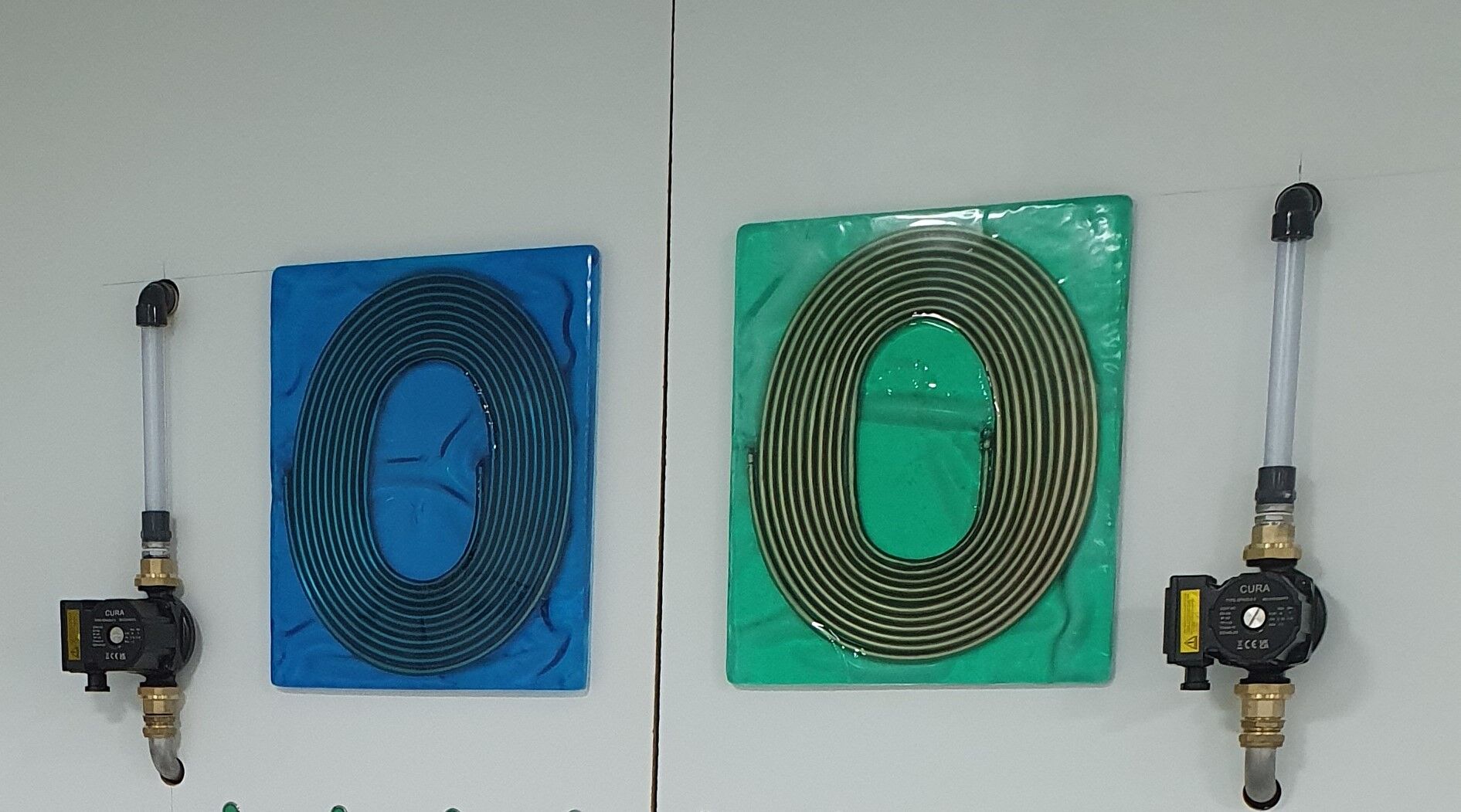
@johnmo You are correct, standard Ethylene glycol used in the motor industry is highly toxic, however, the product used for heat pumps is a detoxified version and is completely harmless. I do not use it in air-source systems but do use it in ground-source systems as the viscosity is very much lower and specific heat capacity is higher than propylene glycol. The difference in performance between propelling glycol (the commonly available product mentioned above) and water is significant. In a real-life demonstration when I ran my training center, showed that to transfer the same amount of heat in an ethylene glycol medium mixed to -10 concentration required nearly 4 times the pumping energy as water. Hence the reason I do not use glycol unless where absolutely necessary.
Below is a picture of the demonstration rig I built, it was connected to a PLC that measured the flow rate and pressure drop, energy consumption and delivery of the 2 mediums.
3

26/05/2025 10:30 pm
I don't doubt your findings but the energy required to operate the pump is a still a tiny fraction of the power consumed - even with glycol added.

27/05/2025 7:02 am
@ecodan-efficiency If you consider £200.00 to £300.00 a year, inconsiderate for a 10 kw system, then maybe, I do not consider that insignificant. Depending on the concentration of the glycol, you may need 150 to 300 watts more to do the same job as a water based system.

27/05/2025 11:02 am
I don't doubt your findings but the energy required to operate the pump is a still a tiny fraction of the power consumed - even with glycol added.
@ecodan-efficiency If you consider £200.00 to £300.00 a year, inconsiderate for a 10 kw system, then maybe, I do not consider that insignificant. Depending on the concentration of the glycol, you may need 150 to 300 watts more to do the same job as a water based system.
Since you're each focusing on a different measure both of you can be (and probably are) right.
The extra pumping energy needed is quite likely only a small proportion of the overall power consumed but given the scales the cost of that extra pumping energy amounts to a yearly amount most of us would consider significant.
As for whether that extra yearly cost is worth spending is then based on the cost of not doing it; if the risk of not adding glycol introduces a large risk of expensive freeze damage, I suspect most of us would consider £200 a reasonable insurance cost. If the design of the system makes the risk of freeze damage highly unlikely then that £200 is probably an unnecessary expense.
105 m2 bungalow in South East England
Mitsubishi Ecodan 8.5 kW air source heat pump
18 x 360W solar panels
1 x 6 kW GroWatt battery and SPH5000 inverter
1 x Myenergi Zappi
1 x VW ID3
Raised beds for home-grown veg and chickens for eggs
"Semper in excretia; sumus solum profundum variat"
27/05/2025 11:29 am
@majordennisbloodnok I have never installed antifreeze valves or glycol and have never had any damage to any of my customers installations due to frosting, In reality, the only component that is going to be damaged is the pump, and most will be around the £200.00 mark to replace if very unlucky. Some will say the heat exchanger will be damaged, this I despite this, in the ground source world we often freeze the heat exchangers with Glycol in them when commissioning, and again, I have never had any damage.
There may be a risk, but in my view, it is negligible and worth taking. The additional installation cost to correctly install a system with Glycol will be significant as the internal pump that comes with the heat pump will, in almost all cases, be significantly too small (probably 4 times larger with a cost in to the thousands), possibly one of the reasons manufacturers like buffers and separation.

Topic starter
27/05/2025 11:45 am
Thank you everyone for your help. I have received a quote for £300+ for the draining and refilling. Judging from the comments this probably isn’t great value. I am seeking another quote and will send what happens!
2

27/05/2025 1:12 pm
@majordennisbloodnok I have never installed antifreeze valves or glycol and have never had any damage to any of my customers installations due to frosting, In reality, the only component that is going to be damaged is the pump, and most will be around the £200.00 mark to replace if very unlucky. Some will say the heat exchanger will be damaged, this I despite this, in the ground source world we often freeze the heat exchangers with Glycol in them when commissioning, and again, I have never had any damage.
There may be a risk, but in my view, it is negligible and worth taking. The additional installation cost to correctly install a system with Glycol will be significant as the internal pump that comes with the heat pump will, in almost all cases, be significantly too small (probably 4 times larger with a cost in to the thousands), possibly one of the reasons manufacturers like buffers and separation.
Agreed.
And since, as a system designer, you have a certain liability for what you deliver, the reasoning behind your viewpoint carries weight. As I said in my earlier post...
...
If the design of the system makes the risk of freeze damage highly unlikely then that £200 is probably an unnecessary expense.
105 m2 bungalow in South East England
Mitsubishi Ecodan 8.5 kW air source heat pump
18 x 360W solar panels
1 x 6 kW GroWatt battery and SPH5000 inverter
1 x Myenergi Zappi
1 x VW ID3
Raised beds for home-grown veg and chickens for eggs
"Semper in excretia; sumus solum profundum variat"
1
27/05/2025 1:56 pm
@sallyl That sounds about right if they are re-filling with glycol, personally I would fill it with water, if you are worried, I would get them to install an antifreeze valve on the lower heat pump connection and just fill with water. That will maintain the warranty.
1

19/07/2025 4:12 pm
For the record, Grant supply ethylene glycol for their heat pumps:
Grant Inhib03 Heat Pump Fluid (Heat Pump Concentrate) - MSDS:
 DAM.CITYPLUMBING.CO.UK
 So if it's a Grant system it's highly likely it's been used.
Page 2 / 2
Prev
SPONSORS

Degrees of Separation
Latest Posts
-

RE: New Build 3 Phase or 1Phase
@etchedpixels I've just looked back, it was March this ...
By E A WEST , 4 minutes ago
-
RE: How will removing the standing charge on gas bills benefit heat pumps?
I'm not sure it makes much of a difference to heat-pump...
By Temperature_Gradient , 14 hours ago
-
@editor Ouch, sorry to re start the tick. I had assume...
By DavidB , 15 hours ago
-
RE: Say hello and introduce yourself
@e-a-west as the good Major said, welcome to the forums...
By Mars , 16 hours ago
-
RE: How much of your renewable and home setup would still work if the internet went down?
Yes I actually have a copy of a tool that whenever a ce...
By EtchedPixels , 1 day ago
-
RE: Indevolt Batteries UK Support & Info Thread
@editor Hi, To resolve this, please tap on the A...
By Indevolt Tech , 1 day ago
-
RE: Double or Triple Glazed Windows?
Posted by: @singlespeed With 9 years repairing windo...
By Rob of York , 2 days ago
-
@transparent we’re still running a secure version of PH...
By Mars , 2 days ago
-
RE: How quickly would you want/expect heat recovery to take from setback?
Much longer than that here. The heating isn't even on. ...
By bobflux , 3 days ago
-
RE: Passiv Smart Thermostat - Help & Forum Support
Obviously the weather is changeable but there's a defin...
By Singlespeed , 3 days ago
-
RE: The Changing Jet Stream Could Challenge UK Air Source Heat Pumps
@rob-of-york I must admit that when we had a Daikin hea...
By Toodles , 3 days ago
-
RE: Forum updates, announcements & issues
Get the Renewable Heating Hub heads-up on WhatsApp. I...
By Mars , 3 days ago
-
RE: Safety study for plug in batteries out to tender - looks like Q3 2027 at best before legal
@editor I pointed out to the one of the Fuse execs that...
By dansus , 3 days ago
-
RE: 15kw pump for 225m2 1990's house - over kill?
@seaviews As well as loft insulation, there are othe...
By Rob of York , 3 days ago




SPONSORS

