
Notifications
Clear all
Safety, Regulations, Tools, Plumbing & DIY Installations
86
Posts
13
Users
13
Reactions
2,932
Views

24/12/2025 2:06 pm
“the 15kWh battery being discharged at the maximum 100A (5kW) would therefore last 3-hours.”
15kW would only last 2h42m as discharge stops at 10%
better to use dilithium crystals with a matter inverter
2

24/12/2025 3:27 pm
@agentgeorge Alternatively …. Use cheapest tariff times to create hydrogen which is then stored in weather balloons in your garage or back garden; later, whilst the peak tariff rates apply, this hydrogen is then converted back into electrical power and … Anon.😉
Toodles, heats his home with cold draughts and cooks food with magnets.

24/12/2025 5:58 pm
@agentgeorge Alternatively …. Use cheapest tariff times to create hydrogen which is then stored in weather balloons in your garage or back garden; later, whilst the peak tariff rates apply, this hydrogen is then converted back into electrical power and … Anon.😉
Boom, Boom!
2kW + Growatt & 4kW +Sunnyboy PV on south-facing roof Solar thermal. 9.5kWh Givenergy battery with AC3. MVHR. Vaillant 7kW ASHP (very pleased with SCOP 4.7) open system operating on WC

28/12/2025 3:16 pm
15kW would only last 2h42m as discharge stops at 10%
Wow, it looks like I missed out in the fun here..
When charging my battery, my 8kw Solis delivers max 180 ou 190Amps and the BMS usually asks for it to be much lower as the SOC goes up... very quickly... But not sure I would want to tinker with it
better to use dilithium crystals with a matter inverter
Hope no dark matter involved? 😆
8kW Solis S6-EH1P8K-L-PLUS hybrid inverter; G99: 8kw export; 16kWh Seplos Fogstar battery; Ohme Home Pro EV charger; 100Amp head, HA lab on mini PC

Topic starter
28/12/2025 4:28 pm
Wow, it looks like I missed out in the fun here.
No, you haven’t missed out, @batpred. This thread’ll stay around for people to drop in on whenever they want. You don’t need to get your thoughts out in the open right now; any time you’re ready….
105 m2 bungalow in South East England
Mitsubishi Ecodan 8.5 kW air source heat pump
18 x 360W solar panels
1 x 6 kW GroWatt battery and SPH5000 inverter
1 x Myenergi Zappi
1 x VW ID3
Raised beds for home-grown veg and chickens for eggs
"Semper in excretia; sumus solum profundum variat"

04/01/2026 2:36 pm
Happy New Year to all fellow tinkerers. I've been doing some minor fine tuning tweaks on my Ecodan system over the Christmas period and wanted to seek the hive mind's advice on potentially extending this further, particularly with regard to any potential issues that I may be exposing the system to should I do so.
Specifically, the topic at hand is trying to find the optimal system flow rate. I initially tried to do this using the Ecodan's control panel settings, which allow separate controls points notated 1-5 for each of heating and DHW. Changing them from the original 5 to 3 had no effect on the flow rate and, thanks to info from @ecoste, it turns out that these only have an impact if you're using the Ecodan's official pre-plumbed cylinder, rather than a 3rd party device.
I subsequently did a bit more research on this and discovered that the 'big green and grey thing' that I hadn't dared to touch in the cylinder cupboard was the pump controller. Specifically it's a Wilo Yonos PICO 25/1-8 (ROW) model, which becomes relevant when looking at the instruction manual for it, which covers several variants.
At the point of commissioning in late June 2025, the settings on this have been at the 'large house' icon, and the system has religiously displayed 75W and 1.3m³/h on its alternating display and, subsequent to having access to the flow rate data from the system via the MelPump app and the dongle that @f1p sells, I could see that this resulted in a consistent flow rate of 25l/min being reported by the system. This flow rate, based on various posts I read from other Ecodan users, seemed to be higher than typical and I wondered if this was perhaps a factor in my system's adequate but unspectacular COP scoring which, since installation has hovered around the 3.0 mark for heating.
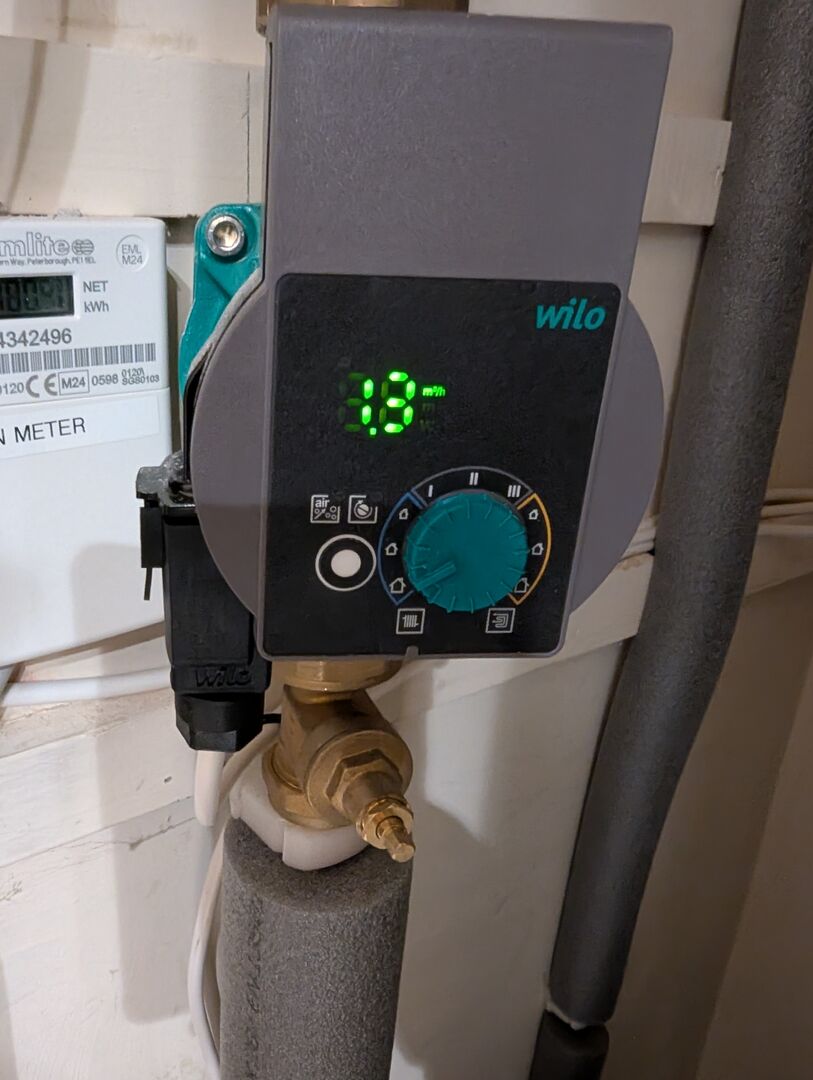
I plucked up the courage to finally tweak the green dial and, having discovered that the figures changed and the house didn't explode by doing so, I've seen that there appear to be incremental improvements in the running COP at each downward tweak of the dial. This has been easier to determine in the recent cold spell over the last few days, when the system has been running constantly on WC at temperatures from -2°C to 3°C and which largely avoid the cycling created by the anti-freeze protection that kicks in at 4-5°C, so the data can now be assessed over longer periods of constant running without any form of cycling creating 'noise'.
Over time, I've determined that each reduction in flow rate so far has seemed to incrementally improve the underlying COP slightly, and I've taken this as far as today's setting of reaching the medium sized house icon on the dial, which equates to an alternating output of 26W and 0.9m³/h, which gives a reported flow rate of 16l/min. I've been monitoring for any adverse performance during this time and the system continues to run without any issues, and is delivering a comfortable constant heat output at around the 21°C level on the current WC curve settings. I'm intrigued as to whether this can continue further, but have reached the point where I want to better understand the potential consequences of any more tweaking, for reasons outlined below.
The manual for the pump itself was the first port of call to understand exactly what the relevant notations on the dial represent, which are as follows:
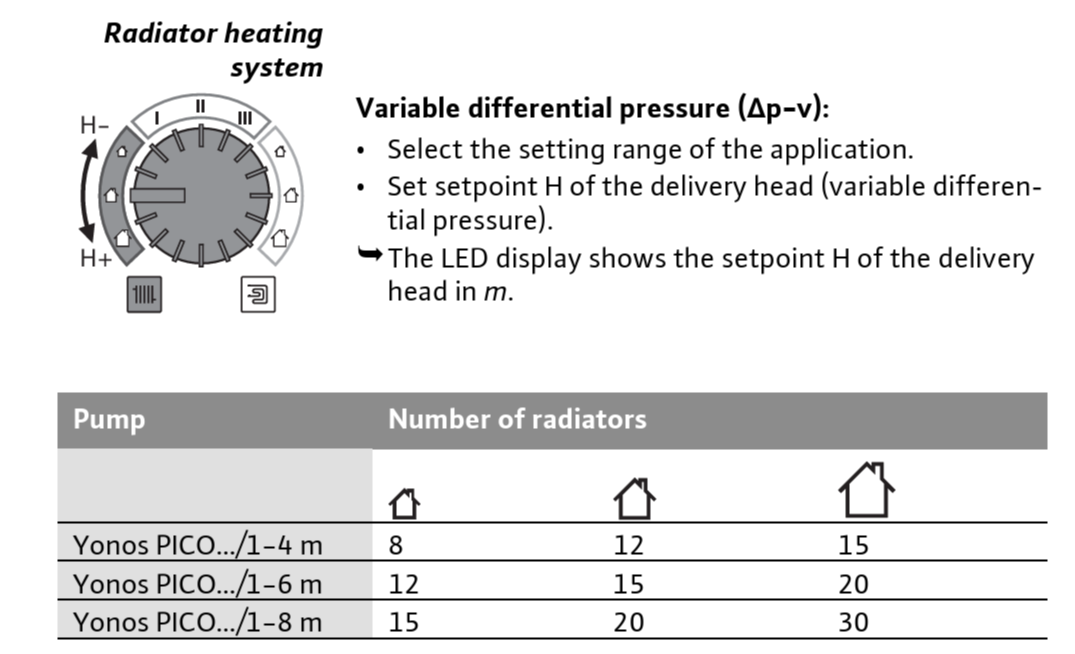
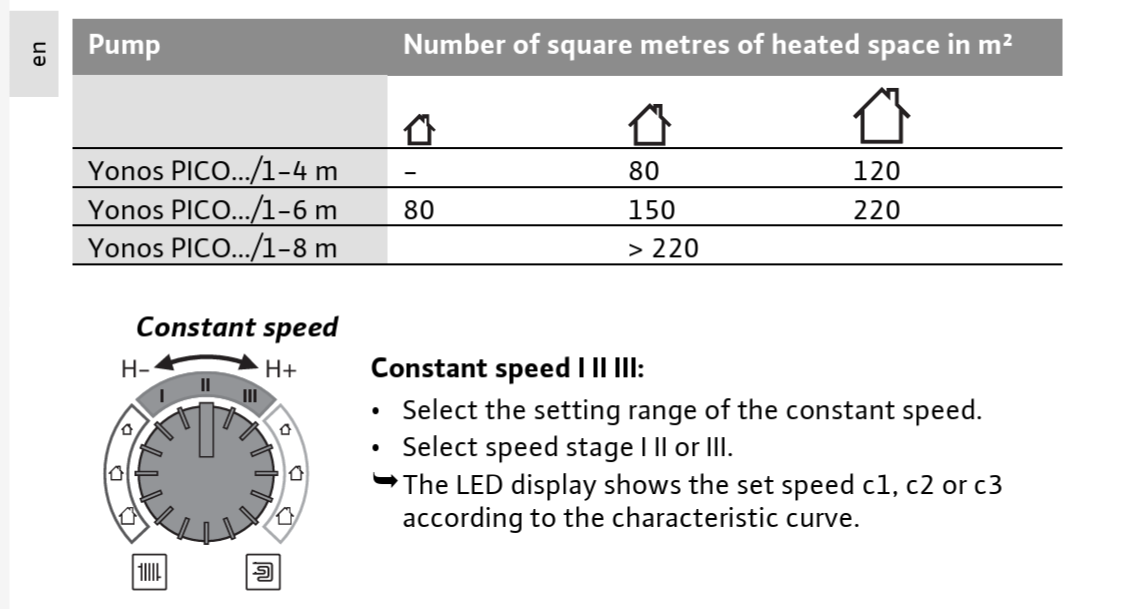
As you can see, there are two options for the type of control available, these being either a variable differential pressure setting (the house icons) or a constant speed setting (the I, II, III icons). To the right of the dial there's an equivalent variable pressure setting intended for underfloor heating systems, so these are not relevant to my setup which is a radiator only retrofit.
Having identified the correct pump variant being the 1-8 model, the tweaking I've done to date according to the guidance in the manual equates to the number of radiators in the system, and I've moved it from a setting for 30 radiators to one for 20. I have 13 radiators overall in the house, so on this basis in isolation, there would be scope to move it towards the small house icon.
It's worth noting at this point that tweaking the dial brings up another display in metres, which I've learned is the pump head setting in metres, and represents the theoretical vertical height of water that the pump output provides to overcome gravity. This is potentially relevant to my setup as the ground level heat pump feeds pipework that goes vertically up the gable end wall and into the loft, which then feeds into a cylinder cupboard in the centre of the house inside the main bathroom, so there is a more substantial gravitational challenge than many typical installations may have, which may explain why I'm outside the range represented by radiator numbers. The tweaks done so far have reduced the pump head figure from, I think, an original 6.5m setting to one of 4.9m at the 16l/m flow rate.
I had also considered whether looking at the constant speed settings as part of the tinkering process might be worthwhile, as the manual references these against square metres of heated space. However, for the 1-8 variant of the heat pump there is only 1 figure displayed, intended for spaces above 220m³, relative to our house being 130m², which doesn't suggest that there's any scope to consider this any further.
I've also consulted the databook for my heat pump model and found the data table below, which provides additional guidance with regard to flow rates, albeit these are referenced against the volume of the heating system, which is a figure that I don't knowingly have available, unless I'm missing something.
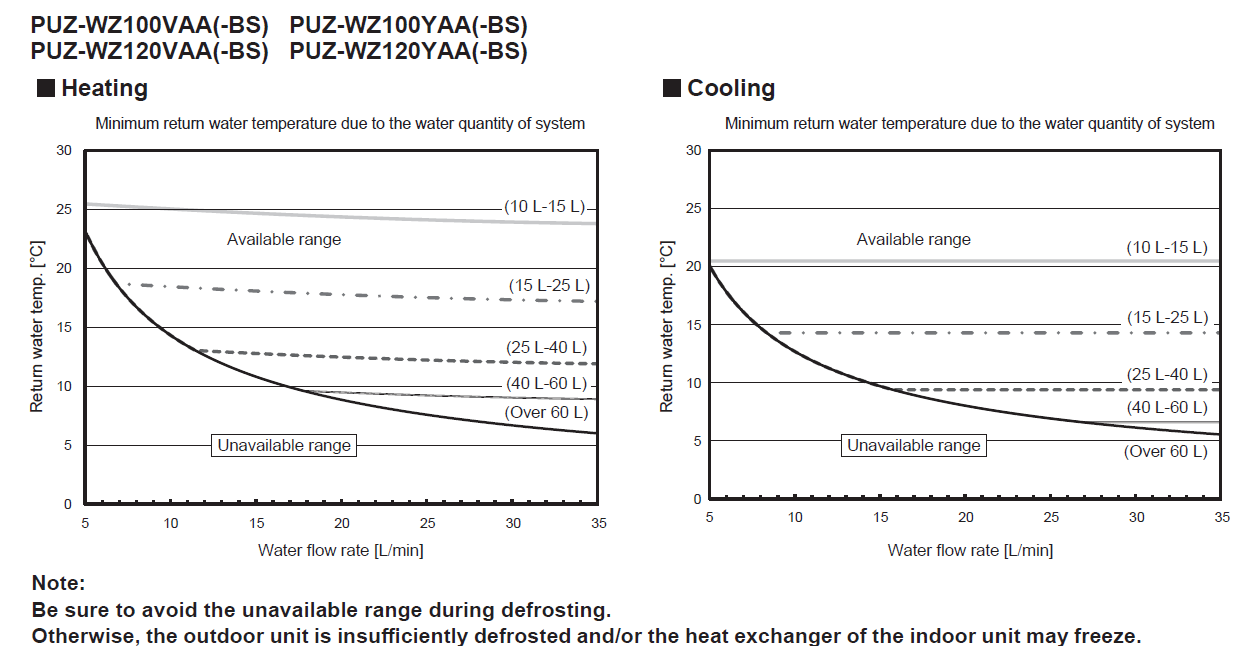
My interpretation of this is that there is potentially scope to reduce the flow rate further, provided that I have a system volume below 60l, but if I'm over this (which is presumably the case with a volumiser tank within it) then I'm already within the 'unavailable range' per the graph and therefore potentially at risk of issues during periods where defrosting is required, which we're currently in the middle of at the moment.
So the immediate question is should I suspend the tinkering exercise for now and put the system back up to 18l/min flow rate during this cold spell?
Assuming the answer to this is yes, and that we ultimately move to a temperature range outside the requirement for defrosts, what are the potential benefits/risks to continuing to tweak the flow rate downwards in order to monitor the incremental COP changes, which will presumably hit an optimal point at some stage before performance starts to diminish again if the setting gets too low, at whatever point that may prove to be. Looking at tables within the databook, my specific model has a stated flow rate range of 10.0-34.4l/min, and the official COP performance testing was done using a flow rate of 16.6l/min, which suggests that this is potentially the optimal level to get the best official figures, but this may well only apply to the 'perfect' setup used for these tests, but it has guided me so far as to why 16l/min is where I've been aiming, and have ultimately paused to seek advice.
I'm realistic enough to know that these tweaks aren't going to turn the system magically into one that has world-beating efficiency scores, but the flow rate variation does appear to be one which has been able to move the dial in a small way so far towards improving the overall performance.
Thanks in advance for any insight provided.
This post was modified 2 months ago by Sheriff Fatman
130m2 4 bed detached house in West Yorkshire
10kW Mitsubishi Ecodan R290 Heat Pump - Installed June 2025
6.3kWp PV, 5kW Sunsynk Inverter, 3 x 5.3kWh Sunsynk Batteries
MyEnergi Zappi Charger for 1 EV (Ioniq5) and 1 PHEV (Outlander)
User of Havenwise (Full control Jun-Dec 2025, DHW only from early Dec)
Subscriber to MelPump App data via CN105 Dongle Kit
Topic starter
05/01/2026 9:16 am
@sheriff-fatman, I have nothing useful I can say but did want to register that I'm interested in your question too.
105 m2 bungalow in South East England
Mitsubishi Ecodan 8.5 kW air source heat pump
18 x 360W solar panels
1 x 6 kW GroWatt battery and SPH5000 inverter
1 x Myenergi Zappi
1 x VW ID3
Raised beds for home-grown veg and chickens for eggs
"Semper in excretia; sumus solum profundum variat"

05/01/2026 10:22 am
So the immediate question is should I suspend the tinkering exercise for now and put the system back up to 18l/min flow rate during this cold spell?
I am not an ecodan expert but my instinct would be to say yes. Failure to defrost can cause a death spiral and leave your heat pump in a position where you would have to manually defrost in order to restart.
I'm realistic enough to know that these tweaks aren't going to turn the system magically into one that has world-beating efficiency scores, but the flow rate variation does appear to be one which has been able to move the dial in a small way so far towards improving the overall performance.
Thanks in advance for any insight provided.
Interesting. I have a couple of questions (which will affect any subsequent insights if any):
- Do you have a buffer or LLH or is your ecodan plumbed direct to the emitters?
- If you do have a buffer/LLH is the pump in question the primary or the secondary?
- Are you operating on pure weather compensation or with some sort of room influence?
- How are you determining COP - what are you measuring and does it include the water pump consumption - and what are the actual figures?
The simplest argument says that, at least up to a point, COP reduces as flow rate is reduced (which is one reason why we operate heat pumps at high flow rates). However that conclusion depends on assumptions, several of which are unlikely to be true in the way the experiment was done (for clarity Im not saying there is anything wrong with the experiment). There are also a few 'moving parts' in the analysis and some unknowns. Hence why Im keen to understand a bit more. The folks on Openenergymonitor did a bit of analysis a couple of years ago and concluded that, for any given system, there was effectively an 'optimum' flow rate. Generally however this was higher than the nominal one often quoted based on achieving an emitter DT of 5 when operating at the design power output.
4kW peak of solar PV since 2011; EV and a 1930s house which has been partially renovated to improve its efficiency. 7kW Vaillant heat pump.
05/01/2026 2:15 pm
Interesting. I have a couple of questions (which will affect any subsequent insights if any):
- Do you have a buffer or LLH or is your ecodan plumbed direct to the emitters?
- If you do have a buffer/LLH is the pump in question the primary or the secondary?
- Are you operating on pure weather compensation or with some sort of room influence?
- How are you determining COP - what are you measuring and does it include the water pump consumption - and what are the actual figures?
The simplest argument says that, at least up to a point, COP reduces as flow rate is reduced (which is one reason why we operate heat pumps at high flow rates). However that conclusion depends on assumptions, several of which are unlikely to be true in the way the experiment was done (for clarity Im not saying there is anything wrong with the experiment). There are also a few 'moving parts' in the analysis and some unknowns. Hence why Im keen to understand a bit more. The folks on Openenergymonitor did a bit of analysis a couple of years ago and concluded that, for any given system, there was effectively an 'optimum' flow rate. Generally however this was higher than the nominal one often quoted based on achieving an emitter DT of 5 when operating at the design power output.
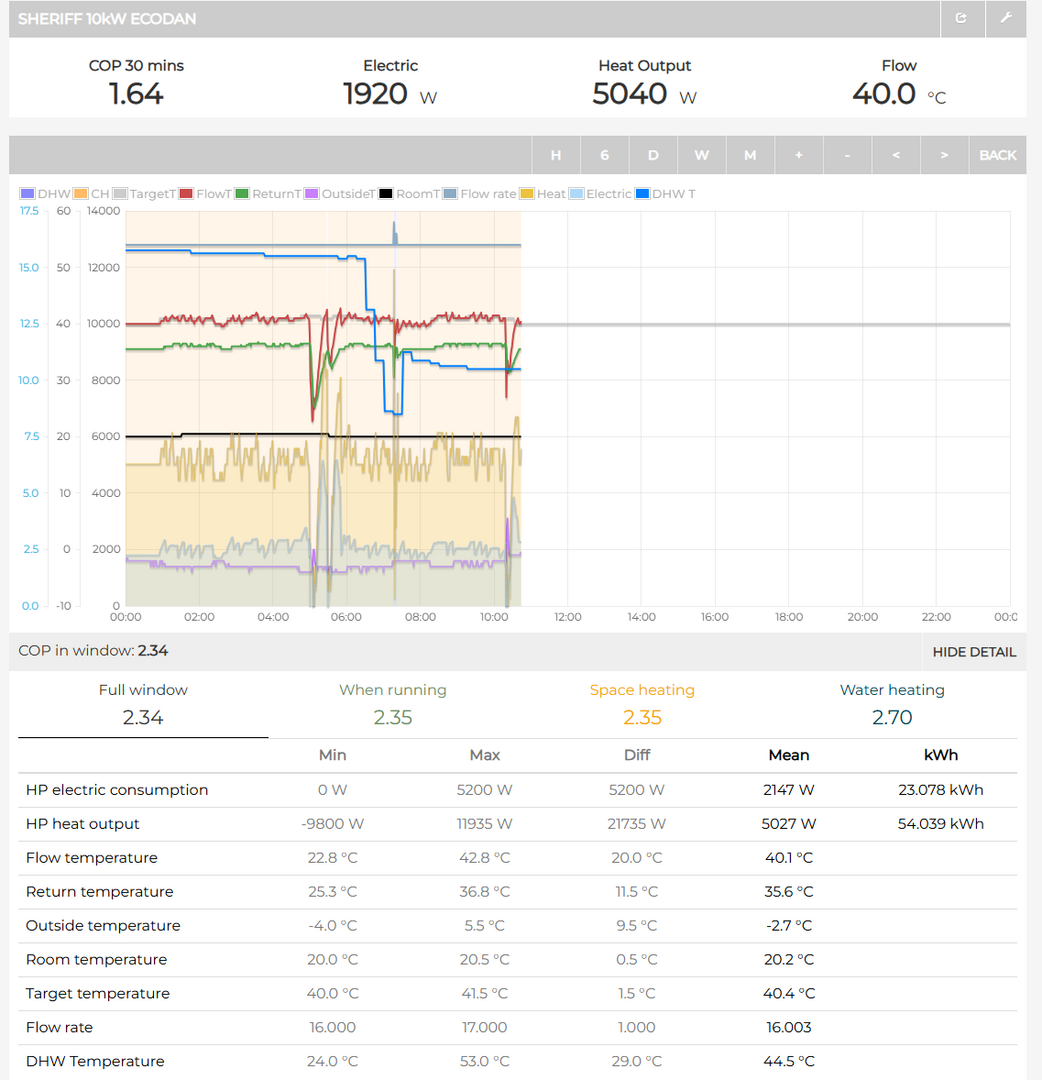
The reason for doing the experiment was based on a lower flow rate increasing the DeltaT at the emitters, as this had typically been around 2-2.5°C at the original flow rate of 25l/min. As per the screenshot below, the DeltaT since midnight running at 16l/min is 4.5°C, so is moving in the right direction via reducing the flow rate, which is consistent with the theory I'd read on how to achieve this (for clarity, 'research' = google search on increasing deltaT)
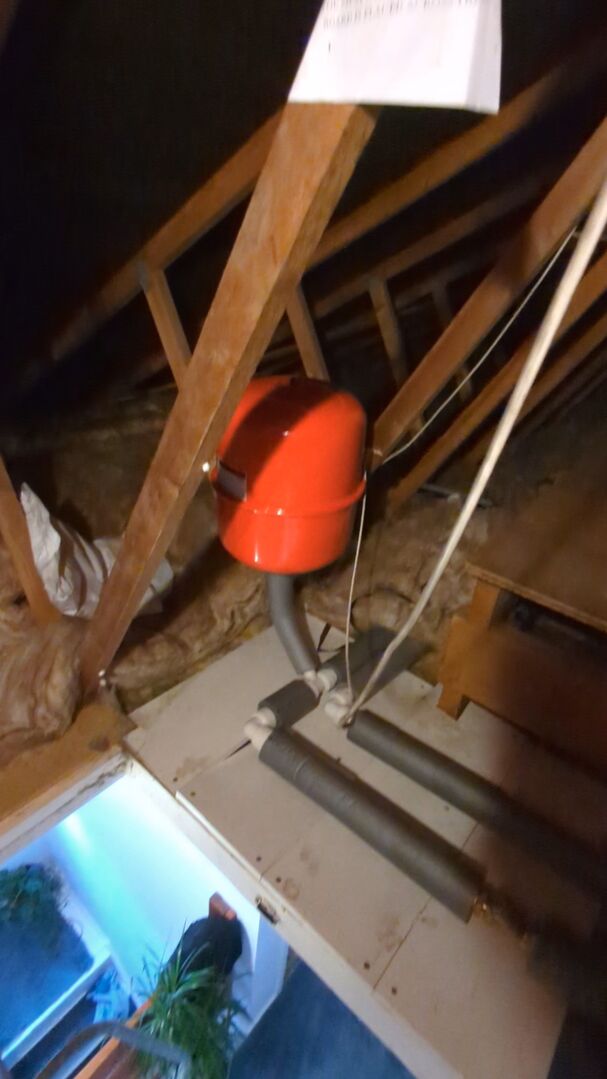
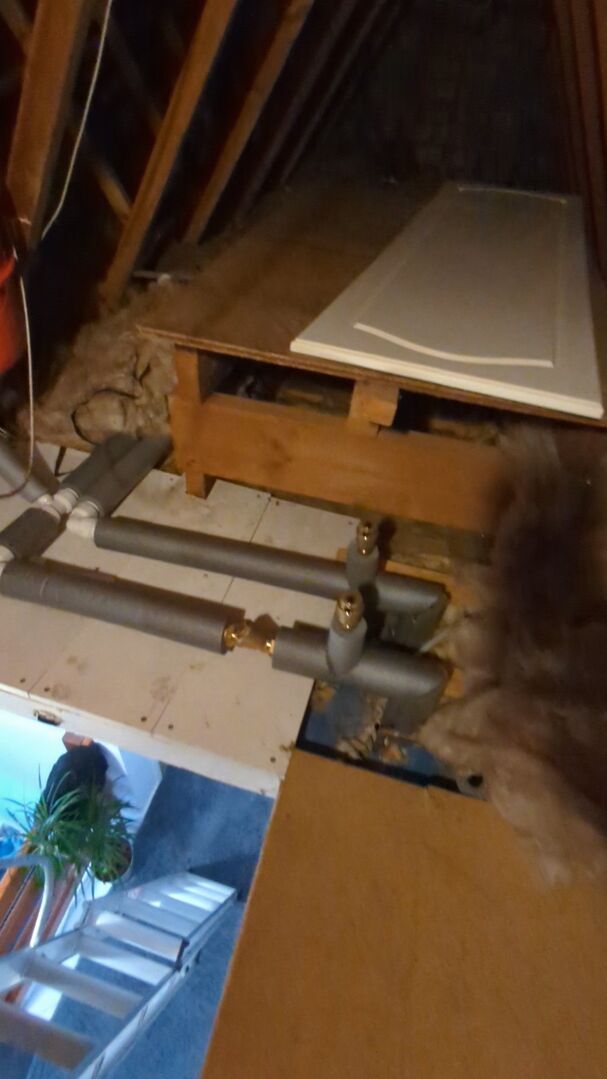
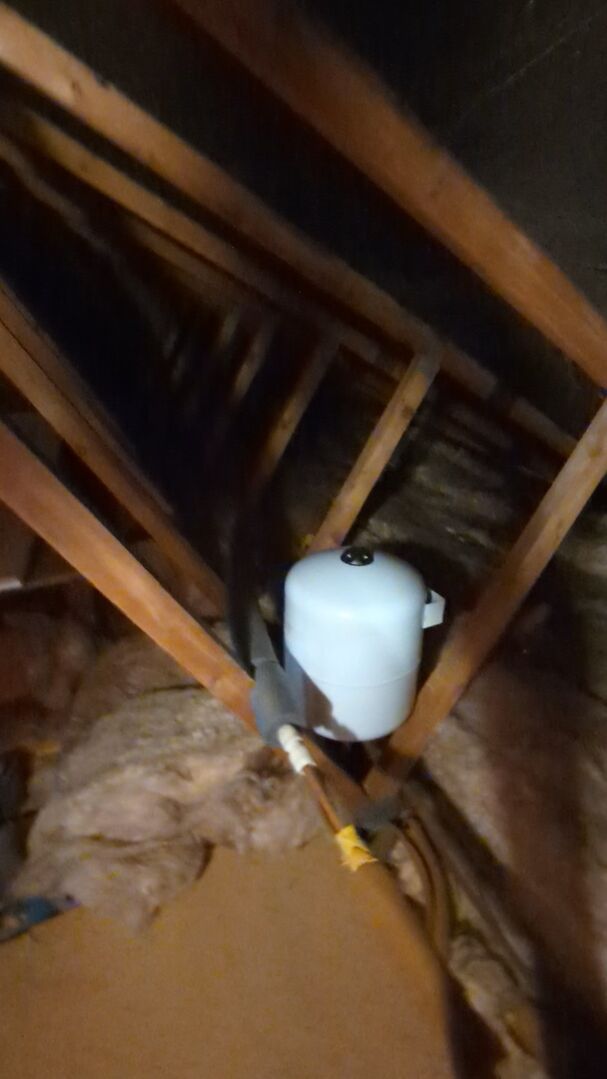
I don't believe that there is a buffer or a low loss header in the system, based on conversations I had with the installation team, who advised that they were going to add a volumiser in the loft when I queried at the start of the job if they were planning to add a buffer tank. I've attached stills from a bit of footage I took in the loft after they had left the site, as you're undoubtedly better informed than me as to what they actually are. The extent of my verification was to note that the red tank had only one input and output flow pipe, so seemed to be consistent with being the 2-port volumiser they referred to, rather than anything with 4 ports. I'm not sure what the white tank is in the other photo, but you can see from the photos that the red one has pipework runs that extend to two entry points into the cylinder cupboard, which is to the right of the entry hatch to the loft. I've added photos of the cylinder cupboard so that you reference how the pipework in the loft is subsequently linked into that. The piping on the right hand side of the cylinder looks to be the bit that goes up to the white tank in the loft.
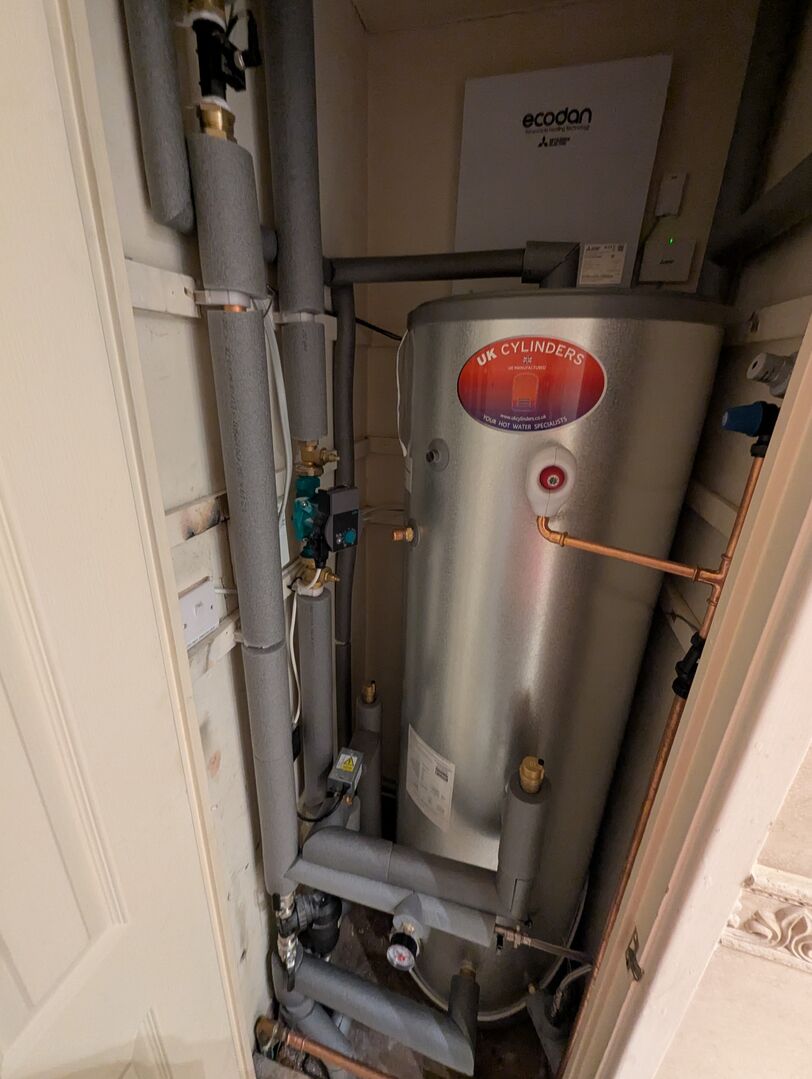
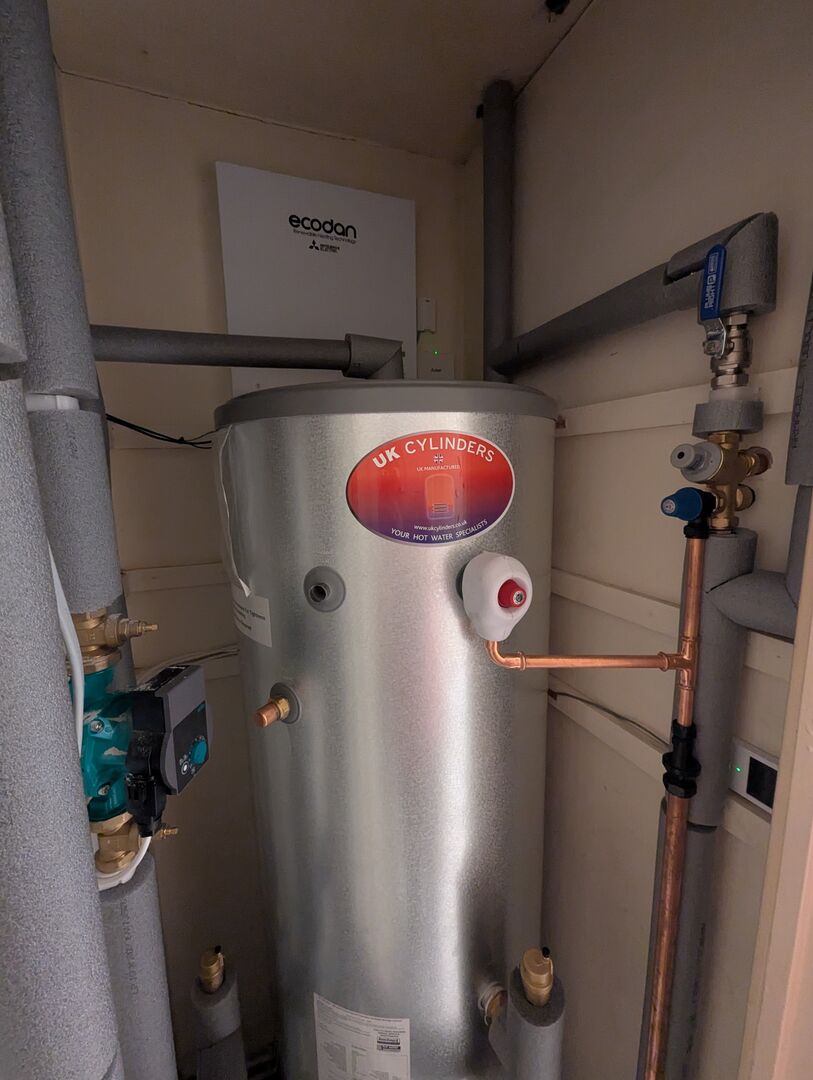
In terms of the other queries, it's been running on pure weather compensation since early December, which is when I switched off the Havenwise control for heating so that I could compare the performance of the two. There have been a few tweaks to the curve over this time, particularly as we experience new extremes of OAT for the first time (and we're in one currently, as yesterday and today are the lowest temperatures we've had yet) but the system is generally in the right place in terms of house comfort. Havenwise still controls DHW cycles as the timed cycles work well for our family showering requirements with two teenage girls in the house.
I have a dongle attached to the CN105 port of the system providing various data measurements into the Mel Pump app and also to a configuration of OEM's software via Home Assistant. The two aren't identical, but are close enough to each other for me to use both for different purposes. The OEM provides a better instant view, as above, with the ability to zoom in on specific sections. Mel Pump provides good overall insight and records daily COP figures as produced by the Ecodan system itself. Short of installing one of OEM's heat monitoring systems, the data recording is just about as extensive as it gets for an Ecodan system, but is largely reliant on the Ecodan's own internal reporting datapoints.
In terms of specific performance data, the December figures are a good reference point, and all of the following are taken from MelPump's daily totals, which are those reported by the Ecodan itself into MELCloud.
Dec 2025 Heating Totals:
Used 681.7kWh
Produced 2,003.34kWh
Heating COP 2.94
Average Temperature 6.6°C
Warmest Day 9th Dec (11.1°C OAT): Used 12.37kWh, Produced 44.41kWh, Heating COP 3.59
Coldest Day 31st Dec (2.5°C OAT): Used 33.23kWh, Produced 83.16 kWh, Heating COP 2.50
For reference on the impact of the flow rate changes so far, albeit very limited samples, the COP figure of 2.50 at 2.5°C was on a day with an average flow rate of 18.72l/min. By comparison, yesterday had an average OAT of -0.6°C, and the figures were 38.81kWh used, 100.38kWh produced and a Heating COP of 2.59 with an average flow rate of 16.88l/min. In general, across all the available data the COP typically follows the expected pattern of reducing as OAT falls. The main attributable difference on the above 2 dates is the change to the flow rate, and 4th Jan shows an improvement compared to the warmer day on 31st. I've avoided using days where the anti-freeze protection kicks in shorter cycle periods (every 20 minutes when OAT is around 4-5°C) and the two dates above have relatively little anti-freeze activity in them (6 on 31st, 2 on 4th, each lasting about 5 minutes). For clarity, I'm referring to anti-freeze cycles here, rather than full defrosts, of which there were 2 on 31st December and 3 on 4th January. Within the available data I have so far, these two dates are the best example of relatively comparable heat pump activity showing an improved COP.
If you have any further queries, let me know.
EDIT: I should also add, as it's something I intended to post about separately at some point, the heat pump output relative to the heat loss calculations for the house suggest a much lower real-life actual heat loss than anticipated, so at design temp the data suggests an actual heat loss of 5kWh, compared to calculated versions of 8-10kWh, so potentially half of the calculated one at the extreme end of the range. I'd expected that there might be some difference, but not on that scale, and I'm sceptical that the 5kWh figure is accurate, as it seems much too low for our property. Part of my thought process is that the Ecodan is actually producing more heat output than it's reporting, and that this is potentially a flaw within Ecodans in general, but I have nothing but gut feel to substantiate this, as yet. For now, the above is looking purely at the relative differences in reported figures, as these are comparable on a day to day basis. If they ultimately turn out to be understated, then they're at least consistent with each other.
This post was modified 2 months ago 7 times by Sheriff Fatman
130m2 4 bed detached house in West Yorkshire
10kW Mitsubishi Ecodan R290 Heat Pump - Installed June 2025
6.3kWp PV, 5kW Sunsynk Inverter, 3 x 5.3kWh Sunsynk Batteries
MyEnergi Zappi Charger for 1 EV (Ioniq5) and 1 PHEV (Outlander)
User of Havenwise (Full control Jun-Dec 2025, DHW only from early Dec)
Subscriber to MelPump App data via CN105 Dongle Kit
05/01/2026 2:49 pm
This thread looks fun, and I'm now wondering if changing how my extra system pump is used (currently controlled by home assistant to only turn on periodically when not actively heating as the built in pump turns off when the unit cycles off, which isn't great). The only thing holding me back is that I don't have a proper flow meter on the system, so I'd be largely flying blind.
Something else I've been considering after watching the (minor) temperature fluctuations over the past few days:
Solar and Lifestyle Compensation.
Currently, we have a weather compensation curve that looks like the following:
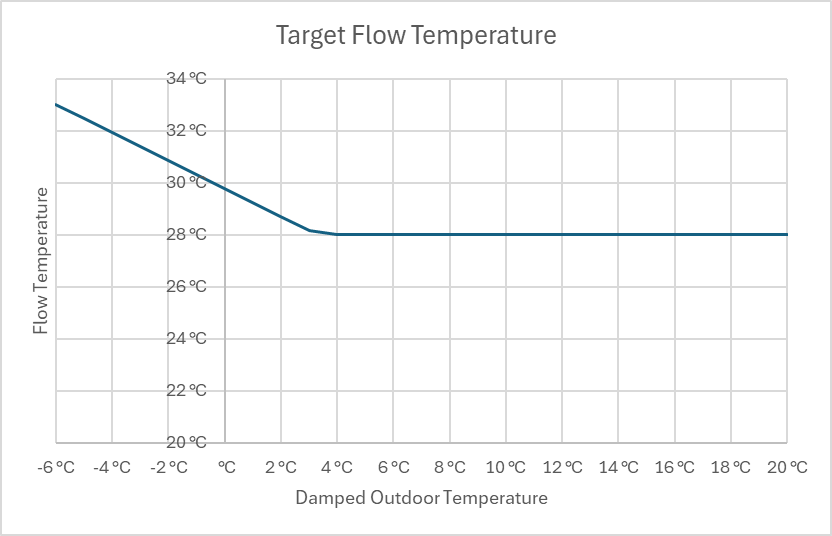
This was based on my own heat loss maths and excel spreadsheets of flow rates for every room zone. It has been hovering within a degree of the target room temperature (22 °C) all throughout the mild and colder weather. We also have a fairly substantial room influence setup so that for every degree over the target it goes, the flow temperature should drop by 3K. I recently also altered this so that Home Assistant turns off room influence when the room is below the target temperature as it was causing the unit to turn off while the flat was warming up. When the target flow temperature drops, the unit will sometimes decide it has overshot by too much and cycle off, which isn't ideal, and was a fairly common occurrence when the flat started warming up in the sun/when humans and electronics started being more active.
Part of this seems to be due to what seems to be a small mistake in the flow temperature control logic on the Bosch 5800i as it always overshoots the target flow by about 3-3.5°C (even though the flow-return dT is only 3K). It feels like something in there is still assuming a 7K flow-return dT, which is the unit's default, although it recommends lower dT for underfloor only systems.
Regardless, this means there's quite a small window the unit needs to stay in, and it will often cycle off any time the target flow temperature drops, as it does so when it sees its flow temperature going too much over the target, and in our case that limit is at about 4K over. So whenever the target flow temperature drops by even a degree, the unit will usually cycle off for 20 minutes or so. When the room was warming up during the day due to sun, activity, and electrics, this resulted in it being a little chaotic.
So Home Assistant now disables room influence when the room temperature is too low, and enables it when it's too high. This is resulting in more stable heat application so far.
But it got me thinking, looking at the graphs.
During the day the room temperature climbs to maybe 22.5 °C, and then falls overnight to 21.3 °C. This suggests that the curve I'm using is pretty close to exactly right, but it's obviously putting in a tiny bit too much heat during the day and evening, and then not quite enough overnight. The natural question then is can I tweak the curve to account for that?
First, I have added Forecast.Solar to my Home Assistant instance. This uses realtime weather and geographical information to work out how much power your solar panels should be producing every hour of the day (free tier is hourly only, but that's fine). What are windows but the original solar panel? Solar radiation hits the window, and some amount of it becomes 'useful' heat within the property. In our case, I'm going to assume about 50% efficiency as we have low-g argon filled glazing. By orienting our 'solar panels' to be vertical, and aligned to the walls, I can then get an hour-by-hour approximation of the amount of solar energy being added to the indoor system by the sun.
I can also approximate the relative gain of closing the curtains by assuming close-fitting thermal curtains cut the heat loss through those windows by around 10% or so. This allows me to potentially create an automation for our curtains so that they close whenever it is thermally advantageous. So far, the transition has happened at sunset/sunrise, so this isn't a big improvement, but it does again get me a number for how much more/less energy the property needs at different times.
Then I can monitor energy use by other parts of the property. TVs, PCs, oven/hob, etc. If we assume most of this energy eventually makes its way into the property as low-grade heat, we can again modify our expectations for the energy need.
All in, this results in us needing just 600W or so more heating overnight to make up for the reduced energy from other sources (on about 3kW at the design temperature). A bit of scaling and this means I could maybe completely offset the night-time heat reduction by upping the top end of the weather compensation curve by around 3°C.
Or I could just leave it as is because the slight cooling overnight is actually appreciated anyway.
But I did like the idea of using PVGIS to approximate solar gain. It's just a pity we get almost no sun at this time of year anyway.
Topic starter
05/01/2026 3:33 pm
First, I have added Forecast.Solar to my Home Assistant instance. This uses realtime weather and geographical information to work out how much power your solar panels should be producing every hour of the day (free tier is hourly only, but that's fine). What are windows but the original solar panel? Solar radiation hits the window, and some amount of it becomes 'useful' heat within the property. In our case, I'm going to assume about 50% efficiency as we have low-g argon filled glazing. By orienting our 'solar panels' to be vertical, and aligned to the walls, I can then get an hour-by-hour approximation of the amount of solar energy being added to the indoor system by the sun.
Just to clarify, are you doing this to work out how much thermal gain you're getting as a result of the windows?
If so, you might want to look at an alternative. What I'm doing is the following (all within Home Assistant):
- I'm using the Sunlight Intensity custom integration by UrbanFrame to tell me how much of the sunlight is falling on which of my house's walls.
- I'm also using the same integration to tell me how high in the sky the sun is.
- I'm using the HA Metar Weather custom integration to tell me the cloud coverage state (the Gatwick METAR info is close enough geographically to be useable) so that I can decide whether or not sun will actually be getting through the clouds. I tried the OpenWeatherMap data but found it too unreliable for cloud coverage.
- I've added a couple of number helpers for thresholds - one for a minimum sun elevation (I've got a tall hedge at the end of the garden) and one for minimum level of sun intensity for a given wall (solar gain doesn't happen if the % of sun is below a certain level). These helpers allow me to quickly and easily tweak the parameters without having to amend the automations.
Using the data from above, I'm able to offset the heat pump's WCC downwards if the weather's sunny enough, the sun is high enough and sun intensity for the wall with lots of glazing is high enough.
It so happens I also separately take a look at the Met Office's 3-hourly forecast for temperature and feels-like temperature since that is already the result of a tried and tested windchill algorithm. I then use the difference between the two (as it happens, halved and rounded down to the nearest half-degree) to offset the WCC upwards. The net result is that this morning I had my heat pump running with a WCC offset of -1 for the solar gain and +1.5 for the windchill. The windchill offset has been varying between 0.5 and 1.5 most of the day whilst the solar gain was in place for slightly over two hours (9:38 until 11:48). One of my plans if I get round to sorting out the woodburning stove flue temperature sensor for Home Assistant is to use that to tweak the manual offset or the solar gain offset (renamed thermal gain, I suspect) so the heat pump can take the stove's heating into account. Similarly, if you see earlier in the thread, if I can sort out blinds for some awkward windows then in the summer I could close the blinds when thermal gain is highest to keep the home cooler.
This post was modified 2 months ago by Majordennisbloodnok
105 m2 bungalow in South East England
Mitsubishi Ecodan 8.5 kW air source heat pump
18 x 360W solar panels
1 x 6 kW GroWatt battery and SPH5000 inverter
1 x Myenergi Zappi
1 x VW ID3
Raised beds for home-grown veg and chickens for eggs
"Semper in excretia; sumus solum profundum variat"
1

05/01/2026 5:13 pm
Just to clarify, are you doing this to work out how much thermal gain you're getting as a result of the windows?
Thermal gain from Windows is a common issue.
But Home Assistant can also run on a Raspberry Pi, which takes less power of course. 😉
Save energy... recycle electrons!

Latest Posts
-
RE: Heat Pump vs New Gas Boiler for Inherited House - Worth the Extra Cost?
*** I now see @jamespa has already posted but will stil...
By cathodeRay , 25 minutes ago
-

RE: Tell us about your Solar (PV) setup
@mk4 Charge to 100%, discharge down to 10%.
By bobflux , 33 minutes ago
-
RE: Daikin Altherma 3 LT compressor longevity question
This mess is intriguing: I wonder if this represent...
By bobflux , 2 hours ago
-
RE: Connecting Growatt SPH5000 over wired ethernet rather than wireless
The simplest wired option is usually the Growatt Ethern...
By Jonatan , 6 hours ago
-
RE: Peak Energy Products V therm 16kW unit heat pump not reaching flow temperature
ASHPs do have a minimum compressor speed. The minimum h...
By bobflux , 13 hours ago
-
RE: Electricity price predictions
@jamespa And it seems some of the nasty public cloud...
By Batpred , 13 hours ago
-
RE: Jokes and fun posts about heat pumps and renewables
Technology is rapidly advancing. BBC News reported th...
By Transparent , 16 hours ago
-
What matters for flow and pressure drop is internal dia...
By bobflux , 17 hours ago
-
RE: Do Fridges and Freezers have COP ratings?
@editor Thank you all for your replies and submitted in...
By Toodles , 20 hours ago
-
I know and yes. The secondary deltaT wont necessaril...
By JamesPa , 23 hours ago
-
RE: Designing heating system with air to water heat pump in France, near Lyon
Just love the way you put it! 🤣
By Batpred , 2 days ago
-
RE: Safety update; RCBOs supplying inverters or storage batteries
Thank you for sharing. So it seems that your Schneid...
By Batpred , 2 days ago
-

RE: Forum updates, announcements & issues
@upnorthandpersonal thanks for the thoughtful, consider...
By Mars , 2 days ago
-
RE: Solar Power Output – Let’s Compare Generation Figures
@mk4 All 21 panels have their own Enphase IQ7a microinv...
By Toodles , 2 days ago
-
RE: Setback savings - fact or fiction?
Great, so you have proven that MELCloud is consistently...
By RobS , 3 days ago
-
RE: Mitsu PUHZ120Y 'Outdoor Temp 'error?
Thanks David & James It almos...
By DavidAlgarve , 3 days ago
-
RE: Surge protection devices SPDs
@trebor12345 - your original Topic about the right type...
By Transparent , 3 days ago
-
RE: Help needed with Samsung AE120RXYDEG
@tomf I’ve been sent this from a service engineer at Sa...
By Mars , 3 days ago
-
RE: Buying large amp bidirectional RCD and RCBO
Yes... I went through this particular headache and ende...
By bobflux , 4 days ago
-
O-oh! Let's take this as an opportunity to 'pass the ...
By Transparent , 4 days ago
-
RE: Homely setup on daikin heat pump
@craigh I refer to our somewhat elevated temperature of...
By Toodles , 4 days ago
-
RE: Air source heat pump roll call – what heat pump brand and model do you have?
My turn, this describes the future installation, only t...
By bobflux , 4 days ago