

Notifications
Clear all
Joining the Renewable Heating Hub forums is completely free and only takes a minute. By registering you’ll be able to ask questions, join discussions, follow topics you’re interested in, bookmark useful threads and receive notifications when someone replies. Non-registered members also do not have access to our AI features. When choosing your username, please note that it cannot be changed later, so we recommend avoiding brand or product names. Before registering, please take a moment to read the Forum Rules & Terms of Use so we can keep the community helpful, respectful and informative for everyone. Thanks for joining!
Air Source Heat Pumps (ASHPs)
51
Posts
12
Users
27
Reactions
17.5 K
Views

Topic starter
06/02/2023 3:46 pm
With the pending rise in energy prices pushing the unit cost of electricity from 0.34p/kWh to anywhere between 0.40p and 0.48p/kWh, what is the limit that would see widespread use or adoption of ASHPs economically unviable?


06/02/2023 4:17 pm
With the pending rise in energy prices pushing the unit cost of electricity from 0.34p/kWh to anywhere between 0.40p and 0.48p/kWh, what is the limit that would see widespread use or adoption of ASHPs economically unviable?
As long as electricity price is still pegged to the mains gas price, ASHPs are only really economically beneficial to those without mains gas, but at least while that link remains, they're not going to get any worse economically because as the electric unit cost increases, so does the gas cost.
Topic starter
06/02/2023 4:32 pm
But as many of us in rural areas are not on the mains gas grid, so then the choice is oil, lpg, logs or ASHP. The linked rising unit price of mains gas is therefore irrelevant. At some point those off mains grid are effectively economically denied access to running ASHP if the unit price of 'leccy becomes too high. Already I would argue we are near that point. An annual energy requirement of 25000 kWhs, which is not too excessive, is going to mean an annual bill of around £5,500 on the worst case scenario of 048p/kWh with oil costing £3,500. That gap is not sustainable.
1
06/02/2023 5:00 pm
But as many of us in rural areas are not on the mains gas grid, so then the choice is oil, lpg, logs or ASHP. The linked rising unit price of mains gas is therefore irrelevant. At some point those off mains grid are effectively economically denied access to running ASHP if the unit price of 'leccy becomes too high.
LPG price is also linked to mains gas price, while ASHP beats Oil and logs so comfortably that it would need such a high electricity unit price that the government will never let it happen because so many people would go broke, no matter what they heat with.
Already I would argue we are near that point. An annual energy requirement of 25000 kWhs, which is not too excessive
25000kWh is pretty excessive, as energy requirement and definitely as an electricity usage. After all, 15000kWh was the national average before the current crisis. If we look only at 5-bedroom houses, 20300kWh of energy is the average, with 4,300kWh of electricity and 16,000kWh of heat, which should be about 5,500kWh of electricity with a decent ASHP, so that's under 10,000kWh of electricity.
I humbly suggest that anyone with 25000kWh electricity usage probably doesn't have a 25000kWh requirement and should look at reducing usage, but there's not many. How many do you think there are?


06/02/2023 5:11 pm
But as many of us in rural areas are not on the mains gas grid, so then the choice is oil, lpg, logs or ASHP. The linked rising unit price of mains gas is therefore irrelevant. At some point those off mains grid are effectively economically denied access to running ASHP if the unit price of 'leccy becomes too high. Already I would argue we are near that point. An annual energy requirement of 25000 kWhs, which is not too excessive, is going to mean an annual bill of around £5,500 on the worst case scenario of 048p/kWh with oil costing £3,500. That gap is not sustainable.
Whilst the cost of electricity has gone up by a factor of 3, the price of mains gas is now 5 times higher. I think that oil is one of the cheapest options at the moment, but may not be in the future.
To help keep your energy bills in check you should concentrate both on improved insulation and ensuring that your heat pump is operating at optimal efficiency.
Topic starter
06/02/2023 5:22 pm
which should be about 5,500kWh of electricity with a decent ASHP,
Okay, with a ASHP with a SCOP of 2.5 that still leaves a bill of around £2600. Heat with an oil boiler and that is sub £1,800 with around 6000kWh for heating.
My point is the danger in such a built in disadvantage to change will prevent uptake of clean renewable heating. Look at this and other similar fora and see the number of dissatisfied ASHP users where it turns out that the Heat pump is actually performing as expected but it is the concomitant bill attached to using it that causes the problem.

06/02/2023 5:24 pm
@derek-m, bang on Derek. I've just done the maths this weekend – based on our consumption with oil at 75p/litre (that's our oil club price this weekend) and electricity at 34p/kWh if temperatures are above 5C our ASHP is about 20% cheaper to run than oil. As temperatures go up (over 5C in our case) ASHPs will continue to be cheaper to run.
🔥 Britain’s Heat Pump Shitshow
How Installing a Heating System Became a National Nervous Breakdown
Free UK shipping.
📗 Heat Pumps Explained
A Jargon-Free Guide for Homeowners
Rewritten and updated for 2027
📘 From Zero to Heat Pump Hero
🛠️ Bodge Buster
New to heat pumps?
Take the Heat Pump Fundamentals course and use INTRO50 at checkout for 50% off.
1
Topic starter
06/02/2023 6:06 pm
I've just done the maths this weekend – based on our consumption with oil at 75p/litre (that's our oil club price this weekend) and electricity at 34p/kWh if temperatures are above 5C our ASHP is about 20% cheaper to run than oil. As temperatures go up (over 5C in our case) ASHPs will continue to be cheaper to run.
That is surprising and welcome. Oil at 75p/litre seems very keen, Boiler Juice are quoting 84p/litre today. How many litres of oil v how many kWhs of 'leccy was that nominal calculation using (without prying to deeply into your domestic energy consumption!). I understood that 1 litre of kerosene gives 10.3 kWh of energy so the ASHP COP will have to be 3.3 to break even at 0.34p/kWh for 'leccy, or have I missed something?


06/02/2023 7:06 pm
while ASHP beats Oil and logs so comfortably
I don't think so, at least for oil, don't know about logs. Assume:
cost of electricity = 34p per kWh used, COP of 3.5 => cost per delivered kWh = 9.7p (plus standing charge) (plus it's going to get a LOT worse)
cost of oil (RBO/kerosene) = 80p per litre (today's boilerjuice.com price for England), 10.35kWh in a litre, kWh yield at 80% boiler efficiency = 10.35 * 0.8 = 8.28 kWh => cost per delivered kWh = 9.7p (plus oil price is currently trending downwards)
After adding in the electricity standing charge, oil is the cheaper option.
ASHPs are also vastly more expensive to install, and probably cost a lot more to maintain, because you have to have 'pro' servicing to maintain your warranty.
25000kWh is pretty excessive, as energy requirement
I think maybe you have forgotten about all those old leaky buildings out there, many of them listed, so plastering them with insulation or for that matter solar panels is not an option (nor would I want to do it, the character of listed buildings is too precious; I would rather accept higher bills as the cost of keeping the character of the building). But the higher costs need to be within the bounds of reasonableness, if (when?) governments start acting unreasonably eg by allowing runaway fuel price inflation without limit, then the people start to get unreasonable.
if temperatures are above 5C our ASHP is about 20% cheaper to run than oil.
Mars, far be it for me to question The Master, but are you sure? See my above calcs (unless you've got an Aga, in which case you might as well use bank notes as the fuel).
Midea 14kW (for now...) ASHP heating both building and DHW
06/02/2023 8:08 pm
Okay, with a ASHP with a SCOP of 2.5
Look, if you hate heat pumps, just say so. Please don't make up comparisons using the sort of SCOPs generally seen with defective units or botched installations.
My installation has faults that I've not yet resolved, as well as some that I have (but not before they cost a packet) and it still had a first-year SCOP over 3.2.
My point is the danger in such a built in disadvantage to change will prevent uptake of clean renewable heating.
I'd agree that the increasing electricity price will slow uptake, but it's nowhere near as bleak as these comparisons suggest.
Look at this and other similar fora and see the number of dissatisfied ASHP users where it turns out that the Heat pump is actually performing as expected but it is the concomitant bill attached to using it that causes the problem.
I think pretty much every dissatisfied user I've seen has had an ASHP that isn't working as expected.
After adding in the electricity standing charge, oil is the cheaper option.
That seems an unfair comparison because how many oil boilers aren't connected to mains electricity which therefore requires payment of the standing charge?
ASHPs are also vastly more expensive to install, and probably cost a lot more to maintain, because you have to have 'pro' servicing to maintain your warranty.
I agree on the expense if you can't get the market-distorting grant, but warranty-continuing servicing seems about the same price. I know some on here are paying mid/high three figures to their original installer for their approved servicing, but I don't (not least because the installer is playing possum).
I think maybe you have forgotten about all those old leaky buildings out there, many of them listed
If someone is going to take on a listed building and do nothing to improve its energy efficiency, they'll need deep pockets no matter what the heating. The energy usage will be excessive and that's such a niche group that it's barely going to move the needle on the average, which, just to repeat, is 15000 kWh not 25000. No-one should be making energy policy or generalisations based on such a tiny niche.
1

06/02/2023 8:17 pm
what is the limit that would see widespread use or adoption of ASHPs economically unviable?
This should give you an idea. I think if you get a CoP of 3.9 or higher you are cheaper than oil, though depends on your price of electricity.
https://nottenergy.com/resources/energy-cost-comparison/
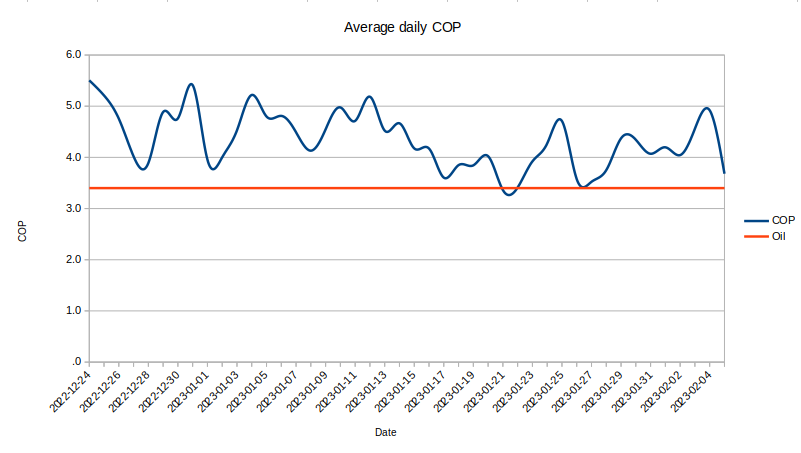
This is my CoP vs oil - including hot water - based on average of 33p per kWh, at that price you need to get CoP of 3.4. [Excludes standing charge - but I would pay that anyway to run the pumps if I had oil, so I have not included it, it is common to both]
06/02/2023 8:18 pm
After adding in the electricity standing charge, oil is the cheaper option.
If someone has an oil boiler that does not need electricity and is thus exempt from the standing charge let me know 😀. I excluded it as this is a tax everyone on the grid has to pay afaik.

Page 1 / 5
Next
SPONSORS

Degrees of Separation
Latest Posts
-

RE: How will removing the standing charge on gas bills benefit heat pumps?
I'm not sure it makes much of a difference to heat-pump...
By Temperature_Gradient , 5 hours ago
-
@editor Ouch, sorry to re start the tick. I had assume...
By DavidB , 5 hours ago
-
RE: Say hello and introduce yourself
@e-a-west as the good Major said, welcome to the forums...
By Mars , 7 hours ago
-
RE: New Build 3 Phase or 1Phase
We are on three phase power because it's an enormous li...
By EtchedPixels , 7 hours ago
-
RE: How much of your renewable and home setup would still work if the internet went down?
Yes I actually have a copy of a tool that whenever a ce...
By EtchedPixels , 16 hours ago
-
RE: Indevolt Batteries UK Support & Info Thread
@editor Hi, To resolve this, please tap on the A...
By Indevolt Tech , 23 hours ago
-
RE: Double or Triple Glazed Windows?
Posted by: @singlespeed With 9 years repairing windo...
By Rob of York , 2 days ago
-
@transparent we’re still running a secure version of PH...
By Mars , 2 days ago
-
RE: How quickly would you want/expect heat recovery to take from setback?
Much longer than that here. The heating isn't even on. ...
By bobflux , 2 days ago
-
RE: Passiv Smart Thermostat - Help & Forum Support
Obviously the weather is changeable but there's a defin...
By Singlespeed , 2 days ago
-
RE: The Changing Jet Stream Could Challenge UK Air Source Heat Pumps
@rob-of-york I must admit that when we had a Daikin hea...
By Toodles , 2 days ago
-
RE: Forum updates, announcements & issues
Get the Renewable Heating Hub heads-up on WhatsApp. I...
By Mars , 3 days ago
-
RE: Safety study for plug in batteries out to tender - looks like Q3 2027 at best before legal
@editor I pointed out to the one of the Fuse execs that...
By dansus , 3 days ago
-
RE: 15kw pump for 225m2 1990's house - over kill?
@seaviews As well as loft insulation, there are othe...
By Rob of York , 3 days ago




SPONSORS
