Joining the Renewable Heating Hub forums is completely free and only takes a minute. By registering you’ll be able to ask questions, join discussions, follow topics you’re interested in, bookmark useful threads and receive notifications when someone replies. When choosing your username, please note that it cannot be changed later, so we recommend avoiding brand or product names. Before registering, please take a moment to read the Forum Rules & Terms of Use so we can keep the community helpful, respectful and informative for everyone. Thanks for joining!
Sorry, my fault, I only saw defrost, not its prefix. A 'normal' cycling stop and start then, and happening because your 'thermostat' (room stat?) is turned down?
No worries! The WC curve is setup for our usual 20-21C IAT so that's what the heat pump is trying to achieve, but the "thermostat" is set lower and so is cycling the heat pump off before it can achieve the usual IAT.
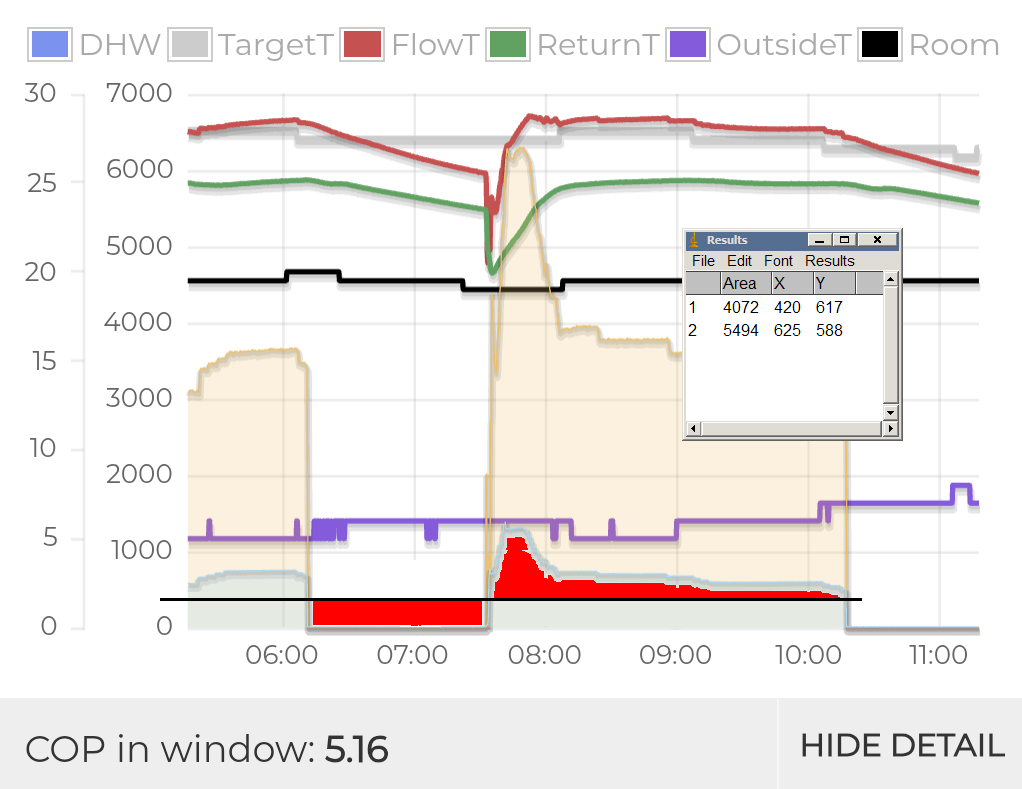
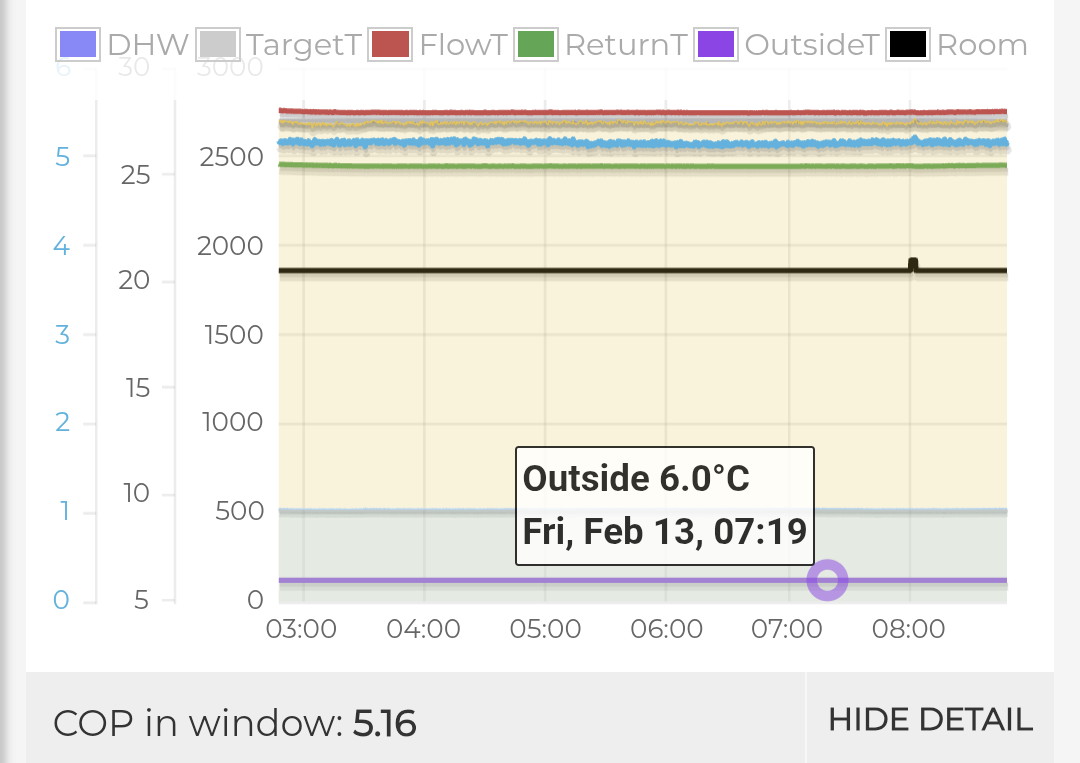
The 'COP in window' is still impressively (suspiciously?) high for an OAT of 6°C. It is also as you say a very low peak flow temp given the OAT. Can you throw some light on how you achieve that? UFH?
The low flow temperatures are from having big radiators that have DIY fans systems added, effectively making them large fan coils. This means we are able to run at UFH flow temperatures but without the expense or disruption of retrofitting UFH.
I wonder if the off period somehow contributes to high COP, all the more so as the 'window' includes part of another off period, without its recovery period.
Off periods actually very slightly reduce COP because of the small electrical draw of less than 10W (for the controller electronics) without any heat being produced. The window was picked just to show the restart ramp up, as this shows that a post defrost ramp up isn't very different to a regular restart.
Hi @robs. Your summary of defrost is missing and/or misplacing the full defrost ELECTRICAL energy, mainly because the real defrost period is a lot longer than the 11 minutes you have used as your reference. (I will explain later)
Edit… in your last 2 replies you have not replied to any of my questions merely deflecting, which concerns me.
However if an analysis is going to be representative of how heat pumps generally perform during defrosts then your particular installation is not typical. As stated before your installation is operating at .950 kWh at 3c AMBIENT. which means your recovery needs are smaller than typical defrost situations.
a better indication of how heat pumps perform during defrosts would be any one of the other installations and brand models you have posted earlier this month.
The above heat pumps are all operating at -1c which is giving a higher energy demand generally 2kwh load which is more than double the energy demand of your data produced at +3c.
Your chart summary is only just about entering the defrost zone. The other reason for trialling at a lower temperature is there is a stronger frosting to recover from.
Do you have any data sheets on the minimum electrical operating conditions for your model of heat pump? My previous understanding is that there is a limited electrical operating requirement and your electrical energy graph suggests it is operating below that minimum. Perhaps you have a variant of the R290 which I may not have data on.
The WC curve is setup for our usual 20-21C IAT so that's what the heat pump is trying to achieve, but the "thermostat" is set lower and so is cycling the heat pump off before it can achieve the usual IAT.
Strictly speaking, running in weather compensation mode the heat pump tries to achieve a set LWT, based on a curve which you have determined will heat your home to the temperature you want. In pure weather compensation mode, a heat pump doesn't know or care about the IAT, it only knows about and uses the OAT.
I'm still not sure what the "thermostat" is, the use of quotes suggests that it is a thermostat but not a thermostat. Nor am I sure why you have chosen to set up weather compensation, only to override it with a on/off device that causes cycling. Isn't the answer to just lower the weather compensation curve to get the IAT you want?
The low flow temperatures are from having big radiators that have DIY fans systems added, effectively making them large fan coils. This means we are able to run at UFH flow temperatures but without the expense or disruption of retrofitting UFH.
Off periods actually very slightly reduce COP because of the small electrical draw of less than 10W (for the controller electronics) without any heat being produced.
That is certainly what we would expect, along with the loss of efficiency caused by the ramp up. I was just indulging in a bit of outside the envelope nonsense thinking.
I am not persuaded the 'COP in window' concept is particularly useful, given it is a moving window of adjustable size, which means you can change the COP merely by changing the window's position and size. Better to have fixed windows, say an hour, a day or a season, whatever makes sense for whatever it is that you are looking at. We might for example use daily COPs to say that when the mean daily OAT is X degrees, then my COP will be Y. Instantaneous COPs have the same problem as variable windows, it depends on which instant you choose to look at.
If the chart wasn't being squeezed onto my phone's screen I might agree with you, but I think this time less is more!
I don't have a smartphone, can't see the point of inflicting eye strain on yourself. 99% of what I do is done on a desktop or laptop with a decent sized screen. The only concession I make is to have a 7" tablet with Bluetooth for those things that have Bluetooth and no alternative to an app ie a pesky program designed to run only on android or IOS.
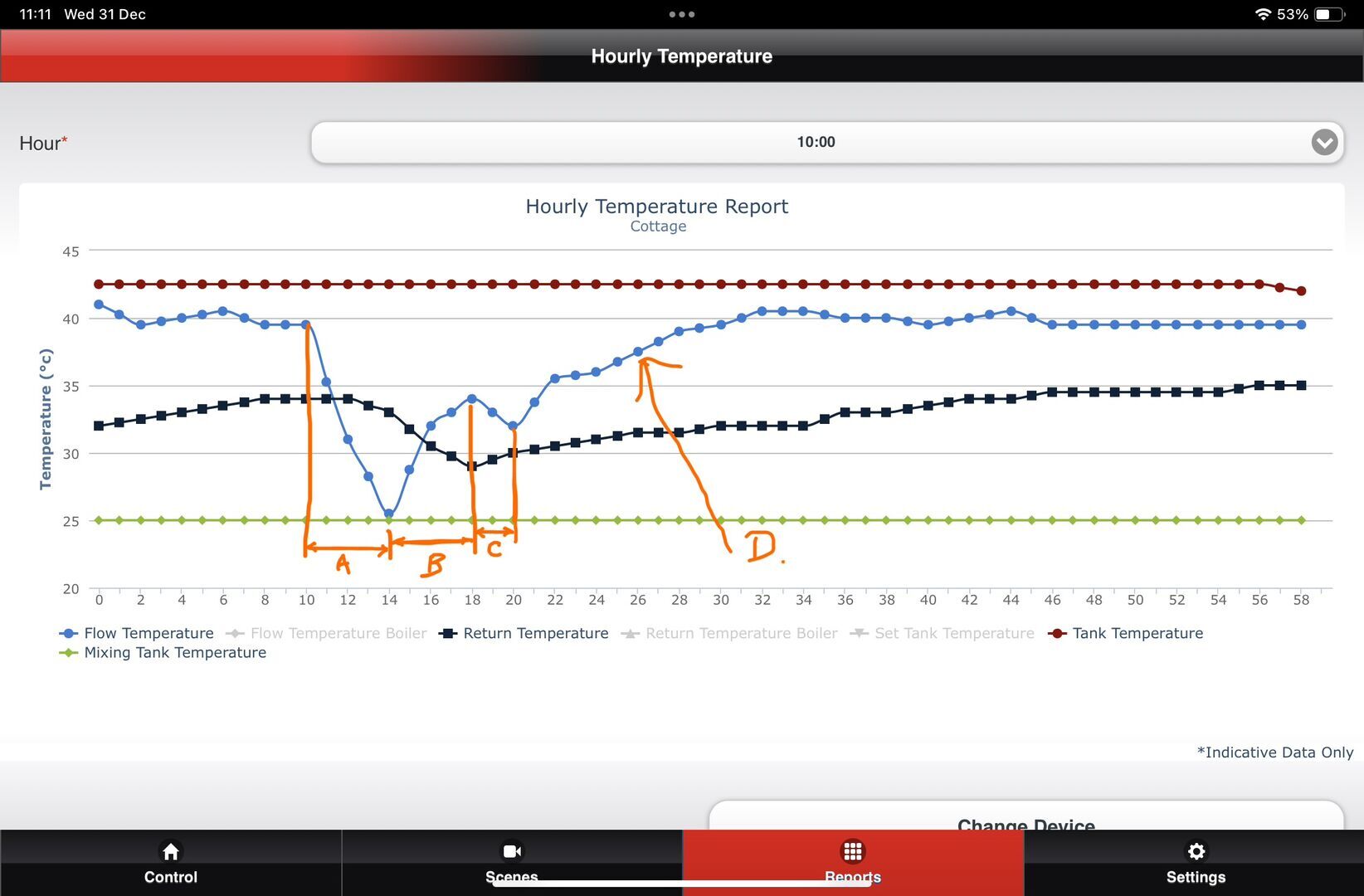
But I digress, you still haven't said what the units are! Given what you have now said, in particular the use of an external "thermostat", I suspect the are hours. If they are minutes, then that "thermostat" is giving your heat pump a right royal work out.
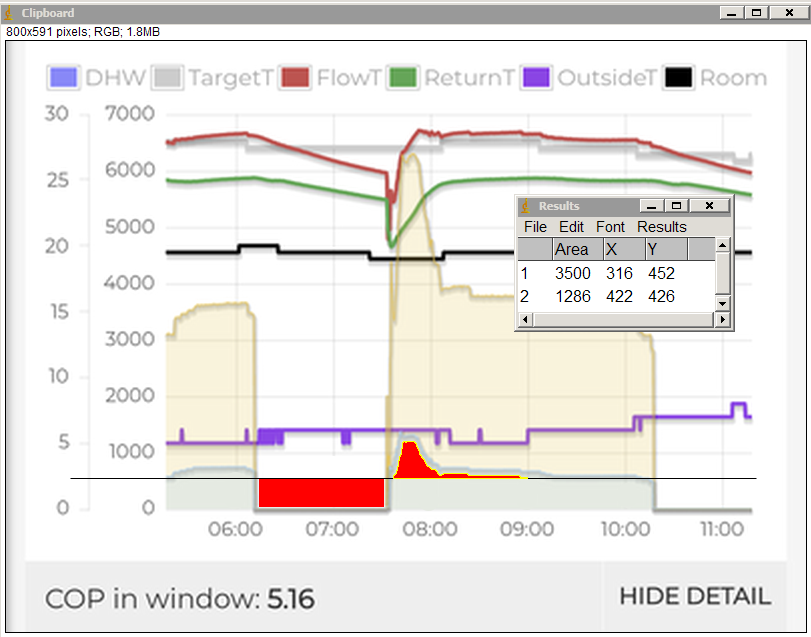
Any comments on the AUC chart I posted, given that it appears to show that on/off running saves energy without lowering the IAT, which is effectively stable, and ends the period as it started it. Roughly quantified*, you appear to have saved 0.47 kWh between say 06:00 and 10:00. Such a suggestion is of course heresy in the heat pump world, but what if it was true?
The answer of course is it all depends on the baseline used. I used the period 09:00 to 10:00, when both the OAT and IAT were stable, as the baseline. But what if in steady state running it might have needed a bit less energy in? I don't have to change the baseline very much to reverse the result, such that the setback and recovery uses more energy than steady state running:
Which brings us, or at me, back to where I began: we have the observed values with the setback for sure, but what is the expected value, had we not had the setback?
* the saved rectangle represents 0.5kW x 1.5h = 0.75 kWh. The area is 3500 pixels, which gives us 1 kWh = 4667 pixels, which means the extra energy used during the recovery was 1286/4667 = 0.28 kWh, giving a net saving of 0.47 kWh for the 06:00 to 10:00 period compared to running without the off period.
this chart you posted conveniently shows the rapid ramp up which takes place after each defrost. Reason possibly being the system doesn’t know yet when the next defrost is going to be needed.
The "rapid ramp up" is just the heat pump resuming normal operation to return the flow to the set temperature, the input power ramps up to 1-1.5kW much like any other restart.
Are you sure About that, @robs because that’s what I was saying earlier. Here is a post I made
Here are the areas for the 'non-defrost' cycle shown above, area 1 is energy saved during off, area 2 is extra energy used during recovery, given a baseline as shown, based on the steady state OAT (6°C) and energy in between 09:00 and 10:00:
I am probably just being thick again, but it seems to me 1286 is a considerably smaller number than 3500. Overall, that 'non-defrost' setback appears to have used considerably less energy than would have been used if the setback had not happened.
If it helps any here's this period with recorded numbers:
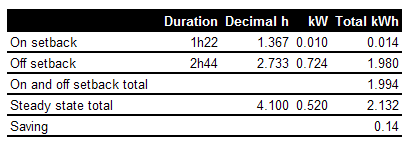
The off period is 1h22m and the on period is 2h44m, the system's steady state input at 6C is usually 0.52kW. So the off period saved 0.71kWh of electricity. The on period used 1.98kWh of electricity, 0.56kWh more than steady state.
Thus a saving of 0.15kWh... but the 0.52kW is steady state is at 21C IAT while this period (and calculations) are during a period that the room stat is limiting IAT to 19.5C. I'd expect that to achieve an IAT of only 19.5C at 6C OAT the system would require less that 0.52kW (when continously running), so the saving calculated above would therefore be lower.
@robs — I get effectively the same answer, with a slightly different approach/layout:
I reverse engineered your 1.98 kWh to get the mean rate for the off setback period. How did you determine the 1.98kWh figure, as it is the major contributor to the off/on period energy use?
Likewise, how do you establish that the normal steady state input at 6°C OAT to get 21°C IAT is 0.52kW?
I do agree that the period in question is not typical, as the IAT is lower than 21°C. This is the constant bugbear with these assessments, something that matters has changed. Nonetheless, I also agree a lower IAT implies lower energy use, so the saving may well be wiped out, or even reversed.
However, having said that, an IAT drop of 1.5°C isn't trivial in how it might affect energy use. To do this properly we need either to know your steady state energy use at 19.5°C IAT, or look as a setback period when the IAT was 21°C.
As I said before, this is effectively an observed vs expected approach, and the expected value is at the end of the day a whatiffery* number (what it the system had run in steady state, rather than with a setback?). This is one of the reasons why I have moved towards direct observations, with no whattiffery within a square mile.
I'm still curious to know why you use an external "thermostat" to limit the IAT, when it appears it may not save costs, and may even increase them, and it may also reduce comfort, less stable IAT. Why not, as I said before, just lower the weather compensation curve a bit?
* Whatiffery is a general term for running up a spreadsheet and doing 'what if' calculations, and similar activities, as we have done here. The 2.132 kWh for steady state total isn't a real observed number, it's a 'what if' number. It goes without saying that a 'what if' number is totally dependent on the assumptions that lie behind it, if they are wrong, it is wrong.
Midea 14kW (for now...) ASHP heating both building and DHW
Hi @robs. Your summary of defrost is missing and/or misplacing the full defrost ELECTRICAL energy, mainly because the real defrost period is a lot longer than the 11 minutes you have used as your reference. (I will explain later)
The analysis I previously posted was 90+ minutes long and not just 11 minutes. All of the electrical energy passing into the system goes through an electrical energy monitor and is recorded, this was used in my analysis.
Edit… in your last 2 replies you have not replied to any of my questions merely deflecting, which concerns me.
Your questions have for the most part been answered before or assertions. When you have asked a question not answered before, like what happens to the heated refrigerant when the defrost starts, I have answered your question (the energy is not lost).
However if an analysis is going to be representative of how heat pumps generally perform during defrosts then your particular installation is not typical. As stated before your installation is operating at .950 kWh at 3c AMBIENT. which means your recovery needs are smaller than typical defrost situations.
While the magnitudes will change the fundamentals won't, the laws of physics don't change at different temperatures and energy levels (within the parameters experienced by heat pumps anyway).
a better indication of how heat pumps perform during defrosts would be any one of the other installations and brand models you have posted earlier this month.
If you'd like to do a similar detailed analysis of one of these systems, using the public data on heatpumpmonitor.org, then do please post it.
The above heat pumps are all operating at -1c which is giving a higher energy demand generally 2kwh load which is more than double the energy demand of your data produced at +3c.
Your chart summary is only just about entering the defrost zone. The other reason for trialling at a lower temperature is there is a stronger frosting to recover from.
As I said above, the magnitudes may change but the fundamentals won't. The reason that my analysis uses the onset of defrosting is so there is a long(ish) period of no defrosts to establish an accurate baseline for power in and out at the OAT.
Do you have any data sheets on the minimum electrical operating conditions for your model of heat pump? My previous understanding is that there is a limited electrical operating requirement and your electrical energy graph suggests it is operating below that minimum. Perhaps you have a variant of the R290 which I may not have data on.
Yes it's an R290 and can modulate lower than the older R32 units. The latest (and previous) Mitsubishi data books (as Mitsubishi call them) have the R290 heat pumps, they're on Mitsubishi's website
The "rapid ramp up" is just the heat pump resuming normal operation to return the flow to the set temperature, the input power ramps up to 1-1.5kW much like any other restart.
Are you sure About that, @robs because that’s what I was saying earlier. Here is a post I made
I've posted charts showing the input power ramping up to the same 1-1.5kW in both (defrost and non-defrost) cases. Your image doesn't show input power, but then MelCloud doesn't monitor it.
I'm still not sure what the "thermostat" is, the use of quotes suggests that it is a thermostat but not a thermostat. Nor am I sure why you have chosen to set up weather compensation, only to override it with a on/off device that causes cycling. Isn't the answer to just lower the weather compensation curve to get the IAT you want?
It's not a room stat per se but acting as one at the moment and its use is just temporary.
I am not persuaded the 'COP in window' concept is particularly useful, given it is a moving window of adjustable size, which means you can change the COP merely by changing the window's position and size. Better to have fixed windows, say an hour, a day or a season, whatever makes sense for whatever it is that you are looking at. We might for example use daily COPs to say that when the mean daily OAT is X degrees, then my COP will be Y. Instantaneous COPs have the same problem as variable windows, it depends on which instant you choose to look at.
How is it different to changing from hour to day to month? The time period changes so the mean COP changes.
But as COP is the ratio of two powers and power is instantaneous, COP is also instantaneous. Calculating the mean over various time periods is certainly useful, as is a mean temperature over a time period, but the underlying value is instantaneous.
But I digress, you still haven't said what the units are! Given what you have now said, in particular the use of an external "thermostat", I suspect the are hours.
Given the number of charts I've posted and that they all have times on the X axis in the same format, and nine of them are of 11 minute periods... the times are hours and minutes.
@robs — I get effectively the same answer, with a slightly different approach/layout:
I reverse engineered your 1.98 kWh to get the mean rate for the off setback period. How did you determine the 1.98kWh figure, as it is the major contributor to the off/on period energy use?
Nicely done. The 1.98kWh was simply recorded by the monitoring for that time period.
I do agree that the period in question is not typical, as the IAT is lower than 21°C. This is the constant bugbear with these assessments, something that matters has changed. Nonetheless, I also agree a lower IAT implies lower energy use, so the saving may well be wiped out, or even reversed.
Agreed, but there was never any intention to use this chart for anything other than to show @sunandair that the input power ramp up from a defrost isn't different to the ramp up from a non-defrost off period. That said, I agree with your thoughts about the lower IAT and the saving being wiped out or even reversed.
How is it different to changing from hour to day to month? The time period changes so the mean COP changes.
But as COP is the ratio of two powers and power is instantaneous, COP is also instantaneous. Calculating the mean over various time periods is certainly useful, as is a mean temperature over a time period, but the underlying value is instantaneous.
Agreed the interval used is arbitrary but I use regular intervals for consistency convenience and comprehension, with hours, days and seasons making the most sense for me. I could use 9.63 seconds, 129 minutes, 3.82 hours, 4.372 days, 3.33 weeks or one and a half seasons, but they are not intervals I am familiar with on a daily basis. Using a consistent interval makes it easier for me to assimilate results, see patterns and compare like with like.
The only irregular (in time) interval that does have utility that I can think of is the cycle.
The interval which is least useful to me is the instantaneous one. On one level, it is just another interval, it is just so short you can't measure the time, but time is in there, because it takes time to take the reading. Or perhaps it is the interval where t = 0 (we'll be on to Heisenberg before we know it). The problem with an instantaneous reading is that it tells you nothing about anything except that instant. Given that COP is volatile, the fact it is 2 now tells me nothing about what it was over the last hour.
Given the number of charts I've posted and that they all have times on the X axis in the same format, and nine of them are of 11 minute periods... the times are hours and minutes.
Again, I know it is time, what is missing on the charts is the units. I should not need to go back and refer to countless charts to somehow infer what the units are. 10:30 is ambiguous: it could be 10 hours 30 minutes in the morning (or evening for that matter) or it could be 10 minutes 30 seconds into an unspecified hour. Just label the frigging thing! Or perhaps use the 00:00:00 format, though I would still prefer to see the units specified. I also usually add the date, given that heating use varies with the seasons.
The 1.98kWh was simply recorded by the monitoring for that time period.
A lot can happen between the s and the y of simply. I'll take it that you have an easy way of determining the mean power between two arbitrary points in time. I also note, in keeping with what I have said above, that this is an interval value, not an instantaneous one. It is intervals that we are most interested in.
I used a period when nature was kind and gave us 5+ hours of 6C OAT and the input power was 520W +/- 3W the entire time.
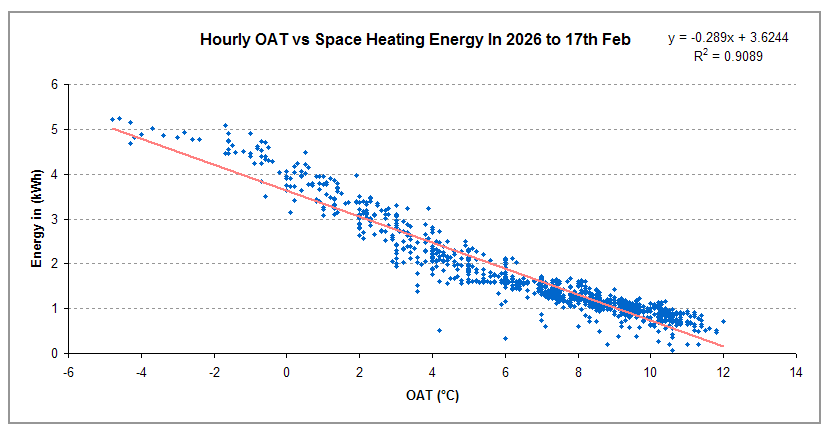
That is certainly one approach, and it is hard to argue that the power in use was 520W +/- 3W at 6°C OAT on Friday 13th, lucky for some on this occasion, when nature was kind. But does that mean it will be 520W +/- 3W at 6°C on Sunday 9th March? Nature can be fickle. I find the power use varies even for the same OAT. Given the relationship between OAT and (power and) energy in is tolerably linear (energy out isn't because it is affected by changing efficiency), I prefer to plot one against the other and then use the equation to calculate the energy use (energy rather than power because that again is what we are actually interested in). Here's my OAT ve Energy in for 2026 to date:
This plot is less linear than usual, not sure why. Perhaps nature has been fickle. The outliers are mostly hours where the heat pump divided its time between space and DHW heating during the hour (chart is just space heating), disn't bother to remove them for this demo. Nonetheless, it is clear that for a given OAT there can be quite a spread of energy in values. A spot value could be quite misleading, eg the kWh values for an OAT of 6°C range (excluding outliers) from around 1 to just over 2kWh. However, the equation will in effect give us the mean value for any OAT. Thus for an OAT of 6°C my mean energy in value is 1.89kWh per hour. A lot more than yours, but I do have an old leaky building.
If you can do such a plot for your system, I think it would be useful, to see if the 520W +/- 3W at OAT 6°C is indeed representative, or an outlier.
Edit: this chart, and the remarks above that it should be tolerably linear, are not correct, see my later post at 19/02/2026 7:22 pm
The only irregular (in time) interval that does have utility that I can think of is the cycle.
Or part of a cycle like a defrost or ramp up. Being able to set an arbitrary interval gives the greatest flexibility and doesn't preclude the use of hour/day/week/month/year windows.
That is certainly one approach, and it is hard to argue that the power in use was 520W +/- 3W at 6°C OAT on Friday 13th, lucky for some on this occasion, when nature was kind. But does that mean it will be 520W +/- 3W at 6°C on Sunday 9th March? Nature can be fickle. I find the power use varies even for the same OAT.
If the OAT was steady at 6C for multiple hours on the 9th March (so the requirements on the refrigerant circuit was the same), the WC curve unchanged and the IAT steady at the same temperature (so the load was the same), then the inputs to the controller algorithm would be the same and so the output (compressor speed) would be the same, and along with it the input power required.
Nonetheless, it is clear that for a given OAT there can be quite a spread of energy in values. A spot value could be quite misleading, eg the kWh values for an OAT of 6°C range (excluding outliers) from around 1 to just over 2kWh. However, the equation will in effect give us the mean value for any OAT. Thus for an OAT of 6°C my mean energy in value is 1.89kWh per hour. A lot more than yours, but I do have an old leaky building.
While your graph will give a mean value, it is presumably the mean of various ramp ups, steady state and ramp downs when the OAT was 6C. So it unfortunately doesn't tell us what the steady state value is, due to the non-steady state values in the data. To calculate a baseline for the "what would happen if there was no defrost" question we need the steady state value, as without the defrost the heat pump would continue steady state running.
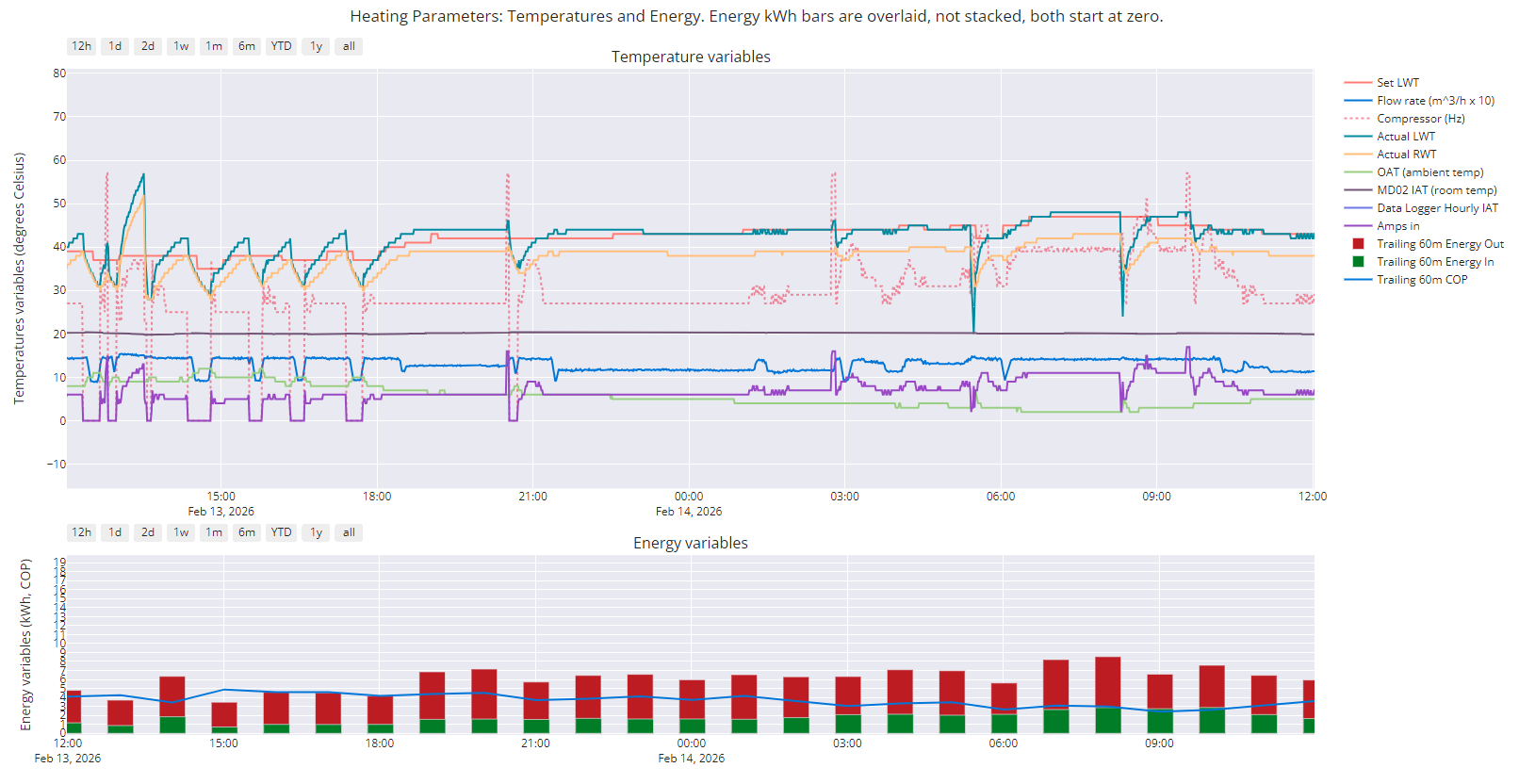
@robs — I am still not persuaded that you can take an observation at one OAT from one date, and then say because "the OAT was steady at 6C for multiple hours on the [the date] (so the requirements on the refrigerant circuit was the same), the WC curve unchanged and the IAT steady at the same temperature (so the load was the same), then the inputs to the controller algorithm would be the same and so the output (compressor speed) would be the same, and along with it the input power required" then when the same conditions apply at another time, the input power/energy will be the same. The reason for thinking this is that at OATs when my heat pump does normally run in steady state, which happens to include include 6°C OAT, the energy in varies considerably. Here is a (reposted) chart showing steady state running for several hours at 6° OAT:
On this occasion, the current is 6A (apart from the wobbles, I checked the original data). If I then convert that to power (x225V, the voltage reported at the time, and apply the 1.18 correction factor (to bring the Midea reported values in line with the independent kWh meter values) I get 1.593kW, or 1.593 kWh per hour (the same thing can be seen in the lower energy bar chart). But the OAT vs Energy In chart posted not far above shows that even at that steady state OAT of 6°C (when your equal conditions logic should apply), the actual energy in varies considerably. Checking the underlying 2026 data, and excluding the DHW heating hour outlier, the range is 1.165 to 2.117 kWh. I can't explain this variation, but it is definitely there in the data. Same OAT, same WCC, steady IAT, the energy in should be the same, yet it varies by getting on for a factor of two. I think you need to confirm that your data doesn't show the same variations, if you are going to apply a value from one time to a different time, by plotting OAT against energy in, and posting the result. I suspect, but won't know until you do the plot and post it, that you will also see similar variations, caused in effect by unknown unknowns. If you don't see such variations, then I will have to take a long hard look at my system and its monitoring!
More generally, and assuming you do also have variation even in the same conditions, we continue to have a problem over how to establish the steady state value for energy in to use as the expected value to be compared with the observed value from a defrost or deliberate setback. It may even be impossible, until we make sense of he unknown unknowns. My preferred solution, not to use predicted (expected) values at all, because of the problems of estimating them, and instead use only observed values with condition matching to compare like with like may also fall apart if in the real world like for like conditions (same OAT, same WCC, steady IAT) do not consistently produce the same energy in requirement, which increasingly seems likely to be the case, at least on my system.