In my opinion insulated walls are not a “nice to have” option, rather it is necessity.
Insulation of older housing stock must be seen as an absolute priority. It improves not just thermal efficiency for heat-pump use but it also transforms wall temperatures to directly eliminate condensation, mould growth and all the health hazards associated with it.
Absolutely agree with everything you've said, but there is also a massive risk of increasing condensation and mould issues if the internal wall insulation is incorrectly fitted, as has been discovered recently under the ECO4 scheme. As per my very limited understanding, issues can arise where the insulation is not fitted in an air tight manner, and damp air is free to find it's way between the insulation and the cold external wall, upon where moisture can condense and cause mould to grow.
We had damp and mould issues in our old stone cottage (solid stone walls, 300mm thick), and had 50mm PIR backed plasterboard fitted as part of an ECO4 upgrade. They also installed extra ventilation in the form of trickle window vents in each room, and improved extraction fans in bathrooms and kitchen. Luckily for us, we do not have mould issues now, but I think this may be more to do with the constantly warm temperature with a heat pump as opposed to the temperature swings with a conventional boiler. Humidity may have also improved due to better ventilation.
I don't know exactly why our house is OK and thousands of others have had issues, but I'd wager our PIR insulation is not airtight as I saw no attempt to seal joints when installing, plus there are loads of cutouts around exposed beams where air can potentially get in behind. Walls are now lovely and warm to the touch though.
Samsung 12kW gen6 ASHP with 50L volumiser and all new large radiators. 7.2kWp solar (south facing), Tesla PW3 (13.5kW)
Solar generation completely offsets ASHP usage annually. We no longer burn ~1600L of kerosene annually.
@old_scientist that’s quite an interesting story and I agree there are some serious issues when the insulation is installed incorrectly.
And possibly that is the key word. “Incorrect” installation.. just like heat pump installations knowledge of the nature of the products and materials is central to a successful installation.
But not to forget- there can be some walls which simply may be already suffering from penetrating damp which need remedial work before ever considering adding insulation to them.
But I do think this knowledge has only recently been evolving in the general building trades to realise how exacting the conditions of installing vapour barriers needs to be.
By understanding the risks associated with interstitial condensation and implementing appropriate design and construction techniques, it is possible to create walls that are durable and healthy for occupants. Minimising the risk of interstitial condensation requires a deep understanding of the role of the vapour barrier, small gap sealing and prevention. Gaps around cables, joists, pipes, sunken electric sockets or sunken light fitting intrusions, to name a few. This is about raising the importance of the insulation system and each component.
My previous comment stated I was commenting about design principles rather than offering guidelines. I could see there is a rabbit hole of issues about technique and bad installation.
Importantly-Good collaboration among the installation team architects, engineers and knowledgeable builders is essential to make sure the integrity of the installed insulation is maintained. But if the right skills aren’t there or there is no attention to detail problems will inevitably occur.
there is also a massive risk of increasing condensation and mould issues if the internal wall insulation is incorrectly fitted
Indeed. Traditional materials 'breathe' and if you suffocate them by adding insulation which may add thermal insulation but at the same time block the natural flow of moisture, or alter the way it flows, then you may well do more harm than good. There is a lot of research and guidance on this (predates ECO4 but ECO4 because of its scale highlighted the problem), and in some cases the guidance is do not fit insulation. For instance, Historic England has this to say:
"Adding insulation to a historic building may reduce heat loss, but thought and care are needed to make sure the works are technically sound and effective and do not unacceptably alter the building's character or appearance.
It will not always be reasonably practicable or desirable to add insulation. Ill-conceived work may cause long-term deterioration to the building fabric, impact the internal environment or harm the occupants' health and wellbeing."
Back in 2015, it had this to say:
"Traditional solid wall construction is probably the most difficult and in many cases the least cost effective building element to insulate. Whether applied externally or internally work of this nature will have a significant impact on the appearance of the building."
The problems are well known, and have been for some time. Rigidly mandating insulation for older buildings as 'a necessity' and 'an absolute priority' risks doing more harm than good, and doing that harm at great cost both in money, visual amenity and disruption. If I choose to live in a 250 year old listed building, with very attractive mellow sandstone solid walls, then I fully accept that comes at a small cost in increased heating bills. A few less meals out, a more affordable car, or a saving here and there can cover that increased cost. Or I can just accept a slightly lower room temperature, and wear an extra layer. These, rather than diktats, are the sensible and practical solutions.
Edit: had to remove the 2015 link as it broke the page layout. Use the Wayback Machine if you want to find the source
@sunandair — I see we have cross posted. I can see that in some circumstances, the right team of experts might be able to come up with a workable insulation solution that doesn't do more harm than good, but that approach will be very costly in all sorts of ways. The alternative is just to accept that old walls are old walls and that is the way it is. A bit like traditional wooden boat. They too leak (water). Those leaks can be fixed, but again at great cost, in all sorts of ways, and done badly by the owner/shipwright unaware of the risks, can lead to irreparable harm. Best just to accept that you will have to use the bilge pump a bit more often than on a modern glass fibre boat.
@cathoderay yes I agree, listed buildings may present challenges depending on what is a particular listed feature. Importantly, of course, it’s also the owners personal choice if it is preferred to retain architectural features.
But I guess the leaky boat analogy only works if you’re happy managing the bilge pump and you’re not going to ever sell it.
On the other hand, I somehow think leaky walls in a property might affect the property value if ever you needed to sell and move.
regarding the cost of experts approach… maybe It’s time to look at government grants to pay for the right skilled workmanship. Not just for Eco4 households.
if older building regulations are superseded and previous standards are now obsolete? Doesn’t our government controlled building regulations system need to pay for house insulation upgrades. Especially if we are all committed to electrification and low energy heating.
But regarding listed buildings it would be right that each property is taken on individual merit.
But I guess the leaky boat analogy only works if you’re happy managing the bilge pump and you’re not going to ever sell it.
On the other hand, I somehow think leaky walls in a property might affect the property value if ever you needed to sell and move.
...
I understand the point you're making, @sunandair, but not sure I agree. The leaky boat analogy works more closely than one might think.
Leaky walls will affect the property value in the case of selling, but so will the look of the walls, the provenence of them (if it's in any way historic), the integrity of them and so forth. It's rare any aspect of any property will be entirely positive or negative, and will therefore be a compromise. Ditto a boat, in that its leakiness, its charm, its structural integrity and its cost of maintenance will all be playing their part to the overall compromise a prospective owner might be looking at. And if there isn't a compromise then the cost of the boat (or house) will be higher to reflect that - another compromise.
As Keith Bontrager (one-time mountain biking pioneer and later well known mountain bike designer) said of mountain bike components:
Cheap, light, strong. Pick any two.
105 m2 bungalow in South East England
Mitsubishi Ecodan 8.5 kW air source heat pump
18 x 360W solar panels
1 x 6 kW GroWatt battery and SPH5000 inverter
1 x Myenergi Zappi
1 x VW ID3
Raised beds for home-grown veg and chickens for eggs
"Semper in excretia; sumus solum profundum variat"
Importantly, of course, it’s also the owners personal choice if it is preferred to retain architectural features.
Absolutely. I think most, but all, I know of exceptions as I am sure you do, listed building owners will want to protect the character of their building. It's just as much me as the local planning dept and Historic England who wants to protect the character of my particular listed building. I'm also in a national park, and that adds further constraints. Again, by and large, I welcome those constraints.
A dry bilge traditional wooden boat is a very rare thing! Some modern wooden construction methods are inherently drier, but traditionally planked boats (carvel, smooth and clinker, overlapped) rely on sealed seams to keep the water out and wood being wood it moves and the seams leak. Sometimes eg if they have been out of the water and have dried out too much they leak like a sieve until they have 'taken up', the process whereby the wood swells and closes the seams. Wooden boat owners generally expect their boats to leak, a bit of water in the bilge won't put a buyer off an otherwise sound boat. And owners just accept they have to pump the bilges from time to time. The general point I was trying to make is that if you have something that is a bit special, like a beautiful wooden boat (or a listed building), then you know certain inconveniences are going to come with owning whatever it is. Its a trade off.
Likewise, I think most potential buyers interested in buying a listed property know that it will come with some compromises. Any buyer who said to me I want X grand off because the walls aren't insulated would get very short shrift from me. If he wants well insulated walls, he needs to look elsewhere! Or do and pay for the work himself, once the property is his. It won't be an easy job, and it will cost a lot of money, and without truly expert design the chances of messing up the natural moisture flows in the wall still remain.
Having a listed building doesn't have to be a barrier to electrification, indeed I have electrified my heating. But it is still an old leaky building, whatever the heat source is, and it will always cost more to run, whatever the heat source, than a modern very well insulated build. But, as I say, that is a compromise I am willing to accept to live in an attractive old building. I'm very happy to do the sensible things, full thickness loft insulation and secondary glazing, which is OK because it can be removed, meaning it is not a permanent alteration to the character of the building, but again it illustrates the sort of things that you come up against in old buildings, most of my window frames are neither level (flat) nor square, and some fiddly work is needed to get the secondary glazing to fit. It certainly makes a difference, as much because it reduces drafts as it adds insulation per se.
Indeed, the often held belief that heat pumps are not suitable for old leaky buildings is I suspect the main reason why these old leaky buildings don't get heat pumps. Add in the 'fabric first' mantra and the owner says 'I don't think so', because they are not willing to contemplate the cost and disruption. If folks just loosened up a bit, and said, do you know what, the lovely old building that is my home is always going to be an old leaky building, so why don't I just fit a heat pump anyway? It will always cost more to heat, whatever the heat source, so why not fit a heat pump?
Midea 14kW (for now...) ASHP heating both building and DHW
Leaky walls will affect the property value in the case of selling, but so will the look of the walls, the provenence of them (if it's in any way historic), the integrity of them and so forth.
Hi @majordennisbloodnok, I don’t think I have a different view than yours here. Im very passionate about listed buildings. I’m just pointing out that property values can be severely impacted by badly insulated walls. And a house might be a family’s biggest investment, compared to a leaky old boat. Meanwhile a Property surveyor can decimate a house value if there is even a hint of structural flaws.
Perhaps I’m reading the analogy slightly differently.
@sunandair — boat owners often care very much about their boats, sometimes as much as they care about their homes, and in some cases the boat will be their home! As the Major, says, it is all about compromise. We simply accept that if we want one thing, an old characterful boat/house/whatever, then we will have to compromise on something else. Sure, a property surveyor can decimate (strictly speaking not the right word, but as you have used it...) a house value on paper, but that doesn't mean the buyer has to sell. As long as the asking price is reasonable in the round, then the house will sell at or near to its asking price, damning surveyor's report notwithstanding, because the property is worth it, taking in the other positive aspects. And that's not even mentioning the best response to a dire survey: if its that bad, how come it has managed to survive 250 years without falling over?
Midea 14kW (for now...) ASHP heating both building and DHW
You may well be right, @sunandair, and I certainly don't doubt your keenness to protect older buildings.
I suppose the clarification I was trying to highlight is that where you were appearing to say "a leaky wall will reduce the value of the building, which is a bad thing", I was trying to expand that into "the appeal of an old building will attract a certain value. The leakiness will detract from that value, but so will poorly implemented insulation and so keeping a building leaky and sound may well be the compromise that gets the better price". @cathoderay made a variation of the same point and I suspect you're in agreement too, meaning we're probably arguing about different ways to make the same point 😀.
As far as concerns the impact of heat loss characteristics on the price of old houses, I'm inclined to think it may be a bit more nuanced. To wander down another analogy, fuel efficiency is normally a key metric that car manufacturers want to maximise, so all other things being equal a gas guzzler will be worth less than a similar sized and performing car that has a good MPG. However, the appeal of owning a Rolls Royce, Bentley, Ferrari, Lamborghini etc. far outweighs any fuel efficiency conversations. At the same time, the target audience for those cars is a fraction of the motoring population. Similarly, if energy costs are foremost in a potential home-buyer's mind, the value to them of a quaint old 14th century cottage with a thatched roof is likely to be far less than the list price so they won't even go to a viewing. However, if another home-buyer can comfortably afford the heating costs, those costs won't really influence the house price at all and it'll be all about location, condition of the property and so forth. The difference between the value to one person vs the value to the market.
105 m2 bungalow in South East England
Mitsubishi Ecodan 8.5 kW air source heat pump
18 x 360W solar panels
1 x 6 kW GroWatt battery and SPH5000 inverter
1 x Myenergi Zappi
1 x VW ID3
Raised beds for home-grown veg and chickens for eggs
"Semper in excretia; sumus solum profundum variat"
It looks like there’s some good discussions on applying insulation which can’t be a bad thing @majordennisbloodnok and @cathoderay. Regarding out topic I can see @cathoderay s point that in some instances where architectural features are dearly loved or protected then it might not be practical or desireable to introduce insulation.
my original comment was more aimed at the general housing stock where building types are basically sound construction. Just for information there are around 360,000 grade 2 listed buildings across the UK which equates to about 1.5% of the overall housing stock. But I’m sure a lot of these may be able to introduce some insulation measures and that would require some form of compromise.
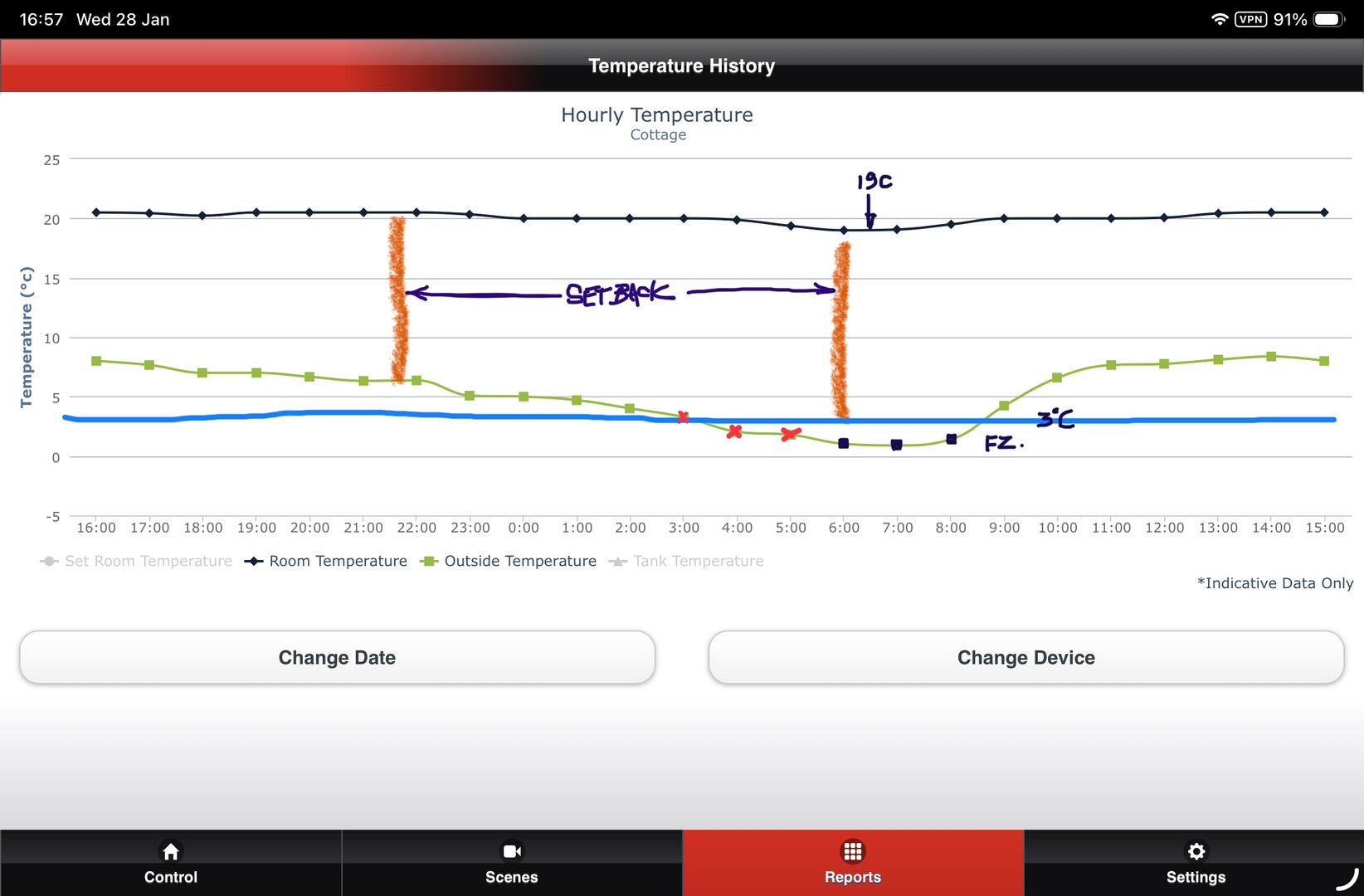
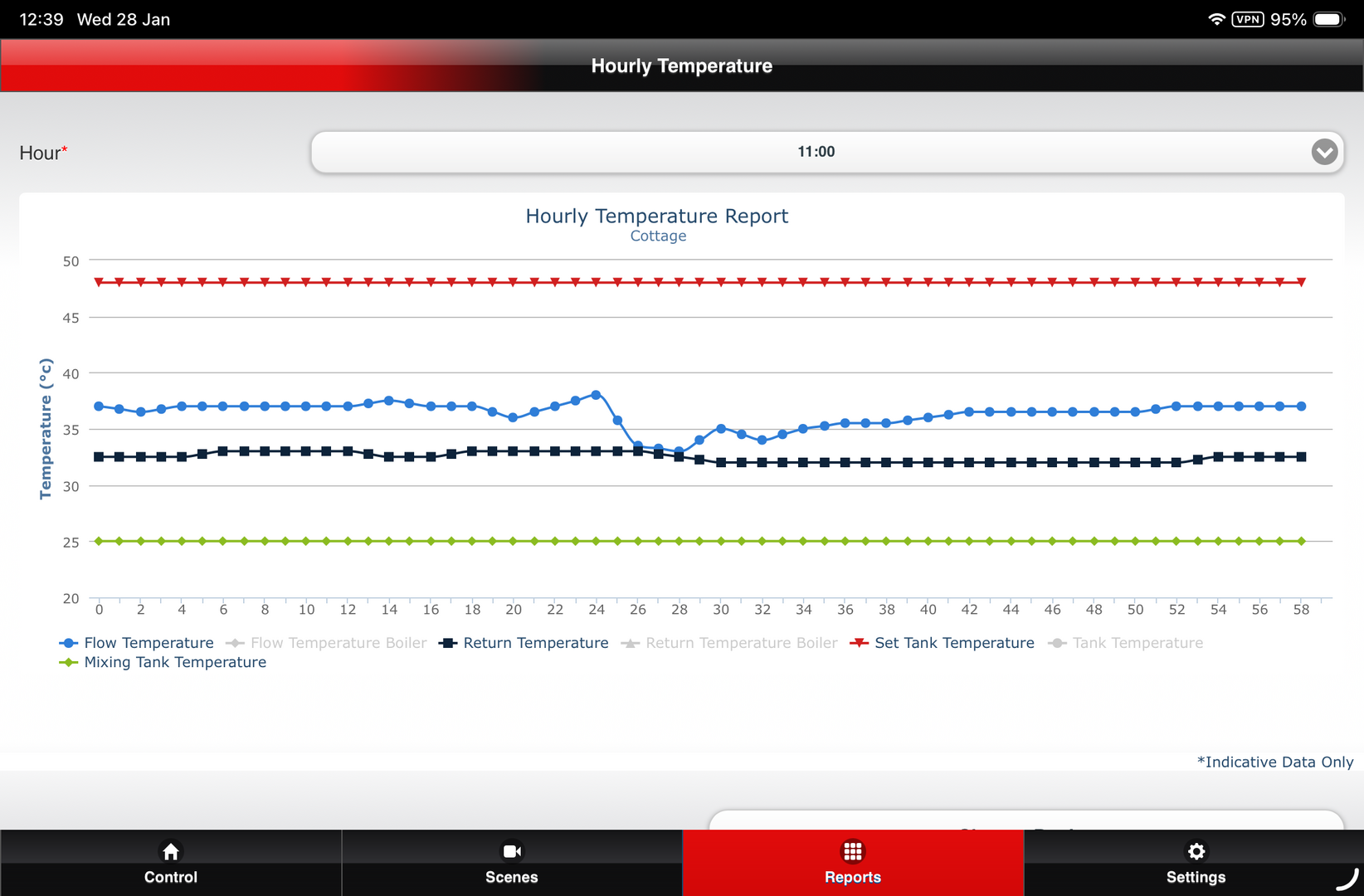
Moving back to the topic of setbacks and can they save energy. Here is a view of our HP operation last night… during a typical yo-yo outdoor ambient.
in the chart the outdoor temp drops until it hits the defrost zone where the start up of the heat pump coincides with the coldest part of the night. The Hp would appear to miss 3 defrosts because the room has only cooled by 1.5c so it only started to reheat after 6am. The room temp is up to target temp by 9.00am and it has 3 defrosts before the sun warmes the ground.
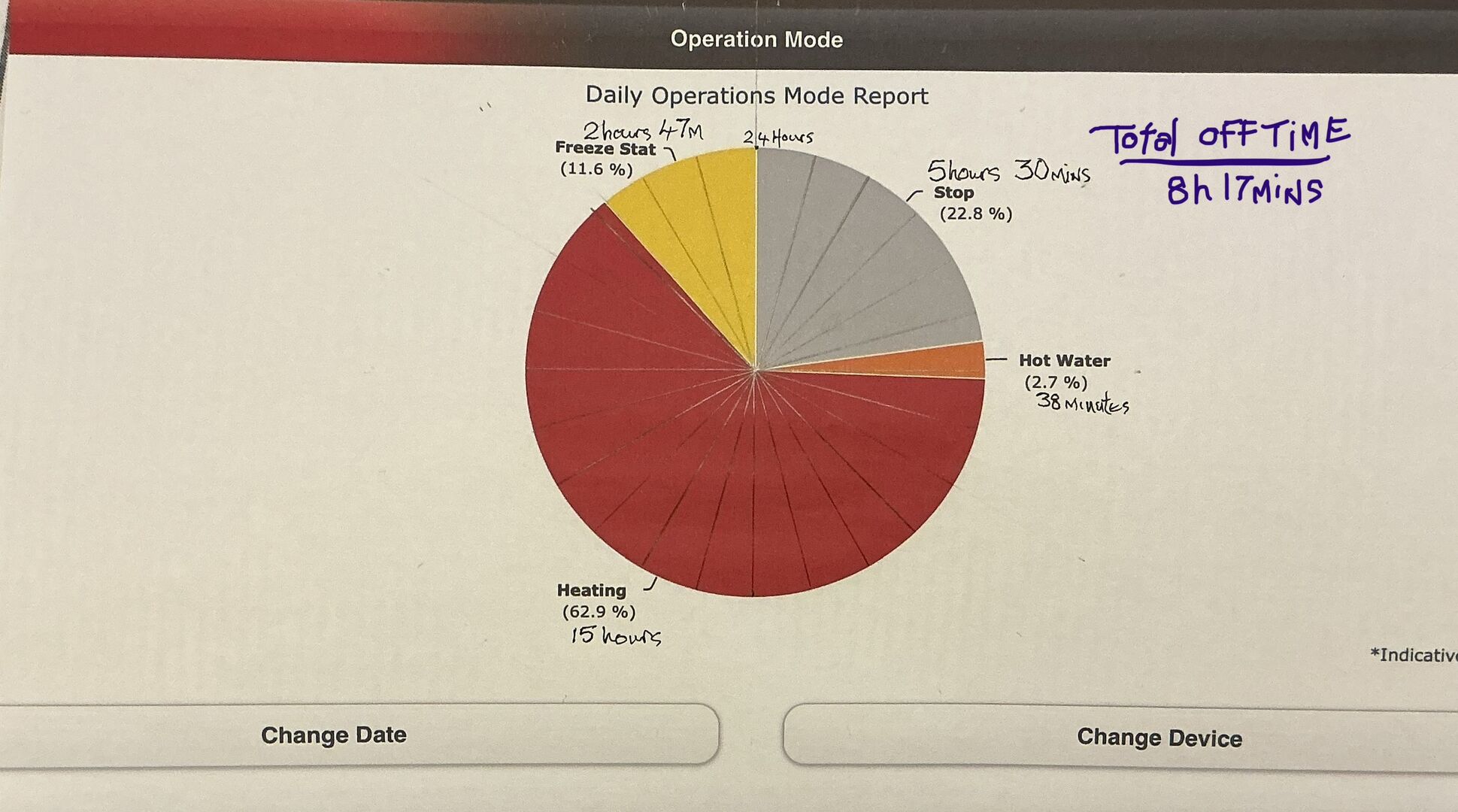
here is a pie chart of the 24 hour operation where the setback period is made up by an off period and a freeze stat period (the freeze stat period didn’t require a temp boost and it just circulated the the water system.
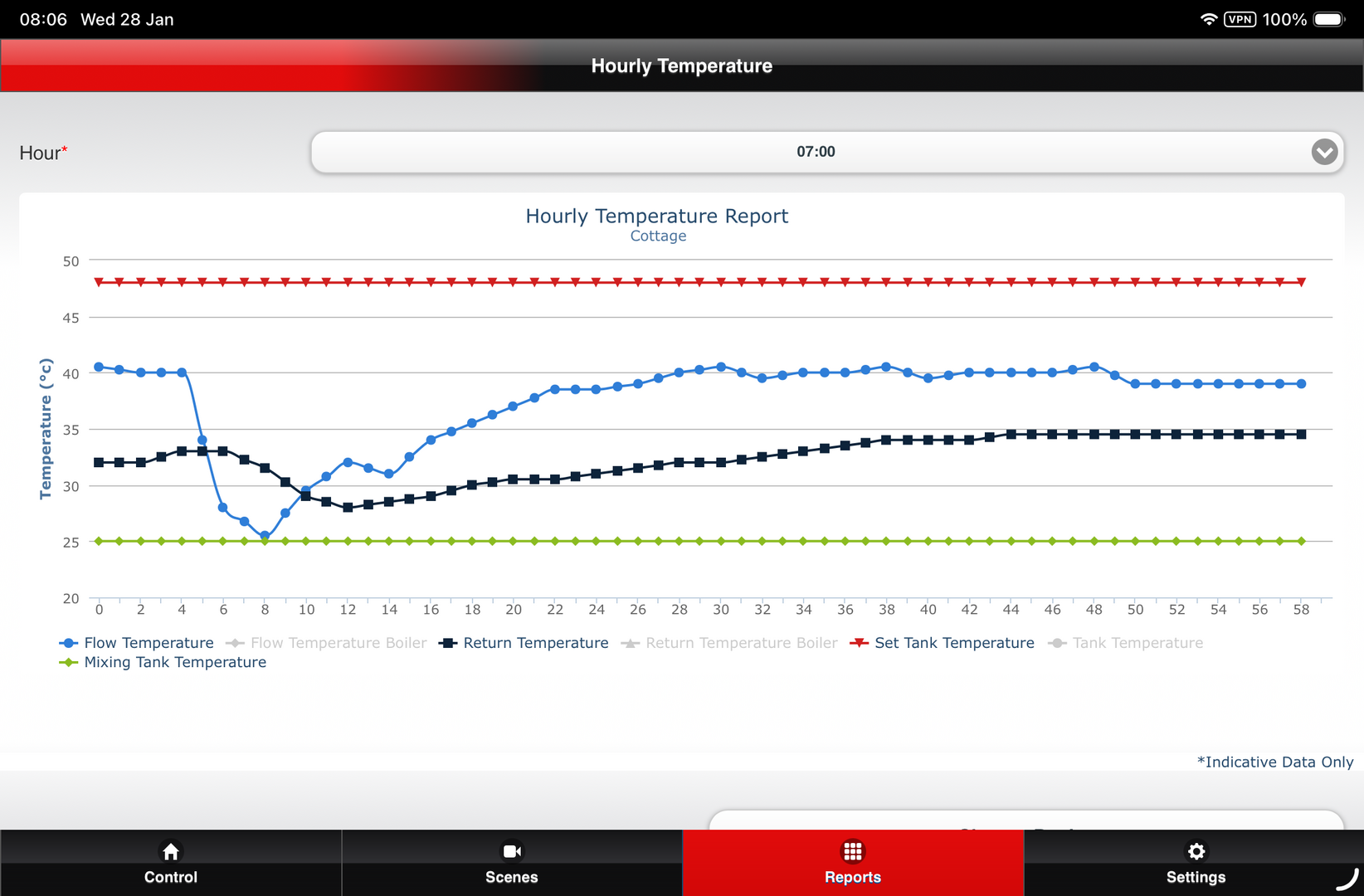
The defrost -when it happened at 7am provided a 15c drop in flow temp in 4 minutes and started a gentle reheat for the next 4 minutes. This was followed by a 2 minute pause in heating before the proper ramp up to its target flow temp of 40C. It’s easy to see the modulated steps in energy being applied.
Once the sun comes up in our garden we get gentle heat reflected off the house wall and so today, very quickly the air temperature changes from 1C to 6C. By 11AM the HP is modulating down and no longer defrosting.
So I decided to post these because it’s nothing remarkable it is just doing what a heat pump is supposed to do and not especially efficiently. But it does show over 8 hours of off-time and a recovery to a comfortable room temperature within 3 hours.
So in terms of the question do setbacks save energy… fact or fiction? this post might only use rudimentary MELCloud data to back it up but I believe the overall scheduling, and quite possibly the insulation helps make it highly likely.
So in terms of the question do setbacks save energy… fact or fiction? this post might only use rudimentary MELCloud data to back it up but I believe the overall scheduling, and quite possibly the insulation helps make it highly likely.
The problem is, unfortunately, none of your charts show energy use. You know that I am predisposed to the common sense idea that setbacks save energy/money (obvs innit) but I also accept the physics says it is not that simple. Then there are effects such as the finding that while defrosts impair efficiency, they may actually consume less energy than normal running (they are complicated, because on one level a defrost is a mini setback). What all this means is that we can't just use obvs innit arguments to say setbacks save energy, we have to show they save energy. Because of the complexity of analysing observation data (the need to compare like with like problem) I now believe the only way we can get a definitive answer is on a property by property basis (and it would be useful over time to have data from a variety of properties) where we compare 24 hour periods with very similar environmental conditions. Last spring (2025) I used setbacks, this spring I am not. I am hoping that despite Mother Nature's capacity for infinite variations, there will be enough matched pairs of 24 hour periods (one from last spring, one from this spring) with similar enough OAT profiles to mean that a direct comparison is valid.
I think this is worth doing (and it doesn't take up any of my time during the data collection phase because it all happens automatically) because my observed vs expected method does suggest savings but most importantly the method uses whatiffery (what if there wasn't a setback) and as many readers of this forum will know, I have a deep and profound distrust of whatiffery, a form of numerology know by some as modelling, when it is applied to complex natural events eg weather forecasting and epidemics and pandemics*. Put another way, I don't trust my own methods! Which means I want to test them against real world data.
* Note: I do of course accept that modelling can and does work is some situations, but these tend to be engineered events, like landing an aeroplane or even a space craft on the moon. Where it starts to fall down is when it attempts to use equations to describe complex natural events. The key word here is complex, which natural systems tend to be: too many independent variables known and unknown all jostling away to influence the eventual real world outcome. The Sisyphean nature of this task, accounting for all those variables, is partly why I think it is best to accept the modelling is just too complex, and look instead at the results (actual measured energy used) of sufficiently well controlled (by which I mean matched rather than directly controlled) observations studies.