@jamespa Most discussions over savings that may (or may not!) be possible using setback are usually based on the hard-nosed monetary gains or losses to be made. If like myself, being retired and home most of the time, some readers may be more concerned with comfort and whether any possible savings are worth sacrificing this. I realise that one person’s comfort may be another person’s ‘cool night and comfort’ but if 24/7 stable temperatures are required for comfort - I doubt the cost of this choice is likely to be that great. Regards, Toodles.
Hi @toodles…. Comfort is, of course an essential need of any heating schedule. We operate a setback which aims to give us 19.5C by 9am and 21 usually by 3pm . If we wanted a higher temperature than that we can easily have it come on earlier.
We don’t put savings ahead of comfort.
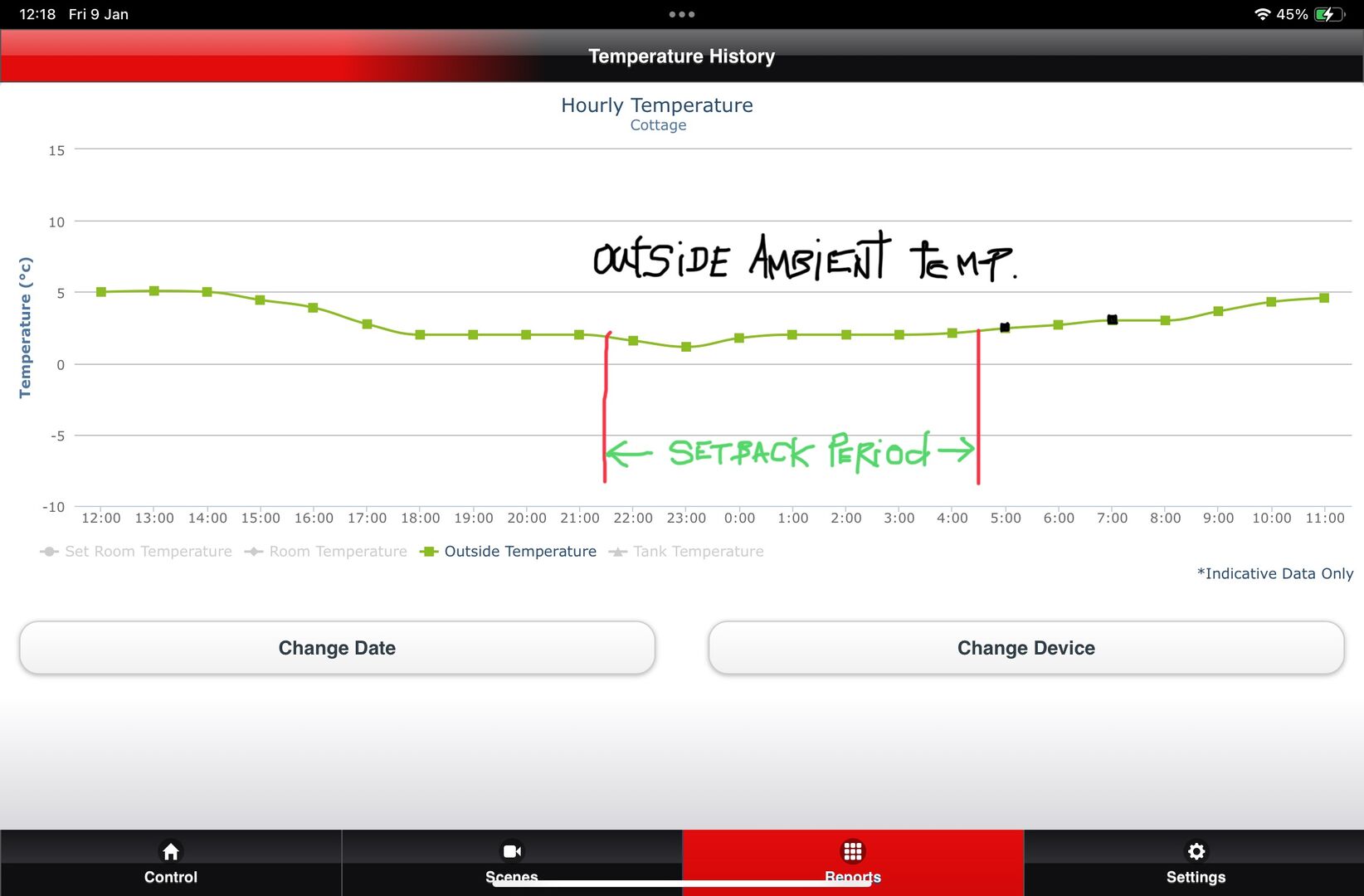
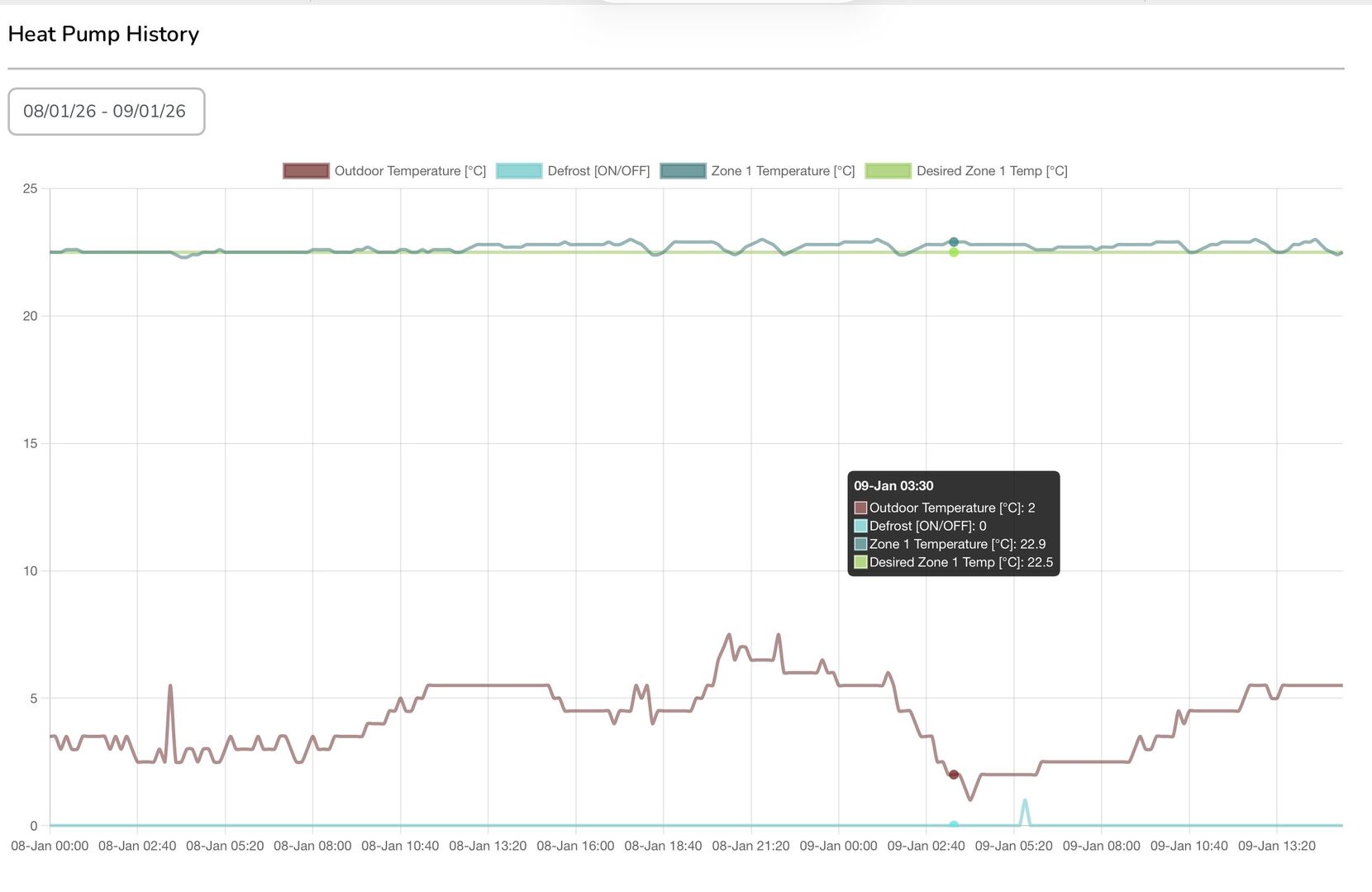
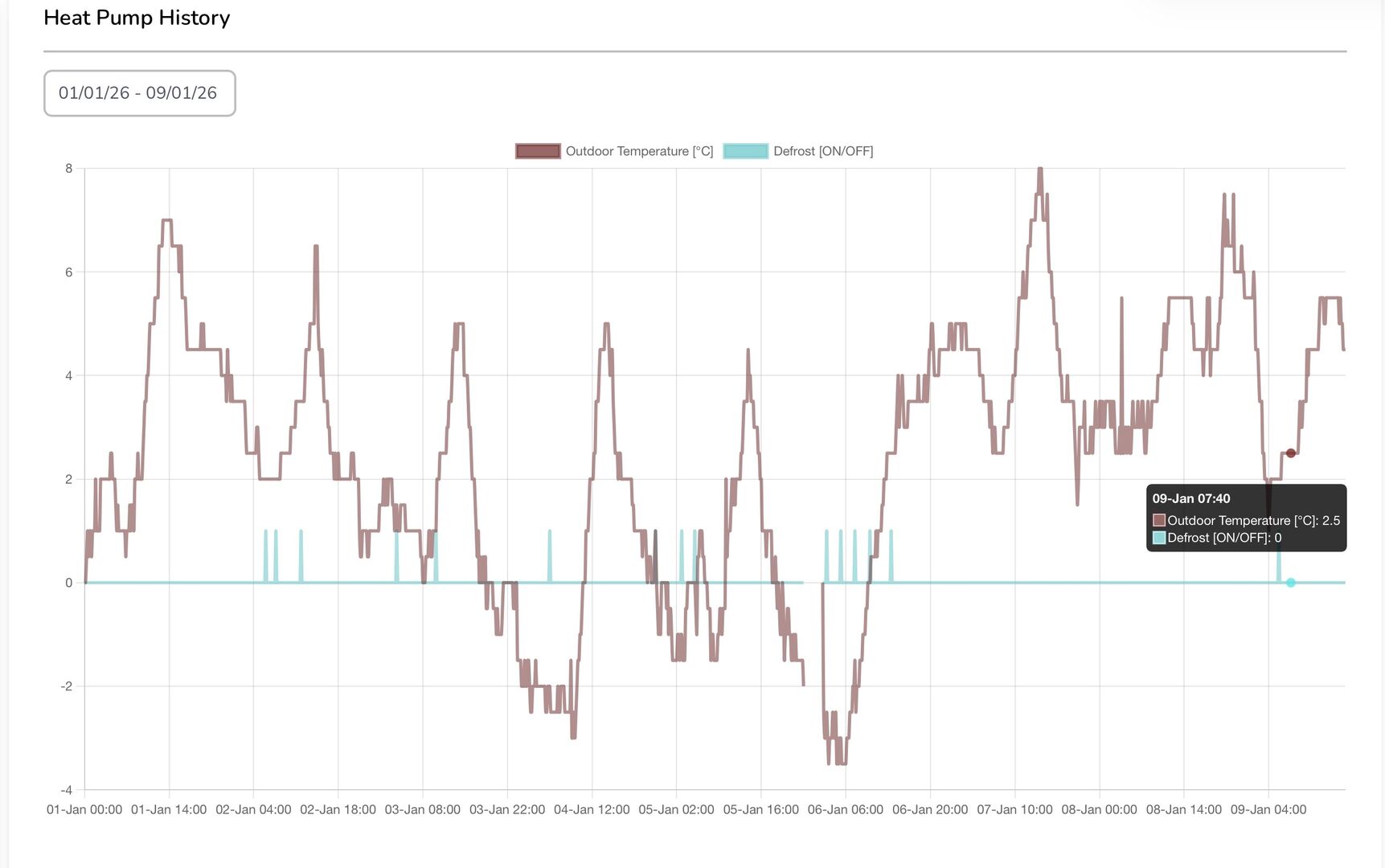
However there are significant costs associated with overnight use of heat pumps especially during the colder nights. Defrosts are widely quoted as using as much as 1.2 KWh to execute a full defrost. I have attached a graph of our outside air temperature last night which shows the entire setback period was within the defrost period. However, since we did not have the heat pump operating we prevented upwards of 6 or 7 defrosts… potentially saving 8.4 KWh of energy just on the defrost cycle.
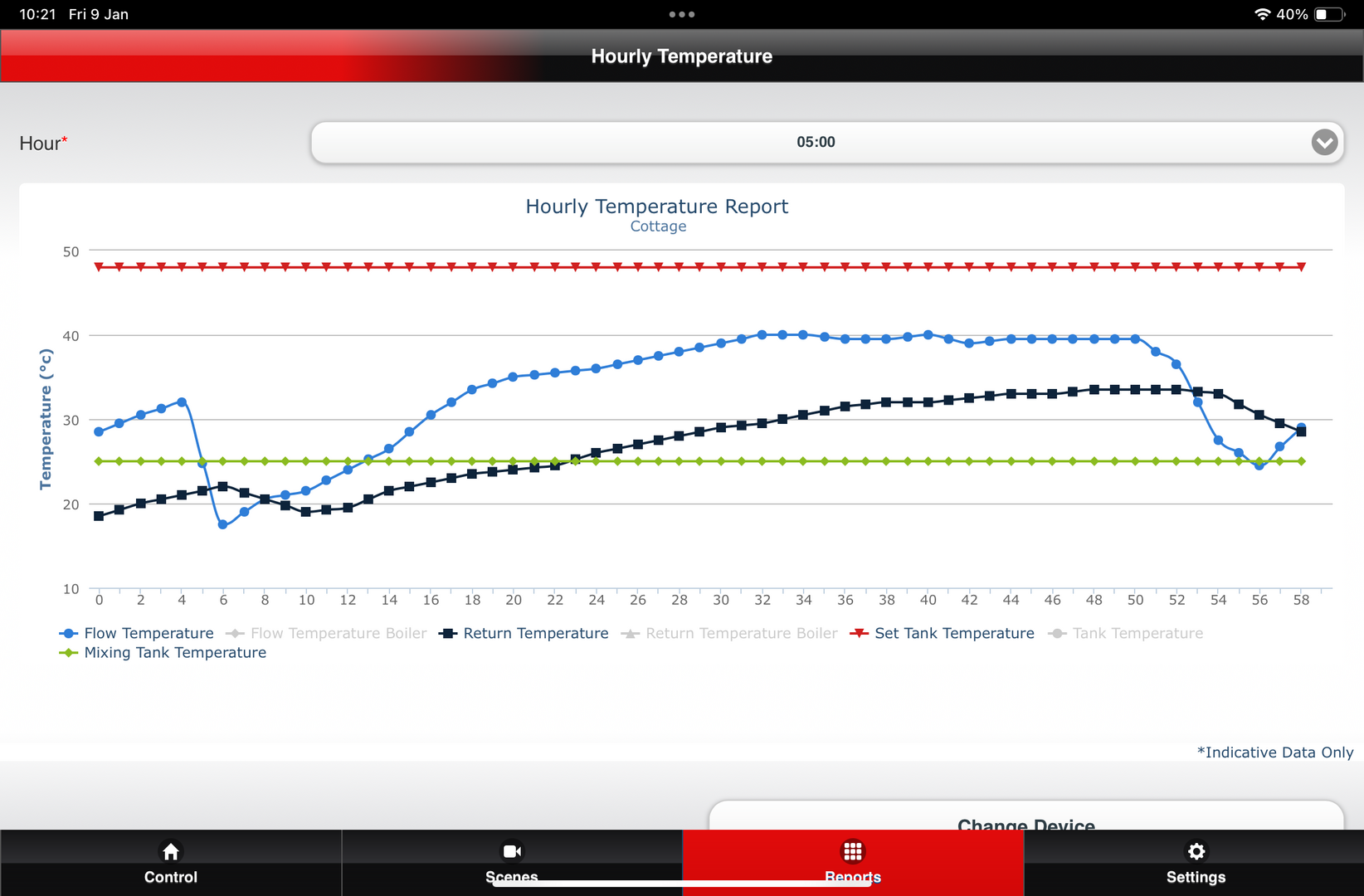
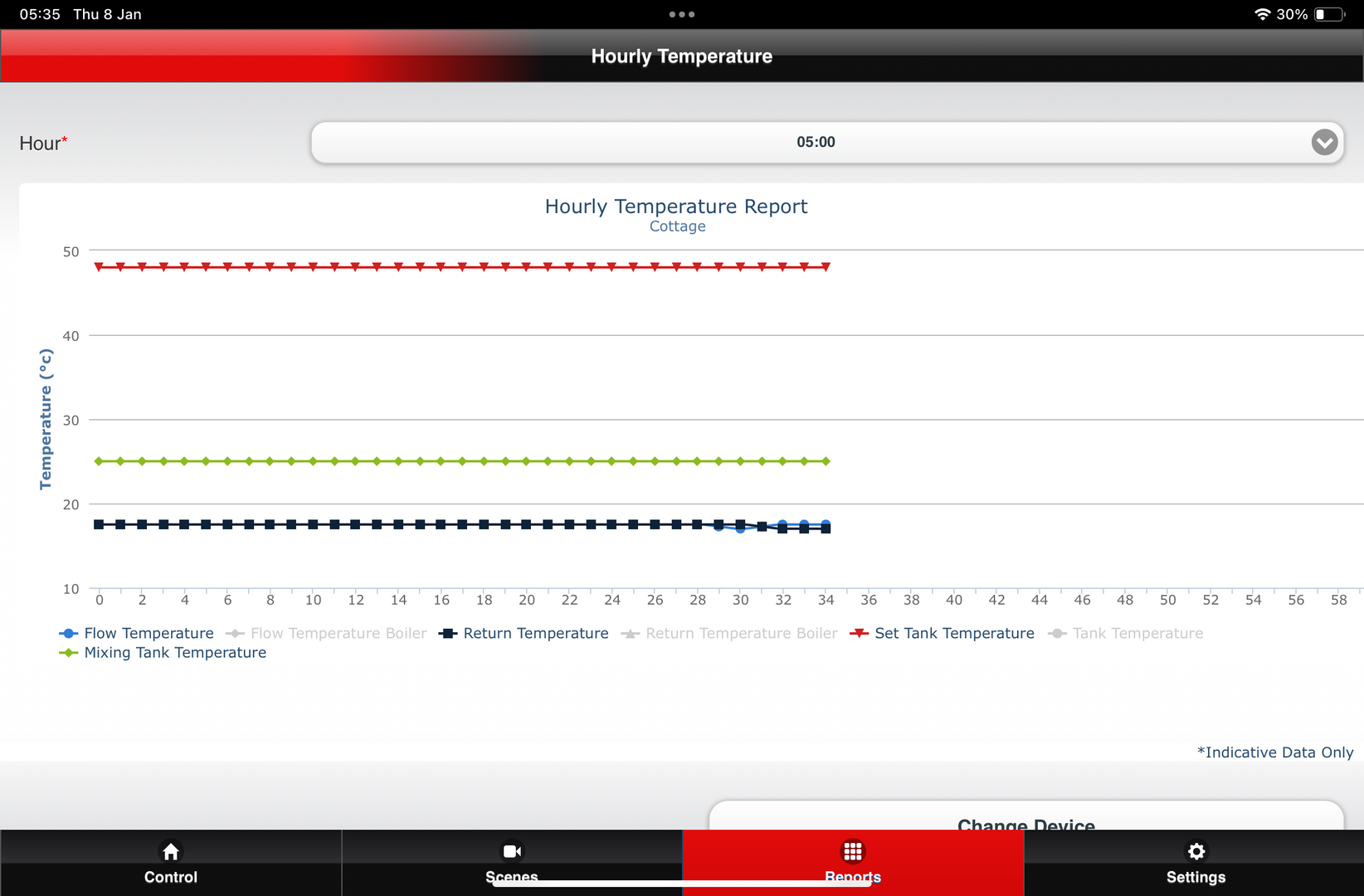
When our heating started at just before 5.00AM the temperatures were still in the grip of defrost cycles. See 5am flow graph showing 2 defrosts in one hour.
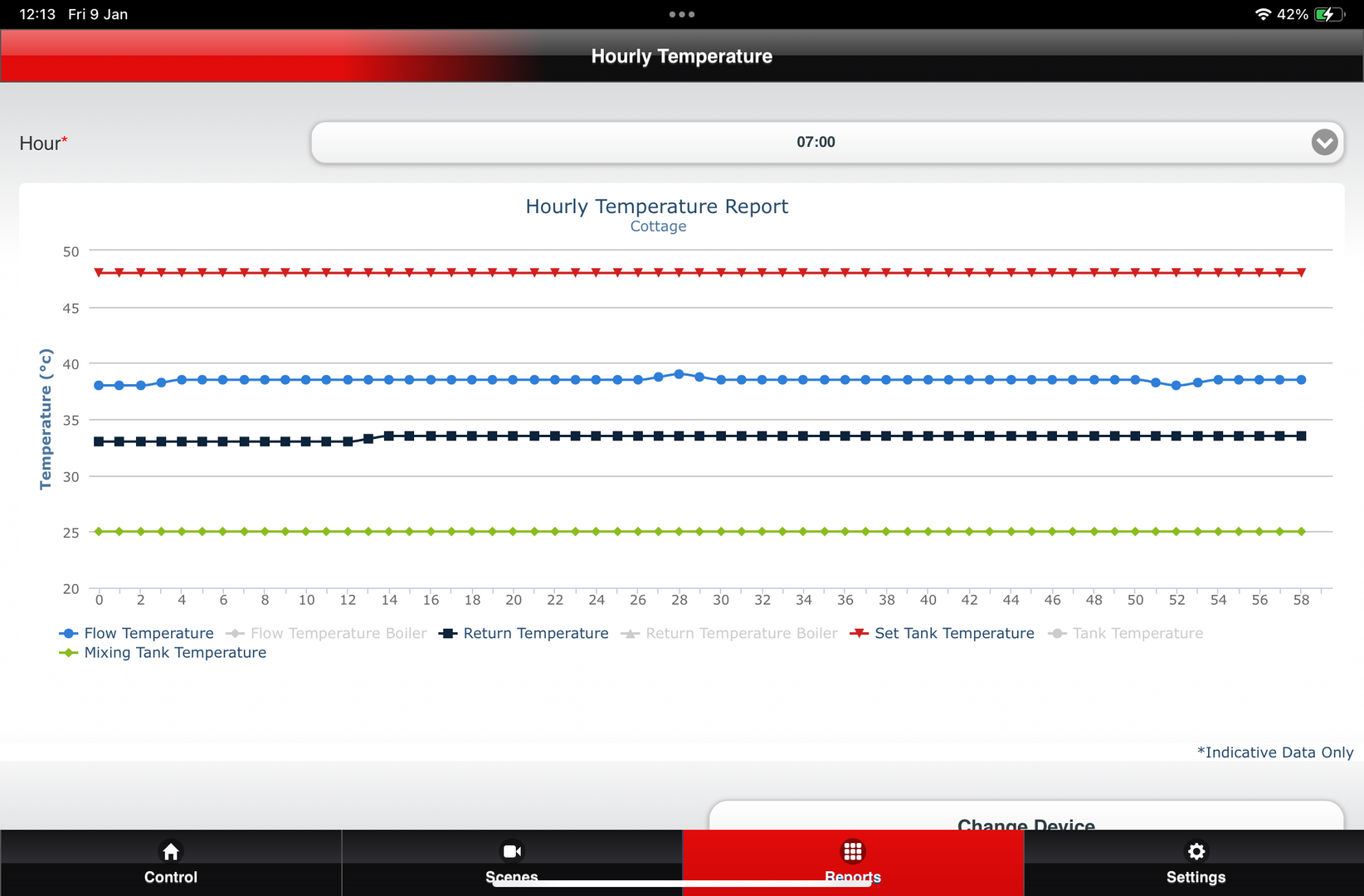
The energy required for recovery from a defrost is significant and is far greater than the energy used in steady state. This next graph shows the same heat pump at 7am when the defrosts have stopped.
So perhaps you might be able to see that setbacks can and do save energy if you imagine that they may be defrosting continually throughout some of the colder nights.
Having said that it is essential to ensure the chosen comfortable room temperature is attained by the time you are getting up in the morning.
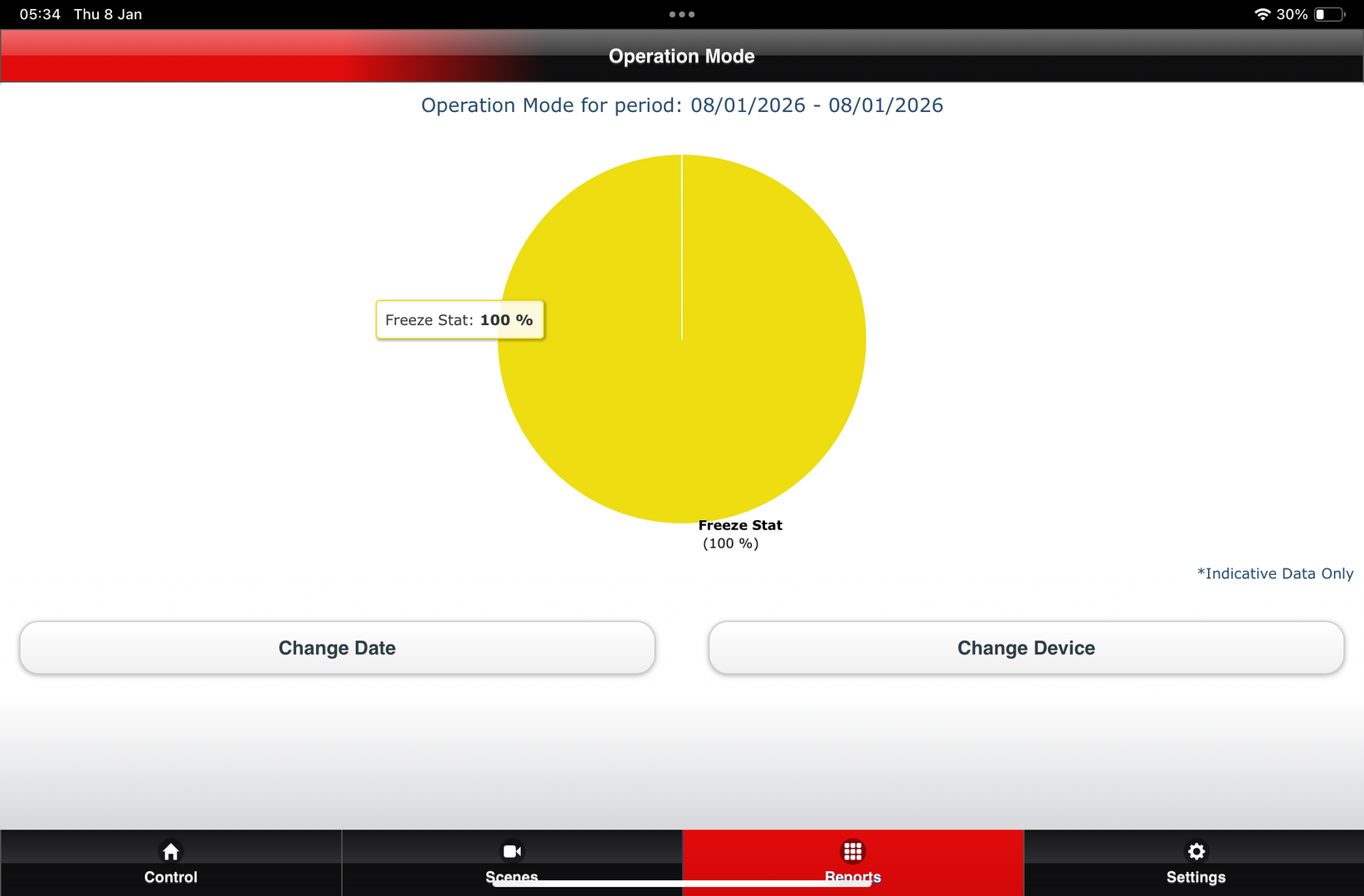
When we operate a setback we are reliant on the insulation in our house to ensure we only lose about 1.5C to 2C room temperature this also means the internal water temperature in our pipes rarely need to be reheated. The attached pie chart shows operation mode for 8th Jan’26 from 12 midnight until just before the hp comes on. Time stamped at 5.34am.
This shows the HP operated all night by just circulating the water in the heating system to ensure the pipes outside never froze. There was no energy used to reheat the water in the radiator system.
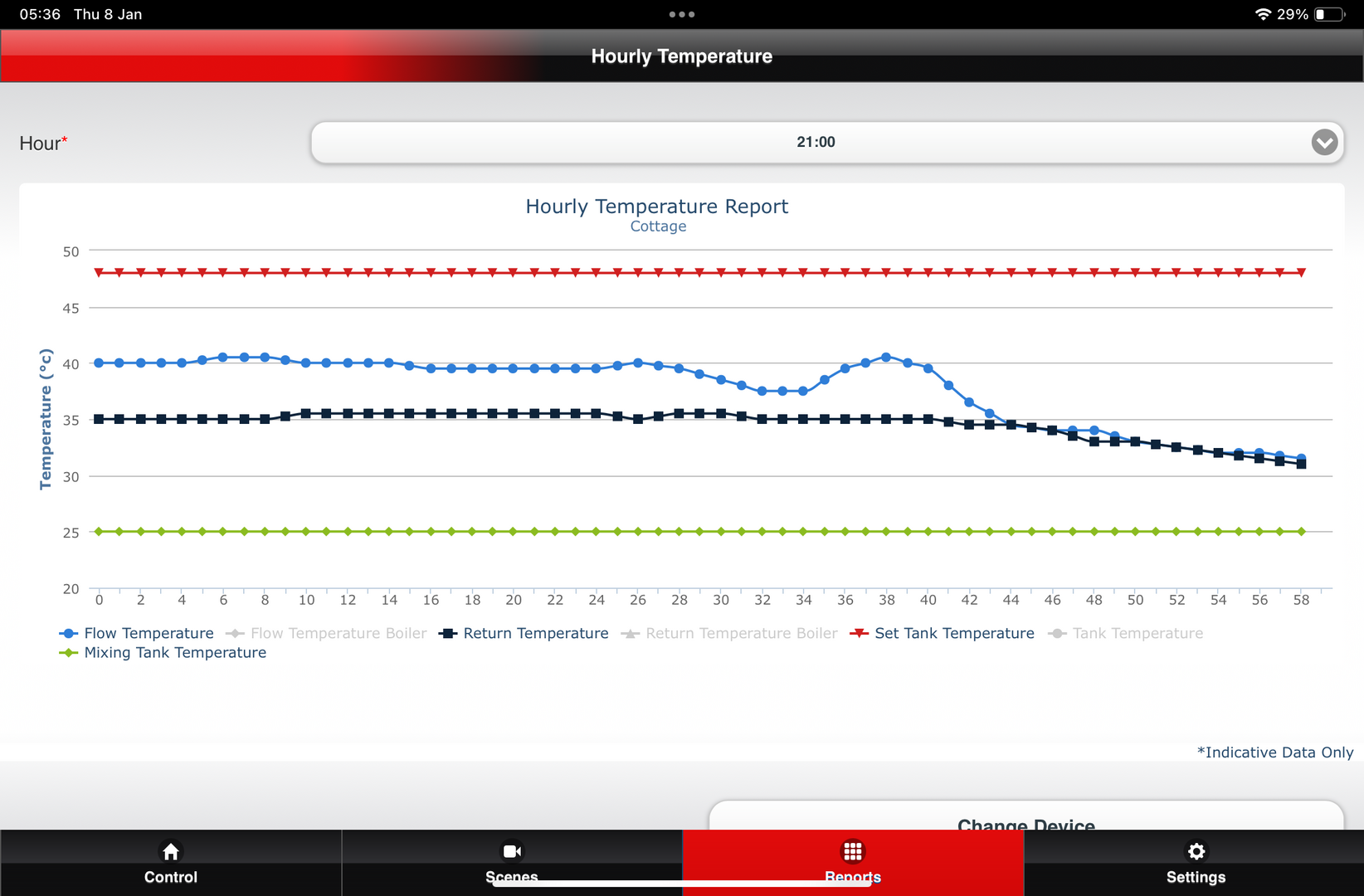
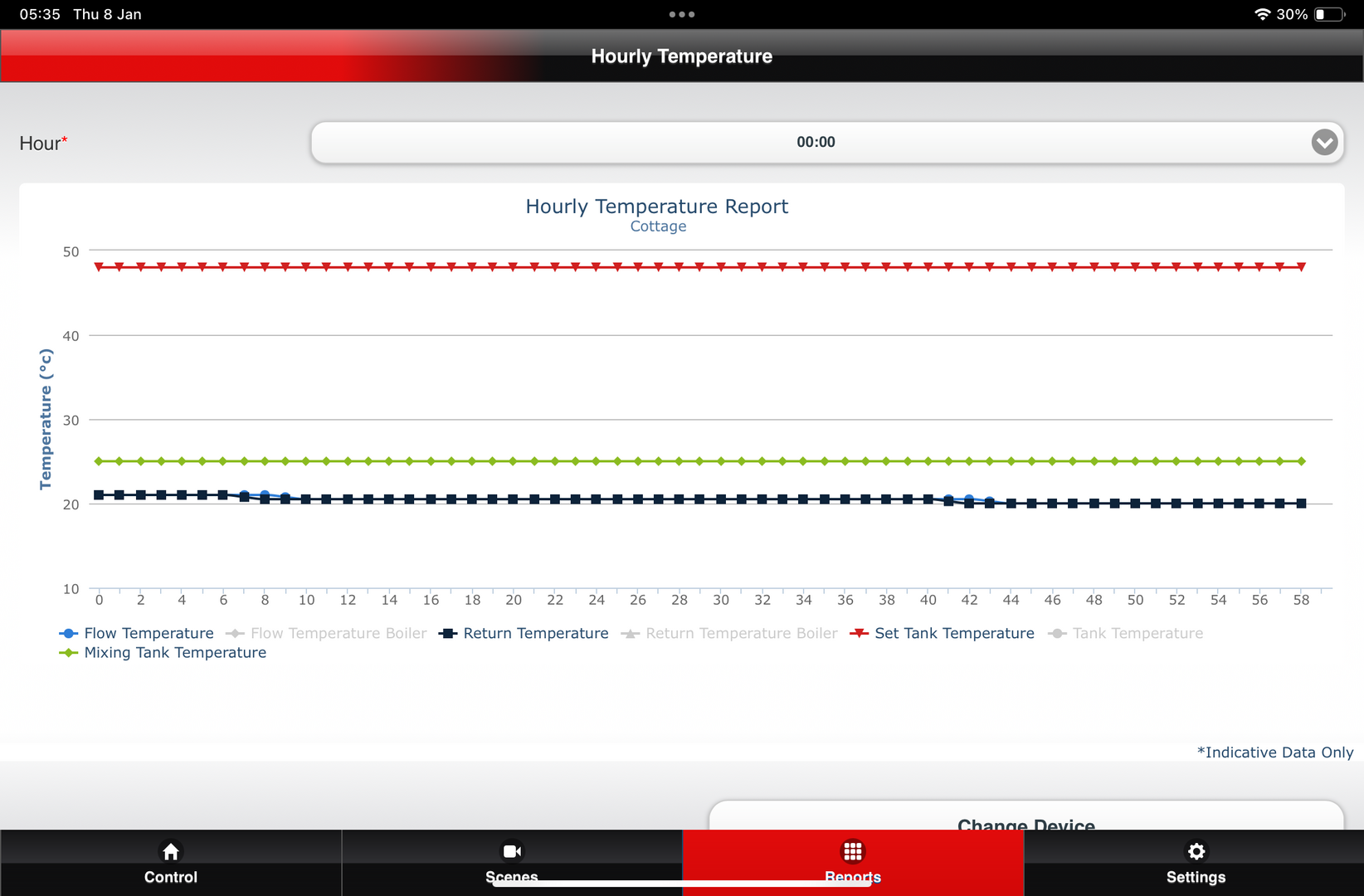
For the doubters in this forum here are a few charts showing the water temperature in the pipes at different times in the night.
9.45pm HP switches into standby
second graph shows 12.00 midnight the freeze stat has been circulating the water in the radiators and it has dropped to 21C.
The Freeze stat function continues to circulate the water without attempting to reheat the water. In this last chart the water can be seen to be approx 18C. It was created live at 5.35am.
Our circulation pump, operating at 30w per hour is the only activity from 9.30pm until 6am when the heating started to operate.
On this particular night it was milder than previous nights coasting at around 4C so if we had been operating the heating continuously through the night then we would not necessarily have been operating during the repeat defrost cycles. However the system would have been operating an extra 8.5 hours at an elevated flow temperature of approximately 38C.
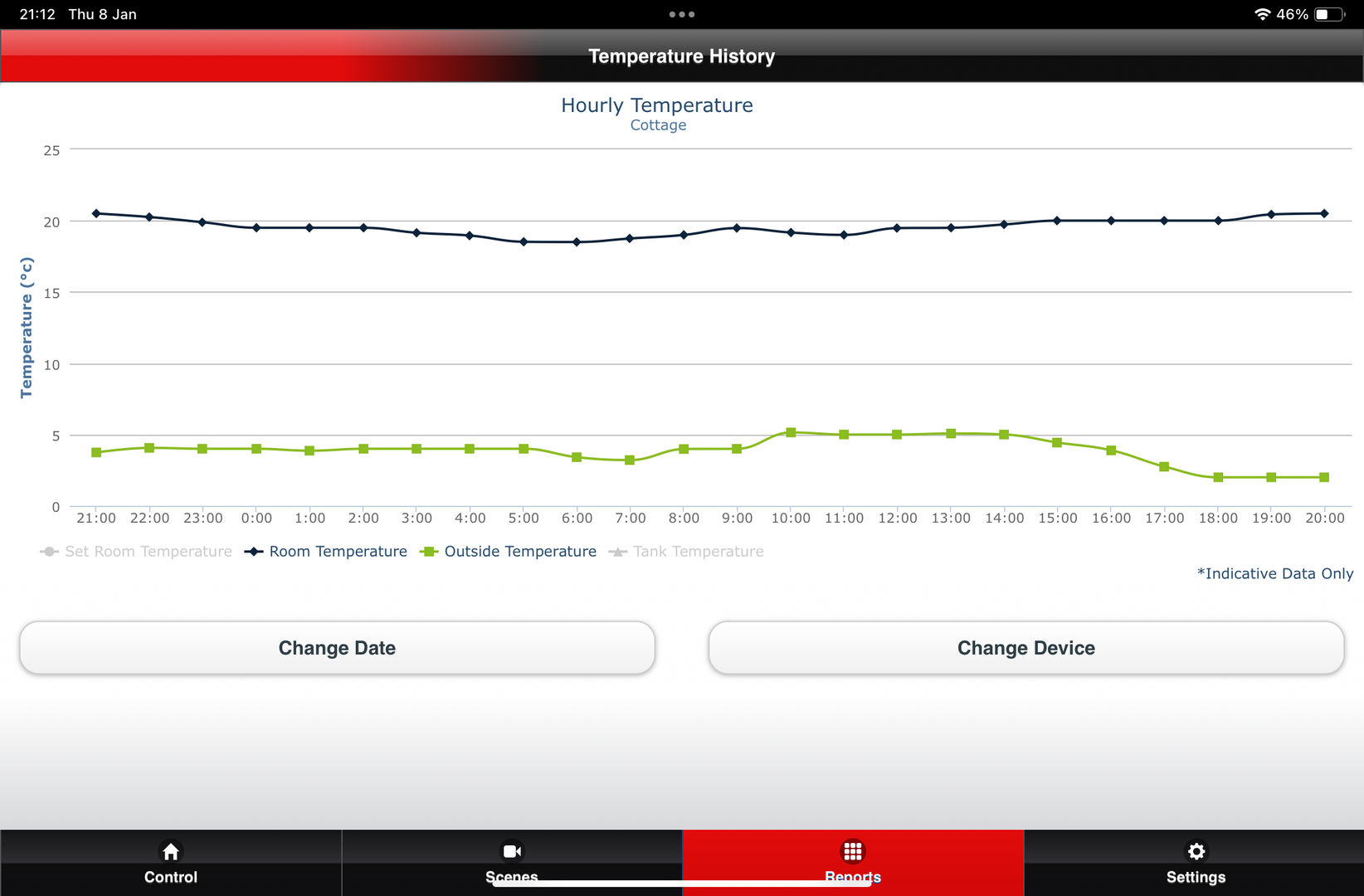
Recovery of the room temperature was as planned for 9.00am when the heating came on at 6.00am but we also note the overnight temperature drop was only down to 18.5C. Although we did put the DHW on at 9am which has caused a dup in the recovery. These things are sent to test us…
Our property has had the external brick walls all insulated On the internal face which means there is a low heat transfer to the fabric of the building and quicker recovery when compared to exposed high mass walls. Another benefit of internal insulation is that it reduces the risk of condensation and therefore the risk of mould and associated health risk.
@toodles yes it was a bit excessive getting 2 defrosts in one hour. I think it must have been the changing climate while it was still cold. We normally get away with 1 defrost every hour or a bit longer..
Your chart shows a very small number of defrosts,… that’s very impressive. Does your system report on how much energy was used during the defrost? That would be pretty useful.
So perhaps you might be able to see that setbacks can and do save energy if you imagine that they may be defrosting continually throughout some of the colder nights.
This is an interesting and very useful observation, albeit one limited to a relatively small range of temperatures (which we are experiencing a lot of just at the moment). If you can shift energy production from defrost periods to non-defrost periods it is very plausible that energy could indeed be saved.
However the system would have been operating an extra 8.5 hours at an elevated flow temperature of approximately 38C
... and delivering energy to the house almost all of which which would otherwise have to be delivered later*.
Now if the efficiency of delivering it later is greater (eg because it avoids defrost periods) then there is certainly a real saving, if however the efficiency of delivering it later is less (eg because the result of part time heating is that you have to increase the flow temperature - which in principal must be the case for a system that is well designed and properly set up - or because the HP is working harder it is operating in a less efficient part of the compressor curve) then any saving because the house was colder (and thus lost less energy) has to be offset against the extra cost of delivering it less efficiently.
That's the nub of the setback conundrum and why it may well be (to my guess almost certainly is) house-dependent and of course dependent on OAT/diurnal variation.
-----------------
* the amount that has otherwise to be delivered later is a little bit less because the house is cooler so loses a bit less energy. But as it doesn't cool very much this 'little bit' is pretty small!
PS The latent heat of fusion of water is about 330kJ/kg, so 1kWh (3,600kJ) would suffice to melt 10kg of water, rather more I would think than is released from the average defrost. Obviously the process wont be 100% efficient and there may be a bit to add for heating the ice from below freezing point to freezing point, but 1kWh feels like a top end estimate unless I have got my figures wrong! Also, this is taken from the hot water, so was produced at a COP of perhaps 2.5, thus rather less consumed. A rough eyeball integration of a 'defrost spike' on my Vaillant suggests the consumed energy is perhaps 0.25kWh in my case. With defrosts happening about once per hour and a typical consumption in freezing weather of 2kW, thats about a 12% uplift which, if it can be avoided, is not insignificant.
This post was modified 2 months ago 19 times by JamesPa
4kW peak of solar PV since 2011; EV and a 1930s house which has been partially renovated to improve its efficiency. 7kW Vaillant heat pump.
PS The latent heat of fusion of water is about 330kJ/kg, so 1kWh (3,600kJ) would suffice to melt 10kg of water, rather more I would think than is released from the average defrost. Obviously the process wont be 100% efficient and there may be a bit to add for heating the ice from below freezing point to freezing point, but 1kWh feels like a top end estimate unless I have got my figures wrong! Also, this is taken from the hot water, so was produced at a COP of perhaps 2.5, thus rather less consumed. A rough eyeball integration of a 'defrost spike' on my Vaillant suggests the consumed energy is perhaps 0.25kWh in my case. With defrosts happening about once per hour and a typical consumption in freezing weather of 2kW, thats about a 12% uplift which, if it can be avoided, is not insignificant.
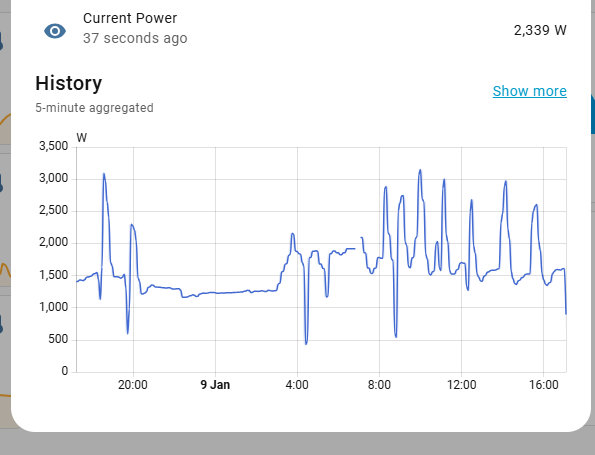
Just as an aside, I notice your graph has come from Home Assistant, so there's a bit of extra info that could be gleaned from future events.
If you set up a new helper (Config\Devices & services\Helpers) and choose "Integral sensor", you can create a new sensor that pretty closely approximates the energy used in kWh. The entity you'd base it on is, of course, the current power as you have displayed above, the time unit would stay at Hours, the integration I normally use is the Left Riemann sum, the precision I set at 2 and the max sub-interval would be 5 minutes if that's the frequency you get your data from the heat pump. Obviously, you may need to play about with these settings a bit, but you should end up with a sensor that'll give you a cumulative amount of energy consumed per day.
With that new sensor, you'd naturally be able to use the Home Assistant history and add this new sensor along with whatever entity you have that shows when the heat pump is defrosting to get the energy consumed at the start and end of the defrost. Still requires a reading of values and a bit of manual calculating to subtract starting value from end value, but it'd be a lot more precise than the Mk I eyeball; I use the integral sensor to calculate my heat pump's current day's consumption since I don't get kWh from it until the following day, but I generally find it has between 2% and 4% discrepancy against the confirmed figure.
Understandably, the new sensor won't give you any retrospective data, so you'd need to wait for the next defrost. Additionally, my apologies if you're already au fait with all this and I'm teaching Granny to do the proverbial.
105 m2 bungalow in South East England
Mitsubishi Ecodan 8.5 kW air source heat pump
18 x 360W solar panels
1 x 6 kW GroWatt battery and SPH5000 inverter
1 x Myenergi Zappi
1 x VW ID3
Raised beds for home-grown veg and chickens for eggs
"Semper in excretia; sumus solum profundum variat"
However there are significant costs associated with overnight use of heat pumps especially during the colder nights. Defrosts are widely quoted as using as much as 1.2 KWh to execute a full defrost. I have attached a graph of our outside air temperature last night which shows the entire setback period was within the defrost period. However, since we did not have the heat pump operating we prevented upwards of 6 or 7 defrosts… potentially saving 8.4 KWh of energy just on the defrost cycle.
We also have a Mitsubishi Ecodan but we also have OEM's energy monitoring kit installed, so have access to data with far greater accuracy than MelCloud.
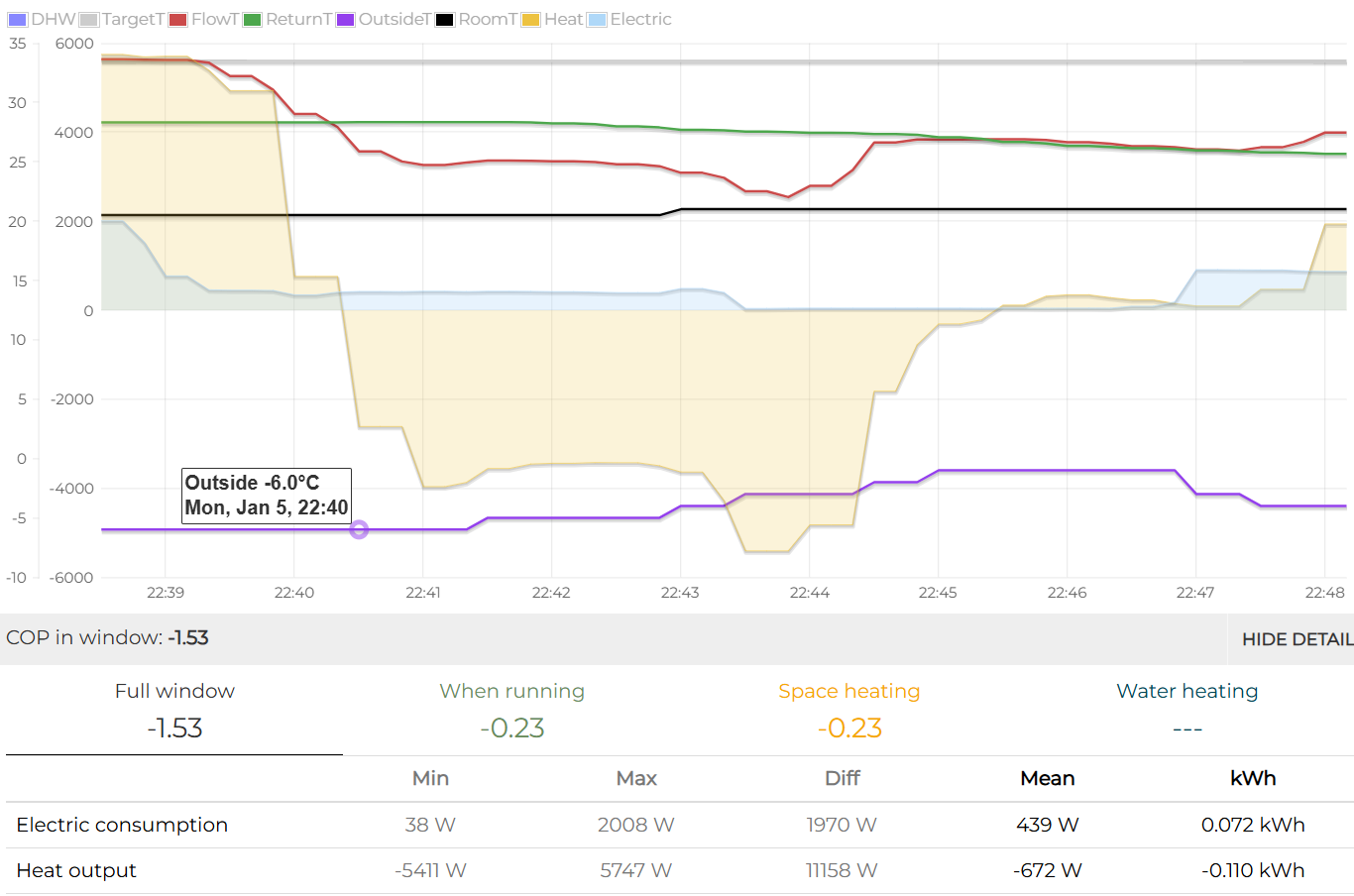
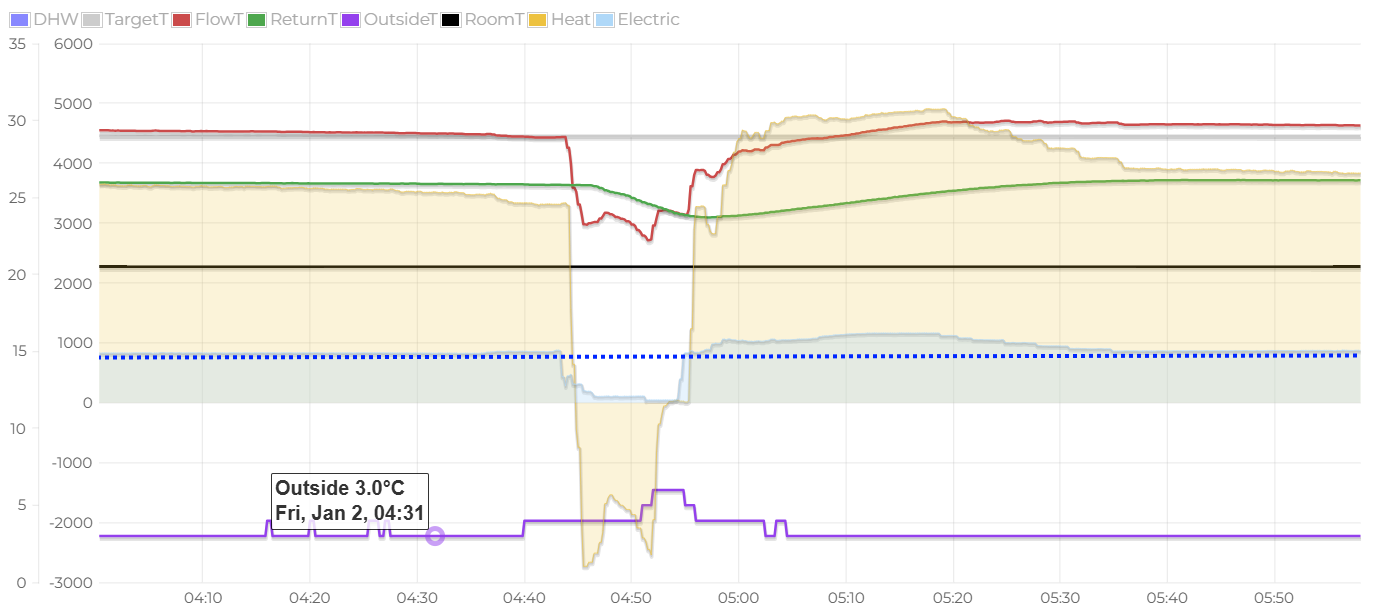
Our 8kW Ecodan uses less than 0.1 kWh to perform a defrost, here's one at -6C OAT:
The energy required for recovery from a defrost is significant and is far greater than the energy used in steady state.
Also the belief that recovering from a defrost uses far more energy than continuous running is also not so simple, here is a typical defrost at 3C OAT with the baseline electrical input shown with the blue dotted line. The area of grey (electrical input) above the line is only slightly larger than the area of white (absent electrical input) below the line.
So I'm afraid avoiding 6 or 7 defrosts won't have saved you anything like 8.4 kWh.
Our property has had the external brick walls all insulated On the internal face which means there is a low heat transfer to the fabric of the building and quicker recovery when compared to exposed high mass walls. Another benefit of internal insulation is that it reduces the risk of condensation and therefore the risk of mould and associated health risk.
You clearly have a well insulated low thermal mass house, so you only heat the air and not the structure/fabric. Given your slow heat loss during your setback you presumably also have good draft proofing and a low overall heat loss for the size of house. So one thing puzzles me, given such good insulation and draft proofing, why do you need flow temperatures of 38-40C? Are you radiators (IIRC you have fancoils?) very small and low power output? Because with larger radiators or UFH you could be running flow temperatures 5-10C lower.
Our 8kW Ecodan uses less than 0.1 kWh to perform a defrost, here's one at -6C OAT:
That’s an interesting stat. I’m thinking that the 0.1 KWh might be the energy used during the flow reversal process….? I’m also thinking that the real energy which provides the heat for the defrost isn’t recorded during the defrost because it is the hot water which is already created and stored in the radiator circuit. Is it possible that the 0.1kw you refer to plus the 1 kWh water heat to provide the defrost was created at a cop of circa 3.8 and would result in the total energy for the defrost?
So one thing puzzles me, given such good insulation and draft proofing, why do you need flow temperatures of 38-40C? Are you radiators (IIRC you have fancoils?) very small and low power output? Because with larger radiators or UFH you could be running flow temperatures 5-10C lower.
Yes you’re quite right I’ve worked out we should have at least 3 more radiators to give us enough output to operate at a lower flow temperature. This is a legacy issue from the original design. The extra volume would also allow us to operate at higher ambient temperatures without cycling….
Thank you for your comments they are very helpful regarding the effects of thermal insulation and heat retention. Regarding drafts we are about half way… Our house is old and we are still working on a few leaky doors and an old thin walled fireplace but it is all being addressed one step at a time.
Just as an aside, I notice your graph has come from Home Assistant, so there's a bit of extra info that could be gleaned from future events.
If you set up a new helper (Config\Devices & services\Helpers) and choose "Integral sensor", you can create a new sensor that pretty closely approximates the energy used in kWh. The entity you'd base it on is, of course, the current power as you have displayed above, the time unit would stay at Hours, the integration I normally use is the Left Riemann sum, the precision I set at 2 and the max sub-interval would be 5 minutes if that's the frequency you get your data from the heat pump. Obviously, you may need to play about with these settings a bit, but you should end up with a sensor that'll give you a cumulative amount of energy consumed per day.
With that new sensor, you'd naturally be able to use the Home Assistant history and add this new sensor along with whatever entity you have that shows when the heat pump is defrosting to get the energy consumed at the start and end of the defrost. Still requires a reading of values and a bit of manual calculating to subtract starting value from end value, but it'd be a lot more precise than the Mk I eyeball; I use the integral sensor to calculate my heat pump's current day's consumption since I don't get kWh from it until the following day, but I generally find it has between 2% and 4% discrepancy against the confirmed figure.
Understandably, the new sensor won't give you any retrospective data, so you'd need to wait for the next defrost. Additionally, my apologies if you're already au fait with all this and I'm teaching Granny to do the proverbial.
I don't intend to hijack the main thread but are you aware of a way to reset the daily totals from doing this? I set up integrations of this kind a few weeks ago when doing the heat pump configuration into OEM's integration, but everything runs as a cumulative total and I haven't yet figured out a way to create an output that can take these figures and hold them as daily totals.
Please feel free to split off this query into a HA thread somewhere else so that it doesn't divert from the central discussion, but wanted to ask the question after reading this.
130m2 4 bed detached house in West Yorkshire 10kW Mitsubishi Ecodan R290 Heat Pump - Installed June 2025 6.3kWp PV, 5kW Sunsynk Inverter, 3 x 5.3kWh Sunsynk Batteries MyEnergi Zappi Charger for 1 EV (Ioniq5) and 1 PHEV (Outlander) User of Havenwise (Full control Jun-Dec 2025, DHW only from early Dec) Subscriber to MelPump App data via CN105 Dongle Kit
No need to create a new thread, @sheriff-fatman. You don’t reset the integral sensor; you just create another helper - a utility meter helper - based on the integral. It’s in the utility meter helper that you have the choice of time period to cumulate over; day, month etc.
105 m2 bungalow in South East England
Mitsubishi Ecodan 8.5 kW air source heat pump
18 x 360W solar panels
1 x 6 kW GroWatt battery and SPH5000 inverter
1 x Myenergi Zappi
1 x VW ID3
Raised beds for home-grown veg and chickens for eggs
"Semper in excretia; sumus solum profundum variat"
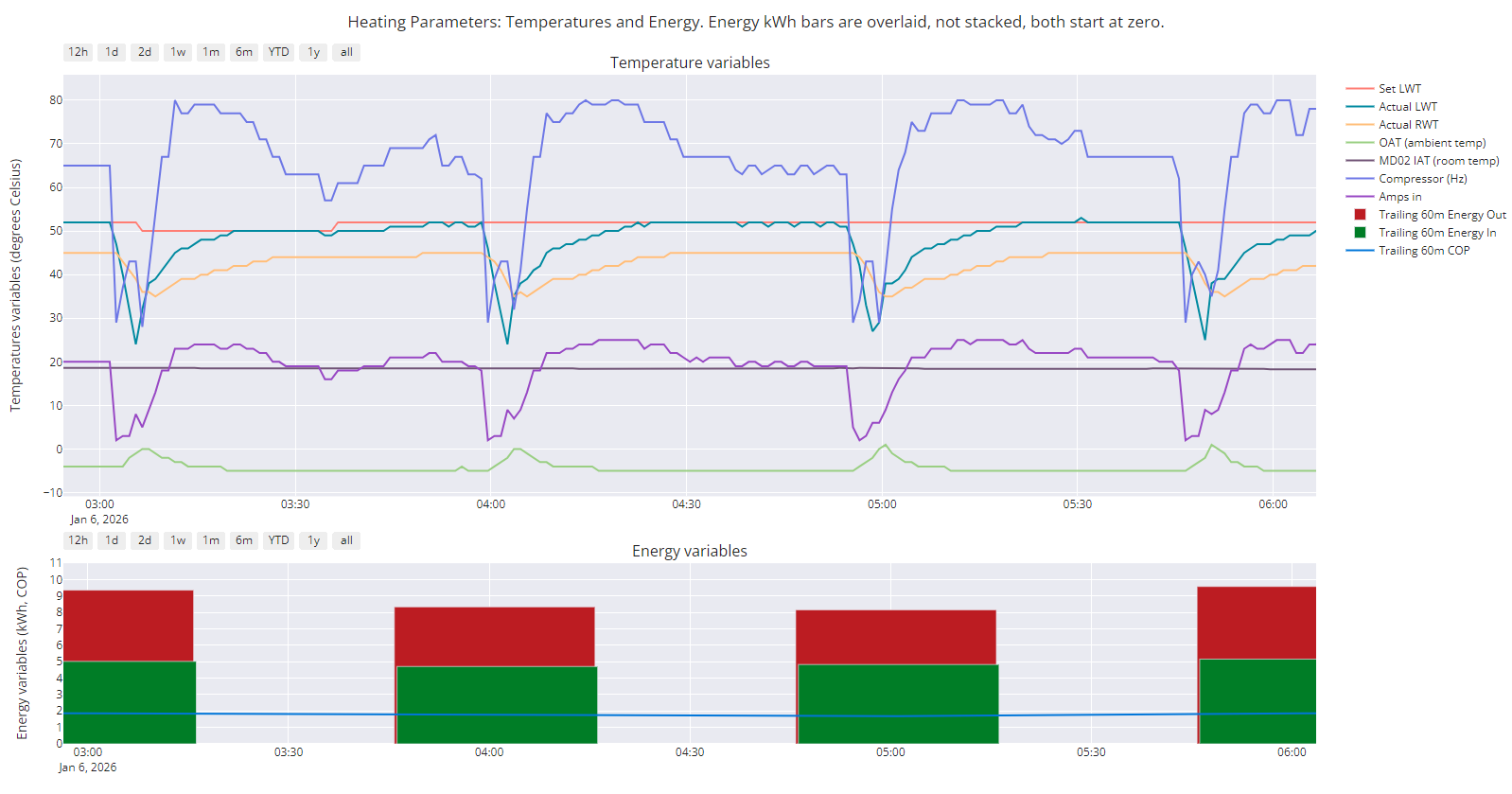
As far as I am aware, the majority, if not all, of the energy used in a defrost comes from the hot water in the radiator circuit. When I look at my minute by minute energy out data, it goes negative during a defrost. Instead of energy from from the heat pump to the house (a positive flow), it is flowing from the house to the heat pump (a negative flow). While this may seem a bit like water flowing uphill, it makes sense, because mathematically the LWT/RWT delta t goes negative (the LWT is cooler than the RWT) and thus the energy out equation flow rate x delta t x specific heat produces a negative energy out, because the delta t is negative. Here are some recent defrosts from my heat pump, the upper chart is minute by minute data:
The increase in energy use during the recovery from a defrost can also be seen, in the amps in (a valid proxy for energy in as the volts in stay pretty constant) and compressor frequency bulges after the defrosts. I dare say the extra amps in during the bulges approximate to the amps in saved during the defrost trough, meaning the defrost has little overall effect on the energy in over time, further confirming as I see it that the defrost energy comes chiefly from the hot water in the radiator circuit.
The hourly COP is correspondingly dismal, at around 1.7. Ouch. That said, the actual IAT is within one degree of the desired IAT, 18.3 vs 19°C. The heat pump is doing its job, albeit at a painful cost.
Midea 14kW (for now...) ASHP heating both building and DHW