

Notifications
Clear all
Joining the Renewable Heating Hub forums is completely free and only takes a minute. By registering you’ll be able to ask questions, join discussions, follow topics you’re interested in, bookmark useful threads and receive notifications when someone replies. Non-registered members also do not have access to our AI features. When choosing your username, please note that it cannot be changed later, so we recommend avoiding brand or product names. Before registering, please take a moment to read the Forum Rules & Terms of Use so we can keep the community helpful, respectful and informative for everyone. Thanks for joining!

Topic starter
27/04/2023 8:54 pm
I have a secondary circulation pump on the other side of my Low Loss Header from my heat pump. I realise there is a lot to discuss about the problems around an LLH but for now I am interested in the setting of the pumps and therefore how they might be interacting.
The pump in question is a Grundfos UPM3 AUTO 25-70 130 zzz, I've included a picture below which shows the setting of the pump. It is not speed controlled by the heat pump and appears to be on all the time except when the heat pump is doing DHW.
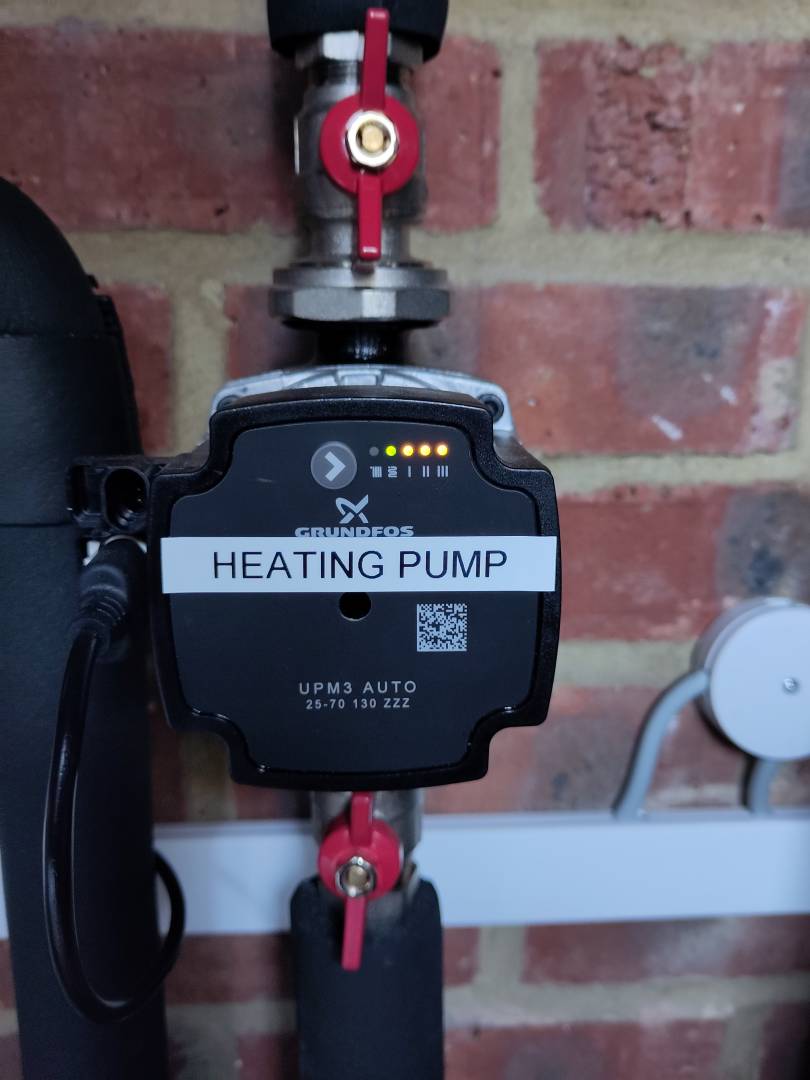
Given the pump inside the heat pump is variable speed I can't see how having a fixed speed pump on a high setting will do anything other than cause a lot of mixing in the LLH and so might help partially explain the low COP values I get (currently 1.8 - 2.4).
The heat pump is a 16kW Midea monobloc. From the manuals for similar pumps there seem to be setting options for Proportional Pressure, Constant Pressure, and Constant Curve but I don't know which of these would work best in my setup (diagram below).
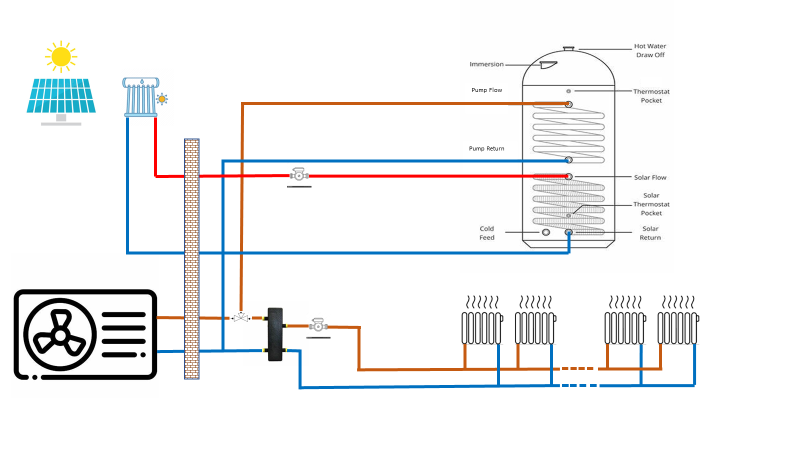
Any thoughts greatly appreciated.
16kW Midea Monobloc R32 Heat Pump (Heating & DHW)
4kW Solar PV (No battery storage yet)
CPC 12 INOX Solar Thermal (DHW)

28/04/2023 12:12 am
Given the pump inside the heat pump is variable speed I can't see how having a fixed speed pump on a high setting will do anything other than cause a lot of mixing in the LLH and so might help partially explain the low COP values I get (currently 1.8 - 2.4).
Your concern about mixing flow and return temperatures within the LLH is an issue for efficiency. And this is very likely to be more extreme if flow rates are in any way different either side of the low loss header. The mixing of the hotter LWT with the RWT means that the HP is having to work harder to produce the correct deltaT only for it to be mixed and cooled again before the water gets to the emitters.
if you have some means of measuring pipe temps entering and leaving the LLH you will know straight away if you have a significant heat mixing/loss problem.
However if you have a heat pump that has an internal circulation pump built in then this may be more complicated to do anything about it especially if it is a variable speed pump and you’re secondary pump is manually controlled and especially if operating at a fixed full speed setting.
Our situation is different to yours in that our Ecodan has an external Primary circulation pump which is now set to a constant pressure on the slowest speed which gives us a flow rate of 13 litres per minute. (Well within manufacturers minimum required flow rate) the hp then modulates to produce the deltaT of about 5 to 7c. Again this might be different to how your Midea HP regulates it’s heat output.
We have then adjusted our secondary pump to the same pump speed and checked flow rates again to try and match the flows through both circuits. This has meant that the temperature loss through the header has been measured to be only 1c. Not ideal but it’s much better than it was.
Im not sure how you might do something similar if you have a variable pump speed from an internal pump.... unless you can get a second output cable from controller to try to match the pump speeds but then you would need a compatible pump.
The other option, as I think you were hinting at, would be to explore the possibility of removing the low loss header but only if your system can operate as a single circuit.
i hope this helps clarify what can be done and perhaps someone who knows Midia might have an easier fix solution.
Our COP figures were significantly improved from 1.59 to a promising 3.3 to 3.7 depending on outside ambients. We still have the LLH fitted at the moment.

SPONSORS

Degrees of Separation

Latest Posts
-

First you need to know how much thermal energy you'll n...
By bobflux , 1 hour ago
-
RE: How quickly would you want/expect heat recovery to take from setback?
@toodles Ah, that makes sense. Your using the TRV bo...
By Singlespeed , 1 hour ago
-
RE: Renewables & Heat Pumps in the News
Yes, energy seems less of a priority, even if the cost ...
By Batpred , 2 hours ago
-
RE: Renewable Heating Hub Homeowners' Q&A Podcast
Come for the low-carbon homes. Stay for George Clarke’s...
By Mars , 1 day ago
-
RE: Octopus Cosy 12 Heat Pump Regret: Incredibly Loud, Poor Heating & Constant Hum - Help!
@razz, as we head into the heating season, I just wante...
By Mars , 1 day ago
-
RE: How should the Boiler Upgrade Scheme be reformed?
Not quite, regular A2W heat-pumps need a load of extra ...
By Temperature_Gradient , 3 days ago
-
RE: Heat Geek installations: share your experiences
one thing i learnt from reading people’s comments and e...
By Batpred , 3 days ago
-
RE: Cooling/heating with one unit
"The way we use A2A on a cheap overnight EV tariff is t...
By mrkfm , 3 days ago
-
RE: Do I add Air Con or MVHR to existing A2W ASHP?
We have ‘signed on the dotted line’ today for a Panason...
By Toodles , 3 days ago
-
RE: Heat pump branding. Clever, contemporary… or a bit too much?
...or it was there and was lost thanks to laziness and ...
By Majordennisbloodnok , 3 days ago
-
Bufferless design & control of Chinese air to water monoblock hybrid heat pump in Alberta, Canada
This post is about how I successfully configured a buff...
By Tony.Stolz , 3 days ago
-
The installer visited yesterday and suggested the noise...
By JamesChatz , 3 days ago
-
RE: HeatGeek vs Octopus surveys: puzzling disparity - any ideas why?
Your house sounds a lot like mine. 2 surveyors each sp...
By JamesPa , 4 days ago
-
RE: Heat Geek Zero Disrupt: Are We Sleepwalking Into Another Race to the Bottom?
Thats true only if you do the wrong experiment. Done c...
By JamesPa , 4 days ago






SPONSORS

