
Notifications
Clear all

Topic starter
04/03/2026 10:12 pm
We're looking at replacing a boiler in an early 2000s detached house in the UK. After getting multiple heat loss surveys done (varying from 8.5kW to 11.5kW heat loss) I've created a spreadsheet to compare the individual heat loss per room across each survey. I've removed anomalies and averaged them to get a better idea of what radiators I actually need. To me, that seems simple enough.
However a lot of people talk about the importance of design, so I've got to ask what else goes into a design that I'm not really thinking of? So far all the surveyors have looked at the existing pipework (mix of 22mm and 15mm, but no clue how far the 22mm goes before it turns into 15mm) and essentially shrugged and said it's fine, or even said it's great/ideal. During their visit they only seem to care about heat loss (which has never been anything more than educated guesswork) and radiator sizing and then picking an ASHP that has enough output.
What else should a good design be considering? What questions should I ask and what should I look out for?
The only other thing I have a basic understanding of is system volume, but again, every installer seemingly goes off gut feeling for this (or worse, just always do/don't install a buffer/volumiser). Even this topic seems to have wildly different opinions where you look, this forum I read you should have 15-20L of system volume per kW of output on the ASHP, but if I look at a manual for a 12kW ASHP it says a minimum of 16L and a recommendation of 64L, which is just over 5L per kW - significantly less than what you might read online.
Basically, I don't want to end up with a bodge job. But I also don't want to pay thousands more for an expertly crafted design that's never going to recoup the extra cost incurred instead of just throwing in some bigger radiators.
This topic was modified 2 hours ago by petch
1


04/03/2026 10:31 pm
Heat loss and radiator sizing are necessary, but they’re only the opening chapter of a proper design.
A competent heat pump design should also include the following, but I’m not sure how many installers will do this all, let alone share their calcs.
Hydraulic design. This is where most installs fall down. The designer should calculate required system flow rate at design conditions, based on the chosen delta T, typically 5K for a heat pump. From that, they should confirm the primary pipework can carry the required kW without excessive velocity or pressure loss. A heat pump sized correctly on paper will still underperform if the pipework throttles flow. Simply shrugging at 22 mm and 15 mm without calculating flow rate and velocity is not design… it’s assumption. This was something that was never factored in our own install.
Pressure loss and pump capability. Once flow rate is known, the total circuit resistance should be estimated… emitters, valves, pipe lengths, bends, manifolds, etc. The circulation pump must be capable of delivering the design flow at that head. Otherwise you’ll see flow errors, cycling or poor heat distribution.
Domestic hot water design. An undersized coil limits transfer rate and increases compressor stress. The coil should be matched to the heat pump’s output at realistic flow temperatures, not boiler-era assumptions. Some of the guys on the forums will probably disagree. Recovery time and legionella strategy should also be defined.
Controls philosophy. Weather compensation curve setup, room influence strategy, zoning approach and whether the system is open loop or thermostat-driven. Poor control logic can undermine an otherwise good hydraulic design.
System volume and minimum water content. The online litres per kW rule of thumb (15-20 L/kW) is conservative and largely aimed at ensuring stable operation and preventing short cycling in low-load conditions.
Defrost management and bypass strategy. How is flow maintained during defrost? Is there a buffer, volumiser, low-loss header or direct system? Each approach has consequences for efficiency and stability. If there’s talk of a buffer, run!
Finally, optimisation margin. A good design considers part-load behaviour, not just peak heat loss. Your house will operate most of the season at 30-60% of design load. Modulation range of the chosen unit matters as much as its peak output.
What you should be asking installers:
What flow rate are you designing for at design temperature?
What delta T are you assuming?
Have you calculated pipe velocities and pressure loss?
Can the internal pump deliver required flow at that head?
How are you ensuring minimum run times and preventing short cycling?
How will weather compensation be configured?
If those questions are met with numbers rather than reassurance, you’re dealing with a designer rather than a box-swapping installer IMO.
You don’t need over-engineering. You need quantified decisions rather than gut feel. That’s the difference between a bodge and a properly designed system.
Get a copy of The Ultimate Guide to Heat Pumps
Subscribe and follow our YouTube channel!

04/03/2026 10:57 pm
The only other thing I have a basic understanding of is system volume, but again, every installer seemingly goes off gut feeling for this (or worse, just always do/don't install a buffer/volumiser). Even this topic seems to have wildly different opinions where you look, this forum I read you should have 15-20L of system volume per kW of output on the ASHP, but if I look at a manual for a 12kW ASHP it says a minimum of 16L and a recommendation of 64L, which is just over 5L per kW - significantly less than what you might read online.
@editor has said a lot but let me address this one head on and specifically explain the disparity. Heat pump manufacturers typically specify a minimum system volume sufficient to ensure that defrost will work, ie there is enough heat in the system to defrost the fins. Thats relatively small and is the absolute minimum. However the other 'system volume' related consideration is cycling. Heat pumps, just like boliers, will inevitably cycle at mild temperatures and its more efficient if the cycles are long rather than short. Length of cycle is determined firstly by the minimum output of the heat pump relative to the demand (which is why oversizing is generally to be discouraged) and secondly by system volume. The latter matters because the greater the system volume the more excess energy can be absorbed by the system before the flow temperature gets too high and the heat pump shuts down. Basically it acts as a smoothing function. Recommendations for larger system volume than minimum are targeted at this and yes its a good idea.
I hope that helps.
A few other things:
- Dont accept a design with a buffer, plate heat exchanger or low loss header between the heat pump and radiators, it should be directly connected. A volumiser in the flow only (or even in the return only) is fine
- As regards hydraulic design, I hope you have 2 pairs of 22mm pipes (eg upstairs and downstairs), plus separate feeds to the DHW. If there is only one pair then its unlikely to be sufficient and the hydraulic design needs a specific focus.
- It would be good if you could narrow down that loss uncertainty. Is there any useful evidence available from gas /oil consumption? 11.5kW is big unless your house is well over 200sqm, as the scattergram below of measured consumption vs floor area from the 250 or so systems on heatpumpmonitor shows
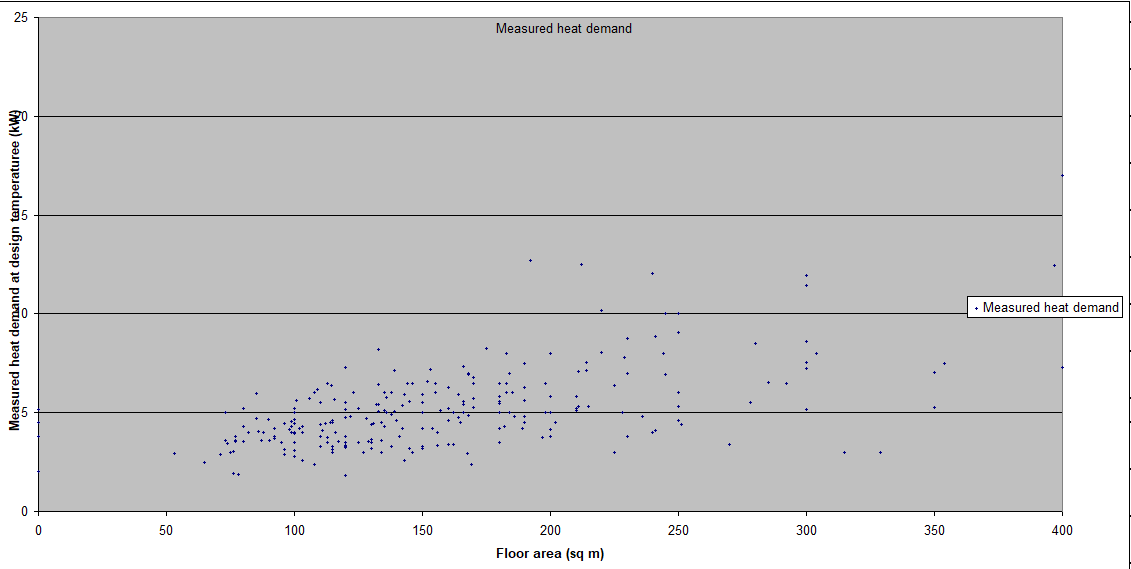
Hope that helps. As @editor says asking the installers questions is a good approach. Dont get too overwhelmed though, some things are not knowable without taking up the floorboards, and in these cases it may be best for the installer make a reasoned risk assessment that what they cant know is unlikely to be a problem, but if it is turns out that it is then there is a backup plan. Thats probably true with the pipework for example, 2x22mm primaries plus 15mm to the rads is very likely to be enough given the loss estimate, unless the primaries immediately downsize to 15mm before any rads split off. Without taking up the floorboards you cant be certain what they do. So a reasonable approach, at least in my view, is to measure the flow rate early on in the install, check its sufficient, but be prepared to deal with it if it isnt.
Feel free to ask us more questions and if you have some specific options to put them to the forum.
4kW peak of solar PV since 2011; EV and a 1930s house which has been partially renovated to improve its efficiency. 7kW Vaillant heat pump.

Latest Posts
-
@editor has said a lot but let me address this one head...
By JamesPa , 56 minutes ago
-
RE: How to control DHW with Honeywell EvoHome on Trianco ActiveAir 5 kW ASHP
Well I've had an interesting few days and would like to...
By giganto , 2 hours ago
-

RE: Peak Energy Products V therm 16kW unit heat pump not reaching flow temperature
Yes, here's mine. From the service manual parts numbers...
By bobflux , 6 hours ago
-
RE: Underfloor Heating Installation Issues with Heat Pump
Thanks for sharing your observations, both of you. From...
By Jonatan , 6 hours ago
-
Had to learn the hard way 🤣 now I'm sharing T...
By bobflux , 6 hours ago
-
RE: Issue with a Grant Air Source Heat Pump & Tado Smart Thermostat
Im assuming from your original post that hysterisis ref...
By JamesPa , 7 hours ago
-
RE: Heat Pump vs New Gas Boiler for Inherited House - Worth the Extra Cost?
Hi @fretless6 Mike, I have experience with Taggas (Re...
By Old_Scientist , 9 hours ago
-
RE: Daikin Altherma 3 LT compressor longevity question
@bobflux With my limited HA skills I can't ad...
By Ubert767 , 11 hours ago
-
RE: Testing new controls/monitoring for Midea Clone ASHP
Now seems a good time to summarise the costs and effici...
By benson , 14 hours ago
-
RE: Tell us about your Solar (PV) setup
@mk4 Charge to 100%, discharge down to 10%.
By bobflux , 15 hours ago
-
RE: Connecting Growatt SPH5000 over wired ethernet rather than wireless
The simplest wired option is usually the Growatt Ethern...
By Jonatan , 21 hours ago
-

RE: Electricity price predictions
@jamespa And it seems some of the nasty public cloud...
By Batpred , 1 day ago
-

RE: Jokes and fun posts about heat pumps and renewables
Technology is rapidly advancing. BBC News reported th...
By Transparent , 1 day ago
-

RE: Do Fridges and Freezers have COP ratings?
@editor Thank you all for your replies and submitted in...
By Toodles , 1 day ago
-
I know and yes. The secondary deltaT wont necessaril...
By JamesPa , 2 days ago
-
RE: Designing heating system with air to water heat pump in France, near Lyon
Just love the way you put it! 🤣
By Batpred , 2 days ago
-
RE: Safety update; RCBOs supplying inverters or storage batteries
Thank you for sharing. So it seems that your Schneid...
By Batpred , 2 days ago
-

RE: Forum updates, announcements & issues
@upnorthandpersonal thanks for the thoughtful, consider...
By Mars , 2 days ago
-
RE: Solar Power Output – Let’s Compare Generation Figures
@mk4 All 21 panels have their own Enphase IQ7a microinv...
By Toodles , 3 days ago
-
RE: Setback savings - fact or fiction?
Great, so you have proven that MELCloud is consistently...
By RobS , 3 days ago
-
RE: Mitsu PUHZ120Y 'Outdoor Temp 'error?
Thanks David & James It almos...
By DavidAlgarve , 3 days ago
-
RE: Surge protection devices SPDs
@trebor12345 - your original Topic about the right type...
By Transparent , 4 days ago
-
RE: Help needed with Samsung AE120RXYDEG
@tomf I’ve been sent this from a service engineer at Sa...
By Mars , 4 days ago


