Joining the Renewable Heating Hub forums is completely free and only takes a minute. By registering you’ll be able to ask questions, join discussions, follow topics you’re interested in, bookmark useful threads and receive notifications when someone replies. Non-registered members also do not have access to our AI features. When choosing your username, please note that it cannot be changed later, so we recommend avoiding brand or product names. Before registering, please take a moment to read the Forum Rules & Terms of Use so we can keep the community helpful, respectful and informative for everyone. Thanks for joining!
Mitsubishi Ecodan Stats Reporting - Accuracy Worsens In Auto-Adaptation Mode
In that case no surprise COP is only 3.1 if my understanding of autoadapt is correct.
What is the current set value for minimum target flow temp. From the graph it looks suspiciously like the answer is 37C?
Are all your TRVs and thermostats (if any) set well above desired temp?
Zero compressor starts when it's 2-4 outside is no surprise, it's what's happening at higher temperatures that's more interesting. Can you find compressor starts and hours of operation in the information that the heat pump collects or alternatively post plots from days where the temperature varies over the range 5-12.
PS plot suggests heat pump oversized, ticking along at min compressor modulation at oat of 2-4. More info will confirm or not.
This post was modified 7 months ago 6 times by JamesPa
4kW peak of solar PV since 2011; EV and a 1930s house which has been partially renovated to improve its efficiency. 7kW Vaillant heat pump.
Thanks for making it all the way through a lengthy post!
Since posting that detail, I've continued to monitor the system reporting, and now have a total of 55 days data running under auto-adaptive mode, and the conclusions remain the same. Consequently, as you're running in auto-adaptive mode for the stats that you have reported, and making the assumption that the reporting discrepancies are consistent in your system as they are in mine, then my findings would suggest that your Heating COP could be understated by close to 0.3 (I have a mean difference of 0.292 over 55 days) and your overall COP could be understated by 0.2. It's not clear which one you've used in your analysis, but I assume that it's likely to be the overall COP.
It's a pretty broad-brush assumption to try to assign specific differences like this, as there are potentially numerous ways in which the two systems may differ, such as the overall COP difference will depend on your ratio of DHW use to Heating, relative to mine. For example, we are relatively inefficient in terms of DHW management, with two full reheats to 52°C assigned in each 24 hour period to meet the demands of showering teenagers, so we typically use 3.6kWh per day solely on DHW, which then drags our overall COP down compared to households with more frugal DHW use.
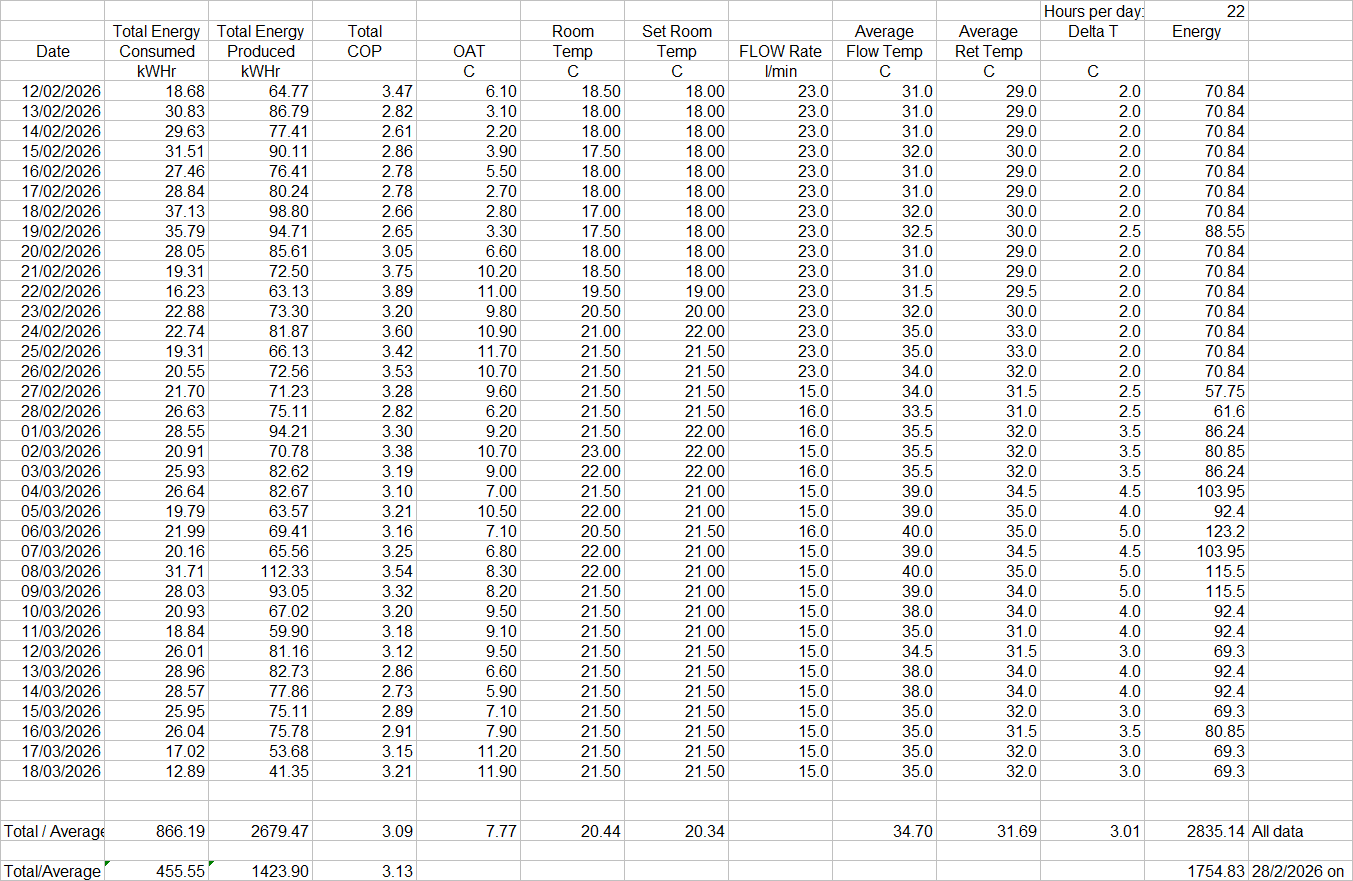
I am very disappointed with the efficiency of the Ecodan, I consider that it has been miss sold and is not capable of delivering the specified performance. A coefficient of performance of 3.1 with an average temperature of 7.8C and an average flow temperature of 34.7C.
Any suggestions for the best method of resolving this?
The difficulty in answering this is that it all depends on what your expectations are for the system. Having analysed my own system in detail, I'm increasingly of the view that the reported figures from the Ecodan are not fit for purpose, as they are likely under-reporting overall efficiency to some extent within every system. Personally, my own expectation, based on the general information marketed to the general public, is that I expected my system to be between 300-400% efficient, and the reality is that it is performing within that range, albeit at the lower end of it. The more fundamental issue I had was that, if I relied on the Ecodan's own reporting and was running it permanently in Auto-Adaptive mode, which does appear to be the best mode of operation (assuming, as noted by @jamespa that there's a sensible WC curve for it to work from), then the Ecodan reporting data would be telling me, incorrectly, that it's running at a COP of 2.8.
I'm not sure where your expectations lie, but I believe from previous posts that you're relying on the stated COP performance in the databook, which in my view is equivalent to expecting to get the same mpg from a vehicle as is reported in the spec sheets. There's simply no way that you are going to replicate lab conditions in a real-world system.
Flipping the question around somewhat, and assuming my findings were replicated into your own scenario, would an accurate COP of 3.3 or 3.4, rather than the reported 3.1, change your interpretation of the Ecodan's performance?
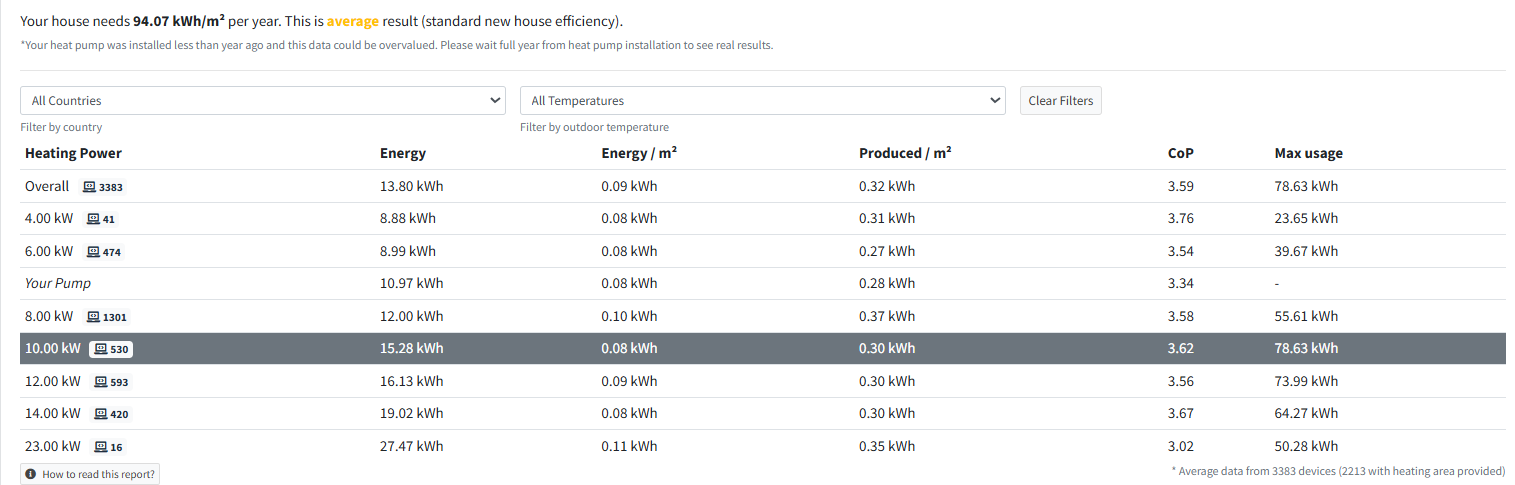
In terms of gaining overall perspective, one very helpful source of data within MelPump is the overall summary obtained from all systems. I've copied the data from yesterday as an example of this.
I've learned now to largely disregard where my own system sits on this listing, but what I find striking is that the overall COP figures for 3,383 Ecodan systems in use across various countries are all relatively modest, with a global COP being reported of 'only' 3.59. The data which feeds into these figures is that obtained from the Ecodan's daily reporting, so does not reflect the 'true' analysis being reported by those using the dongle, which is essentially why I created this thread initially.
There are two conclusions I can reach according to this data. (1) Ecodan systems, in general, are inefficient relative to other brands which systematically report SCOP's of 4+, or (2) Ecodan systems fundamentally under-report their own efficiency. The global statistics are quite compelling to me in terms of suggesting that the latter is the more accurate of the two conclusions.
The problem for me is that it should not require this much effort to have to disprove data that a manufacturers reporting systems are generating. As you are a user of the dongle within MelPump, you have the same overall suite of tools available as I have to be able to set up the alternative monitoring within Home Assistant, should you have the energy and desire to do so. This would potentially confirm the scale of your own individual reporting error within Auto Adaptive mode. If you have a smart meter connected to your heat pump installation, as mine has, there is an additional means of measurement available via the pulse readers that can generate real-time input power usage directly from the smart meter. I have been using one from a company called Frient for over a month now, comparing the output to daily meter readings taken at midnight, and the accuracy has exceeded my expectations - it is literally 100% correct at every measurement point, allowing for the fact that it measures to 2 decimal places, and the smart meter only reports to 1. I would recommend it to anyone who has a smart meter capable of taking data from, with the caveat that it requires a Zigbee adapter and Home Assistant to output the data into a usable format.
I consider the Frient sensor to be the most accurate input measurement available, as it is taken directly from the smart meter connected to the system, but obtaining it is perhaps a step beyond what most users are perhaps prepared to go to. The encouraging news is that, when measured against this, @f1p's formula-derived dongle data is impressively close to this, with a cumulative over-reporting of only 2.2% across 40 consecutive days of measurement. By comparison, the Ecodan in Auto-Adaptive mode over-reports the usage data by 12.5%.
This post was modified 7 months ago 2 times by Sheriff Fatman
130m2 4 bed detached house in West Yorkshire 10kW Mitsubishi Ecodan R290 Heat Pump - Installed June 2025 6.3kWp PV, 5kW Sunsynk Inverter, 3 x 5.3kWh Sunsynk Batteries MyEnergi Zappi Charger for 1 EV (Ioniq5) and 1 PHEV (Outlander) User of Havenwise (Full control Jun-Dec 2025, DHW only from early Dec) Subscriber to MelPump App data via CN105 Dongle Kit
@jamespa Please would you explain In that case no surprise COP is only 3.1 if my understanding of autoadapt is correct" My understanding of auto adapt is that it is an alternative to Weather Compensation, it still uses the external temperature but auto learns
I have not set a value for minimum flow temperature, however, I have seen operation at 31C.
@ecoste what happens to DeltaT if you double your flow rate to 30L/min, via the pimary circ pump and also proportionally increase any other zone pumps you might have?
In terms of gaining overall perspective, one very helpful source of data within MelPump is the overall summary obtained from all systems. I've copied the data from yesterday as an example of this.
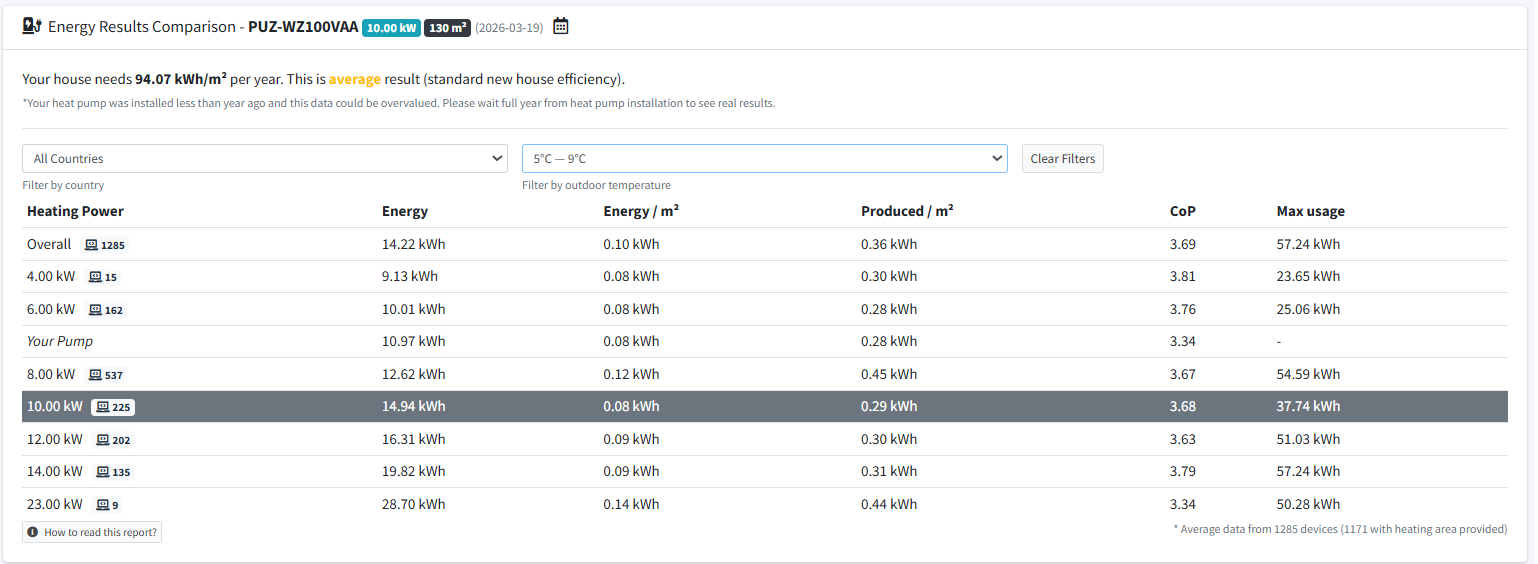
Just wanted to mention.. 38% of these devices had an average outdoor temperature of 5-9C and 47% were outside the filter ranges (below 0 or 20+)
In terms of gaining overall perspective, one very helpful source of data within MelPump is the overall summary obtained from all systems. I've copied the data from yesterday as an example of this.
Just wanted to mention.. 38% of these devices had an average outdoor temperature of 5-9C and 47% were outside the filter ranges (below 0 or 20+)
True, but the overall picture I referred to doesn't change dramatically when filtered for that 5-9°C range. The mean figure across circa 1,200 systems is 3.69, rather than the global 3.59 quoted previously.
130m2 4 bed detached house in West Yorkshire 10kW Mitsubishi Ecodan R290 Heat Pump - Installed June 2025 6.3kWp PV, 5kW Sunsynk Inverter, 3 x 5.3kWh Sunsynk Batteries MyEnergi Zappi Charger for 1 EV (Ioniq5) and 1 PHEV (Outlander) User of Havenwise (Full control Jun-Dec 2025, DHW only from early Dec) Subscriber to MelPump App data via CN105 Dongle Kit
Please would you explain In that case no surprise COP is only 3.1 if my understanding of autoadapt is correct" My understanding of auto adapt is that it is an alternative to Weather Compensation, it still uses the external temperature but auto learns
Based on what several others have said here and elsewhere my understanding was that it adapts, but only to a fairly limited extent. I have never been clear whether it also learns. Of course this could change between firmware versions and/or what people say could be wrong. Your results seems to suggest that it may be more adaptive that others have said.
Given that the algorithm is not declared I still would personally start by setting up manually even if I then switched to autoadapt, to be certain. That could just my desire to know what is going on!
I calculated output power from your flow rate /deltaT table and assuming 22hrs space heating. The numbers dont quite stack up which makes me suspiscious. Im looking particularly at the total. Its particularly noticable 28/2/2026 onwards, when you reduced the flow rate. This would and did increase deltaT which would make the deltaT measurement more accurate. Whats going on here. Is it possible that 'Total energy produced' is the extra energy NOT the total to the radiators. Vaillant report it that way, I dont know about Mitsubishi.
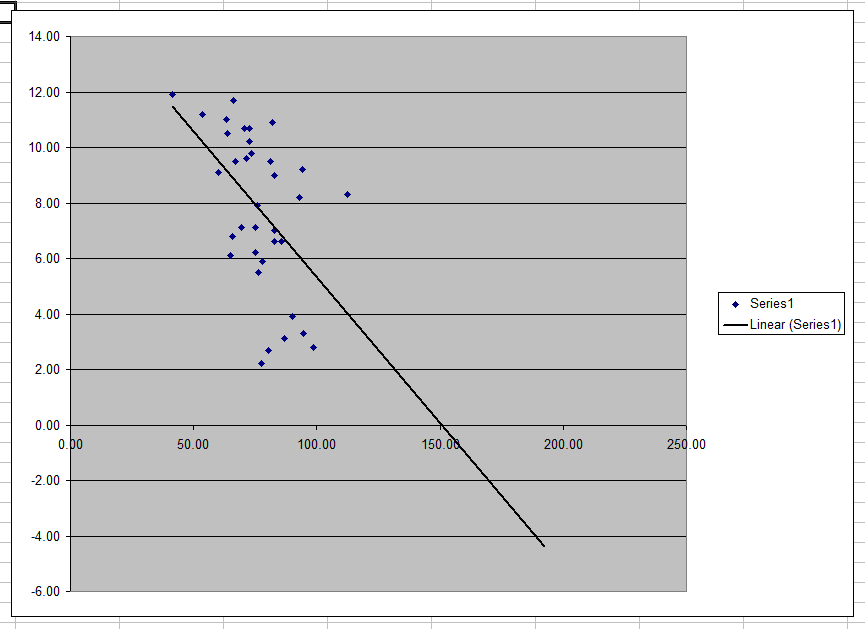
Here is a plot of OAT vs total energy produced, suggesting a house loss of maybe 7kW at -2. Given that it was ticking along at 3.5-4kW at 2-4, I would say that this may well be about right, but more data needed to be sure. If so it may well be oversized, therefore running at a relatively low efficiency point on the compressor efficiency curve.
Finally its worth bearing in mind that the temperature sensors they use can be up to about half a degree out. As you are comparing the values on two sensors to get DT, which may be out in opposite directions, this can lead to a proportionately high error. The error will be proportionately less at higher DTs, which is why Im particularly interested in the figures after you reduced the flow rate. Some people have swapped the sensors round or calibrated them to resolve this matter.
Looking at your Feb 28 graph posted earlier the COP on the graph is, so far as I can tell, almost always above 2.8 and typic ally 3.2. Yet the COP in your table is shown as 2.8. This seems potentially inconsistent.
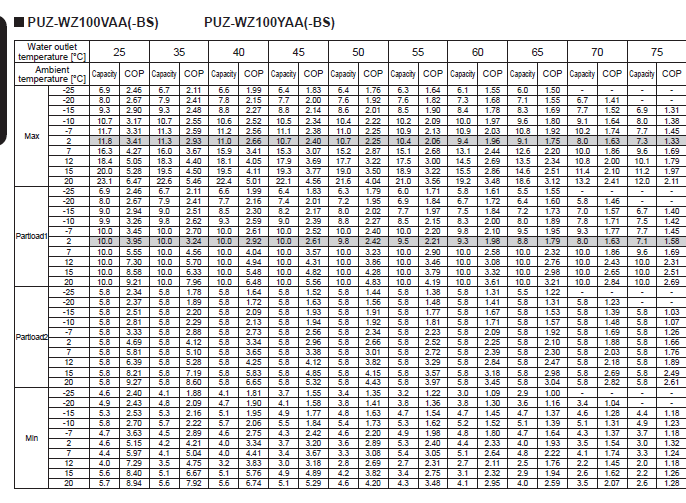
All that said it does appear COP may be in the low 3s not the high 3s, depending on how well matched the sensors are. The capacity/COP table below (I presume that this is the right model) would suggest that oversizing shouldn't make too much difference.
Not sure any of this is conclusive TBH, more a case of a bit more info to ponder.
This post was modified 7 months ago 3 times by JamesPa
4kW peak of solar PV since 2011; EV and a 1930s house which has been partially renovated to improve its efficiency. 7kW Vaillant heat pump.
@jamespa Thank you for the reply. I recognise that the data that I am using is not very accurate but it is good enough to show that the efficiency of the heat pump is poor. I also recognise that the heat pump was chosen to be slightly greater than the calculated heat loss, the calcs give 9kW. My gas boiler used to run at about 9kW on very cold days. However, I don't get short cycling and the heat pump modulates very well. The table that you have provided is the correct one and specifies that even at minimum load the heat pump should be much better.
The heat pump efficiency remains at about 70% of what could reasonably be expected, which results in running costs that are about 40% greater than expected.
I can try refining the measurement accuracy, it will take time and cost, but it is just going to more accurately tell me that the performance is poor and I still won't know why. I have ruled out everything that I can think of and have read about, which is why I suspect that the heat pump doesn't meet its specification. However, Mitsubishi blame it on the system implementation, without providing any reason.
I don't know how to get to a clear understanding of the cause.