

Notifications
Clear all
Joining the Renewable Heating Hub forums is completely free and only takes a minute. By registering you’ll be able to ask questions, join discussions, follow topics you’re interested in, bookmark useful threads and receive notifications when someone replies. Non-registered members also do not have access to our AI features. When choosing your username, please note that it cannot be changed later, so we recommend avoiding brand or product names. Before registering, please take a moment to read the Forum Rules & Terms of Use so we can keep the community helpful, respectful and informative for everyone. Thanks for joining!
Air Source Heat Pumps (ASHPs)
38
Posts
5
Users
3
Reactions
6,166
Views

23/03/2026 5:50 pm
@sheriff-fatman Thank you for the additional information. Your system seems to be very similar to mine and it produces very similar results. I have used the data from the Ecodan system as my measure of performance, this is provided by Mitsubishi and is their data not something that I have put together. The data for the heat pump specifies a COP of about 5 at 7C, you and I are achieving about 3, that's a big difference. I don't think that there is anything about routing the pipework that should impact the COP. I have had 4 visits from Mitsubishi, they have accepted that the COP is poor and have noted that the data provided is for specific laboratory conditions which are not met by a standard installation.
23/03/2026 8:36 pm
Whether or not it turns out to be statistically significant is another matter, but it's a good visual to show the difference between the two operating modes that caused me to post the findings.
...
I hadn't really studied the above graphs when I posted them, but the data within them is actually quite interesting.
That's why I like charts. The human brain can assimilate information very quickly from images. As I mentioned earlier, the easiest way to check whether the samples are statistically different is to plot the 95% confidence intervals for the regression line and checking whether they overlap or not. This can be done both in R and in python. Here's my infamous 2025 setback vs no setback energy in vs OAT data plotted in R with 95% confidence intervals:
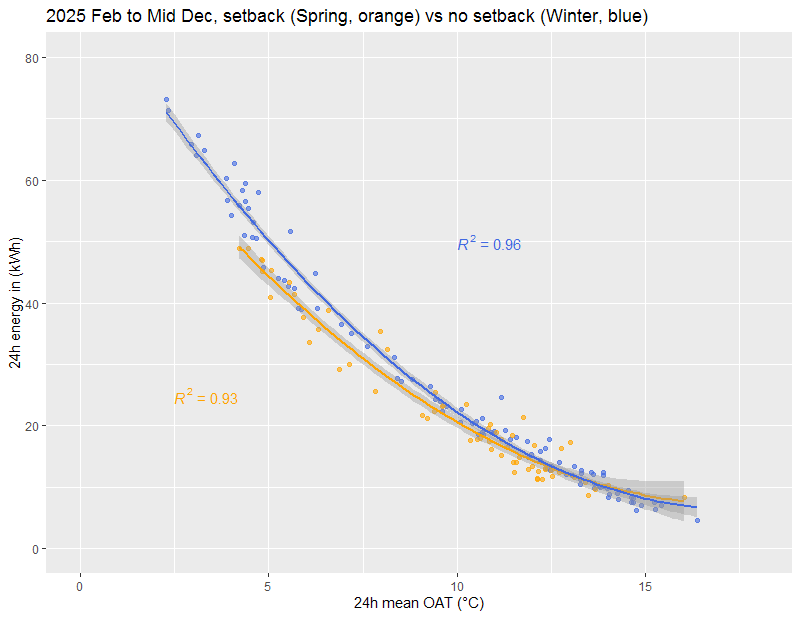
It appears to show the daily energy use is significantly lower when running a setback, at least at lower OATS, but I think the data may be biased. For a start, spring is not the same as Autumn and winter. Other unknown unknowns could also be in play. This in turn led me to the idea of using 'matched pairs' ie match setback days to non-setback days where the variables we do know about are matched. For a start, that means from the same season. I already have the Spring 2025 data, which was a period of setback running, and I am still collecting this Spring's data, which is a period on non-setback running. Once I have all the data (around about the end of April) I will do the plots and see what appears.
Midea 14kW (for now...) ASHP heating both building and DHW
2
Page 4 / 4
Prev

SPONSORS

Degrees of Separation

Latest Posts
-

RE: Heat pump branding. Clever, contemporary… or a bit too much?
I think Heat Geek have done an amazing job on their bra...
By Tomtheheatingengineer , 7 hours ago
-
RE: HeatGeek vs Octopus surveys: puzzling disparity - any ideas why?
I have just had 3 heat loss surveys, one by heat geek o...
By David , 7 hours ago
-
RE: Heat Geek Zero Disrupt: Are We Sleepwalking Into Another Race to the Bottom?
I think that's the key question. After all inverter uni...
By Prunus , 9 hours ago
-
RE: battery storage without solar
As of October 1st they need specific qualifications to ...
By EtchedPixels , 10 hours ago
-
RE: How should the Boiler Upgrade Scheme be reformed?
A unit which uses water to transfer the heat/chill from...
By Temperature_Gradient , 10 hours ago
-
RE: Renewables & Heat Pumps in the News
With regards to the BUS grant raid, I gave it more thou...
By ASHP-BOBBA , 10 hours ago
-
RE: Why are ASHP installs so expensive?
The whole system seems to work on the basis of...
By ian33a , 11 hours ago
-
RE: Missing flow temperature in Heat Geek proposal
Good plan. If you can get half hourly meter readings a...
By JamesPa , 16 hours ago
-
RE: Heat Pumps Without Grants: Would You Have Installed One & Will You Now?
@editor Most certainly. The heat pump was an ideal s...
By Abernyte , 16 hours ago
-
Although regulations may well vary from country to coun...
By Majordennisbloodnok , 16 hours ago
-
RE: Does anyone have experience of a smart water meter?
Yep I caught our slow leak from a £100 bill rise 8)
By EtchedPixels , 16 hours ago
-
RE: Do You Need a Buffer Tank or Low Loss Header for Underfloor Heating in a Large Property?
@jamespa in some cases, failing the Turing test might b...
By GrahamF , 20 hours ago
-
RE: Passiv Smart Thermostat - Help & Forum Support
@energystoragetech The heat capacity of some...
By JamesPa , 21 hours ago
-
RE: tepeo ZEB UK Support & Info Thread
Sorry you are correct, I was remembering figures from t...
By JamesPa , 1 day ago




SPONSORS