

Notifications
Clear all
Joining the Renewable Heating Hub forums is completely free and only takes a minute. By registering you’ll be able to ask questions, join discussions, follow topics you’re interested in, bookmark useful threads and receive notifications when someone replies. Non-registered members also do not have access to our AI features. When choosing your username, please note that it cannot be changed later, so we recommend avoiding brand or product names. Before registering, please take a moment to read the Forum Rules & Terms of Use so we can keep the community helpful, respectful and informative for everyone. Thanks for joining!
Air Source Heat Pumps (ASHPs)
11
Posts
5
Users
4
Reactions
1,538
Views

Topic starter
10/02/2026 10:49 am
I've been lurking on this forum for a while - reading a lot of posts and learning quite a bit in the process. I took the plunge and created a login ...
I have an engineering background, including a Cambridge degree in the dim and distant past. I've been working as a software developer for about 40 years, but have always enjoyed getting my hands dirty with hands-on engineering when opportunities arise.
We (two adults) live an a rather typical 1950's 4-bed suburban semi, about 160m2. Until Dec last year, we had a very conventional gas condensing boiler on a Y-Plan system with radiators and a vented, loft-fed DHW Cyl of about 120l. I had added a Honeywell EvoHome smart TRV system on all but one rads, creating 12 Zones. This all worked very nicely...
We have a 3.3kW PV system, which we have had now for nearly 20 years - we were early adopters - so we get the very generous original Feed In Tariff. We later added a battery storage system with around 10kWh capacity. We also have an EV, Zappi and Eddi.
About a year ago we were told by a gas engineer that our boiler was nearing the end of its life - it was nearly 20 years old, and he had been unable to clean the heat exchange due to warped and stuck baffles. We should be budgeting for its replacement...
Well, we decided to ditch gas for for an ASHP instead.
So, back in November we had a local Heat Geek installer come and do one of their 'Zero-Disrupt' installs.
Our airing cupboard is slap-bang in the middle of the house, with no possible route to run a G3 discharge pipe without major work - so we had the choice of keeping the hot water vented, or using one of their 'Mini-Store' systems which would have meant loosing the immersion heater and rendering our nearly-new Eddie useless. We opted to keep the existing (1980's?) cylinder and cold water tank. HG thought we could get away with no radiator upgrades and still achieve a SCOP of at least 3.4 - which is what we went for. In practice, I think there are a couple of radiators which are a bit marginal and I may replace them in due course.
So there we are - all up and running, and nice and warm, with our new Vaillant Arotherm 7kW on a zero-Disrupt install.
Having been a long-time user on Open Energy Monitor, we upgraded our OEM system to include a heat meter to fully monitor our system.
https://heatpumpmonitor.org/dashboard?id=902
This topic was modified 8 months ago 2 times by Mars
This topic was modified 8 months ago 2 times by MartinRobinson
1
Topic starter
10/02/2026 10:54 am
@Admin Why is my link to my OEM heatpump monitor page not working? The URL contains .../dashboard?id=902 which should it to my specific system and not their landing-page?


10/02/2026 10:56 am
@martinrobinson welcome to the forums.
That seems to be the way OEM has set up processing previews of links... but the link does work and takes you to your page. Here's the direct link for others.
This post was modified 8 months ago 2 times by Mars
🔥 Britain’s Heat Pump Shitshow
How Installing a Heating System Became a National Nervous Breakdown
Free UK shipping.
📗 Heat Pumps Explained
A Jargon-Free Guide for Homeowners
Rewritten and updated for 2027
📘 From Zero to Heat Pump Hero
🛠️ Bodge Buster
New to heat pumps?
Take the Heat Pump Fundamentals course and use INTRO50 at checkout for 50% off.

10/02/2026 11:02 am
@martinrobinson, must just be the way that they've set up previews.
🔥 Britain’s Heat Pump Shitshow
How Installing a Heating System Became a National Nervous Breakdown
Free UK shipping.
📗 Heat Pumps Explained
A Jargon-Free Guide for Homeowners
Rewritten and updated for 2027
📘 From Zero to Heat Pump Hero
🛠️ Bodge Buster
New to heat pumps?
Take the Heat Pump Fundamentals course and use INTRO50 at checkout for 50% off.

12/02/2026 9:28 am
That shows a highly respectable COP of about 3 each month. Good choice on your part.
How zero disrupt was it? Did you need upgrade of the pie work directly from the ashp, to get the full 8kW from the unit? We needed a length of 22mm replaced by 28mm, because of the way the house was plumbed. Although only a third of the house length it was convoluted and a lot of work for the guys, (and new bathroom vinyl for us).
Do you need the full 8+kW?, we do need it to run at maximum eg in the cold January spell.
2kW + Growatt & 4kW +Sunnyboy PV on south-facing roof Solar thermal. 9.5kWh Givenergy battery with AC3. MVHR. Vaillant 7kW ASHP (very pleased with SCOP >4) open system operating on WC
1
Topic starter
12/02/2026 10:42 am
'Zero Disrupt' is a bit over-optimistic I suppose, but we did keep the old cylinder and rads, so any Disruption was limited to the airing cupboard, attic, and outside for them to run new 28mm primary pipes.
The work required:
Removing boiler. Capping off the old boiler flow/return in our downstairs loo. removing gas pipe (and meter).
Heating header tank removed from attic, and replaced with new expansion vessel and PRV (in attic). PRV piped to outside though soffit. Cold water tank was retained - DHW is a vented system.
New diverter valve, OEM flowmeter, filling loop in airing cupboard (plus Vaillant control panel etc).
28mm primaries run from airing cupboard, up through the attic across two bedrooms and down the outside of the house, then over a side passage to the heat pump.
Outside, a couple of paving slabs were removed, soak-away dug, filled with a plastic cage, and capped in concrete to form a base for the outdoor unit.
New electric supply installed from understairs cupboard (new small CU including RCD and MCB, teed off a henley block), and run around outside of house.
So actually quite a lot of work was involved - but mostly outside and in one room inside.
So not really 'Zero Disrupt' - more a 'Less Disrupt' in reallty.
We subsequently had our bedroom radiator replaced when I realised that the TRV was not functioning allowing the room to overheat. We have our bedroom set to 18, and less overnight, and so is cooler than elsewhere, limited by a TRV. Our bedroom was overheating and I realised that the TRV was not closing properly and needed replacing. Since that radiator came out as rather undersized on our heat-loss survey, we got out installers back to replace the whole radiator (upgrading a 11 to a 22) rather than just the valve.
Topic starter
12/02/2026 10:50 am
I should add that our survey came up with a heat loss of 6.6kW - which is pessimistic.
On our coldest day so far (6th Jan) it was looking like this:
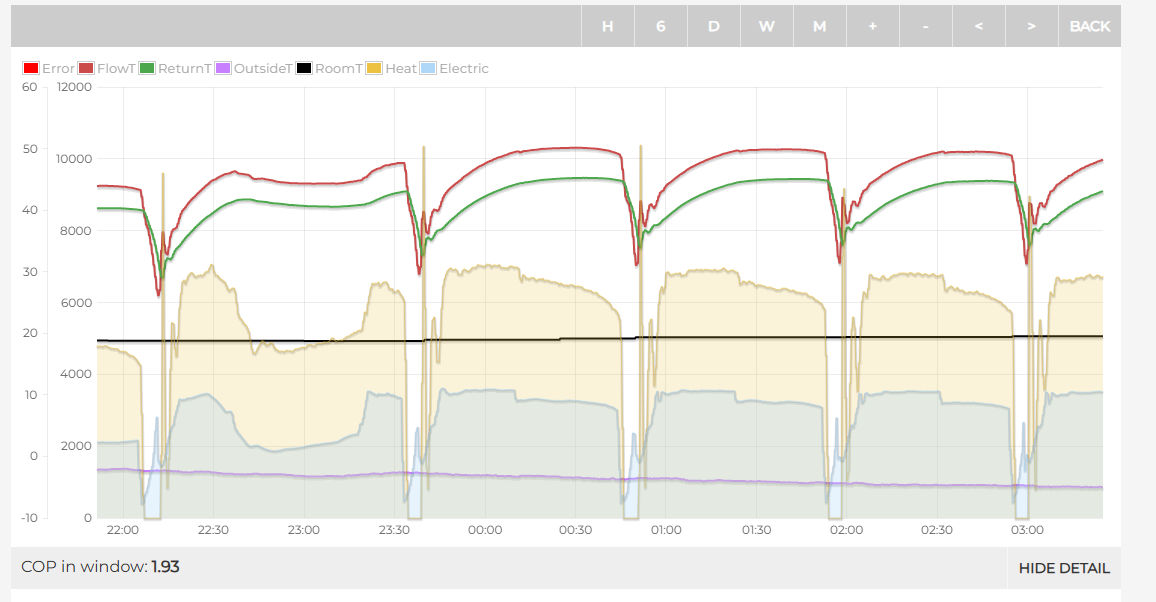
Flow temp was about 50. Average heat output 5.5kW, and the house stable at 19 C and about -5 outside.


20/02/2026 9:23 pm
Sorry to bounce your thread. To put to bed some concerns that I had about R290 heat pump protected zones; 10mm PLEX piping etc, I agreed to a HG Min Disrupt survey.
The cost came in at £2250 with no radiator changes and a 5kW Valliant HP with a 5.86kW heat loss. The installer favoured a 7kW heat pump to reduce de-icing cycles. We then looked at options. I asked whether it would be possible to upgrade a K22 radiator panel in our family room. This was priced as a customer option and we agreed to use the family room radiator in our dining room. The installer then ran the survey again.
This came in with a revised cost of £3400 with 5 further radiator changes; a Valliant 7kW HP and a minimum SCOP of 4. The ‘delta’ cost of £1150 for effectively 6 radiator changes doesn’t seem like bad value. I assume greater water volume must count for something in system design and bigger radiators should result in a lower flow temperature?
The only piece of the HG offer that is missing from the survey is any mention of heating controls? Am I missing something?
This post was modified 8 months ago by L8Again

21/02/2026 10:02 am
The only piece of the HG offer that is missing from the survey is any mention of heating controls? Am I missing something?
No you arent, because you dont need any, and furthermore shouldn't have any other than the controller that comes with the heat pump. Third party heating controls are, with a very few exceptions, a way to cripple your heat pump performance and often reduce comfort levels.
The Vaillant controller is very flexible and anything you add will detract from, rather than augment, performance. Some monitoring (beyond that which comes with the app) is useful for diagnosis if you are that way inclined. Home assistant, pulling the same data as the app pulls (from the same source) is sufficient.
I assume greater water volume must count for something in system design and bigger radiators should result in a lower flow temperature?
Greater system volume helps with cycling, by increasing the length of the cycles. Bigger radiators = lower flow temperature = lower running costs. £1150 for 6 rad changes is good value, but illustrates how simple this upgrade is provided the rads fit in the space available! Im not a plumber, well past my most agile years, and even I can do 2 in a very relaxed day.
This post was modified 8 months ago 4 times by JamesPa
4kW peak of solar PV since 2011; EV and a 1930s house which has been partially renovated to improve its efficiency. 7kW Vaillant heat pump.
1
Topic starter
23/02/2026 1:21 pm
Home assistant, pulling the same data as the app pulls (from the same source) is sufficient.
There has been quite a bit of discussion (mostly on OEM forums I think) that the flow/return temp sensors used by Vaillant on the Arotherm units are not to be trusted to give accurate readings, as they are not well calibrated. This can lead to significant errors in the COP figures reported on the Vaillant app. I opted for an independent heat meter with the full OEM kit - which should give more accuracy, and a lot more detailed information.
My HG Z-D price was a fair bit higher than quoted by @l8again above, but my primary pipe run is quite long and complex, which probably accounts for this.
SPONSORS
Degrees of Separation

Latest Posts
-

RE: Heat pump branding. Clever, contemporary… or a bit too much?
I think Heat Geek have done an amazing job on their bra...
By Tomtheheatingengineer , 6 hours ago
-
RE: HeatGeek vs Octopus surveys: puzzling disparity - any ideas why?
I have just had 3 heat loss surveys, one by heat geek o...
By David , 6 hours ago
-
RE: Heat Geek Zero Disrupt: Are We Sleepwalking Into Another Race to the Bottom?
I think that's the key question. After all inverter uni...
By Prunus , 8 hours ago
-
RE: battery storage without solar
As of October 1st they need specific qualifications to ...
By EtchedPixels , 8 hours ago
-
RE: How should the Boiler Upgrade Scheme be reformed?
A unit which uses water to transfer the heat/chill from...
By Temperature_Gradient , 9 hours ago
-
RE: Renewables & Heat Pumps in the News
With regards to the BUS grant raid, I gave it more thou...
By ASHP-BOBBA , 9 hours ago
-
RE: Why are ASHP installs so expensive?
The whole system seems to work on the basis of...
By ian33a , 9 hours ago
-
RE: Missing flow temperature in Heat Geek proposal
Good plan. If you can get half hourly meter readings a...
By JamesPa , 15 hours ago
-
RE: Heat Pumps Without Grants: Would You Have Installed One & Will You Now?
@editor Most certainly. The heat pump was an ideal s...
By Abernyte , 15 hours ago
-
Although regulations may well vary from country to coun...
By Majordennisbloodnok , 15 hours ago
-
RE: Does anyone have experience of a smart water meter?
Yep I caught our slow leak from a £100 bill rise 8)
By EtchedPixels , 15 hours ago
-
RE: Do You Need a Buffer Tank or Low Loss Header for Underfloor Heating in a Large Property?
@jamespa in some cases, failing the Turing test might b...
By GrahamF , 19 hours ago
-
RE: Passiv Smart Thermostat - Help & Forum Support
@energystoragetech The heat capacity of some...
By JamesPa , 20 hours ago
-
RE: tepeo ZEB UK Support & Info Thread
Sorry you are correct, I was remembering figures from t...
By JamesPa , 1 day ago




SPONSORS
