Joining the Renewable Heating Hub forums is completely free and only takes a minute. By registering you’ll be able to ask questions, join discussions, follow topics you’re interested in, bookmark useful threads and receive notifications when someone replies. Non-registered members also do not have access to our AI features. When choosing your username, please note that it cannot be changed later, so we recommend avoiding brand or product names. Before registering, please take a moment to read the Forum Rules & Terms of Use so we can keep the community helpful, respectful and informative for everyone. Thanks for joining!
Mitsubishi Ecodan Stats Reporting - Accuracy Worsens In Auto-Adaptation Mode
The heat pump efficiency remains at about 70% of what could reasonably be expected, which results in running costs that are about 40% greater than expected.
Frustrating though this may be unfortunately I don't think it is to the level that would be required eg to sustain a legal claim or indeed be fully conclusive given known problems with such measurements. As a minimum I would suggest that one would need to (a) rule out temperature sensor mismatch and (b) check flow rate sensor is correctly measuring. Ideally one would also get some independent verification of power consumption although this is normally the easiest thing to measure!
The table that you have provided is the correct one and specifies that even at minimum load the heat pump should be much better.
Agreed, although its notable that the minimum outputs you seem to be getting are less at least in many cases than the minima shown in the table, which adds credence to the possibility that there may be sensor errors.
I also recognise that the heat pump was chosen to be slightly greater than the calculated heat loss, the calcs give 9kW. My gas boiler used to run at about 9kW on very cold days.
This statement could be turned round and used to add further credence to the possibility that there are sensor errors! With a fairly high degree of certainty one of two things is the case namely
a) the actual loss is quite a lot less than the surveyed loss or
b) the sensors are underrepresenting the delivered energy
Which of these we dont know, but care is needed in interpreting results without knowing
I have ruled out everything that I can think of and have read about, which is why I suspect that the heat pump doesn't meet its specification. However, Mitsubishi blame it on the system implementation, without providing any reason.
Based on what you have said I would say that the most likely reasons for your measurements are (in no particular order)
a) a measurement/sensor error
b) that the heat pump doesn't meet its specification
c) that there are specific conditions under which the specification is measured (eg flow rate) and yours are, for some reason, materially different
I would say that the 'system implementation' argument is very weak unless (c) applies, because you are measuring COP at the heat pump not COP of the system as a whole. However its a convenient excuse for the manufacturer (which doesn't justify using it!)
If you wish to pursue this then the first step I would take is investigate the temperature sensors. You might do this initially be measuring flow and return temperatures independently (using the same probe for each). Thats at least reasonably easy to do provided you take care to make sure that the probe is in good contact with the pipe and well insulated on the outside so it is genuinely measuring pipe temperature
This post was modified 7 months ago 8 times by JamesPa
4kW peak of solar PV since 2011; EV and a 1930s house which has been partially renovated to improve its efficiency. 7kW Vaillant heat pump.
@jamespa Thank you, I have validated the temperature sensors and found them to be accurate.
I am interested in suggestion c) that there are specific conditions under which the specification is measured (eg flow rate) and yours are, for some reason, materially different, but unfortunately can not think of any cause and hence any test
b) that the heat pump doesn't meet its specification, remains the obvious choice Mitsubishi will not accept this suggestion and I don't know how to get irrefutable evidence to support this. Is there a third party organisation that could provide this?
My heating cost is about £1,500 per year therefore the extra due to the lack of efficiency is about £500 per year.
Thank you, I have validated the temperature sensors and found them to be accurate.
As a matter of interest how and to what level are they accurate? What would be the deviation between the reading of the two sensors if placed adjacent on the same pipe so they are at the same temperature.
I am interested in suggestion c) that there are specific conditions under which the specification is measured (eg flow rate) and yours are, for some reason, materially different, but unfortunately can not think of any cause and hence any test
The most obvious ones are flow rate and deltaT. The heat transfer across the internal heat exchanger will likely be most efficient when rad deltaT (and thus deltaT across the heat exchanger) is fairly high (which of course has the opposite effect on system efficiency - ie it makes it lower). This typically wont occur (in a real system) at low load (where you are mostly operating), but they might measure it that way eg at a standard deltaT which is not load dependent. They might even measure it at high/standard flow rate and high deltaT which again wont happen in a real life system but is the sort of condition one might standardise on for doing the measurement. I dont know if any of the international/national standards specify this.
b) that the heat pump doesn't meet its specification, remains the obvious choice Mitsubishi will not accept this suggestion and I don't know how to get irrefutable evidence to support this. Is there a third party organisation that could provide this?
There are independent test houses that the manufacturers use, but the cost will be exorbitant. Otherwise its diligent data collection on your part which would need thinking through very carefully and some questions to Mitsubishi about their test conditions.
There is some discussion about the limitations of Mitsubishi energy monitoring here You should read this.
This is a very interesting topic. Heat pump manufacturers have the easy get out of 'system configuration' but in reality you can (as you are doing) measure the COP of the heat pump alone. Provided it is running for a reasonable amount of time, the only influences (so far as I can see) of 'system configuration' on this are the flow temps, flow rates, OATs and deltaT flow to return (exception - around freezing point OAT humidity has an influence). Since they give figures for a variety of flow temps and OATs, you can take this out leaving only flow rate and deltaT. Provided these are reasonable I cant see a reason why the hardware would not be expected to perform to spec.
This post was modified 7 months ago 7 times by JamesPa
4kW peak of solar PV since 2011; EV and a 1930s house which has been partially renovated to improve its efficiency. 7kW Vaillant heat pump.
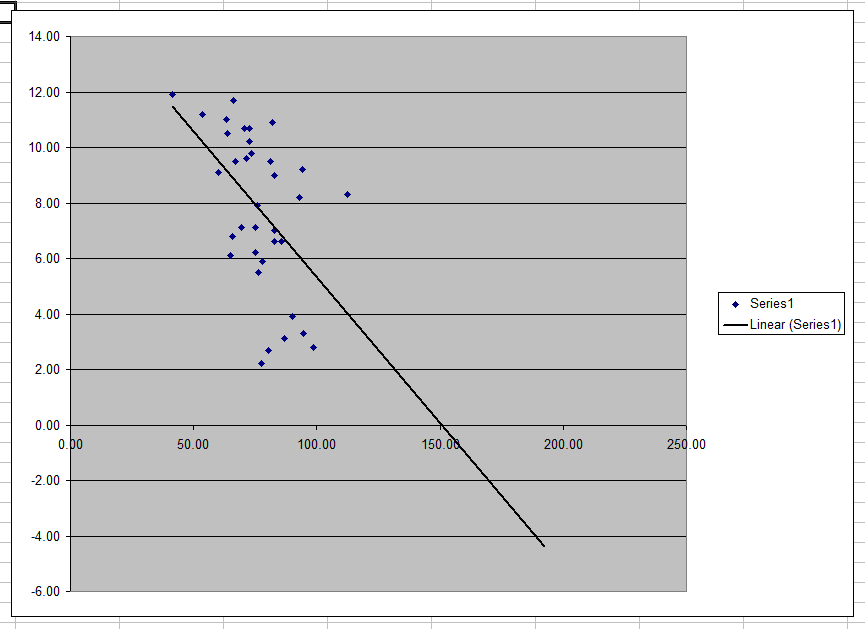
Here is a plot of OAT vs total energy produced, suggesting a house loss of maybe 7kW at -2. Given that it was ticking along at 3.5-4kW at 2-4, I would say that this may well be about right, but more data needed to be sure. If so it may well be oversized, therefore running at a relatively low efficiency point on the compressor efficiency curve.
This chart makes me suspicious, because of the data spread. The regression line looks off to me as well. Assuming the Y axis is the daily mean OAT, then look at the range of X axis values, which I assume is the daily energy produced, for a mean OAT of around 9°, which shows a spread from about 60kWh to 100 kWh. Why is there such variation?
Thank you for the reply. I recognise that the data that I am using is not very accurate but it is good enough to show that the efficiency of the heat pump is poor.
It doesn't need to be very inaccurate to be misleading. Given the variability in your data, your COP estimates could be way out.
I can try refining the measurement accuracy, it will take time and cost, but it is just going to more accurately tell me that the performance is poor and I still won't know why.
I don't think you know performance is poor. It is possible your current data is far enough out to mean it is effectively GIGO. To know whether your performance is a poor as you believe it is, you need more accurate monitoring.
My heating cost is about £1,500 per year therefore the extra due to the lack of efficiency is about £500 per year.
There are other factors to consider. Have you gone from timed heating with gas to always (or almost always) on with the heat pump? This can increase costs because, in short, the property stays warmer for longer.
But really it all comes back to the same thing, to make confident assertions about efficiency you need accurate energy in and energy out data. As previously noted, even a small error in say delta t of 0.5° for a delta t of 2.5 is still a large percentage error, and that means the derived energy out figure will be way out, more than enough to have a major impact on COP.
Midea 14kW (for now...) ASHP heating both building and DHW
This chart makes me suspicious, because of the data spread. The regression line looks off to me as well. Assuming the Y axis is the daily mean OAT, then look at the range of X axis values, which I assume is the daily energy produced, for a mean OAT of around 9°, which shows a spread from about 60kWh to 100 kWh. Why is there such variation?
I also am not too confident. There is not much data and the resolution of the data is poor. However there are other reasons to suspect the house loss is actually more like 7 than 10kW.
However one thing linked to this is clear, and I say it above, namely
The majority of my monitoring has focused on inaccuracies of the input power data, for which I can compare to verified alternative sources. Without a specific Open Energy Monitor kit to measure heat output there's no truly verifiable way to ascertain the 'correct' output data, so we're reliant on the formulaic approaches for pretty much any source of information.
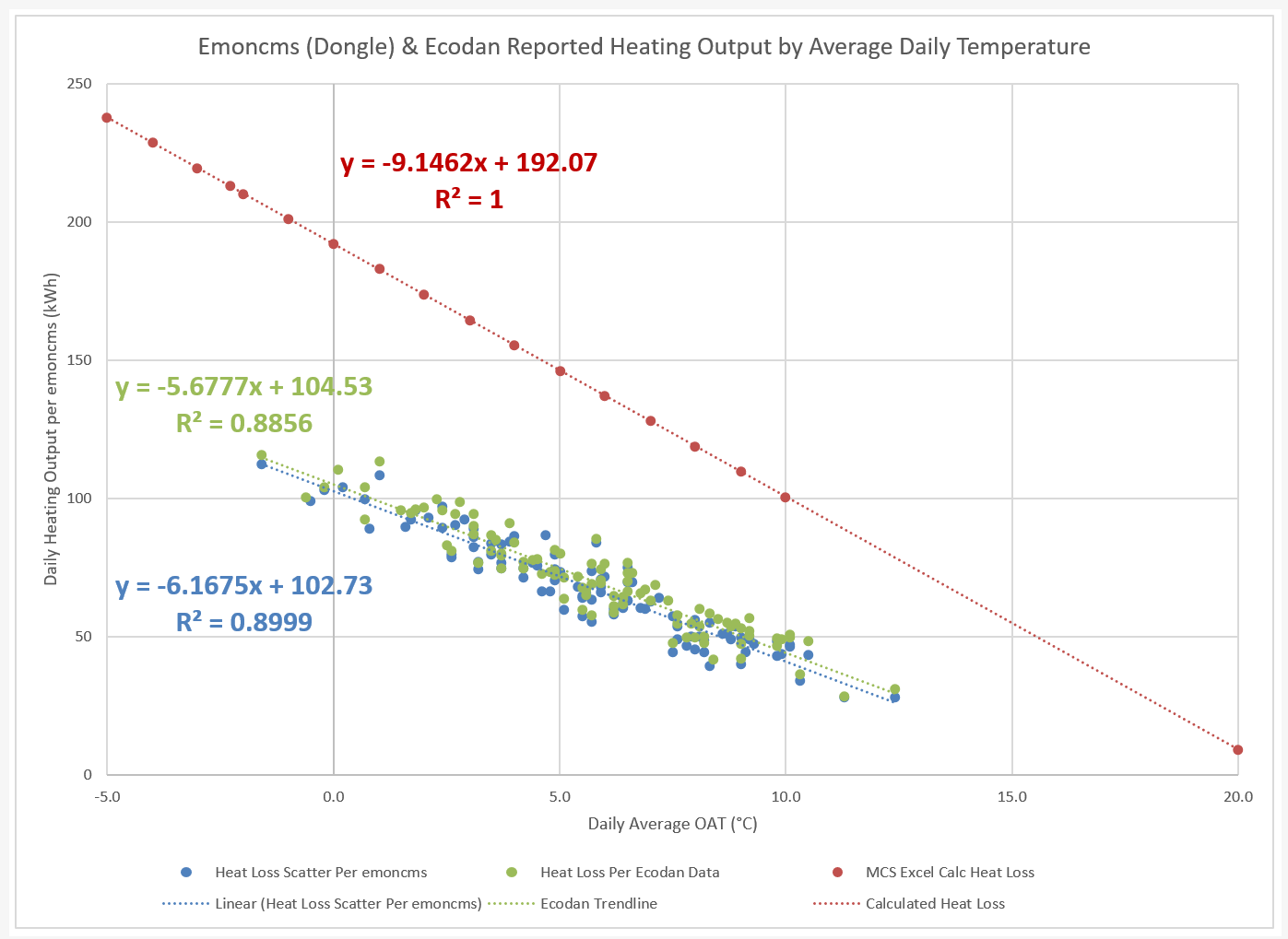
One thing I have done throughout my monitoring period is to compare the two sources of output data (Ecodan reporting and Dongle-derived data via the Open Energy Monitor integration) via scattergraphs of each, as detailed below. The two are reasonably well aligned to each other, with both showing an R-squared correlation of circa 90% on the regression line.
NB: (and something of a digression for this thread) The main issue identified, and I suspect this is endemic across the industry, is how different the actual heat loss data is compared to the heat loss assessment done during the installation. Short of appointing @jamespa as Government Tsar for this area of MCS compliance, the methodology for these calculations is always likely to produce such anomalies. In my case, I had several heat loss surveys carried out by various providers, all of which were consistently in the 8-10kW range, so persuading any of them to rely on other data to reduce their heat pump sizing recommendations would have been a challenge, particularly from the position of being a potential purchaser of a heat pump system and therefore being somewhat reliant on what you are being consistently told by various heat-loss assessments.
For the purposes of the query raised by @ecoste on his own installation, the main point of sharing this data is to attempt to quantify the scale of any error in the output data recording, which the two regression line formulae could potentially be used to assess. Relative to the issues with input measurement, and the general uncertainty in being able to accurately verify output data, I would suggest that this is a lesser source of overall concern. As in my case, the true heat loss relative to the assessed one might be indicative of potential heat pump oversizing, but those inefficiencies are separate to the ones he's trying to demonstrate on the basis of the heat pump's measured performance vs specification.
130m2 4 bed detached house in West Yorkshire 10kW Mitsubishi Ecodan R290 Heat Pump - Installed June 2025 6.3kWp PV, 5kW Sunsynk Inverter, 3 x 5.3kWh Sunsynk Batteries MyEnergi Zappi Charger for 1 EV (Ioniq5) and 1 PHEV (Outlander) User of Havenwise (Full control Jun-Dec 2025, DHW only from early Dec) Subscriber to MelPump App data via CN105 Dongle Kit
@sheriff-fatman — nice chart, ten out of ten! Eyeballing the emoncms and Ecodan data, they are the same. If you add 95% confidence intervals for the regression lines (can be done in R if your spreadsheet can't do it) I am sure they will overlap considerably, which in effect means they are the same, or in this context, they are not significantly different, either statistically or in any practical sense.
Quick note: R squared is not the correlation coefficient, r, but that value squared, and it tells us the extent to which the independent variable explains the dependent variable. High R squared, and the data points will be close to the line, lower R squared and they will be more spread out. If all the points are on the line, ie the independent variable 100% explains the dependent variable, then R squared will be 1, as happens for the red data and regression line on your chart.
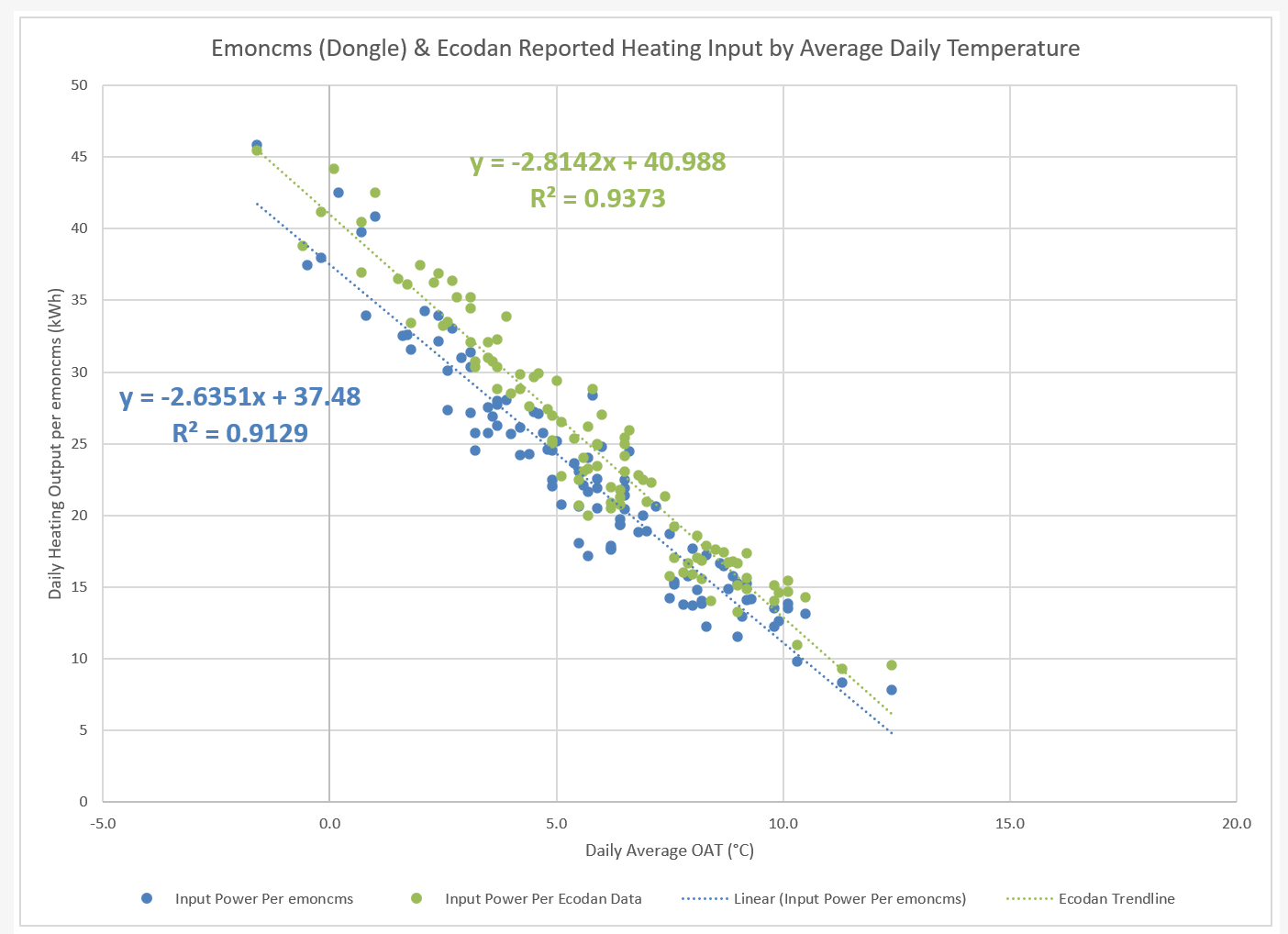
Can you do a similar chart for daily energy in vs mean daily OAT, comparing emoncms data with Ecodan data?
Midea 14kW (for now...) ASHP heating both building and DHW
Can you do a similar chart for daily energy in vs mean daily OAT, comparing emoncms data with Ecodan data?
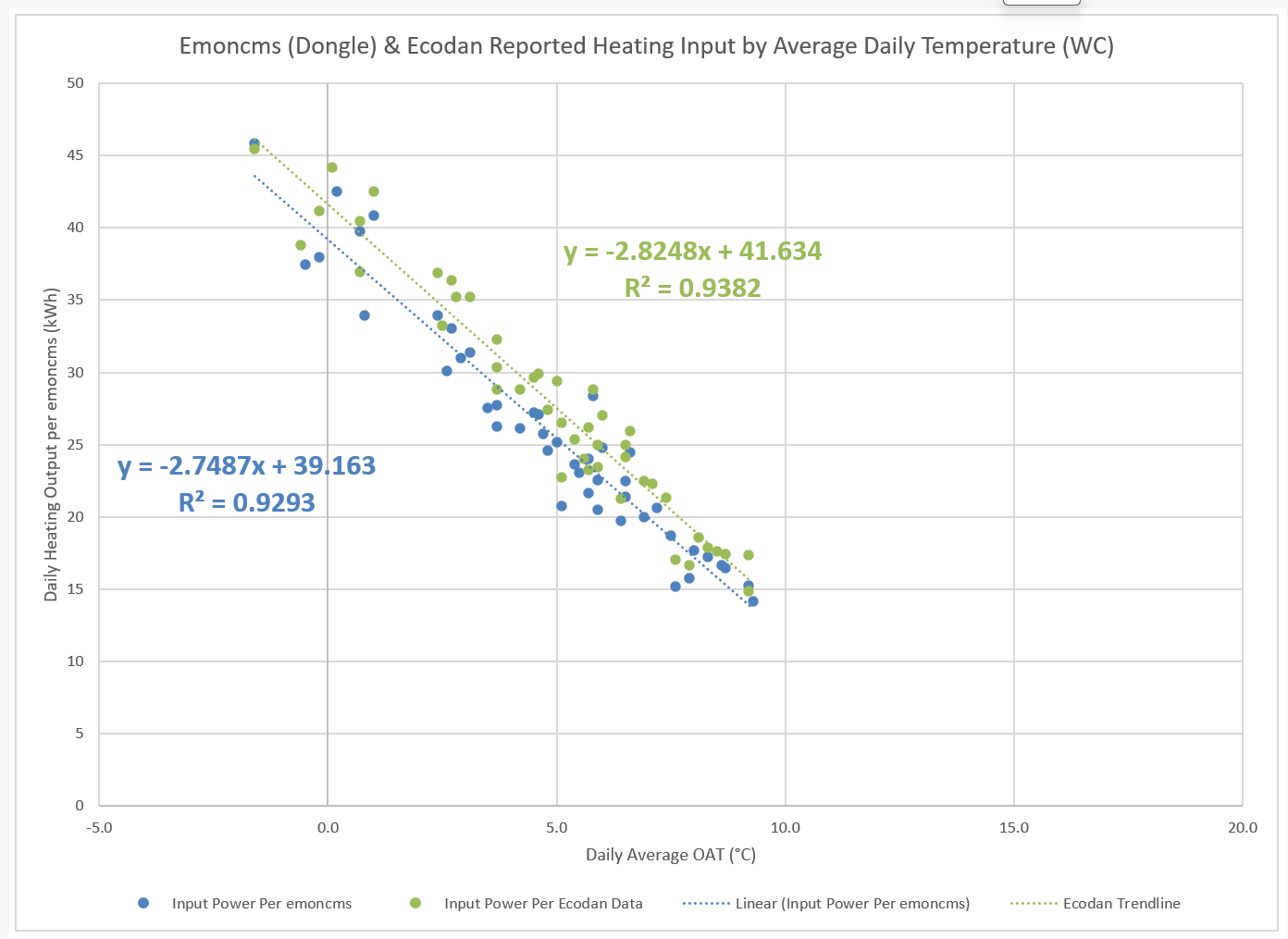
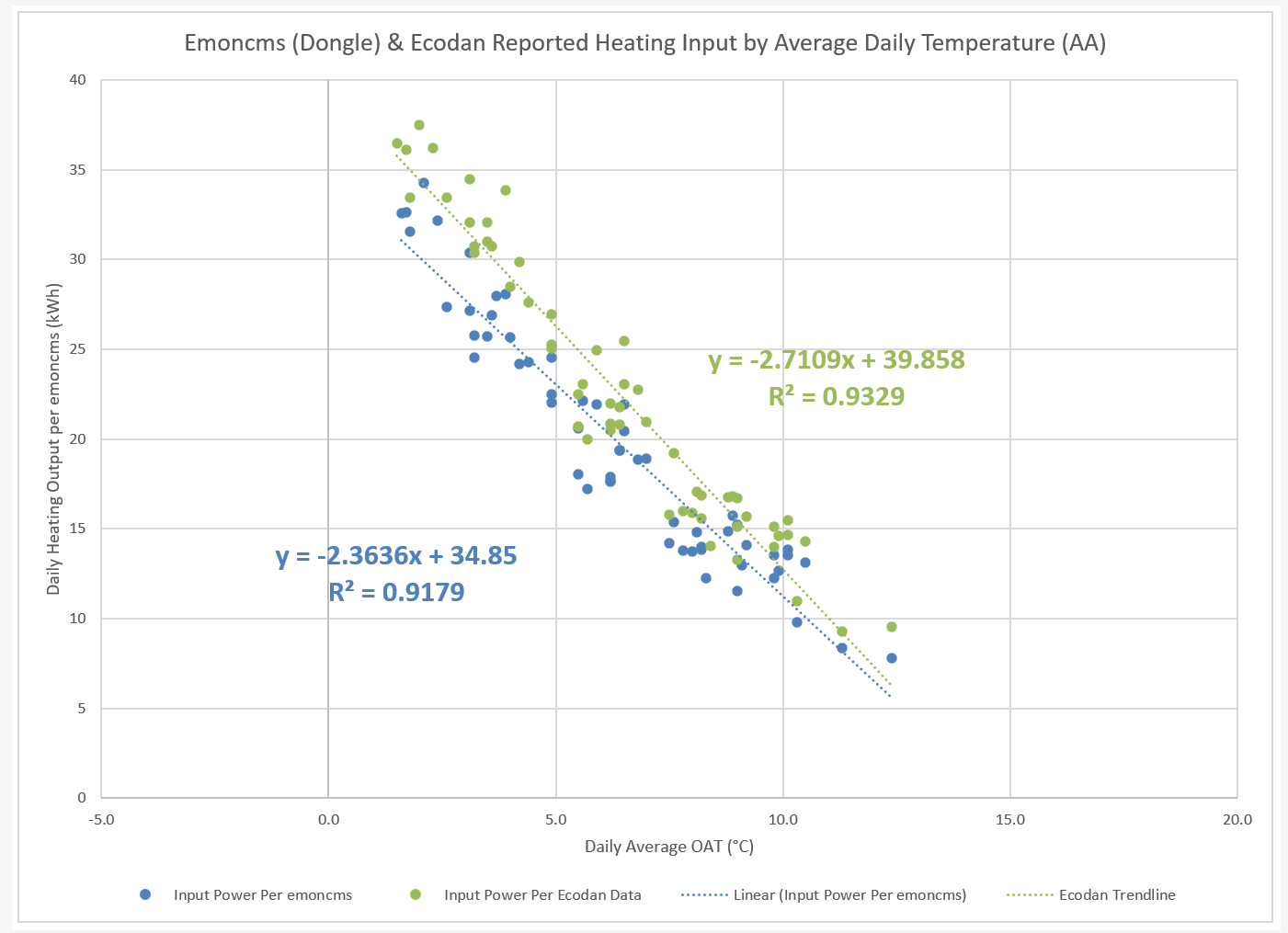
I didn't have those graphs but they were easy enough to create. I've done one for the tracking period (currently 102 days) along with separate graphs for the weather comp running (45 days) and the auto adaptive (57 days). I wasn't sure how compelling they would be, but there's a distinct difference in what they show, with the weather comp data being broadly aligned, as for the output graphs. By comparison, the Auto Adaptive data has a much more noticeable difference between the two lines, such that you can actually visualise the point of intersection.
Whether or not it turns out to be statistically significant is another matter, but it's a good visual to show the difference between the two operating modes that caused me to post the findings.
130m2 4 bed detached house in West Yorkshire 10kW Mitsubishi Ecodan R290 Heat Pump - Installed June 2025 6.3kWp PV, 5kW Sunsynk Inverter, 3 x 5.3kWh Sunsynk Batteries MyEnergi Zappi Charger for 1 EV (Ioniq5) and 1 PHEV (Outlander) User of Havenwise (Full control Jun-Dec 2025, DHW only from early Dec) Subscriber to MelPump App data via CN105 Dongle Kit
I hadn't really studied the above graphs when I posted them, but the data within them is actually quite interesting. Not only do they quantify the scale of difference between the Ecodan reporting and that obtained from the dongle device, but the dongle data from each of the final two graphs provides a quantification of the more efficient running of the heat pump in Auto-Adaptive mode compared to that in weather compensation. Just taking the formula intercept values alone, at 0°C, the implied reduction in input power is 4.3kWh per day. The gradient of the auto-adaptive graph is also shallower than that for WC so the incremental increases at lower temperatures will be lower too.
There's a similar conclusion from using the Ecodan data formulae, but the performance improvement between the two modes is greatly reduced compared to the dongle data (which, again, was one of the observations in the original post).
130m2 4 bed detached house in West Yorkshire 10kW Mitsubishi Ecodan R290 Heat Pump - Installed June 2025 6.3kWp PV, 5kW Sunsynk Inverter, 3 x 5.3kWh Sunsynk Batteries MyEnergi Zappi Charger for 1 EV (Ioniq5) and 1 PHEV (Outlander) User of Havenwise (Full control Jun-Dec 2025, DHW only from early Dec) Subscriber to MelPump App data via CN105 Dongle Kit
I had my 10kW Ecodan R290 replaced by Mitsubishi in early December because it was faulty. The new unit works but has a very poor COP. Using the Mitsubishi data the COP for the period from 12th Feb to 18th March was 3.1, which I regard as unacceptable.
I am very disappointed with the efficiency of the Ecodan, I consider that it has been miss sold and is not capable of delivering the specified performance. A coefficient of performance of 3.1 with an average temperature of 7.8C and an average flow temperature of 34.7C.
@ecoste Just returning to your post detailing your stats, as I thought it would be useful, in terms of providing some context, to provide my own system stats for the same period from 12th Feb to 18th March, as I have the same 10kW R290 Ecodan heat pump as you.
For the equivalent period I have a Heating CoP of 3.22, and a DHW CoP of 2.07, which results in an overall CoP of 3.04 at an average OAT of 7.1°C, as calculated from the dongle data extracts.
If I had relied on the Ecodan system reporting within MelPump, the equivalent figures would have been 2.98 for Heating, 2.34 for DHW and an overall CoP of 2.89. The system has been run in auto adaptive mode throughout the period in question.
Average indoor temperature for the reporting period was 21.1°C, as reported via the Ecodan thermostat in the living room. Average daily flow temperature was 34.6°C.
In my case, I can attribute some inefficiency to the specifics of the house, and the installation setup. The pipework from the heat pump runs from ground level, through the loft, into a cylinder room on the 1st floor in the centre of the house, so there are some gravitational challenges to be met. One installer did suggest an improved design would be to run pipework through the upstairs floorboards, but the additional cost of such would have been prohibitive, so there's a trade off of design and cost. Additionally, the heated envelope of the house includes a conservatory area, with approx 17m^2 of glazing, albeit it now has a fully rebuilt and insulated roof, rather than the polycarb one that was there at the point of installation.
Beyond that, the low overall CoP (but in my case still within the tolerance of my expectations) is, as far as I can see, attributable to the inefficiencies of an oversized system and the inadequacies of the Ecodan data itself. I have tried to address the latter as far as possible, in terms of input power, but have no meaningful way to accurately assess if the output figures are reliable.
The oversizing issue, as shown via the heat loss data graph earlier in the thread, is largely a MCS modelling issue, consistently applied by several heat loss surveys from a number of providers. I pushed back on the calculations as much as I felt able during the quotation process to try to mitigate any potential oversizing, but when you are presented with multiple assessments telling you broadly the same thing, there is a point where you have to rely on their information. It is only with the benefit of analysing actual post-installation data that I can quantify the potential scale of error in the heat loss assessment.
Finally, just to repeat my usual caveat, the most important stat for me is the cost of running figure, and the system has delivered cost savings of 40-50% to date compared to the gas boiler system it replaced, despite the very modest stats, thanks to my ability to integrate it with the existing PV and battery system via the Octopus Intelligent Go tariff. Fundamentally, that is why my conclusion as to fitness for purpose for my own system is very different to yours.
I hope that you are able to satisfactorily resolve your system issues in due course.
This post was modified 7 months ago 3 times by Sheriff Fatman
130m2 4 bed detached house in West Yorkshire 10kW Mitsubishi Ecodan R290 Heat Pump - Installed June 2025 6.3kWp PV, 5kW Sunsynk Inverter, 3 x 5.3kWh Sunsynk Batteries MyEnergi Zappi Charger for 1 EV (Ioniq5) and 1 PHEV (Outlander) User of Havenwise (Full control Jun-Dec 2025, DHW only from early Dec) Subscriber to MelPump App data via CN105 Dongle Kit