
Notifications
Clear all
Joining the Renewable Heating Hub forums is completely free and only takes a minute. By registering you’ll be able to ask questions, join discussions, follow topics you’re interested in, bookmark useful threads and receive notifications when someone replies. When choosing your username, please note that it cannot be changed later, so we recommend avoiding brand or product names. Before registering, please take a moment to read the Forum Rules & Terms of Use so we can keep the community helpful, respectful and informative for everyone. Thanks for joining!

Topic starter
19/02/2026 12:26 pm
Hi all, I've been reading the posts in this forum with great interest for the last few days, especially @pash44pump journey. I've already had some golden nuggets of support from some of you on the MSE forum but was informed of this resource and wanted to share my own experience and ask some questions if I may?
House:
1989 detached brick build, 1900 sq ft, 4 bedrooms, 4 reception rooms, 3 bath, (unheated) double garage.
No cavity wall insulation that we are aware of. Loft appears well insulated but survey suggested it may not be quite up to current standards.
Located in Hampshire, England.
System installed October 2024:
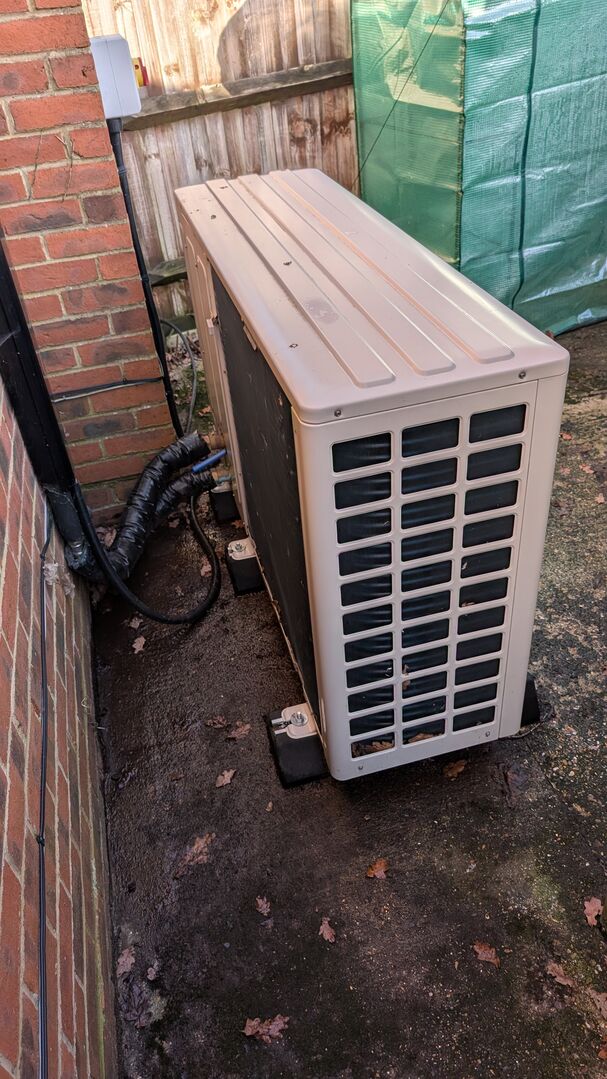
Midea R32 Monobloc MHC-V12W/D2N8-B
Pump located on east side of house, 400mm away from the wall and mounted on rubber feet (albeit 2 of the 6 bolts appear to be missing and are being replaced).
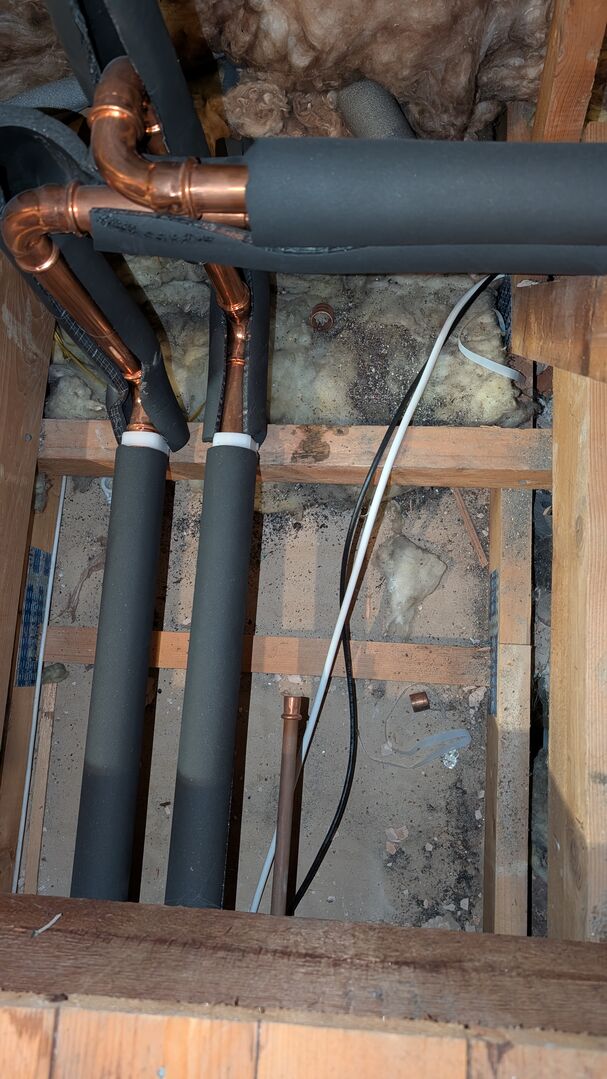
Pipework goes up east side of house into attic space, from where it drops down into first floor airing cupboard. Heating is provided by radiators.
I believe that the existing gas boiler pipework was used but new radiators were fitted to all rooms apart from the lounge and hallway.
I bought the house a couple of months ago but have only just moved in. The previous owner had the system fitted but subsequently needed to sell the house and move up north so I inherited it just past its first birthday.
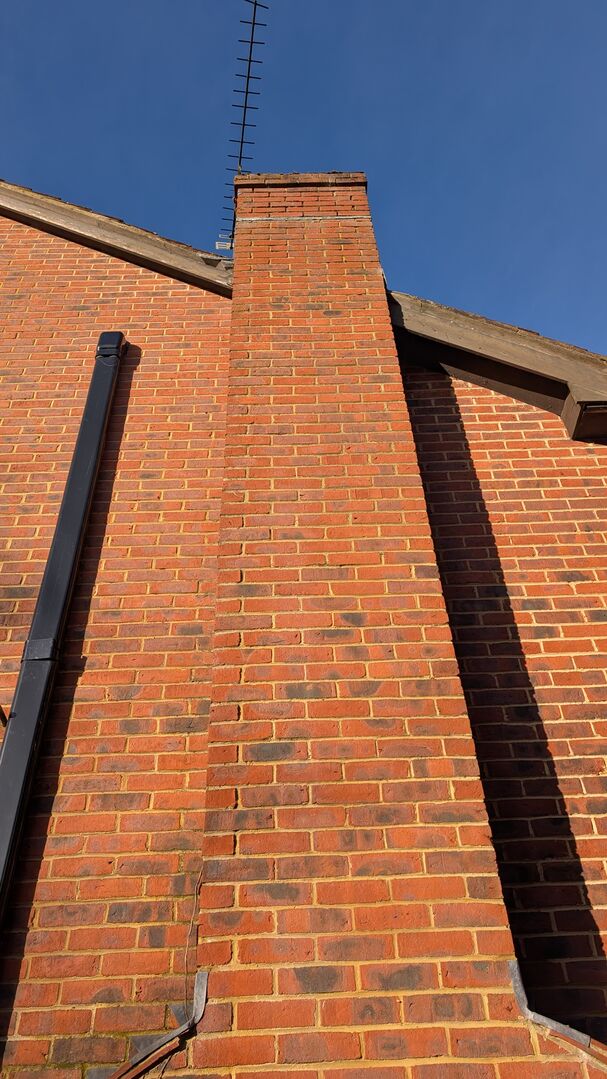
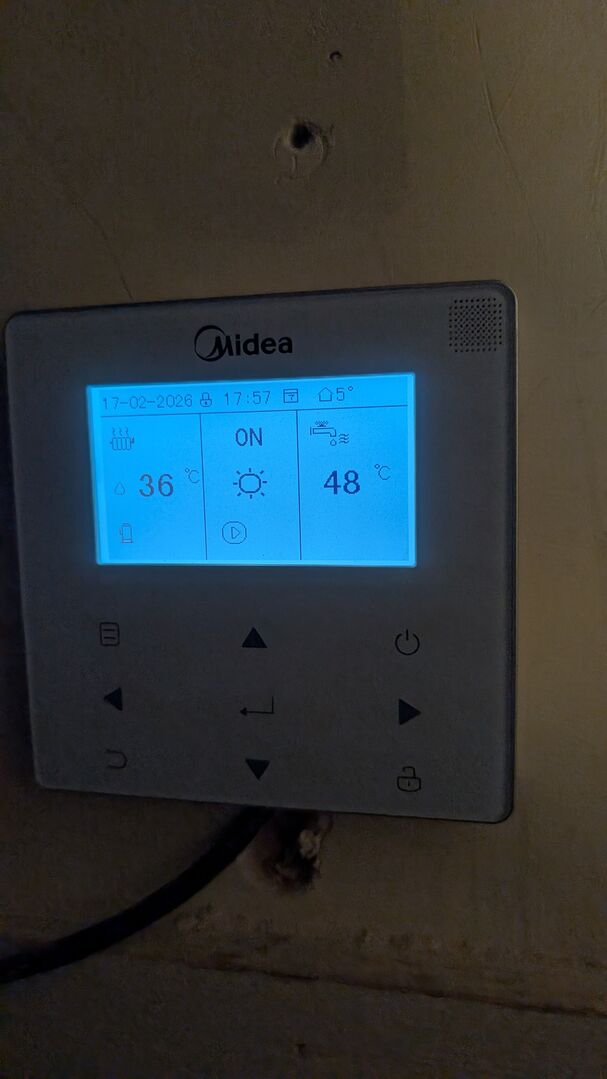
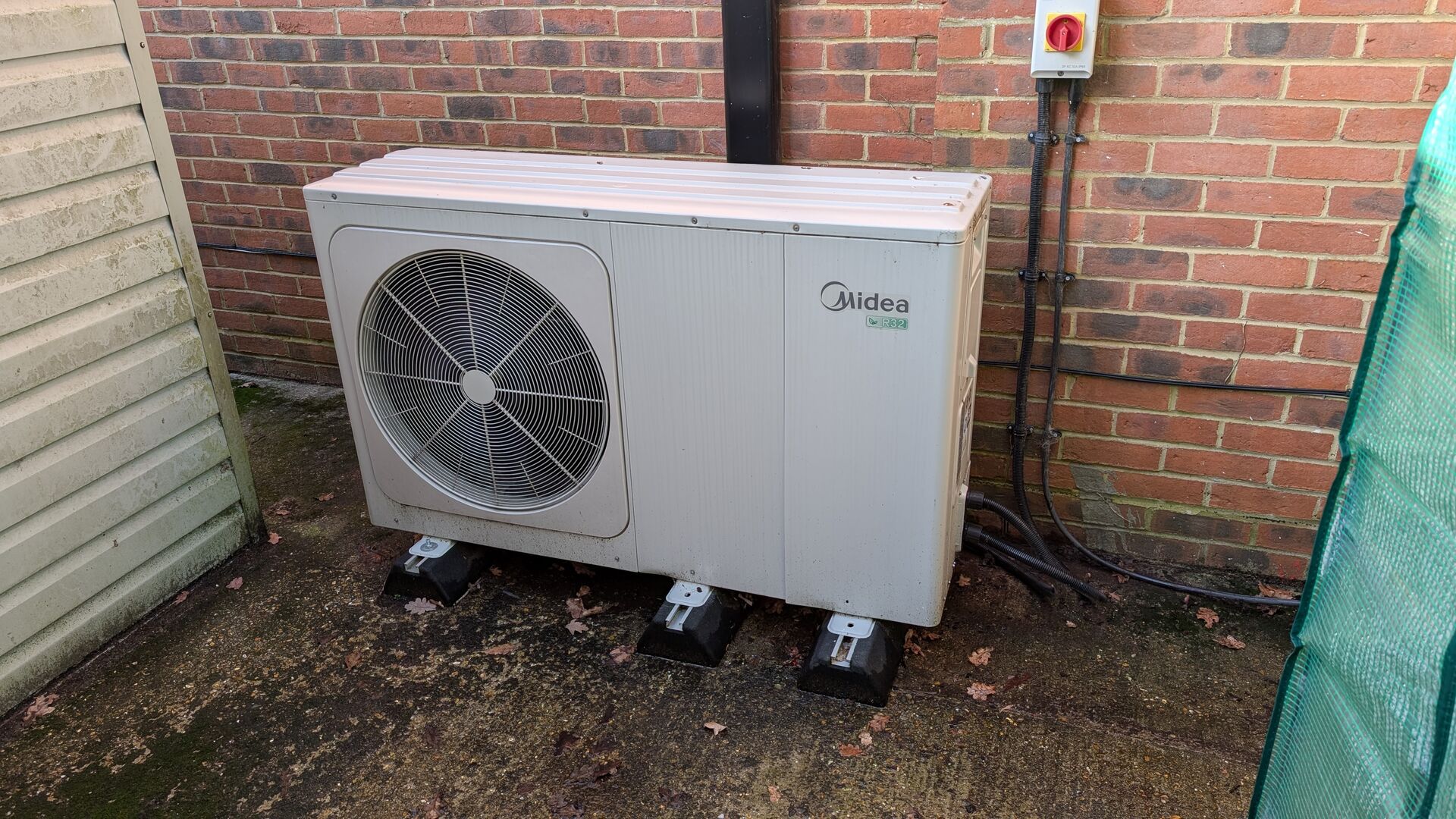
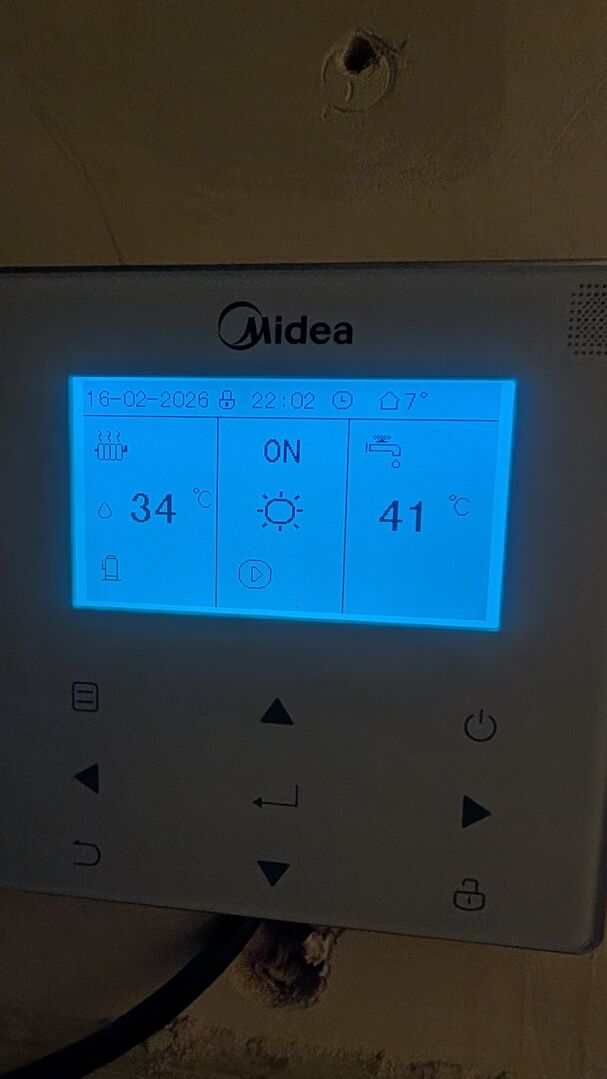
Heating
I'm generally happy with the heat levels I get across the house. The upstairs is slightly warmer as one might expect, and as the rear of the house is south facing it benefits from sun a lot of the time.
I'm confused about how to balance heating output with the lock shield valves though. Currently all my TRVs are open fully so not sure if I need to do anything further with lockshields. All the radiators seem to heat up to similar levels, although the lounge, which was one of only 2 radiators not replaced, is a bit cooler (probably exacerbated by not currently being able to close the door fully!).
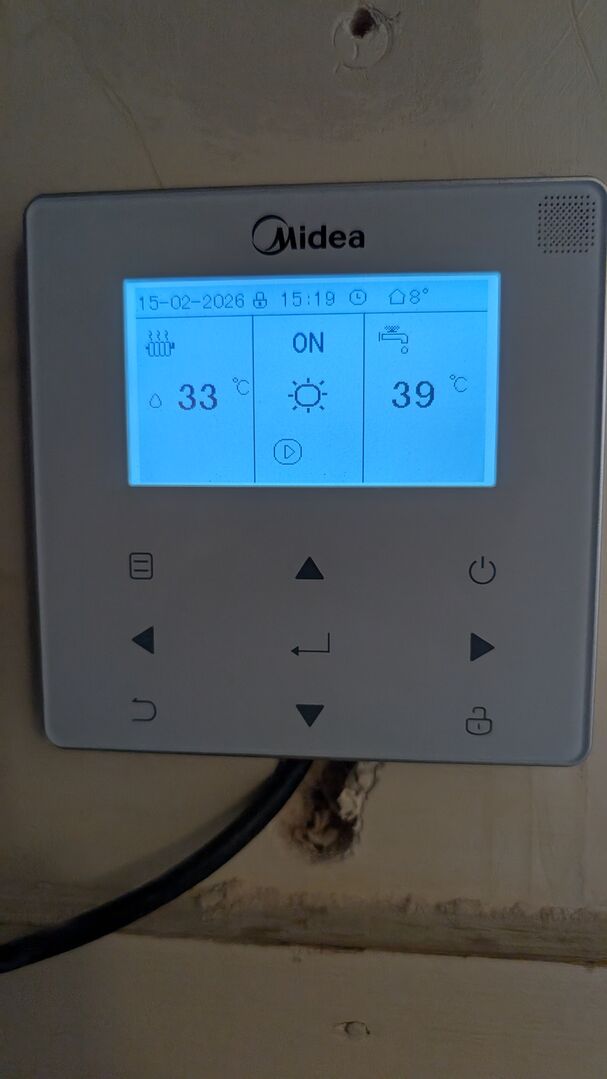
I have a weather compensation curve active which seems to do its job (typically 33 flow temp at 8 degrees outside temp and 38 flow temp at 3 degrees outside temp).
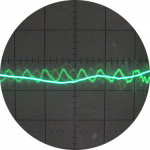
I've never lived my adult life in a property with a wet central heating system as I've always been in apartments with electric panel heaters, so I'm totally unfamiliar with the noises that one should hear from the heat pump. The outside pump itself makes a low whirring noise when the fan and compressor are active which can occasionally be heard inside through the adjoining wall to where it's mounted outside - but it's never particularly intrusive. However, I do hear noise inside the property which is louder than I was expecting. When the pump and/or compressor are active I hear a 'buzzy' noise through the inlet/outlet pipes in the loft and down into the airing cupboard. Hard to describe but like 'data scrambling' and, perhaps like the noises I remember my old central heating system as a child making.
Because the airing cupboard is sandwiched between my bedroom and one of the spare bedrooms I can hear the faint sound of the internal workings and what can only be described as a very very faint rumble like a wheelie bin being wheeled down a path. Very very faint and not audible in the loft pipes but only occasionally in the house itself. I do have exceptionally sensitive hearing so not sure if I'm overthinking what are perfectly normal noises.
As I hear it at night and I'm a light sleeper I wondered if it was worth considering setting back the heat overnight for a few hours or whether the re-heat efforts are not worth it.
Additionally, sometimes I hear an intermittent drip noise from the kit in the airing cupboard. There's no visible leak (and because I did have a leaking hot water tank replaced under warranty I'm super paranoid at checking every day). It's not audible elsewhere in the house and it's only occasionally from the pipes somewhere around the 2 expansion tanks. I can't work out if it's just condensation in the pipes or natural dripping noises from water going through the system. Only occasionally and I can't pinpoint it to a set time.
Domestic Hot Water
I was setting the DHW using the timer tab on the controller for e.g. 14:00-15:00 every day to hit 45 degrees, but I was finding it wasn't always heating up at these set times. Even though the 'squiggles' next to the tap symbol would turn on as planned the tank temp wouldn't increase.
I've just changed this to use the 'schedule' function instead and seem to be observing a similar pattern, maybe only every other day will the tank actually heat up. I wonder if this is because my 'tank reheat trigger' point hasn't been met yet (i.e. if my target temp is set to 45 on the timer, my reheat threshold is -5 then the timer will only ever kick in if the actual tank temp falls to 40 or below?) So, for example, at a current tank temp of 41 it wouldn't reheat even if the timer was instructing it to hit 45?
On the subject of legionella and immersions, I have the seperate immersion and TimeGuard clock fitted, however for the last few weeks the power and output LEDs don't light up on the timer, even though the display works and allows me to control it 'on and off' etc. I wonder if the timer is working off battery power and may have lost its electricity supply (I've recently had a new consumer panel fitted). If the electric immersion heater *was* actually running would the Midea controller reflect the increased 60 degree tank temp, or is it independent of the Midea temp detection?
I've read mixed opinions on whether running a legionella cycle is required. If the immersion heater is indeed not working could I just set one of my weekly timers on DHW to hit as close to 60 as possible? I believe that temps over 50 degrees will kill legionella over a couple of hours anyway? Does the legionella disinfect cycle on the Mideas require a seperate immersion heater or does it control the heat pump to increase the flow temp?
As an aside, I've signed up to Midea's MiCare scheme and awaiting my first service from them. Unfortunately, and I'm not sure how, they'd assigned my pump's serial number to another property record so I've been in dispute with them about convincing them I'm due the service which shows as already completed on their system.
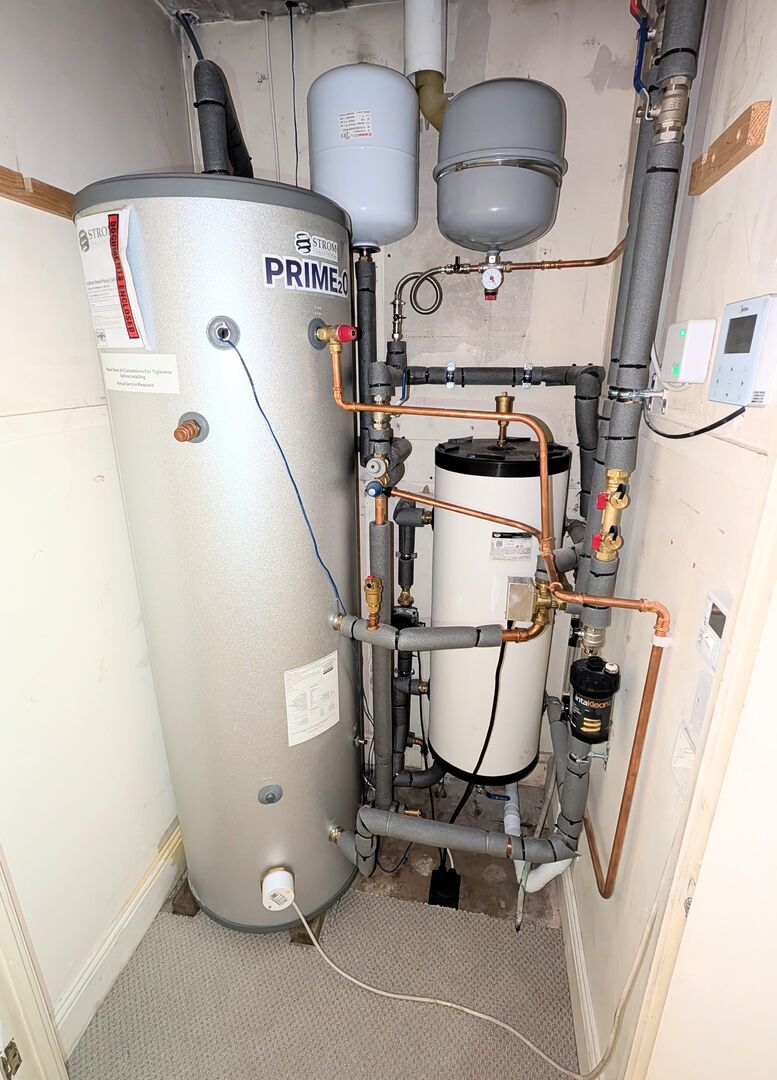
I've attached some photos to show my set up.
19/02/2026 1:22 pm
@painter26 — welcome, and thank you for your clear description of what you have, and your questions.
First of all, I think you are largely on top of things. You are running weather compensation, which is the right way to do things given your setup. The importance of radiator balancing is sometimes over-rated, as long as it is roughly right, then it is probably good enough. You have all the TRVs fully open as you should, and if the heating just works with all the lock shields also fully open, that is fine. As it happens that is what I have, air flow between the rooms evens things out. Your lounge rad may be a bit on the small side, it may be worth considering fitting a larger one. If you have copies of the original heat loss survey and individual room losses, it should be easy to decide whether that is something worth pursuing.
You are on the right track with the DHW failing to reheat. The tank temp at the sensor needs to be below the the threshold. In your example, 45°C set DHW temp, -5 threshold (which by the way can be adjusted), at say 41°C for the tank temp sensor, a reheat won't be triggered. I find in practice (I also have a Midea heat pump) the tank temp sensor often needs to be a degree or two below the threshold to trigger a reheat. If you do need to do a manual reheat, the easiest way is to temporarily raise the DHW set temp, say to 50°C in your case, and then turn on DHW heating. You can do both of those things from the main home screen. Once the reheat has happened to the temp you want, you turn off the DHW heating, and reset the DHW set temp to your normal value.
I personally think the legionella risk in a closed (sealed) system in regular use is probably close to zero, and so don't bother with a legionella cycle. Having a resident with a pre-existing health condition might alter that assessment, but I doubt it. If you decide you do want to run a legionella cycle, you can use the heat pump, which will be more efficient than an immersion heater. I'm not familiar with it, because don't use it, but I believe Midea units have a legionella setting. Alternatively, you could run your own DIY cycle by setting the DHW set to maybe 55°C and make sure the tank stays at that temp for an hour or two (ie much as you suggest). There is a good Heat Geek article on legionella risk and how to manage it here.
The noises: not sure what to make of them. None of them sound (sic) particularly sinister to me. If they trouble you, you will need to do some diagnostics to narrow down where the noises come from. Using a night time setback is indeed another option to quieten things down overnight, but as you have already spotted these are controversial as to whether they (a) save or cost money and (b) recovery can be slow, because heat pumps aren't designed or meant to do sudden boosts.
I think I've covered all your question, let me know if I have missed anything out. And please do let us know how you get on!
Midea 14kW (for now...) ASHP heating both building and DHW
1
Topic starter
19/02/2026 2:47 pm
Thanks a lot @cathoderay - I've learned a lot from yours and others' posts on this forum.
Does the occasional 'drip' sound from the system sound normal in the airing cupboard? As I say, no signs of a leak and it sounds like it's coming from inside the pipework or maybe the expansion tanks - and only then occasionally.
Also, are you able to help identify what the purpose of the various tanks in my set up do?
I understand that the smaller cylinder next to the main DHW tank is the buffer. I'm not totally sure what it does and my installer did suggest that he felt it unnecessary but they're required to fit them.
The two expansion vessels - white one above the DHW tank I imagine is the cylinder's expansion tank? What is the purpose of the grey vessel top right?
I should also add that the pressure gauge when I moved in was reading below 0.5 bar. I believe the previous owner had an issue keeping pressure too with no evidence of leaks when the installer looked for them. In the last few weeks I discovered the hot water tank was leaking so has now been replaced (we suspect a potential pin hole leak which the manufacturer is now investigating). I've also got a leaky pipe valve into the bathroom towel rail which based on the amount of verdigris has been leaking for ages and I've temporarily turned it off at the TRV. Since these interventions it looks as though the pressure has stabilised so I'm hoping this was the cause.
1
19/02/2026 3:51 pm
I've learned a lot from yours and others' posts on this forum.
Thank you!
Does the occasional 'drip' sound from the system sound normal in the airing cupboard? As I say, no signs of a leak and it sounds like it's coming from inside the pipework or maybe the expansion tanks - and only then occasionally.
It doesn't sound alarming to me, given the context, occasional, no leaks and sensitive hearing. Maybe other can come up with a (benign) explanation? @transparent? @jamespa
Also, are you able to help identify what the purpose of the various tanks in my set up do?
I understand that the smaller cylinder next to the main DHW tank is the buffer. I'm not totally sure what it does and my installer did suggest that he felt it unnecessary but they're required to fit them.
The two expansion vessels - white one above the DHW tank I imagine is the cylinder's expansion tank? What is the purpose of the grey vessel top right?
Buffers are for duffers, as you will know from your forum reading. Do you know if this indirectly a 'Freedom Heat Pumps' installation (ie they supply usually as a kit it to the installer who then installs it), quite likely as they are based in Chandlers Ford and you are in Hampshire. If so, they went through a period when they said some form of primary/secondary circuit separation was mandatory (I have a plate heat exchanger as a result, but low loss headers and buffers were also used). Long term, you may want to convert it to a volumiser which does what it implies, adds volume. I've kept my plate heat exchanger because it provides physical separation, meaning no rad crud in the primary circuit and glycol only in the primary circuit. Freedom have since been said to have relaxed the separation requirement.
The two expansion vessels: one will be for the hot water circuit. I can see what looks like a Caleffi pressure reducing valve (thing with the grey and blue caps on the vertical pipework by the main tank), the lower outlet on that valve will probably go to bottom DHW tank inlet, and one of the expansion vessels is likely to be teed into that feed, follow the pipework to work out which one. The other one is possibly for your rad circuit. You may be able work it out by following the pipework again. Faling that post more photos and we will see what we can make of them.
It also looks like you have an analogue flow meter, brass thing with two red valve handles on the right, another common Freedom feature. This is also used to fill the system, but the meter is a useful independent check on flow rate.
My primary circuit has a very small leak, such that the pressure will drop, but take weeks even months to do so. It must be a leak, but so small I am not sure it matters, and, like you, I have not been able to find out where the leak is. I just live with it, all the more so since I have never found a clear explanation of why the system most be pressurised to a positive pressure (obviously you don't want a negative pressure). Every now and then when I get round to it (twice a year?) I top it up using a temporary filling loop/adaptor which on my system can be temporarily connected to the rad filling loop, if that makes sense, I guess if you have been topping the system up, you have your own working arrangement. If anyone who reads this can enlighten us as to why the system needs actively maintained positive pressure, I am sure we will all be very grateful.
Midea 14kW (for now...) ASHP heating both building and DHW
1
Topic starter
19/02/2026 5:51 pm
Thank you @cathoderay .
The system was indeed supplied by Freedom (or at least the Midea handover booklet also has their logo on it!).
Now, I didn't realise the analogue gauge was a flow meter - I understood it to be pressure (although I'm not sure the pressure of what part of the system - and is this the same as the flow rate?)
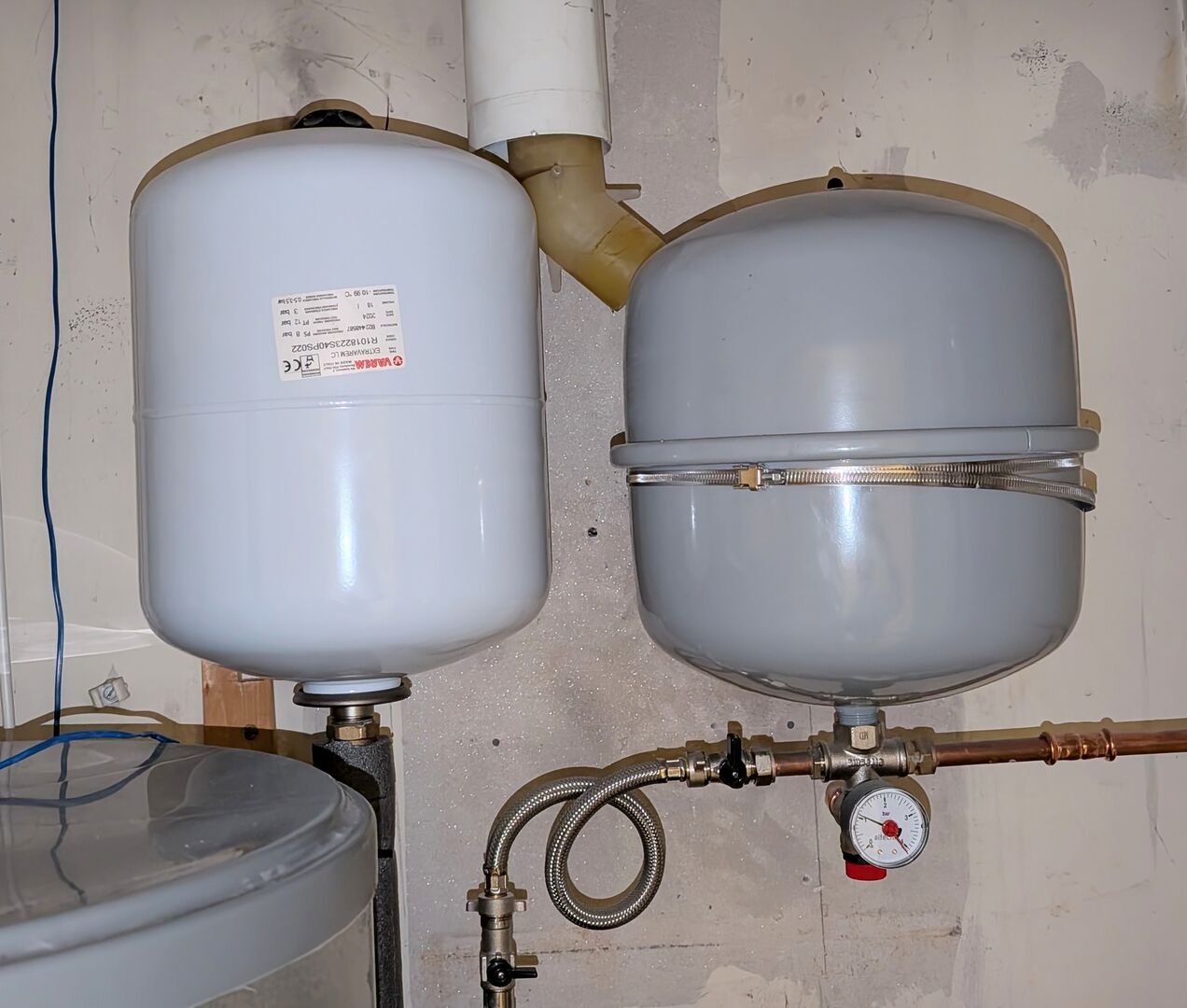
The left hand expansion tank is an ExtraVarem unit which looks like it connects to the blue/grey valves. The top right expansion tank with the filling loop and gauge is connected by copper pipe to ond of the two pipes that come down from the attic. This tank is also connected to the blue/grey valves from another pipe.
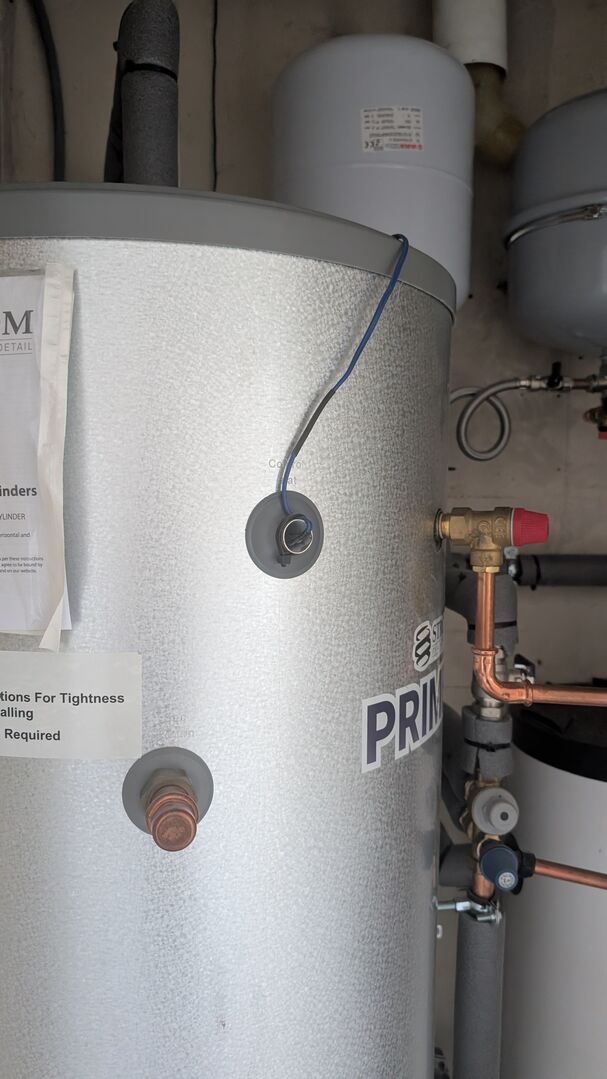
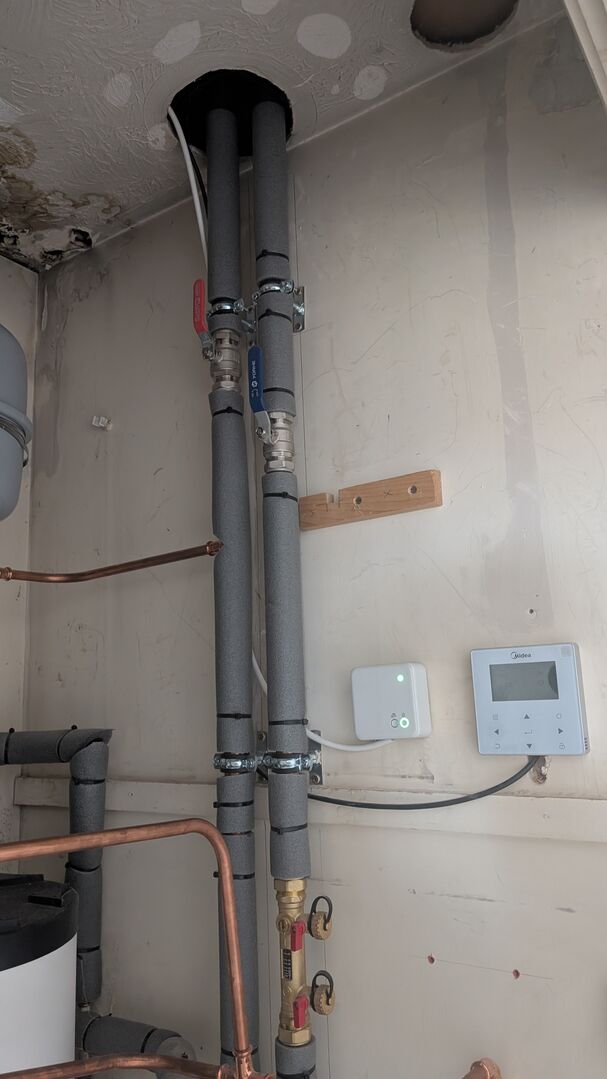
I've attached an assortment of photos to try and illustrate. Ignore things like the isolation valve to the tank turned off - some of these were taken when I discovered the tank leak!
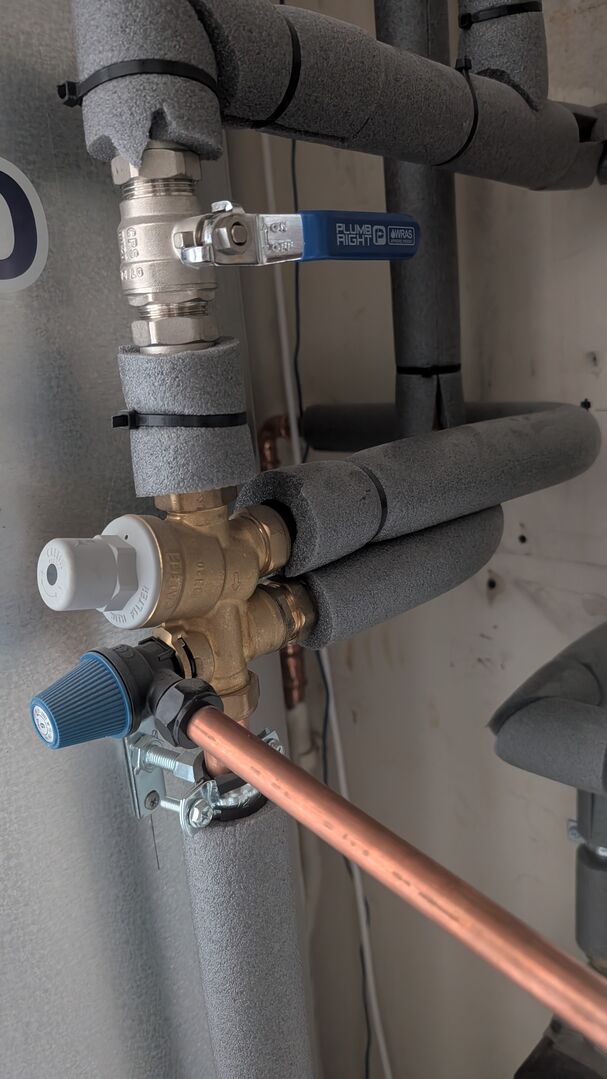
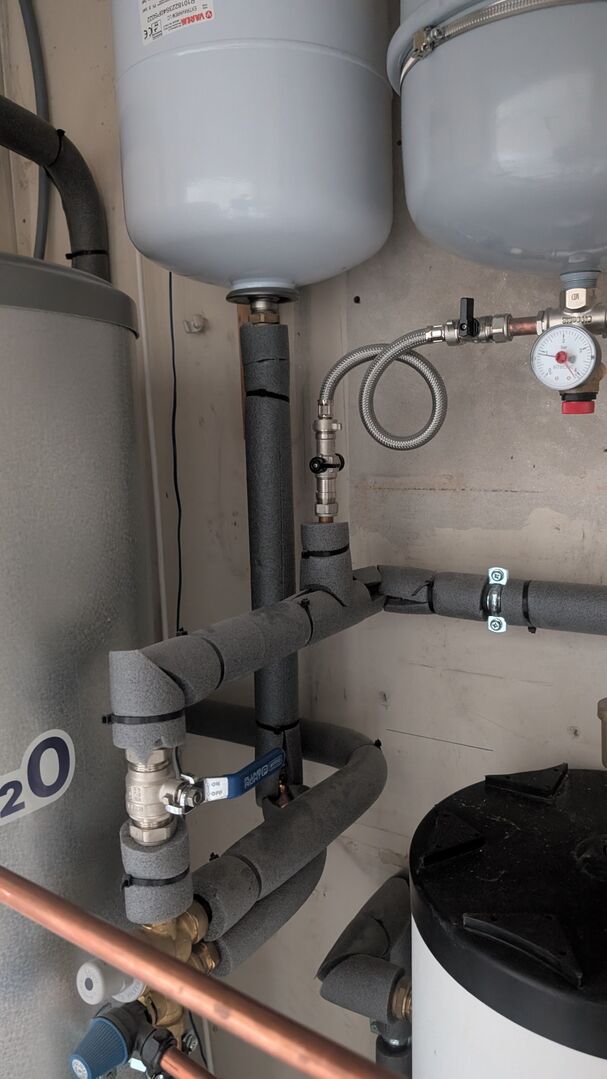
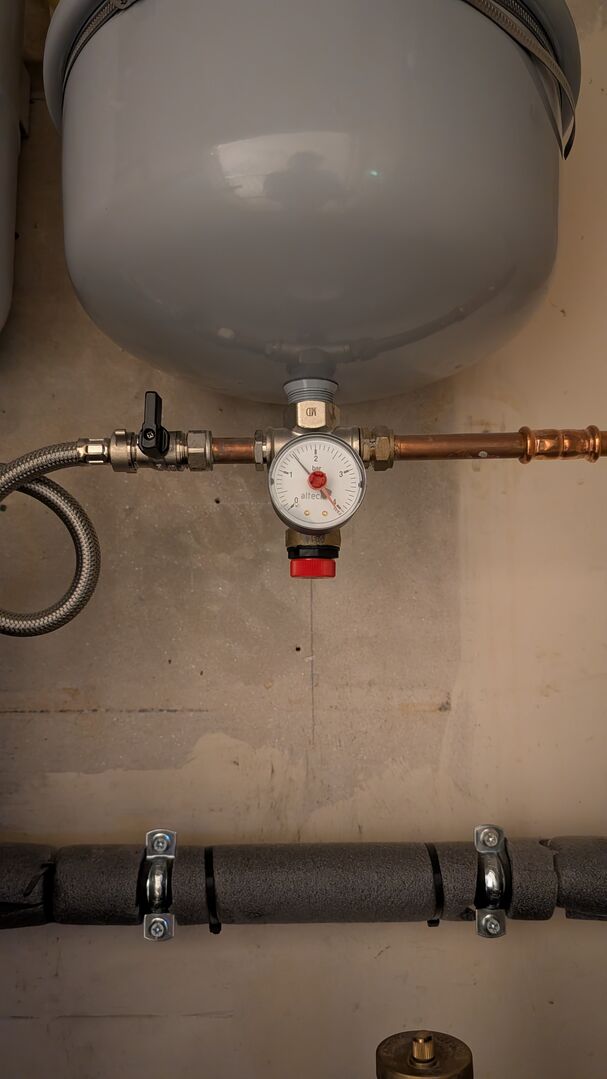
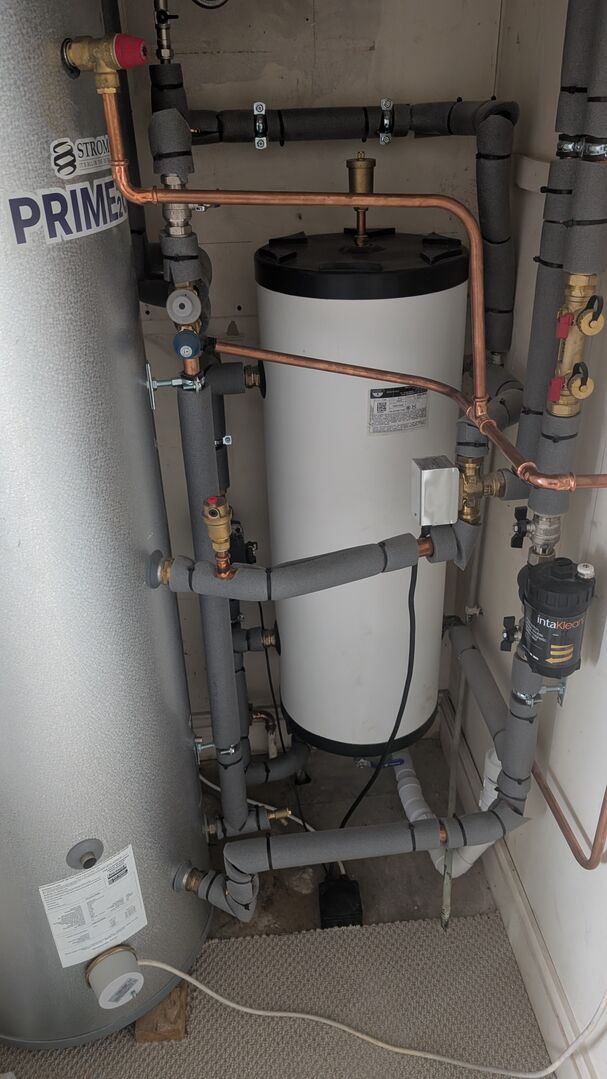
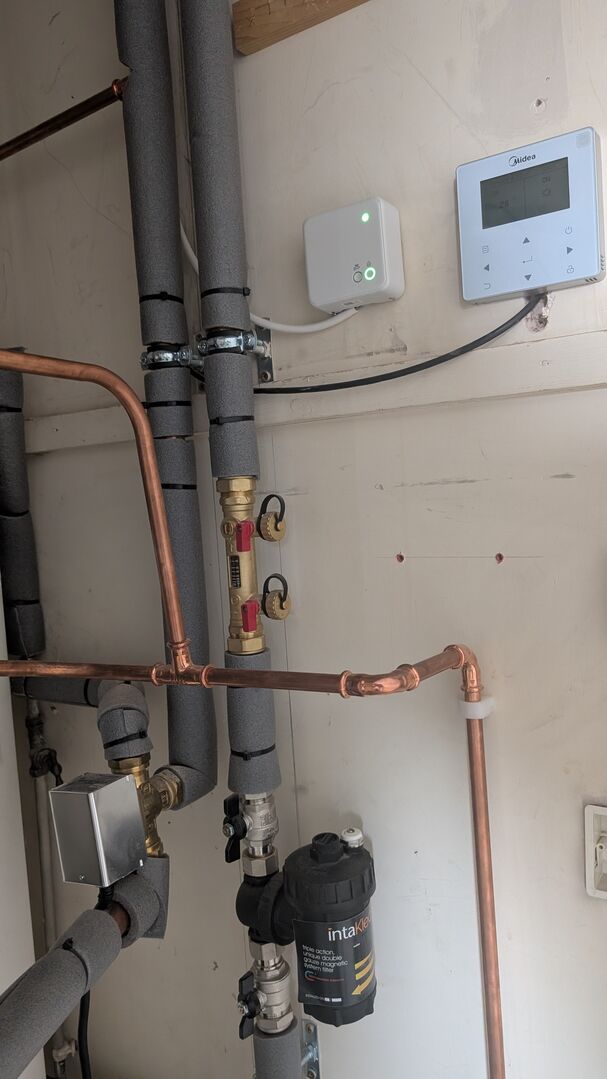
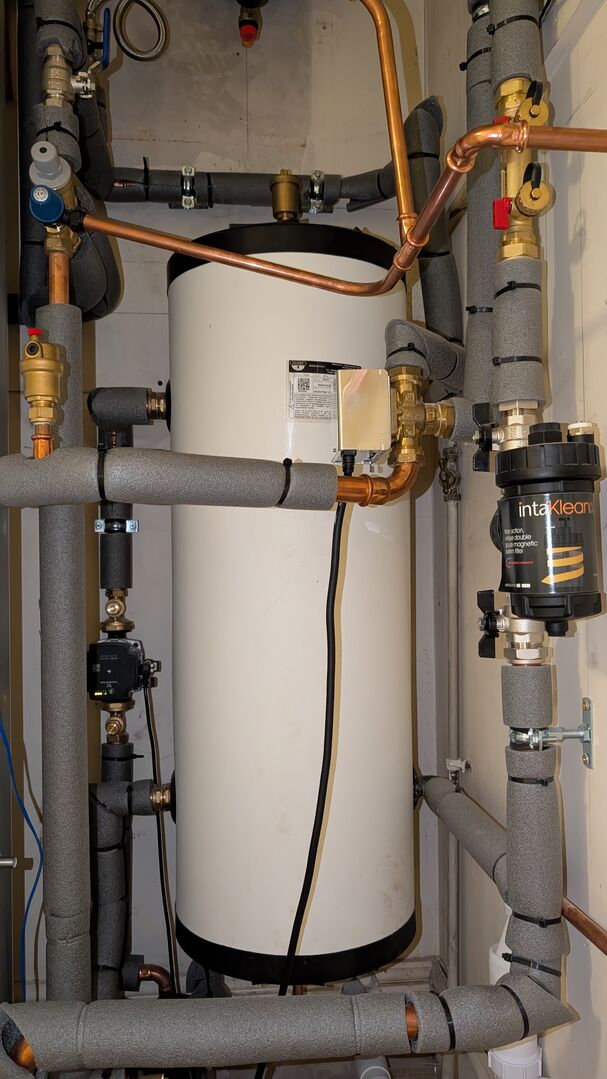
This post was modified 3 weeks ago by Painter26
19/02/2026 7:54 pm
Now, I didn't realise the analogue gauge was a flow meter - I understood it to be pressure (although I'm not sure the pressure of what part of the system - and is this the same as the flow rate?)
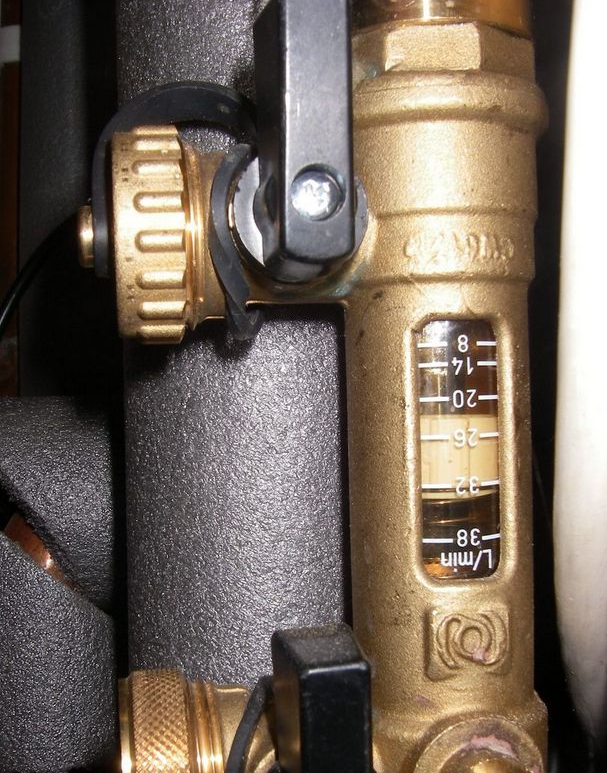
If you look at the side of it, you will see a glass observation port with with a scale marked on it, and behind that a little disk that moves up and down depending on the flow rate. Note it may be fitted upside down! Normally you read the value at the bottom of the disk, which is now at the top of the disk! The units are not the same (L/min) as the wired controller, but can be converted easily enough.
The left hand expansion tank is an ExtraVarem unit which looks like it connects to the blue/grey valves. The top right expansion tank with the filling loop and gauge is connected by copper pipe to ond of the two pipes that come down from the attic. This tank is also connected to the blue/grey valves from another pipe.
I'm pretty sure the left hand one is the DHW supply pipework (ie what eventually comes out of your hot water taps). The other one I remain less sure about. If the circular gauge on the right hand expansion tank is the one you use to check the system pressure, then that means it is connected to the primary pipework, and if it is also connected to to the two pipes that come down from the attic, which I think are the flow and return of your primary circuit, that adds further support to that conclusion. The pig tail and two valves pipe is likely to be a filling loop coming off the rising main which then goes on to the Caleffi pressure reducing valve with the blue and grey caps. At least that is what I think the layout is, particularly if the rising main is as I have suggested it is.
I don't actually have an external expansion tank on the primary circuit (there is however I believe one in the main outdoor unit). I have the same DHW supply expansion tank that you have, but the other expansion tank I have covers the secondary radiator circuit. The difference may arise because of the plate heat exchanger I have, which physically separates the primary from the secondary circuit.
Midea 14kW (for now...) ASHP heating both building and DHW
Topic starter
19/02/2026 8:57 pm
The pig tail loop you refer to is what I was told by the installer to open both valves to increase the pressure (and thus the gauge that's attached to it). That's why I'm not sure what I'm actually increasing the pressure 'of' but it needs to be between 1 - 1.5 bar.
I've looked for this little flow gauge but can't seem to see anything.
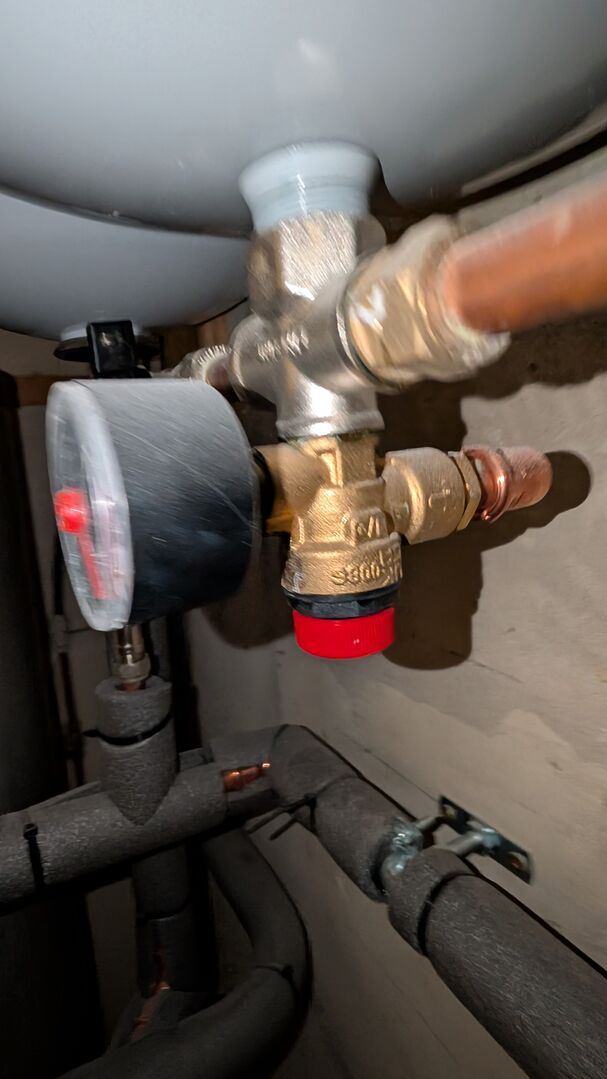
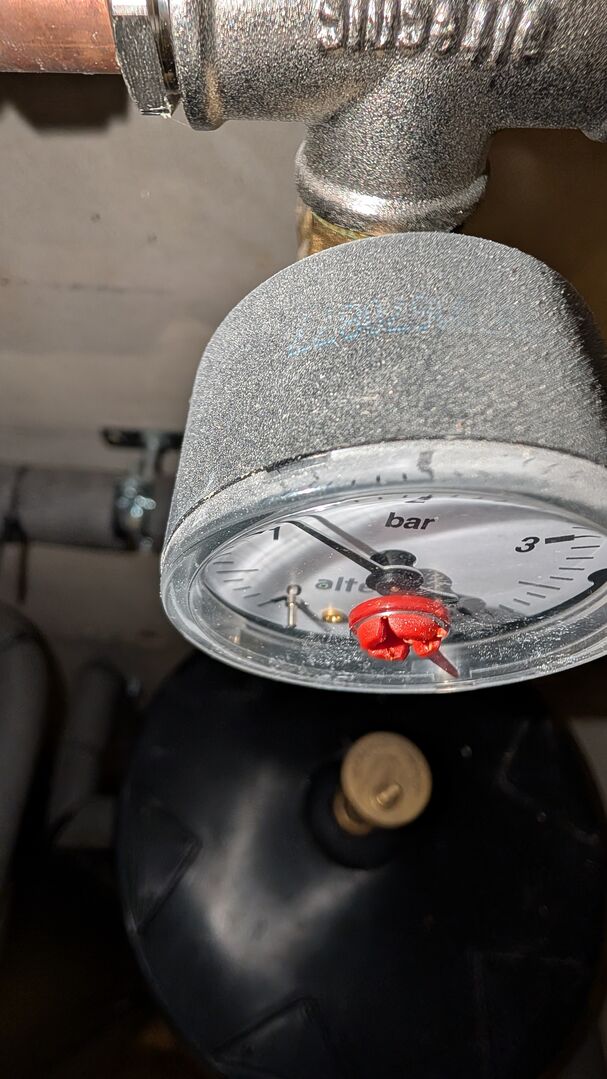
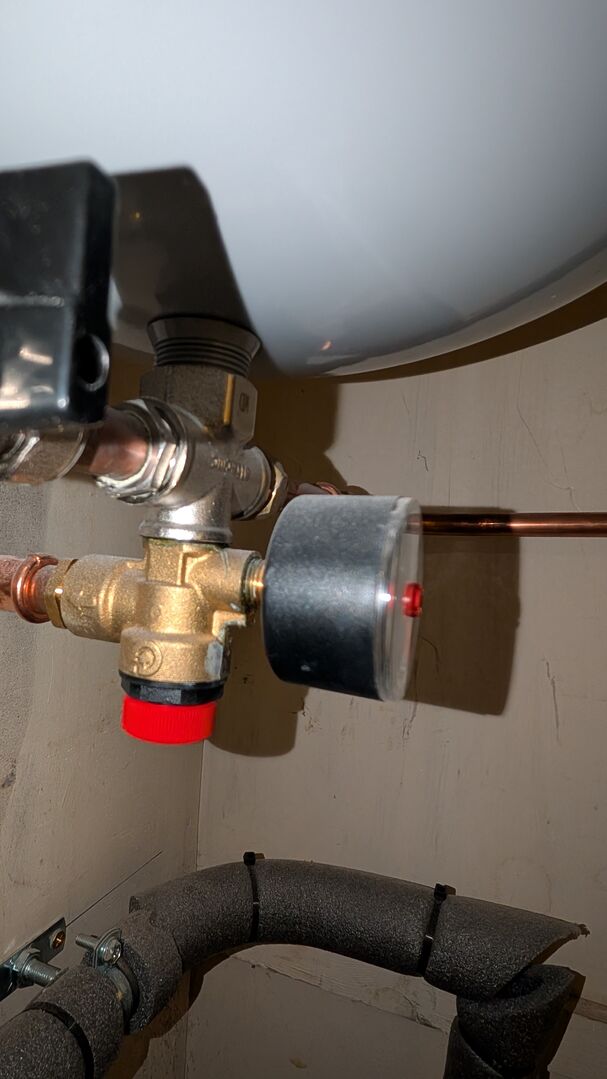
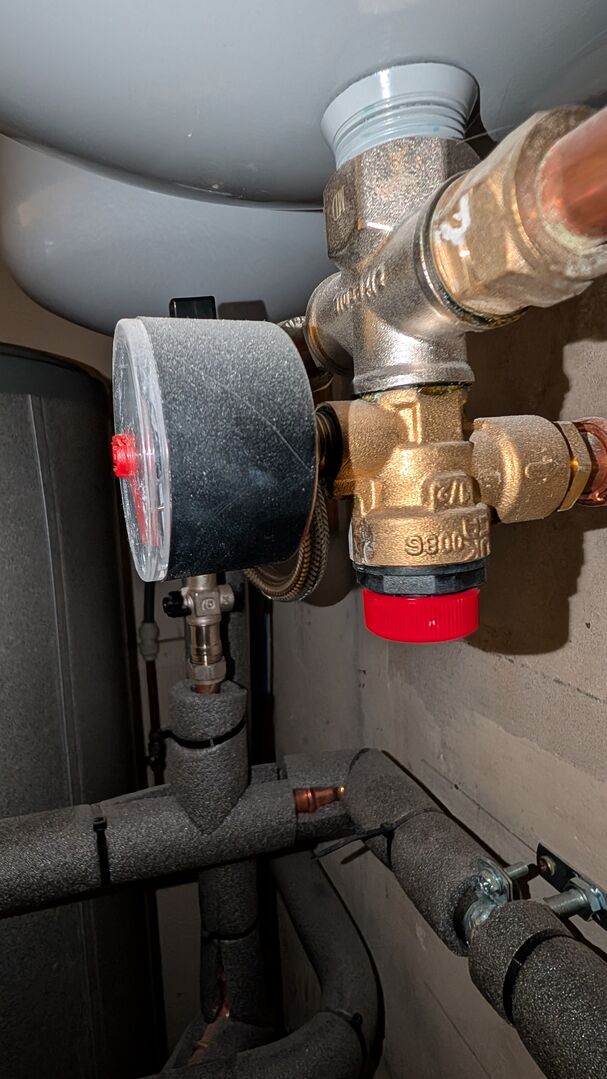
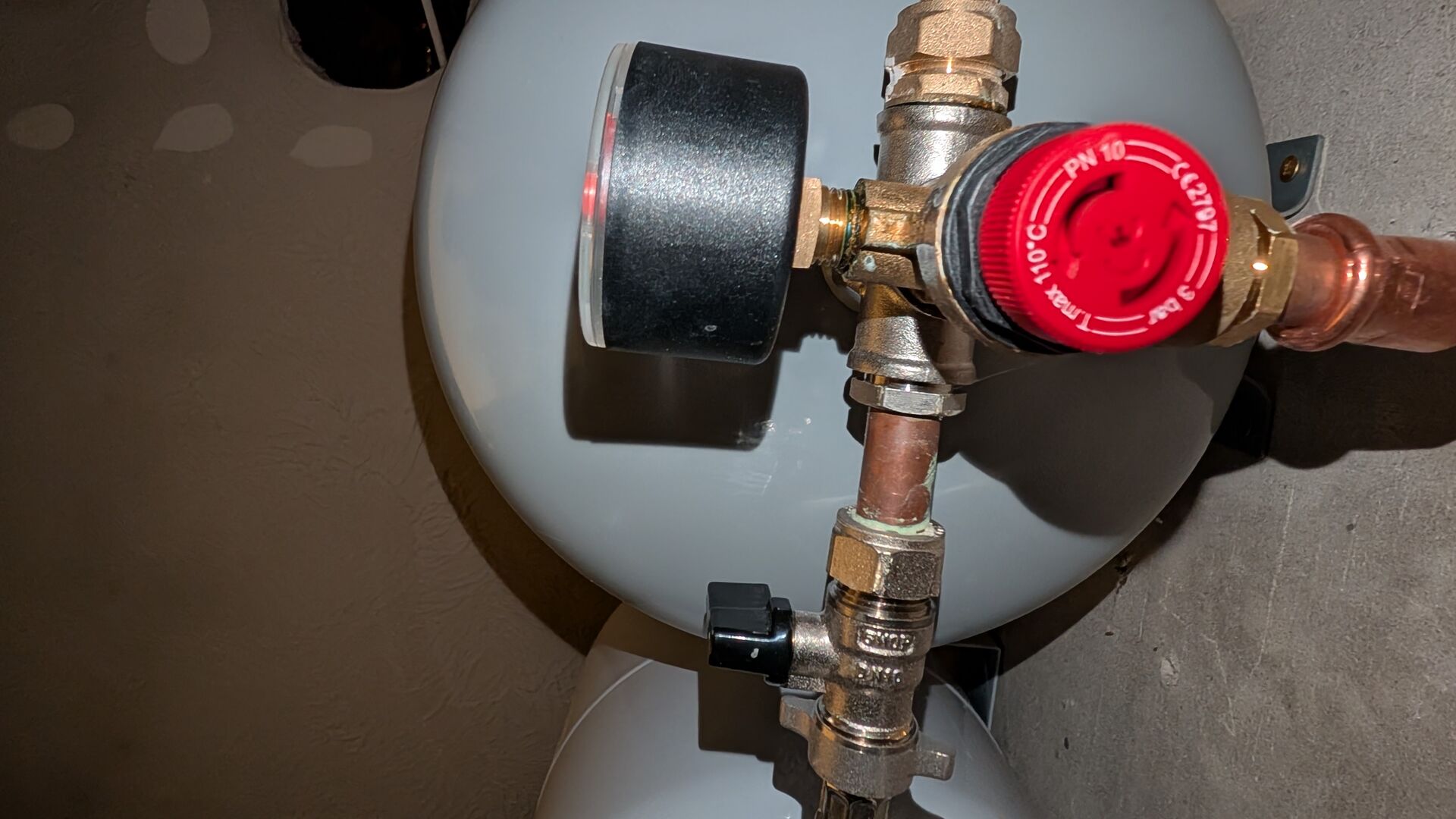
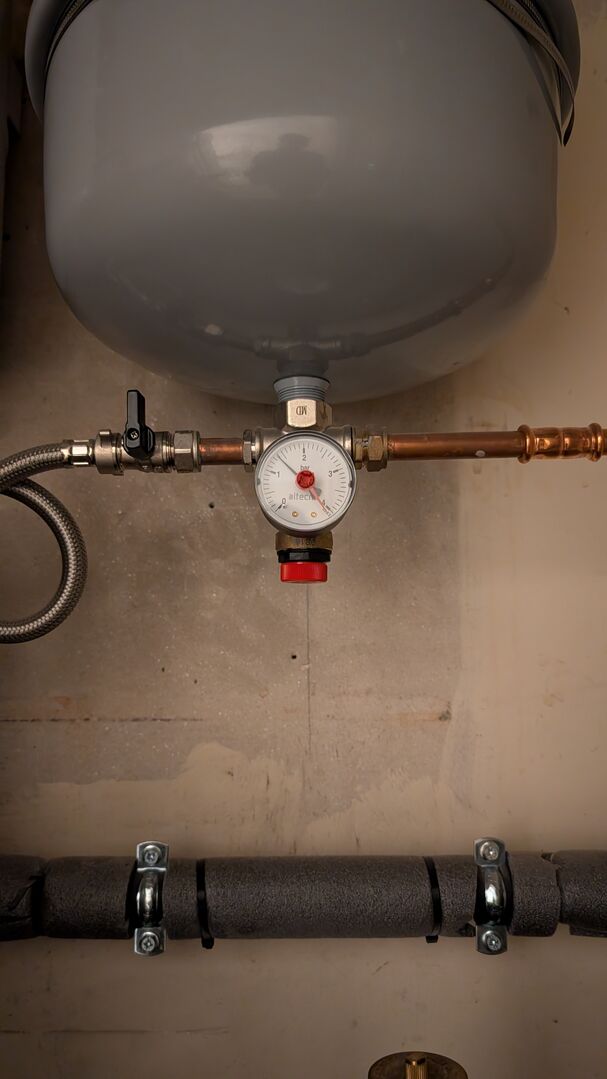

19/02/2026 9:23 pm
The pig tail loop you refer to is what I was told by the installer to open both valves to increase the pressure (and thus the gauge that's attached to it). That's why I'm not sure what I'm actually increasing the pressure 'of' but it needs to be between 1 - 1.5 bar.
This is absolutely standard for any sealed pressurised system (ie any system without a gravity fed tank usually in the loft). This is true whether boiler or heat pump so absolutely any plumber will know about it..
As @cathoderay says this is called a filling loop; its basically to allow you to let more water into the system (from the mains) if the system pressure drops because of a leak, because you have to bleed air out of the system, or for any other reason. The reason there are two taps and a non return valve is to prevent backflow of contaminated water in the system polluting the potable mains water.
4kW peak of solar PV since 2011; EV and a 1930s house which has been partially renovated to improve its efficiency. 7kW Vaillant heat pump.
20/02/2026 7:58 am
@painter26 — as @jamespa says, it's for filling and re-pressurising the main circuit that goes round the rads whenever that is needed, using water at mains pressure from the mains, and because its the mains, there are devices to stop backflow into the mains. The pressure from one of your earlier photos looks like it is 1.5 bar, ie where it should be. That is pressure. The flow rate meter is the brass thing on the right:
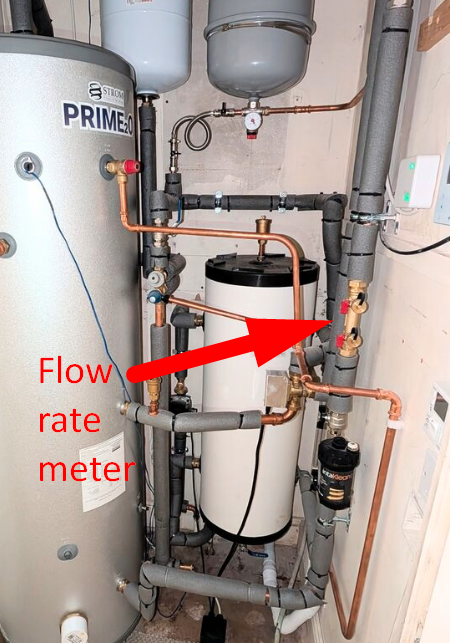
As I said earlier, it is quite likely that it is upside down. Here's a photo of mine, which is upside down, showing a flow rate of ~22.5L/min. You take the reading from the bottom of the disk, which is as the top when the thing is upside down and yes it is confusing!
Midea 14kW (for now...) ASHP heating both building and DHW
Topic starter
20/02/2026 7:30 pm
Ah, thank you. I was clearly looking at the wrong thing.
I've found it (right way up!) and it seems to correlate broadly with the Midea controller (albeit it's quite murky in there so difficult to see!)
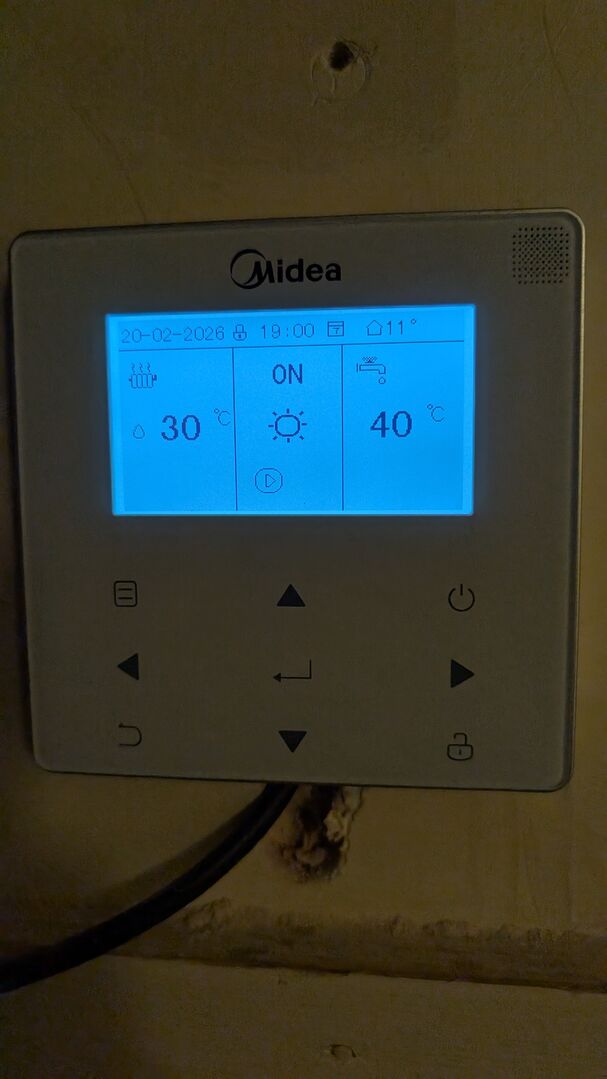
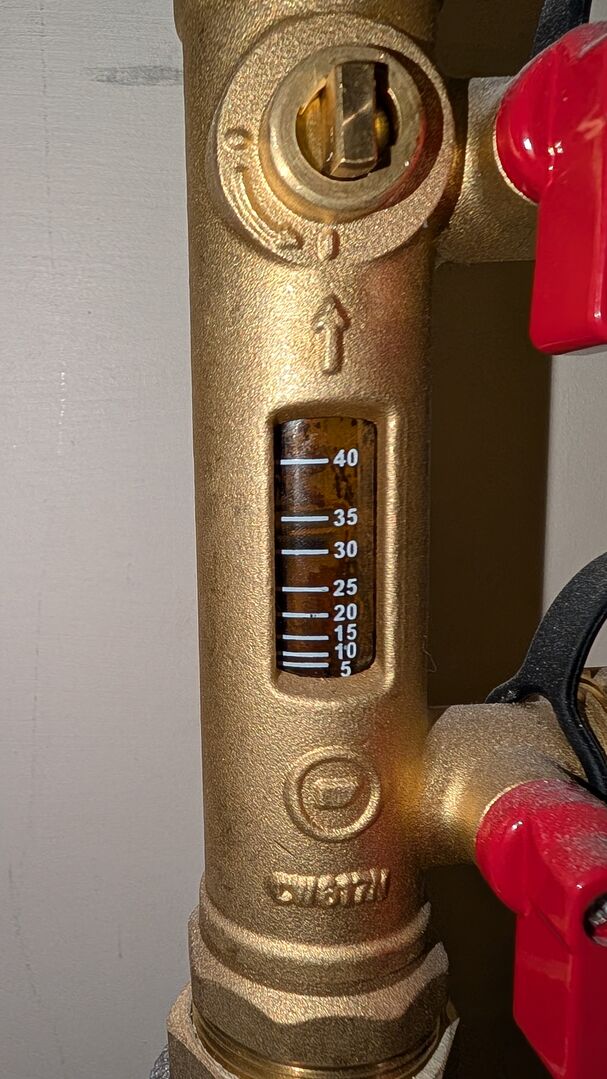
Coincidentally, I work for a large food retailer and we spend some days of the year working on the shop floor. Today I heard the same 'wheelie bin down a smooth path' sound I sometimes here when the compressor is running: it's the refrigerant through the pipes. I only realised this as I was filling up milk and cheese and could hear it all around me.
This post was modified 3 weeks ago by Painter26
20/02/2026 7:49 pm
@painter26 — they (the analogue gauges) are subtly different, also I can't see the units on yours (mine shows L/min) but most importantly the flow meter shows Flow Rate, whereas the wired controller is showing the Set Room Temp which it isn't using if you are in weather compensation mode (it's using the outside air temp instead). To see the flow rate on the wired controller, go into Menu > OPERATION PARAMETER and scroll through the pages to the one that shows the flow rate. It will be in m^3/h, if the analogue gauge is in L/min which it probably is then you will need to convert one to the other.
Coincidentally, I work for a large food retailer and we spend some days of the year working on the shop floor. Today I heard the same 'wheelie bin down a smooth path' sound I sometimes here when the compressor is running: it's the refrigerant through the pipes. I only realised this as I was filling up milk and cheese and could hear it all around me.
Well I never! A serendipitous discovery!
Midea 14kW (for now...) ASHP heating both building and DHW
Topic starter
22/02/2026 4:28 pm
@cathoderay ah yes, of course. I suppose there's no benefit then in me reading that analogue flow meter in practice, unless I need to verify the Midea controller.
Page 1 / 5
Next

Latest Posts
-
RE: Octopus Cosy 12 Heat Pump Regret: Incredibly Loud, Poor Heating & Constant Hum - Help!
Balancing is a long process and its possible to mess th...
By JamesPa , 2 hours ago
-
RE: Daikin Altherma 3 LT compressor longevity question
Up to a point yes. However every heat pump (and every ...
By JamesPa , 3 hours ago
-
Thanks everyone for the help, Havenwise now diasbled. q...
By Boycey , 5 hours ago
-
RE: Advice needed after a successful "leftfield" experiment.....
@pauli Depending on whether you can get an EV tariff, I...
By ChandyKris , 6 hours ago
-
-
RE: New Build ASHP Defects - Looking for Advice, Support & Shared Experiences
Is that a single pair only? If so it may be part if th...
By JamesPa , 7 hours ago
-
RE: Solar Power Output – Let’s Compare Generation Figures
@technogeek I think you are correct, but, it didn’t inf...
By Papahuhu , 8 hours ago
-

@batpred, you’re quite right; it does work well. I don’...
By Majordennisbloodnok , 8 hours ago
-

@Mars at the time of writing heating oil is £1.28 / ltr...
By TechnoGeek , 9 hours ago
-
RE: Ecodan Cylinder Possible Weeping Around Thermostat Port
Update: Mitsubishi sent an engineer around. It was li...
By Gruff2001 , 11 hours ago
-
RE: A Smarter Smart Controller from Homely?
@benson Agreed. I believe the COP gains with homely, i...
By Papahuhu , 12 hours ago
-
RE: Samsung Gen 7 16kW Integrated unit Modbus monitoring
The setup for this is a Samsung Modbus card. Connected ...
By antonical , 13 hours ago
-

RE: Forum updates, announcements & issues
@davidalgarve, if the emails are more than roughly a mo...
By Mars , 14 hours ago
-
How to Find All Your Posts and Topics on the Forum – A Quick Guide
If you’ve ever posted something on the forum and then s...
By Mars , 14 hours ago
-
RE: If a heat pump can only heat DHW to 50C then what? Issue with 18KW Heliotherm heat pump
Sorry to hear that but I'm not surprised TBH. Stratifi...
By JamesPa , 15 hours ago
-
RE: Say hello and introduce yourself
@pt151 welcome to the forums, and looking forward to he...
By Mars , 1 day ago
-
RE: Setback savings - fact or fiction?
The answer was in two parts in my reply, the second par...
By RobS , 1 day ago
-
Samsung Gen 7 16kW Integrated unit Modbus monitoring
Looking for some assistance to get modbus monitoring wo...
By antonical , 1 day ago
-
Ecodan control return to Melpump from Havenwise trial. settings check
Hi, Just got control back after being on the hav...
By Boycey , 1 day ago
-
RE: Refrigerant R32, is it now banned in the EU from 1st Jan 2027 for monobloc ASHPs?
I wonder if heat pump manufacturers will tone these sit...
By JamesPa , 1 day ago
-
RE: Who’s Caved and Switched the Heating On Already?
@editor yesterday we used 12kW of electricity for heat,...
By Judith , 1 day ago
-
RE: Rate the quality of your heat pump design and installation
Loss assessments can be a very serious case of GIGO. I...
By JamesPa , 2 days ago
-
RE: Who's your electricity provider and what's your tariff?
@jamespa Just bizarre. This is our data. I really don't...
By antonical , 2 days ago
-
RE: Mitsubishi Ecodan 11.2kW review
I think you said its an 11.2kW model and your house is ...
By JamesPa , 2 days ago