

Notifications
Clear all
Joining the Renewable Heating Hub forums is completely free and only takes a minute. By registering you’ll be able to ask questions, join discussions, follow topics you’re interested in, bookmark useful threads and receive notifications when someone replies. Non-registered members also do not have access to our AI features. When choosing your username, please note that it cannot be changed later, so we recommend avoiding brand or product names. Before registering, please take a moment to read the Forum Rules & Terms of Use so we can keep the community helpful, respectful and informative for everyone. Thanks for joining!
22/02/2026 6:15 pm
I suppose there's no benefit then in me reading that analogue flow meter in practice, unless I need to verify the Midea controller.
Not on a regular basis, no, but it is handy to have it there to confirm once in a long while that the wired controller flow rate makes sense.
BTW, I meant to ask why it appears so murky? Mine you will observe is crystal clear.
Midea 14kW (for now...) ASHP heating both building and DHW

Topic starter
22/02/2026 7:13 pm
@cathoderay I'm not sure to be honest! I will ask the installer when he's next over.
22/02/2026 7:26 pm
@painter26 — good idea. Please do let us know what he says.
Midea 14kW (for now...) ASHP heating both building and DHW
Topic starter
27/02/2026 5:39 pm
@cathoderay I spoke to him on the phone so haven't had a chance to show him but he did say it was a retrofit installation using old pipework and that glycol in the system might also make it murkier? Not sure if this is right though as I understand it to be a clear liquid.
On a seperate note I have a mystery I would like your opinions on.
Since yesterday I've decided to set the hot water flow temp to 55 degrees on a daily timer at 15:00-16:00. I only set this last night so yesterday evening I manually heated the water to 55 which took about 2 hours. Once it hit 55 I switched it off but noticed that the radiators were hot (previously they only ever get lukewarm, especially as the outdoor temp was quite high and my curve set low).
Within an hour or so the radiators had dispersed this heat and were back to being lukewarm.
Today the DHW timer kicked in at 15:00-16:00 and managed to heat the water up to 50 degrees within this time (rather than the 55 set) which I assumed was the fact that the 1 hour timer was not long enough to get it to full temp. However, once the controller indicated the system had flipped back to heating, from DHW, the radiators were once again hot. After 25 mins or so they cool down again to normal temp.
Is this a feature where any excess hot water after a DHW cycle gets dumped into the radiators? Or is it some fault with the diverter valve not fully controlling what goes where?
In all other respects the heating works fine and the radiators come on in line with the weather curve. It's only since heating to 55 that I've noticed this short term 'dump' of hot water into the rads.

27/02/2026 6:05 pm
I spoke to him on the phone so haven't had a chance to show him but he did say it was a retrofit installation using old pipework and that glycol in the system might also make it murkier? Not sure if this is right though as I understand it to be a clear liquid.
The system should have been flushed, ideally power flushed, before recommissioning with the heat pump. My system also has glycol in it, and as you can see from the photo I posted earleir, the circulating fluid is clear, no murkiness at all. These sound rather like 'my dog ate the paperwork' type excuses...
Is this a feature where any excess hot water after a DHW cycle gets dumped into the radiators?
I haven't really noticed this on my system, and in fact have asked myself why it doesn't appear to happen briefly, or at least isn't very obvious. At the moment the DHW heating stops the LWT is typically over 55°C in my system, and you might imagine that a volume of water at that temperature then being directed at the radiators, through a PHE (plate heat exchanger) in my case, might have some discernable effect, but it doesn't appear to. Instead, the LWT cools down to the normal LWT very quickly, over about four minutes or so.
I think it may depend on the system relative volumes. I don't have a volumiser (nor a buffer as I have a PHE), if present I imagine these might well hold more heat that then gets dumped to the rads when the space heating restarts. Others may know of a better explanation, and I am sure will chip in if they do.
Midea 14kW (for now...) ASHP heating both building and DHW

27/02/2026 6:08 pm
Do the radiators only get hot at the end of the cycle or at the beginning. If they only get hot right at the end perhaps its a (deliberate) timing difference to avoid any change that colder space heating water gets into the DHW. Another possibility is that you have a buffer/volumiser before the branch off to the DHW. Otherwise it sounds like a diverter valve fault to me. You can move them manually which might help tell whats going on.
This post was modified 8 months ago by JamesPa
4kW peak of solar PV since 2011; EV and a 1930s house which has been partially renovated to improve its efficiency. 7kW Vaillant heat pump.
Topic starter
27/02/2026 9:33 pm
@jamespa @cathoderay it appears that it's only at the very end of the DHW cycle that it happens. I've only noticed it the last 2 days as I've been here when the DHW is active. However, as I'm aware that the system can only do 'one thing at a time' I'm always aware that the rads get cold during the DHW cycle.
I'll keep monitoring it and mention it to the engineer when he's back next week and also show him the flow meter.
27/02/2026 9:55 pm
@jamespa @cathoderay it appears that it's only at the very end of the DHW cycle that it happens. I've only noticed it the last 2 days as I've been here when the DHW is active. However, as I'm aware that the system can only do 'one thing at a time' I'm always aware that the rads get cold during the DHW cycle.
I'll keep monitoring it and mention it to the engineer when he's back next week and also show him the flow meter.
Interesting. My DHW cycle happens at night so I wouldn't notice it, but it would make a lot of sense sense for the heat pump to switch the diverter before changing the flow temperature (at the end, other way at the beginning), so maybe thats exactly what it does!
4kW peak of solar PV since 2011; EV and a 1930s house which has been partially renovated to improve its efficiency. 7kW Vaillant heat pump.

28/02/2026 8:30 am
it appears that it's only at the very end of the DHW cycle that it happens
Which is what I would expect. When I do a manual DHW re-heat, the switch over from space to DHW heating and back again usually appears to happen as shown on the wired controller display by the position of the 'compressor running' icon within a few seconds, if that. I have never actually had a hand on the three port two way diverter valve at the time, but I have assumed it changes over at the same time. During the DHW re-heat, the rads do cool a bit, enough to be felt, and sometimes a dip in the IAT is visible. Next time i do a manual DHW re-heat I will make a point of checking the rads immediately after switching back to space heating, to see if they warm up at all.
Midea 14kW (for now...) ASHP heating both building and DHW
1
Topic starter
28/02/2026 6:09 pm
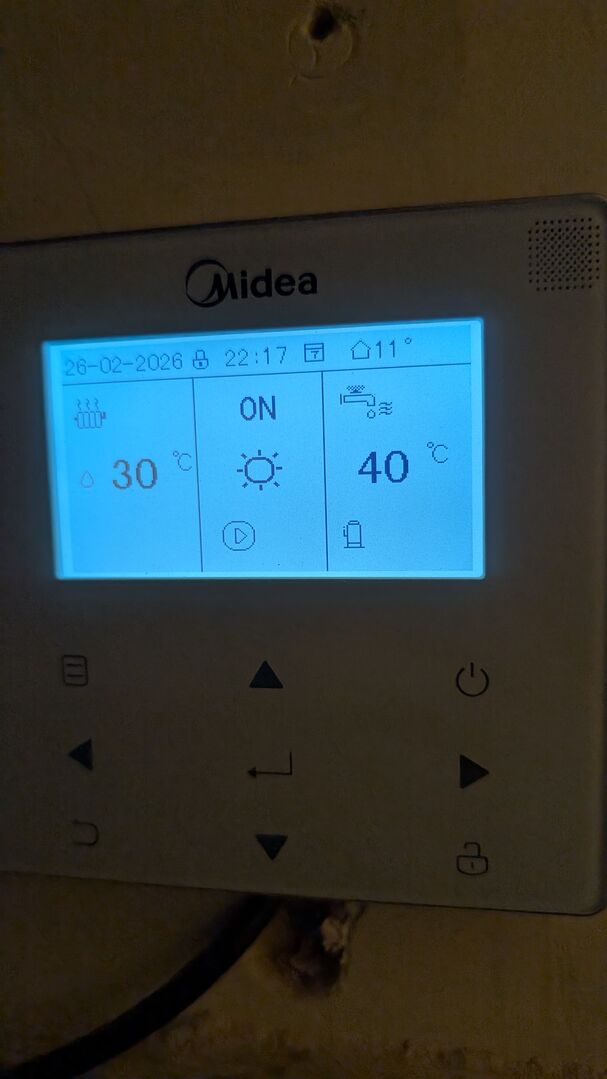
Something I've never been sure of is whether the hot water 'squiggly lines' should always be visible even when you want space heating active. I understood that the squiggles should only appear if you manually turn on DHW or when the timer instructs it as it is the visible indicator of water being heated, but that otherwise the squiggles shouldn't appear?
And similarly the 'teardrop' symbol on the space heating side is always illuminated even during DHW mode. Is this correct?
I'm assuming the 'ON sun' symbol in the centre is always a 'sun' regardless of mode?
E.g. in the attached photo my DHW mode was active but I still have a teardrop and sun symbol.
This post was modified 8 months ago by Painter26
28/02/2026 6:50 pm
I understood that the squiggles should only appear if you manually turn on DHW or when the timer instructs it as it is the visible indicator of water being heated, but that otherwise the squiggles shouldn't appear?
I think that is correct, and it is what happens on mine. I think the squiggles mean 'on' but not necessarily 'active' which is how you can have squiggles on the left above the rad icon and on the right by the tap icon, as you have in your image. I use the petrol pump icon to tell me which actually active. Since DHW heating takes priority over space heating, you don't want tap squiggles apart from when you want DHW heating.
The teardrop on the left and the number next to it (mine is showing 40 at the moment) mean nothing so far as i can tell in WCC mode. In fixed LWT mode, my understanding is that it is the set LWT, and I think you can adjust it there on the home page.
The middle ON and sun symbol are supposed to mean the space heating is on. There was a period when I would get a tap there, possibly when the heating was off in the summer. In the photo, you are clearly heating the DHW, so maybe again the middle ON means space heating is 'on' but not necessarily 'active'.
Bottom line for me is to use the petrol pump icon location to tell me what is on and active.
Midea 14kW (for now...) ASHP heating both building and DHW
Topic starter
28/02/2026 7:24 pm
Thanks @cathoderay - my understanding too, although I take the petrol pump to mean the compressor is running to actively heat whatever it should be. And that as long as the water circulating the system is still hot enough you're still getting warmth or hot water as long as the 'play' button us showing '(circulating) pump active',
SPONSORS
Degrees of Separation

Latest Posts
-

RE: Heat pump branding. Clever, contemporary… or a bit too much?
I think Heat Geek have done an amazing job on their bra...
By Tomtheheatingengineer , 6 hours ago
-
RE: HeatGeek vs Octopus surveys: puzzling disparity - any ideas why?
I have just had 3 heat loss surveys, one by heat geek o...
By David , 6 hours ago
-
RE: Heat Geek Zero Disrupt: Are We Sleepwalking Into Another Race to the Bottom?
I think that's the key question. After all inverter uni...
By Prunus , 8 hours ago
-
RE: battery storage without solar
As of October 1st they need specific qualifications to ...
By EtchedPixels , 8 hours ago
-
RE: How should the Boiler Upgrade Scheme be reformed?
A unit which uses water to transfer the heat/chill from...
By Temperature_Gradient , 9 hours ago
-
RE: Renewables & Heat Pumps in the News
With regards to the BUS grant raid, I gave it more thou...
By ASHP-BOBBA , 9 hours ago
-
RE: Why are ASHP installs so expensive?
The whole system seems to work on the basis of...
By ian33a , 9 hours ago
-
RE: Missing flow temperature in Heat Geek proposal
Good plan. If you can get half hourly meter readings a...
By JamesPa , 15 hours ago
-
RE: Heat Pumps Without Grants: Would You Have Installed One & Will You Now?
@editor Most certainly. The heat pump was an ideal s...
By Abernyte , 15 hours ago
-
Although regulations may well vary from country to coun...
By Majordennisbloodnok , 15 hours ago
-
RE: Does anyone have experience of a smart water meter?
Yep I caught our slow leak from a £100 bill rise 8)
By EtchedPixels , 15 hours ago
-
RE: Do You Need a Buffer Tank or Low Loss Header for Underfloor Heating in a Large Property?
@jamespa in some cases, failing the Turing test might b...
By GrahamF , 19 hours ago
-
RE: Passiv Smart Thermostat - Help & Forum Support
@energystoragetech The heat capacity of some...
By JamesPa , 20 hours ago
-
RE: tepeo ZEB UK Support & Info Thread
Sorry you are correct, I was remembering figures from t...
By JamesPa , 1 day ago




SPONSORS