Joining the Renewable Heating Hub forums is completely free and only takes a minute. By registering you’ll be able to ask questions, join discussions, follow topics you’re interested in, bookmark useful threads and receive notifications when someone replies. Non-registered members also do not have access to our AI features. When choosing your username, please note that it cannot be changed later, so we recommend avoiding brand or product names. Before registering, please take a moment to read the Forum Rules & Terms of Use so we can keep the community helpful, respectful and informative for everyone. Thanks for joining!
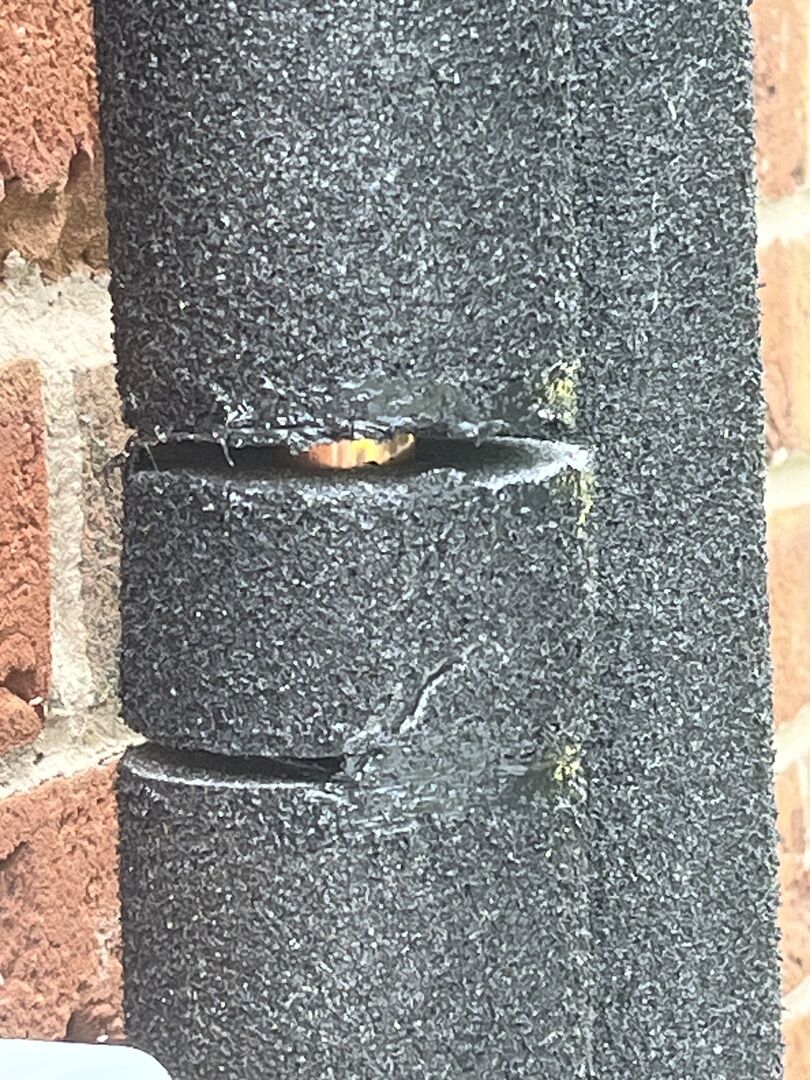
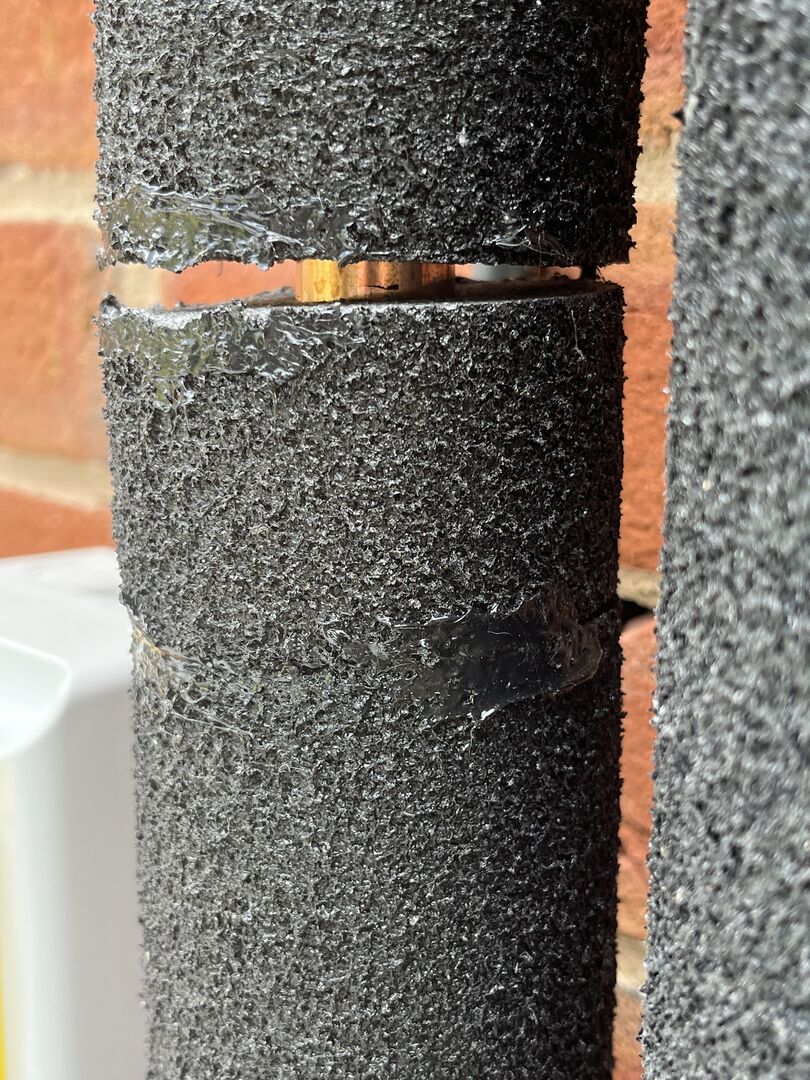
My ASHP was installed 6 weeks ago. I have just noticed that a number of the external insulation joints have failed. My first thought was this was down to the recent heat wave but I suspect that it is more likely due to copper pipe expansion during the HW cylinder disinfection cycle. I have asked my installer to return to site to make appropriate repairs.
Is the repair just a case of
more mastic or is there something missing from the design which might mean that this is a recurring problem?
Is that actually closed cell insulation designed for outdoor use or ordinary internal insulation, If its the latter it all needs to be stripped off and replaced with the correct stuff.
4kW peak of solar PV since 2011; EV and a 1930s house which has been partially renovated to improve its efficiency. 7kW Vaillant heat pump.
My installer has just got back to me to say that the manufacturer is aware of the problem (which is due to insulation shrinkage not pipe expansion) and that they advocate re-sealing each joint with a tube of their sealant.
My installer has a different view. I am now being told that as the insulation shrinkage has now taken place a better solution is to cutout the affected areas; compress and insert foam plugs which are slightly longer than the gaps needing filling along with copious amounts of sealant.
I am also not sure that short plugs ( as per the photos) are a good idea when insulation is liable to shrink after installation.
My installer has a different view. I am now being told that as the insulation shrinkage has now taken place a better solution is to cutout the affected areas; compress and insert foam plugs which are slightly longer than the gaps needing filling along with copious amounts of sealan
If they are waterproof (ie closed cell) I cant see a problem with this, maybe others can! In fact an expansion gap makes sense.
4kW peak of solar PV since 2011; EV and a 1930s house which has been partially renovated to improve its efficiency. 7kW Vaillant heat pump.
The key issue is that no gaps must appear after the remedial work is done.
A gap would allow ingress of rainwater between the insulation and the pipe. That will absorb heat energy and deposit on the ground outside the house!
I hadn't realised that Primary Pro would shrink post-manufacture. I wonder whether the rate of shrinkage is affected by high temperatures or whether it's merely the elasticity of the material which reduces the fibre lengths over time.
I've used Solar Thermal pipe insulation outside and haven't noticed any shrinkage there. I tape the joins rather than use a mastic. Perhaps that's what prevents gaps opening between lengths.
My ASHP was installed 6 weeks ago. I have just noticed that a number of the external insulation joints have failed. My first thought was this was down to the recent heat wave but I suspect that it is more likely due to copper pipe expansion during the HW cylinder disinfection cycle. I have asked my installer to return to site to make appropriate repairs.
Is the repair just a case of
more mastic or is there something missing from the design which might mean that this is a recurring problem?
Can you send us a picture of the whole pipe length, I think there is a lack of clips and the pipe has dropped, I am not sure the insulation shrinks that much but it will bunch at the top and drop at the bottom if it scales the whole house to the roof?
If the pipe only rises up a meter then it will not be that and I would then say the insulation was cut short but pulled together slightly and sealed, I have used this product a lot and it is very robust and we do not have any installation that have shrunk over months or hot or cold weather.
When we install our Primary Pro we cut 2020mm of insulation to fit a 2000 length of pipe 10mm for every meter to cover expansion and contraction, pipework over the same distance. The approximate expansion of copper 28mm rising from 20DegC to 60DegC is about 1.4mm over a 2m length, your gaps are the 10mm I am allowing on our installations. Also the special sealant they use is not mastic it is something else like a rubber, its very hard to pull it apart and it stretches more than 3mm so again this would cover the expansion.
I would check if the pipe dropped 1st, might have might not have.
I would be interested in the end result so we all installers can be aware of any product defects.
AAC Group Ltd covering the Kent Area for design, supply and installation of ASHP systems, service and maintenance, diagnostics and repairs.
Just to add to this, it is a very easy fix so I don't think anything to worry, if you live in Kent I would be happy to come and fix it for free as long as I can video it for learning materials.
AAC Group Ltd covering the Kent Area for design, supply and installation of ASHP systems, service and maintenance, diagnostics and repairs.
@ashp-bobba The vertical pipe rise from the heat pump is about 2M to just above the back door. I cannot see any other broken butt joints or stress points.
Looking again at the two vertical pipes, it looks to me that the installer’s apprentice has elected to use two very short insulation plugs. Personally, I might have cutback the insulation and gone for longer plugs. It also looks as if very little mastic has been used to secure the butt joints. This looks like a simple apprentice error to me which was not picked up on inspection.
The installer responded quickly and he will return to site to make good. I am confident that second time around he will make sure that all the joints are secure.
My ASHP was installed 6 weeks ago. I have just noticed that a number of the external insulation joints have failed. My first thought was this was down to the recent heat wave but I suspect that it is more likely due to copper pipe expansion during the HW cylinder disinfection cycle. I have asked my installer to return to site to make appropriate repairs.
Is the repair just a case of
more mastic or is there something missing from the design which might mean that this is a recurring problem?
From these photos, it is obvious that the joints have not been sealed to MIs ( see attached Link to PDF )
All materials expand and contract; it is important to not only bond. Seal and Cap as advised, but to allso use the right amount advised ( one tube of Bond & Seal to 3 lengths of 28mm , if a bigger size than more needed)
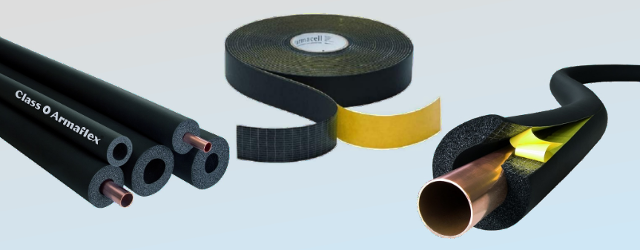
Last year, we manufactured over 1.8 million insulation lengths in the six years since its launch. Our guidance has always been to form correct joints and ensure enough Bond & Seal is left to seal the sleeve through the wall, typically three tubes for every three lengths of 28mm insulation.
Based on this guidance, approximately 533,000 tubes of Bond & Seal should have been used alongside the insulation supplied. However, we identified a shortfall of around 290,000 tubes. This highlighted that joining can be time-consuming and messy for some installers, which led us to develop additional solutions.
As a result, we introduced joint covers for straight runs and 90° bends. These not only speed up installation but can also be used as a repair solution for issues such as those shown in the images in this post.
From these photos, it is obvious that the joints have not been sealed to MIs ( see attached Link to PDF )
All materials expand and contract; it is important to not only bond. Seal and Cap as advised, but to allso use the right amount advised ( one tube of Bond & Seal to 3 lengths of 28mm , if a bigger size than more needed)
Last year, we manufactured over 1.8 million insulation lengths in the six years since its launch. Our guidance has always been to form correct joints and ensure enough Bond & Seal is left to seal the sleeve through the wall, typically three tubes for every three lengths of 28mm insulation.
Based on this guidance, approximately 533,000 tubes of Bond & Seal should have been used alongside the insulation supplied. However, we identified a shortfall of around 290,000 tubes. This highlighted that joining can be time-consuming and messy for some installers, which led us to develop additional solutions.
As a result, we introduced joint covers for straight runs and 90° bends. These not only speed up installation but can also be used as a repair solution for issues such as those shown in the images in this post.