

Notifications
Clear all
Joining the Renewable Heating Hub forums is completely free and only takes a minute. By registering you’ll be able to ask questions, join discussions, follow topics you’re interested in, bookmark useful threads and receive notifications when someone replies. Non-registered members also do not have access to our AI features. When choosing your username, please note that it cannot be changed later, so we recommend avoiding brand or product names. Before registering, please take a moment to read the Forum Rules & Terms of Use so we can keep the community helpful, respectful and informative for everyone. Thanks for joining!

Topic starter
29/05/2026 11:25 am
OK so Im going to put something controversial 'out there'. The trigger is a decision by the Hertfordshire Retrofit Strategy Steering group to include a proposition for the 'failed boiler' scenario as one of its targets. Its a market that must be tackled if heat pumps are ever to replace boilers, we install 1.6M boilers each year and build only 200K houses, implying 1.4M boiler retrofits of which I would venture to suggest a fair proportion are distress purchases.
The problem with this is clearly timescale, one person on the team commented that their typical lead time was 6 weeks, to which I responded, only slightly tongue in cheek, that the local plumber will fit a replacement boiler next week, and its not the local plumber that needs to change!
One approach is to encourage people to be prepared, but this will be a niche only. Using electric heaters temporarily is hardly attractive mid winter, both for comfort and cost reasons, so while that may work for some its another niche and we still aren't addressing the real issue, which is lead time. That said I do think that its valid to start off with a particular segment (much as Octopus did) and build out from there.
So here are some observations which might point at how the lead time issue could be addressed:
- The Ofgem standard house consumes 11,500kWh gas per annum, this puts it at <6kW (actually closer to 4kW) loss at design temperature. This suggests that a fairly high proportion of houses are <6kW
- Most manufacturers minimum capacity machine* has a nominal output of 5kW or more
- You generally want 5kW+ for DHW reheat anyway
so in a house that is definitely 5kW or less, in practice a 5kW (or a machine with a minimum capacity the same as a 5kW machine) is going to be fitted, at which point whole house sizing becomes irrelevant
- If radiators are 'undersized' its always possible to compensate by increasing the flow temperature, and R290 pumps can run at 70C
- Radiator upgrades are an easy 'stage 2' retrofit, in fact there is a good argument for measuring what actually happens before deciding which radiators to upgrade, because its a real measurement not a gigo spreadsheet. Thats what Adia advocate and make the kit for!
- provided primaries in a <=6kW house are 22mm and there is no microbore, the plumbing is going to work (or, worst case, there are no further checks that would be done as part of a survey that will detect a reason why it wont work)
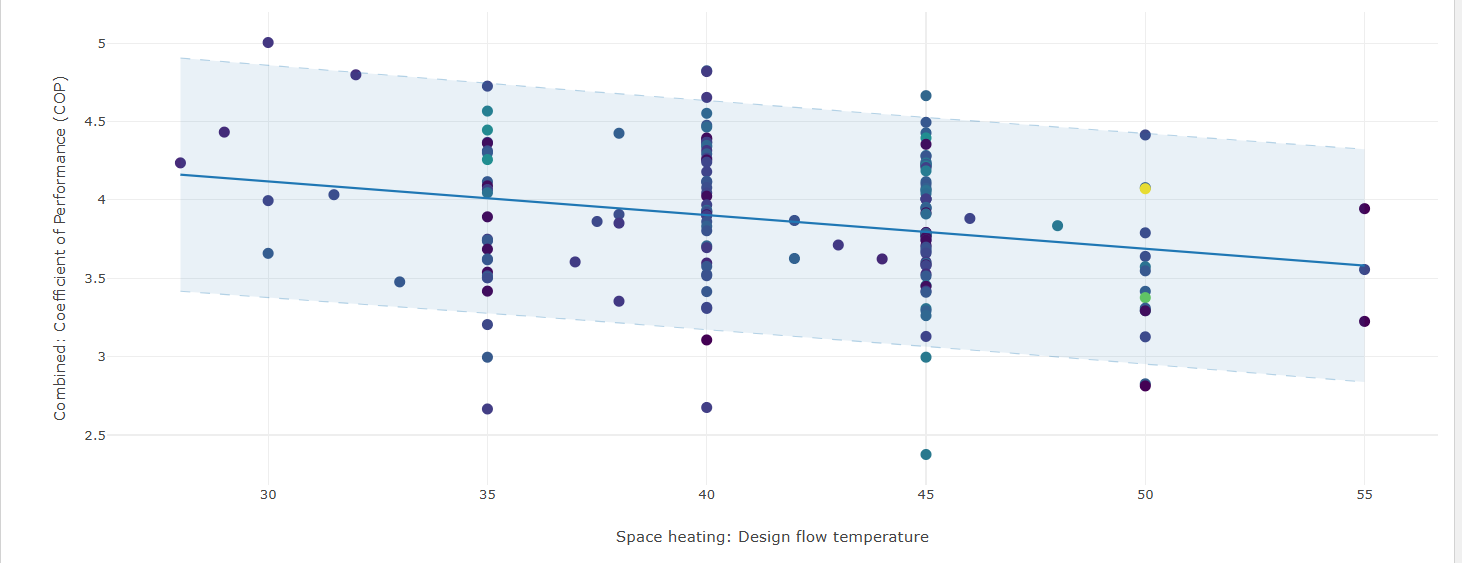
- Real world SCOP is dependent more on installation quality/operating mode than on FT - see graph below from openenergymonitor (I suspect that this is what is behind the zero disrupt heat geek offering and Octopus's philosophy!)
So, taking all the above together I propose that the following is a technically practical way of dealing with the 'failed boiler' scenario, which crucially does not compromise quality so far as I can see.
- Do some very basic checks to be certain that the house loss is <=5kW, no microbore, 22mm primaries
- fit a 5/6kW heat pump and UVC plus th a 50l volumiser to ensure defrost works
- Fit Hhomely or Passiv, or if you want the full monty Adia, leave it to self adjust
Householder now warm, panic over!
Over next few months monitor flow temperature etc and then return in summer or a few weeks later to upgrade radiators if necessary.
This requires some derogation from MIS3005-D, but this is justifiable from an engineering standpoint.
Obviously, in addition to the technical viability, we have to consider if its commercially viable (or make it commercially viable). I suspect that this might not be attractive for the 'top installers' who employ engineers that are expert in everything, but maybe its a very useful 'entry point'/training ground. Do a dozen of these before you do anything else. From a learning point of view I would think this would actually work better - instead of swallowing the whole elephant in on go you first get some understanding of the basics nd of commissioning in a relatively 'safe' context, and only once this is 'under your belt' do you need to learn the more detailed design stuff. Maybe it should be a separate 'MCS light' qualification which can be upgraded to the full month later, targeted at your local plumber who normally fits boilers?
I would comment further that doing this this way poses no threat to most existing installers, this is a new market that many cant actually access at present.
Constructive comments invited - we have to solve the 'failed boiler' problem if heat pumps are ever to succeed in displacing fossil fuel burners, is this the basis of a start?
*with the exception of firmware limited versions of higher capacity machines, the minimum output of which generally be the same as its larger cousin
This topic was modified 5 months ago by JamesPa
4kW peak of solar PV since 2011; EV and a 1930s house which has been partially renovated to improve its efficiency. 7kW Vaillant heat pump.
4

29/05/2026 11:44 am
Personally I see merit in what you are suggesting. I can readily envisage a boiler failure and just putting a gas boiler back - cos is quick, cheap and easy. I guess the problem is that, without the whole accreditation process being in place, the grant won’t be available. I assume that is the idea of an “MCS light”. Thinking as I write, this approach might also act against the technology. An uninformed householder goes the direction suggested, first stage of the instal is done and the customer hasn’t really understood the iterative nature of what I think is being suggested. This might be mana for the anti heat pump brigade able to quote lots of cases where the retrofit is “defective”.
This response really is a bit off the cuff and I do like the idea in principal.
This post was modified 5 months ago by Mars
Topic starter
29/05/2026 12:01 pm
I guess the problem is that, without the whole accreditation process being in place, the grant won’t be available. I assume that is the idea of an “MCS light”.
Exactly. We have to design an accreditation system to fit the circumstances not the other way round!
An uninformed householder goes the direction suggested, first stage of the instal is done and the customer hasn’t really understood the iterative nature of what I think is being suggested. This might be mana for the anti heat pump brigade able to quote lots of cases where the retrofit is “defective”.
That's a risk I agree, but a risk that is quantifiable.
This response really is a bit off the cuff and I do like the idea in principal.
Fair enough, but thanks for the response. It's a problem that has to be solved and to solve it something has to change, it won't be solved by the passage of time alone, nor by just growing the industry!
This post was modified 5 months ago by JamesPa
4kW peak of solar PV since 2011; EV and a 1930s house which has been partially renovated to improve its efficiency. 7kW Vaillant heat pump.
1

29/05/2026 2:37 pm
So, taking all the above together I propose that the following is a technically practical way of dealing with the 'failed boiler' scenario, which crucially does not compromise quality so far as I can see.
- Do some very basic checks to be certain that the house loss is <=5kW, no microbore, 22mm primaries
- fit a 5/6kW heat pump and UVC plus th a 50l volumiser to ensure defrost works
- Fit Hhomely or Passiv, or if you want the full monty Adia, leave it to self adjust
Householder now warm, panic over!
Over next few months monitor flow temperature etc and then return in summer or a few weeks later to upgrade radiators if necessary.
This requires some derogation from MIS3005-D, but this is justifiable from an engineering standpoint.
Great idea, this is one of the elephants not yet tackled... 😀
One point to consider is whether there are minimal electrical standards to be met - judging by the way in which MCS and the DNOs defined the process, there may be significant risks if progressing without fully surveying the electrics or missing isolation of the ASHP installation appropriately.
Now seriously, perhaps scrutiny of the current standard, to define one that electricians can work with (like mandating a mini CU) will reduce the opportunity for scope creep and enable some consumer protection during a distress purchase.
I am hoping to be corrected about an ASHP requiring an immediate upgrade of the CU to one with SPD. Could I have missed similarities between the ASHP and lightning rods? 😉
Obviously, in addition to the technical viability, we have to consider if its commercially viable (or make it commercially viable). I suspect that this might not be attractive for the 'top installers' who employ engineers that are expert in everything, but maybe its a very useful 'entry point'/training ground. Do a dozen of these before you do anything else. From a learning point of view I would think this would actually work better - instead of swallowing the whole elephant in on go you first get some understanding of the basics nd of commissioning in a relatively 'safe' context, and only once this is 'under your belt' do you need to learn the more detailed design stuff. Maybe it should be a separate 'MCS light' qualification which can be upgraded to the full month later, targeted at your local plumber who normally fits boilers?
I love the concept, it sets a lower MCS bar to allow the ASHP retrofit market to grow in a managed way. I suspect it will be worth evaluating the most common transition scenarios to get to the final best practice state. By best practice I mean the ones building on the MCS basis (Heat Geek with its meaningful performance guarantees). Like this we could answer what further benefit will be realised along that upgrade path (to try not leaving too many installations left at the MCS light level, which could become sources of bad press for the industry). But since any such changes would require public consultation, that could do it.
This post was modified 5 months ago by Batpred
8kW Solis S6-EH1P8K-L-PLUS hybrid inverter; G99: 8kW export; 16kWh Seplos Fogstar battery; Ohme Home Pro EV charger; Vaillant Arotherm Pro 7kW; 100Amp head, HA lab on mini PC

Topic starter
29/05/2026 3:06 pm
Now seriously, perhaps scrutiny of the current standard, to define one that electricians can work with (like mandating a mini CU) will reduce the opportunity for scope creep and enable some consumer protection during a distress purchase.
one with SPD. Could I have missed similarities between the ASHP and lightning rods?
Thats a good point. A 6kW heat pump will invariably be specified to need a 16A circuit. Many CUs can have one easily added, for others a mini CU is an obvious solution.
There are no special earthing requirements and actually its not even obligatory in the wiring regs to use an RCD for external fixed plant (which is how a heat pump is classified), although if one is available for the CU it would be sensible to do so!
Electricians are pretty good at this sort of thing in my experience so I dont see it as a particular issue. Perhaps the greater issue is an immersion heater in the cylinder, however this isnt actually needed with an R290 heat pump that does the legionella cycle natively (mine does but I dont know how many do), albeit that its a useful backup. That said the mini-cu could have two circuits, one for the heat pump and one for the immersion. Job done!
This post was modified 5 months ago by Majordennisbloodnok
4kW peak of solar PV since 2011; EV and a 1930s house which has been partially renovated to improve its efficiency. 7kW Vaillant heat pump.

29/05/2026 3:12 pm
My only significant concern with the plan you're proposing, @jamespa, is the "get it running now, sort out the kinks later" issue. Not that I think that's a bad principle - far from it - but it requires the homeowner to commit to a pathway with unquantifiables in the future and that requires a level of trust between the installer and the homeowner, and a level of professionalism, expertise and integrity on the part of the installer to justify that trust.
In particular, if we just focus for the moment on radiator upgrades, you're quite right that a heat pump could be run at boiler-type flow temperatures to get the home owner out of the immediate problem and work out which rooms need what kind of upgrade later. However, once the homeowner has had that heat pump installed, a less scrupulous installer could hike the price of radiator swaps because they know the homeowner can't go back.
As a result, I think there would need to be something in your plan somewhere that gives the homeowner some reasonably reliable estimates of best case/worst case/incremental costs so they know what they're truly committing to, and to have some form of pressure to keep the installer to a reasonable approximation of those estimates. Some mechanism that any respectable installer wouldn't bat an eyelid over but would worry anyone trying to pull a fast one.
105 m2 bungalow in South East England
Mitsubishi Ecodan 8.5 kW air source heat pump
18 x 360W solar panels
1 x 6 kW GroWatt battery and SPH5000 inverter
1 x Myenergi Zappi
1 x VW ID3
Raised beds for home-grown veg and chickens for eggs
"Semper in excretia; sumus solum profundum variat"
Topic starter
29/05/2026 3:20 pm
My only significant concern with the plan you're proposing, @jamespa, is the "get it running now, sort out the kinks later" issue. Not that I think that's a bad principle - far from it - but it requires the homeowner to commit to a pathway with unquantifiables in the future and that requires a level of trust between the installer and the homeowner, and a level of professionalism, expertise and integrity on the part of the installer to justify that trust.
In particular, if we just focus for the moment on radiator upgrades, you're quite right that a heat pump could be run at boiler-type flow temperatures to get the home owner out of the immediate problem and work out which rooms need what kind of upgrade later. However, once the homeowner has had that heat pump installed, a less scrupulous installer could hike the price of radiator swaps because they know the homeowner can't go back.
As a result, I think there would need to be something in your plan somewhere that gives the homeowner some reasonably reliable estimates of best case/worst case/incremental costs so they know what they're truly committing to, and to have some form of pressure to keep the installer to a reasonable approximation of those estimates. Some mechanism that any respectable installer wouldn't bat an eyelid over but would worry anyone trying to pull a fast one.
Thats a fair observation and one that had crossed my mind. Of course anyone could do subsequent radiator upgrades but Im not sure a homeowner would feel confident, so I think you are perhaps right that some way to stop the installer pulling a fast one is needed. Thanks for raising it.
That said I would be willing to bet that a fair proportion wont need rad upgrades in practice, because the fabric has been upgraded since they were installed. Thats what heat geek zero disrupt banks on, and it also banks on (I suspect) running at up to 55C if necessary which, as the chart I posted above shows, doesn't make as much difference provided the heat pump is correctly installed and operated as one might first think.
Frankly a 'suck it and see' approach to rad upgrades makes sense in many ways, the fiction of heat loss surveys at the room level is just that. It looks scientific but depends on things which all too often aren't true and surveyors that dont do a particularly good job. Why not, at least for the class of house I have outlined above, just admit that!
This post was modified 5 months ago 3 times by JamesPa
4kW peak of solar PV since 2011; EV and a 1930s house which has been partially renovated to improve its efficiency. 7kW Vaillant heat pump.
1
29/05/2026 3:42 pm
Now seriously, perhaps scrutiny of the current standard, to define one that electricians can work with (like mandating a mini CU) will reduce the opportunity for scope creep and enable some consumer protection during a distress purchase.
one with SPD. Could I have missed similarities between the ASHP and lightning rods?
There are no special earthing requirements and actually its not even obligatory in the wiring regs to use an RCD for external fixed plant (which is how a heat pump is classified), although if one is available for the CU it would be sensible to do so!
I understand where you come from. I am basing my concern since a few of the installers estimating for our install brought up the Surge Protection Device topic. I did not even question it (ours is already SPD enabled). But judging from the breakdown and the assumptions they stated, it does not seem their electricians relax their "requirement".
Admittedly the SPD was not added by most installers, but given it is such a clearly unwarranted one, one wonders how others are "extending" the building regs.
The point about planning the "stage transitions" after the MCS light install is aimed at preempting what to be done with rad and other upgrades (cylinder capacity) that can be incremental.
Others would be building the base for the pump vs install on wall (not everybody is happy to leave it to their installer´s choice), need for planning permission that still applies to conservation areas, etc.
This post was modified 5 months ago by Batpred
8kW Solis S6-EH1P8K-L-PLUS hybrid inverter; G99: 8kW export; 16kWh Seplos Fogstar battery; Ohme Home Pro EV charger; Vaillant Arotherm Pro 7kW; 100Amp head, HA lab on mini PC


29/05/2026 4:39 pm
Even more pragmatic would be to encourage people to just add some air/air to a house and accept that it won't instantly remove 100% of the gas usage but means people can add it without ripping out gas, and just extend on it a bit when the gas boiler finally dies (which may be almost forever as most people find with a bit of air/air the gas does very little work).
1
29/05/2026 4:44 pm
Even more pragmatic would be to encourage people to just add some air/air to a house and accept that it won't instantly remove 100% of the gas usage but means people can add it without ripping out gas, and just extend on it a bit when the gas boiler finally dies (which may be almost forever as most people find with a bit of air/air the gas does very little work).
I think you're right that we should be encouraging all options to be explored rather than just A2W vs boiler. That said, the recent podcast @editor had with @ashp-bobba demonstrates rather well that A2A isn't a panacea for all situations, so a blanket A2A encouragement doesn't seem as pragmatic as it might first sound. Well worth a consideration, though.
105 m2 bungalow in South East England
Mitsubishi Ecodan 8.5 kW air source heat pump
18 x 360W solar panels
1 x 6 kW GroWatt battery and SPH5000 inverter
1 x Myenergi Zappi
1 x VW ID3
Raised beds for home-grown veg and chickens for eggs
"Semper in excretia; sumus solum profundum variat"
29/05/2026 4:58 pm
@majordennisbloodnok It's certainly not a panacea. There are buildings where A2A would be a complete nightmare (eg 3 or 4 storey houses with fire doors to each room off the landings)
1
29/05/2026 5:53 pm
Even more pragmatic would be to encourage people to just add some air/air to a house and accept that it won't instantly remove 100% of the gas usage but means people can add it without ripping out gas, and just extend on it a bit when the gas boiler finally dies (which may be almost forever as most people find with a bit of air/air the gas does very little work).
A2A is clearly having much interest these days!
If I understood right, James is putting forward ideas to enable a decarbonised alternative to a very typical case (where a boiler fails and it is decided to replace with a new one, instead of repairing the failed boiler).
It seems that, technically, with HG zero disrupt and similar concepts, an A2W heatpump could be installed in a slightly longer timescale than replacing with a gas boiler. At the moment, a replacement gas boiler is usually installed in less than a week vs months for all the regs process for an ASHP.
Could the installation of an A2A system (+ whatever solution is required for hot water) be technically completed in a few days on a similar failure scenario (and in a typical dwelling using a gas boiler that only needs a 6kW A2W heatpump)?
8kW Solis S6-EH1P8K-L-PLUS hybrid inverter; G99: 8kW export; 16kWh Seplos Fogstar battery; Ohme Home Pro EV charger; Vaillant Arotherm Pro 7kW; 100Amp head, HA lab on mini PC
Page 1 / 8
Next

SPONSORS

Degrees of Separation
Latest Posts
-

RE: The Changing Jet Stream Could Challenge UK Air Source Heat Pumps
@susannasaunders Indeed, lots to think about there! ...
By Rob of York , 5 minutes ago
-
RE: Electrical works for air to air heat pump
An electrician who signs off work is responsible for it...
By EtchedPixels , 5 hours ago
-
RE: Are there any comparisons of DHW heat stores around?
@sarahemmm I have done things the opposite way round I ...
By Toodles , 5 hours ago
-
RE: 15kw pump for 225m2 1990's house - over kill?
@seaviews I have read you latest response re buffer ...
By JamesPa , 1 day ago
-
RE: How will removing the standing charge on gas bills benefit heat pumps?
The BUS grant funding for 2026/27 will run out at the c...
By Rob of York , 1 day ago
-
-
@editor Ouch, sorry to re start the tick. I had assume...
By DavidB , 3 days ago
-
RE: Say hello and introduce yourself
@e-a-west as the good Major said, welcome to the forums...
By Mars , 3 days ago
-
RE: How much of your renewable and home setup would still work if the internet went down?
Yes I actually have a copy of a tool that whenever a ce...
By EtchedPixels , 3 days ago
-
RE: Indevolt Batteries UK Support & Info Thread
@editor Hi, To resolve this, please tap on the A...
By Indevolt Tech , 4 days ago
-
RE: Double or Triple Glazed Windows?
Posted by: @singlespeed With 9 years repairing windo...
By Rob of York , 4 days ago
-
@transparent we’re still running a secure version of PH...
By Mars , 5 days ago
-
RE: How quickly would you want/expect heat recovery to take from setback?
Much longer than that here. The heating isn't even on. ...
By bobflux , 5 days ago
-
RE: Passiv Smart Thermostat - Help & Forum Support
Obviously the weather is changeable but there's a defin...
By Singlespeed , 5 days ago






SPONSORS
