

Notifications
Clear all
Joining the Renewable Heating Hub forums is completely free and only takes a minute. By registering you’ll be able to ask questions, join discussions, follow topics you’re interested in, bookmark useful threads and receive notifications when someone replies. Non-registered members also do not have access to our AI features. When choosing your username, please note that it cannot be changed later, so we recommend avoiding brand or product names. Before registering, please take a moment to read the Forum Rules & Terms of Use so we can keep the community helpful, respectful and informative for everyone. Thanks for joining!

21/04/2026 7:14 pm
UFH = underfloor heating.
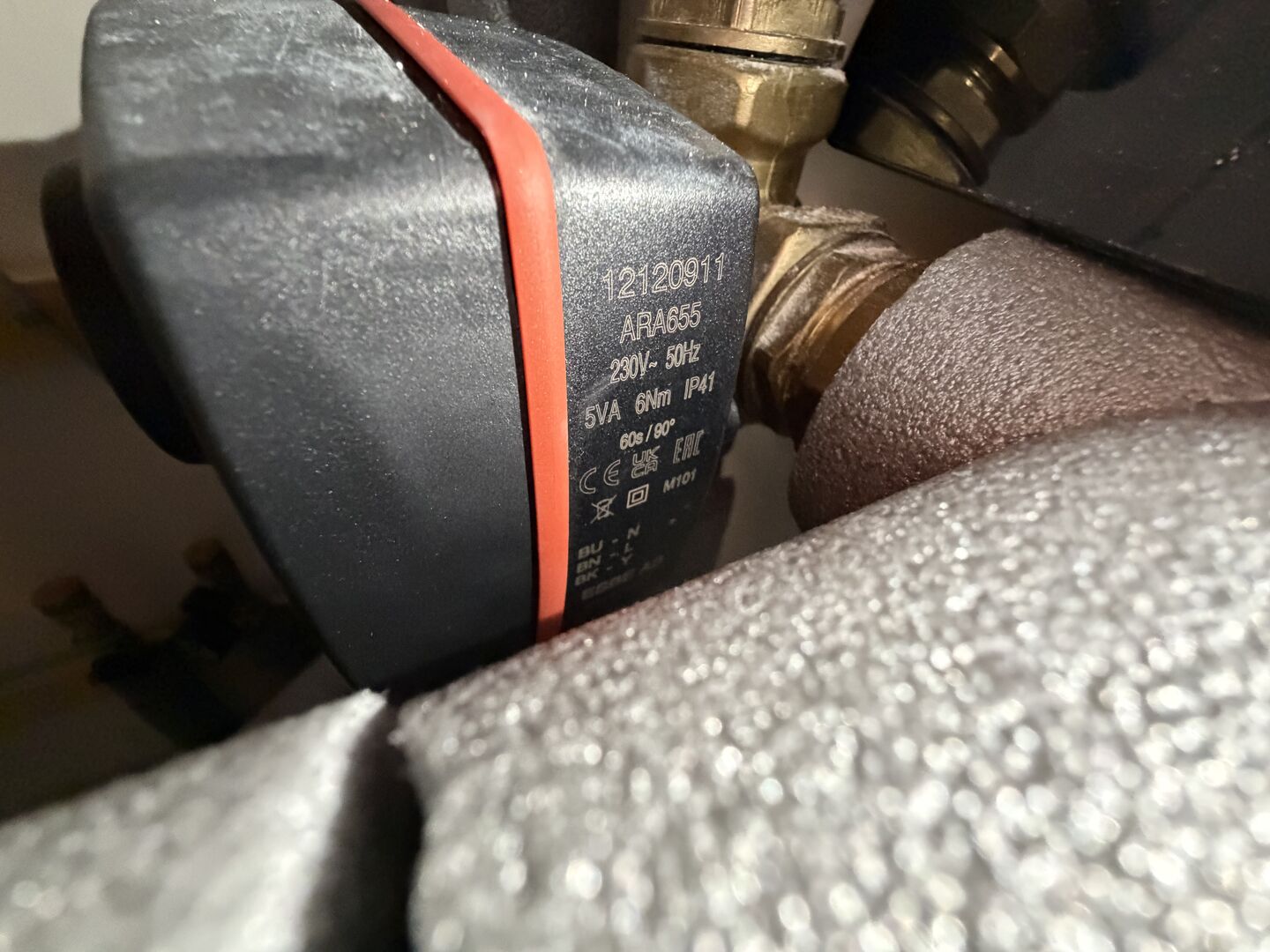
Can you check any part numbers on this valve, something odd here unless it's a being used as a temperature operated switch to avoid a power lead. Has anything else changed since it all worked ok?
4kW peak of solar PV since 2011; EV and a 1930s house which has been partially renovated to improve its efficiency. 7kW Vaillant heat pump.

21/04/2026 10:24 pm
We had one of these Esbe valves fitted as part of our recent install.
We had a similar issue. The hot water tank temperature would drop rapidly after a reheat and the radiator temperatures were much hot than expected.
The installers immediately knew there was an issue with the Esbe valve not function correctly.
They suggested the valves can be easily installed/setup incorrectly.
The replaced the valve and it is now diverting correctly.
You can visibly see it moving (and hear it) when the dhw recharge starts/ends.
No more heat loss into the rads once it was corrected!
22/04/2026 8:29 am
Contacting the installer is the thing to do
I note from the online description of this part:
- Reliable and quiet operation
- Can be used for both 2-point and 3-point control signal
- Perfect match between the actuator and ESBE valve
The bullet in bold rather suggests the possibility to set it up incorrectly!
4kW peak of solar PV since 2011; EV and a 1930s house which has been partially renovated to improve its efficiency. 7kW Vaillant heat pump.


Topic starter
22/04/2026 8:41 am
@jamespa I have called them this morning. I will update this thread when they try a fix and what it was. Thanks for all the help.
22/04/2026 12:19 pm
Our installer said the same. You need to adjust it inside and can be easy to overtighten or get it set incorrectly. In the end they just replaced ours as it was a brand new install.
22/04/2026 12:30 pm
Our installer said the same. You need to adjust it inside and can be easy to overtighten or get it set incorrectly. In the end they just replaced ours as it was a brand new install.
Goodness knows why they fit this rather than a conventional diverter-only valve. Its a nice (and jolly expensive) valve for sure, but the more you leave up to the installer the more there is to go wrong! Doubtless they have their reasons.
4kW peak of solar PV since 2011; EV and a 1930s house which has been partially renovated to improve its efficiency. 7kW Vaillant heat pump.
22/04/2026 12:55 pm
Hopefully their reasons are well intended! They did say that it is better than what they used to install. Time will tell whether that proves to be correct!

1
Topic starter
20/11/2026 9:26 am
Update. Sorry for the long gap. I connected Claude to Home Assistant and ask it to see if it could see any pattern to the "randomness"
What happens. On cold days the heat pump circulates the primary water at about 13 L/min with the compressor off. ESPAltherma shows the operation mode as “Fan Only”, and the diverter is set to Space, not DHW. As soon as that flow starts, the cylinder starts losing 2–4.4 °C an hour (0.4–1 kW). With no primary flow it loses only 0.2–0.35 °C an hour. The faster loss starts within one 30-second reading of the flow starting and stops when the flow stops. A 34 °C reheat then kicks in, sometimes several times a night, with no hot water being used.
When it happens. It’s not random: it’s tied to the outdoor temperature as the heat pump itself measures it. Every time the flow has started, the unit’s own outdoor sensor has read 6 °C or below. That’s often 1–2.5 °C warmer than my garden weather station at night, because it’s sheltered by the house. On mild days it never happens: no flow and normal standing loss all day. It also often starts the moment space heating finishes on a cold morning. It’s a monobloc (EDLA04E2V3), so I assume this is the frost protection keeping water moving through the outdoor unit.
What Claude thinks is wrong. With the diverter on Space, that flow shouldn’t touch the cylinder, but some of it clearly does. I put a clip-on sensor on the coil flow pipe near the cylinder. It drops to the circulating water temperature, about 20 °C, within minutes of the flow starting, even though the tank is at 40 °C or more. Only about 0.5–1.5 L/min getting through the coil would explain the losses. So, as some of you suggested, the ESBE valve or actuator (ARA655) looks like it isn’t fully closing the DHW port. The installer has checked this and says it is closed, but it would seem that is incorrect.
Impact. Claude is saying on cold days we lose about 5–9 kWh of heat from the cylinder, and it takes roughly 1–3.5 kWh of electricity to put it back. Much of that comes from the battery in the evening. We don’t usually run out of hot water because I keep an eye on it and top up when needed, but baths taken after a Fan Only spell start several degrees cooler.
Waiting to hear back from installer. I’ll update again once it’s fixed. Claude wrote me a lovely Word document I could send them.
1

20/11/2026 3:20 pm
Even when it is not operating, the heat pump will turn its circulator on periodically:
- To prevent it from getting stuck, especially in summer
- To sample actual water temperature and decide whether it should turn on
- To avoid water freezing in the outside pipes and heat pump itself.
Close to or below freezing, the circulator should be on constantly at reduced flow rate. Between 2°C and 5-6°C it should turn on for a few minutes periodically, maybe every hour. Above that it should turn on for a few minutes every day or week.
Here's mine: check the outside_air_temperature plot, and how the flow_rate and pump (blue) curves show the circulator getting more frantic as temperature drops.
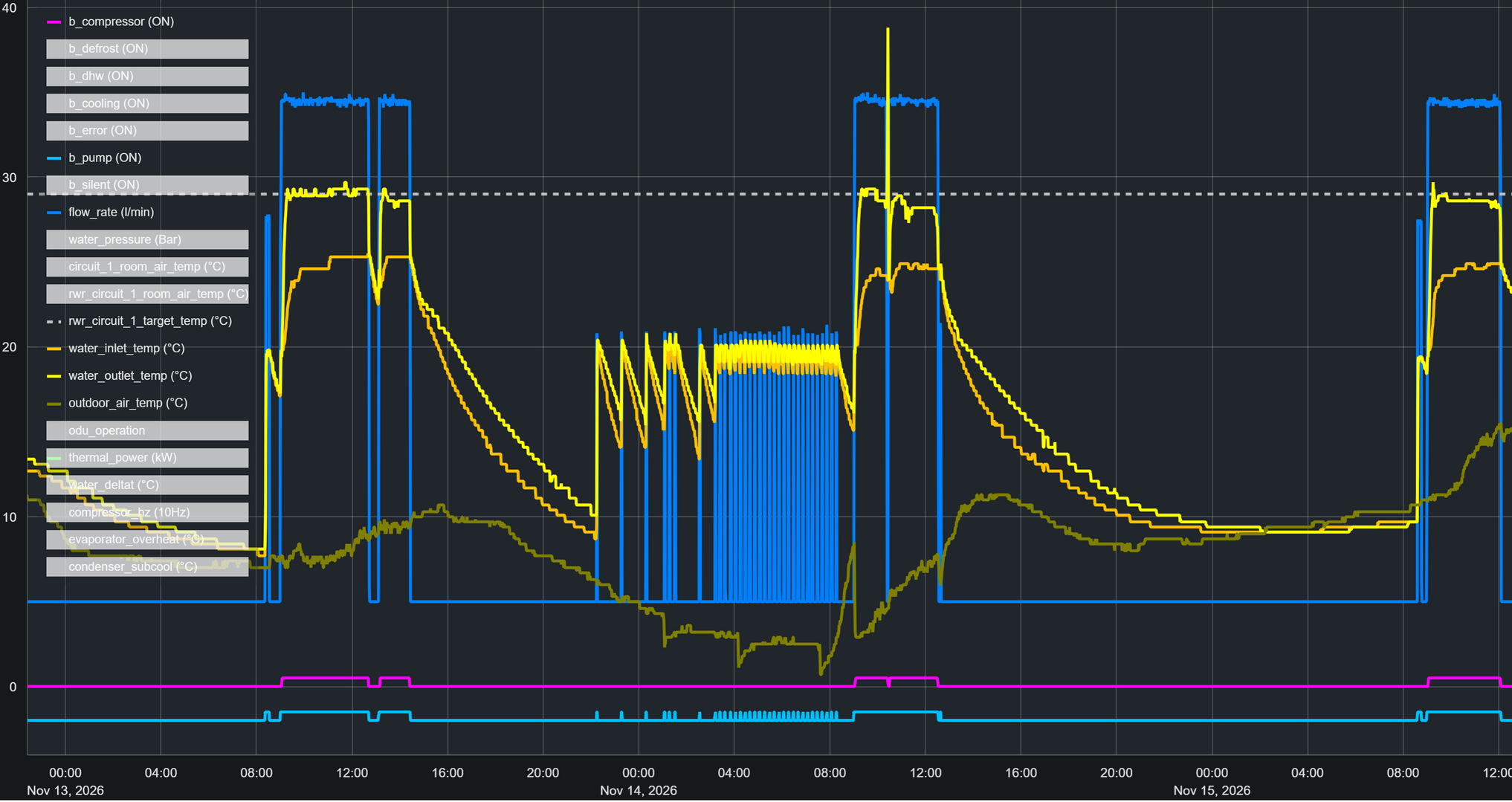
So what the circulator is doing is absolutely normal, it's part of the heat pump's self preservation routines. It steals a bit of heat from the house to avoid freezing and bursting pipes.
If it cools your DHW tank, now that's not normal at all. There are two possible explanations.
1) Two flow directions can coexist in a single pipe via thermosiphon, so a single pipe can act both as flow and return. The solution is a check valve. This is unlikely.
2) DHW directional valve not doing a full quarter turn and remaining partially open. This is the most likely.
To discriminate, simply turn on the heat pump circulator with the testing menu, or wait for it to turn on. In case 2, the DHW tank flow pipe should get cold because the heat pump sends cold water into it, and the DHW tank return pipe should get hot because the hot water that was inside it gets flushed out. Both almost immediately, it should be very obvious to the touch.
Your ARA655 actuator takes 60s for a full quarter turn. This is a relatively long time. Quite often, much quicker valves are fitted. There's nothing wrong with using a mixing valve as a directional valve, but... the heat pump drives this actuator with relays and there is an option in the settings or installer menu to set how long it should drive the valve to open or close it. So the issue may simply be that the time is set too short because the default value was 30s or something, and the installer didn't configure it.
You can investigate by watching the big button on the ARA655 and listening. It should do a quarter turn, full 90°, not 80°. The normal way to configure these is to set the time in the heat pump controller to longer than the valve needs (say, 120s) to ensure the actuator turns until the limit switch triggers, which guaranteed it has done a full 90°. So you should hear the internal limit switch clicking, the motor stopping immediately, then sometime later the relay in the heat pump IDU should click, having done its job. If the motor stops right when the heat pump IDU relay clicks, but you don't hear the actuator limit switch clicking, then it probably didn't go all the way.
Another thing you can do it go manual. I asked the AI about how to do it on ARA655:
To put an ESBE ARA655 actuator into manual mode, simply pull the main knob toward you to disengage the motor drive and adjust the valve by hand.
Step-by-Step Procedure
- Switch to manual mode. Grip the large front knob (graduated from 0 to 10) and pull it outward (toward you) until it clicks. A colored ring (usually red or orange) appears at the base of the knob to confirm that the motor is disengaged.
- Adjust the valve opening. Turn the knob manually to the left or right depending on the desired position for your heating or mixing circuit.
- Return to automatic mode. Once the adjustment is complete (or power is restored), push the knob firmly back toward the housing until it clicks into place. The indicator ring disappears and the controller takes over again.
Good to Know
- Purpose. This mode allows you to troubleshoot your system during a power outage or controller failure, or to align the valve during installation.
- Watch out when removing. If you pull too hard on the knob to remove it completely (for example, to access the mounting screw), be careful not to change the position of the valve spindle or the knob before putting it back on. For more technical details, check the ESBE rotary actuators FAQ as well as the ESBE online guide.
If the knob feels stuck or if you are adjusting a specific valve (VRG, 3-way, etc.), share a photo of the front of the actuator or specify the context of your adjustment so I can guide you more accurately.
...so, if you switch it to manual, then you can still turn it a bit, it means it didn't go all the way.
This post was modified 5 days ago 3 times by bobflux
Topic starter
20/11/2026 7:01 pm
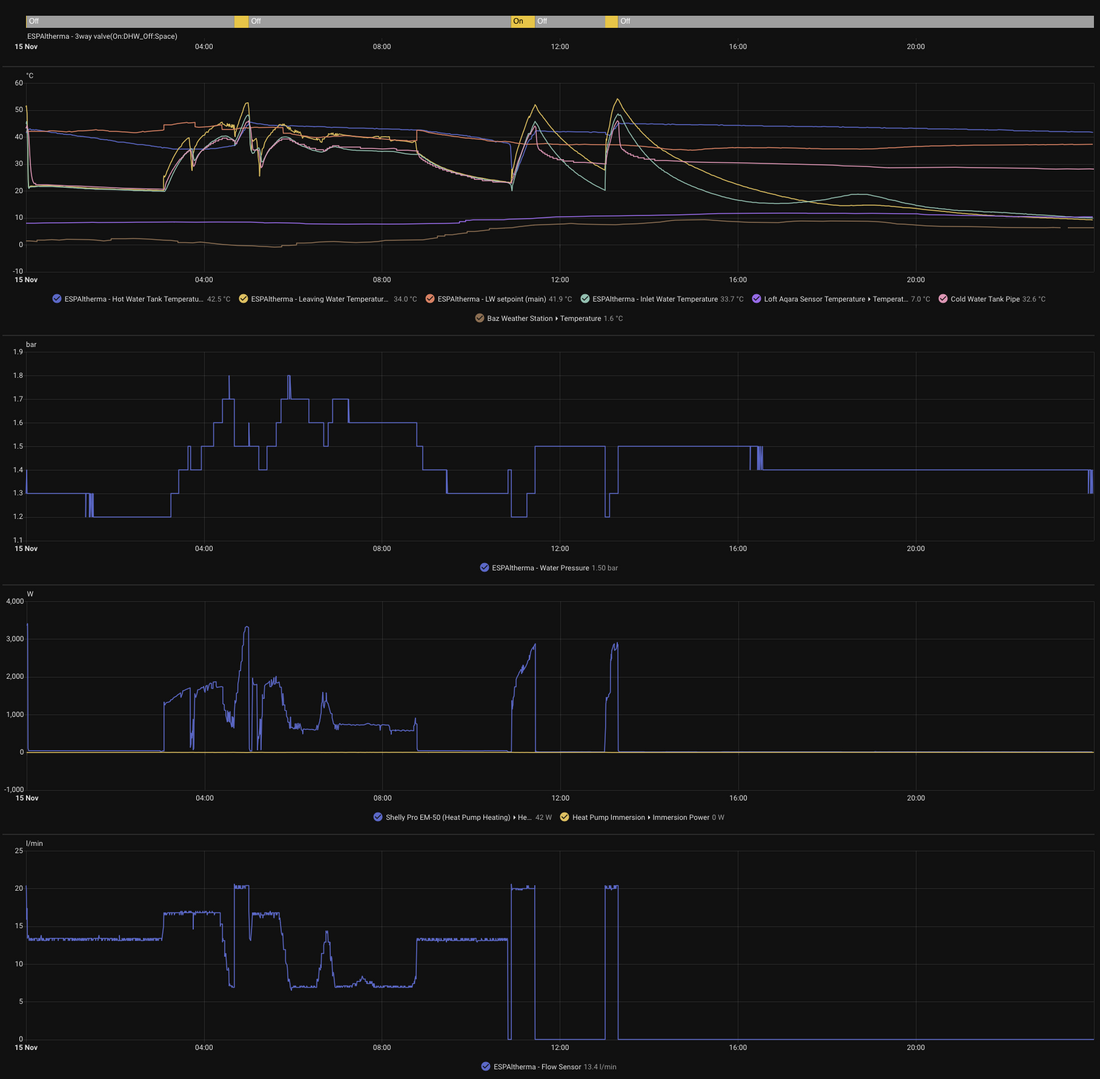
@bobflux Thank you very much for the detailed explanation. I will what manual tests I can do.This is a great example. It did it in the morning and was fine in the afternoon. As you can see it stops when the flow stops.
20/11/2026 8:12 pm
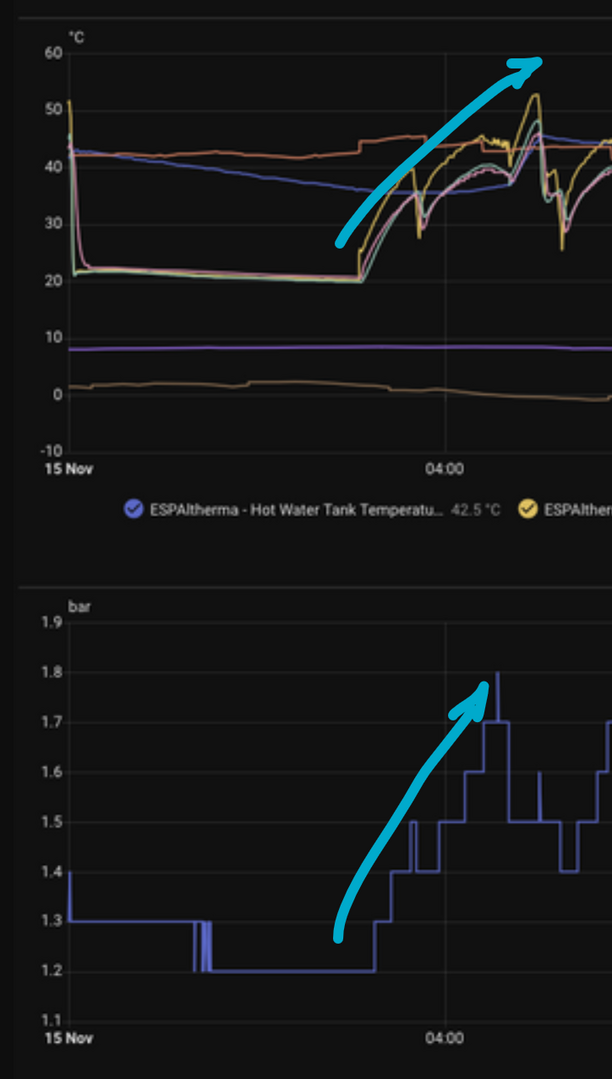
Pressure rises a lot in sync with water temperature. It should not rise that much. Your expansion tank is not doing its job. Normally as water gets hot in the circuit and expands, some water enters the expansion tank to avoid this kind of pressure rise.
Most likely reason: the bladder inside the tank is inflated to a pressure above the circuit water pressure, so water from the circuit can't compress the bladder to get in the tank. I just had this issue on my brand new expansion tank: it said "inflated to 1.5 bar" on the label, but it was actually inflated to 2 bar. So I got the same kind of wild pressure swings. Please check pressure on the expansion tank Schrader valve with tyre pressure gauge. I bet you get 2.something bar. If this is the case the fix costs nothing: it just needs to be deflated a bit.
Alternate explanation: completely deflated bladder (needs some gas) or perforated bladder (expansion tank needs replacement) but these are unlikely because the tank would then be completely full of water, so your system pressure would be much lower, and the heat pump would complain about that.
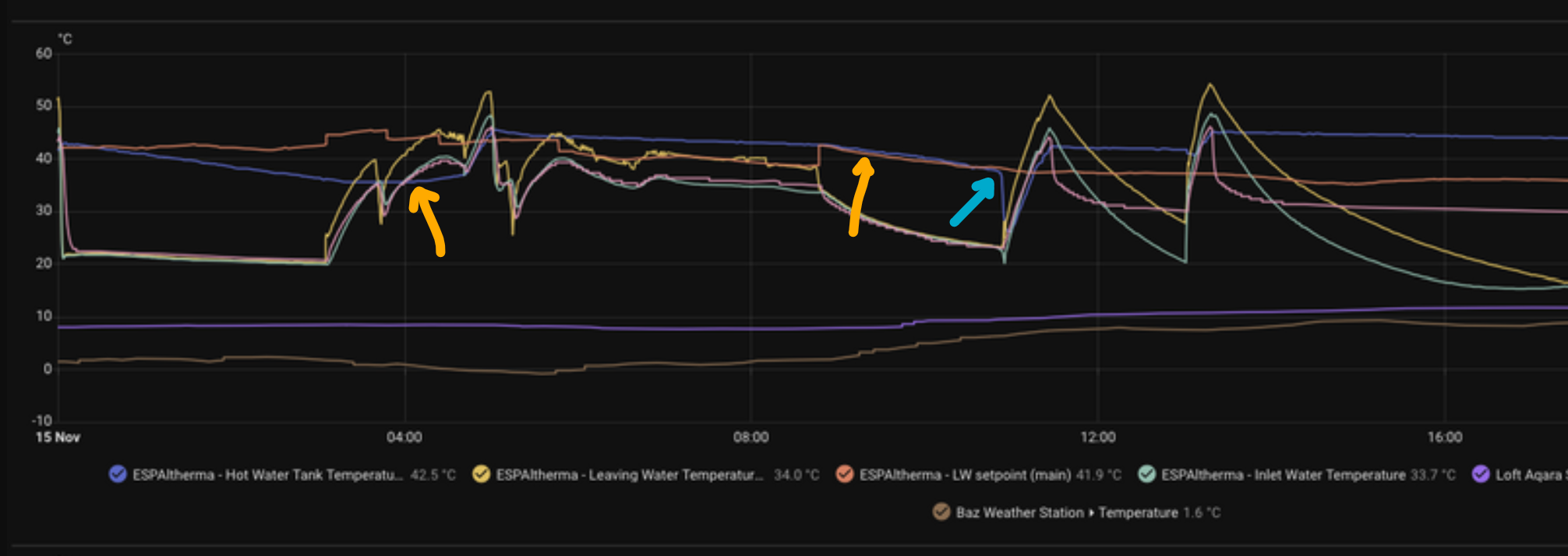
Blue arrow looks like heat pump in DHW mode, seems to work fine.
Orange arrow on the left shows DHW temp going down, then going up as heat pump flow temperature rises above DHW temperature. So the DHW tank flow temp follows heat pump flow temp, not just in one direction but in both. This inflection point strongly points to the valve not closing completely.
Note mixing valves like yours are leaky by design. I mean, not leaky as in "leaks on the floor" but the isolation between both sides of the valve is not perfect. Even when completely closed, about 0.1-0.5% of the flow will still go to the wrong port because there is no rubber seal on the rotating valve core like in a 3 way ball valve. Only the axis is sealed so it doesn't leak on the floor. Isolation between the two ports is achieved by tight machining tolerances. When used as mixing or diverting valves it is not a problem, in fact it is an advantage because these valves move constantly to regulate temperature, so seals would wear out, but brass parts machined to almost touch don't wear out. I doubt this is your issue because the temperature drop implies higher flow than the leaks these valves have.

