Joining the Renewable Heating Hub forums is completely free and only takes a minute. By registering you’ll be able to ask questions, join discussions, follow topics you’re interested in, bookmark useful threads and receive notifications when someone replies. Non-registered members also do not have access to our AI features. When choosing your username, please note that it cannot be changed later, so we recommend avoiding brand or product names. Before registering, please take a moment to read the Forum Rules & Terms of Use so we can keep the community helpful, respectful and informative for everyone. Thanks for joining!
I have had a few issues with my Hitachi spilt heatpump over the last winter. Hitachi have now been to site and installed new software to fix some of the issues.
I have one issue that I would like to ask. I appreciate that you will not know the specific Hitachi unit, but I think this could be generalised across different brands.
So the issue. On occasions following a short cycle or off, I see a 100m high area on the evaporator coil that is very cold and wet to the touch and the rest of the evaporator is cold and dry. I have been given the following explanation as to why this is:
The lowest section of the evaporator being cooler during first start up.
The reason is that during compressor stop the liquid refrigerant settles at the lowest point, (in this case the evaporator lower section) it won’t settle in the compressor because the crank case heater is designed to keep the compressor warm to avoid this. So when the system first starts up, until the refrigerant has started circulating around, the bottom section of the evaporator would be observed to be cooler than the top.
Does this sound a reasonable and valid explanation?
2024 build bungalow, Southern England, 179 m2, 12w/m2 Underfloor heating, fully open
Vaillant aroTHERM plus 3.5kW
50 litre volumiser
3.6KW solar panels Tesla 13.5kw Powerwall 3
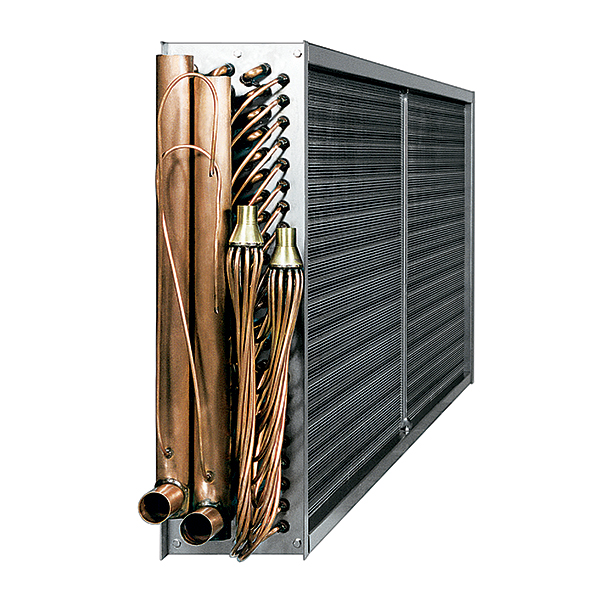
@trebor12345 I must admit I noticed that about Hitachi more than any other brand, don't think of an evaporator as one pipe in and one pipe out, they will have a distributor and multiple fingers into the coil meaning the liquid going in would be at the bottom of multiple parts of the coil, like the coil is made up of 6 sections for example. I
t is likely what you are seeing is un-evaporated liquid still containing energy in the bottom of the coil and was not evaporated as well as the rest of the coil where the air pulled over by the fan is less effective at the bottom. I noticed that when running on full power with hitachi it would often have 2 or 3 frost lines instantly before it got going and then after a bit it would settled down. See attached diagram from the manual.
This is just my observation, I am not an expert on Hitachi.
AAC Group Ltd covering the Kent Area for design, supply and installation of ASHP systems, service and maintenance, diagnostics and repairs.
@trebor12345 I must admit I noticed that about Hitachi more than any other brand, don't think of an evaporator as one pipe in and one pipe out, they will have a distributor and multiple fingers into the coil meaning the liquid going in would be at the bottom of multiple parts of the coil, like the coil is made up of 6 sections for example. I
t is likely what you are seeing is un-evaporated liquid still containing energy in the bottom of the coil and was not evaporated as well as the rest of the coil where the air pulled over by the fan is less effective at the bottom. I noticed that when running on full power with hitachi it would often have 2 or 3 frost lines instantly before it got going and then after a bit it would settled down. See attached diagram from the manual.
This is just my observation, I am not an expert on Hitachi.
Thank you. That's an excellent find. As you can probably see I know nothing about the mechanics of how HP work. Looking at the diagram how many different coils is the evaporator split into, there are three different zig-zag lines? What do the 3 different zig-zag lines mean?
2024 build bungalow, Southern England, 179 m2, 12w/m2 Underfloor heating, fully open
Vaillant aroTHERM plus 3.5kW
50 litre volumiser
3.6KW solar panels Tesla 13.5kw Powerwall 3
@trebor12345 So I think the 1st zigzag section shows some through coil sub-cooling before expansion and then the next section show the 1st stage distributor and then after this 1st evaporation it goes through additional distribution to the rest of the coil.
AAC Group Ltd covering the Kent Area for design, supply and installation of ASHP systems, service and maintenance, diagnostics and repairs.