
Notifications
Clear all

Topic starter
01/01/2026 11:19 am
I initially posted last winter and thanks to both the information provided by the community here and in liaison with Grant support my setup has moved on somewhat and seems to be largely running ok when the outside temp is more than around +4C
Original thread is here :
Forums | Renewable Heating Hub
As there's a change in focus on the advice I'm looking for, I have decided to start a new thread rather than continue the old one.
In summary, the house is 1960’s large bungalow which is being fully refurbished in stages with a full basement below, only a small part of which is going to become habitable, the rest houses utilities and storage and of coruse acts as a good buffer to the outside temperatures. Half the ground floor is now finished and we are living this part now with the ASHP’s providing HW and CH via UFH to this. Roof is a "Warm Roof" but it only 90% finished and should be fully completed in Feb, so currently the thermal effeciency of the roof is somewhat compromised.
The ASHP have still not been formally commissioned and cannot be until the whole of the house is finished as until then insulation is not finished and half the UFH has not even been installed yet.
Having read the SAP calcs with the benefit of hindsight there are so many mistakes in them I’m not sure they are worth the paper they are written on. I assume they were used to calculate the sizing of twin 10kw ASHP’s which on face value seems quite a lot for a house that’s going to be fully refurbished with new windows, roof and insulation.
Nevertheless the finished rooms are keeping warm the majority of the time on a single master only ASHP and the master uses what appears to me to be a modest amount of power to do so until the outside temp falls to a level where defrost cycles starts to kick in. At this point the power usage goes up considerably. Instead of sitting steady anywhere from 1.3-2.0kw usage, the power starts to spike considerably shooting up to near max of a single ASHP around 3.5kw, then after 15mins plunging to 0.2-0.4kw for the next 15mins. Overall heating starts to slide slowly as the inefficiency of this constant defrost-max-defrost cycling takes its toll on the heating loop temp. At was at this point I bean to investigate more about my cascade setup and how it was supposed to work.
The ASHP have been installed in a cascade setup which seems quite uncommon and I have struggled to find much information on this other than from Grant who finally got the slave running for me about 2 months ago by talking me through a couple of missing config params. In summer of course it didnt really matter as the master alone was more than covering our demands.
Setup is as follows:
- 2x 10kw Grant Aerona ASHP in a cascade setup as master & slave with just one EP-001 and one EP-002. Slave is currently setup via param 46-13 to kick in when the outside temp is 3.5C or lower. Only the master ever heats the HW regardless of outside temp. I have confirmed that this is an approved setup by Grant.
- Both ASHP have only the non-smart old style Chofu controllers. The controllers are in the unheated basement which is typically around 10C in winter and 15C in summer.
- Both ASHP have a grant 30l volumiser installed on the plinth next to the ASHP unit and as a result we do not have a central combined volumisers/low loss header tank. Both volumisers have the immersion disabled as enabling it seems to cause each one to pull an additional 3kw when the defrost cycles kick in which is even worse. Again this is an approved Grant setup although I don’t really know why we ended up with two volumisers rather than the low loss header tank.
- Both ASHP/volumisers are plumbed in parallel into the main loop. The main loop feeds either the HW tank when the relay is enabled, or two UFH manifolds each running roughly half the house. Each manifold has zone valves each of which have WiFi thermostat controllers in the rooms.
- Both ASHP have had their pump speeds set to minimum via DIP switches on the pcb. The flow regulator valves have not been set and tbh I’ve never seen a ball int he window which makes me suspect they are still on too fast and the ball is flying off the end. I have no idea what the correct setting should be however even if I was to try adjust the valves.
- 3 UFH zones completed in the house so far.
- Kitchen/lviing/dining - large room 980 sq ft. Off Manifold 1. Room is stable around 20c - thermostat is set to 22C.
- Main bedroom - 305 sq ft off Manifold 2 room fluctuates between 20-21c - thermostat is set to 21c
- Main ensuite - 110 sq ft off manifold 2. Room is stable around 20-20.5C - thermostat is set to 21C
- These 3 zones represent a total estimated heat loss of around 8kw and 45% of the house floor area. These areas all have high spec double glazing and a new MVHR installed.
- The remainder of the house has no CH or any heating at all as not refurbished yet and old gas boiler was ripped out. Old windows are double glazed but some have failed due to age, all have trickle vents and some rooms have wall vents for additional airflow due to humidity.
- Remainder of house not yet refurbished is 1400 sqft ground floor with UFH plus a further 340 sqft in the basement with planned new radiators (as limited ceiling height and wall foundations prevent fitting UFH).
- We have installed a new 10kwp solar array and a new 10kw inverter with 16.1kwh of batteries. We are on Octopus Cosy tariff so top up the batteries 3x a day between 4-7am, 1-4pm and 10-12pm.
- HW is set to run at 55C and kicks in at 1pm (as off peak at this time) until the 240l tank is up to temp and the thermostat turns it off at around 48C which typically takes around 90-105mins. Otherwise CH is on for the full 24hrs when not overridden by the HW cycle.
- We are in West Yorks. Climatic curve has been set mostly by trial and error to 32c@20c / 45c@-6c
- Following is a list of the only params which have been changed from the defaults. Note all params are identical on both master and slave units.
- 21-02 WC changed to 45C
- 21-04 WC changed to -6C
- 21-05 WC changed to 23C
- 31-11 DHW changed to 55C
- 31-21 changed to 150mins
- 43-01 frost protection room air temp changed to 6C
- 43-11 frost protection outside air temp changed to 2C
- 46-00 enable heater (backup slave ASHP as wired) to 3
- 46-01 changed to 55C
- 46-4 changed to 0
- 46-05 changed to 2
- 46-11 changed to -20C
- 46-14 changed to 2
- 51-46 heater type (backup = slave) changed to 1
- 21-41 hysteresis of heating water set point changed to 4C
- 46-13 outside temp for backup heater (slave) to enable = 3.5C
So the problem starts to be when the temp drops to around 4C or less and the defrost cycles kick in with increasing regularity. These cause big spikes in either the master alone or both master and slave power use. The colder it gets the more pronounced the saw tooth use of electricity gets. There is a gradual slow drop in room temps too, which I suspect is due to the loss of loop and floor temp from the defrost cycles taking their toll. This appears to be quite a common issue from what I’ve read here and on the FB group.
From what I had read having a slave enabled should substantially mitigate the defrost cycle issue as in theory only one ashp is allowed to defrost at once with the other picking up the heating whilst the defrost cycle completes. In reality however when the slave kicks in at whatever temp is set, broadly speaking the power usage just doubles! Twice as many defrost cycles and overall no real increase in room temp. This seems contract to my expectations I would have thought two ASHP’s would each modulate their power down to use half the current loading compared to the master alone before the switch over, yet it doesn’t seem to do that! I also expected the slave to efficient wipe out the losses from the defrost cycles.
So what should I change to:
- Get both ASHP’s modulating together when both master & slave are active
- Reduce the impact of the defrost cycles on master and master/slave
- Should I change the set point at which the slave kicks in? Currently set to 3.5C. Debating dropping that even lower to 3C or even 2.5C.
- Should I attempt to reduce the flow rate further by adjusting the valves (with a spanner?) and if so to what flow rate?
- Any suggested tweaks to the WC curve? By some people’s advice my temps are set quite high, but low by others. It does feel like we have what has been described as the defrost doom loop so reducing temps in that case would make sense. I can see a case for either turning down the temp at the bottom end (to reduce defrost frequency) but also for turning it up (to try drive more heat into the loop between defrosts).
So having typed all that over a couple of days off at xmas and reading up even more whilst doing so I have decided to make a change to my WC curve in an attempt to avoid what I suspect is likely the root cause - the "defrost doom loop"! As a result I’ve reduced the bottom end curve from 45C@-6c to 38C@-2c. This should reduce the demand and loop temp by around 4C at the point at which the doom loop has been starting. The week ahead is forecast quite cold so I figured it was a now or never opportunity to test out quite a radical change….
-
- 21-02 WC changed from 45C to 38C
- 21-04 WC changed from -6C to -2C
I am of course still very much open to other any suggested changes as per above…
Adam
This topic was modified 2 months ago by adam

01/01/2026 5:15 pm
The colder it gets the more pronounced the saw tooth use of electricity gets
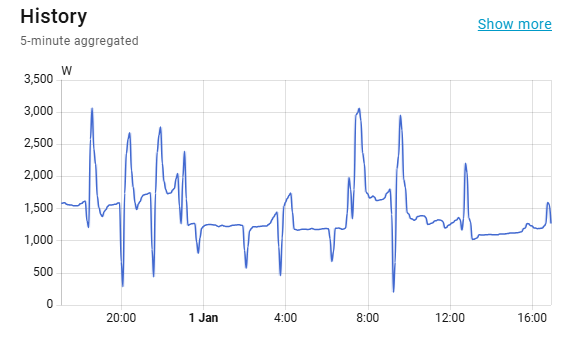
This is actually normal, or at least its more or less what I see with my Vaillant and there is an obvious logical explanation. The heat pump has to work harder when its colder anyway, but harder still when its in defrost mode because its only heating part of the time and thus needs to work doubly hard to deliver any given amount of energy. Thus power, and in particular peak power, when its heating will be much, much higher. Power during the actual defrost is small. Of course energy = power * time so if its high some of the time and low some of the time the average, which still higher, is nothing like as high as the peak.
Here is a snip from my Vaillant showing defrosts. Overnight the defrost recovery spikes are suppressed because its in low noise mode (and as a result the house cools slightly), otherwise they are clearly visible. Around 7am, when low noise switches off, there is a broader spike because its recovering not just from defrost but also from the fact that it has been failing to match demand during the overnight period so has to catch up.
There is a gradual slow drop in room temps too, which I suspect is due to the loss of loop and floor temp from the defrost cycles taking their toll. This appears to be quite a common issue from what I’ve read here and on the FB group.
Assuming that the heat pump isnt reaching its max output then adjusting the WC curve up (ie to higher flow temp) should mitigate this. If the heat pump is reaching max output then it wont.
So having typed all that over a couple of days off at xmas and reading up even more whilst doing so I have decided to make a change to my WC curve in an attempt to avoid what I suspect is likely the root cause - the "defrost doom loop"! As a result I’ve reduced the bottom end curve from 45C@-6c to 38C@-2c.
If you are genuinely in a defrost doom loop then you probably dont have sufficient system volume. Reducing the FT may well reduce the defrosts, but also the emitter output. You may need to address the root cause if the situation is really this, but I dont think you have said anything yet which tells me that it is in a doom loop
From what I had read having a slave enabled should substantially mitigate the defrost cycle issue as in theory only one ashp is allowed to defrost at once with the other picking up the heating whilst the defrost cycle completes. In reality however when the slave kicks in at whatever temp is set, broadly speaking the power usage just doubles!
Is that peak power or average power? In general terms I would expect, for a properly tuned system, that the average power to increase fairly linearly as a second heat pump is introduced because you are actually meeting the demand. Its quite likely that the peak power will indeed double because defrost recoveries will overlap.
If however the second heat pump switch on point is too low, then you will see a leap in average power when does switch in (a) because you are returning to the point of actually meeting demand and (b) because if the system has failed to meet demand for some time, there is some catching up to do (like my Vaillant above at 7am)
The week ahead is forecast quite cold so I figured it was a now or never opportunity to test out quite a radical change….
- 21-02 WC changed from 45C to 38C
- 21-04 WC changed from -6C to -2C
I am of course still very much open to other any suggested changes as per above…
Try it if you wish but if its cold enough defrosts are absolutely inevitable and all that turning down the WC curve is doing is to reduce output from the emitters, so I cant see how this will help.
By some people’s advice my temps are set quite high, but low by others.
The required flow temperature is determined by the loss of your house and by your emitters. Not other peoples houses or emitters!
Fundamentally you have to accept defrosts, they will happen when the temperature is around freezing. You also have to accept that this will result in power spikes. You also must remember that the output from the emitters depends principally on flow temperature and if that is not sufficient (with or without defrosts) your house will cool.
The key questions in respect of the cascade is do you or do you not need the second heat pump to get sufficient output capacity. If you do then the question is, at what temperature should it kick in. By the sound of it, and assuming you are already operating with the system fully open loop 24x7 (please confirm this is the case) then it may need to kick in at a slightly higher OAT
- 21-02 WC changed from 45C to 38C
- 21-04 WC changed from -6C to -2C
will cause the FT to flatline at -2 instead of at -6. Given how cold it is going to be this week you dont want it to do that, you want it to keep going up as the OAT gets colder.
I think you may be getting a bit muddled and perhaps should step back a bit. Remember the basics, as it gets colder the house needs more energy. This means that both the heat pump must be able to supply more energy AND the emitters must emit more. This means that you need
(a) sufficient capacity, including defrosts, to cover the house loss at the minimum OAT you want it to work at and
(b) a WC curve which means that the emitters emit the required energy at the minimum OAT you want it to work at. This may or may not need to be a bit higher (at low temps) than an 'ideal' curve would predict, depending on whether or not the heat pump 'compensates' internally for the time lost during defrost, by increasing the actual FT above the target.
(a) determines the temp at which the second heat pump must be told to kick in
(b) determines the settings on your WC curve
trying to finesse the WC curve 'to minimise defrosts' is unlikely to work.
Finally I will reiterate something I say above, please confirm that you are operating 24*7 with a fully open system, no operational thermostats/TRVs. Also do you have low noise mode (night mode I think in Grant-speak) set by any chance?
This post was modified 2 months ago 15 times by JamesPa
4kW peak of solar PV since 2011; EV and a 1930s house which has been partially renovated to improve its efficiency. 7kW Vaillant heat pump.
Topic starter
01/01/2026 8:14 pm
Thank you JamesPA for taking the time to reply to me, it is much appreciated.
I will try to respond to some of the questions and points you raise.
This is actually normal, or at least its more or less what I see with my Vaillant and there is an obvious logical explanation. The heat pump has to work harder when its colder anyway, but harder still when its in defrost mode because its only heating part of the time and thus needs to work doubly hard to deliver any given amount of energy. Thus power, and in particular peak power, when its heating will be much, much higher. Power during the actual defrost is small. Of course energy = power * time so if its high some of the time and low some of the time the average, which still higher, is nothing like as high as the peak.
Yes, I do get that, its just pretty much as soon as the defrost cycles kick in, i start to lose heat from the rooms. Above that with no defrost cycles the rooms stay warm. Its pretty clear its the defrost cycles kicking in at around 4C which is causing the problems. My WC curve went down to -6C so I had a good 10C of temp increases left in reserve at the point of the defrost cycles beginning, yet regardless the room temps fall.
I have seen countless people with Aerona R32 ASHP saying similar things, when the defrost loops start they start to lose room temp. It seems to be a thing with this model as far as I can tell. What Im trying to ask for is help with how to minimise / remove it. Perhaps more adjustment to the various defrost cycles paramters?
Assuming that the heat pump isnt reaching its max output then adjusting the WC curve up (ie to higher flow temp) should mitigate this. If the heat pump is reaching max output then it wont.
In theory my ASHP are nowhere near their max outputs.
I made the adjustments to WWC this morning at 10am. During the day the rooms stayed stable, if anything temps went up slightly but that could have been solar gain.
Since sun down the rooms have each fallen 0.5C so I have gone and adjusted the WC curve back up a little.
-
- 21-02 WC changed back from 38C to 40C
So the net reduction should now be only about 2C lower than before I started this morning.
Having made that change I watched the stats on the panels for a while as we had also got to +3C outside temp and the 2nd ASHP kicked in.
Prior to the change the single master was running at around 2kw power. Once the slave kicked in both seem to run around 1.6kw. Flow temp rose from 36C to 38/39C and return temp crept up in the 40mins or so that I watched from 33C to 35C. I did not witness a defrost cycle but I believe one had just happned before I went down due to seeing a huge drop off in power use, followed by a huge spike.
If you are genuinely in a defrost doom loop then you probably dont have sufficient system volume. Reducing the FT may well reduce the defrosts, but also the emitter output. You may need to address the root cause if the situation is really this, but I dont think you have said anything yet which tells me that it is in a doom loop
It is entirely possible I dont have sufficient volume, as the house is only half finished and thus 55% of the UFH loop pipes simply do not exist yet. Regardless I do have 2x 30l volumisers plus around 1400 sq ft of UFH pipeing plus the main loop to and from both manifolds, so there must be a decent amount of litres of water in there in total!
Is that peak power or average power? In general terms I would expect, for a properly tuned system, that the average power to increase fairly linearly as a second heat pump is introduced because you are actually meeting the demand. Its quite likely that the peak power will indeed double because defrost recoveries will overlap.
Im talking roughtly doubling whatever was being used before, so yes an average I suppose. Each 10kw ASHP can draw upto about 3.5kw, two can therefore double that. As you can imagine with 16.1kwh of batteries drawing 7kw following a master/slave defrost cycle fair takes it toll on the battery. Over the last week or so on the coldest nights we only just made it through the 6 hour evening window before 10pm and the batteries could be recharged.
If however the second heat pump switch on point is too low, then you will see a leap in average power when does switch in (a) because you are returning to the point of actually meeting demand and (b) because if the system has failed to meet demand for some time, there is some catching up to do (like my Vaillant above at 7am)
Try it if you wish but if its cold enough defrosts are absolutely inevitable and all that turning down the WC curve is doing is to reduce output from the emitters, so I cant see how this will help.
The fundamental problem I had before was that defrosts were occuring around every 60mins. During the following hour around 10mins is lost to the defrost cycle which pulls the loop temp down to a crazy low around 15C. Then for the next 20mins the ASHP(s) go on near full power getting the loops back up to temp, then drop back in power and run stable for around 30mins before triggering a new defrost cycle. So all in all around 50% of the time the loop is below the correct temp, and 50% of the time its right and heating the UFH block. It seems apparent to me that this is a recipe for loosing heat overall if your only heating the room half the time.
The required flow temperature is determined by the loss of your house and by your emitters. Not other peoples houses or emitters!
Yup, I totally get that but I do not have any official figures to use and wont get them until my house is finished and the system configured. I have asked more than once... The best I can do is make an educated guess based on other peoples experience and advice on here and from Grant Tech support.
The key questions in respect of the cascade is do you or do you not need the second heat pump to get sufficient output capacity. If you do then the question is, at what temperature should it kick in. By the sound of it, and assuming you are already operating with the system fully open loop 24x7 (please confirm this is the case) then it may need to kick in at a slightly higher OAT
Yes that is exactly my question... TBH I dont even know why they specified them as 2x10kw units rather than say one 13kw and a slave 6kw - which would have made more sense to me, i.e. a powerhouse as the main and then a nominal slave to top up when needed in extreme cold. Unless of course they always match them as a pair? Do they????
- 21-02 WC changed from 45C to 38C
- 21-04 WC changed from -6C to -2C
will cause the FT to flatline at -2 instead of at -6. Given how cold it is going to be this week you dont want it to do that, you want it to keep going up as the OAT gets colder.
Yes, but dont forget the -6C setting was something I made up, it is not an official figure. From reading -2c or -3c is more normal for West Yorkshire where I live, hence I tinkered it back to that. I do take your point that its due to be cold this week but based on our local forecast and how sheltered our house is by trees its unlikely we will get much below -2c I expect, but who knows...
I think you may be getting a bit muddled and perhaps should step back a bit. Remember the basics, as it gets colder the house needs more energy. This means that both the heat pump must be able to supply more energy AND the emitters must emit more. This means that you need
(a) sufficient capacity, including defrosts, to cover the house loss at the minimum OAT you want it to work at and
(b) a WC curve which means that the emitters emit the required energy at the minimum OAT you want it to work at. This may or may not need to be a bit higher (at low temps) than an 'ideal' curve would predict, depending on whether or not the heat pump 'compensates' internally for the time lost during defrost, by increasing the actual FT above the target.
(a) determines the temp at which the second heat pump must be told to kick in
(b) determines the settings on your WC curve
trying to finesse the WC curve 'to minimise defrosts' is unlikely to work.
Yes I get all that totally. My logic was that if I could reduce the impact of the defrost cycles by reducing how often they needed to occur by working the ASHP's less hard on a cooler bottom end WC curve, that somehow it might just net itself out as either warmer, or the same warmth with far less electricity used.
As it is, not only does the electricty shoot up when the defrost starts, but we loose warmth and then soon after the slave kicks in and doubles the usage again with very little apparent gain in temp as the slave also goes into a defrost doom loop of its own!
Finally I will reiterate something I say above, please confirm that you are operating 24*7 with a fully open system, no operational thermostats/TRVs. Also do you have low noise mode (night mode I think in Grant-speak) set by any chance?
Yes, I had posted such above but I appreciate its a little lost in the ton of info I provided. Yes the 3 UFH loops, (2 on one manifold, 1 on the other other manifold) are all fully open 24x7 except for around 90mins or so from 1pm when the DHW cycle kicks in. We do have a thermostat and TRV in each room but the stats are all set higher that the rooms are getting to currently, so they are not switching off any loops ever.
I had originally run the HW twice a day once at 1pm for 1hr and once at 4am for 1hr but the reality was that the 4am cycle was waking me up with the fan speed running at max and with only 2 of us in the house we use very little water overall showering so I experimented and found that a single 90mins at 1pm, when the ASHP dont need to work as hard due to higher OAT worked just fine.
I confirm we do not have low noise mode set. I dont even know how to do that, so it will be on the factory default as not one of the params I have changed.
So in summary Ive added 2C back onto the low end WC curve. Again Im into the doom loops this evening although possibly not quite as bad as yesterday, but that's also to be expected I guess given I have still reduced the WC temps by a nett 2C.
Im still looking for info on how to maintain room temps with only half a finished house when we get below 4C and the defrost cycles kick in. It feels like theres a cliff face that we fall off as soon as the defrosts start to happen and power usage literally doubles almost instantly. Its painful to watch as above 4C the system is running extreemly well and the running costs are very modest indeed. I do appreciate theres literally only 4-5 weeks a year when the defrost loops are likely to happen, and we do have a 10kw DRU gas fire in the living room which we can run, so we arn't going to get too cold, but I am trying to get a setup where the defrost cliff face doesn't feel quite so steep!
Also looking for any wisdom on what temp (and associated additional parameters) to engage the slave to facilitate a smoother switch into cascade master/slave mode that again doesn't literally just double the electricity use!
This post was modified 2 months ago 2 times by adam
01/01/2026 9:37 pm
Yes, I do get that, its just pretty much as soon as the defrost cycles kick in, i start to lose heat from the rooms. Above that with no defrost cycles the rooms stay warm. Its pretty clear its the defrost cycles kicking in at around 4C which is causing the problems. My WC curve went down to -6C so I had a good 10C of temp increases left in reserve at the point of the defrost cycles beginning, yet regardless the room temps fall.
I have seen countless people with Aerona R32 ASHP saying similar things, when the defrost loops start they start to lose room temp. It seems to be a thing with this model as far as I can tell. What Im trying to ask for is help with how to minimise / remove it. Perhaps more adjustment to the various defrost cycles paramters?
(Almost) all heat pumps do defrost by taking heat from the water in the emitters and using that to melt the ice. This causes the flow temperature to drop, in the extreme cases to below room temperature. You cant avoid defrost, it occurs because we live in a damp climate and the heat pump works by creating a surface that is colder than the outside air and is thus inevitably below the dew point when the humidity is high. I would be surprised if you notice cooling in a single defrost cycle (but say if you do) but if, over multiple defrost cycles, the heat pump isn't keeping up because its capacity is exceeded then of course you will
The amount of energy defrost needs is pretty constant and the only place it can come from is the house, so the question really is how can you minimise the effect.
Firstly it would be helpful to know what flow temperature it gets down to during defrost and for how long. Because I can plot FT for my heat pump I know that and it would be good to compare, do you have any logging capability?
In system terms you can reduce the impact of defrost by
a larger engaged system volume. If you have a buffer/llh then make sure that the secondary pump continues to run during the defrost cycle otherwise the engaged system volume is only the primary. If you dont have a buffer then adding a volumiser in the flow would help.
not running it as hard, which in practice (since you cant change the load) means engaging the slave at a higher OAT, maybe just above the defrost threshold
Both of these will smooth the cyclical variations due to defrost, but the energy consumed wont change materially so it will still be the case that, if your heat pump is undersized, the house will cool over several cycles. By engaging the slave earlier it should never reach the point where its undersized.
The fact that the WC curve went down to =-6 is largely irrelevant. If the FT at 4 isn't sufficient or the heat pump has reached capacity, the FT at 4 isn't sufficient/the heat pump has reached capacity and to first order, only increasing whichever one is causing the problem will help.
So in summary Ive added 2C back onto the low end WC curve. Again Im into the doom loops this evening although possibly not quite as bad as yesterday, but that's also to be expected I guess given I have still reduced the WC temps by a nett 2C.
If the WC temps are reduced your emitter outputs will reduce so the house will cool, its as simple as that. I don't understand why, if your house isn't warm enough, you are reducing flow temperature. It just doesn't make sense!
Im still looking for info on how to maintain room temps with only half a finished house when we get below 4C and the defrost cycles kick in. It feels like theres a cliff face that we fall off as soon as the defrosts start to happen and power usage literally doubles almost instantly.
You keep talking power but haven't answered the energy/average power question. Expect peak power to double, its the energy (=power, which varies, * time) that you pay for.
If there is a cliff edge then and the heat pump is failing to keep up with the load when the WC is adjusted to the point it needs to be for the emitters to emit the energy they need to, your fundamental problem is insufficient output, so engaging the slave will help. In the end doing so cant double energy use (unless the cascade arrangement is poor and something is very inefficient) because the energy has to go somewhere and your house wont take double without warming up. So I would start by trusting the physics and the controller and engaging the slave at a temperature greater than the threshold for defrost, and seeing what happens over a period of at least 24, preferably 72, hours, concentrating on energy not instantaneous power.
Its impossible to tell for certain what the best course is without being there, but for sure the first step is to do the obvious ie increase the power available (and stop working the heat pump so hard) by running up the slave at a higher OAT. Then carefully monitor what happens. Check flow and return temperatures (because they will tell us if the heat pump is struggling to keep up), energy use over time, OAT, target and actual FT. With that info it might be possible to do some optimisation, but until you do the obvious (or have more extensive measurement data) it is impossible to be certain.
This post was modified 2 months ago 5 times by JamesPa
4kW peak of solar PV since 2011; EV and a 1930s house which has been partially renovated to improve its efficiency. 7kW Vaillant heat pump.
Topic starter
02/01/2026 10:17 am
Ok so I’ve called Grant this morning and talked through the issues.
their advice was that my flow rates are likey too high which is what is causing excess defrost cycles. Ideally I should have 2-4 defrost per day whereas I can currently having more like 12-18 of them!
Both ashp pumps are already set to min, so he suggested turning down the flow rate valves a little at a time so that the differential
between flow temp and flow return was min 5C ideally 6-7c. Currently my differential is around 3C.
i must admit I still don’t fully understand why having a lower differential would cause more defrosts but for now I will go with his advice.
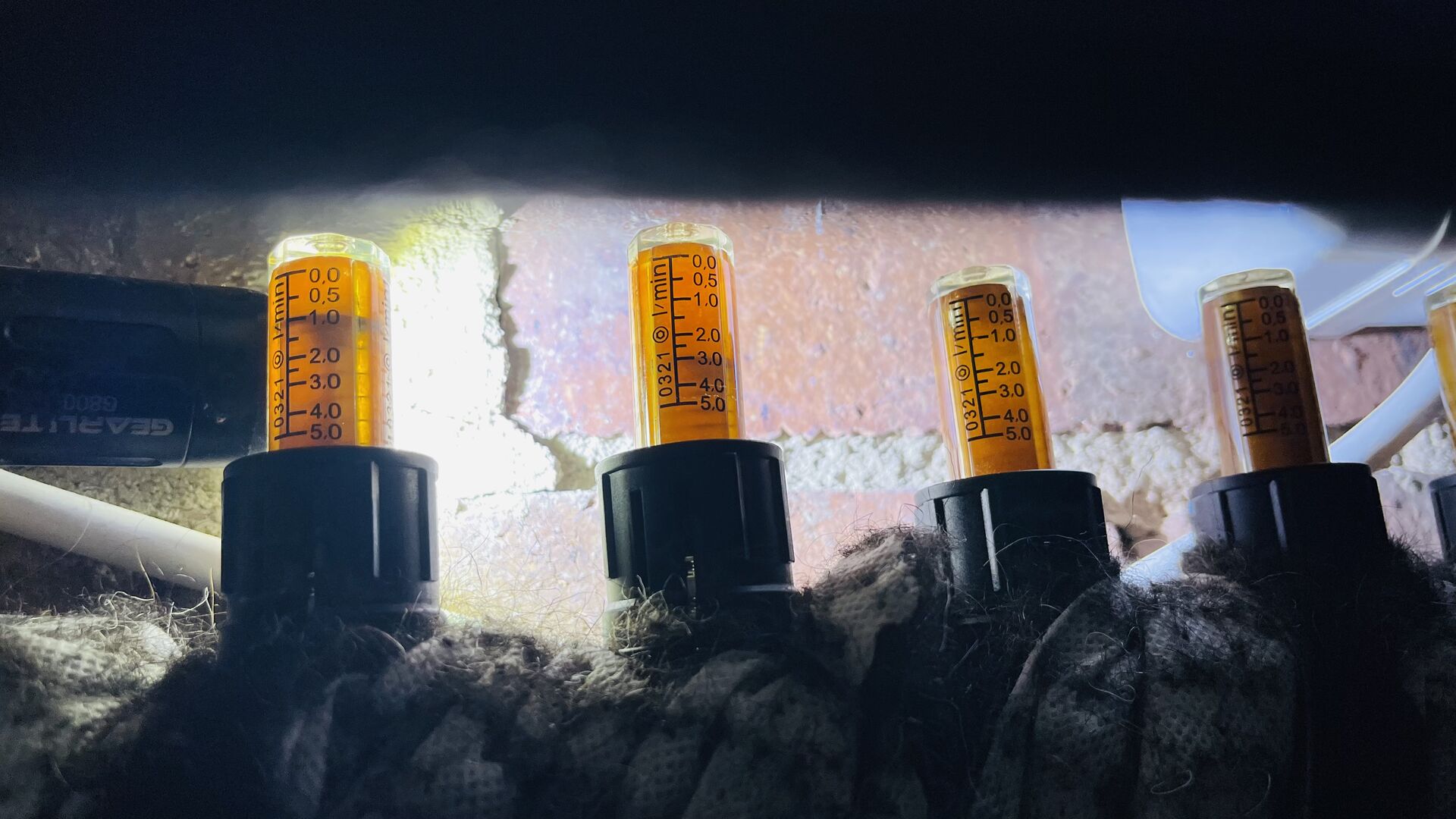
the next trouble is my flow rate valves are mysteriously gunked up which is largely occluding the glass and making it impossible to take a reading. They were both on max so I turned them about 1/8th of a turn as half a turn seemed to go from max to min.
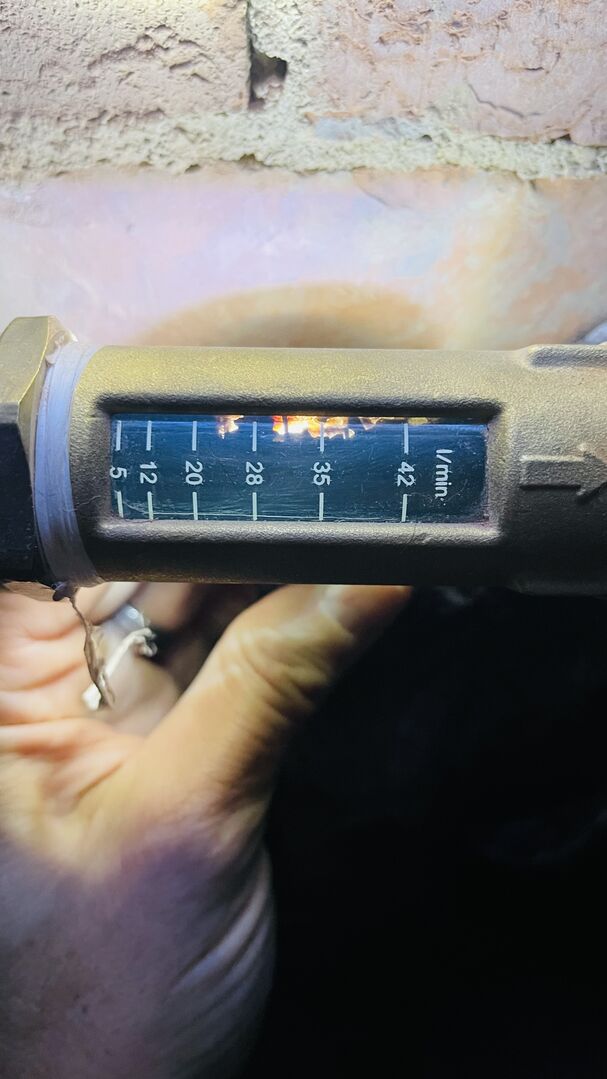
So will see if that has any impact over the next 24hrs and adjust again.
any ideas as to why a 12mth old system would be gunked up so badly?
he also talked me though a parameter 46-20 which is used to ensure the slave (or backup heater as it was intended for) remains active during master defrosts. Mine was set to disable (0) so we’ve changed it to (2) which ensures the slave keeps running when the master defrosts. This will mitigate the consequence of master defrosts but of course the idea is to reduce them happening by adjusting the flow rate first. There is no such relationship for the slave back up to the master so the master would already have remained running during a slave defrost anyway so no action needed to prevent that.
i watched and tested it and sure enough param 46-20 =2 did indeed keep the slave running and the consequence of the loop temp drop was far less severe, losing only 5-6C rather than the 10-20c I was losing before!
02/01/2026 10:44 am
their advice was that my flow rates are likey too high which is what is causing excess defrost cycles.
I presume he didnt say why? I dont personally understand how this can be the case (so suspect BS) but of course willing to listen to arguments.
Ideally I should have 2-4 defrost per day whereas I can currently having more like 12-18 of them!
Interesting. 2-4 would be great but certainly not what I and others see on the damper days. 12-18 more likely as far as I am concerned and some report 1 every 45 mins (not with Grant, but the physics is identical).
Both ashp pumps are already set to min, so he suggested turning down the flow rate valves a little at a time so that the differential between flow temp and flow return was min 5C ideally 6-7c. Currently my differential is around 3C.
Stupid idea to impose unnecessary restrictions in the pipework IMHO or to deliberately increase DT, unless he can explain the mechanism by which this will improve defrost. By all means try it but my advice would be to reverse it out if it doesn't make a difference!
If you increase DT from 3 to 7 you will, at least in principle, need to jack your FT up by 2C to compensate so that the average emitter temp, and thus output, stays the same. This costs 6% in efficiency.
any ideas as to why a 12mth old system would be gunked up so badly?
possibly not properly flushed, possibly just residual cr*p. My filters blocked after 6 months.
he also talked me though a parameter 46-20 which is used to ensure the slave (or backup heater as it was intended for) remains active during master defrosts. Mine was set to disable (0) so we’ve changed it to (2) which ensures the slave keeps running when the master defrosts.
Now that does sound sensible!
Good luck, please post back results.
4kW peak of solar PV since 2011; EV and a 1930s house which has been partially renovated to improve its efficiency. 7kW Vaillant heat pump.
Topic starter
02/01/2026 11:36 am
As far as I can remember the reason why it caused more defrosts was that it kept the compressor running constantly which caused it to ice up. Keeping a bigger differential meant it would have periods of recovery meaning the coils didn’t frost up as quickly.
to be honest it’s really quite dry here at the moment albeit is cold. Outdoor RH is 67% according to the inlet sensor on my MVHR which is a couple of metres away from the ASHP’s. I had never actually seen any frost on the compressor fins but I havnt closely inspected them either.
anyway yes I really couldn’t understand why it would help turning the flow rate down so I asked him to repeat it so I would understand. Made little sense to me either but googling it does seem to support that as common knowledge that too high or too low flow rate is really bad. I’ll give it a go for now.
next step then is how to clean the filers in that case. I’ll google it, presumably there’s plenty of hand vids on youtube…
will cleaning the filters then cause the tung to slowly fall off meaning I can view the flow rates again or will they need dissembling and cleaning properly?
This post was modified 2 months ago 2 times by adam
02/01/2026 11:51 am
As far as I can remember the reason why it caused more defrosts was that it kept the compressor running constantly which caused it to ice up. Keeping a bigger differential meant it would have periods of recovery meaning the coils didn’t frost up as quickly.
Either complete Bow Locks or at best a marginal effect.
The amount of energy it needs to produce is fixed by your house. If you force it to produce that amount in a shorter time then it will have to work harder. A bigger differential wont result in shorter running, it will result in a lower average flow temperature. If anything that is likely to increase the running time.
The only argument I can see is that if you are forced to operate at a higher FT because of the higher DT, the COP is poorer so the amount of energy that is extracted from the air is less (and the amount you have to supply more) so the fins cool a bit less for any given amount of energy supplied to the house. Thats defeating the purpose of having a heat pump and taken to its logical extreme is an argument for resistance heating alone.
Remember that Grant don't make heat pumps, they resell far eastern heat pumps, until recently with some add-ons of their own design which cripple the performance of an otherwise perfectly good underlying piece of hardware.
googling it does seem to support that as common knowledge that too high or too low flow rate is really bad. I’ll give it a go for now.
Yeah, and google can tell you all sorts of untruths these days.
Too high is bad because it reduces the average emitter temp for any given FT thus reducing the efficiency because you have to jack up FT to compensate. Simple physics. Too low - no evidence to support this that I have seen and, more importantly, no explanation for the mechanism, unless its so low that you are really working the water pump too hard. Thus suspect BS.
I would also give it a go just so I can tell Grant I had done so, but with little expectation of success and a recognition that it will probably increase running costs.
next step then is how to clean the filers in that case. I’ll google it, presumably there’s plenty of hand vids on youtube…
Note there may be two filters - a largish magnetic one about 200mm high cylinder, and a small mesh filter perhaps only about 50mmx50mm. The latter will be closer to the heat pump than the former, mine is outside immediately behind the pump and I didnt know it existed until it blocked up!
will cleaning the filters then cause the tung to slowly fall off meaning I can view the flow rates again or will they need dissembling and cleaning properly?
Maybe. maybe not, impossible to tell TBH.
This post was modified 2 months ago 3 times by JamesPa
4kW peak of solar PV since 2011; EV and a 1930s house which has been partially renovated to improve its efficiency. 7kW Vaillant heat pump.
Topic starter
03/01/2026 7:42 am
Must admit I am also cynical as to why reducing flow rate in order to achieve a bigger differential between flow temp and return flow temp would be beneficial to ashp effeciency.
i appreciate it will be heating less water per min, but having to increase the water temp by more C per litre surely offsets any savings made?
anyway I think today’s job has to be to try clean out those filters. It’s dark in that area as the lighting hasn’t been fitted yet and the pipes are all double lagged but I cannot see anything resembling a tiny mesh filter, just two large Grant Mag-One magnetic filters, one on each of the master and slave pipework. Fortunately the plumber has left the removal tools and spare o-rings in a very obvious place so thumbs up to him for that.
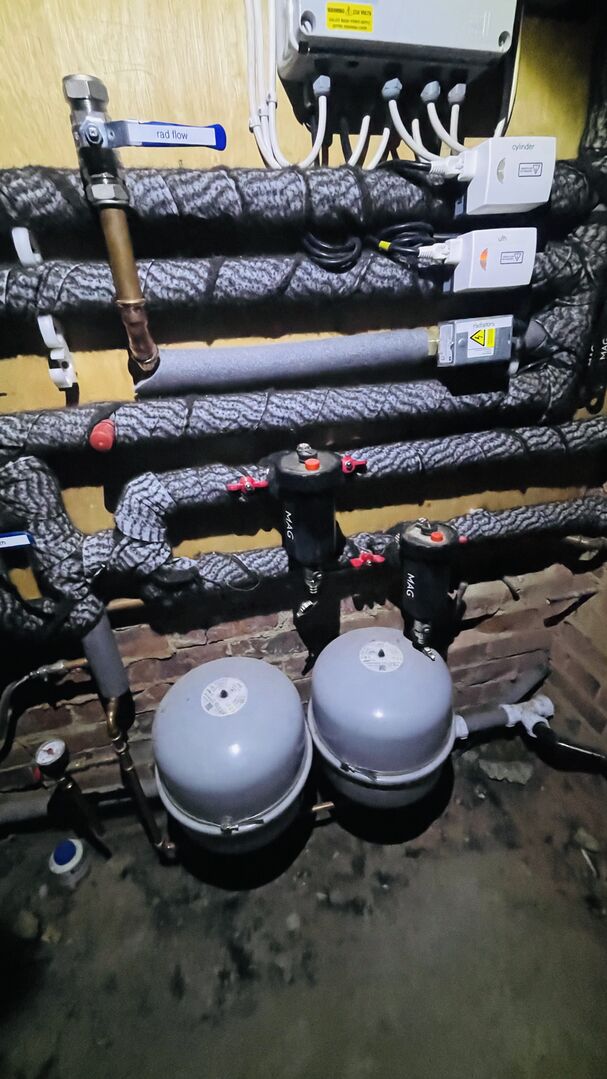
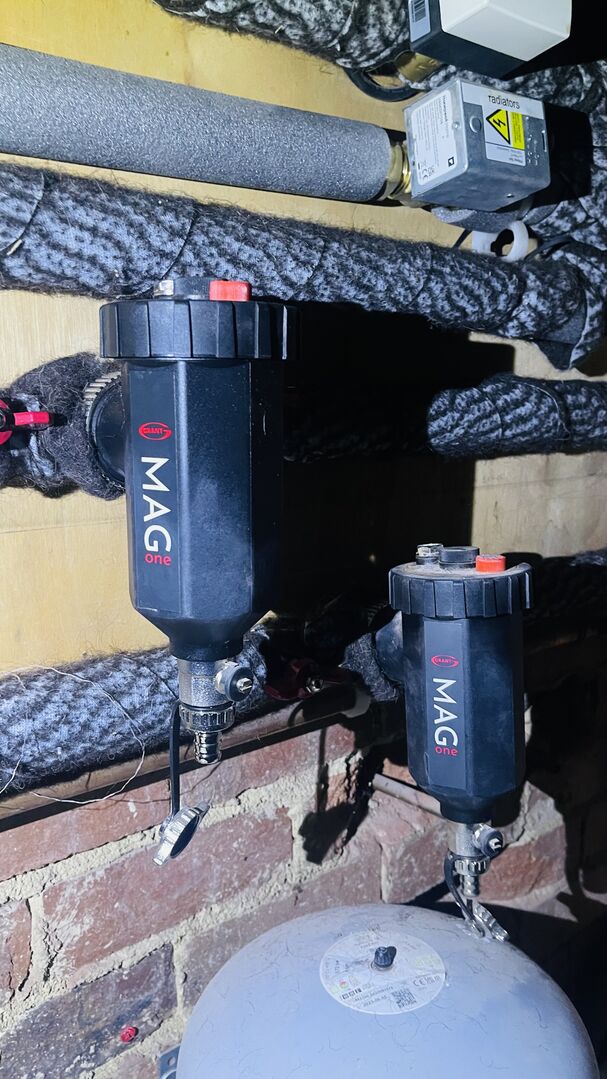
so I’m going to read the manual for them, watch a couple of vids on YouTube for similar mag filters and give it a go at cleaning them over lunchtime when the sun is out and we’re getting a bit of solar gain into the rooms to offset the fact I’ll need to turn the ASHP’s off whilst I isolate and clean the filters.
in terms of power use which you were asking before. On a good day when the temp is around 4C or more and we are just before the defrosts start to happen the ASHP’s have been using around 38kwh during a 24hr cycle for both heating and HW.
on bad days when the defrost doom loop has been happening that is more like 60kwh during a 24hr cycle.
i made one more change yesterday too given that the next 5-7 days look extremely cold. I’ve disabled the HW cycle on the ASHP’s and enabled an immersion heater timer in its place. That way the ASHP’s will now run for an uninterrupted 24hrs a day.
My plan is that this will give me a better run at understanding any changes I’m making is having and also that the additional power used by the immersions for a couple of hours in place of the ASHP HW cycle will be offset in part by the smoother running of the UFH not having to recover. TBH an extra 3-4kwh per day for the immersions is reality small fry compared to what the ASHP’s are doing!
This post was modified 2 months ago by adam
Topic starter
03/01/2026 9:45 am
Ok I’ve cleaned both filters - both were quite dirty with fine black soot, but I wouldn’t like to say they were dirty enough to restrict flow. I’m just hoping the lenses in the flow valves will slowly clear now. Strangely one set of manifold valves are also dirty whereas the 2nd set further away from the ashp and filters is still clean and clear!
I also managed to witness a slave defrost cycle and could see the master continued to run through it. I knew theoretically it had to but it was nice to see the mirror half process to what I witnessed yesterday. Again the impact on loop temp drop was dramatically less than before so this change alone has made a significant improvement i feel.
lets see how today goes…
03/01/2026 9:51 am
That all sounds very sensible and I agree with your analysis. Like you I turn on the immersion on the very coldest days, because I run low noise overnight there is a bit of a deficit and this helps mitigate. Let's see what the next days being but the fact the master and slave are now defrosting in antiphase is a major step forward imho.
4kW peak of solar PV since 2011; EV and a 1930s house which has been partially renovated to improve its efficiency. 7kW Vaillant heat pump.
Topic starter
04/01/2026 2:57 pm
Well this morning the master bedroom & ensuite were at 19.2C and the living room 20C so both towards the bottom end of normal but quite close and it was especially cold out over night so all in all, a decent result..
Power use yesterday was around 70kwh, so I would say a good +10kwh on even the prior bad days. That said looking at the power use graph on my inverter there was far less saw toothing, which is good thing and no doubt manifest itself as a much more stable temperature. At least theres some return now on the investment, sinking a lot of electric and watching the temps fall at the same time was a double whammy.
I suspect the high usage is largely down to the warm roof lacking any insulation around 45% of the perimeter edges behind the soffits, yet so we must be loosing a fair old huge chunk of heat through that, not to mention every time an internal door between the new and the old parts of the house is opened, warmth rushes into the unheated area. The roof will be resolved by mid Jan, the rest of the house, maybe with some luck, before winter'26.
So for now I suspect its likely as good as it can be, and the WC curve isn't far off the mark for a half finished house. I dunno if I could be getting away with using less electricity but I'm at a loss as to what else to tweak now, other than maybe tinkering with turning down the flow rate, albeit Im also struggling to see how that would help really.
I have a busier week ahead next week, prepping for the roof works so likely have less time to tinker after today. By Tuesday we're over the worst of this cold snap so I suspect it will be far less on my mind anyway.
1
Page 1 / 2
Next

Latest Posts
-
RE: Heat Pump vs New Gas Boiler for Inherited House - Worth the Extra Cost?
*** I now see @jamespa has already posted but will stil...
By cathodeRay , 26 minutes ago
-

RE: Tell us about your Solar (PV) setup
@mk4 Charge to 100%, discharge down to 10%.
By bobflux , 33 minutes ago
-
RE: Daikin Altherma 3 LT compressor longevity question
This mess is intriguing: I wonder if this represent...
By bobflux , 2 hours ago
-
RE: Connecting Growatt SPH5000 over wired ethernet rather than wireless
The simplest wired option is usually the Growatt Ethern...
By Jonatan , 6 hours ago
-
RE: Peak Energy Products V therm 16kW unit heat pump not reaching flow temperature
ASHPs do have a minimum compressor speed. The minimum h...
By bobflux , 13 hours ago
-

RE: Electricity price predictions
@jamespa And it seems some of the nasty public cloud...
By Batpred , 13 hours ago
-

RE: Jokes and fun posts about heat pumps and renewables
Technology is rapidly advancing. BBC News reported th...
By Transparent , 16 hours ago
-
What matters for flow and pressure drop is internal dia...
By bobflux , 17 hours ago
-

RE: Do Fridges and Freezers have COP ratings?
@editor Thank you all for your replies and submitted in...
By Toodles , 20 hours ago
-
I know and yes. The secondary deltaT wont necessaril...
By JamesPa , 23 hours ago
-
RE: Designing heating system with air to water heat pump in France, near Lyon
Just love the way you put it! 🤣
By Batpred , 2 days ago
-
RE: Safety update; RCBOs supplying inverters or storage batteries
Thank you for sharing. So it seems that your Schneid...
By Batpred , 2 days ago
-

RE: Forum updates, announcements & issues
@upnorthandpersonal thanks for the thoughtful, consider...
By Mars , 2 days ago
-
RE: Solar Power Output – Let’s Compare Generation Figures
@mk4 All 21 panels have their own Enphase IQ7a microinv...
By Toodles , 2 days ago
-
RE: Setback savings - fact or fiction?
Great, so you have proven that MELCloud is consistently...
By RobS , 3 days ago
-
RE: Mitsu PUHZ120Y 'Outdoor Temp 'error?
Thanks David & James It almos...
By DavidAlgarve , 3 days ago
-
RE: Surge protection devices SPDs
@trebor12345 - your original Topic about the right type...
By Transparent , 3 days ago
-
RE: Help needed with Samsung AE120RXYDEG
@tomf I’ve been sent this from a service engineer at Sa...
By Mars , 3 days ago
-
RE: Buying large amp bidirectional RCD and RCBO
Yes... I went through this particular headache and ende...
By bobflux , 4 days ago
-
O-oh! Let's take this as an opportunity to 'pass the ...
By Transparent , 4 days ago
-
RE: Homely setup on daikin heat pump
@craigh I refer to our somewhat elevated temperature of...
By Toodles , 4 days ago
-
RE: Air source heat pump roll call – what heat pump brand and model do you have?
My turn, this describes the future installation, only t...
By bobflux , 4 days ago