

Notifications
Clear all
Joining the Renewable Heating Hub forums is completely free and only takes a minute. By registering you’ll be able to ask questions, join discussions, follow topics you’re interested in, bookmark useful threads and receive notifications when someone replies. Non-registered members also do not have access to our AI features. When choosing your username, please note that it cannot be changed later, so we recommend avoiding brand or product names. Before registering, please take a moment to read the Forum Rules & Terms of Use so we can keep the community helpful, respectful and informative for everyone. Thanks for joining!

Topic starter
29/09/2023 9:33 am
Great thanks everyone, lots of food for thought.
So the key takeaway is to not trust the nameplate capacity, and you have to size instead based around the nominal capacity (usually listed as -2c). And, for some models that's basically the same (e.g. the Ecodan 11.2kw still outputs 11.2kw down to -5c), and for others it's a massive difference (the Daikin 16kw HT drops to 11.5kw at -2c). So in this case the 11.2 Ecodan and the 16 Daikin are on a par. Confusing!
Question the need for such items as a buffer tank or plate heat exchanger, and if absolutely necessary then make allowance for these in the sizing of the heat pump.
I was chatting to my proposed installer yesterday, he said I would need a buffer tank (in fact 2, one for the rads and one for underfloor heating). I asked why, he said to deal with the expansion of the water in the heating system as it's heated, and to provide a buffer of hot water used when the heatpump does a defrost cycle. I've goggled needing a buffer tank with a heat pump and there are lots of articles saying that it's necessary.
You seem to be saying that a buffer tank is only rarely necessary. Why do you say that?

29/09/2023 9:35 am
@Fazel @Derek_M
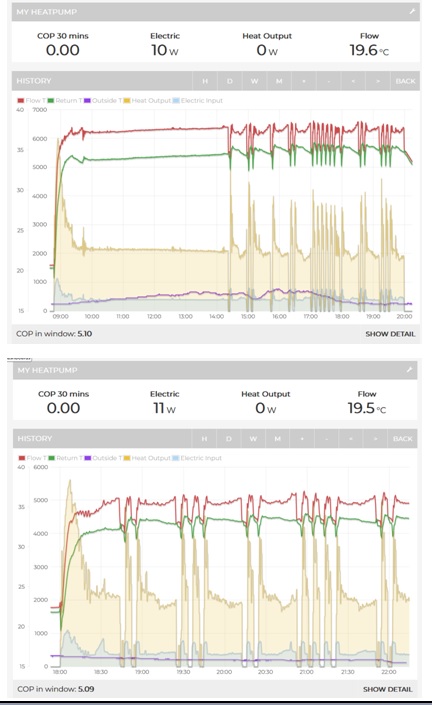
Well here is some interesting behaviour last night. I lowered the flow temperature at the top end of my WC curve by 2 degrees bringing it down from 37C at 15C OAT (top graph) to 35C at 15C OAT (bottom graph)
Although last nights was a shorter run length, cycling appeared much more quickly, COP was virtually identical. We were both warm enough in the house but the thermostat in the hall never reached the 23C set point
House-3 bed partial stone bungalow, 5kW Samsung Gen 6 ASHP (Self install)
6.9 kWp of PV
10kWh DC coupled battery
Blog: https://thegreeningofrosecottage.weebly.com/
Heatpump Stats: http://heatpumpmonitor.org/system/view?id=60
29/09/2023 9:43 am
@Kev_M
I was thinking about the right hand graph again last night Kev. My understanding of it is that the different plots for A12, A7, A2 and A-7 are for the different OAT's and all show peak COP at about 9kW load for the 11kW heat pump.
If that is the case shouldnt we be aiming for the most frequently used load to be in that 9kW region, not the peak load?
If Im reading this totally wrong, anyone feel free to jump in please.

House-3 bed partial stone bungalow, 5kW Samsung Gen 6 ASHP (Self install)
6.9 kWp of PV
10kWh DC coupled battery
Blog: https://thegreeningofrosecottage.weebly.com/
Heatpump Stats: http://heatpumpmonitor.org/system/view?id=60

29/09/2023 10:05 am
Although last nights was a shorter run length, cycling appeared much more quickly, COP was virtually identical. We were both warm enough in the house but the thermostat in the hall never reached the 23C set point
As the flow temperature is degreased, the mean radiator temperature degreases, thus there is less heat transfer from the radiator to the air. As you cannot increase the radiators(only if you play with those pc fans) the only thing left is to have it off for longer, to allow the heat to dissipate.

29/09/2023 10:16 am
@Kev_M
I was thinking about the right hand graph again last night Kev. My understanding of it is that the different plots for A12, A7, A2 and A-7 are for the different OAT's and all show peak COP at about 9kW load for the 11kW heat pump.
If that is the case shouldnt we be aiming for the most frequently used load to be in that 9kW region, not the peak load?
If Im reading this totally wrong, anyone feel free to jump in please.
I would see it like this:
Before anything else, don't constrain yourself with just one point 9kW, there is a range from 6kW to 11kW that is close to that peak, so use the range rather than the point
Usually you would size let's say 11kW for -5 then it automatically drops to lower at 2,7,12 degrees, so let's say 11,9,7,5kW ish
29/09/2023 10:16 am
@fazel Ah, I see, that would account for what appears to be a smaller delta T at the lower temperature.
Does the increase in off cycles negate the potential increase in efficiency from having a lower flow temp as the COP appears the same?
House-3 bed partial stone bungalow, 5kW Samsung Gen 6 ASHP (Self install)
6.9 kWp of PV
10kWh DC coupled battery
Blog: https://thegreeningofrosecottage.weebly.com/
Heatpump Stats: http://heatpumpmonitor.org/system/view?id=60
29/09/2023 10:18 am
@derek-m @editor @bontwoody shall we move/create @bontwoody own hp thread and move his topic there?

29/09/2023 10:19 am
Like most on here I'm not a heatpump engineer either. My background is in physics and engineering with a recent diversion into local government. So I tend to try to understand broad brush principles as an aid to homing in on specific solutions, which of course then need testing' against the specific requirement.
To answer the questions
Based upon a normal home, with an accurately assessed heat loss of say 8kW, how would you define an undersized heat pump, a correctly sized heat pump and an oversized heat pump?
An 8kW house will spend most of its time at 4kW and towards the end if the season will be at 2kW or less. Given that many heat pumps have a modulation ratio of about 3 or a bit less I would therefore say anything over 12 kW is oversized by more than is comfortable. Allowing for a bit for dhw I'd say anything from say 9-12 is OK,. Between 8 and 9 is 'tight' and on continuous really cold spells supplementary heating will likely be needed. Anything less than 8 is undersized, but if householder has a supplementary form of heating that they want to use, still a valid choice (logburners can be several kW and many people actively like using them.). I make this observation conscious also that the BRE plots referred to earlier definitely point in many cases to undersizing. Having said that the grant requirement is to deliver 100pc of dhw and ch requirement, so less than 8 and a bit wouldn't strictly qualify.
In all cases I mean actual capacity at design OAT, not sticker capacity, and I'm assuming 24x7 operation in the coldest season so no allowance for reheat (in the coldest season).
This being the case and all other things being equal I would steer a techy friend who likes to live on the edge towards the bottom end of 9-12, and a non techy one who liked creature comforts at all cost towards the top end. However unit sound power, appearance and size also become factors at this point, perhaps more so than capacity.
So in summary I would not argue against a 50% uplift on an accurately assessed heat loss, provided the chosen heat pump has a decent modulation capability. However I would argue against the blanket application of a 50% uplift on top of a spreadsheet based loss assessment which in all liklihood already has margin or actual error built in.
The point that I am making is that when the heat pump stops the supply of thermal energy does not immediately fall to zero, but that on - off operation will tend to balance out, particularly under milder weather conditions.
I agree and said so earlier. Obviously the rate at which the heating system cools down so the radiators stop emitting depends on the thermal mass of the central heating system. My radiators cool very quickly even in mild weather, taking I would guess less much than 30mins to reach something quite close to room temperature.
I did speculate above that fast cycling, at a frequency such that the radiators don't cool much between cycles, may be better than slow cycling. Of course this goes against hp 'lore' but if @fazel is correct that cycling per se (as opposed to the change in lwt necessary to compensate for cycling) doesn't, with modern heat pumps, cause much of a penalty then it seems to me that extending the modulation range by fast cycling is not such a bad idea.
I am not certain how you arrived at the assessment of 50% on and 50% off operation for the larger pump in a comparison situation
That wasn't an assessment it was an example, for the purpose of illustrating the uplift in ft needed in a cycling situation. That said I have certainly seen 50:50;on off ratio or worse at fairly low OAT in plots people have presented. To get to the uplift in lwt required I assumed rad output goes as deltat (rad-room)^1.3, which is the case for most rads, and that the no-cycling delta t (rad-room) was 20. This leads to an uplift of 10C on the basis that (30/20)^1.5 is roughly 2, corresponding to the doubling in output required.
Overall I think a couple of things have come out of this:
A bit more thought, and possibly experiment, is needed, with up to date info on the performance of heat pumps, on whether fast/short cycling is actually good or bad. I don't _think_ it's as obvious as it used to be with modern inverter driven pumps!
It would be good if we had some actual figures averaged over the year for the theoretical cycling 'penalty', initially assuming no averaging of the type discussed above. If I could find some figures for OAT over the year in' buckets' I'd happily do the spreadsheet. It might be possible to get some sort of estimate from a year's worth of smart meter readings. Thus calculation would inform the cost/comfort debate in relation to sizing.
And of course: we really don't have a commonly accepted method which is capable of determining the required load with sufficient accuracy.
For me the last of these remains the stand out issue, unless it can be shown by some work on the first two that the penalty for gross oversizing is not as bad as it might be. Given the frequency of complaints which can be traced in part to gross oversizing, I'm not hopeful for this but still open minded if the figures were run.
4kW peak of solar PV since 2011; EV and a 1930s house which has been partially renovated to improve its efficiency. 7kW Vaillant heat pump.

29/09/2023 10:22 am
@fazel Agreed, but the highest COPs are clustered around the 9kW load so shouldnt we aim for the mode output to be in that region?
House-3 bed partial stone bungalow, 5kW Samsung Gen 6 ASHP (Self install)
6.9 kWp of PV
10kWh DC coupled battery
Blog: https://thegreeningofrosecottage.weebly.com/
Heatpump Stats: http://heatpumpmonitor.org/system/view?id=60
29/09/2023 10:51 am
@fazel Ah, I see, that would account for what appears to be a smaller delta T at the lower temperature.
Does the increase in off cycles negate the potential increase in efficiency from having a lower flow temp as the COP appears the same?
At the point where it starts cycling because it cannot lose the heat in the system, even if the COP is the same, it is up to you if you want to allow it to run like that, or do different. Having it off, allowing the water to cool should basically help with the efficiency in theory. Because the heat pump regardless of the type, likes to loose the heat it produces, there is a fine line and in time you might be able to notice or not a small difference in COP.
@fazel Agreed, but the highest COPs are clustered around the 9kW load so shouldn't we aim for the mode output to be in that region?
you sure can at -5, but as the OAT increases your radiators cannot put out 9kW thus you are starting the cycling prematurely.
29/09/2023 11:11 am
you sure can at -5, but as the OAT increases your radiators cannot put out 9kW thus you are starting the cycling prematurely.
There sure are a lot of variables to consider here! 🙂
House-3 bed partial stone bungalow, 5kW Samsung Gen 6 ASHP (Self install)
6.9 kWp of PV
10kWh DC coupled battery
Blog: https://thegreeningofrosecottage.weebly.com/
Heatpump Stats: http://heatpumpmonitor.org/system/view?id=60
29/09/2023 11:14 am
you sure can at -5, but as the OAT increases your radiators cannot put out 9kW thus you are starting the cycling prematurely.
There sure are a lot of variables to consider here! 🙂
for sure there are, everything varies as much as OAT varies
SPONSORS

Degrees of Separation
Latest Posts
-

At this point, whenever someone mentions our heat pump,...
By Mars , 6 minutes ago
-
RE: Say hello and introduce yourself
@e-a-west as the good Major said, welcome to the forums...
By Mars , 26 minutes ago
-
RE: New Build 3 Phase or 1Phase
We are on three phase power because it's an enormous li...
By EtchedPixels , 41 minutes ago
-
RE: How much of your renewable and home setup would still work if the internet went down?
Yes I actually have a copy of a tool that whenever a ce...
By EtchedPixels , 9 hours ago
-
RE: How will removing the standing charge on gas bills benefit heat pumps?
The shoulder months are very difficult to judge COP on ...
By scrchngwsl , 11 hours ago
-
RE: Indevolt Batteries UK Support & Info Thread
@editor Hi, To resolve this, please tap on the A...
By Indevolt Tech , 17 hours ago
-
RE: Double or Triple Glazed Windows?
Posted by: @singlespeed With 9 years repairing windo...
By Rob of York , 1 day ago
-
@transparent we’re still running a secure version of PH...
By Mars , 2 days ago
-
RE: How quickly would you want/expect heat recovery to take from setback?
Much longer than that here. The heating isn't even on. ...
By bobflux , 2 days ago
-
RE: Passiv Smart Thermostat - Help & Forum Support
Obviously the weather is changeable but there's a defin...
By Singlespeed , 2 days ago
-
RE: The Changing Jet Stream Could Challenge UK Air Source Heat Pumps
@rob-of-york I must admit that when we had a Daikin hea...
By Toodles , 2 days ago
-
RE: Forum updates, announcements & issues
Get the Renewable Heating Hub heads-up on WhatsApp. I...
By Mars , 2 days ago
-
RE: Safety study for plug in batteries out to tender - looks like Q3 2027 at best before legal
@editor I pointed out to the one of the Fuse execs that...
By dansus , 2 days ago
-
RE: 15kw pump for 225m2 1990's house - over kill?
@seaviews As well as loft insulation, there are othe...
By Rob of York , 2 days ago




SPONSORS